Il suivait la guidière nord de San Francisco... Soudain, la voiture fut happée, soulevée, et violemment écartée de la route. Un tourbillon grisâtre l'emporta ; il se sentit aspiré par le vide — Puis il eut la sensation de retomber sur terre, doucement, telle une particule flottante. II n'éprouvait aucune douleur ; rien. Une épaisse brume l'enveloppa. Il venait d'être projeté dans le futur... Dans ce roman paru en 1960 aux États-Unis, Philip K. Dick aborde le voyage dans te temps et la suite des paradoxes temporels. Mais également il peint de manière saisissante un futur où la soif de vivre a fait place à la soif de la mort, et où mourir est devenu la seule préoccupation.
Philip Kindred Dick was a prolific American science fiction author whose work has had a lasting impact on literature, cinema, and popular culture. Known for his imaginative narratives and profound philosophical themes, Dick explored the nature of reality, the boundaries of human identity, and the impact of technology and authoritarianism on society. His stories often blurred the line between the real and the artificial, challenging readers to question their perceptions and beliefs. Raised in California, Dick began writing professionally in the early 1950s, publishing short stories in various science fiction magazines. He quickly developed a distinctive voice within the genre, marked by a fusion of science fiction concepts with deep existential and psychological inquiry. Over his career, he authored 44 novels and more than 100 short stories, many of which have become classics in the field. Recurring themes in Dick's work include alternate realities, simulations, corporate and government control, mental illness, and the nature of consciousness. His protagonists are frequently everyday individuals—often paranoid, uncertain, or troubled—caught in surreal and often dangerous circumstances that force them to question their environment and themselves. Works such as Ubik, The Three Stigmata of Palmer Eldritch, and A Scanner Darkly reflect his fascination with perception and altered states of consciousness, often drawing from his own experiences with mental health struggles and drug use. One of Dick’s most influential novels is Do Androids Dream of Electric Sheep?, which served as the basis for Ridley Scott’s iconic film Blade Runner. The novel deals with the distinction between humans and artificial beings and asks profound questions about empathy, identity, and what it means to be alive. Other adaptations of his work include Total Recall, Minority Report, A Scanner Darkly, and The Man in the High Castle, each reflecting key elements of his storytelling—uncertain realities, oppressive systems, and the search for truth. These adaptations have introduced his complex ideas to audiences well beyond the traditional readership of science fiction. In the 1970s, Dick underwent a series of visionary and mystical experiences that had a significant influence on his later writings. He described receiving profound knowledge from an external, possibly divine, source and documented these events extensively in what became known as The Exegesis, a massive and often fragmented journal. These experiences inspired his later novels, most notably the VALIS trilogy, which mixes autobiography, theology, and metaphysics in a narrative that defies conventional structure and genre boundaries. Throughout his life, Dick faced financial instability, health issues, and periods of personal turmoil, yet he remained a dedicated and relentless writer. Despite limited commercial success during his lifetime, his reputation grew steadily, and he came to be regarded as one of the most original voices in speculative fiction. His work has been celebrated for its ability to fuse philosophical depth with gripping storytelling and has influenced not only science fiction writers but also philosophers, filmmakers, and futurists. Dick’s legacy continues to thrive in both literary and cinematic spheres. The themes he explored remain urgently relevant in the modern world, particularly as technology increasingly intersects with human identity and governance. The Philip K. Dick Award, named in his honor, is presented annually to distinguished works of science fiction published in paperback original form in the United States. His writings have also inspired television series, academic studies, and countless homages across media. Through his vivid imagination and unflinching inquiry into the nature of existence, Philip K. Dick redefined what science fiction could achieve. His work continues to challenge and inspire, offering timeless insights into the human condition a
Tales of time travel have been around for hundreds of years. Perhaps the best known work within the world of science fiction is The Time Machine by H.G. Wells. In addition to Wells' tale of an Edwardian scientist battling the Morlocks in the distant future, my personal favorites are:
1) Return from the Stars by Stanisław Lem published in 1961 and featuring an astronaut returning to Earth more than one hundred years into the future to find a utopian society based on a universal medical procedure to alter human nature;
2) Connie Willis’ 1992 Doomsday Book where a medieval historian travels back to the 14th century to live in a rustic English village. Like nearly all other tales of time travel, the novels by Wells, Lem and Willis revolve around travel to one point in time, either forward or backward.
Dr. Futurity is a tale of time travel but Philip K. Dick being Philip K. Dick, the time travel for the novel’s hero, a doctor by the name of Jim Parsons living in the early 21st century, is a bit more complex, having the doctor propelled to the distant future of 2405 and then traveling via a compact time ship to 1579, back to the years when Sir Francis Drake explored the Pacific Coast of North America.
Published in 1960, Dr. Futurity is PKD’s seventh novel sandwiched between Time Out of Joint and Vulcan's Hammer. So as not to spoil for a reader, I’ll avoid saying too much about plot and jump immediately to a number of colorful highlights and then several philosophical issues the novel addresses.
Race - The men and women of this futuristic society are all of one race, coffee in color and facial features that appear to be a mixture of Native American, African and other racial groups under what we nowadays refer to as "people of color." Those Parsons encounters are put off by his white skin. In other words, the Caucasian race is a thing of the past. Back in the 50s and 60s it was quite common among the educated classes to think issues of race would eventually be solved by such a future "one and only one coffee-colored race."
Youth - Parsons is struck by the fact these men and women are all young - from the looks of it, ranging in age from 19 to 25. Where are all those individuals of middle age and old age? As the good doctor learns quickly, the population is all youth. As a man of 31, he is an outsider. Oh, PKD, you prescient author! You wrote Dr. Futurity several years before American in the swinging sixties came to place a high value on youth and youth culture. One of the catchphrases of the sixties free speech movement: "Don't trust anyone over 30."
Language - This future population speaks a language other than 21st century English but close enough that multilingual, linguistically facile Parsons can pick out their words and phrases without much difficulty. PKD thus handles the language issue with a touch of authenticity - we are reading plain English throughout the novel but there is a tacit understanding the words spoken are in a future amalgamated language.
Religion - Formal religion as we know it in our present day is a thing of the past. Nowhere does Parsons come across any signs or symbols of the major world religions. And not one of these young people appears to have a notion of an afterlife, either in another realm or in rebirth or reincarnation. Quite the contrary - there's a high premium placed on death and knowing you will be replaced by another, more perfectly evolved individual.
Healing versus Euthanasia - When Parsons saves a young lady's life he's arrested since, in this future world, healing people is a violation of the law. One big reason there are no older people - if you are sick and injured, you volunteer for euthanasia - if anything is worshiped here, it is death itself.
Tribes - The future world is split up into tribes. The main tribe in power is the Shupo tribe. Parson brushes against a number of tribes, most notably the Wolf tribe with a man and woman he comes to know quite well, particularly the woman who holds an important rank and power. The Wolf tribe objects to death as supreme; rather, they value healing and the wisdom that comes with growing old. The Wolf tribe has mastered time travel and is responsible for bringing Dr. Parsons to this future world for the purpose of healing one of their leaders.
Soul Cube - A huge repository of zygotes that furnish the needed biology for future generations. A critical aspect of the social network since all males are sterile. Tribes compete for a place in this cube - the stronger the tribe, the more representative zygotes, all with the aim of keeping a stable 2.5 billion population and continually improving the human stock genetically.
Killing Drake - Members of the Wolf tribe see themselves as the descendants of Native Americans (since the novel is written in 1960, PKD terms this race of peoples "Indians.") The Wolf tribe wants to go back in time to kill Sir Francis Drake as a first step in nullifying European conquest of the New World.
Of course, what I've noted above cries out for much philosophic reflection. Firstly, we have the whole issue of race. Would one future coffee-colored race provide the answer? My own sense is tolerance and a deeply felt compassion for others is infinitely more important than a blending of skin color.
And then there's the values associated with healing and aging. Should an injured or sick man or woman receive medical treatment? I would assume everyone reading this review would answer "yes," most especially if the reader was the person sick or injured. However, our current world, or at least many countries similar to the US, does have a dilemma in automatically opting to keep elderly people alive even to the point of sustaining a life of unending intense pain and suffering. Thus, I recall the Japanese aphorism: "Life without death isn't life, but self-preservation."
Additionally, the novel forces us to consider the dynamics of human evolution. Are we wise to construct a plan to "improve" human development from generation to generation? Should such development be valued over healing the sick and injured?
Turning to time travel, we have the paradox of entering the past to change the course of history. To take one example: if a time traveler traveled back to Germany and shot a twenty-one year old Hitler. Or, if that same time traveler went back and shot his own father before he was conceived. Would we have parallel histories? Again, a major paradox.
More specifically, would it be preferable to make major changes to human history? At first, eliminating European domination of the New World sounds appealing to the doctor but when he might be stranded on the Pacific Coast prior to European exploration, he reflects: "Sixteen years here, living on clams and deer, squatting around a fire, huddled in a tent made of animal hide, scratching at the soil for roots. This was the superlative culture that Corith (a leader of the Wolf tribe) wanted to preserve, in place of Elizabethan England."
Lastly, Philip K. Dick has us ponder our human condition and the very reasons we value life over death. Ultimately, although the novel is a bit rough around the edges, it is the highly engaging philosophic questions that really make Dr. Futurity worth the read.
American Science Fiction author Philip K. Dick, 1928-1982
Un viaggio nel futuro. Una società che dà più importanza alla morte della vita. Un'unione di etnie e un'aspettativa di vita di quindici anni.
Dick riesce sempre a proporre idee brillanti e tematiche importanti che necessitano riflessioni, però stavolta si perde e si dilunga nei paradossi dei viaggi temporali, dove il risultato finale è quello di rimanere con mille dubbi.
Forse sviluppare il tema iniziale a fondo sarebbe stato preferibile che vedere il protagonista saltare nel tempo e giocare a fare l'indiano.
---------------------- A journey into the future. A society that gives more importance to death than to life. A union of ethnicities and a life expectancy of fifteen years.
Dick always manages to propose brilliant ideas and important themes that require reflections, but this time he gets lost and dwells on the paradoxes of time travel, where the final result is to be left with a thousand doubts.
Perhaps developing the initial theme thoroughly would have been preferable to seeing the main character jump through time and play at being an American Indian.
Dr. Futurity marks phase two of my PKD reading project. I just finished the last of Dick’s 1950’s novels and I’m entering the 60’s.
Reading those early novels was good preparation for this one. I feel like Dr. Futurity is inferior to those novels, but I want to appreciate it as much as possible despite its flaws. There are really two stories here that are loosely stitched together and I’m okay with that. Dick has pulled it off before. It works well enough in The World Jones Made, which is four stories stitched together. But it doesn’t work in Dr. Futurity. The story that takes up the first third of the book intrigued me, but the remaining two-thirds lost me.
The main story concerns the Wolf Tribe. They want to improve the present by changing the past. This is an interesting idea, but it is largely undermined by their observation that changes in the past have very little effect on the present. I found myself disliking the time-traveling tribe as much as I disliked the mainstream society. They were no less obsessed with racial purity and death than their enemies. I could go into more detail, but I would rather focus on the first one-third of the novel which had so much potential.
As soon as Stenog started talking about zygotes and “euthanors” I thought this novel was going to explore ethical questions about the beginning and ending of life and perhaps philosophical questions about personhood and the value of life. The possibilities are numerous. Unfortunately, Dick doesn’t pursue this part of the story very far. I wonder why? There’s so much material here.
When Dr. Parsons is arrested for the crime of saving a woman’s life, he expresses moral outrage that this society euthanizes people who could be saved. But the members of this society are morally outraged by his statement that he even saves the lives of the deformed. Because they are motivated by their eugenic goals, they value zygotes above people. And in order to keep the population stable, a zygote is only allowed to develop when a person dies. Thus, the sooner people die, the sooner they can be replaced by the next generation and the faster the race can progress. For them, it is the race, not the individual, that matters.
Stenog puts Parsons in his place by reminding him of his own society’s method of population control: “Your science was also devoted to keeping new life from appearing. You had contraceptives. Chemical and mechanical agents preventing zygote formation within the oviduct” (33). I recently read Dick’s short story “The Pre-Persons,” [my review] which is an anti-abortion story, so this caught my attention.
I feel like there’s social criticism lurking beneath the surface, but it never quite comes to light. This leaves me wondering what Dick’s own views were. The mainstream society in Dr. Futurity practices male sterilization, sex apart from reproduction, eugenics, and euthanasia. It seems likely that Dick opposed all these practices just as he opposed abortion. If so, that would explain why Stenog’s remark to Parsons was uttered with a “cunning expression” (33). It would also suggest that Dick was opposed to contraception. This interpretation is supported by the changes made by the Wolf Tribe at the end of the story (161).
Finally, I can’t resist a comparison with H. G. Wells’ The Time Machine. I think Dick pays homage to Wells in his description of the Earth in its last days ~ the redness, the desolation, the lichens ~ and the spectacle observed by the time traveling doctor as everything goes in reverse (62-66). I found this scene more memorable than anything else in the book.
What can I say? At his worst, PKD is still quite good.
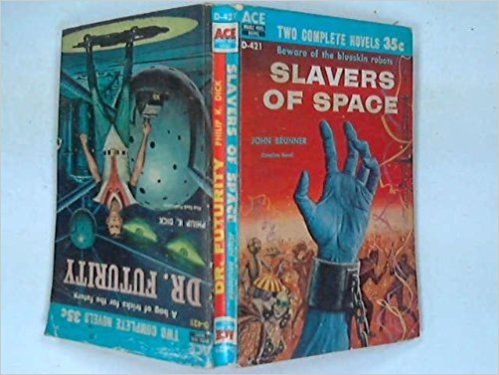
Back in the day, Ace books released a paperback with TWO sci-fi gems contained for our reading pleasure. Ace doubles. In 1960, Ace published Philip K. Dick’s Dr. Futurity in an Ace Double; flip the book over and upside down and John Brenner’s Slavers of Space was on the other side.
Dr. Futurity is an honest to God time travel book by PKD, with all the necessary kooky eccentricities that Phil brings to any work. Fans will recall other alternate history fantasies like The Crack in Space and The World Jones Made and of course his brilliant The Man in the High Castle. This one is more straightforward SF, but just as Robin Williams breathed strange life into any portrayal, so too does Dick animate this work with his own brand of eclectic charm.
Doctor Jim Parsons finds himself taken out of his own time and cast far forward to discover things very different in the future. In a setting and with themes reminiscent of Heinlein’s Farnham's Freehold and of Fritz Lieber’s The Big Time, Dick explores racism, colonialism and family with all of the paradoxes and time twists inherent in this SF vehicle.
Not one of his great stories but it’s vintage PKD so a must read for fans and SF aficionados.
"There was simply no complete theory about time, he realized. No hypothesis by which results could be anticipated. Only experiment -- and guesswork." - Philip K. Dick, Dr. Futurity.
One of the most "traditionally" SF novels PKD has written. This is largely due, obviously, to it being early in the PKD's output. Dr. Futurity was published in 1960 and was his 7th published novel (after Time Out of Joint and before Vulcan's Hammer).
In this novel Dick explore basic ideas of time travel, complete with "arrows". Think of the Hippocratic Oath pushed backwards and forwards in time. Probably the most interesting piece of this novel is the future civilization that keeps a static level of human beings, only allowing a new baby to be born when someone dies. PKD is quickly able to push this type of social evolution to its furthest realities or unrealities.
20° secolo o giù di lì, Jim Parsons, il nostro protagonista, è un medico. Un giorno, come succede quotidianamente, esce di casa per andare a lavoro, ma succederà qualcosa che cambierà totalmente la sua vita. P.K. Dick, questa volta, utilizza il viaggio nel tempo per raccontarci di come la società si potrebbe evolvere se i fondamenti della vita, non ci fossero più. Così veniamo sballonzolati avanti ed indietro nel tempo alla ricerca della verità, ma la verità cos'è? Un altro tassello, nell'immenso mosaico, della bibliografia dell'"androide" più visionario nel panorama della fantascienza mondiale, è stato messo. La scrittura è così scorrevole e coinvolgente, che non si riesce a smettere di leggere, ma anche visionaria e riflessiva. Così i temi, molto cari all'autore, quali le libertà in tutte le forme possibili, vengono sviluppate sempre col suo inimitabile stile, passione e fascino!
As I mentioned in my review of Philip K. Dick's 1960 novel "Vulcan's Hammer," by 1959, the future Hugo winner was feeling decidedly disenchanted with science fiction in general, despite having had published some 85 short stories and half a dozen novels in that genre. The author, it seems, was still pinning his hopes on becoming a more "respectable," mainstream writer, and had indeed already completed nine such novels: "Return to Lilliput," "Pilgrim on the Hill" and "A Time for George Stavros" are considered lost, probably never to see the light of day, whereas "Gather Yourselves Together," "Voices From the Street," "Mary and the Giant," "The Broken Bubble," "Puttering About in a Small Land" and "In Milton Lumky Territory" were only released years after Dick's premature death in 1982.
And yet, despite his interest in science fiction being at its lowest point ever in 1959, the author yet managed to work on two such novels, economic pressures being what they were. The two books were both expanded from earlier novellas: "Vulcan's Hammer" from a novella in a 1956 issue of "Future Science Fiction" magazine, and the book in question, the whimsically titled "Dr. Futurity," from the novella "Time Pawn," which initially appeared in the Summer '54 issue of the 25-cent pulp "Thrilling Wonder Stories." Like "Vulcan's Hammer," "Dr. Futurity" first saw the light of day in 1960, as one-half of one of those cute little 35-cent "Ace doubles" (D-421, for all you collectors out there), backed by John Brunner's "Slaves of Space." I was fortunate enough to lay my hands on this Ace double thanks to NYC bookstore extraordinaire The Strand, and was happy to discover that, despite its poor reputation, the book is still surprisingly fun and enjoyable, with a complex plot, several nice touches, and wonderful atmosphere. Yes, it's far from Dick at his best, and is a somewhat atypical outing for this most cultish of authors, but should still manage to please his many fans.
In "Dr. Futurity," the reader encounters a 32-year-old doctor named Jim Parsons (hmm, why does that name seem so familiar?), who lives in Northern California with his wife Mary in the futuristic year of, um, 2012. Driving to work one day, Parsons is suddenly dredged up by a time travel device and kerplopped into the year 2405! He learns that in this distant time, all men are forced to become sterilized after reaching puberty, and all human zygotes are stored in a repository called the "Soul Cube." Dr. Sheldon Cooper--I mean, Jim Parsons--makes the huge mistake of saving the life of a grievously injured female activist (her clique is actively protesting the fact that women in 2405 have been denied the right to vote!), in a society in which death is seen as a precursor to life (i.e., for every human death that occurs, another zygote in the Soul Cube is brought to term). Parsons is deemed a menace and is summarily shipped off to a prison on Mars, but not before the owners of that time machine--the life-worshipping Wolf Tribe, the full-blooded descendants of the Native American Iroquois--rescue him and ask him to resuscitate their 35-year-dead leader, Corith, who is being stored in "cold-pack" stasis after being pierced with an arrow, through the heart, while on a mission in the year 1579! Cooper--I mean, Parsons; geez, gotta stop doing that!--agrees, and before long is immersed in a plot to not only bring Corith back to life, but to assassinate the English explorer Francis Drake and thus alter future history in favor of the Amerindians!
I have said elsewhere that the inherent paradoxes contained in many time travel novels can sometimes induce a borderline migraine in me as I endeavor to unravel them, and Dick surely does deliver some doozies in "Dr. Futurity." Indeed, this is one of the most pleasingly mind-warping such tales I've ever read; one in which Parsons not only gets to travel to the far past and distant future, but also hops about in time attempting to alter history as well as his own future actions. Somehow, though, far-fetched as the proceedings often get, Dick manages to make it all hang together; he evidently gave a lot of thought to all the many plot intricacies here. Still, the book has been roundly denigrated, not only by Scottish critic David Pringle, in his "Ultimate Guide to Science Fiction" (an "exceedingly minor novel by one of sf's greatest writers," he calls it), but also by Dick biographer Lawrence Sutin, in his "Divine Invasions," as well ("a potboiler that barely bubbles," he sniffs). Personally, I would agree with Pringle that the book is a minor one for Dick, but feel that Sutin is being a tad too harsh, as "Dr. Futurity" does have any number of fine qualities to commend itself to the reader.
Besides being complexly plotted, the book is at times marvelously atmospheric, such as when Parsons is marooned by the Wolf Tribe, back in an unknown era, and walks the desolate shore of the Pacific Ocean, wondering how or if he will ever return. Then again, take the scene in which Parsons witnesses the dying Earth of untold millennia hence; a barren wasteland in which he finds nothing but an ancient plaque...with his name on it! Dick fills his book with unusual little grace notes and weird bits of business, such as passenger cars in the year 2012 that are controlled by long-distance beam; that rat brain-controlled prison ship; and the "shupos," maniacally violent children used by the government in 2405 as enforcers. The book is sexually frank for its time--Parsons has an affair with the Wolf clan's Mother Superior, Loris, and even fathers some 25th century children with her--and even advocates for a woman's freedom of choice (in this case, the freedom to either have a baby the old-fashioned way or via the Soul Cube, if she wishes). Most of the author's later pet concerns are not addressed in this book--those dealing with drugs, divorce, cars, the slippery nature of so-called "reality," the German language, cigars--although there is a passing reference to Beethoven's "Archduke Trio"; a reminder of Dick's passion for opera and classical music.
"Dr. Futurity," tightly plotted as it is, is hardly a perfect work, and Dick is guilty of an occasional slip here and there. He tells us that Drake was born in the "early sixteenth century," whereas the actual date was circa 1540. He describes those time-traveling ships as "pencil-shaped" when we first encounter them, and later as being a "metallic sphere." A sphere-shaped pencil? And then there is the little matter of Parsons learning the language of four centuries hence in a scant matter of minutes. Plus, that "Plate of Brasse" that Dick tells us was left by Drake on the California coast? Well, that relic was determined to be a fake, a hoax, back in the late 1970s...not that Dick had any way of knowing this in 1959, of course.
As you may have discerned, "Dr. Futurity," again like "Vulcan's Hammer," is something of a mixed bag, but yet, a highly readable and--for this reader, anyway--entertaining one. Sutin calls these books "Phil's two worst-ever SF novels," which, in a way, just goes to show how great Dick's later work became. And indeed, Dick did seem to rouse himself that very next year, when he worked on the 1962 Hugo winner "The Man In the High Castle"; the first of a string of highly imaginative sci-fi classics that Dick compulsively wrote over the course of the following decade. As it turns out, even a "minor" work from a great author can prove to be a rewarding experience....
(By the way, this review originally appeared on the FanLit website at http://www.fantasyliterature.com/ ... a most ideal destination for all fans of Philip K. Dick....)
This book inspired me to write a song. It goes a little like this:
Salagadoola mechicka boola bibbidi-bobbidi-boo Put 'em together and what have you got A far more coherent statement than this book Salagadoola mechicka boola bibbidi-bobbidi-boo Not even magic can salvage this work

Dr Jim Parsons, a proud and condescending famous surgeon is very abruptly kidnapped and rapidly is found outside of his own time where he saves the life of a teenage girl only to be arrested for the crime of preventing death!
While enroute to the penal colony on Mars, he is again kidnapped and escapes finally finding the family who is reaponsible for it all in a desperate generation long struggle to save 1 Iriquois man from 1600s.
This was a wild ride but isnt quite PKD yet…. I think it gets a lotta negative reviews because it isnt as original as later work- but still good IMO.
I love the way the book started and got really excited when Parsons was sentenced to be exiled to Mars, but, sadly, he never made it and the rest of the book turned into a big mess. I've never been a huge fan of time traveling stories in the first place and this one was no exception, no matter how much I connect with PKD's writing style. Oh well, I can't love all of his novels.
Only PKD can take the element of time travel to a level that is not cliche. As with some of his other sci-fi books, you tend to forget you're reading science fiction and find yourself just reading brilliant fiction.
Dr Jim Parsons is in a car accident and finds himself in a future society. But is there truly a future, present, or past? Or do we all just live in a space that time alters?
The shupo's are like the young children of the Chinese cultural revolution. I don't think that was an accident on PKD's part. Read this book. Check your date. Wonder.
A time travel meditation, tinged with typical Dickian aesthetics. A doctor from 1998 (30 years in the author's future) travels forward to 2500 only to find a world where doctors are outlawed in favor of institutionalized euthanasia. Here, he becomes involved in a neo-Native-American plot to travel back to the 16th century to assassinate Sir Francis Drake when he docks near San Fransisco in 1597. Is it possible to change the past? Yes, but as we discover, only if you've already changed it...
It gets the extra star only because I don't have the heart to give a 1-star rating to a Dick novel. I still can't believe this was actually written by the author of Do Androids dream of electric sheep, The man in the high castle and so many other books I've loved. It was like reading a ten-year-old kid's effort in creative writing. I'll blame it partly on the translation and partly on the fact that it was one of his earlier novels.
Unusually for Dick, this was a very fun and simple read, without too much head-scratching or loose ends to the plot.
It's your basic time travel story, diving into all the paradoxes that usually accompany such exercises. And of course there are plot-holes galore, but you just gotta kinda ignore and go with the flow.
The most unique part of this was his take on race in the future. I won't go into too much detail, because most of the enjoyment comes from discovery. It was a unique motivation to give the plot, and especially at the time he was writing I think.
It's a fast and fun read. Imagine a Blake Crouch novel, but if Crouch could actually write well.
Would I re-read: no. Doesn't feel essential, just a good time.
Others here have noted not only that 'DF' feels, first, like one novel and then another (it does) but that the first half is stronger and clearer (it is).
It ultimately feels forced. Characters are rather weak, loosely defined. There may very well be a designed logic to the overall piece but developments seem random and scattershot. The second half is ruled by frenzy. In it, like the deaf-dumb-and blind kid of 'Tommy', PKD "sure plays a mean pinball" with his exhausting point-by-point bouncing.
In the more compelling first half, I like the idea that the dominant, mixed race of the future has consigned the white man to the dustheap. So much for white supremacy, finally!
But, overall, I found it a frustrating read that (as the Brits would say) I didn't much get on with.
Dr. Gelecek; ilgi çekici kurgusu, yalın ve eğlenceli anlatımı, ırkçılığı, ölüm olgusunu, yabancılaşma ve ayrımcılık kavramlarını işleyen hikayesi ile keyifle okuduğum ve beğendiğim bir kitap oldu. Kitabın ilk yarısı; 400 sene sonrasında tek bir ırka evrilen insanlığın kültürel değerlerini, ölümün yüceltildiği bir anlayışı, bireysellik yerine ırksal gelişime öncelik veren değer kavramını ve zaman yolculuğuna dair bir çok fikri yansıtması bakımından soluksuz okunuyor. Ancak ikinci yarıda hikayenin tek bir olay örgüsüne indirgenmesi ile heyecanın ve merak duygusunun bir ölçüde azaldığını düşünüyorum. Yine herhangi bir boşluk kalmaması ve kurgunun etkileyici bir sonla bağlanması ile severek okuduğum Philip K. Dick kitapları arasında yerini aldığını söyleyebilirim.
Sene 2010. Doktor Jim Parsons , otoyoldaki kılavuz ışınının kontrolü ile işe giderken, aracın yoldan çıktığını ve bildiği çevrenin ortadan kaybolduğunu farkeder. Parsons, uzun ve renkli kuleleri, canlı atmosferi, benzer fiziksel görünüme sahip genç insanları ile 2405 senesine yolculuk yaptığını keşfeder. Ten rengi ve anatomik yapısı ile benzerlik gösteren bu insanlar arasında 20 yaşın üzerinde kimse bulunmamaktadır.Doğal yoldan üreme yasaklanmış, erkekler kısırlaştırılmış, kadınların zigotları ortak bir alanda muhafaza edilerek geliştirilmektedir. Ölüm doğal kabul edilen ve yüceltilen bir olgu olup, herhangi bir fiziksel yaralanma durumunda, ötenazist denilen meslek grubu tarafından ulaşılması istenen bir sonuç olarak görülmektedir. Kendini kamufle ederek bu toplumun içine karışan Parsons, bir gün yaralı bir kadını iyileştirir ve bu durum yakalanmasına sebep olur. Mars'ta bulunan hapishane kolonisine gönderilirken aykırı bir grup tarafından kaçırılan Parsons tehlikeli bir görev ile yüzyüze gelecektir.
Yaşama verilen anlam, ırk üstünlüğü, farklılıklara tahammülsüzlük gibi kavramların ve zaman yolculuğuna dair fikirlerin işlendiği bu kitap önerimdir.
Like Vulcan's Hammer, this is a better-than-usual Philip K. Dick book. As is usual with Philip K. Dick, the book is not really about its premise. Once you get to know his writing, you simply enjoy the ride because the story goes where the characters would take it if they were real people. In this case, the premise IS interesting: a society of people who don't believe in doctors, so there's no recovery from significant physical traumas. Dick's vision of what such a society would look like works for me, but when a doctor is plucked from another time and dropped into such a society, I'm not surprised his biggest question is "How did I get here?" rather than "What do I do here?"
I wouldn't necessarily recommend this unless you're a fan of classic science fiction and / or Philip K. Dick, but it's a good story, very readable, and certainly doesn't drag on at 170 pages. Also, I give it bonus points for references to La Jolla and San Francisco.
Ήταν το πρώτο βιβλίο του Philip Dick που διάβασα και είχα ενθουσιαστεί. Αργότερα όμως όταν διάβασα το ηλεκτρικό πρόβατο και κατάλαβα τι παιχτουρα είναι ο P. D. Κατέβασα ένα αστεράκι την βαθμολογία. Το βιβλίο καταπιάνεται με το ταξίδι στον χρόνο ... νταααα... και με την γενοκτονία των ιθαγενών αμερικανών . Παρά τις φιλότιμες προσπάθειες , την καλή γραφή και τις φρέσκιες ιδέες , πάσχει από άσκοπα μπερδεμένη πλοκή όμως δεν καταστρέφει το βιβλίο . Όπως πάντα μας φέρνει κάτι νέο ... δεν λέμε ποτέ όχι σε ένα βιβλίο του Philip K Dick !
In questo romanzo Dick si è anche lui cimentato con uno dei classici della fantascienza: il viaggio nel tempo ed i suoi paradossi. Sebbene ci siano cenni della solita genialità dell’autore, non è una delle sue opere più convincenti, con una trama che si avvolge su se stessa e alla fine diventa caotica e confusionaria.
This kindle e-book novella is from my Kindle Unlimited account
I did not know what to expect from this novella. It turned out to be a time travel adventure into the future. I had some issues with the time and characters.
I would recommend this novella and author to 👍 readers of futuristic adventure novels 👍🔰. 2025 🌐👀
I adore most of Philip K. Dick's works, including many of his non-science fiction novels, but Dr. Futurity is not one of his better works. In my opinion it is a subpar time travel narrative with some troubling sentiments about race. Nevertheless Dick does begin the novel strong, with a very interesting premise, as the main character, a medical doctor, is mysteriously teleported into a futuristic society. This society is fixated on death, where the prospect of saving a dying life is considered taboo. This presents an interesting dilemma for the protagonist, whose profession prioritizes prolonging life, when he comes to this realization. "Which was more realistic? This integration of death into the society, or the neurotic refusal of his own society to consider death at all?" (48). Philip K Dick is his best when exploring these type of premises, but unfortunately the story moves past this to focus on the time travel plot.
The latter half of this short novel gets bogged down in a convoluted time travel plot with questionable racial motivations. Granted, this was published in 1960, so it is notions on race are more based on contemporary thought than on any malice. The concept of race is what motivates the actions of several characters in this future world (such as protecting their race or destroying another), which doesn't make much sense when everyone in this future world is racially mixed. Dick treats the concept of race as a universal one, instead a socially contingent concept. But how would the concept of "whiteness" really exist when "white" people no longer exist? The second half of Dr. Futurity is basically reduced to a Pocahontas type tale in a futuristic setting, but these types of "white" savoir narratives have certainly lost their appeal. So what started out as a promising exploration of the cultural significance of death transformed into a story about a "white" doctor saving a time traveling "Native American" clan from their own obsession with racial justice...In other words a total mess, in my honest opinion.
That said, this is still an accessible and suspenseful novel, and worth a read for anyone who's a committed Philip K. Dick fan. Even in his less successful works there is always a nugget of good science fiction to enjoy. Also, I love just how awkward Dick writes his female characters. They are often either shrills or sex objects, maybe both, andDr. Futurity continues the Philip K Dick tradition of some cringe inducing writing about the female anatomy. Feast on this line:
"Loris is in her womb now, as I’m looking at her. And one day she will nurse at those superb breasts." 129
A doctor was brought many many years into the future by a mysterious force. There, he lands painfully and unceremoniously in the middle of nowhere, and found himself in the middle of a highway. A car drives towards him - he's saved! Or maybe not - he had to leap rather quickly out of the way as the car attempted to plow him down. Eventually he made his way into the city, where he tried to save a dying girl, but was immediately branded a pervert for committing such a heinous crime.
PKD's quirkiness and creativity shines through in the premise of Dr. Futurity. We see that the doctor has landed in a time where death was encouraged and saving lives was prohibited. Lots of great potential here for a more thoughtful piece but that wasn't the case here. The story felt rushed and contrived. The eventual mapping of the society and its beliefs around death and racial identity, and the roles of its individual had merit, but it was glossed over. It struck me that women played an even more subversive, servant role in the future, and that the fervor around racial purity has reached an equal state, if not a higher peak, as compared to what it was like when this book was written. Of course, all these reflect the current beliefs of society back in 1960s, and to read this in nearly 2020 feels like a glimpse into the ugly underbelly of the past.
Again, I wonder what PKD meant to do with all of that. I was disappointed that the main plot of the story was much focused on a tribe and its obsession about their genetics and racial identity. Perhaps it was a crowd-pleaser then.
I've read a lot of PDK over the last 60 years and now that I am retired I decided to go back and try to read them all again in the order they were written. There were 3 novels he wrote in 1953 (but published later) and I'm not sure in what order they were written so I started with "The Cosmic Puppets" which I enjoyed very much. I can't say the same for this one. This is a convoluted story about time travel and one of the few stories he actually wrote about time travel using a time machine. I got lost in the overlapping trips to change history. The American Indian group that wanted to go back and change history to eliminate domination by white Europeans didn't make sense either. They never clearly stated that they were doing it solely for the future history of the North America or the whole world. If they were trying to eliminate the early dominance of the western world by white Europeans I don't understand how that would be accomplished by limiting European control of North America in the 16th century. The beginning of the novel where Parsons, a doctor, was thrown into a future where individual life came second to promoting a mixed genetic creche to keep the population stable and his reaction was the most interesting part.
I read this book in about half a day, so it is definitely engaging. For my money, the most interesting bits were the ideas around this new society, in which death is a value more than life, and certainly more valuable than life with any sort of disability. There are interesting notions here around progress and value that are worth exploring, and I look forward to spending some time thinking through them.
The book, however, decides to stop worrying about these issues pretty quickly, and instead move on to more time travel paradox stuff, which is also interesting (although I'm not sure that the resulting timeline actually makes sense, since the event that makes them fetch Parsons in the first place is only possible because of him having been fetched....).
In all, a good, entertaining book, with a somewhat unsatisfying end.
A typical early Dick novel, "Dr. Futurity" immediately makes the reader uncomfortable by describing a future where death is the most important aspect of life, the government controls procreating and tribal factions fracture societies.
This is almost two different short novels. The first concerns the ethics of saving a life and whether (in this case) a doctor is in wrong for saving a life even is he doesn't know that's illegal.
Then the book takes a left turn down time-travel avenue and it goes completely off the grid. Still interesting, but some of the motives for the actions and explanations for why those actions need to take place get lost in the shuffle.
Enjoyable, but a non-PKD fan probably wouldn't like it.
Easily the best book I have ever read about time travel. Only a genuine paranoid like Philip K. Dick could see in advance the many wrinkles and contradictions possible if time travel were a reality. Without giving the plot away, I will say that one could easily run into oneself coming and going and getting all mixed up in the process. The Starship Enterprise's transporter problems pale in comparison.
I will leave you with this one situation: Imagine the descendants of American Indians hundreds of years in the future coming back via time travel to assassinate the Spanish Conquistadores and others (such as Sir Francis Drake) to change the course of history. I've already said too much....
I hope Phil was able to pay some bills with whatever money he got from this. It is filled with the kind of prose that sounds like the author is thinking through what his character might do next, making notes rather than telling a story. This one if definitely for completists only.