Flesheating corpses and an ancient temple discovered beneath London lead authorities to call upon Edward Grey, Queen Victoria's official occult investigator. But the sinister Heliopic Brotherhood of Ra also has interests in the underground ruins. When they ask for Grey's help, he has to wonder if the threat is great enough to team up with a secret society he's sworn to destroy." " "Hellboy" creator Mike Mignola teams with his new writing partner Chris Roberson ("iZombie, Hellboy & the BPRD 1953") and his original "Witchfinder" collaborator Ben Stenbeck ("Frankenstein Undergound") for an occult mystery exploring the darkest corners of London.
Mike Mignola was born September 16, 1960 in Berkeley, California and grew up in nearby Oakland. His fascination with ghosts and monsters began at an early age (he doesn't remember why) and reading Dracula at age 13 introduced him to Victorian literature and folklore from which he has never recovered.
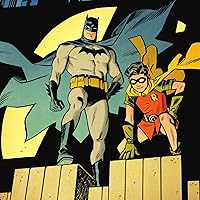
In 1982, hoping to find a way to draw monsters for a living, he moved to New York City and began working for Marvel Comics, first as a (very terrible) inker and then as an artist on comics like Rocket Raccoon, Alpha Flight and The Hulk. By the late 80s he had begun to develop his signature style (thin lines, clunky shapes and lots of black) and moved onto higher profile commercial projects like Cosmic Odyssey (1988) and Gotham by Gaslight (1989) for DC Comics, and the not-so-commercial Fafhrd and the Grey Mouser (1990) for Marvel. In 1992, he drew the comic book adaptation of the film Bram Stoker's Dracula for Topps Comics.
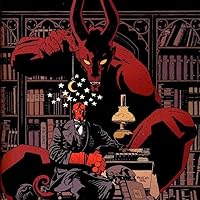
In 1993, Mike moved to Dark Horse comics and created Hellboy, a half-demon occult detective who may or may not be the Beast of the Apocalypse. While the first story line (Seed of Destruction, 1994) was co-written by John Byrne, Mike has continued writing the series himself. There are, at this moment, 13 Hellboy graphic novel collections (with more on the way), several spin-off titles (B.P.R.D., Lobster Johnson, Abe Sapien and Witchfinder), three anthologies of prose stories, several novels, two animated films and two live-action films staring Ron Perlman. Hellboy has earned numerous comic industry awards and is published in a great many countries.
Mike also created the award-winning comic book The Amazing Screw-on Head and has co-written two novels (Baltimore, or, the Steadfast Tin Soldier and the Vampire and Joe Golem and the Drowning City) with best-selling author Christopher Golden.
Mike worked (very briefly) with Francis Ford Coppola on his film Bram Stoker's Dracula (1992), was a production designer on the Disney film Atlantis: The Lost Empire (2001) and was visual consultant to director Guillermo del Toro on Blade II (2002), Hellboy (2004) and Hellboy II: The Golden Army (2008). He lives somewhere in Southern California with his wife, daughter, a lot of books and a cat.
Sir Edward Grey fights the Undead in London. The bad guy's goals could have been explained a bit better but still a solid read. I like anytime Witchfinder ties in more with the rest of the Mignola-verse. Ben Stenbeck's art has grown in leaps and bounds. Along with Michelle Madsen's colors, the book looks very polished.
This was a great Witchfinder mini, with Eddie facing off against the undead, including a foe that will be very familiar to Hellboy readers. This actually may be my favourite Witchfinder story to date and that's saying something as this title's generally pretty good. The pacing was just about perfect and there was a nice mix of horror and action.
Ben Stenbeck's artwork in this was superb (aided and abetted by the great Dave Stewart on colours). I've really enjoyed watching Stenbeck grow as an artist from his initial Mignola-clone days to a more mature artist with his own style. I can now see Tyler Crook and Michael von Oeming influences here alongside the Mignola. I have a feeling that Stenbeck's just getting started, though. I eagerly anticipate his future works.
World: Fantastic and Moody art that fits the series, I liked the art in Unland more but it's still pretty great. The world building is also good calling back to Hellboy and the villains he's faced, really good use of the Mignolaverse.
Story: Paced well and structured soundly a very straightforward horror tale that takes pieces of the Mignolaverse and makes for more great world building Grey is good fun Victorian style and I love it.
Characters: Grey is good but it's the villain that makes this book special, and oldie but a goodie. The setting and tone were the biggest characters making this a world building book. There are bits and pieces of character development but not really.
Very happy to have Ben Stenbeck back on Witchfinder art duties! His work on the first Witchfinder volume remains some of my favorite in the entire Mignolaverse. This looks just slightly different, probably because he opted to use grey tone for the artwork, which seems to work well with the Victorian setting. This is also a fun story that wraps back in several elements from other Mignolaverse comics, including vampires, Hecate, the Heliopic Brotherhood, and plenty more, without spending too much time recapping the events of previous comics.
The only thing I noticed was that there were a few places where I got tripped up on a sentence level by something like a word repeated too close together, which is notable less because it was egregious than because I haven't run into it in Mignolaverse comics before, that I recall. But those were minor, and detracted little from the experience.
On a largely tangential note: Ben Stenbeck draws good snakes. I kind of want him to draw them all from now on.
Mike Mignola and Ben Steinbeck, both are back for the fourth volume of Sir Edward Grey, and it shows. This volume is much better than the previous one.
This time, our protagonist is pitted against the undead, and readers will also find the return of a familiar character from the main Hellboy books.
Ben Steinbeck's artwork looks so amazing, but the colouring seems off. Not that it is bad, but it just doesn't suit the Hellboy universe.
I wasn't bored out of my skull by this story but it wasn't exactly a good read. I know by this point Mignola uses hired help like Roberson to flesh out his Mignolaverse but this filling in the gaps is just lazy writing. Stenbeck's polished artwork isn't really made to depict zombies, vampires or other creepy stuff, it all looks so huggable.
A well told tale that tangentially ties into a half dozen other storylines in a subtle way that enhances all the arcs rather than detracting from them with burdensome interconnectivity.
Felt very much like an introduction to Roberson's interpretation of the character. My second favorite witchfinder story after "in the service of Angels"
Series: Sir Edward Grey, Witchfinder #4 Rating: 3 stars - I liked it
This review is for volumes 4-6.
In these volumes, Edward Grey continues to deal with the Helioptic Brotherhood of Ra. He also has to deal with a vampire named Giruescu, the Foundry’s wayward member, and the Jack the Ripper murders.
I really enjoyed Sir Edward’s continued fight against the Helioptic brotherhood and anyone trying to bring evil into the world. He does get a bit obsessed with the cases, especially the Jack the RIpper case, but it does work out for him. I enjoyed his dedication to fighting evil and protecting the innocents.
All the missions in these three volumes were interesting and action packed. Edwards' fight against the Brotherhood doesn’t end in these volumes but he does cause a major blow to their ranks and prestige. I will be interested how he continues to fight against them, especially since he is no longer an agent to the crown. Also I do want to know what else the brotherhood learned from Giruescu’s vampire.
Overall, a good continuation of Edward’s story and life. I am really curious to see if there will be any more volumes or if this is the end for now. I know he appears in Hellboy and we learn some about him then.
This was a very different read. Sir Edward Grey was always shown as a more man of thinking and less of action. That he is ready to move and fight the evil forces, of course, but he was never an action hero. In this story arc he seems .... more angry and willing to spill blood. It could be that I am missing something from before but here Grey seems to be more like Baltimore - highly motivated to go and suppress the night creatures that are starting to terrorize the city of London through any means necessary.
Story itself is very interesting - it is good to see that shadowy societies (and lets not forget that Grey is member of such a troop in direct service of the Queen) do work side by side when they encounter the common enemy. It seems that end of XIX and start of XX century [in Hellboy's universe] were years of great dangers. Although ending is positive it is made obvious how very fragile the established balance is and how easy is to plunge the world into literal hell.
Art as always is great.
Highly recommended to all fans of Hellboy universe and horror stories in general.
This was alright, pretty much just "meh". It took me WAY too long to read this trade. I wasn't necessarily bored, but I found myself uninterested through the first half. It picked up later and the last chapter was pretty solid. Honestly, I never really cared for the vampire storyline in the Mignolaverse. That may have contributed to my indifference to this, but I'm starting to think that maybe Witchfinder isn't for me. I think the Witchfinder stories I've read so far have been quality both with the writing and art, I'm just not connecting to the characters and world. I did enjoy Witchfinder: Omnibus Volume 1 for the most part, yet I still felt disconnected from a lot of the stories in that collection as well. I'll go ahead with volume 5 and if that turns out the same I may need to drop this series if it continues.
Edward Grey stumbles upon another supernatural mystery as the workers digging out the London Underground find an ancient subterranean temple. Grey isn't the only one interested...the Heliopic Brotherhood of Ra, a group that blends scientific understand and occult knowledge, also investigates. They offer to work together but Grey is extremely mistrustful (they are mostly villainous). When workers from a cemetery disappear, Grey comes into conflict with a big vampiric villain from the larger Hellboy narrative. With the London police doing their usual waffling, Grey may have to work with the Brotherhood after all.
The story moves at a good pace and has lots of atmospheric art. The underground scenes and the graveyards have implicit spookiness that artist Stenbeck enhances with his style. A good job all around.
Highly recommended--this may be the best Edward Grey story I've read.
The strongest volume of the series by far, even if it ultimately delivers a fairly tidy narrative one would expect to see if this series were ever adapted for the silver screen. Sir Edward Grey must investigate missing bodies beneath London and encounters an ancient vampire menace whom we have already met in the pages of Hellboy. The story nicely wraps in Grey’s longtime foil, the Heliopic Brotherhood of Ra, as well as draws thick, broad lines that connect to the dire meta-story tying together the entire Mignolaverse. If on;y every Witchfinder volume so easily found its pace and employed such a fine partnership between writing and art.
(4,4 of 5 for decent vampire hunting) This is Witchfinder I like, nicely occult, with a great atmosphere, and nice settings (especially the London underground, the new and the old as sewers and older). The art is very nice, fits greatly and supports the atmosphere. The covers are superb dark/horror, I appreciate that. I read this book in order of multiversity reading order, which I recommend. This way, you see a lot of connections, hints and mentions to the future (Hellboy and BPRD series) which would slip out unnoticed otherwise. Also, I like how it has that little Sherlock Holmes vibe, only more supernatural, action and Edward is just cool (and of course my favourite character).
I love how a major Hellboy nemesis shows up in Edwardian England to tangle with the Heliotropic brotherhood and Sir Edward Grey. I won't say who they are as those would be spoilers but suffice to say this story does them justice and fits seamlessly into the Hellboy universe. Portions of the writing are pure poetry, the plot is tight, paneling flows naturally and the art is beautifully rendered. I am now expecting great things from the Edward Grey series.
After Mignola's absence was sorely felt last volume, his presence here is a relief. This story is sort of a prequel to one of the earliest Hellboy tales, but it does a great job functioning standalone as well. It's just good old fashioned Hellboy fun, with quite a few good spooky moments and sharp action. This is probably my favorite volume of the series so far, as I can tell the creative team is really finding its footing.
3.5 Witchfinder is not my favorite Mignola series and this volume started out a bit slow for me. It accelerated as it went along and I enjoyed the ending very much. I thought, again, of the unfairness to black birds that a group of ravens is called an unkindness of ravens and for crows it is a murder of crows. I enjoyed the slight references to other Mignola series.
This is full of familiar characters and one of my favorite villains, the Napoleonic vampire Count Giurescu, and a solid plot centered around a time-bomb of slumbering vampires in the heart of London. however, it comes off a little flat. The witchfinder himself seems a bit peevish and bothered throughout and the usually sinister Heloipic brotherhood is uncharacteristically helpful. This was better than volume 3, but not on par with the excellent volume 1.
Late 19th c. London, vampires, orientalist societies... how perfunctorily can you script a mignolaverse comic these days? It feels very padded, and the art reflects that as well. There are some very boring pages in this.
As usual, Sir Edward Grey starts investigating some spooky stuff, discovers something sinister — in this case the vampire Giurescu, who later shows up in Wake the Devil, the second Hellboy arc. A good, solid horror yarn.
Una banale storiella di caccia al vampiro. Qui Grey risulta veramente antipatico. Inoltre ha sempre troppo il controllo della situazione, non mi è mai sembrato che fosse veramente in pericolo. Possibile che un semplice uomo, per quanto esperto nella caccia al sovrannaturale, riesca a battere un vampiro plurisecolare con poca fatica?