Jump to ratings and reviews
Rate this book

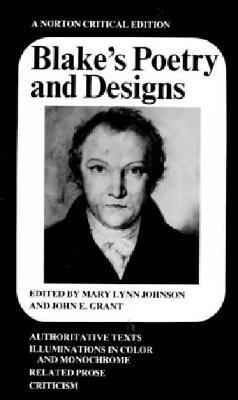
Poetry and Designs: Authoritative Texts, Illuminations in Color and Monochrome, Related Prose, Criticism

Rate this book
This generous selection from Blake's poems, prose, notebooks, marginalia, and letters is accompanied by many of Blake's illuminations for his own works, some in full color. The spelling and punctuation have been modified for greater intelligibility to modern readers.

Almost all of Blake's published writings are here, as well as most of his best shorter poems that remained in manuscript at his death, and much of his most energetic prose. Of Blake's major epics, Milton is printed in full, in its longest version; Jerusalem is represented by selection amounting to one third of the complete poem, and The Four Zoas by briefer excerpts. All the other poetic works are presented complete.

618 pages, Paperback

First published January 1, 1979

34 people are currently reading
1241 people want to read

About the author

William Blake

1,235 books3,191 followers
William Blake was an English poet, painter, and printmaker. Largely unrecognised during his lifetime, Blake's work is today considered seminal and significant in the history of both poetry and the visual arts.

Blake's prophetic poetry has been said to form "what is in proportion to its merits the least read body of poetry in the language". His visual artistry has led one modern critic to proclaim him "far and away the greatest artist Britain has ever produced." Although he only once travelled any further than a day's walk outside London over the course of his life, his creative vision engendered a diverse and symbolically rich corpus, which embraced 'imagination' as "the body of God", or "Human existence itself".

Once considered mad for his idiosyncratic views, Blake is highly regarded today for his expressiveness and creativity, and the philosophical and mystical currents that underlie his work. His work has been characterized as part of the Romantic movement, or even "Pre-Romantic", for its largely having appeared in the 18th century. Reverent of the Bible but hostile to the established Church, Blake was influenced by the ideals and ambitions of the French and American revolutions, as well as by such thinkers as Emanuel Swedenborg.

Despite these known influences, the originality and singularity of Blake's work make it difficult to classify. One 19th century scholar characterised Blake as a "glorious luminary", "a man not forestalled by predecessors, nor to be classed with contemporaries, nor to be replaced by known or readily surmisable successors."

Ratings & Reviews

What do you think?
Rate this book

Friends & Following

Create a free account to discover what your friends think of this book!

Community Reviews

5 stars
1,100 (53%)
4 stars
568 (27%)
3 stars
308 (14%)
2 stars
61 (2%)
1 star
29 (1%)
Displaying 1 - 30 of 37 reviews
Profile Image for Alok Mishra.
Author 9 books1,248 followers
March 14, 2019
Well, there is something about Blake's poetry that can connect to every reader of his very easily. However, what I have been impressed with is the designs made by him and this edition by Norton - the authentic text as well as authentic designs. Norton editions often impress me!
7 reviews36 followers
January 10, 2023
To be sure, there are authors, those who write and get published and meet acclaim or obscurity. There are also visionary authors, those whose words evoke the past as much as they forecast the future, because no matter what one thinks of the word visionary it's relevant in this case. I definitely think Blake was a visionary as he's one of my personal heroes.

The 18th century English poet, prophet and artist William Blake, who I wouldn't say belonged to the Romantic school but to himself, as he was fully and consciously responsible for his own style, can be safely identified with the second class. "I must Create a System, or be enslav'd by another Man's/I will not Reason & Compare: my business is to create." (p. 219). And create he did. Few people were as intensely creative as Blake in his highly productive artistic career, and the same holds true today. If anyone knew they were an artist, a true working artist who created to live, it was him.

The second edition of Blake's Poetry and Designs, just one of many in the Norton Critical Editions series, is a total literary vindication of this visionary status, bringing Blake's imaginative art, creative poetry and revealing letters together in one highly authoritative volume that also houses a preface, an introduction, footnotes, plates of Blake's artwork, literary criticism, a chronology of Blake's life, and a bibliography. The robust learning of editors Mary Lynn Johnson and John E. Grant, both amply qualified as Blake scholars, can't be denied here.

In the sense of the layout of Poetry and Designs, one gets an idea of how the written word and the visual picture interact creatively in Blake's work, since the man was fearless in breaking the popular 18th century convention of keeping the former isolated from the latter. One only has to glance at the frontispiece of one of Blake's illuminated poems, so that of the lyrically wonderful but thematically unsettling Songs of Innocence and of Experience, for example, to realise how he succeeded in combining, if not effectively coalescing, text and image to form a wholly novel medium of art, one his contemporaries (Leigh Hunt among them), at their own loss, either wilfully ignored or vehemently attacked.

Fortunately, I wasn't a part of that century, hence why I'm able to appreciate his genius here. Given what I've read, Blake was a natural artist and had absolute artistic control over his own work from the task of engraving or illustrating the works of individual writers to the more extensive stages of writing, printing, colouring and publishing his illuminated visions.

A favourite Blake poem of mine is The Marriage of Heaven and Hell, and it's beautifully set out in Poetry and Designs. The late American singer-songwriter and poet Jim Morrison of the 1960s American band The Doors took their name from the following line, much quoted and discussed today: "If the doors of perception were cleansed every thing would appear to man as it is, infinite." (p. 75). It's an absorbing read, especially philosophically. I often had to reread many lines and passages. It was rewarding, though, for some of Blake's primary ideas are elucidated in The Marriage, with many of them presented in just one line (as the above quote shows). The text is small in it, not to mention in every other poem, so reading it definitely took time.

I also took copious notes on it, as I did with every other illuminated work included in the book. I couldn't help myself. Great artists of all mediums tend to invite multiple opportunities for interpretation. Blake has always been this kind of artist, for I always find something new and revelatory in his words each time I encounter them. The informative introductions and footnotes to them in Poetry and Designs, the latter of which often explain open or veiled references to the Bible (a text Blake drew much inspiration from), assisted the writing of these notes.

Other poems I took notes on were All Religions Are One/There Is No Natural Religion, Songs of Innocence and of Experience, The Book of Thel, Visions of the Daughters of Albion, America a Prophecy, Europe a Prophecy, The Song of Los, The Book of Urizen, The Book of Ahania, The Book of Los, Milton: A Poem, and Jerusalem The Emanation of the Giant Albion. I was particularly puzzled by the last one. One has to see it to believe it. All of them were published from the late 1780s to the early 1820s, and Poetry and Designs succeeds in bringing them to vivid life.

What became apparent through slowly reading these esoteric poems wasn't only the intellectual and artistic development of Blake's poetic style, thought, meaning, and themes over time but the gradual emergence of a personal mythology, a little internal literary system full of powerful characters and symbols that, not unlike the nature of Tolkien's fictional universe in The Lord of the Rings book series, came directly from his own undeniably fecund imagination.

The highly imaginative quality of Blake’s work, both in his art and poetry, can’t be denied, as his imagination is arguably his best quality. Blake said: “The tree which moves some to tears of joy is in the eyes of others only a green thing that stands in the way. Some see nature all ridicule and deformity … and some scarce see nature at all. But to the eyes of the man of imagination, nature is imagination itself.” (p. 75). It’s striking quotes like these that tend to summate Blake’s philosophy, and its basis, as brilliant and multi-dimensional as the man was, is grounded in spiritual exploration. While Blake had a deep Christian faith, it wasn’t conventional. He certainly wasn’t an admirer of the church and its oppressive authority in his time.

His works, particularly those of the labyrinthine depth of Jerusalem, compel readers to envision a much earlier if not primitive time where Britain and the British people, the former of which is referred to as Albion, were truly spiritual, truly united and truly one. So much more has been said in academic criticism about Blake’s writings and ideas. So much more can be said in the future. But one only has to read a single eternal Blake poem, so “The Tyger” or “London”, for instance, to connect with Blake, for there were none like him then, just as there are none like him now.


Reference List

Blake, W 2008, Blake’s Poetry and Designs, W. W. Norton & Company, Inc., p. 75, p. 219.
Profile Image for John Pistelli.
Author 9 books361 followers
January 4, 2022
Please read my complete review here. A sample:
William Blake is several different poets to several different kinds of reader. To popular culture, or perhaps popular counterculture, he is an inspiration as outcast and dissident, visionary self-publisher and spiritual and political radical, the forerunner of Ginsberg and the Beats and Patti Smith and rock and roll, the engraver of picture-poetry epics that make him the patron saint of the graphic novel, that inspired Alan Moore to proclaim "It’s not enough to study or revere him, only be him."

Then there is modernism's Blake, the Blake of Yeats and Joyce, modernity's first impossible-to-read avant-grade writer, the deviser of a private myth in his prophetic books, especially the epics Milton and Jerusalem, about which the editors of this Norton Critical Edition say, "most of the plot is almost impossible to follow," and "long stretches of the poem offer scarcely any readerly amenities," respectively.

Finally, there is the rumored common reader of poetry, for whom Blake is the author of those anthology staples, the delicate lyrics of Songs of Innocence and Experience and the startlingly modern aphorisms of The Marriage of Heaven and Hell; for this last reader, the complexities of the early poetry remain unfathomable because they are so simple, while the labyrinth of the prophetic books is merely complicated rather than complex and therefore justifiably ignored, like Joyce's first three novels vis-à-vis Finnegans Wake (itself obviously modeled on Blake's Jerusalem, the dream of a sleeping giant who is also a city).

Read more...
Profile Image for Jeff Crompton.
440 reviews18 followers
November 9, 2020
This book has been on my shelves for about 40 years, but I had not read much of it, except for Songs of Innocence and Experience, until recently. The longer visionary poems scared me off - they seemed so strange. Well, strange they are, but they're also fascinating. I particularly enjoyed The Marriage of Heaven and Hell, with its "Proverbs of Hell."

I'll be making up for my years of neglect by returning to this collection often.
Profile Image for Lynda.
2,497 reviews121 followers
May 6, 2013
They called him mad,insane,and blasphemous. Like many geniuses, William Blake was long dead before he was appreciated. "Songs of Innocence" was the first work of his that I read. Over the years, I have read most of his works. There are some so rare, they are not available to the public.

I really enjoyed this edition of his works and "designs". If you haven't read Blake's breathtaking poetry, please don't miss out on it. I think that you too will be drawn back over and over through the years.
Profile Image for Nancy Bielski.
744 reviews7 followers
August 22, 2009
I wrote some incredible papers on Blake in college.
Profile Image for Ostap Bender.
991 reviews17 followers
September 9, 2021
I’ll start by saying that this collection includes one of my favorite quotes of all time, from Auguries of Innocence:
“To see a World in a Grain of Sand
And a Heaven in a Wild Flower:
Hold Infinity in the palm of your hand
And Eternity in an hour.”

Blake was creative, intense, and quasi-religious, opposing both the repressiveness of the established church and the rationalism of its critics. As the commentary in this edition states, “…after eighteen centuries during which Christianity had come to identify itself with the interests of the ruling class, it was now high time to recall the disruptive and revolutionary actions of Jesus.” However, Blake also rejected the popular Deist movement of the day: “…you are also Enemies of the Human Race & of Universal Nature.”

So in some ways a good portion of his writing is a pulling down of religion, with Blake creating his own mythology to replace it. He sees the fall from grace as (1) the error of perceiving life as finite and corrupt, and limited to the physical plane (personified by a character he calls Urizen, who reduces all reality to what can be manipulated by cold, calculating rationality, the proponent of royalty and creator of religion), and (2) the error of perceiving reality as brute matter resulting from a failure of imagination (which is symbolized by Los, the creative force, a poet, and the ‘eternal prophet’).

There are many other aspects to this mythos: Fuzon, pure defiance, the pent-up lust of Urizen who cannot better the world; Orc, who struggles against political oppression, sexual repression, and all rational constrictions and restrictions on energy (representing America) … and many others that I won’t go through as it’s a bit tedious. Blake sees the resurrection as man, with the help of imagination, attaining self-acceptance and a recognition of the divinity within.

There are occasional nuggets of gold in the passages, but Blake is a bit overwrought and I am a little surprised in retrospect that I read through this entire book. The Norton Edition is quite nice if you’re a Blake fan; it includes all his artwork; personally I think his art is only ‘ok’ but they do add to the text, and are given beautiful treatment including color plates in the center.

Quotes:
On babies, from A cradle song in Blake’s Notebook:
“Sleep sleep beauty bright
Dreaming oer the joys of night
Sleep sleep: in thy sleep
Little sorrows sit & weep

Sweet Babe in thy face
Soft desires I can trace
Secret joys & secret smiles
Little pretty infant wiles”

On clarity, from A Memorable Fancy in The Marriage of Heaven and Hell; which Jim Morrison read and named his band after:
“If the doors of perception were cleansed every thing would appear to man as it is, infinite.”

On experience, from Night II:
“What is the price of Experience? do men buy it for a song?
Or wisdom for a dance in the street? No, it is bought with the price
Of all that a man hath: his house, his wife, his children.
Wisdom is sold in the desolate market where none come to buy,
And in the withered field where the farmer plows for bread in vain.”

On goodbye, from An Island in the Moon:
“Leave, O leave me to my sorrows,
Here I’ll sit & fade away,
Till I’m nothing but a spirit
And I lose this form of clay.

Then if chance along this forest
Any walk in pathless ways,
Thro the gloom he’ll see my shadow,
Hear my voice upon the Breeze.”

On the holiness of life, from America: A Prophecy:
“For every thing that lives is holy, life delights in life:
Because the soul of sweet delight can never be defil’d.”

And this one, from Milton, Book the Second:
“His little throat labours with inspiration; every feather
On throat & breast & wings vibrates with the effluence Divine;
All Nature listens silent to him & the awful Sun
Stands still upon the Mountain looking on this little Bird
With eyes of soft humility & wonder, love & awe.”

On innocence, this is actually from the criticism, Northrop Frye, Blake’s Treatment of the Archetype:
“When we say that a child is in the state of innocence, we do not mean that he is sinless or harmless, but that he is able to assume a coherence, a simplicity and kindliness in the world that adults have lost and wish they could regain.”

On pity, and forgiveness, from Jerusalem:
“Every Harlot was once a Virgin: every criminal an Infant Love!”

On religion, from Milton, Book the Second:
“Thy purpose & the purpose of thy Priests & of thy Churches
Is to impress on men the fear of death; to teach
Trembling & fear, terror, constriction; abject selfishnesss.
Mine is to teach Men to despise death & to go on
In fearless majesty annihilating Self, laughing to scorn
Thy Laws & terrors, shaking down thy Synagogues as webs.”

On tolerance, from The Divine Image in Songs of Innocence:
“An all must love the human form,
In heathen, turk or jew.
Where Mercy, Love & Pity dwell
There God is dwelling too.”

On transience, from The Book of Thel:
“O life of this our spring! why fades the lotus of the water?
Why fade these children of the spring? born but to smile & fall.
Ah! Thel is like a watry bow, and like a parting cloud.
Like a reflection in a glass, like shadows in the water,
Like dreams of infants, like a smile upon an infant’s face,
Like the dove’s voice, like transient day, like music in the air:
Ah! gentle may I lay me down, and gentle rest my head…”

On war, and achieving peace, from The Grey Monk:
“But vain the Sword & vain the Bow,
They never can work War’s overthrow.
The Hermit’s Prayer & the Widow’s tear
Alone can free the World from fear.

For a Tear is an Intellectual Thing.
And a Sigh is the Sword of an Angel King,
And the bitter groan of the Martyr’s woe
Is an arrow from the Almightie’s Bow.”
Profile Image for Kristopher.
Author 2 books30 followers
May 30, 2010
I grossly underappreciated Blake's poetry before I slogged through all of it. He's easy to write off based on a superficial reading of his "Songs of Innocence and Experience." But it's the development of his thought and writing that is so astounding. Taken together, his life's work is an incredible testament to a highly individual mind writing at a time such individualism should have been wider appreciated. Blake is the great bridge between the Enlightenment and Romanticism. Blake is the great ur-Modernist.
Profile Image for sologdin.
1,853 reviews868 followers
January 12, 2021
I appreciate Blake quite a bit for identifying "mind forg'd manacles" as an object of critique. This volume however offers a mere selection, and the effect is lost for much of it, as the images are mostly not reproduced. There is a selection of color plates, but this is not really the way to read Blake, who nevertheless should be read. Decent supplementals, though, in this Norton Critical.
Profile Image for Francis Berger.
Author 167 books36 followers
November 23, 2017
I enjoyed this in university, but I enjoyed it even more now. Contrary to popular belief, age can make some things better.
Profile Image for Nikos Gouliaros.
42 reviews24 followers
July 16, 2022
[The prophetic works of William Blake] are in proportion a to its merits the least read body of poetry in the English language." - Northrop Frye

This should have been enough of a warning for how overwhelming an experience this would be.

The "Songs of Innocence and of Experience" are magnificent in their deceptive simplicity. Works like "The marriage of Heaven and Hell" and "Visions of the daughters of Albion" are relatively approachable, and allow a general reader like me to catch a glimpse of Blake's unprecedented iconoclastic imagination, revolutionary mode of thinking, and metaphysical vision. However, the more I slogged through works that expand on Blake's inconsistent mythology the more I couldn't tell what draws the line between vision and madness, or what interest a 21st-century atheist can find in the ramblings of a sui generis dissenter. And then came Milton and Jerusalem: As a non-academic reader, albeit with experience in the poetry of previous centuries, and with quite a lot of interest in scholarly approaches to literature, I could simply not follow. Despite admiring the visionary originality of the poet, anything else was beyond me, and it was impossible to keep the pages turning.

I was looking forward to the "Criticism" section, but much of it too proved beyond my grasp. It's perhaps not a coincidence that much of it felt like original material inspired by Blake, and not actual insight to his texts. I did enjoy though the approaches of Nurmi, Ostriker, and Makdisi.

V.A. De Luca did sum it up nicely: The reader experiences something like Kant's sublime of magnitude, "for there is here a feeling of the inadequacy of his Imagination for presenting the idea of a whole, wherein the imagination reaches its maximum, and in striving to surpass it, sinks back into itself ".
352 reviews6 followers
October 4, 2021
As a whole, Blake's work is better than it was when I first read it, likely because I had a better method/system for making sense of it. My favourites were The Book of Urizen, The Book of Los, Jerusalem, The Book of Thel, and more. Blake had an interesting system, but it requires educators who are equipped to teach responsibly in order to make the most of someone like William Blake. I suggest to any and all to read him on their own, supplemented by Northrop Frye's 'Fearful Symmetry'. These 2 books are all you need to get a substantial understanding of Blake.
Profile Image for Gregory Ashe.
Author 2 books
June 21, 2023
Very interesting poet/artist--definitely creative (if not a bit crazy).
Profile Image for Tina Dalton.
835 reviews10 followers
February 1, 2014
William Blake received nominal recognition in his own lifetime, and when he did get attention it was often to call him a madman. Nowadays his work is widely regarded as genius, one of the most influential and talented of the Romantics, indeed of all British literature.

I'd never read Blake before and didn't realize exactly what I was in for. I adored his "Songs of Innocence and Experience." Simply beautiful and so profound. I honestly struggled with most of the rest of what I read, particularly "Milton". The edition I have includes many of his etchings and artwork, which in my opinion add a great deal to his writing. I may not have been able to absorb much of his theology, but I can see how profound it is/was and I'm glad I've learned more of this great man.

An interesting side not: The His Dark Materials trilogy is heavily influenced by Blake's writings.
Profile Image for Juju.
271 reviews23 followers
May 26, 2011
This was a great text for this spring's course on Blake, containing most of his written work, helpful comments on the texts, a good selection of illustrations from his Illuminated books, and an interesting range of essays in the back, which often gave me a fresh perspective when I was feeling lost or overwhelmed. Overall, a really good way to study William Blake's written work, but especially insightful when read in conjunction with the actual Complete Illuminated Works edition.
Profile Image for Tom.
192 reviews138 followers
May 29, 2007
Blake himself is an unparalleled writer. This edition features all of his major poetry (except "Jerusalem" has only an excerpt), important essays he wrote, and letters to friends, as well as helpful annotations, introductions to each work, and a few insightful critical essays.

If you want a good Blake experience for $20, check this out.
Profile Image for James.
156 reviews10 followers
September 26, 2011
I'm always revisiting this book so I might as well list it. Took it with me on our trip to England where we got to see some of his original drawings. Can't imagine not having this one within arms reach.
Profile Image for Tom.
47 reviews3 followers
January 6, 2012
Lived in this book for three months at OSU. Robert Frank, prof. Can't say Blake is or was one of my favorites, but this book and the prof made this madman very accessible. Still think he's a better mystic than a poet.
Profile Image for Pirate Hat Hughes.
74 reviews6 followers
July 24, 2016
The joy of this book was Blake's talent as a painter. Some of the plates, although I didn't care for the constant religious imagery, were quite beautiful. The epic/balled style prose at age 55 leaves me cold. I simply have no more use for the "romantic individual striving against all odds" ethos.
Profile Image for Tina Romanelli.
255 reviews4 followers
February 18, 2008
Blake is brilliant. I'm totally enamored with his poetry and the criticism of that poetry.
This entire review has been hidden because of spoilers.
Profile Image for Archer.
63 reviews6 followers
Want to read
June 19, 2008
recommended by f.fathi, just your average coffeehouse book.
74 reviews
Read
August 6, 2011
William Blake is the most intriguing poet I have ever read voluntarily.
Displaying 1 - 30 of 37 reviews

Can't find what you're looking for?

Get help and learn more about the design.