Edith Wharton emerged as one of America’s most insightful novelists, deftly exposing the tensions between societal expectation and personal desire through her vivid portrayals of upper-class life. Drawing from her deep familiarity with New York’s privileged “aristocracy,” she offered readers a keenly observed and piercingly honest vision of Gilded Age society.
Her work reached a milestone when she became the first woman to receive the Pulitzer Prize for Fiction, awarded for The Age of Innocence. This novel highlights the constraining rituals of 1870s New York society and remains a defining portrait of elegance laced with regret.
Wharton’s literary achievements span a wide canvas. The House of Mirth presents a tragic, vividly drawn character study of Lily Bart, navigating social expectations and the perils of genteel poverty in 1890s New York. In Ethan Frome, she explores rural hardship and emotional repression, contrasting sharply with her urban social dramas.
Her novella collection Old New York revisits the moral terrain of upper-class society, spanning decades and combining character studies with social commentary. Through these stories, she inevitably points back to themes and settings familiar from The Age of Innocence. Continuing her exploration of class and desire, The Glimpses of the Moon addresses marriage and social mobility in early 20th-century America. And in Summer, Wharton challenges societal norms with its rural setting and themes of sexual awakening and social inequality.
Beyond fiction, Wharton contributed compelling nonfiction and travel writing. The Decoration of Houses reflects her eye for design and architecture; Fighting France: From Dunkerque to Belfort presents a compelling account of her wartime observations. As editor of The Book of the Homeless, she curated a moving, international collaboration in support of war refugees.
Wharton’s influence extended beyond writing. She designed her own country estate, The Mount, a testament to her architectural sensibility and aesthetic vision. The Mount now stands as an educational museum celebrating her legacy.
Throughout her career, Wharton maintained friendships and artistic exchanges with luminaries such as Henry James, Sinclair Lewis, Jean Cocteau, André Gide, and Theodore Roosevelt—reflecting her status as a respected and connected cultural figure. Her literary legacy also includes multiple Nobel Prize nominations, underscoring her international recognition. She was nominated for the Nobel Prize in Literature more than once.
In sum, Edith Wharton remains celebrated for her unflinching, elegant prose, her psychological acuity, and her capacity to illuminate the unspoken constraints of society—from the glittering ballrooms of New York to quieter, more remote settings. Her wide-ranging work—novels, novellas, short stories, poetry, travel writing, essays—offers cultural insight, enduring emotional depth, and a piercing critique of the customs she both inhabited and dissected.
Story 5/72 from Black Water 1 (The Anthology of Fantastic Literature) read together with The Short Story Club
I admit I cannot warm up to Wharton. I gave up on two of her novels and I barely enjoyed Roman Fever. She is American writer who lived between 1862-1937. She enjoyed a very privileged life and her work circles around the upper classes. I have no problem with that, the writing is what fails to impress me.
Pomegranate Seed is a ghost story of sorts. Charlotte recently married a widower, Kenneth Ashby and she struggles to find her place in the household. She almost manages when the husband starts to receive strange letter in a grey envelope. The reading of those letter deeply affect Kenneth, and the wife becomes obsessed to find their source.
I read an interpretation of the story where the idea of a ghost is actually the depression for losing one's wife and the letters, the inability move further and live in the present, represented by the wife and even the mother. The story also touches on the plight of being a 2nd wife in those days. That point definitely reminds of Rebecca although there is where I will end the comparison.
I don't know. Both as a plain ghost story or as a social/mental health commentary it was still too long.
Generally speaking, I don’t much like Edith Wharton’s writing style. It reminds me of Henry James: another American author who I don’t particularly care for, except for one short novel. You can probably guess which one this is, when I say that I was pleasantly surprised to learn that as well as 40 novels, one of which won the Pulitzer prize, Edith Wharton had also written ghost stories. That could well be more my cup of tea. I like early 20th century comedies of social manners, enjoying their wit and style, but cannot appreciate Edith Wharton’s elegant class-obsessed stories. It seems even stranger that she should be part of America’s so-called “classless” society.
In fact Edith Wharton came from a wealthy upper class American family, being part of the New York “aristocracy”. She also had an unhappy marriage. These facts seem to inform her work, which to me feels dull, flat and dreary. If there is satire, then I am not picking it up—but I am English—so the fault may well be mine. Edith Wharton was after all, nominated for the Nobel Prize in Literature in 1927, 1928 and 1930.
It was mostly earlier in her writing career when Edith Wharton wrote her quietly terrifying ghost stories, although Pomegranate Seed is a later one. It is among the most popular of her tales, and before I go any further I urge you not to read a blurb on any other site for this story. I was uploading it to the Goodreads database, and was appalled to find that the 2 sentence blurb revealed the ending. (Naturally, I changed it.) Not that the ending is clearly spelled out in this disturbing tale, although it is heavily implied.
So what it it about? Pomegranate Seed is an odd title for an American story about an upper class woman. It is simultaneously a mystery tale, a ghost story, and a penetrating study in the psychology of jealousy. The mystery element is possibly the least important and successful, here. As you might expect from Edith Wharton, the study of relationships is more important and what interests her. But the tension in the ghost story is finely controlled, and builds up nicely.
Edith Wharton wrote Pomegranate Seed near the end of 1930, and it was published by the “Ladies’ Home Journal” and the “Saturday Evening Post” in 1931. The tale was subsequently included in Wharton’s collection of short fiction, “The World Over” in 1936, and then in her collection, “Ghosts” which was published in 1937, the last year of the author’s life.
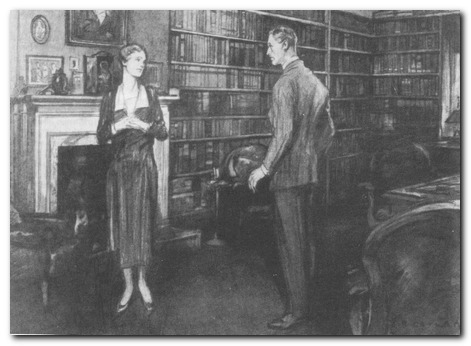
Here is the original Saturday Evening Post illustration: which I feel exactly conjures up the stifling and claustrophobic domestic setting of the story. It has very few characters—just three or four. We cannot count the servants of course, who are mere factotums, without personalities or desires of their own. The sole purpose of these unnamed beings is to ensure that the rooms are clean, the cushions are plumped up, and the meals arrive on time.
The story focuses on a young woman, Charlotte, who has recently married a widower, Kenneth Ashby. They are blissfully happy, she tells us, even though her husband had dearly loved his first wife, to whom he had been married for 12 years. In fact she reports that her friends tell her of his utter devotion to Elsie, who by all accounts had him wrapped round her little finger. Even his own mother seems relieved when Elsie’s portrait is moved to the children’s room, saying that it was better for the couple to start afresh.
Charlotte and Kenneth had honeymooned in the West Indies, and Kenneth had returned to his work as a lawyer when they returned. Oddly he did not seem to want to go away any more, resisting Charlotte’s suggestions. Charlotte remained in the house, not changing any of the furnishings and decorations which her predecessor Elsie had chosen and arranged. Perhaps you know the later famous novel “Rebecca” (1938) by Daphne du Maurier, with its overpowering presence of Maxim’s first wife. If so, you will recognise the suffocating feelings here, and the relentless pacing of its suspenseful plot.
I was also conscious of the soporific interior. Neither of the female viewpoint characters in these two stories seemed to use their independent status to venture far from the domestic setting, staying trapped—albeit voluntarily—in their luxurious four walls. They both make the choice to remain confined. This is a recurring theme of Edith Wharton: relating the house as a physical space to its inhabitant’s characteristics and emotions. It is skilfully done, and indicates repression on many levels. At the start Charlotte protests that she is carefree, but as the story moves on, among the almost overpowering social manners we pick up her lack of social and individual fulfillment; her alienation, and her repressed sexuality.
So there it is, spelled out for us. Jealousy, with all its agonies and uncertainties. For months, Kenneth has occasionally received a letter, always written by the same strange, unknown hand. Whenever he receives one he inevitably turns pale, and closets himself alone for hours, eventually reappearing tired and stressed. Charlotte confronts her husband, having convinced herself that he must have a mistress or an old romantic entanglement, but he assures her that everything is fine.
This then is the nub of the story. The mother comes in on the scene later in the tale, and provides a welcome relief: a touch of sanity in this emotionally charged atmosphere. The dialogue between husband and wife is manipulative and cruel, indicating a never-ending power struggle. The ending chillingly evokes the supernatural, and sends a cold shiver down the reader’s spine. In one way it is perhaps inevitable; we could see this a mile off, although as mentioned, it does cleverly leave room for ambiguity.
And the pomegranate seeds? Where do they come in? The simple answer is that they don’t. It is merely an oblique metaphor. In the Graeco-Roman myth about Persephone, Persephone is abducted by Pluto, the god of the underworld. Persephone is taken to Hades, where she breaks her vow of abstinence by eating six pomegranate seeds. Edith Wharton is referencing Ovid’s Metamorphoses, and relating this to
The ghost story may be perceived as one of the less important genres in literature. No doubt Edith Wharton’s novels of social observation which made her reputation over several decades, are her main legacy in literary terms. Nevertheless, it is to her well crafted ghost stories that I am drawn. If you like your ghost stories to be traditional and subtle, understated and restrained: full of dreadful foreboding, and giving you a fearful sense of unease rather than a series of shocks, then you may well enjoy this one.
The title conjures Persephone in the Underworld. But the story opens with the young wife of a widower, back from a blissful honeymoon, only to feel increasing disquiet. Du Maurier’s Rebecca springs to mind, published three years earlier. However, the cause of anxiety here seems firmly rooted in the corporeal world: occasional letters, with distinctive handwriting, that upset her husband, but he won’t discuss.
Persephone seems far away, but it’s about reading between the lines and reversing some of the mythological characters.
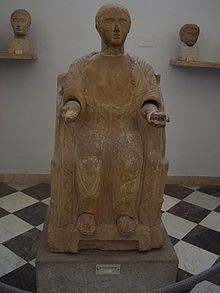
Image: Etruscan terracotta cinerary statue of Persephone holding a pomegranate (Source)
Quotes
• “Her passionate need to feel herself the sovereign even of his past.”
• “He began to make conversation with an assumption of ease that was more oppressive than his silence.”
• “She’s everywhere in this house, and the closer to him because to everyone else she’s become invisible.”
See also
I first read this as one of Wharton’s New York Stories, all of which I reviewed HERE. The ending was a pleasant surprise as the supernatural aspect wasn't in the other New York Stories, so I gave it 4*. It fits better in anthologies of her ghost stories and this Anthology of Fantastic Literature, but has less impact, hence only 3* now.
By the time I finished reading Wharton’s New York Stories, they felt a bit formulaic, so I devised a "recipe" for writing a Wharton short story, HERE.
Wharton wrote a poem called “Pomegranate Seed”, more closely tied to the Greek myth. You can read it here.
Charlotte recently married a widower, Kenneth Ashby. His first wife, Elsie, had a reputation as a controlling woman during their 12 years of marriage. Kenneth said they could not afford to redecorate their home so Charlotte is feeling unimportant as she lives surrounded by Elsie's furnishings and decorations.
Charlotte has been noticing that her husband has been receiving letters written in a faint feminine handwriting. Kenneth turns pale every time he receives one of these mysterious letters, but refuses to divulge the name of his "client." Charlotte is feeling jealous and threatened by her husband's unknown correspondent. The story has a disturbing conclusion.
This is an atmospheric work that was first published in magazines in 1931. It was included in Edith Wharton's excellent collection of ghost stories in 1937. I'm reading this story with The Short Story Club from the anthology "Black Water."
Boring. The mystery of the grey envelopes is established in the first scene, but nothing of consequence happens at all in the next 25 pages. One and a half stars round down. One star.
I've read other ghost stories from Edith Wharton, and I'm sure I would have enjoyed this one more if I hadn't just savoured Summer — a masterpiece in social realism.
This short story pales in comparison to the honest splendours and real life struggles of "Summer".
"to surprise a secret" is a phrase that appears several times here, apparently meaning "to discover a secret" or "uncover the truth behind a secret". At first I wondered at the usage, but over time I have grown fond of it — many of us are unnervingly motivated by the need to surprise a secret.
A man receives letters, reluctantly tells his wife who they are from, panic ensues, and boom! all is well again with no more mysteriously letters arriving. While a curious little tale, I found this to be a weak story with no punch at all.
Interesting Note: This story was made into a teleplay on the television show, Lights Out. It aired on April 30, 1951, renamed "Grey Reminder," and starred John Newland who later hosted the television show One Step Beyond. He was an actor, screenwriter, television producer, and director. I found the episode and streamed it on the Internet to make the comparison to the written word.
💥 Recommended, but only for the curiosity of the television episode version. Otherwise, it is a weak story. 📺
Wharton is unmatched in her observation of the restrictions placed on women in a society that legally places them in the same category as land , horses and diamonds. Taking on the baton from Trollope she twists his inevitable happy endings into stories that finish with ambiguity, forcing more questions than answers.
Charlotte has bought into the role of the Perfect Wife and Rescuer , marrying a widower with children whose first wife's death apparently released him from terrible domination. He works as a lawyer, disparaging the women who see him in their legal struggles as demanding, so Charlotte contains her increasing anxiety over a series of personal letters her husband is clearly disturbed by. The inability of the couple to share vulnerability in the prison of their domestic space contrasts with their apparently bliss when away from the formality and structures of this setting and their need not to dissemble in front of servants. It's a masterpiece of subtle observation, mounting tension and drama as both protagonists fail to understand each other and are cloth eared to ech others emotional needs. Both are unable to be anything other than the roles society demands - the adored new wife and the virile strong husband husband despite the inner turmoil of their emotions.
Ich habe dieses Buch auf einem Flohmarkt gefunden und hatte dementsprechend wenig Erwartungen.
Die Kurzgeschichte ist gut geschrieben und lässt sich schnell lesen. Sie spielt fast ausschließlich im Haus der zwei Hauptcharaktere, was einen gut in die Handlung eintauchen lässt.
Allerdings hat mir dann doch ein bisschen das Take-Away der Geschichte gefehlt. Ich musste sowohl die Bedeutung des Endes als auch des Titels googlen, da mir beides aus der reinen Erzählung nicht klar wurde.
Wonderful descriptions, but honestly very little story (or character).
The tension was strained for too long and what we thought would be a predictable ending… didn’t end at all! Not even an open ending, just a blunt cut without any narrative indication whatsoever. It was disappointing because of the momentum that was being built.
“Rebecca” by Du Maurier will give you what you wanted from this kind of story - and much, much more.
Qué malas son las expectativas. Es, con diferencia, lo peor que he leído de la autora y estoy muy decepcionada, la verdad. Gracias a los comentarios de The Short Story Club he podido entender algo de lo que quiere decir la autora y del porqué del título, que es una referencia al mito de Perséfone y que las semillas de granada son en este caso las cartas que lo atan al pasado. Pero es que el final ha sido tan decepcionante, estoy acostumbrada a giros de trama muy interesantes en las historias de la autora y aquí he sentido que nos deja a mitad, faltan explicaciones.
It started off so well and I was thinking that it starts awfully similar to Rebecca, although the latter was written later I'm guessing. And the ending was satisfying if you think about it but the delivery of the ending was lacking. Just an allusion to a specific character having made a certain choice and the main character pissed off rather than sad. It was weird. I had to replay several times to make sure I understood. It might have been different if I'd read it myself but doubtful.
Una colección llena de gran poder de ambientación, muy bien construida. Sin embargo, el argumento es pobre y el desarrollo no logra equiparar la habilidad de Wharton para unirse con le esterilidad del espacio material. «Si tan solo uno pudiera entrar en una comunión lo suficientemente profunda con la casa, podría uno descubrir su secreto y adquirir por cuenta propia el poder de ver fantasmas».
so this one felt like six months in Hades give or take depending on one's longitudinal perspective mixed with six months of fresh earthy substance, 30 aught pages that could have taken a lesson in lessening from Climax, I guess I don't dig paranormal stories where the scary deviation from norm is relegated to not feeling like dressing up for dinner . . . On the other hand, her poem Pomegranate Seed (concerning the Greek myth) is pure poetry.
Back to the story: and why would Charlotte have not actually double checked her assumption that the parlormaid was transferring the letters from the letterbox to the table by actually enquiring about the matter, which would have her clued her in to the bigger mystery earlier, perhaps in time to 🅰🅲🆃🆄🅰🅻🅻🆈 🅳🅾 🆂🅾🅼🅴🆃🅷🅸🅽🅶, a sadly lacking aspect of the story, like, who are the ghost characters really?
I did not understand this one. A woman marries a widower who everyone says is still madly in love with his dead wife. Once they return from their honeymoon, a letter awaits him and she can see how anguished he becomes. This goes on for several months, a letter arrives and he is upset, to the point where she cannot take it anymore and demands to know who they are from. He refuses to tell her but agrees to go away with her on a trip when she begs. The next morning, he leaves to see to their passage but he never returns. The woman goes to her mother in law for help and she recognizes the handwriting on the letters as that of his dead wife. They call the police.
This entire review has been hidden because of spoilers.
Kenneth is haunted by death in the form of mysterious letters. His second wife Charlotte is trying to fit into Kenneth's life. The dead first wife, Elsie, is casting a pall over their life together as Charlotte descends into jealousy and Kenneth sinks toward depression. This is available in 'Ghost Stories of Edith Wharton'. Also available on youtube.
I assume this short story was more frightening—and more surprising—at its own time than it is now, perhaps because so many ghost stories that came after it have made it seem predictable—the tyranny of time, making the most extraordinary seem mundane.
A gothic tale of a man remarried after the death of his wife but is still haunted by her. It has a slight Rebecca feel to it. Edith Wharton is such a fine writer. She recreates that British upper class manor house gothic so well.