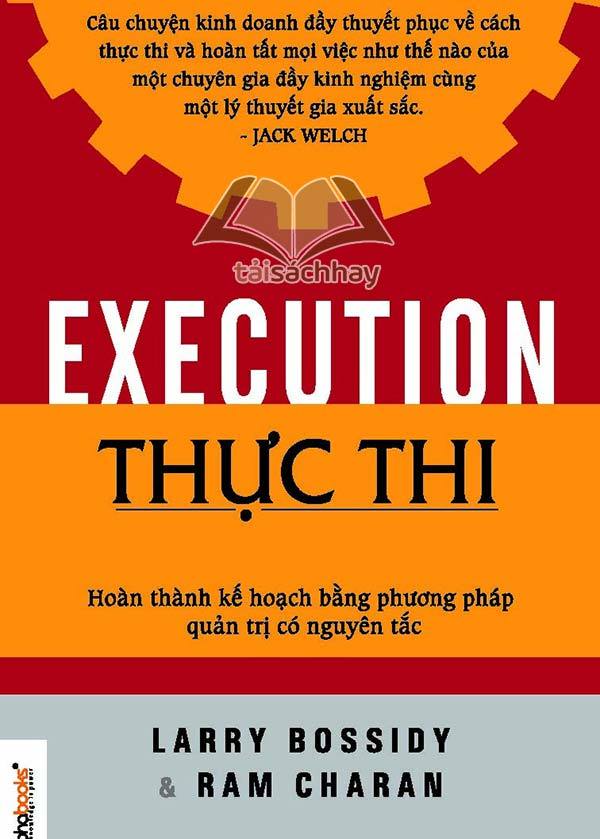
Đối với nhóm biên dịch chúng tôi, dịch tựa đề quyển sách này là cả một sự thú vị. Chúng ta đã quá quen thuộc với chức danh CEO (Chief Executive Officer) được dịch là Giám đốc điều hành, đến mức một cách mặc định hầu hết chúng tôi đều nghĩ rằng Execution hay Executive có nghĩa là Điều hành, có lẽ để tựa đề quyển sách này là “Điều hành” thì sẽ kêu hơn là “Thực thi”. Nhưng điều mà hai tác giả Larry Bossidy và Ram Charan muốn nhấn mạnh qua quyển sách này là hầu hết các lãnh đạo của chúng ta đã quá mơ mộng và tự bằng lòng với chức danh “Điều hành” mà quên mất bản chất công việc của một nhà lãnh đạo là Thực hiện và thi hành các kế hoạch đã được đặt ra, là làm tất cả những gì có thể, để chiến lược không chỉ là những câu chữ hào sảng, giấy tờ, mà sẽ mang lại những thay đổi tích cực và dẫn dắt doanh nghiệp đến những tầm cao hơn. Đề ra chiến lược chưa đủ, một người lãnh đạo giỏi thực sự phải là người biết thực thi.
Dù đứng từ góc độ nào, là người lãnh đạo hay là nhân viên, chúng tôi tin rằng khi bạn tìm đọc quyển sách với một tựa đề tưởng như không hấp dẫn này, “Thực thi”, bạn đã thể hiện mình là một người hoài bão, có khả năng và đang suy nghĩ về việc điều hành và quản trị thực sự nghiêm túc. Chúng tôi cũng tin rằng, những kinh nghiệm của Larry Bossidy và Ram Charan sẽ mang lại cho bạn những giây phút suy ngẫm thú vị và “thực thi” sẽ là chìa khóa, là yếu tố sống còn trong công việc lãnh đạo của bạn.
Larry Bossidy là Chủ tịch và Giám đốc điều hành của tập đoàn đa quốc gia Honeywell trị giá 25 tỷ đô la Mỹ - chuyên sản xuất các thiết bị khoa học công nghệ. Trước đó, Bossidy đã tạo tên tuổi của mình với thành tích chuyển hóa hoàn toàn AlliedSignal thành một trong những công ty được ngưỡng mộ nhất thế giới - một công ty tập trung vào tăng trưởng và nâng cao năng suất lao động bằng áp dụng Six Sigma. Bossidy cũng từng trong các vị trí điều hành cao cấp của GE, nơi mà ông bắt đầu làm việc từ năm 1957 tới năm 1991.
Ram Charan là một chuyên gia tư vấn được săn đuổi của các tổng giám đốc và các nhà quản trị tên tuổi, từ GE, Ford, DuPont, EDS, Verizon cho tới các giám đốc của các đơn vị kinh doanh mới thành lập. Tiến sĩ Charan đã viết rất nhiều bài báo cho tạp chí Havard Business Review, Fortune và là tác giả của nhiều quyển sách nổi tiếng. Ông là cựu sinh viên của Harvard và đã từng dạy học ở đây.
Cuốn sách này được viết theo lối đàm thoại với độc giả và hai tác giả thay nhau nói về các ví dụ thực tiễn đầy sinh động của mình để minh họa cho các ý tưởng chủ đạo. Đôi khi Larry và Ram phải thay tên công ty thành XYZ, thay tên người thành Peter X, nhưng những câu chuyện hai người kể đều rất gần gũi và quen thuộc với bất kì một lãnh đạo nào, dù là ở vị trí tổng giám đốc hay giám đốc bộ phận. Quyển sách chia làm ba phần, trong phần thứ nhất, hai tác giả thuyết phục người đọc tại sao “thực thi” lại cần thiết đến như vậy. Tuy nhiên, “thực thi” là một kĩ năng hơn là một thiên phú trời sinh. Và vì vậy, trong Phần Hai, tác giả thảo luận về các nền tảng cơ bản để việc thực thi mang lại những kết quả tốt đẹp, từ các ứng xử thiết yếu của người lãnh đạo cho tới việc người lãnh đạo phải tự mình tuyển dụng nhân sự và tìm ra các vị trí thích hợp cho mỗi một cá nhân có khả năng. Các mắt xích cơ bản và mối liên hệ chặt chẽ giữa các mắt xích này để quá trình thực thi diễn ra hoàn hảo (như: Yếu tố con người, yếu tố chiến lược và yếu tố vận hành kinh doanh) là nội dung của Phần Ba.
Dù đứng từ góc độ nào, là người lãnh đạo hay là nhân viên, chúng tôi tin rằng khi bạn tìm đọc quyển sách với một tựa đề tưởng như không hấp dẫn này, “Thực thi”, bạn đã thể hiện mình là một người hoài bão, có khả năng và đang suy nghĩ về việc điều hành và quản trị thực sự nghiêm túc. Chúng tôi cũng tin rằng, những kinh nghiệm của Larry Bossidy và Ram Charan sẽ mang lại cho bạn những giây phút suy ngẫm thú vị và “thực thi” sẽ là chìa khóa, là yếu tố sống còn trong công việc lãnh đạo của bạn, hay chọn người lãnh đạo cho công ty, hay chọn đối tác làm ăn và thậm chí trong chọn một công ty với những người lãnh đạo giỏi để làm việc cùng.
Lawrence Arthur "Larry" Bossidy is an American author and retired businessman. He was CEO of AlliedSignal (later Honeywell) in the 1990s, prior to which he spent more than 30 years rising through executive positions at General Electric.
Execution: The discipline of Getting Things Done: Larry Bossidy and Ram Charan
Central Truths:
1. Execution is a systematic process of rigorously discussing hows and whats, questioning, tenaciously following through, and ensuring accountability. 2. No company can deliver on its commitments or adapt well to change unless all leaders practice the discipline of execution at all levels. 3. You need robust dialogue to surface the realities of the business. 4. How people talk to each other absolutely determines how well the organization will function. 5. Organizations don’t execute unless the right people, individually and collectively, focus on the right details at the right time. 6. People imitate their leaders. 7. Leadership without execution is incomplete and ineffective. 8. Leader must show up. You cannot be detached and removed and absent. 9. Good people liked to be quizzed – when you probe, you can learn things and your people learn things. Everyone gains from the dialogue. 10. Realism is at the heart of execution; don’t try to avoid or shade reality. 11. Rewards and respect are based upon performance. 12. Coaching is the single most important part of expanding others’ capabilities. 13. When leader discusses business and organizational issues in a group setting, everybody learns. 14. Best learning comes from working on real business problems; ask people to work on 3 or 4 issues facing company – form teams to work on those issues. 15. Every leader and supervisor needs to be a teacher. 16. Leader must have emotional fortitude to be able to be honest with yourself; deal honestly with business and organizational realities; or give people forth right assessments. 17. Emotional fortitude comes from self discovery and self mastery. It is the foundation of people skills. 18. Putting people in the right jobs requires emotional fortitude. 19. Four qualities that make up emotional fortitude include authenticity, self-awareness, self-mastery, and humility. 20. We don’t think ourselves into a new way of acting; we act ourselves into a new way of thinking. 21. A business’s culture defines what gets appreciated and respected and ultimately, rewarded. It tells people what in the organization is valued and recognized. 22. You cannot have an execution culture without robust dialogue; one that brings reality to the surface through openness, candor, and informality. 23. Good motto: truth over harmony. Harmony can be the enemy of truth. 24. Formality suppresses dialogue; informality encourages it. It invites questions, encourages spontaneity and critical thinking. 25. The culture of a company is the behavior of its leaders. Leaders get the behavior they exhibit and tolerate. 26. The more you get involved and the better you hash the issues out on the table, the better decisions you will make in terms of their resolution. 27. In successful businesses, leaders focus intensely and relentlessly on people selection. 28. Leaders must be personally committed to the people process and deeply engaged in it. 29. When the right people are not in the right jobs, the problem is visible and transparent. 30. Leaders need to commit as much as 40% of their time and energy (emotional) to selecting, appraising, and developing people. 31. Doers energize people; they are decisive on tough issues, get things done through others and follow through as second nature. 32. Getting things done through others: fundamental leadership skill: if you cannot do it, you are not leading. 33. When the wrong people get rewarded, the whole organization loses. 34. Mechanical evaluations miss how candidates performed in meeting their commitments. Meeting them the wrong way can do enormous damage to an organization. 35. Nowhere is candid dialogue more important than in the people process. Must be able to speak forthrightly in evaluating others, if not, evaluation is worthless. 36. The people process is more important than either the strategy or operations processes. 37. Robust people process: evaluates individuals accurately and in depth; provides framework for identifying/developing leadership talent; and fills the leadership pipeline. 38. Traditional people process; backward looking, focused on evaluating the jobs people are doing today. More important to determine if individuals can handle the jobs of tomorrow. 39. Meeting strategic milestones greatly depends on having a pipeline of promising and promotable leaders. Strong leadership pipeline based on good information. 40. HR person must be well trained in the craft: how to teach people, develop them, make them interested in staying with company, and know what’s important for building momentum and morale in an organization.
Application:
1. A leader just does not sign off on a plan. She wants an explanation and she should drill down until the answers are clear. 2. The knowhow of execution: involve all people responsible for the strategic plan’s outcome; ask staff about the hows of execution; set milestones for the progress of the plan with strict accountability for the people in charge; and have contingency plans to deal with unexpected. 3. Seven essential behaviors of leaders: know your people and your business; insist on realism; set clear goals and priorities; follow through; reward the doers; expand people’s capabilities; and know yourself. 4. Work on the personal connection everyday and every way you can. Show up with an open mind and a positive demeanor, be informal and have sense of humor. 5. Focus on a very few clear priorities that everyone can grasp. Strive for simplicity in general. Speak simply and directly. 6. Ask people to work on 3 or 4 issues facing company: form teams to work on these issues. 7. Need to make judgments about which people have the potential to get something useful out of a course and what specific things you are trying to use education to accomplish. 8. Gain experience in self-assessment. 9. Cultural change must change people’s behavior. Must change the beliefs and behavior of people in ways that are directly linked to bottom – line results. 10. Do not reward individuals for just strong achievement on numbers but also on the desirable behaviors that people actually adopt. 11. Increase population of A-players: those who are tops in both behavior and performance. 12. Search for people with an enormous drive for winning. 13. Never finish a meeting without clarifying what the follow-through will be; who will do it; when and how they will do it; what resources they will use; and how and when the next review will take place and with whom. 14. Personally check references. Focus on candidate’s energy, implementation, and accomplishments. Find out about their past/present, accomplishments, how they think, and what drives their ambitions. 15. Look closely at how the people under review met their commitments. 16. When identifying high-potential and promotable people, avoid two dangers: organizational inertia (keeping people in the same jobs for too long); and moving people up too quickly.
What a completely over-rated book. I suspect this made the top 20 best-ever booklist that led me to it on the basis that the title sounds good, like something a knowledgeable business person should advocate. Bossidy has earned the right to write on this topic, but the story lacks any sense of instructive meat. It's really more suited to a motivational speech or a Tom Peters interview. Reading 250+ pages was painful. Some business books are thoughtful; others make me really dislike business culture in general. This was exemplary of the latter. Bossidy and Charan's pompous tone was omnipresent, but the pinnacle came with Bossidy's way of explaining that every employee assessment should include something developmental, since even "The Good Lord had some development needs." I was slightly amused at their summary of the typical strategy review (a boring 4-hour sleeper that ends up decorating a credenza), but then sobered by the discussion about the engagement and discussion that should happen. Their 3 fundamental tasks where the leader must see execution: picking leaders, setting strategic direction, and running operations. They also made uncomfortable points about "emotional fortitude."
1. As a CEO or a leader at the top level management, it is wrong to only focus on the planning or big pictures. The 'modern' style of managing is to also make sure how to get the things done. Do not blame the staffs if execution goes wrong.
2. To do point 1 above, make sure you hire good people that are entitled to get things done. To do so, you have to use all channels of reference checking, contact people that know your candidates closely.
Very inspiring, but could have been written in a much more concise way.
A former manager of mine once told me to read this book. That was back in 2007. It took me until now to read it, but now I understand why he had such high praise for the book.
Execution in it's simplest sense is to: get things done. Period. But it's more complex than those 3 words might suggest. It's about getting the right people in place, building a strategy around the resources available, and finally implementing the strategy, linking the strategy with people.
As with many other books on management science, the veracity of the concepts is undeniable: Nothing is more important than people, candid dialogue leads to realistic plans, following up is crucial in implementation of a strategy. Yet of all the books in this category of literature that I have read, I always encounter the same problem. These concepts are easy to talk about, and even easier to understand, but hard to practice in real life.
In spite of the negatives, I am certain that this is a book that I will refer to again and again for inspiration, and as a reference point on how to execute. If there is one thing I would like to add to this book however, it would be as follows:
Execution is learned through practice, not just reading.
So many business books read like a rehash of a boring seminar and this is no exception. Every page could be a power point. Every line could be a bullet point. Everything is crafted for presentation with very little background, substance or reference. Anecdote is not evidence, yet anecdote is ever-present.
You know, it reminds me of sitting through talks and speeches in church when I was a kid. All Mormon talks are exactly like this - a few bullet points, an anecdote, a weak conclusionary statement and a call to action. Amen.
It's not worth reading, in my opinion, because it's full of jargon and puffery. Who knows if the wall of corporate verbiage has any meaning or not? Apparently many are convinced it does. I am not.
As to the puffery, the book makes out plain prudence to be some great new discovery. This is not even marketing, but simply spin, as far as I can see. Because the authors are corporate leaders, this book is treated better than it deserves. It deserves to be treated as an marketing addition to the authors' resume, rather than as a serious addition to the literature on prudence.
Just avoid it.
Edit: Serious about dramatically increasing execution? Then I recommend "The 12 Week Year" instead.
Начинал читать в ожидание, что найду в книге инструменты, решения, шаблоны для поднятия исполнительной функции в компании и достижение. Книга больше по стратегическому планированию и исполнению стратегии. Никаких фреймов нет, но по стратегии, созданию стратегии, обсуждению, это по-моему одна из лучших книг. Для топов и руководитель любого направления будет очень полезна!
A rambling mess that seemed to have never crossed an editor's desk, this book read as though it was literally spoken into a tape recorder, transcribed and then published. As to its subject matter: I cannot think of one bromide the "authors" managed to leave out, particularly of the tautological sort. You hire good people by....hiring good people, you build good products by....building good products. Wow.
I finally tossed this sucker aside after about the 84,000th mention of Jack Welch, in such slobbering terms they'd make a St. Bernard blush.
So, a "WTF?" is not an inappropriate way to end this review. The authors have obviously done a great deal in the business world, done it quite well and should have a great deal of constructive, practical advice to offer. Well, it ain't in this book, gang. Sorry. Indeed, I'm borderline to calling this work an insult to anyone who picks it up, expecting something remotely resembling the blurbs on the back cover. I don't know what they were reading, but it could not possibly have been this mess.
The idea that many people intellectualize, philosophize and cannot actually implement or execute is so very true, I have seen it over and over again in my career.
Leaders show up and get into the weeds, it builds dignity in subordinates. Forty percent of a leader's time should be spent on selecting, evaluating, and providing feedback to their people.
I've heard something similar to this many times, but I loved the way the authors worded this - "We don't think our way into a new way of acting, we act our way into a new way of thinking".
I totally agree with the thoughts on senior leadership teams. Robust, open, honest dialog is key to execution, be open minded without private agendas. Internally competitive behavior is destructive and people who cannot work with other drain an organizations capacity.
Overall I enjoyed the book, it just didn't offer much new content for me personally, I would not hesitate to recommend it as a good book on Leadership and Execution.
There were some good things to think about as far as open and honest feedback from reviews and assessment. There were also some good points on when to take coaching opportunities. Most of the book was about setting expectations and following through by holding people accountable. There is a lot of emphasis on scrutinizing the business plans of underlings and driving out the specific actions to see if they have actually thought about it or just made up numbers to meet their performance objectives. The authors assume that money is the primary motivator of employees. They also assume that most everyone who is not in management wants to be promoted into management. I did not really enjoy this book, it sort of made me edgy.
This book is valuable to individuals and is even more value to senior leadership in organizations. I enjoyed considering the key difference between what behaviors successful companies exude. Also, I strongly agree that a culture of execution normally separates industry leaders from other companies. Here is my personal review of this book.
“Execution is a systematic process of rigorously discussing hows and whats, questioning, tenaciously following through, and ensuring accountability. It includes making assumptions about the business environment, assessing the organizations capabilities, linking strategy to operations and the people who are going to implement the strategy, synchronizing those people and their various disciplines, and linking rewards to outcomes. It also includes mechanisms for changing assumptions as the environment changes and upgrading the company’s capabilities to meet challenges of ambitions strategy. In its most fundamental sense, execution is a systematic way of exposing reality and acting on it. Many companies don’t face reality well.” (Pg. 22- paragraphs 1 & 2)
Too many people like to dwell on pie in the sky planning. An person or organization must seriously expose and address what can and should be done.
The story of EDS and its CEO Dick Brown provided valuable insight into effective hard working execution driven leadership. It also shows an effective attempt at leadership with transparency. Pgs. 46-54
Three Building Blocks of Execution I. Leaders 7 Essential Behaviors 1. Know your people and your business 2. Insist on realism 3. Set clear goals and priorities 4. Follow through 5. Reward the doers 6. Expand peoples capabilities 7. Know yourself
In Chapter 4 – Building Block 2: Creating the Framework for Cultural Change
“The basic premise is simple: cultural change gets real when your aim is execution. You don’t need a complex theory or employee survey to use this framework. You need to change people’s behavior so that they produce results. First you tell people clearly what results your looking for. Then you discuss how to get those results, as a key element of the coaching process. Then come up short, you provide additional coaching, withdraw rewards, give them other jobs, or let them go. When you do these things, you create a culture of getting things done (1st paragraph – pg. 86).”
“There’s a saying we recently heard: We don’t think ourselves into a new way of acting, we act ourselves into new ways of thinking (1st paragraph – pg. 89).”
“The beliefs that influence behaviors are more likely to need changing (3rd paragraph – pg. 89).”
When being a realist when dealing with issues of a business requires what the authors call “Emotional Fortitude” which means to be secure and strong enough to listen to negative and be forceful with people. This emotional fortitude is mentioned through-out the book.
I think the importance of robust dialogue section in this book is a key component to an individual that executes. “You cannot have an execution culture without robust dialogue—one that brings reality to the surface through openness, candor, and formality. Robust dialogue makes an organization effective in gathering information, understanding the information, and reshaping it to produce decisions. It fosters creativity—most innovations and inventions are incubated through robust dialogue. Ultimately, it creates more competitive advantage and shareholder value (pg. 102).”
“Informality is critical to candor. … Formality suppresses dialogue; informality encourages it. Formal conversations and presentations leave little room for debate. … Informality gets the truth out. It surfaces out-of-the-box ideas – the ideas that may seem absurd at first hearing but that create break throughs. … Finally, robust dialogue ends with closure. At the end of the meeting, people agree about what each person has to do and when. They’ve committed to it in an open forum; they are accountable for the outcomes. … The reason most companies don’t face reality very well is that their dialogues are ineffective (Pg. 103 – paragraphs 2 – 3).”
WHAT KIND OF PEOPLE ARE YOU LOOKING FOR? “The person who is a little less conceptual but is absolutely determined to succeed will usually find the right people and get them together to achieve objectives. I’m not knocking education or looking for dumb people. But if you have to choose between someone with a staggering IQ and an elite education who’s gliding along, and someone with a lower IQ but who is absolutely determined to succeed, you’ll always do better with the second person (paragraph 3 – Pg. 119).”
“You’re searching for people with an enormous drive for people with an enormous drive for winning. These people get satisfaction from getting things done (pg. 120).”
He (speaking of an effective CEO) never finishes a conversation without summarizing the actions to be taken (1st Paragraph – pg. 123 – last sentence).”
The bottom of page 123 explained that good leaders are decisive on tough issues. Decisiveness is the ability to make difficult decisions swiftly and well, and act on them. “Organizations are filled with people who dance around decisions without ever making them. Some leaders simply do not have the emotional fortitude to confront the tough ones. When they don’t, everybody in the business knows they are wavering, procrastinating, and avoiding reality (last paragraph – pg. 123).”
“Getting things done through others is a fundamental leadership skill (pg. 125).” After reading this section I also think a person needs a good balance between hands-off delegation and micromanagement by smothering others.
“Never finish a meeting without clarifying what the follow-through will be, who will do it, when and how they will do it, what resources they will use, and how and when the next review will take place and with whom. And never launch an initiative unless you’re personally committed to it and prepared to see it through until it’s embedded in the DNA of an organization (1st paragraph – pg. 128).”
HOW TO GET THE RIGHT PEOPLE IN THE RIGHT JOBS “The first things I look for are energy and enthusiasm for execution. Does the candidate get excited by doing things, as opposed to talking about them? Has she brought that energy to everything she’s done, starting with school? I don’t care if she went to Princeton or to Poduck State; how well did she do there? Is here life full of achievement and accomplishment (3rd Paragraph – Pg. 129).”
Chapter 6 – The People Process: Making the Link with strategy and Operations
“To put it simply and starkly: If you don’t get the people process right, you will never fulfill the potential of your business. (Last sentence – 1st paragraph – pg. 141).”
“One of the biggest shortcomings of the traditional people process is that it’s backward-looking, focused on evaluating the jobs people are doing today. Far more important is whether the individuals can handle the jobs of tomorrow (Last paragraph on Pg. 141).”
Chapter 7 – The Strategy Process: Making the Link with People and Operations
“The basic goal of any strategy is simple enough; to win the customer’s preference and create a sustainable competitive advantage, while leaving sufficient money on the table for share holders (1st Sentence – Pg. 178).”
“Few understand that a good strategic planning process also requires the utmost attention to the hows of executing the strategy (1st Sentence of 2nd Paragraph – Pg. 178).”
“A business unit strategy should be less than fifty pages long and should be easy to understand. Its essence should be describable in one page in terms of its building blocks, …If you can’t describe your strategy in twenty minutes, simply and in plain language, you haven’t got a plan. … Every strategy boils down to a few simple building blocks.
A good strategic plan is a set of directions you want to take. It’s a road-map, lightly filled in, so that it gives you plenty of room to maneuver. You get specific when you’re deciding the action part of the plan, where you link it with people and operations (Paragraph 1 & 2 – Pg. 185).”
The rest of the book was insightful too. These are only a few recorded comments. I enjoyed stories about good leadership who executed by hard work, follow-up, and emotional fortitude, using open dialogue and allowing people to take ownership and build themselves by accomplishing specific executable goals. I desire a personal culture or execution and therefore will continue to reference this book. Personally, I need to be real about my situation, set clear strategic, operational goals and be held accountable for my progress.
"Исполнение. Система достижения целей" очень хорошая, основательная и тщательно проработанная книга в которой приведено множество принципов, моделей и способов управления персоналом с целью незамедлительной, а главное качественной реализации бизнес-панов а также целей предприятий.
Авторы не просто люди оторванные от действительности теоретики, а люди которые достигли высоких позиций в корпоративном секторе и весьма успешные личности. И возможно поэтому книга у них получилась очень насыщенная и ценная, а её рецепты готовы для применения во многих видах бизнеса.
Основная ценность книги в том, что авторами изучены проблемы провалов хороших стратегий компаний с идеальными бизнес-планами даже в руках сильных лидеров вместе с отличными командами управленцев. Да, и такое бывает! Боссиди и Чаран глубоко исследовали проблемы почему такое происходит в мире бизнеса. Они нашли множество причин этих проблем, и конечно же ими приведено большое количество советов и инструкций к применению.
I learned a lot of things from Bossidy and Charan, specially that execution is not something you delegate, it is the direct responsibility of the leader. I also learned that business plans have to be so detailed, they become daily guides.
The only thing I didn't like is that they wrote the book from the perspective of huge company, in the billions of dollars of sales category. I understan that is the primary area of expertise of the author, but I would like to read a book this good intended for medium size companies and start ups.
I highly reccomend this book.
2017: Even Better
I just finish re-reading this book, looking for ways to apply Bossidy's and Jack Welch's teachings on creating an execution culture to small and medium size companies.
I still find this book amazing and revealing. In my company we now have and operating plan, and are working on stepping our managers up to a culture of accountability.
The authors recommendations will become a guided plan for becoming as execution oriented as Honeywell and GE.
I was lucky enough to work at AlliedSignal and participate as Larry Bossidy ran the Execution machine he describes in this book. I have found it invaluable in transforming organizations of all sizes.
This is a decent book about implementation and follow through in corporate strategy. The format is the now standard in the genre "buddy system" of teaming a high profile CEO with a consultant/academic to tamp down the bombast and increase the detail and logic flow. Here Bossidy is the exec and Charan is the consultant (who was also at the Kellogg School). Th material is fairly rich and the style is relatively readable - remember the genre!
A few interesting and helpful suggestions, but for the most part it was a lot of verbiage without much actionable content. Geared for much larger organizations with a larger hierarchical structure of authority where one can push off the actual process of doing to many direct reports.
This is a must read for anyone working in a corporate office, small business, or hot dog stand. In the 5 or 6 years since reading, time and time again I have thought about the things I learned here.
I had very high expectations when starting this book due to the praise it has received from multiple angles, even the Goodreads book description is written in superlative. It's definitely a good book but I have to say that I was not impressed, mainly due to two reasons: 1) Most of the recommendations were familiar from somewhere else there was little completely new material that I had not encountered before. 2) I did not like that most of the examples were impersonal (company A, project Y, person X) which made them hear artificial. I did enjoy the part of evaluating the performance of leaders and how it may be deceived (i.e. meeting targets at the cost of people (expecting people to work overtime as a norm) or timing financial/production decisions to maximize reported numbers in a way that compromises future earnings). Also the discussions around organizational culture were sound. "Leaders need to commit as much as 40% of their time and energy (emotional) to selecting, appraising, and developing people." (principle that was endorsed by GE CEO Jack Welch).
For key concepts I'm going to borrow the book review from user "Al" (https://www.goodreads.com/review/show... 1. Execution is a systematic process of rigorously discussing hows and whats, questioning, tenaciously following through, and ensuring accountability. 2. No company can deliver on its commitments or adapt well to change unless all leaders practice the discipline of execution at all levels. 3. You need robust dialogue to surface the realities of the business. 4. How people talk to each other absolutely determines how well the organization will function. 5. Organizations don’t execute unless the right people, individually and collectively, focus on the right details at the right time. 6. People imitate their leaders. 7. Leadership without execution is incomplete and ineffective. 8. Leader must show up. You cannot be detached and removed and absent. 9. Good people liked to be quizzed – when you probe, you can learn things and your people learn things. Everyone gains from the dialogue. 10. Realism is at the heart of execution; don’t try to avoid or shade reality. 11. Rewards and respect are based upon performance. 12. Coaching is the single most important part of expanding others’ capabilities. 13. When leader discusses business and organizational issues in a group setting, everybody learns. 14. Best learning comes from working on real business problems; ask people to work on 3 or 4 issues facing company – form teams to work on those issues. 15. Every leader and supervisor needs to be a teacher. 16. Leader must have emotional fortitude to be able to be honest with yourself; deal honestly with business and organizational realities; or give people forth right assessments. 17. Emotional fortitude comes from self discovery and self mastery. It is the foundation of people skills. 18. Putting people in the right jobs requires emotional fortitude. 19. Four qualities that make up emotional fortitude include authenticity, self-awareness, self-mastery, and humility. 20. We don’t think ourselves into a new way of acting; we act ourselves into a new way of thinking. 21. A business’s culture defines what gets appreciated and respected and ultimately, rewarded. It tells people what in the organization is valued and recognized. 22. You cannot have an execution culture without robust dialogue; one that brings reality to the surface through openness, candor, and informality. 23. Good motto: truth over harmony. Harmony can be the enemy of truth. 24. Formality suppresses dialogue; informality encourages it. It invites questions, encourages spontaneity and critical thinking. 25. The culture of a company is the behavior of its leaders. Leaders get the behavior they exhibit and tolerate. 26. The more you get involved and the better you hash the issues out on the table, the better decisions you will make in terms of their resolution. 27. In successful businesses, leaders focus intensely and relentlessly on people selection. 28. Leaders must be personally committed to the people process and deeply engaged in it. 29. When the right people are not in the right jobs, the problem is visible and transparent. 30. Leaders need to commit as much as 40% of their time and energy (emotional) to selecting, appraising, and developing people. 31. Doers energize people; they are decisive on tough issues, get things done through others and follow through as second nature. 32. Getting things done through others: fundamental leadership skill: if you cannot do it, you are not leading. 33. When the wrong people get rewarded, the whole organization loses. 34. Mechanical evaluations miss how candidates performed in meeting their commitments. Meeting them the wrong way can do enormous damage to an organization. 35. Nowhere is candid dialogue more important than in the people process. Must be able to speak forthrightly in evaluating others, if not, evaluation is worthless. 36. The people process is more important than either the strategy or operations processes. 37. Robust people process: evaluates individuals accurately and in depth; provides framework for identifying/developing leadership talent; and fills the leadership pipeline. 38. Traditional people process; backward looking, focused on evaluating the jobs people are doing today. More important to determine if individuals can handle the jobs of tomorrow. 39. Meeting strategic milestones greatly depends on having a pipeline of promising and promotable leaders. Strong leadership pipeline based on good information. 40. HR person must be well trained in the craft: how to teach people, develop them, make them interested in staying with company, and know what’s important for building momentum and morale in an organization.
Application:
1. A leader just does not sign off on a plan. She wants an explanation and she should drill down until the answers are clear. 2. The know-how of execution: involve all people responsible for the strategic plan’s outcome; ask staff about the hows of execution; set milestones for the progress of the plan with strict accountability for the people in charge; and have contingency plans to deal with unexpected. 3. Seven essential behaviors of leaders: know your people and your business; insist on realism; set clear goals and priorities; follow through; reward the doers; expand people’s capabilities; and know yourself. 4. Work on the personal connection everyday and every way you can. Show up with an open mind and a positive demeanor, be informal and have sense of humor. 5. Focus on a very few clear priorities that everyone can grasp. Strive for simplicity in general. Speak simply and directly. 6. Ask people to work on 3 or 4 issues facing company: form teams to work on these issues. 7. Need to make judgments about which people have the potential to get something useful out of a course and what specific things you are trying to use education to accomplish. 8. Gain experience in self-assessment. 9. Cultural change must change people’s behavior. Must change the beliefs and behavior of people in ways that are directly linked to bottom – line results. 10. Do not reward individuals for just strong achievement on numbers but also on the desirable behaviors that people actually adopt. 11. Increase population of A-players: those who are tops in both behavior and performance. 12. Search for people with an enormous drive for winning. 13. Never finish a meeting without clarifying what the follow-through will be; who will do it; when and how they will do it; what resources they will use; and how and when the next review will take place and with whom. 14. Personally check references. Focus on candidate’s energy, implementation, and accomplishments. Find out about their past/present, accomplishments, how they think, and what drives their ambitions. 15. Look closely at how the people under review met their commitments. 16. When identifying high-potential and promotable people, avoid two dangers: organizational inertia (keeping people in the same jobs for too long); and moving people up too quickly.
Has a lot of great anecdotes about executive vice president A challenging mid-level leaders B and C to achieve margin initiative 1 by timeline 1998 through upgrades to technology, implementation of operations efficiencies, and negotiation with suppliers X and Y to avoid competitor D gaining market share. If that inspires you then you’ll probably enjoy the book much more than I did; if not then congratulations, settle for reading the back cover and save 8 hours.
#A – The leaders 7 essential behavior 1. Know your people and business a. Master the art of questioning and take questions – you intuitively know the culture and how well the managers normally communicates w/ the workforce. b. Build personal connection – absent that personal connection, you are just a name. c. Conduct business reviews – show up as a way of your appreciation and a reward for their extensive preparation. It’s not an interrogation, but take the form of a Socratic dialogue. 2. Insist on realism a. Ask the question of ‘what’ and ‘how’ instead of simply ask ‘what’ b. Always understand where you are comparing it with other companies 3. Set clear goals and priorities – less is more, laser focused on the top 3 priorities. 4. Follow through – have the review process to ensure feedback and progress. 5. Reward doers – enforce accountability and promote execution. 6. Expand people’s capabilities via coaching – master the art of questioning, asking incisive questions forces people to think, to discover, to search. 7. Know yourself – build emotional fortitude – comes from self-discovery and self-mastery. a. Authenticity – walk your talk, be real. b. Self-awareness – Know your strength and your weakness. Put mechanisms in place to help you disciplined and overcome your weakness. c. Self-mastery – keep your ego in check (don’t think you are better than others) d. Humility – the ability to contain your ego.
The ultimate learning comes from paying attention to experience. As you gain experience in self-assessment, your insights get converted into improvements that expand your personal capacity. It requires tenacity, persistence, and daily engagement.
#B – Creating the Framework for Cultural Change The hardware of a computer is useless without the right software. Similaryly, in an organization the hardware (strategy and structure) is inert without the software (beliefs and behaviors). Reward – You should reward not just strong achievements on numbers but also the desirable behaviors that people actually adopt. Rigor cadence (rhythm) of the business – strategy planning, operating plan, business reviews… Robust dialogue – effective meetings, plannings, reviews, the difference is in the quality of the dialogue, starts from the top.
#C—Having the right people in the right place 1. Interview – a person who doesn’t interview well may be the best choice for the job. You need to probe deeply, have structured interview to frame your questions which focus on details (not just high-level strategy or philosophy), how to set priorities, qualities, decision making process, energy level… 2. Appraisal – focus on the ‘how’ as well as ‘what’. The ‘how’ unvarnish the truth. 3. Candid dialogue – practice, such that you have enough confidence to give areas for improvements.
3 Core Processes of Execution
#A The People Process 1. People Evaluation – Who are the people who are going to execute that strategy, and can they do it? Deciding what to do about nonperformers. 2. People Development – detertime the organization’s talent over time and planning people development actions that will meet near-, medium-, and long-term milestones. 3. Leadership Pipeline / Strong succession plan – developing leadership pipeline thru continuous improvement, succession depth, and reducing retention risk.
All along I've taken pride that I'm an "ideas guy". I am not an "implementer". This book made it abundantly clear that if there were an extra Beautitude in the bible it would be: "the implementers shall inherit the Earth".
It's not enough to be think strategically and fashion an exception strategic plan. A plan is only as good as it execution. So often leaders are changed out under the guise of having a poor strategy. When in actuality it was poor execution that doomed them to failure.
The book made the case for clearly aligning your People strategy, Strategic plan and Operational plan together. Through the skill of having the courage to practice the art of asking the right questions, a leader can keep those three aligned and moving in the right direction.
It's the leader's job first and foremost to ensure the overall plan is executed. This isn't something that can be delegated. The leader has to be the one holding people accountable for doing their job, while not intervening too much and doing their job for them. Leaders must be hands on.
There wasn't a section on "how to ask effective questions". This would be a wonderful next step as it can doom a leader who might be all about following up and accountability, but just might not know the right questions to ask.
Before reading this book I thought the key thing was having an "impact". In fact, that was my word for 2016. Reading this book literally slapped that thought out of my head and replaced it with "execution". You can't have an impact on anyone or anything if you can't execute.
The thing that hit me hardest about this book is that I saw myself in it. I can look back in my career and endeavors and see a string of poor execution. Areas where I failed to ask the right questions, failed to follow-up, failed to focus (follow one course until success). It was humbling to say the least.
I no longer think of myself as just an ideas guy. I am an executor - first and foremost. I am leaving a trail of results in my wake as proof that I have impacted the world in a positive way.
As a result of reading this book I am beginning to ask questions of how certain things will impact other things. What will be the ramifications if this is (or isn't done)? What is the effect of failure on this process? Who else is doing this better than we are?
This book will definitely be read/listened to once a month for the next six months. I'll even buy the hard cover for the library.
I almost threw this book away after the first 50 pages--it seemed like a typical business book which explains a relatively simplistic common sense idea in business speak and using 10 pages for every one thought--and dated to boot. But being stuck in the Newark airport for 12 hours and having read everything else on me led me to gradually getting deeper into the book--and by the time I had finished it, I was convinced this is a really helpful book to leaders/managers. The authors' basic idea is that getting things done (right) is not as easy as it sounds--especially not in complex organizations where people are likely to self-promote/claim credit and seek to avoid responsibility. The effective leader should focus simultaneously on three large processes: people, strategy and operations. In describing each process, the authors actually do say some very useful things, bringing out what leaders must do to be effective--and by the same token, what distinguishes good leaders from well educated non-doers. Ownership and accountability, positive energy, listening, and realism are all concepts worth emphasizing--regrettably, too many organizations do not really implement. Well worth reading for business leaders!
This is one of the better leadership/management books that I have come across. Like most books of the genre, it stresses goals and visions as essential to moving forward, but this book takes it in a different direction: at some point, you need to stop dreaming and start doing something.
Execution stresses a more hands-on approach to leadership. It's not enough to simply sit back and be the idea guy hoping that someone else is taking care of the work. The book is generally written for the CEO level, but the majority of the lessons are transferable to any level of leadership/management.
I enjoyed this book more than I thought I would. Take aways for me: 1. Follow up to make sure there is follow through, 2. The importance of having the right people in the right jobs, 3. A thorough review process, feedback, critique and coaching, 4. Emotional fortitude in dealing with people (this includes self-mastery and humility), 5. Bringing large scale strategies down to the action items level (and again, follow up being key to success). This book forced me to look inward and evaluate where I fall short. Rather lengthy for the content, I believe it could be condensed.
This is a vintage read from the early 2000s. It is directed towards CEOs and those who want to be CEOs. All that aside, I enjoyed it and I have retrieved some useful nuggets of information that I am able to apply in my current position which is far from the CEO suite. It is a good thing to view the world of work from the top level instead of the trenches. It tends to help put things into perspective for us working guys.
If you see this book on the shelf of the guy interviewing you for your next job, leave.
Terrible book by reckless and mean managers who give corporations a bad name. Some useful lessons in the first 60 pages devolve into a tirade against responsible management. The authors believe that the only purpose of a manager is to maximize profits in the next quarter.
Started off very strong and somehow became less impressive towards the end. For some reason, it felt less precise, even though it was describing the operations and strategy processes. Nonetheless, I wholeheartedly support its core premise that you have be specific about how to get things done.