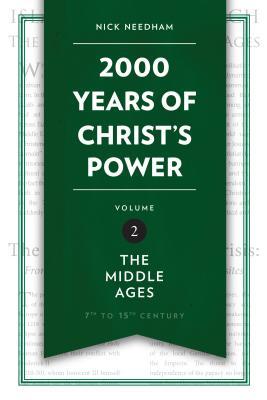
The Middle Ages were dubbed the 'Dark Ages' almost before they had begun to draw to a close. Ever since then, they have continued to be seen as a time of hardship and oppression, full of Popes and Crusades. In the second volume of 2,000 Years of Christ's Power, another side of the Middle Ages shines through though: The continual workings of Christ as He built His kingdom through figures such as Thomas a Kempis and John Wycliffe, who lived and struggled during these centuries. This was far from a period of stagnation; rather it was the fire from which the Reformation was kindled.
Dr. Nick Needham is senior minister of Inverness Reformed Baptist Church and tutor in church history at Highland Theological College in Dingwall, Scotland.
Dr. Needham is a Londoner by birth and upbringing. He studied theology at New College, Edinburgh University, where he specialized in Church History. He also taught a course at New College on the life and works of the Swiss Reformer Ulrich Zwingli, at the same time completing his PhD thesis on the nineteenth-century Scottish theologian Thomas Erskine of Linlathen. He then taught Systematic Theology at the Scottish Baptist College in Glasgow for several years before spending a semester at the Samuel Bill Theological College, where he taught Church History. After a period as assistant pastor in a church in north London, he moved to the Highland Theological College, Dingwall, where he teaches Church History.
Nick Needham's "2,000 Years of Christ's Power, Part Two" is the second volume in a five-volume series on church history. Following his phenomenal first volume on the early church Needham this second volume covers the 6th century to the 15th century. This era is known as the Middle Ages, but also more commonly as the Dark Ages. But Needham dispels the myth of a "dark" age by showing the spiritual vitality and Biblical faithfulness of the Medieval Church.
The strength of these volumes, as I experienced in the first, is their conciseness and clarity. Needham is able to communicate a lot in a few short chapters helping us to understand the main issues of the Middle Ages and the most important people. As well I loved that Needham delved into Eastern Orthodoxy and showed many of the protest/reforming movements (i.e. Waldensians, Lollards, Hussites) in the West that were vibrantly active before the Reformation. It's such a glorious reminder of the faithfulness of the church throughout the ages and that God was still working in history even during the Middle Ages.
Needham's series are glorious, great and extremely accessible. I believe every Christian should read through these series on church history to gain a greatly grasp on what God's historic work and cure ourselves of chronological snobbery.
I love Needham's approach to church history: he is incredibly thorough and yet always engaging and easy to read. To my surprise my favorite chapter was on Russian Orthodoxy, something I knew little about but thoroughly enjoyed learning about. I have now read the first two volumes in this series and have already started the third. Highly recommended.
In line with the first volume, this is a wonderful addition to the best church history narrative series one will come across. Highly readable and accessible, and yet the author leaves no stone unturned in his detailing of the life of the church in the middle ages.
Great book! I learned tons that I did not know, had curiosities provoked that were unprovoked before, and grew much more sympathetic to the church at large.
About 90% of this book was very well done. He follows his standard format in the series: exposition of a certain time period followed by 8 pages of sources from the middle ages. Needham's writing is warmly evangelical (though not without fault, as I will show later) and he tries as hard as possible to be sympathetic to a period that on first glance is not conducive to his own British evangelicalism:
The Highlights: He gives an interesting overview of Charlemagne, covering the essential details from which much of medieval theology will spring. The potraits he paints of the heroes of this age are very life-like.
The section on Byzatine theology was quite good. The two sections on Holy Russia and Holy Serbia were superb. The sermon by St Cyril of Turov at the end of the chapter is among the best sermons ever preached ("The Glory of Easter").
A fault with the book: Needham has this annoying habit of seeing in the arch-heretics seeds of "the doctrines and preaching of grace." Can't we just call them heretics and be done with it? Libertines and those who reject the Church are not definitionally Protestants. This kind of historiography makes us look silly and gives Catholics legitimate ammo to shoot us with.
I must admit that my least favorite era in history to study is the Middle Ages. I have had even less desire to study medieval theology. However, Needham brings this era of history to life in his second volume. I honestly walked away with a better understanding of the events that led up to the Protestant Reformation. Needham also takes time in this work to highlight the rise of Islam. Unlike many church history books he also spends time discussing the Eastern Orthodox Church, which I knew little about and was pleased to learn more about. Needham’s scholarship is evident throughout the book, but one thing that I love about this series is the primary sources that he lays out in full at the end of each chapter.
I am so happy Christian Focus has been able to republish these and make them more available- though I am grateful for Grace Publications for originally publishing these.
This is a terrific series, and Needham does an excellent job wading through history while not reading like a typical textbook. I recommend these books for any Christian wanting to learn Church history- they will take you deeper than a standalone volume would be able to provide, and also will not put you to sleep. :)
Tons to learn in the Dark Ages of church history. I went back and forth between discouraged at the corruption in this time frame to encouraged by the persistent preservation of God’s church. History of crusades and the East/West schism were great to learn about with more detail than I previously knew. As always, quotations from original sources at the end of every chapter is what makes this series superb.
Really great book. It follows on well from the first volume, exploring a section of church history that is often ignored or viewed as mysterious by many. Cannot recommend this series enough.
Best church history I've read. Not too long, not too short. Narrative is engaging and informative. Tracks not only movements but theological controversies/development as well. Each chapter is concluded with excerpts from the writings of that day, some of which are wonderful.
Historical understanding gives perspective to one's own day, practice, and belief. It also grants humility.
Rich. This book is just packed to the rim with useful information that is both inspiring and heart-rending. Starting with the crusades, then the vikings, church corruption, and the beginnings toward the reformation. Highly recommend if you're looking for information in the medieval time period. Nick doesn't skimp out on information no matter how much it hurts. This is a really good resource.
2000 Years of Christ's Power (Vol. 2) by Nick Needham
Please give my Amazon review a helpful vote -
This is a hard book for me to evaluate. It has a lot of virtues, but in a very subtle way it communicates an unfortunate undercurrent of anti-Catholicism, despite, I believe, making a heroic effort to avoid that vice. This assessment is not surprising. The book is written from an unapologetically Evangelical perspective and I am a Catholic with a deep interest in history.
The book is part of a longer series that surveys Christian history from the beginning to the present day. This book offers a broad survey of history beginning with the eruption of Islam into Christian lands outside of Europe to pre-Protestant anti-Catholic religious movements. This survey is broad and informative. It often takes a deep dive into particular subjects. The language of the book is extremely accessible and the subjects are invariably interesting. A very nice feature of this book is that at the end of each section, the author, Nick Needham, provides textual excerpts from some of the sources he's mentioned.
Much of this is very good. I particularly liked the section on St. Gregory Palamas and the dispute over Hesychasm. As an introduction to a very difficult and arcane topic, it was first-rate and well worth the price of the book. Likewise, the section on Scholasticism laid down the basic teachings of the centuries-long line of Schoolmen in a brief and intelligible way.
Although the recounting of this history takes a long and longed for step away from anti-Catholic tropes, it still manages to slip a few of the traditional tropes into the mix. For example, the presentation of the Crusades is premised on Catholic aggression against peaceful Muslims. The myth of peaceful Muslim Spain is promoted:
"The most tolerant and fruitful Christian-Muslim relationships were those of Muslim Spain (or the “emirate of Cordova”, as it was called in the Islamic Empire).
Needham, Nick. 2,000 Years of Christ's Power Vol. 2: The Middle Ages (p. 29). Christian Focus Publications. Kindle Edition.
Given the fact that Christianity was virtually exterminated in Muslim Spain, it's not clear how tolerant these relationships were. A recommendation here is to read "The Myth of the Andalusian Paradise by Dario Fernandez- Morera to become acquainted with the dark side of this history.
Likewise, the Muslim conquest is explained by the nobility of its soldiers:
"Arabia. Within a hundred years, they had created a huge Islamic Empire, stretching from India to Spain. The world had rarely known armies like this before: brave, tough, completely sober (Islam did not allow Muslims to drink alcohol), and burning with a zeal for their faith which made them unafraid of death.
Needham, Nick. 2,000 Years of Christ's Power Vol. 2: The Middle Ages (p. 20). Christian Focus Publications. Kindle Edition.
In none of this is the real desire for loot and wealth acknowledged. Arab warriors had a long tradition of raiding and much of the Muslim conquest was prefigured by years of raiding which destabilized the target prior to conquest.
The way this trope works is that Evangelicals tend to conflate peacefulness with being Christian and start tut-tutting about those war-like Catholics betraying Christian principles by being so beastly and war-like against noble and peaceful Muslims. What this trope leaves out is the fact that the Muslims were occupying lands that had been Christian for centuries and were gradually exterminating Christian populations through continuous pressure such as heavier taxes and social discrimination which could be alleviated through conversion. This pressure was periodically punctuated with bouts of violent persecutions, resulting in genocides.
This book doesn't mention the damage done to Christian Europe by the constant raiding which took millions of Christians as slaves and resulted in Muslim attacks on Rome itself. If Christianity had not learned to fight back, then Christian populations in Europe could easily have gone the same way as Christian populations in the Byzantine Empire. Since this book is about 2,000 years of Christ's power, some due interest in the legitimacy of Christian resistance, and the backstory that justified that resistance, ought to have been presented.
Another trope involves the Inquisition. The author writes:
"It developed into the most feared organisation of the later Middle Ages. Once the inquisition had accused a person of heresy, it was almost impossible for him to prove his innocence.
Needham, Nick. 2,000 Years of Christ's Power Vol. 2: The Middle Ages (p. 319). Christian Focus Publications. Kindle Edition.
This is pure nonsense, according to modern scholars. In the Great Inquisition in Languedoc following the Albigensian Crusade, 5,500 men and women were questioned by the Inquisition. Out of this number, according to "The Corruption of Angels: The Great Inquisition of 1245-1246 by Mark Gregory Pegg:
"In the two hundred and seven known sentences that the two friar-inquisitors pronounced in a series of general sermons given, largely at Saint-Sernin, between Sunday, 18 March, and Sunday, 22 July 1246, only twenty-three did not involve having to wear yellow crosses. Instead, these twenty-one men and two women who had “shamefully offended God and the Church” were all punished with perpetual incarceration in a “decent and humane prison."
If you read other books on the cases that appeared before other Inquisitions, you learn that the Inquisition took due process very seriously and often released the accused where there was a lack of evidence. (See Kagan, Richard L.; Dyer, Abigail (2011-07-21). Inquisitorial Inquiries.) The Inquisition had a light footprint when it came to convictions.
To his credit, the author doesn't spend a lot of time on the Inquisition, but there are few references to it that are fresh meat for anti-Catholics.
Finally, a really unfortunate slip of anti-Catholicism occurs when the author writes:
"The more fervent worshippers of Mary declared that in heaven Bernard bore a blemish on his glorified breast to atone for what he had said against the Virgin.
Needham, Nick. 2,000 Years of Christ's Power Vol. 2: The Middle Ages (pp. 201-202). Christian Focus Publications. Kindle Edition.
I really believe this is an unfortunate error on the author's part. The sense I get from the generally irenic tone of this book is that the author wouldn't intentionally intend to slander Catholics with the "Catholics worship Mary" lie, but, unfortunately, this sentence sets back a desirable ecumenism.
To his credit, the author encourages his readers to take an interest in medieval history, even the Catholic parts because, according to the author, the Reformers were born in the heart of the Catholic Church. He observes:
"As an heir of the Reformation and a Church historian, I often find myself telling people that the great spiritual and theological movement set rolling by Luther and Zwingli was in fact the best elements of Western medieval Christianity trying to correct the worst elements.
Needham, Nick. 2,000 Years of Christ's Power Vol. 2: The Middle Ages (p. 9). Christian Focus Publications. Kindle Edition.
In volume 1, the author explains his model of Christian history whereby Christian history can be thought of as a growing person: Birth>Child>Teenager>Adult, with the Middle Ages being the child and the Reformation being the teenager.
So, fine, we have explicitly stated something that many Protestants probably think. I know that I had a law partner tell me one evening his sincere belief that Catholicism was "transitional paganism." I personally don't think this is a helpful or truthful way to model history.
So, I probably can't recommend this book to people who don't already know enough history to read it in an informed and critical way. On the other hand, I may refer to it as a quick source of names and dates. The textual excerpts are excellent and can be a useful springboard for further reading.
I gave this five stars because most people think of Church History books as boring. I've read many of them, and next to "The Story of Christianity" by Justo Gonzalez and "The Apostolic Fathers," there's nothing better. What I love about this series is that Needham includes sections of writings from the actual people featured in the chapters, probably 10 pages worth. So all those people you've heard of but never read, you get samples of their writings - and just enough to keep you engaged. And he does a great job selecting passages that give you a flavor for the writers overall message and style. And they appear at the end of the chapter, so they don't interrupt the flow of his narrative.
This particular volume is great because he shows how incredibly influential the Middle Ages, often thought of as the "Dark Ages," were. He shows how the interplay between Muslim and Christian thought shaped the world we live in today. He highlights many influential thinkers and they way they set the stage for the explosion of the reformation under Luther. It's an excellent read - highly recommend.
Paired rlly nicely w the current Kings Hall series on the Middle Ages, starting w “Yarmuk: The Most Pivotal Battle in Western History,” “King Alfred”
Needham clearly lays out the middle ages in a helpful & foundational timeframe for the church. I love how little i hear the term “dark ages” in reformed circles, because, as Needham writes, the Church was still bring sanctified and had a remnant. Spiritual authority was used to satisfy power-hungry, political, and diabolical men— but there were still faithful & yet misled believers partaking in wars. I loved reading the wife of a christian crusader’s excerpt.
7 th century - the threats from and enmity with Islam began
Prayers to Mary, the seven sacraments, and many Roman catholic views started now.
Lots of small groups arose against idols, praying to saints, and infant baptism. Quiet, though, and we know little about them, becausebthe State Church would kill them.
Sooo many pre-reformation protestants who were killed by the roman Catholic leaders. The Roman Catholic church was confused, even having with numbers “sole” popes at the same time. The Eastern church survived without a dictator. Wycliff and Huss were two of MANY who died believing the Bible has sole authority and the Roman Catholic popes were antichrists.
Abelards sexual immorality. HIS journal entry…..
Soo intriguing how the human heart and the battles in the Church are nothing new.
Copied and pasted….
While Huss languished in prison, his disciples in Prague started giving the wine as well as the bread to the laity in holy communion: an act of open defiance of Catholic practice (Huss was in full agreement with what his followers did). Finally, in June 1415, the Church authorities brought the sick Bohemian reformer before the Council, which refused to allow him to defend himself, bullied him mercilessly for three days in an attempt to force him to renounce his "heresies", and finally condemned him and deposed him from the priesthood. In a humiliating ceremony, six bishops stripped off Huss's priestly vestments, put on his head a cap covered in pictures of red demons, and solemnly committed Hus's soul to the devil. "And I said Huss,' I" said Huss, "commit myself to my most gracious Lord Jesus? The Council then handed Huss over to Emperor Sigismund, the man who had promised him safe-conduct; Sigismund's soldiers burnt Huss at the stake on July 6th 1415. Huss died with serene courage, refusing a last minute offer of pardon if he would abandon his beliefs: "I shall die with joy today in the faith of the Gospel which I have preached." Huss's martyrdom created an uproar in Bohemia.
Another great volume in this series, and an easy 5 stars from me! I'm genuinely glad I own these books. If an author can get someone like me, who isn't naturally a history lover, to not only learn but stay engaged along the way, that's a pretty good indication of how well written they are!
Realistically, I probably won't remember more than 5% of what I read in any real detail. But there's still tremendous value in letting the broader story of church history wash over me. Even when the details fade, I walk away with ideas, themes, and a better understanding of the general movements throughout history. And that alone makes the reading worthwhile.
I'm also in a phase of life where I need more application than information, so I may hold off on Volume 3 for a while until I'm ready to dive back in. Yet even among all the historical details, there are wonderful little nuggets worth meditating on, reflecting on, and applying to my own life. And for that, I'm thankful.
I'll leave you with one such nugget that truly moved me and gave me pause to ponder more deeply...
Anselm of Canterbury - Proslogion, Chapter 1 (excerpt)
Come along now, little man, Leave your daily work for a while, Get away for a while from the swirling storm of your thoughts. Put those heavy anxieties to one side, Free yourself for God for a little while, And rest for a little while in Him.
Retreat into the innermost room in your soul, Lock out everything else except God And whatever can aid you in seeking Him; And when you have closed the door, Then seek Him.
Now, my whole heart, say to God, "I seek Your face; Lord, it is Your face I am seeking"...
I confess, O Lord, with thanksgiving, That You have made me in Your image, So that I can remember You, Think of You, And love You.
But Your image in me is so worn away, So blotted out by faults, So darkened by the smoke of sin, That it cannot do the thing it was made for, Unless You renew it and remake it.
Lord, I am not trying to climb up to Your height; My understanding is simply not equal to that. But I do want to understand a little of Your truth Which my heart already believes and loves.
I do not seek to understand so that I may believe; I believe so that I may understand.
More than that, I believe that unless I do believe I will not understand.
- Anselm of Canterbury (1033-1109), Proslogion, Chapter 1
This took me several months to finish, but it was a helpful overview of church history in the Middle Ages. It’s simple and clear enough to be a good introduction for a lay-person, but it’s engaging and unique enough to be profitable for all.
There’s a lot more I could say. This introduced me to a lot of interesting theologians—East and West—along with Christianity in the Middle East, Russia, Slavic regions, and so many other places during the Middle Ages. The chapters on the major renaissances were fascinating and inspiring. There were so many movements, wars, and religious kerfuffles that I’d never heard of.
As a Protestant historian, you can see some of Nick Needham’s preferences come through, especially in the sheer volume of pages dedicated to Proto-Protestant movements, and he’s always keen to point out dissenting opinions in the Western Church that smell of reformation. Yet, he’s able to do this in a way that still feels generally “objective” (so far as that’s possible) and balanced.
One of the interesting things about this volume is Needham’s obvious affinity for Eastern Orthodoxy, especially in contrast to Western Catholicism. He frequently praises Orthodox theologians, remarking how many of the corruptions of the West simply never happened in the East, along with how Proto-Reformers appealed to the Eastern Churches to defend their Western reforms.
This is a lay-level introduction (with few footnotes or references to contemporary scholarship), but it is a lengthy, in-depth introduction. A great resource!
A good and helpful resource for understanding the 7th century through the years preceding the Reformation.
This era in church history is incredibly complex: the explosive rise of militant Islam, centuries of the papacy battling for political power against magistrates and kings, the rise of scholasticism, the degeneration of doctrine, and the split of the Catholic Church into the Roman Catholic and Eastern Orthodox traditions.
This era of the church is not for the faint of heart. Yet, throughout these centuries, God’s lamp stand continues to burn bright in select figures as the flame of the Reformation draws near.
While the Middle Ages are commonly known as the dark ages for theology, Needham does a superb job of tracing the light of orthodoxy present in the faithful men and women of this period. A guiding premise for his overview is that the Holy Spirit has always been at work in the church in every age. For this reason, his history reflects a refreshing and biblical ecumenicalism shared by men like Schaff, Cunningham, and Spurgeon.
Highly recommend! a time in church history I knew little about. It is well researched and written. Some parts are really interesting, and others are hard to get through but worth it!
Many years ago, before the earth's crust hardened, I worked at our local university, being a ground's keeper and helping with the Married Student Housing facilities. The summer job had me mowing grass, weed eating, fixing sprinklers, and cleaning apartments after families moved out. Most of the job was actually pretty enjoyable. But there was one deplorable aspect to the job, an aspect that has left an indelible mark in my mind. This part of the job involved cleaning apartments that were left in totally repugnant condition. Case in point involved one apartment where the previous dwellers decided that rather than use a toilet to do what people use toilets for, they had decided that a corner in the living room was the place to leave their human waste. Yeah, you read that correctly. Cleaning this apartment was a mind-boggling experience. It was an abhorrent job. I remember having to wear a mask over my mouth and nose as we removed every piece of furniture to take to the landfill. In fact, because of the staggering stench in the apartment, our boss literally took a five gallon bucket of water mixed with bottles of ammonia and poured the bucket clear across the kitchen and dining room floor, doing so several times. He had us leave because of the power of the ammonia. We let it sit for quite some time, giving time for the apartment to air out, before using mops to clean it up. The carpet was torn out as well. It was an amazing experience, never to be forgotten. I remember well thinking repeatedly, "I have to step out for fresh air." Now, you might be wondering what this has to do with a book review so here goes: Reading Volume 2 (part 2) of 2000 Years of Christ's Power, my mind took me back to the repugnant days of cleaning that apartment, for in this volume the author lays out for the reader, an understanding of the corruption, the debauchery (not in vivid detail), and the heretical elements of the "church" throughout the Middle Ages. There were times, as I read, that I literally could almost not stomach what I read about what the Roman Catholic church did, all in the name of Christ. It has been said that absolute power corrupts absolutely and that is really what seems to describe the Roman Catholic church over the hundreds of years written about within this book. Yet, besides the explanation of the power grabbing that went on century after century, there were elements of the book that are very helpful for the reader. For example, the author gives some time and attention to explaining the Crusades and why they took place. The author also shows the various councils and how key doctrines were hammered out on the anvil of time as church leaders and political figures wrestled with key doctrinal issues. If the reader wonders where the Eastern Orthodox, Russian Orthodox, and Greek Orthodox churches come from, this volume gives explanation to the political and religious landscape and how these religious sects arrived on the scene. Reading this volume was helpful in many respects but reading about the corruption of the Roman Catholic church was like the repugnant work of cleaning that apartment. I had to get some fresh air and that happened when I opened to the last chapter. In the last chapter, a smile broke out on my face when I saw one word: "Wyclif". I am eternally grateful for John Wyclif and if you know the story of Wyclif, you too are most likely grateful. Needham, the author wrote about Wyclif, "He published a book called "The Truth of Holy Scripture," in which he argued that the Bible was the only source of Christian doctrine, by which believers must test all the teachings of the Church, including the early Church fathers, the papacy and ecumenical Councils. All Christians should read the Bible, so it must be translated from the Latin of the Vulgate into the native languages of the various nations." This was a revolutionary thought Wyclif held. Get the Bible into the hands of all Christians, a Bible in the native languages? Yes, indeed. Obviously this was a threat to the power of the papacy and the Catholic church but Wyclif stood his ground. If you want to understand the Middle Ages and get a glimpse of church history through that time period, this volume can be very helpful for you. But grab a face mask and get ready to read of the corruption of religion as it became intertwined with the world system. As for me, I'm moving on to volume 3 and the awesome era known as the Reformation.