“Thrilling — a spirited, poignant coming-of-age vignette and an intriguing window into a little-known chapter in vaudeville history.” — Kirkus Reviews (starred review)
In 1908, a visiting troupe of vaudeville performers is about the most exciting thing to come to Muskegon, Michigan, since baseball. They’re summering in nearby Bluffton, so Henry has a few months to ogle the elephant and the zebra, the tightrope walkers, and — best of all — a slapstick actor his own age named Buster Keaton. Henry longs to learn to take a fall like Buster, “the human mop,” but Buster just wants to play ball with Henry and his friends. With his signature nostalgic touch, Scott O’Dell Award–winning graphic novelist Matt Phelan illuminates a bygone era with lustrous color, dynamic lines, and flawless dramatic pacing.
Matt Phelan made his illustrating debut with Betty G. Birney’s The Seven Wonders of Sassafras Springs (Atheneum/Simon & Schuster). Since then he has illustrated many picture books and novels for young readers, including Where I Live by Eileen Spinelli (Dial), Very Hairy Bear by Alice Schertle (Harcourt), and The Higher Power of Lucky by Susan Patron (Simon & Schuster) winner of the 2007 Newbery Medal.
Matt studied film and theater in college with the goal of one day writing and directing movies. But his first love was always drawing, and the more he saw the wonderful world of children’s books, the more he realized that this was the place for him. Being an illustrator is in many ways like being an actor, director, cinematographer, costumer, and set designer rolled into one.
Matt writes: “I have a fascination with the decade of the 1930s. The movies were learning to talk (and in the case of King Kong, growl), the music was beginning to swing, and the nation was thrown into tremendous turmoil. On one hand, you see a level of suffering documented in the dramatic and gritty photography of Dorothea Lange and Walker Evans. On the other hand, consider what the American public was flocking to see in the movie theaters: the glamour and grace of Fred Astaire and Ginger Rogers dancing in a series of perfect musicals. For my first book as both writer and illustrator (coming in 2009 by Candlewick Press), I naturally gravitated to this complex decade, specifically the strange world of the Dust Bowl.”
I love this lovely watercolor trip back to Muskegon, Michigan, about an hour and a half from where I grew up in Grand Rapids. Holland and Grand Haven were the places I went to get to Lake Michigan from GR, and my parents had a summer home north of Muskegon in Ludington, but I rarely went there, so I wasn't familiar with Bluffton as an area of that town, nor did I know that in 1908 Buster Keaton, his family and a troupe of vaudevillians summered there. This historical fiction for tweens or YA may not find its audience, as who knows who Buster Keaton is today? So older adults are maybe a better audience for this book? Which is why I guess I can critique it for that younger audience a bit and still say I loved it, in part because it calls me back to a simpler, more innocent time of my life. The book is set in 1908, when Keaton was a boy, and Phelan imagines him with some fictional friends there who envy his abilities as a stunt boy and become close to him, and the story is told largely from the perspective of one of those boys, Henry. We also get into how his family's act was banned at one point because it was deemed abusive, since Buster got kicked around by his Dad a lot on stage, for laughs. You would never see anything like that today, but from Phelan's point of view Keaton was not ever hurt seriously and was part of developing acrobatic abilities to learn how to make comic pratfalls. The kid relationships seem interesting and real to me. For me the book is less about Keaton than it is contemplative about a simpler time of growing up, washed in romantic watercolors. I might have given this 4 stars but it's about Michigan, and I'm feeling homesick and missing home in many ways, so it became special for me in a way others might not feel.
I keep reading Phelan's books because they *sound* interesting and I like his art but have found the others just OK and didn't really expect to be reading him anymore, however the historical theme grabbed my attention once again and the Buster Keaton story pulled me right in this time. I love reading about the era of the silent movies and ended up really enjoying this book. The book is actually about Keaton's childhood in vaudeville before he became a movie star and is related through the eyes of a fictional character who spent his summers with him in a tiny town called Blufftown in Muskegon, Michigan where numerous famous vaudevillians of the time would come to relax for the summers. We meet Buster as a kid from the ages about 12-14, though his paperwork had him as two years older to help get around child labour laws. We learn what Buster was like, his interests and goals, he wanted to be an electrical engineer. We see how he was an acrobat from toddlerhood and a natural comic playing his part he became famous for well before he hit the movies. An enjoyable tale of childhood life in the early 1900s, the vaudeville experience and where Buster Keaton came from. The book ends with a short essay from the author on both his interest in and the history of Keaton following the time frame of the book. Personally, my favourite of Phelan's books to date.
Matt Phelan has been one of my favorites authors and graphic novelist since reading the graphic novel about life during the Dust Bowl, "The Storm in the Barn" and the delightful picture book entitled "Flora's Very Windy Day." I wasn't expecting to read "Bluffton" today, but I am so glad that I did. I cried at the end, and that is without even knowing anything about Buster Keaton or his life. The story follows a young Buster during three of his summers in Muskegon, Michigan. The narrator of the story is a fictional character named Henry who wishes he had Buster's life rather his own in boring Muskegon. According to the Author's Note, The Actors' Colony at Bluffton was outside of Muskegon from 1908-1938 and many vaudevillian actors spent their summers there. While pranks and jokes are pulled, and baseball games are played, the story doesn't shy around Joe Keaton's alcoholism and even possible abuse to a young Buster. I have never seen any of Buster Keaton's films, but now I can't wait to watch "The General" and "Cops", which are said to be two of his fine films. This is SUCH a good book, made even better by the gorgeous illustrations.
I am not giving this book two stars because it is bad. But I don't like books in which the goal is to educate someone about a real-life person. Buster Keaton is a real-life person. This book is like a graphic novel historical fiction of Buster Keaton. Ick.
If I want to read a biography on Buster Keaton, I'll do that. Inventing a fictional character and making Buster Keaton his best summer friend just annoys me.
A charming whimsy about Buster Keaton’s time as a young teenager, visiting Bluffton, on the outskirts of Muskegon, with Lake Muskegon on one side, Lake Michigan on the other.
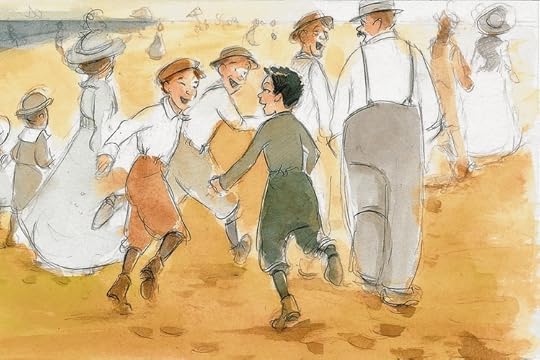
The book is a graphic novel, a description which only begins to describe what we look at - casually drawn pencil and water colour illustrations in soft pastels redolent of the era. The figures are what I would describe as animated, almost caricatured, with young Buster plausibly Keatonish and the other real life figures equally so; notably Joe Keaton, Big Joe Roberts and Harry Houdini, the escapologist who christened Joseph Keaton Junior, ‘Buster’.
For three summers in young Henry Harrison’s life, Buster Keaton, already famous as the star of the family act ‘The Three Keatons’, comes to Bluffton with the holidaying vaudevillians. Henry and Buster spend their time playing baseball (Keaton was a fanatic, later pausing his film shoots for impromptu games), and did things young teenagers did in the endless summers before World War One.
The story is as much Henry’s as Buster’s; in fact Buster is kept at a distance, which works by enhancing his mythical aura. The author, Matt Phelan, is respectful of the Keaton story, all the details are correct: the restless energy, athletic prowess and gymnastic skill, plus his mechanical, inventive bent and his essential diffidence. My only wish is that Phelan might have invested his invented Buster with a bit more personality, drawn more from his films perhaps.
The practical details, with which I am familiar, are also presented: the efforts of the Gerry Society to have Buster attend school; the one and only day in his life Buster actually attends; the attempts of others to prove Buster was being abused (‘The Three Keatons’ was a roughhouse act featuring Joe throwing his son across the stage – Buster maintained he was never hurt); Joe Keaton’s alcoholism (an affliction which affected Buster himself for decades as an adult) and the appearance of family friend Harry Houdini.
There was one subtle touch I admired greatly, a nod to the opening scenes of Keaton’s greatest masterpiece The General (he made several, including The Navigator, Steamboat Bill Junior, and The Cameraman). At the opening of The General, Buster walks along the street to the home of his sweetheart (Mary Mack), and Matt Phelan has young Henry Harrison walking along the street to the home of his sweetheart, Sally. Like Mary Mack, Sally is not easily impressed, but is ultimately won over when Henry shows his inner worth, as Mary Mack was won over by Buster’s quiet heroics.
Bluffton is a sweet story, a few seasons in the lives of young Henry and Buster. And if the lovely book wins new fans for ‘The Great Stone Face’ (which he never was), then all the better.
I actually forgot this was about Buster Keaton until I was pretty far into the book (the subtitle's not on the cover - just the title page). Which, I think, worked to the books advantage.
It's a relatively chill story about a kid growing up in Michigan, who meets a bunch of vaudeville performers taking their break at a retreat center on the (great) lake. There are some darker themes, but most of it is pretty relaxed. Or, at least, I relaxed after I realized the impetus for the story.
Beautiful illustrations, as per norm for Phelan. Although his speech bubbles stick out like a sore thumb in a bad way - need to start integrating them better, dude!
I did not know that Buster Keaton vacationed in my neighboring town as a kid. Check out the full review of the book with photos of Bookends' trip to Bluffton to walk in Keaton's footsteps. Phelan's graphic novel is the perfect vehicle for this story of summers on the Lake Michigan shoreline in the early 1900s. http://bookends.booklistonline.com/20...
One Sentence Review: A mildly melancholy but never depressing look at a famous figure in his youth, set in a time and place so realistic it should be required reading for those kids studying American history.
Such an enjoyable story! It's summer, 1909 in Muskegon, MI, and Harry is lonely and bored, helping out at his father's hardware store and wondering how to fill his days until school starts again. He also seems lonely. Then the train arrives and off it comes. An elephant! Lots of lively noisy people! A zebra! And a boy about his age who leapt, tumbled, twisted and fell off the train, just full of energy and making moves unlike anything Harry had ever seen. An adult from the train yells 'Buster', all hustle off to the trolley that serves Muskegon Lake commnities, and Harry discovers all, including the elephant, zebra and boy, are heading to the last trolley stop: Bluffton, on the lake and next to the state park. Harry has just met the vaudeville troupe headed by the Keaton Family, summering in Bluffton while the NYC vaudeville theaters were closed during the sweltering summer heat.
This beautifuly drawn and written story is based on truth: Buster Keaton and his family and the vaudvilleans they performed with, summered in Bluffton until about 1938. The story covers about 3 full summers of Harry's friendship with Buster and the vaudvilleans, his envy of their life which he sees as so rich and desirable, his efforts to juggle, and in general growing up. The author is the artist and he uses a soft watercolour palette and tone to his art, a nice change from the black/white/grays that seem prevalent in the few other graphic novels I have read. The mood of the long slow summers as they appear to a young boy, the feeling of early 20th Century beach community, even the sense of emptiness and waiting throughout the rest of Harry's year, are well portrayed.
I've already added Phelan's other middle-grade books to my TBR.
I want to mention something, very emblematic of the sychronicity that sometimes happens when reading. This book revolves in part around a vaudville troop which summers outside the cities where they perform (this was before A/C remember) in a lakeside community - essentially taking over some section of it. In Notes on a Cowardly Lion: The Biography of Bert Lahr, With a New Preface by the Author, which is as much a history of comic theater, including vaudeville, as it is a biography, Bert Lahr and his first wife spend summers in a similar town on a lake in New Jersey. It was rather wonderful to encounter it yet again.
Beautiful drawings. Ok story. Not so captivating but calm to read. I can see why my 9 year old students can't get too interested in it without my prompting.
This graphic novel explores the early 20th century era of Vaudeville, and one particular summer resort that catered to many of the era’s Vaudeville stars – including the Keaton family and their talented son, Buster.
It’s 1908 and Henry Harrison, whose father owns the local hardware store, is excited to learn that a troupe of vaudevillians will be taking over a resort near Muskegon, Michigan. Young Henry makes his way there to see the elephant and zebra and tightrope walker! And he meets a couple of teens who join him for a summer of baseball games and swimming in the lake. One of these is Buster Keaton, and Henry begins to dream of following in his footsteps.
What a great way to introduce young readers to a by-gone era. Phelan’s illustrations are marvelously detailed. I love one set of panels that show the day slowly progressing through sunset over the lake and followed by a night sky illuminated by fireworks. And I like how he adroitly shows the passage of time with just a few panels moving from the end of summer through fall, winter and spring and then to the next summer’s adventures when the vaudevillians return.
While the characters of Harry, Sally and the other residents of Muskegon are fictional, there really was an Actor’s Colony at Bluffton on Muskegon Lake from 1908 to 1938. It was founded by Jim Keaton as a place where vaudevillians could gather and rest in their off-season.
This interesting and unusual graphic novel intertwines the lives of a fictional boy and the young Buster Keaton.
Welcome to Muskegon, Michigan, where every year, the "circus" comes to town and stays for the whole summer. Henry, a local boy, is enchanted by the performing vaudevillians, and the star of the show - a strange boy who seems to be made of rubber. The two boys bond over swimming, pranks, and games of baseball.
The book is frequently wordless, and the author's artwork is very pastel and dreamy - most evocative of a languid summer afternoon.
Perhaps too languid for children; I imagine many would be bored by the story. I was reminded of one of Ray Bradbury's short stories about boys who have magical experiences.
This was a lovely, gentle graphic novel about 1908 Bluffton, a community for vaudeville performers in Muskegon, Michigan. I enjoyed the use of Henry, a fictional character and Muskegonite, as narrator because he revealed an outsider's perspective on Buster Keaton and his vaudeville friends. I could see this appealing to some students and possibly even inspiring them to watch some Buster Keaton films. This is also a nice book for visual literacy discussions as many panels feature only images to progress the story.
With Buster Keaton at center stage through the eyes of a boy, this is a satisfying but not demanding book. The visual delivery of the story seems to have an understated quality to it - think Keaton's expression but less deadpan - Phelan's watercolors carry the story along. The high points of the narrative are when Keaton engineers some prank. This is all very satisfying for a Keaton fan who also likes Lake Michigan' coastal environment.
A delightful, engaging story beginning 1908 about vaudevillians who come to a Michigan resort town to relax for the summer, including a young Buster Keaton who is honing his craft.
How interesting! My son has been loving graphic novels but it is difficult to find ones that aren't full of violence or other questionable themes. When I stumbled across Bluffton, I was drawn to Phelan's illustrations and that there appeared to actually be literary substance in the book. I thought that my son would resonate with the story of the young boy, summer fun, and of course all of the pranks. Also, given how much he enjoyed Lions in the Barn, I thought it would be a hit. My favorite part in this coming of age tale is when Henry is sitting down with his father and remarks that he doesn't want to take over the family business, to which his father responds, "Don't worry so much about what you are going to do, Henry. Concentrate on who you are going to be." (Emphasis mine).
I didn't realize is that this book is based upon the true story of Buster Keaton! Now we'll have to see if we can hunt down a copy of The General as a fun follow-up to the book.
Interesting that the subtitle is NOT on the cover. The surprise happens early in the book and I'm glad the cover wasn't a spoiler. Goodreads actually had the wrong subtitle, including the last name so I got in and changed it.
I enjoyed the read--worth the time. Phelan's watercolor on drawings style is always enjoyable for me. The building bromance was an engaging character arc, along with the conflicts it brought and the constant tension of keeping the idol just out of reach while being right in front of him. Easily as enjoyable as watching tv or a movie.
I thought the ending just dropped a lot of what he built. I don't appreciate that. I was especially disappointed that Sally didn't develop further--he just started an arc for her in the last part of the book--and that her endpoint was being married to dude.
Graphic design of the speech bubbles was the big disappointment. Bela discussed this with me at length. Easy to see pixelation distracted from Phelan's style by screaming COMPUTER in every panel. The font felt like a throwaway decision, also looking computery, and certainly made no nods to Vaudeville or the early 1900s. Missed opportunity. If I get a chance to talk to Matt Phelan I will ask him a lot of questions about his editor and production team.
I feel like this is the absolute perfect example of someone being passionate about a topic, creating a nice work of art about it, and it being entirely un-entertaining. This is just so... marvelously bland, and the soft watercolors do nothing to break this or create any excitement about the topic. I feel like, almost literally, if you aren't interested in Buster Keaton, you're not going to care about this. And also it's not going to even *make* you interested if you aren't. Yeesh.
Matt Phelan has done an amazing job in his graphic novel of famous vaudeville actor Buster Keaton. Although his character, Henry Harrison, is a fictional boy, the vaudevillians summering in Bluffton, Michigan, at The Actors’ Colony was not. Henry meets the performers the summer of 1908 and although he is impressed with Buster, he realizes that Buster and another performer, Lex, have more similiarities than differences. Henry would like Buster to teach him some of his tricks but Buster is more interested in everyday summer activities like baseball. Phelan uses soft watercolors to depict the frames, but the facial details of the characters draw you into the undercurrent themes of the novel. Henry is awe struck with the vaudevillians yet his father and friend, Sally, are not. There responses to his gushing’s of stardom seem sad, and the fact that the Gerry Society has been following the Keaton family because of Buster’s age leads the reader to believe all is not as it seems. Buster’s life has been hard, moving from city to city, hotel to hotel, in a dangerous profession which has the potential to seriously hurt him. We learn that Buster only attended school for one day. As the story progresses, clues are given that Buster is not as enamored with show business as Henry might think such as Buster telling Lex and Henry that “if anybody asked me, I’d tell them I wanted to be a civil engineer some day” (142). By the end of three summers, Henry has grown in maturity and even had the courage to talk to his father about not wanting to run the hardware store someday. This graphic novel is a poignant view of two boys wishing to be in the others shoes. Bluffton was the winner of the Jefferson Cup, and also the Wil Eisner Comic Industry Awards Nominee for Best Publication for Teens (ages 13-17), Best Graphic Album – New, and Best Writer/Artist (2014). I would recommend this book to the reluctant reader and anyone interested in graphic novels. Target audience: 4th-8th.
This isn't a novel that you read. This is a novel that you stand in front of, and then "you think, you wink and you do a double blink." Yes, it IS that magical. As you turn the pages, you are surrounded by soft images of a time when Buster was young, summers were long and a baseball game was just a bunch of kids in the park having fun.
I have had the great good fortune to visit Muskegon on a yearly basis since 1997, as part of the International Buster Keaton Society's annual Convention. We have a wonderful time; many of us even gather on Buster's ballfield (as of November 2014, in serious jeopardy; do a Google to see how you can help) for a game.
Phelan captures the beauty of a child's summer - when you disappeared in the morning and didn't come home until suppertime, tired and sunburnt and smelling of the lake.
There are so many things to love about this book. The colours, the story, the images that rest in your soul. There are funny moments, but many are bittersweet. Buster is a star, and is deeply envied by the protagonist of the story, Henry. But Henry has a quiet, loving life and Buster sometimes wishes for that, it would seem. There's a lot of the grass looking greener in other places for these two. There's a longing for childhood, for meaning, and for life to be special. Matt Phelan comes closer to what makes Buster so precious to those of us who love him than just about anyone else I've ever read.
Henry is in awe when he sees a group of vaudeville performers, including an elephant and a zebra, pass through his town of Muskegon, Michigan one summer. The year is 1908 and the performers are staying in nearby Bluffton as a vacation from the exciting vaudeville circuit. Henry becomes friends with some of the kids in the group, including the famous comic actor Buster Keaton. Henry wishes he could have a wild and interesting life like Buster, instead of going to school and helping in his father's store like he does. Buster, however, just seems to want to relax and play baseball. Over the summers they knew each other, Henry gets a unique perspective into the fascinating life of someone very different from him.
This book is very well done, and I'm amazed at how much can be conveyed even in the panels without words. It's a bit of a slow and sometimes quiet story, maybe a bit like summer itself. This might not be the book for someone who likes non-stop action, but the premise of meeting a young celebrity in your own hometown is an enticing one.
I would recommend this book to grades 3-7, especially those who enjoy historical fiction and more realistic graphic novels. I've also read Matt Phelan's Around the World, and I think that would be a good readalike for this.
I really enjoy Matt Phelan's books. I think they are wonderful slices of life. I appreciate the minimal text and lovely illustrations. Bluffton is the story of Henry and his summers spent with Buster Keaton. It seems Keaton and other vaudeville acts summer at Bluffton and fictional Henry was able to get to know them a bit. Henry wasn't happy working in his dad's store and really wanted to do more with his life. Unfortunately, Buster never shows him any tricks and just wants to hang out and play baseball. The book takes place over several years as Buster and family returns to Bluffton each summer. While I enjoyed this book, I am not sure it will find a wide audience with kids. I would guess very few kids have heard of or know of Buster Keaton or even vaudeville. Also, they might not be interested in a book that really doesn't have a lot to say or a very exciting story. This is a sleepy little book that is a fast read and great for fans of Phelan. But we don't really learn a whole lot about the historical characters and I am not sure we learn enough about Henry to really care that much. Beautiful as always with a Matt Phelan book, but limited appeal.
I was not a fan of this graphic novel and I knew it just a few pages in. The art was not my favorite, it felt very unfinished, like they were sketches or rough drafts, not actually the finished product. The main character, Henry is such a whiny brat, "Oh why can't my dad beat me for laughs like Buster's dad does?" WAH. Basically what you would expect to hear from someone who's entitled, and clueless. Also, I know the story starts out in 1908, but the book was written in 2013, and the term "negro" while commonly used back then (1908) didn't need to be used in this book. The character it refers to only ever appears twice, and the second time he appears they just use his name instead of mentioning his race. It just wasn't necessary and I think kids reading this book wouldn't have thought it made it any less authentic if that word hadn't been used. The only thing I actually liked about this book was the portrayal of young Buster Keaton, but even that wasn't as in depth as it could have been. The story was superficial and mostly about Henry who's a fictional character that no one cares about. Basically, just don't waste your time with this book. PASS.
Not a lot seems to happen in Henry's Muskegon, Michigan, hometown. But the summer of 1908 is different. Once a troupe of vaudeville performers arrive to vacation for the summer in Bluffton, a nearby neighborhood, Henry spends every free moment getting to know the animals and hanging out with the boys, one of whom is Buster Keaton, known for his "ability to take a fall better than anyone alive (p. 35) with a deadpan expression, his pranks, and his engineering feats. While Henry longs to learn some tricks of his own, even how to juggle, Buster seems disinterested in his own accomplishments. There's a dark side to the seemingly playful life Buster leads, as Henry's friend Sally quickly recognizes. Once again, in appealing graphic novel form, Matt Phelan pays tribute to a slice of Americana while also exploring family dynamics and the ways in which we may betray our friends. For me, the best part of this book involved the interaction between Henry and his father. It turns out that Henry has underestimated the man.
Bluffton is the story of Henry, a young boy, growing up near Bluffton, Minnesota during the early years of the 20th Century. Every year a group of Vaudeville performers would spend the summer there. Henry befriends the children of the performers, including a young Buster Keaton.
Buster's father, Joe, is hounded for including his children in his act, and it's a constant sore point. Buster is a quiet, reflective child who just wants to play baseball. Henry is enamored with the showbiz life and yearns for his summers with the vaudeville folk. The time between seasons is shown in a series of quick panels.
The story is told mainly with pictures, and not much dialogue. It's a fictional story, except that Joe Keaton did bring vaudeville folks to Bluffton every summer. Also, Buster did love to play baseball, and even played while making his movies. It's a nice coming of age story and the watercolor illustrations work well. My review copy came with black and white illustrations, and I think I may have preferred that for this story.
I confess that as I proud Michigander I'm a little more than just excited about this book because it does such a lovely job of evoking the joy and seemingly endless days of sun and fun that summers on Lake Michigan and environs can be like as a child. The historical factoids and atmosphere just enhance story. The artwork is gorgeous, and highly detailed. I am not always a fan of completely wordless books, but this book does a wonderful job of using the wordless sections to express passage of time, ambiance and quiet focus. The text is spare but moves the story along at a quick pace. The reader feels for both Henry and Buster both looking for their own way in the world. Like any well done historical work I'm excited by the story and want to go read more about Buster Keaton's biography and watch some of his movies. And of course go see what's left of Bluffton the next time I visit Lake Michigan!
I had started then stopped this book. Why? It simply didn't hold my interest and the illustrations were, at best, bland. So I decided to go back and read it with an open mind. This is about a young boy who grows up and one of his companions is Buster Keaton. Buster Keaton was a real person, with a facinating horrible life. This book however simply touches on the fact that he came to a town and was the companion of the young man. They are not friends. The young man is jealous of him, they played baseball together but that's about the depth of their relationship. I did research on Buster Keaton afterwards. And found out what a influential but tragic life he had. The book drops facts about who he was but glosses over the abuses that he suffered. Usually when a book prompts me to do research on a person I enjoy it; this time I did not.
A graphic historical fiction novel that narrates a young boy's summers in the company of young Buster Keaton and the vaudeville troupe he was part of. I felt as intrigued as young Henry, the story's main character, about the vaudevillians, and was moved by both boys' coming-of-age, discovering how each of them found their place and path in life. I appreciated the beautiful pencil and watercolor illustrations and the scarcity of text and wasn't surprised that the book was named one of the best books of 2013. A gem of a book for fans of historical fiction as well as for those wanting to get a first taste of this genre. One of my favorite quotes from the book: Henry's dad's advice for his son: "Don't worry so much about what you are going to do, Henry. Concentrate on who you are going to be."