Set in a bombed-out cityscape, Jeff Jackson’s haunting new novella Novi Sad follows a group of friends who take up residence in an abandoned hotel as they await the end of the world.
This melancholic dream story is filled with mysterious disappearances, floating corpses and decaying memories. Though a standalone work, Novi Sad is also a sister book to Jeff Jackson’s acclaimed novel Mira Corpora.
"In a time when it’s hard to say if the apocalypse is happening or still to come, Jeff Jackson gives us a tale that blurs the lines between our many possible fates. Novi Sad forces us to examine the consequences of adults who’ve run the world like children and in their folly left the world to children made to live in the rags of dignity they’ve stripped from the corpses about them. At once magisterial and decrepit, heartening and glum, this book will make you consider the power of our shadows, and of their dangers, too. The places of our imaginations, Jackson reminds us, are often so much more than real." - D. Foy, author of Made to Break and Patricide
100 page book, paperback, illustrated by artist Michael Salerno. Printed on blue paper.
Limited edition only available directly from the publisher: http://kiddiepunk.com/novi_sad.htm
Jeff Jackson's "Destroy All Monsters" was published by Farrar, Straus & Giroux in Fall 2018. Like a vinyl single, it has a Side A and Side B which can be read in any order. It received advanced praise from Don DeLillo, Ben Marcus, Janet Fitch, Dana Spiota, Laura van den Berg, and Dennis Cooper, plus rave reviews in The New York Times, Washington Post, LA Times, NPR, and more. It was Largehearted Boy's "Best Novel of 2018."
His first novel "Mira Corpora" was a Finalist for the LA Times Book Prize. It was praised by Dennis Cooper, Eimear McBride, and David Gates. It was selected one of the Best Books of 2013 in Slate, Salon, and The New Statesman. His limited edition novella "Novi Sad" was picked by Vice as one of the best books of 2016.
As a playwright, six of his plays have been produced by the Obie Award-winning Collapsable Giraffe company. "Botanica" was selected by New York Times as "one of the most galvanizing theater experiences of 2012." His adaptation of the Chinese novel "The Dream of the Red Chamber" - a performance for a sleeping audience" debuted in Times Square in 2014. "Vine of the Dead," an art ritual that attempted to contact the spirits of ancestors, premiered in 2016.
Memories eclipse as lost holograms in the glimmer of a sentimental mind. Bodies are dredged at the docks, barnacled and solitary. Horrifically, some are familiar. Defeat and rot multiply and share the decayed ruins with living flickers of staunch survival in a one-way battle of ghosts. The lost and the fleeting are accentuated by artistic flashes of dispossessed pride and a flurry of costumed personalities brightened by accoutrements. In a brief snapshot, I remember them all.
I wrote this, so grain of salt etc. But if you enjoy dark fiction and/or my first novel Mira Corpora, there's a good chance you'll like this short novella, which is a sort of "sister" book. It's also accompanied by stunning artwork and printed on blue paper - and a fairly limited edition.
Update: Picked as one of the "Best Books of 2016" in Vice, Entropy, Lit-Reactor, and Vol. 1 Brooklyn. And by Blake Butler and Dennis Cooper.
Novi Sad is both more surreal and more straightforward than Mira Corpora, following a group of kids who gather in an abandoned hotel in a bombed-out city to wait for the end of the world.
Here's what The Nervous Breakdown wrote: "There’s been a handful of books that exemplify what post-apocalyptic fiction can achieve in terms of serving as mirrors for human nature when faced with Armageddon: Earth Abides by George R. Stewart, The Road by Cormac McCarthy, Swan Song by Robert R. McCammon, Blindness by José Saramago, and Alas Babylon by Pat Frank. Now Jeff Jackson has joined this elite group with Novi Sad, a narrative that is as profound and smart as any of the aforementioned classics but somehow manages to deliver the same punch in less than 100 pages."
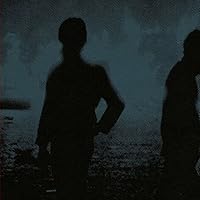
Here's what Electric Literature had to say about it: "Jackson is showing us the Future of Now. He is gazing, as Ballard did, five minutes into the future to show us a world where the news grows increasingly bizarre with each passing day. The entire book is brilliantly illustrated by artist Michael Salerno. The images are hauntingly beautiful — decaying buildings, teenagers with their eyes scratched out. Packaged together, this book acts as a sort of found object that is so cohesive and singular that at times it almost appears to be breathing.
"Novi Sad is a truly singular and profound experience. It firmly roots you in the familiar while simultaneously transporting you to a soft, light-blue dream space. Much like the work of David Lynch or even Harmony Korine, Jackson’s world is one that, despite all logic, you know must be true, not because it looks true, but because it feels true."
A beautifully written post-apocalyptic tale concerning a group of young teens who take shelter in an abandoned hotel amid the desolate ruins of a nameless city. Very vivid, and as others here have mentioned, there's a dreamlike quality even though it never strays into surrealism or dream logic. The kids are just trying to survive as they await total nuclear annihilation. I hesitate to say much more considering this is a short tale that can be read in one or two sittings. Despite its brevity, my $25 or so was well spent. As an aside, I found it strange that the book came with a handful of b & w photos each featuring shirtless young boys. Nothing wrong with the pictures at all (they're tasteful), but I still would have felt extremely awkward had my sister, who was visiting with my niece when I opened the package, seen those pictures. Or customs, for that matter. Not sure of their significance.
Memory realigned to unfold within its appropriate metaphysical context. Here, a blasted city in the midst of a process of ending without end. Despite this, the tethers of memory give this a sense of being more actual than surreal. The space the characters carve out for themselves, physical and narrative, is perfect -- spectral and isolated as the damaged photos of people once known and war-ravaged buildings that appear at intervals throughout these pale blue pages. A quick, probably one-sitting read, but one that burns brightly in the memory, as the images here must continue to smolder in the memory of the author.
Incidentally, I ordered this twice, once losing it to an old address with no one there to accept it or let me know. I'd like to think that it came into someone's unexpecting hands there, but perhaps it's most apt if it remains in some dusty abandoned courtyard to this day, which might also be an appropriate metaphysical context for encountering this.
This novella, a companion piece of sorts to Jeff Jackson's superb 2013 novel Mira Corpora (though it can hold its own as a stand-alone work), is set in the desolate remains of a bombed-out city, and revolves around a group of young friends who take shelter in an abandoned hotel, where, amidst compact and finely written scenes of urban collapse and apocalyptic imagery, they make a new ramshackle life for themselves while awaiting the end of the world. The narrative deals with the eventual disintegration of this group and how this disintegration affects the narrator (here named "Jeff"). Like all of the books and products released by Kiddiepunk, the presentation here is impeccable, with quite haunting artwork and design by Michael Salerno that compliments the text itself. The decision to have the book printed on blue paper was a nice touch, and further enhances the melancholic feel of the novella, giving one the impression that the words themselves were unable to bear the collective grief of the unfolding narrative, and that this grief flowed from the words onto the very pages, staining them with an azure agony. Highly recommended, grab it while you can.
I read "Novi Sad" on the bus where my destination was at the barber for my haircut, and I didn't want to go home till I finished the book - so I ended up in a local bar to read the entire novella. It's a very moving book regarding the subject matter of imminent death, the loss of an important person in one's community, and the presence of the world that is not going to get better. A gang of young people, who are barely existing, are located in an abandoned hotel waiting for their 'leader' of sorts. They go through an abandoned and destroyed city to find the lost one. Not to give away the details of the plot, but it is very much a haunted work I think dealing with sadness and the acknowledgment of one who has passed on to the other side.
One of the characters in this short narrative is named "Blue," and the pages in this book are on light blue paper. I was reading it in a dark bar, and the blue is a nice bath for the eyes, but also in tuned with the character "Blue," as well as the story being sort of a version of the blues. It's a beautifully designed artbook by Michael Salerno and published with great love by Kiddiepunk, who works by the way, with Dennis Cooper. The images or artwork fits in greatly with the narrative. A really nice package. A great read. Now, it must be yours.
From the moment I laid my eyes upon the soft blue pages I could feel a connection forming in my mind. All the lines, the imagery threaded together by memory made these people, this story timeless and RAW. My mind started to switch channels tracing lines between Mira Corpora in unseen photographs, faces just out of focus. This story seems very close to Jackson's heart and as such I found myself trying to slow it all down, underlining line after line in various colors, notations marked in multi hued stars.
"A crescent moon sharp as a scythe shines down on the streets around us. The wires overhead link nothing, a forgotten geometry of the sky. The only beings stirring are two Great Danes who silently follow us, their large patient faces trying to puzzle out our midnight expedition."
THIS. IS. NOT. A. STORY. ANYONE. CAN. SPOIL.
Those of you who read it will understand when you turn that "last" page to that final lingering image of post demolition.
I want to read it again and again, seeing more in those black squares every time.
Man, Jeff Jackson blows me away with admiration and respect for his courage to flesh out these lingering memories. It's what I needed and it inspires me to dig deeper into deciphering the images I subconsciously decided long ago to blur out of focus.
Sort of like the ghost of Mira Corpora. Shades of L'amour fou, Silent Hill 2, Salto, The Amber Spyglass, The Atrocity Exhibition, Cosmos, Deconstructionist, M Kitchell, and Alain Robbe-Grillet.
Novi Sad is the story of a group of wasted youths holed up in an abandoned hotel as they await the end of the world and/or their inevitable squabbling and dissolution, whichever comes sooner. The apocalypse they live through is one that seems familiar through contemporary TV news reports and political grandstanding, although its cause remains tantalisingly unspecified. We find our gang of outcast antiheroes, led by the narrator Jeff, meeting these end times with a dazed acceptance and just getting their kicks where they can, be it via piles of pills or stacks of lovingly compiled mixtapes. These 100 blue pages rattle by thanks to Jackson’s evocative, cinematic style, and the artist/designer Michael Salerno’s Kiddiepunk press have produced yet another lush object here.
A vision of community amidst decrepitude that probably seemed a grim fantasy when conceived by Jackson, but now looms as a possible future for us all. A companion piece of a sort to his previous novel, MIRA CORPORA, this slim volume emanates a heavy end-of-the-world vibe, wherein the day's big activity is walking down to the docks to see suicides being dragged to shore by the harbor patrol. Somehow, though, Jackson presents it all with a lightness of tone that allows some beauty to shine through. The art that's used throughout only adds to the experience.
A warning shot, a moving elegy, an ode to fallen friendships -- there's a lot to find here.
Loved everything about this. The blue paper, the artwork, the layout, the sparse present tense narrative, the haunting atmosphere, the way the narrative jumps between the 3 acts, how so much character, setting, key events is conveyed with so little. A perfect book. Glad I checked the Kiddiepunk website again last week - I thought this was long sold out.
This is an amazing book. Here's the blurb I wrote for it: "In a time when it’s hard to say if the apocalypse is happening or still to come, Jeff Jackson gives us a tale that blurs the lines between our many possible fates. NOVI SAD forces us to examine the consequences of adults who’ve run the world like children and in their folly left the world to children made to live in the rags of dignity they’ve stripped from the corpses about them. At once magisterial and decrepit, heartening and glum, this book will make you consider the power of our shadows, and of their dangers, too. The places of our imaginations, Jackson reminds us, are often so much more than real."
An exceptional book. It reads like a dream. Last month I read the companion novel to this, Mira Corpora. Loved that. Love this. For fans of the world falling apart and landing right in your outstretched hands.
Jeff Jackson's new novella, Novi Sad (Kiddiepunk), imagines a city on the brink of the apocalypse. We are never told what happened to Novi Sad, only that it has been reduced to rubble.
"The news grows increasingly bizarre. There are reports of two-headed babies born en masse. Photographs of world leaders hunched in dimly lit underground bunkers. Videos of bankers perched on window ledges, sucking on thousand-dollar bills."
In this blighted landscape six feral teenagers fight for safety and survival while navigating self-destructive urges.
"You can't depend on people for much, but you can always count on them to leave."
The novella serves as a distant cousin to Jackson's previous book, Mira Corpora (Two Dollar Radio), which also features a group of children on the run from murderous adults, but doesn't depend on it to be enjoyed—if that's the right word for a book so pervasively bleak.
Michael Salerno's photos—depicting destroyed buildings and haunting portraits of gaunt children—illustrate Novi Sad. Both the images and the text are printed on blue paper, which contributes to the gloomy mood of the novel, particularly during the scenes when the children assemble on the dock each morning awaiting the boat that collects the bodies of those who have committed suicide.
In a slim book printed on blue paper, six friends squat in the midst of a mostly destroyed city in a blue hotel, one of them a girl named Blue who's in love with the group's charismatic leader, Hank, a character who I imagine looking like Henry Rollins. Through dreamlike sequences of decay and destruction, they wait in wigs and black lipstick and silver toenail polish for the world to end, and then the world ends, and then the ending of the world ends, and friendships and lives and loves and hopes end, and the book ends ... only the narrator goes on living in my head, someone who's invulnerable because unlike the others, he lives as an observer, erasing his own feelings and identity in the act of perpetual watching ...
Stunning. The idea that the end of the world could be quiet is powerful, especially as a metaphor for that magic last summer where kids come together in a pack just before leaving to find their own way in the world because of puberty or college, etc. Echoes here of the best parts of Delany's Dahlgren and Burroughs' Wild Boys. A much more interesting and erotically charged version of Ransom Riggs' novel-as-photo-gallery idea. HIGHLY recommended.
I suppose I'm not a fan of short stories because I'm always wistful for more. I found myself not caring so much about the loss of the characters because I felt no connection to them.