The day was so warm, so fair, so magically a thing of sunshine and blue skies and bird-song that anyone acquainted with Clarence, ninth Earl of Emsworth, and aware of his liking for fine weather, would have pictured him going about the place on this summer morning with a beaming smile and an uplifted heart.
Right here is probably the best quote that explains the allure of Wodehouse, his almost guaranteed uplifting effect on the spirits of even the weariest reader, the iddylic setting that made Evelyn Waugh comment: “The gardens of Blandings Castle are that original garden from which we are all exiled.”
This is not my first visit here, and no matter how ironic is the author’s introduction to this new volume, I do hope I will find the time to read the rest of the Saga. If there is a cure, I don’t wanna know about it.
Except for the tendency to write articles about the Modern Girl and allow his side-whiskers to grow, there is nothing an author to-day has to guard himself against more carefully than the Saga habit. The least slackening of vigilance and the thing has gripped him. He writes a story. Another story dealing with the same characters occurs to him, and he writes that. He feels that just one more won’t hurt him, and he writes a third. And before he knows where he is, he is down with a Saga, and no cure in sight.
Before we begin, let’s note that here we have two separate collections of short stories instead of a single novel. I prefer the longer form myself, but until I get my hands on one, these short forays will do. Wodehouse is once more spot on in the intro:
The stories in the first part of the book represent what I may term the short snort in between the solid orgies. From time to time I would feel the Blandings Castle craving creeping over me, but I had the manhood to content myself with a small dose.
So, let the summer sunshine in and begin the lecture!
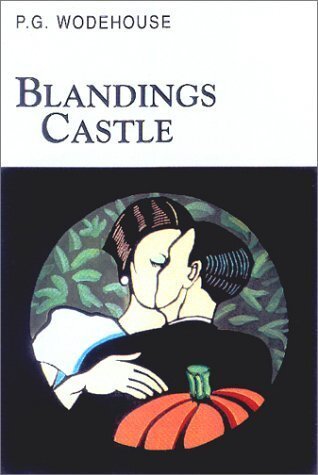
The Custody of the Pumpkin is a fine piece of history to re-familiarize the reader with the main actors and with the usual plot of love triumphing over adversity. We will not meet The Empress of Blandings yet, because the pride of the garden for now is a prize pumpkin.
The ninth Earl of Emsworth was a fluffy-minded and amiable old gentleman with a fondness for new toys.
The toy in question is a telescope that the Lord uses to survey his domain from a tower of his castle. Unfortunately, the instrument also reveals his son, the Hon. Freddie Threepwood kissing a girl in a distant meadow. Further inquiries reveal she is the niece of the head gardener, Angus McAllister, that guy with the heavy accent and inflated sense of his own importance. The ensuing row and the hasty departure of the Scotsman to London puts in grave danger the future growth of the pumpkin. What is Lord Emsworth to do?
Lord Emsworth Acts for the Best is a sequel of sorts to the first story, in that it continues with the romance of Freddie and his new American wife. Back in London to sell a Hollywood script, Freddie is in trouble from his jealous consort and appeals to his father for help. The good-intentioned but clueless Lord Emsworth gets attacked by a savage Pekinese dog, but is more scared to recognize himself in the features of his good-for-nothing son. All’s well that ends well!
Pig-hoo-o-o-o-ey! marks the return on the premises of the Empress of Blandings, with the chorus of worries about her prospects for winning the annual Shropshire Agricultural Festival. When her main handler is sent to prison for drunk and disorderly behaviour, the Lord and his friends must learn how Americans call the pigs to feed in Kentucky, helping a couple of young people in love as a bonus.
She resembled a captive balloon with ears and a tail, and was as nearly circular as a pig can be without bursting.
Company for Gertrude is less about pigs and more about the Modern Girl, with Lord Emsworth harassed by a niece sent down to the Castle to recover from an unlucky Love affair.
The family seem to look on the place as a sort of Bastille. Whenever the young of the species make a floater like falling in love with the wrong man, they are always shot off to Blandings to recover. [...] One of the chief drawbacks to entertaining in your home a girl who has been crossed in love is that she is extremely apt to go about the place doing good. All that life holds for her now is the opportunity of being kind to others, and she intends to be kind if it chokes them.
The cure is sometimes more painful than the illness, especially when the solution comes from the Hon. Freddie Threepwood, who sends down Beefy Bingham. Bingham, who is in love with Gertrude, comes disguised as Mr Popjoy and tries to be helpful, but mostly convinces the Lord that he is as crazy as a bat. Hijinks follow!
The Go-Getter continues with the same cast of characters as the previous story, with the addition of a Crooning Tenor as a rival for Bingham in the graces of Gertrude and with more efforts from Freddie to sell his American brand of dog biscuits. Wodehouse underlines once again the theory that even the Modern Girl prefers a man of strength and determination over one singing about moonlight and nightingales.
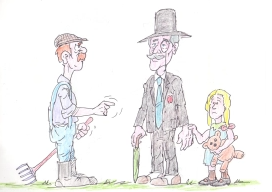
Lord Emsworth and the Girlfriend is my favorite piece in the first half of the collection (that’s where my opening quote comes from). A perfect summer day is ruined for Lord Emsworth by the insistence of his sister that he puts on formal clothes, including a top hat, and that he gives a speech in front of the neighbours gathered for the annual picnic at the Castle. In addition, Angus McAllister wants to put gravel on his yew alley. The Horror!
Clarence is saved by an unlikely young heroine, a Cockney girl named Gladys, who reminds him what are the most important things in life and helps him find the strength to confront both his sister and his head gardener. Excelent closing to the Blandings visit!
Now, lets go Elsewhere for a glimpse at the secret history of Hollywood. Much as I like Blandings Castle, I must confess that I loved the second half of the collection better and I couldn’t stop laughing as the unflappable Mr Mulliner entertained his bar room audience with outrageous tales from the dream factory.
Mr Potter Takes a Rest Cure is a transition piece form London to Hollywood by a way of a New York publicist, visiting England for a bit of ‘delightful old-world peace’. He finds himself instead pulled between Lady Wickam, his host with literary aspirations, and Clifford Gandle, a young man with political aspirations. Mr Potter’s sees a ray of hope entering the summer garden:
She was a boyish-looking girl, slim and graceful, and the read hair on her bare head glowed pleasingly in the sun.
Miss Roberta Wickam is though more similar to the snake in the grass than to a sunny angel, well capable of taking care of her own well-being and not adverse to a little lying and cheating to get her own way. The ensuing troubles put Mr Potter’s recovery in dire straits, but they are good for a laugh or three!
Monkey Business is my first encounter with Mr Mulliner as he tries to impress his pub audience with his insider knowledge of Hollywood.
Mr Mulliner smiled gently.
‘Strange,’he said, ‘how even in these orderly civilized days women still worship heroism in the male. Offer them wealth, brains, looks, amiability, skill at card-tricks or at playing the ukulele ... unless these are accompanied by physical courage they will turn away in scorn.’
This is a recurrent theme in the Wodehouse opus, but never before has Love been demonstrated with the help of a gorilla. Yet this is how the timid young man Montrose Mulliner is asked to demonstrate his devotion to his darling Rosalie Beamish, an aspiring actress. He tries to wiggle out of his predicament by claiming the higher moral ground, but the lady will have none of it:
‘Speaking for myself,’said Montrose, ‘there is nothing I should enjoy more than a quiet wedding in a gorilla’s cage. But has one the right to pander to the morbid taste of a sensation-avid public?
Wodehouse pokes great fun at the American media thirst for sensational headlines and cheap fame, but he reserves some arrows for producers, the press and even for fellow scriptwriters and novelists who claim to be highbrow.
‘I have a tender heart (said Mr Mulliner), and I dislike to dwell on the spectacle of a human being groaning under the iron heel of Fate. Such morbid gloating, I consider, is better left to the Russians.’
Give me a good comedy any day, and leave those Russians to the critics and angsty intellectuals. The more improbable the outcome, the harder the laughter.
The Nodder continues with the expose of the ridiculous Hollywood mentality, as another young man falls in love but is ignored because he has a low status. To illustrate this we go back to the Perfecto-Zizzbaum Motion Picture Corporation of Hollywood and to its president, Mr Schellenhamer, who steers his ship with an iron hand and with the help of certain specialized employees.
It is not easy to explain to the lay mind the extremely intricate ramifications of the personnel of a Hollywood motion-picture organization. Putting it as briefly as possible, a Nodder is something like a Yes-Man, only lower in the social scale.
Young Wilmot Mulliner is paid by the organization to nod at the wise words of its Leader, while his love interest, Miss Mabel Potter, is the private secretary of the President, Mr Schnellenhamer. So you can see why their love is not meant to be. Yet, the secret song of the cuckoo and a few other secrets of the company involving midgets might provide a solution.
The Juice of an Orange is a sequel to the love affair of Wilmot and Mabel, because even happy endings are not forever in Hollywood.
‘Many a girl has fallen into a man’s arms,’said Mr. Mulliner gravely, ‘only to wriggle out of them at a later date.’
Wilmot Mulliner may have had his moment of heroism, but soon enough his love starts comparing him to a “cold-asparagus-back-boned-worm” . It’s a cruel world out there, especially when you tell your boss that you will gladly take a cut in your salary. Few women would endure such spineless behaviour.
‘Don’t dream of cutting your salary, Chief,’ he urged. ‘You’re worth every cent of it. Besides, reflect. If you reduce your salary, it will cause alarm. People will go about saying that things must be in a bad way. It is your duty to the community to be a man and bite the bullet and, no matter how much it may irk you, to stick to your eight hundred thousand dollar a year like glue.’
It's hard not have a tinge of bitterness reading today this dialogue written in 1933 and seeing how little things have changed at the highest levels of management, but in the world of P G Wodehouse there is still hope for Wilmot, even if his first reaction is to fall into depression and into an eating disorder.
No man, however gifted his gastric juices, can go on indefinitely brooding over a lost love and sailing into the starchy foods simultaneously.
The cure recommended is the glass of orange juice from the title, but the effects are all out of proportion with the usually amiable Wilmot. Still funny as hell! Especially when Mr Schnellenhamer tries to find words that just miss him by a letter or two (aiming for sardonic by way of cynical, snickle, Sardinia, sardines and touching down on ‘sardinical’)
The Rise of Minna Nordstrom is focused on the same Perfecto Zizzbaum company, with a plot revolving around the problem of finding good servants in Hollywood and giving a party in the time of the Prohibition.
‘What,’ she demanded passionately at length, ‘is the matter with all you movie magnates? Have you no hearts? Have you no compassion? No sympathy? No understanding? Do the ambitions of the struggling mean nothing to you?’
‘No,’ replied Mr Schnellenhamer in answer to all five questions.
Nevermind, a woman of spirit and courage will always find a way to trick these damn movie moguls!
The Castaways is the last story of the book and I would call it Kafkaesque, if I could stop laughing for a minute or two. The absurdity of kidnapping strangers from the street and locking them up to work as script doctors may have something to do with Mr Wodehouse own experiences in Hollywood, and even more to do with Mr Mulliner’s tendency to twist facts in order to impress his fellow drinkers in the pub. Nevertheless, it has panache, and it has one of the most memorable love scenes never put on the silver screen (I think):
And, seeing her weeping there, Bullstrode could restrain himself no longer. Something snapped in him. It was his collar stud. His neck, normally a fifteen and a eight, had suddenly swelled under the pressure of uncontrollable emotion into a large seventeen. For an instant he stood gurgling wordlessly like a bull-pup choking over a chicken-bone: then, darting forward, he clasped her in his arms and began to murmur all those words of love which until now he had kept pent up in his heart.
I believe Hollywood is the poorer for not embracing Mr Wodehouse more fondly. His dialogue, his screwball plots and the timing of his jokes are some of the best in the genre.
As for me, I will continue with the Sagas, both Blandings and Jeeves, and hopefully I will even meet mt Mulliner again over a hot ‘Scotch and lemon’.