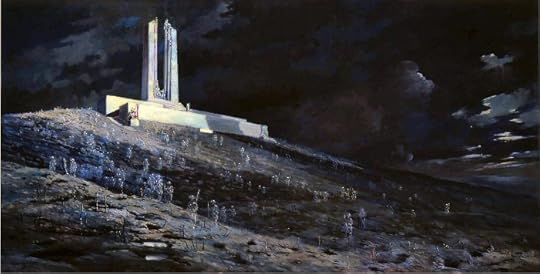
While the world was still reeling from the staggering losses incurred in the First World War, an unknown Canadian sculptor was raising a colossal monument in France, where more than sixty-six thousand of his countrymen had fought and died. The Vimy Ridge Memorial still stands as a stark reminder of the Canadians who gave their lives in France—and as a testament to the vision and single-minded obsession of its now-forgotten architect, Walter Allward.
It is against the backdrop of this incredible achievement that Jane Urquhart sets her intricately woven new novel. At the center of the story is Klara Becker, the granddaughter of a master woodcarver, who spends her childhood in a German-settled community in southwestern Ontario in the years leading up to the Great War. It is a childhood punctuated by tremendous losses: her mother dies of cancer when she is a teenager; her older brother, in love with wandering, eventually leaves the family; and her brief but passionate love affair with Eamon O’Sullivan is cut short when he volunteers for action and never returns. But Klara’s inherited gift for carving eventually reunites her with her brother and gives her purpose as she works on the memorial that will make her whole again.
The Stone Carvers is vintage Jane Urquhart, writing at the height of her powers.
Jane Urquhart (June 21, 1949 - ) is a Canadian novelist and poet.
She is the author of seven internationally acclaimed novels entitled, The Whirlpool, Changing Heaven, Away, The Underpainter, The Stone Carvers, A Map of Glass, and Sanctuary Line.
The Whirlpool received the French Prix du Meilleur Livre Étranger (Best Foreign Book Award). Away was winner of the Trillium Book Award and a finalist for the prestigious International IMPAC Dublin Literary Award. The Underpainter won the Governor General's Award for English-language fiction and was a finalist for the Rogers Writers' Trust Fiction Prize.
The Stone Carvers was a finalist for the Giller Prize and the Governor General's Award, and was longlisted for the Booker Prize. A Map of Glass was a finalist for a regional Commonwealth Writers' Prize for Best Book.
She is also the author of a collection of short fiction, Storm Glass, and four books of poetry, I Am Walking in the Garden of His Imaginary Palace, False Shuffles, The Little Flowers of Madame de Montespan, and Some Other Garden. Her work has been translated into numerous foreign languages. Urquhart has received the Marian Engel Award, Calgary's Bob Edwards Award and the Harbourfront Festival Prize, and is a Chevalier dans l’Ordre des Arts et des Lettres in France. In 2005 she was named an Officer of the Order of Canada. Recently, she was named the 2007 Banff Distinguished Writer.
Urquhart has received numerous honorary doctorates from Canadian universities and has been writer-in-residence at the University of Ottawa and at Memorial University of Newfoundland, the University of Toronto, and the University of Guelph.
She has also given readings and lectures in Canada, Britain, Europe, the U.S.A., and Australia. In 2007 she edited and published The Penguin Book of Canadian Short Stories, and in 2009 she published a biography of
Lucy Maud Montgomery as part of Penguin’s “Extraordinary Canadians” series.
Urquhart lives in Northumberland County, Ontario, Canada, and occasionally in Ireland.
I've probably just experienced my cynicism in a purer form than at any other time during the year.
I thought this was a literary novel, not romantic escapist fiction.
Pumped full of artificial sweeteners and melodrama and exalted feelings described in flowery prose, there was barely anything I found credible in this book. Early on, a young boy is chained up in a barn without so much as a disapproving frown from the author with regards to his jailor parents. He escapes and becomes a hobo, his experiences like some scenic coach tour sponsored by the Canadian tourist board. My incredulousness though peaked when a woman who has never carved marble in her life sneaks onto a war monument and begins carving the face of her lost lover onto one of the archetypal statues. It would be a great scene in a comic novel. The architect though loves what she does so it's all good. Everything is ultimately all good in this novel. I loathed it.
Second ... no, wait, more like third reading. At least.
This is one of the loveliest elegies I've ever read about the First World War. Urquhart's writing is more poetry than prose: that precise emotion that goes directly to the heart, without getting entangled in intellectual wranglings. It is not something I ever have to think about -- I simply feel every page of this novel as if it enters my heart by osmosis.
Ultimately, the novel is a tribute for those who fought in World War I. Woven within the novel, we are given the history of the family whose descendants would one day pay their tribute, in blood and stone, through the Vimy Ridge Memorial erected in France by the Canadian Government. It commemorates those killed or presumed dead -- all those who showed up for the fight, in fact, and sadly ended up without a marked grave.
Ostensibly a history of the German Catholic immigrant to southwestern Ontario, and the building of various communities, including Formosa (Shoneval in the novel) with its beautiful stone church that stands to this day, it is ultimately a love song of all those who ended up on the battlefields of France and never returned. There is nothing easy about giving a child over to the war effort. When a community gives up its children -- or in this case, its one child -- the entire community feels the repercussions of that loss.
The ripples emanate from a dead soldier's body, as surely as if he had been dropped as a hundred-weight stone in the middle of a pond. For years, the loss will continue to be felt. For decades, the wounds are carried, and unwittingly channelled through the generations. War is not just something that happens statically, in a vacuum, and to those persons winning or losing on the battlefield: war is something that trickles through the seasons, the generations, and affects the lives of each community, each country, forever down the line.
It is not solely a history of one time or one place: it is the history of every time and place. It is a song about love, loss and hope, repeated through time, and makes me want to re-read it every time new conflicts erupt in the world. At this stage, and with the world torn with strife as it is, I might be reading it in an endless loop of days.
For almost the first half of this book by Canadian author Jane Urquhart, I was thinking that it was one of the most entrancing novels I had read in a long time. Now having finished it, I still consider it a very good one, though it could not quite sustain the miraculous balance of its opening. This tells how Father Archangel Gstir, a 19th-century Bavarian priest, comes to a small German logging settlement in the forests of Ontario and establishes a church, adorned by the wood carvings of one of the men he meets there, Joseph Becker. Moving ahead to the inter-war years, we see the small village, Shoneval, with the church still standing, a convent by its side, and Becker's granddaughter Klara an eccentric spinster in her late thirties living on a farm at the edge of town. The short chapters jump around in time (though always with perfect clarity) throughout this 75-year span, piecing together Klara's story: how she learned wood-carving from her grandfather and tailoring from her grandmother, how her brother Tilman ran away from home, and how she fell in love, only to see her lover also leave home at the outbreak of war. The characters are rich, the emotions are strong, and the shifts in time give the story enormous scope, yet it remains rooted in that one small part of the Canadian landscape. So much power in such containment—it is a remarkable achievement.
But the other two parts of the novel take us away from Shoneval. The second follows Tilman, Klara's runaway brother. Sensitive but claustrophobic, he wanders all over Canada as a hobo before falling in with a family of stone masons and learning something of that trade. The third part is set in Picardy, where the great Canadian war memorial at Vimy Ridge is being built to the design of the sculptor Walter Allward. There, amid the work of executing the sculptures and engraving the names of the fallen, the various strands from earlier in the novel are pulled together, enabling the characters to reach their own kind of completion.
Several times, I was reminded of David Malouf's Fly Away Peter, another marvelous novel that starts in a small corner of the British Empire (in his case Australia) and moves to Europe; in each case, the sense of place is an essential prelude to the wasteland of the battlefields. But The Stone Carvers is unusual in skipping the war scenes completely and returning to France over a decade later. The elegiac feeling that this creates is unique, but it comes with a loss of immediacy. It may very well be, however, that the novel works differently for Canadian readers, who would be able to follow Tilman's wanderings with more understanding, and for whom the Vimy memorial is a national icon. The perfect photograph on the cover of the Penguin edition captures the mood of the book beautifully, but I strongly advise readers to Google Vimy to get a fuller sense of the visionary scale of this remarkable monument, which was almost begging to have a novel written about it.
Klara Becker had decided to live like a spinster. Although still young, she doesn't expect any more from life: tending the animals on her inherited farm, sewing clothes for the villagers to earn a little extra money, and burying the memories of love and loss, until...
Klara is unquestionably Jane Urquhart's heroine in this wonderfully rich and absorbing novel about deep emotions, drive and determination. Set in the nineteen thirties, against the continuing aftermath of the most devastating historical event of the early twentieth century, World War I, the author, by concentrating on intimate portraits of her protagonists, brings to life the personal challenges ordinary people faced during these difficult times.
The novel is structured into three distinct sections, focusing in turn on Klara, her brother Tilman and the construction of the Canadian War Memorial in Vimy, northern France. Klara's character comes to life primarily through her own observations and inner reflections. The depth of her emotional being that stands in sharp contrast to her external "spinster" persona, is exquisitely evoked in Urquhart's lyrical language. The following quote gives a taste of it: "When one embraces a moment of rapture from the past, either by trying to reclaim it or by refusing to let it go, how can its brightness not tarnish, turn grey with longing and sorrow, until the wild spell of the remembered interlude is lost altogether and the memory of sadness claims its rightful place in the mind?..."
In this section, the narrative moves easily between the thirties and the late eighteen eighties when Klara's grandfather, master woodcarver Joseph Becker, immigrated from Bavaria to southwestern Ontario in search for a new life. He had settled in the village of Shonegal where he found work with Father Gstir's ambitious church project for his small Catholic German congregation. Shoneval remained the centre of Klara's world; wood carving the craft to be passed on through the generations. Tilman, Klara's older brother, less interested in wood carving than in following the migrating birds, leaves home at a young age. Klara, on the other hand, quietly imitated her grandfather until she was ready to embark on her own carving project. Urquhart draws on the close interaction between her heroine and her work in progress - the statue of an abbess - to reveal the different emotional stages Klara experienced. Joseph could describe the changes he saw in the abbess's face, yet only guessing the source for his granddaughter's inner upheavals.
The third section of the novel draws the different threads of the story together and moves it to a different, yet intensely compelling level. The author provides an almost intimate account of the Canadian Vimy Memorial and the last stages of the work in progress, personalizing the direct involvement of its architect, Canadian Walter Allward and of the many skilled carvers implementing his dream. Her description of the enormous Monument, built on the actual battle field, and erected in memory of the many thousands of Canadian soldiers who perished in this decisive battle, leaves no doubt as to its impact on anybody seeing it. Urquhart's lyrical language evokes the eerie atmosphere that surrounds the carvers working high up on fragile platforms on either of the white limestone pylons that form the centre of the monument. The passages describing the intricate work of stone carvers whether swinging on ropes high up or working on engraving the thousands of names of the missing are some of the most memorable of the novel. The author imagines the stone carvers' daily existence: carving from dawn to dusk; living and breathing the atmosphere of the land, still saturated with the evidence of the war. For some, like for Klara and Tilman, the work is a release from the past, a new beginning that is grounded in forgiveness, closure and redemption. Not surprisingly, Urquhart, asked about what the novel was about, responded: "it is about the redemptive nature of art". Yes, indeed.
By bringing the different threads of the novel together around the Vimy memorial, Urquhart also achieves an admirable harmonization between the intimately imagined lives of her characters and the broader historical reality. Shonegal, for example, is based on the town of Formosa, the actual Father Gstir built the enormous church up on the hill as described in the novel. The imposing Vimy Monument continues to be well known to Canadians of all generations; Walter Allward, almost forgotten since as the architect of the Monument, has been given a well-deserved tribute in Urquhart's novel.
Jane Urquhart has demonstrated in A MAP OF GLASS and THE UNDERPAINTER how a person can be transformed by the power of art and memory. The characters are sometimes made whole, or shattered, or both. In this fifth novel, her eccentric, parochial characters emerge from the harsh, often punishing 19th-century landscape of a pioneer community in Southwest Ontario and stretch to a modern monument of the 20th century. Her characters tend to be repressed, isolated, and sexually chaste, or go through a long period of continence after a brief, signifying affair in their youth.
Father Gstir was sent by the voice of God and King Ludwig from the pastoral landscape of Bavaria to the outback of Ontario, to minister to German-Catholic communities. He lands in the valley of Shoneval, a farming and mill town of hard working people who haven't had the time or inclination to attend church, and lures them to Mass by arranging a Corus Christi procession that invites community participation and planning. We are introduced to Jospeh Becker, a farmer and wood-carver with a rare talent, who befriends Father Gstir and creates beautiful sculptures for the new church. The only thing missing for the priest is a bell. He is obsessed with acquiring one, as he was in Bavaria--and ignored by the King. His obsession is one of several character's fanatical desires in this book.
The story progresses non-linearly, but with active forward movement. The structure allows for the background of each character to evolve in gentle installments, but with seamless clarity. Joseph desires to pass on his artisan skills to his son, Dieter, but it is Dieter's daughter, Klara, who blossoms quietly as a carver, and also learns to master tailoring from her grandmother. Her brother, Tilman, named for the great sculptor Tilman Riemenschneider, is too restive to stay and make figures-in-the-round from limewood; he is a wanderlust, and leaves the family when he is twelve after his parents chain him to the barn for roaming too frequently and too far from home.
"I went for a walk...I followed the road."
As he wandered, he embraced the spines of hills and the language of water; he related to a bridge and compared it to home:
"He loved that bridge with a child's love, the way a boy will love a tree house...But he loved it too in a way peculiar to his own nature, because it gave him shelter without closing him in. There were no impenetrable walls, no doors that might contain locks."
Tilman becomes a hobo, and learns a lesson about love from unusual events. He meets another tramp, Refuto, on his travels, who enfolds him into his big, Italian, warm-hearted family. Tilman works in stoveworks for a while with Refuto's son, Girogio, trying to tame his meandering spirit, but then takes off to join as a soldier in WW 1. The prodigal son's return is fraught with meaning and a courageous stride into the future.
Klara Becker, an attractive seamstress, has worked on a wood carving of a medieval abess for over twenty years, and finally abandons it to the barn with her grief intact. Her sorrow and subsequent repression stems from a tragic relationship with a young man, Eamon O'Sullivan, when she was twenty. Eamon was seduced by aeroplanes into WW 1, and departs to follow a burning dream of becoming a pilot. She devotes herself to the church and to her seamstress activities, and embraces her spinster self. The sculpture is consigned to loss.
"All her faith was gone and with it the desire for carving, for making something spiritual out of wood. With Eamon lost, she felt connected to no one."
The themes of the story come together in the third part of the novel, near Arras, France, where sculptor Walter Allward is commissioned to create a monument to the Canadian soldiers who died at Vimy Ridge during WW1. Urquhart synthesizes the real life Allward into her novel to herald a compelling story of loss cumulating into redemption, obsession into letting go, repression into passion, and the prevailing, ubiquitous power of memory and the salvation of art.
At first, I had difficulty adjusting to the last part of the novel, which removed me from the charming village of Shovenal. However, Urquhart convinced me, ultimately, by carrying her motifs and themes to this climactic achievement in history, a monument of memory, arranged by the obsessive Allward but animated by his artisans. Even the change from wood-carving to marble is symbolic, as the dead stone is brought to life in significant, poignant ways. There is so much to discuss about the final chapters, but it is difficult to do without adding spoilers.
Allward: "Carve it with your heart then...Let it go out of your heart and into the stone."
this book is written quite beautifully. at first, i thought i had died and gone to heaven. after the first night of reading i checked jane urquhart's books and saw there were many. i felt saved.
and still do.
however, i liked the book better when it was all immigrants, wood carvers and large churches in the middle of nowhere. i could have read about that for weeks. weeks of a priest's waiting for a bell to be delivered; weeks of harsh winters on the frontier; weeks of breweries, processions, and chisels. it could have gone on forever.
then it all became a very long love story, and if you like love stories, this is for you. me, love stories are like, meh. yeah okay i got it, this person's skin is beautiful and this other person's lips are full.
mostly, i couldn't and can't see a way that this love story is different from other loves stories, and that this character, this potentially fabulous, feminist spinster, is a fully-rounded woman existing outside her love story (or stories). i know she's meant to be, but i can't see it.
sometimes love stories flatten everything. they shine a too-bright light on characters, and the characters' differences, quirks, and neuroses -- their uniqueness -- get lost. these are the love stories i don't care for.
Read this book to commemorate VIMY 100. Thanks to CBC Radio and Shelagh Rogers for giving me the nudge to pick it up from my TBR. I think this book should be in the kit given to immigrants like me, along with books like BOOK OF NEGROES and THE COLONY OF UNREQUITED DREAMS. They help one understand the soul of Canada. This book not only illuminates the beauty of the VIMY monument and the pathos behind it, but also beautifully details pioneer life of early European settlers, their dreams and struggles. Yes, it is a bit romantic, but it is also full of heart.
I think the novel could have been shortened by a good one hundred pages by cutting out some of the unnecessary plot points and the extra fluffy descriptions of fields.
Did not finish in time for my office book club and will have to leave it unfinished just over the 100-page mark. I don't want to hate on CanLit but this is also what I hate about CanLit. Everything about it rubbed me the wrong way, and it shocks me how much praise it was given when the prose was unforgivable, from the overwrought depictions of Klara's wanderlust brother - that scene where he is chained in the yard like a dog as his mom suffers in the house is so corny! - to the cringe-filled sentiment of Eamon's declaration to Klara that no textbook romance novel would ever get away with. Eamon was so quiet yet this was Klara's burning, unrequited love? At one point, Eamon declares to Klara, "I would die of this" Which yeah, you're not the only one, pal. There's weirdness to life, in the subterranean layers in even the most mundane moments to the unspoken tension behind silence, but The Stone Carvers felt so contrived and trying to be than exist and is.
I suppose there are many overarching themes, transcending grief through art, but it was very treacly drama. What I did enjoy - from what I read- was Klara's forbears settling in Ontario. That was interesting from a Canadian history perspective, which as many who took Canadian history know, is not saying much. I give it two stars because as much as it triggers me and my Canadian pride, it's not the worst thing one could spend one's time with. It's simply mediocre.
The Canadian National Vimy Memorial sits on a preserved battlefield in France where the Canadian Expeditionary Force took part in the Battle of Vimy Ridge during World War I. The huge marble monument took 11 years to build and has giant human sculptures representing sacrifice, mourning, and strength and includes over 11,000 names of Canadian soldiers missing in action. In Jane Urquhart's novel The Stone Carvers, we meet three fictional people who wind up working on this magnificent monument. Their lives are transformed both by the beauty of art and the horrors of war. Klara and Tilman Becker grow up in rural Canada in a German immigrant community at the turn of the century. Their grandfather is a wood carver with high hopes for Tilman to learn the master craft. While Tilman has a natural carving ability, he is proves unable to stay on the farm. Even as early as 12, Tilman must migrate. Nothing his family does can keep him on the farm, not even a chain. Klara learns to carve from her grandfather and how to tailor at an early age. She remains deeply rooted on the farm, earning a living for herself and her father. But even steadfast Klara is eventually moved by both personal grief and the greater losses of a county deeply wounded by war. This book isn't about World War I specifically (you learn very little about the actual Battle of Vimy Ridge), but instead it is about overcoming grief even if that grief is indeterminable. I found myself cheering on the characters when they had trouble articulating in a relationship. In that sense, I am reminded of Erdrich's The Master Butchers Singing Club and one of my all time favorites Deafening by Frances Itani. Both of these novels are also set in immigrant communities rural areas (one in North Dakota and one in Canada) and have characters who participate in World War I. The themes of language, communication and sound in Deafening specifically are truly amazing. Highly recommended. Who says rural Canadian World War I fiction is too obscure?!
My initial hook into Jane’s another brilliant novel is her intimacy with her protagonist. What I love about Jane’s narratives is that they are situated in my home province, thus making them so real....I can literally smell, touch, feel, sense and see how her characters live. They are multi dimensional- evocative, captured within a certain historical juncture, generational, based on memory and complexities of characters – a mix of heady ingredients
The first 1/3 of this book made me want to poke my eyeballs out of my skull it was so bad. The second third I enjoyed a tiny bit more simply because it wasn’t the first third anyone. The third third was interesting. It’s when we finally get to Vimy. Only took like 200 pages. I actually enjoyed the final third of the book, but man the first 2/3rds were a brutal slog.
2026 shelf audit: 1 star Keeping for the memories of grade 12 me reading this twice in one year to prep for the diploma exam but that's it. I think some kind of sunken cost fallacy that had me convinced that this book was good, how could it not be? I wasted sooo many hours rereading it for that exam
Skimmed a solid 50-75% of this. Completely skipped Allward's sections
The good: - I still remembered the scene of Crazy Pheobe being washed. That's nice - I also viscerally remember the love interest leaving in the morning having a description of the seal of sweat between them breaking, so that was memorable I suppose - There's a gay love story
The bad: - The plot. This happens, then this happens, then this . . . but very very little is the result of character actions, most is just them reacting to whatever has happened - The characters. Didn't really like any of them or any of them feel real - Klara slapping her love interest and then later her brother??? I actually don't like her, that's not okay to do and there's no subtext that either were bad actions - Insta love x 2 and for why. I think I assumed at 17/18 that love sometimes happens that way, and it actually really doesn't and I don't like to read about it - Sorry Pheobes, you're also on the bad list. Woman goes crazy after losing baby trope
A quote I liked but also hints at the lack of character agency in this book: "She didn't want to see him limping like that on the concession road, going out to meet life and taking all of life with him. And she staying put, trapped in her constant place, the view from the window never changing except on those occasions when it framed a picture of someone walking away from her."
Original 2015 review: 5 stars You need to read this book.
I'm serious.
This is one of the most amazing books I have ever read.
Often times when I read, I often find myself narcissistically thinking "Well I could've written this," or, "If I keep reading and writing, someday I could write a book like this." But not The Stone Carvers.
It flowed so well. I can't even describe it. The Stone Carvers didn't dwell on the unnecessary or speed through the important. All events had equal time in their importance to the characters. There was rising action, a climax, and falling action, but it doesn't feel like a book. It feels like the lives of other people. Which is exactly what good writing is. Having people in your books instead of characters.
Urquhart's writing flows like time itself.
The main motif throughout the novel was passion. Klara and Tillman's passion for carving, Klara's passion for needlework, Eamon's passion for flying, Fr. Gistir's passion for the bell, and Walter Allward's passion for the Vimmy memorial. I found that I connected most with Allward's passion. To make a lasting impact; to leave a mark on the world.
"After the brief ceremonies of installation, these statues in frock coats had become as easy to ignore as trees, fire hydrants, or lampposts. This would not -could not- happen with the memorial."- On his earlier bronze carvings placed in a park. Acknowledging that this is not a auto-biography, I can't help but feel sympathy. That this has happened. That years have passed and people have forgot -or are just not interested in- the war their ancestors played a part in. The Allward's mark on the world was just as small as the bronze statues of his early career. That of the people who go to Vimmy, very few will ever ask the head carver's name.
Loved it. Urquhart has a descriptive and lyrical writing style that paints a picture of the story. I loved the depiction of WWI as told by those who were left behind and those who were left to remember.
I am fortunate to live minutes' walk from the Canadian War Museum, where 17 of the 20 casts of Allward's allegorical figures are part of a permanent installation in Regeneration Hall. This part of the museum is by far my favourite, and I have visited the figures many times. After finishing "The Stone Carvers", I spent 30 minutes with them again, picturing Allward's vision in the figures and Urquhart's descriptions of their arrival at the memorial site in France. The pencil markings Urquhart describes can be seen on the figures, along with Allward's scribbles with further description of how to place them. On one figure, Allward has gouged his sirname in block letters at the base along with "SCULPT" ... it is impossible to see these figures and not imagine Allward's creative genius with them, the Italian carvers examining them to recreate the curve of a neck or the drape of a cloak, and the French sky that the figures would gaze toward.
The mood of the room is always reflective and sombre, and having read The Stone Carvers makes me appreciate the figures and what they represent that much more. If you have an opportunity to visit this national treasure, do not miss it.
I'd heard a lot about this novel when it was first released, and was aware of the rave reviews as well as the awards for which it was nominated. I normally read speculative fiction, so it was with some curiosity that I stated reading a general fiction bestseller. I wondered whether I would see what it was about the novel that entranced so many people.
Although I found the novel had a slow start, in hindsight it made perfect sense to slowly build up the backstory that laid the foundation for the main character's challenges. I really felt Klara's frustration with how her life had unfolded: How everyone moved on while she stayed behind, how her decisions in her first real relationship trapped her in a kind of stasis, all of which left her ultimately unable to mourn those she lost - her lover to the First World War, and her brother to the lure of freedom on the open road. The symbolism of Klara going to France to find a way to worm her way into the work crews carving the Vimy Memorial, and succeeding, was immensely satisfying and gave me a sense of closure.
Raw emotional scenes were presented wonderfully, and writers would do well to study how Mrs. Urquhart conveys them.
"What she never admitted, not to the grey-haired man, not to herself, not to anyone, was that there had never been a waltz, there had never even been a declaration, that all the pain and delight she later thought of as dancing was made known to her simply by the expression on a young man's open face.
"Years later when he came at last to love someone, the memory of this night would fall like rain into his mind: the gentle tenderness, the sound of falling water."
"You kill off a generation of boys and suddenly the whole world becomes interested in poetry."
I read this book because my daughter was reading it for Grade 12 English 30-1. I am thinking after some of the scenes in it that us parents need to monitor what high schools are having the children read. I can see why an adult book club might read the book as there is much that can be discussed as an ADULT. But I guess I am missing why a 17 year child would analyze this book in high school English.
Exquisitely written, as always, with characters you believe in and places you can see. Her description of the making of the monument at Vimy made me want to visit it and explore it in depth, and the way she described, in general, the process of sculpting made me look at sculptures in a different way. For that alone, I thank her.
Read this novel to the end and you will be fully rewarded. Deep and poetic reflections on the stones that come out of war; as monuments and homage and as a heavy weight we carry all our life in the aftermath.
What an incredible read!!!! A lovely, painful story told in stunning language. So many times I read her descriptions only to nod and say I know what you are saying, it is so like that. A must read.
There’s much to like about this novel: that is, there are individual aspects and portions that may each appeal to quite varied audiences. A Historical novel, constructing a very human drama around the building of the colossal Vimy Memorial (surely an icon of Canadian history that is indeed worthy of a novel); a charming, albeit overly sweet love story; a highly appealing portrait of mid-19th century village life in rural Ontario; and a bit of time-and-place mortar (WW2, hobo life during the great depression, the realities of public art and sculpture; even some amusing bits about mad King Ludwig of Bavaria) to hopefully stick the whole thing together into one coherent novel. It took all of Urquhart’s considerable skill to make this collection of oddly shaped pieces fit together; and the result is, on the whole, an easy book to like — more enjoyable to read than, for example The Underpainter, even though that novel is a more substantial piece from a literary standpoint. What saves this book is really its characters: they are almost universally likeable — even the austere, driven master-sculptor Walter Allward, the only real historical figure in the piece. We have the young Bavarian priest Father Gstir, sent off into the wilderness; the tormented claustrophobic boy Tilman; and above all the passionate yet self-possessed Klara, around whom the story revolves. The book cannot escape being cited by both opposing camps in the tiresome “Can-Lit” debate in this country, a product of our obsession with proving to ourselves that we’re not culturally swamped by that overwhelming publicity machine, our immediate neighbor to the south. The truth is, of course that we have an abundance of both good and bad writers and they ought to be judged purely on their merits, not their passports. Urquhart is one of the better ones. The problem this book faces is that it’s so steeped in multiple Canadian themes that there’s not much room for anything else; the risk therefore is that those who are fed up with being told to embrace our own literature may reject it as being overly Canada-centric. That’s unfortunate, because it’s also simply an enjoyable and worthwhile reading experience.
This historical novel tells the story of a brother and sister, Tilman and Klara Becker, who grew up in a small Ontario town populated mainly by Germans. The first part of the book centers on the town of Shoneval and Klara's life. Tilman is a wanderer and eventually wanders off for many years. Klara falls in love with the only Irishman in town, Eamon O'Sullivan, who when World War I starts is the only one from the village to enlist, and to never return. The second part of the book details Tilman's life as he wanders through out Ontario, finally ending up with a family of Italian carvers in Hamilton. Klara also works on carving, just as her grandfather did before her. In the third part, Tilman returns to Shoneval after fighting in World War I and years of wandering. A monument is being built on Vimy Ridge in France to the Canadians who lost their lives in the War and Klara convinces Tilman to go with her to work on the monument. The Battle of Vimy Ridge is seen as a key feature of Canadian national identity. The book brings out their lives well and helps us understand this small town in Ontario and this much larger monument and the place of both in the lives of these siblings.
“The Stone Carvers”, by Jane Urquhart, was published in 2001, but I’m just now getting to it via high recommendations from reader/reviewers I trust. It’s a beautifully written story that spans centuries. The main protagonists are Klara, “the spinster” in her small village in Ontario, and her brother Tilman ‘the wanderer”.
I won’t repeat what other reviewers have written so eloquently, just want to note that Urquhart’s descriptions of northern Canada are lyrical, and the characters are well drawn and memorable. I wasn’t surprised to learn that she is also a poet.
Reader tip: When you finish the novel, I recommend taking a virtual tour of the Vimy Ridge Monument in France on YouTube (there is one that is under 5 minutes). It’s utterly magnificent. You’ll want to look at the statues that Urquhart so vividly describes. I want to go there!
I thoroughly enjoyed this book. It’s not one that I would typically read and somehow just randomly landed on my lap, but I’m really happy that I read it!
I really enjoyed the depth of the characters in this book. The main characters, Tillman and Klara, were both well rounded and interesting. I found myself surprised at different moments throughout the book and that the story had the perfect amount of twists and turns.
I loved the backdrop of the time period and was taken aback by the realization of how young Canada is. Although this book is fiction, a lot of the pieces surrounding the settlers they came to live in Canada are based on fact.
I loved this book, one of those you hope doesn't end..
I really cared about the central character Klara willing her to regain her life after the loss of Eamon. She is a character beautiful created , her losses, her strength , determination and ultimately her hope shine through.
The book switches times ( done without confusion) frequently and effectively and this adds a further positive element to the novel.
I very much enjoyed the historical facts the book is woven around. The story of early Canadian life for the immigrants, their faith, hope and belief in the face of many hardships. The creation of the memorial to the lost at Vimy was immensely moving and brings together the various threads of the novel.