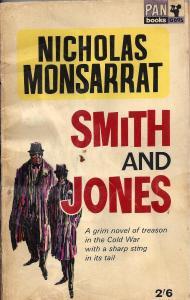
Within the precarious conditions of the Cold War, diplomats Smith and Jones are not to be trusted. But although their files demonstrate evidence of numerous indiscretions and drunkenness, they have friends in high places who ensure that this doesn't count against them, and they are sent across the Iron Curtain. However, when they defect, the threat of absolute treachery means that immediate and effective action has to be taken. At all costs and by whatever means, Smith and Jones must be silenced.
Born on Rodney Street in Liverpool, Monsarrat was educated at Winchester and Trinity College, Cambridge. He intended to practise law. The law failed to inspire him, however, and he turned instead to writing, moving to London and supporting himself as a freelance writer for newspapers while writing four novels and a play in the space of five years (1934–1939). He later commented in his autobiography that the 1931 Invergordon Naval Mutiny influenced his interest in politics and social and economic issues after college.
Though a pacifist, Monsarrat served in World War II, first as a member of an ambulance brigade and then as a member of the Royal Naval Volunteer Reserve (RNVR). His lifelong love of sailing made him a capable naval officer, and he served with distinction in a series of small warships assigned to escort convoys and protect them from enemy attack. Monsarrat ended the war as commander of a frigate, and drew on his wartime experience in his postwar sea stories. During his wartime service, Monsarrat claimed to have seen the ghost ship Flying Dutchman while sailing the Pacific, near the location where the young King George V had seen her in 1881.
Resigning his wartime commission in 1946, Monsarrat entered the diplomatic service. He was posted at first to Johannesburg, South Africa and then, in 1953, to Ottawa, Canada. He turned to writing full-time in 1959, settling first on Guernsey, in the Channel Islands, and later on the Mediterranean island of Gozo (Malta).
Monsarrat's first three novels, published in 1934–1937 and now out of print, were realistic treatments of modern social problems informed by his leftist politics. His fourth novel and first major work, This Is The Schoolroom, took a different approach. The story of a young, idealistic, aspiring writer coming to grips with the "real world" for the first time, it is at least partly autobiographical.
The Cruel Sea (1951), Monsarrat's first postwar novel, is widely regarded as his finest work, and is the only one of his novels that is still widely read. Based on his own wartime service, it followed the young naval officer Keith Lockhart through a series of postings in corvettes and frigates. It was one of the first novels to depict life aboard the vital, but unglamorous, "small ships" of World War II—ships for which the sea was as much a threat as the Germans. Monsarrat's short-story collections H.M.S. Marlborough Will Enter Harbour (1949), and The Ship That Died of Shame (1959) mined the same literary vein, and gained popularity by association with The Cruel Sea.
The similar Three Corvettes (1945 and 1953) comprising H.M. Corvette (set aboard a Flower class corvette in the North Atlantic), East Coast Corvette (as First Lieutenant of HMS Guillemot) and Corvette Command (as Commanding Officer of HMS Shearwater) is actually an anthology of three true-experience stories he published during the war years and shows appropriate care for what the Censor might say. Thus Guillemot appears under the pseudonym Dipper and Shearwater under the pseudonym Winger in the book. H.M. Frigate is similar but deals with his time in command of two frigates. His use of the name Dipper could allude to his formative years when summer holidays were spent with his family at Trearddur Bay. They were members of the famous sailing club based there, and he recounted much of this part of his life in a book My brother Denys. Denys Monserrat was killed in Egypt during the middle part of the war whilst his brother was serving with the Royal Navy. Another tale recounts his bringing his ship into Trearddur Bay during the war for old times' sake.
Monsarrat's more famous novels, notably The Tribe That Lost Its Head (1956) and its sequel Richer Than All His Tribe (1968), drew on his experience in the diplomatic service and make important reference to the colonial experience of Britain in Africa.
This slight book was a surprisingly enjoyable but easy read. It is somewhat moralistic (and very representative of the mainstream prejudices of its era), and the plot is rather basic and predictable, but the writing is often rather good - with a quite a few excellent descriptions and turns of phrase. The 'twist' at the very end was a little baffling and perhaps a trite too clever a trick. But as a kind of diplomatic security 'procedural' I think the story develops the requisite atmosphere and holds its own as an example of genre; enough to be a mildly diverting escapist read before bedtime or on the bus.
Nicholas Monsarrat published Smith and Jones in 1963. It is a novel deeply informed by the most active phases of the cold war, centred as it is on exchanges between the two sides, with the said characters at the focus.
To be brief and not give too much away, it tells the story of the trouble a pair of unreliable foreign office functionaries make for a colleague of theirs from the security branch when they get together on assignment in a distant embassy and egg each other on. The story is told by the officer, who carries the can for their indiscretions because he vetted them (and gave them the okay after being pressured to do so), and has been told to sort the problem out. The main story is his attempts to do so.
The book is nicely written. It's terse -- just 128 pages -- and the viewpoint character has an entertaining voice. It does rely for its ending on a conceit that was not a shock, which is a shame and rather deflates the whole exercise. Much of this can be blamed on Pan Books, because the cover blurbs give rather too much away. I can imagine the author seeing the book jacket and face-palming immediately afterwards.
In short, competent, highly readable, but too heavily reliant on a supposed surprise. Having said that, because it is short, it's not like 300 pages depend on the ending, and there is some entertainment to be had on the ride.
If you do see a copy and feel like reading a short, well-written cold war thriller, avert your eyes from the jacket copy.
This story was a bit hard to follow but fairly interesting. The best part was the ending because it was a huge surprise and one that gave me pause and made me think about it for awhile. I enjoy books about defection. This was scattered, but fairly interesting.
Smith and Jones is a readable if not a memorable spy story, combining the outline of the notorious Burgess/Maclean affair with Monsarrat's recollection of political life in Ottawa (where after the war Monsarrat lived for five years or more as press attache at the British High Commission (embassy.))
I was expecting a particular twist and I got it, but that didn't spoil my enjoyment of this sparse, short novel about defecting diplomats and the mess they leave in their wake. Le Carré lite.