Jump to ratings and reviews
Rate this book

Yesterdays

Rate this book
Yesterdays is a bawdy, outrageously funny novel of West Indian life, detailing young Poonwa's attempt to launch a Hindu Mission to Canada. Dominating the story is Choonilal, pressured to sell his property to finance this dubious scheme. We meet the motley cast of village characters, and the intrigue is enriched by a wealth of island lore, as everyone gossips and reminisces about their own yesterdays.

110 pages, Hardcover

First published January 1, 1974

64 people want to read

About the author

Harold Sonny Ladoo

3 books9 followers
Harold Sonny Ladoo (1945 – 1973) is a Caribbean novelist and author of two books documenting the struggles of living in poverty in the Hindu communities of Trinidad and Tobago.
Ladoo was born and grew up in an environment much like the world of his novels. He was born in Trinidad into extreme poverty and immigrated to Toronto, Canada with his wife and son in 1968 to study English at the University of Toronto.
It was during this time that he wrote his first and most notable novel No pain like this body, published in 1972. The novel is a vivid story of a young boy growing up in a small Caribbean rice-growing community. It focuses on the day-to-day struggles of a single family through illness, storm, and violence during the August rainy season. The writing is raw and often naïve yet manages to create a visceral experience.
His second book, Yesterdays was a much more upbeat book about a young man attempting to launch a Hindu Mission to Canada.
His third book that was intended to be last book of a trilogy, however in 1973 while on a visit home to his Calcutta Settlement, he was mysteriously killed and his body was found on the side of a road in Trinidad.

Ratings & Reviews

What do you think?
Rate this book

Friends & Following

Create a free account to discover what your friends think of this book!

Community Reviews

5 stars
3 (13%)
4 stars
5 (22%)
3 stars
6 (27%)
2 stars
6 (27%)
1 star
2 (9%)
Displaying 1 - 4 of 4 reviews
Profile Image for Alan (the Lone Librarian on film festival hiatus) Teder.
2,734 reviews262 followers
March 5, 2025
Indo-Trinidadian Satyr Play
A review of the Coach House Books paperback (June 25, 2024) of the original Anansi hardcover (1974).
But Ladoo managed to write something that dug deep into colonial trauma. It is not a perfect novel – or even a great one, thanks to its clunky first act and treatment of the queer shopkeeper in its narration – but it is one that struck my nerve endings. - from the Introduction by Kevin Jared Hosein.
There is no point in burying the lede. Yesterdays can only be compared to the ancient Greek style of comedy theatre called the Satyr play. This was the comic relief performed after Greek tragedies in which: "the remarkable feature of the satyr play is the chorus of satyrs, with their costumes that focus on the phallus, and with their language, which uses wordplay, sexual innuendos, references to breasts, farting, erections, and other references that do not occur in tragedy." (Quote source: Wikipedia).

To that list can be added the topics of defecation and latrines, which dominate the first third of the novella described in the Introduction as the "clunky first act." The latter parts move on to the central theme but hardly do it justice. The theme is that the son of 2 characters in the Karan settlement of Tola on Carib Isle has had a vision calling him to go on a Hindu Mission to Canada. This is to be a mission of payback for the indignities and suffering the boy encountered while attending a Christian Missionary school on his home isle which was staffed by Canadian missionaries.

In order to fulfill the mission, the boy requires money which can only be sourced by his father mortgaging his property. The father refuses to do it for the longest time despite everyone else in the village provoking him. But that main theme is distracted by constant stories of sexual adventures and misadventures usually involving the local shopkeeper known as "the queer," who is intent on seducing every man in the village.


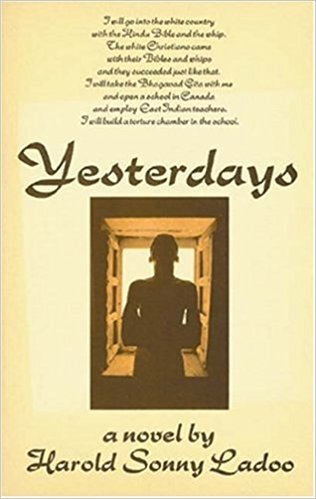
The front cover of the original Anansi hardcover (1974). Image sourced from Goodreads.

There was at least some dark comedy commentary about Canada to be found among the tedium of the excrement and defilement.
Poonwa knew all about Canada from his days at the Mission School. He spoke about blizzards, those wicked winds that were in the habit of destroying barns and killing off livestock; about the ice that fell from the sky and froze a few people to death each year; about the nakedness of the trees and the havoc of regenerating death.


And I did have the joy of remembering the recurring sketch of Mr. Everything Comes From India Man* in the Indo-British comedy show Goodness Gracious Me (1996-2001) thanks to this dialogue exchange:
And Ragbir: ‘Shakspoor couda never write poetry like dat!'
And Poonwa: ‘Not “Shakspoor” you arse! Shakespeare!’
‘Shakespeare de born in India,’ Tailor said.
‘Dat is korek,’ the priest said.
‘Shakespeare was an Englishman!’ Poonwa shouted.
‘Shakespeare was an Indian from India. He de born in dat same India, you hear dat. He dead in India too,’ Pandit Puru said.
Choonilal, wishing to make up to the priest, said, ‘Baba is korek. Shakspoor de born in India.’

I should mention (as is evident in the above example) that all of the dialogue in the book is in Indo-Trinidadian Creole which is usually decipherable by guesswork, although not always. No glossary is provided. This was a fast read due to its novella length, but regardless of that it was rather tedious. It gets a GR 2 star "OK" rating as I can't quite rise to a GR 3 star "Like."

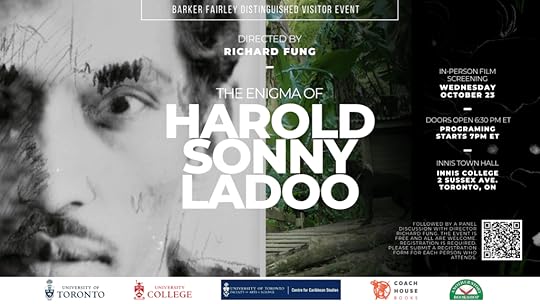
I read Yesterdays through having been introduced to the author Harold Sonny Ladoo from seeing the film The Enigma of Harold Sonny Ladoo directed by fellow Trinidadian-Canadian Richard Fung last year. That excellent film combined archival footage with animation and present day investigation to tell the rather mysterious story of the Indo-Trinidadian Canadian who lived and studied in Canada from 1968 onwards and then died tragically during a trip back home in 1973.


Footnote, Trivia and Links
* If you don't know the "Mr. Everything Comes From India Man" sketches, let me introduce you to Da Vinci was Indian, The Queen is Indian and Christianity is Indian for starters 🤣
Profile Image for Emily DelGrosso.
1 review
January 20, 2025
Made it 16 pages in. DNF. Despite the foreword, I’m already over the talk of poop, sex, and “sodomy.”

I picked this book up as the back discussed a village recovering from trauma inflicted upon them by Christian missionaries. Maybe I don’t get it or maybe it’s above my head, but this isn’t what I thought it would be and honestly isn’t something I even want to read.
335 reviews2 followers
July 2, 2025
Anniversary edition. Portrait of Trinidadian village life among the East Indian Hindus of Trinidad, with a subtext of forced assimilation and resentment towards Canadian missionary teachers. (Sounds familiar?) Published posthumously, because the author went back to Trinidad for a visit and was murdered - at the age of 27 or 27....worth a look.
Profile Image for Jane Mulkewich.
Author 2 books18 followers
November 2, 2024
Harold Sonny Ladoo (1945 – 1973) was an Indo-Trinidadian author who lived in Toronto for about three years when/where he did most of his writing, until he was killed mysteriously on a visit back to Trinidad in 1973. This book "Yesterdays" was published posthumously in 1974, and this year (2024) a new edition was published with a foreword by Kevin Jared Hosein.

This novel is set in 1955 in a Hindu village in Trinidad, portraying "a slice of filthy life" (as Hosein says in his foreword), where "there is much in this book to offend the reader", from the constant swearing to the arguments over latrines to the extramarital "sexual dalliances" between men and between men and women. The whole village gets dragged into Poonwa's attempts to ask his father Choonilal to mortgage his hard-earned property, for money for Poonwa to launch a Hindu Mission to Canada. Poonwa was traumatized by his years of education in Trinidad and the brutality of the white missionaries, and wants to reciprocate by launching a Hindu Mission in Canada - forcing them to forsake English and to learn Hindi, and complete with torture rooms when they do not comply. Definitely worth a read.
Displaying 1 - 4 of 4 reviews

Can't find what you're looking for?

Get help and learn more about the design.