

What do you think?
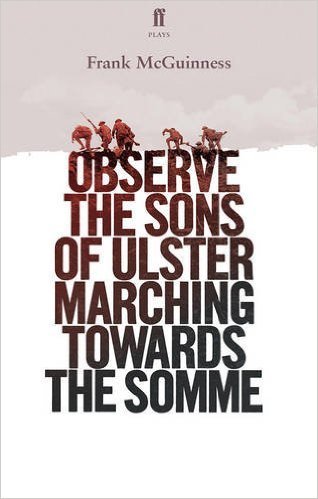
Observe the Sons of Ulster Marching Towards the Somme
On 1 July 1916, the 36th (Ulster) Division took part in one of the bloodiest battles in human history, the Battle of the Somme. This enduring war play is a powerful portrayal of mortality, love and loss. In the extraordinary circumstances of World War I, eight ordinary men arechanged, changed utterly.
In 2016, one hundred years after the battle, Observe the Sons of Ulster Marching Towards the Somme by Frank McGuinness was revived in a co-production between Abbey Theatre, Citizens Theatre, Headlong and Liverpool Everyman & Playhouse.
This edition contains a new introduction by P. J. Mathews.
In 2016, one hundred years after the battle, Observe the Sons of Ulster Marching Towards the Somme by Frank McGuinness was revived in a co-production between Abbey Theatre, Citizens Theatre, Headlong and Liverpool Everyman & Playhouse.
This edition contains a new introduction by P. J. Mathews.
118 pages, Paperback
First published July 28, 1986
About the author
Frank McGuinness
70 books20 followersFrank McGuinness is Professor of Creative Writing in University College Dublin. A world-renowned playwright, his first great stage hit was the highly acclaimed ‘Observe the Sons of Ulster Marching Towards the Somme’. He is also a highly skilled adapter of plays by writers such as Ibsen, Sophocles, Brecht, and writer of several film scripts, including Dancing at Lughnasa, and he has published several anthologies of poetry.
Ratings & Reviews
Friends & Following
Create a free account to discover what your friends think of this book!
Community Reviews
Displaying 1 - 29 of 29 reviews

September 29, 2021
this is some good fricking theatre

August 31, 2016
Tonight I watched the play, and it was powerful. About love and morality, faith and friendship - the things that pull us through the worst of it all, how we are changed by all of it. I've been skimming different sections of the book to relive the strength of the play ever since the play let out - in fact, in the intermission I was reading the opening bits, to hear them again in my mind. The actors did a brilliant job in the show, a moving performance all around.
I even went in and willingly underlined a couple of passages that I found particularly moving. I don't think I have ever, under my own free will and initiative, underlined a book. Not even in the pencil I did it in tonight.
ELDER PYPER: I will not talk, I will not listen to you. Invention gives that slaughter shape. That scale of horror has no shape, as you in your darkness have no shape. Your actions that day were not, they are not acceptable. You have no right to excuse that suffering, parading it for the benefit of others.
ELDER PYPER: Those I belonged to, those I have not forgotten, the irreplaceable ones, they kept their nerve, and they died. I survived. No, survival was not my lot. Darkness, for eternity, is not survival.
(P.S. JULIE!! It was either at the quote of Crawford or of Moore/Millen below which made me think of the Auxiliary Animorphs - yes, specifically of them in the middle of watching this play. Hrm, I am inclined to think it was more Moore/Millen where I thought it...)
CRAWFORD: What am I? I'll tell you. I'm a soldier that risks his neck for no cause other than the men he's fighting with. I've seen enough to see through empires and kings and countries. I know the only side worth supporting is your own sweet self. I'll support you because if it comes to the crunch I hope you'll support me. That's all I know. That's all I feel.
MCILWAINE: The whole of Ulster will be lost. We're not making a sacrifice. Jesus, you've seen this war. We are the sacrifice.
MOORE: Who leads you?
MILLEN: Top brass. I do as I'm told. I make no complaints. If they order me to put my hand in the fire, for the sake of what I believe in, I'd do it willingly. You have to do that as well, Moore. That's the only way you'll come back alive.
PYPER: Dance.
I even went in and willingly underlined a couple of passages that I found particularly moving. I don't think I have ever, under my own free will and initiative, underlined a book. Not even in the pencil I did it in tonight.
ELDER PYPER: I will not talk, I will not listen to you. Invention gives that slaughter shape. That scale of horror has no shape, as you in your darkness have no shape. Your actions that day were not, they are not acceptable. You have no right to excuse that suffering, parading it for the benefit of others.
ELDER PYPER: Those I belonged to, those I have not forgotten, the irreplaceable ones, they kept their nerve, and they died. I survived. No, survival was not my lot. Darkness, for eternity, is not survival.
(P.S. JULIE!! It was either at the quote of Crawford or of Moore/Millen below which made me think of the Auxiliary Animorphs - yes, specifically of them in the middle of watching this play. Hrm, I am inclined to think it was more Moore/Millen where I thought it...)
CRAWFORD: What am I? I'll tell you. I'm a soldier that risks his neck for no cause other than the men he's fighting with. I've seen enough to see through empires and kings and countries. I know the only side worth supporting is your own sweet self. I'll support you because if it comes to the crunch I hope you'll support me. That's all I know. That's all I feel.
MCILWAINE: The whole of Ulster will be lost. We're not making a sacrifice. Jesus, you've seen this war. We are the sacrifice.
MOORE: Who leads you?
MILLEN: Top brass. I do as I'm told. I make no complaints. If they order me to put my hand in the fire, for the sake of what I believe in, I'd do it willingly. You have to do that as well, Moore. That's the only way you'll come back alive.
PYPER: Dance.

March 18, 2018
Read this for a literature course I'm taking. I don't read a lot of drama and it took a while for me to get into the flow of the character interchanges. Very gritty and poignant though and I'm now glad to have read it.

May 23, 2008
An Irish-Catholic from the South reflects sorrowfully on young Ulster Protestants being offered up to Mars. Read along with Sebastian Barry's A Long Long Way.

August 18, 2025
I feel like I need someone to explain all the symbolism to me.

October 6, 2023
buf, potser la meva nova obra de teatre preferida, tant de bo veure-la. quina cosa més forta... ara no tinc espai mental per dir res més però sisuplau son 80 paginetes feu-vos el favor de llegir-la (i pensar-la en el seu context socio-polític!)

March 16, 2018
2.5 Stars
Another play for my dissertation. It was a really good source... the play is just incredibly... depressing. It's an Anti-war play from the perspective of a Company of men, with one of them surviving the war and remembering what happened, and his mates. I didn't particularly enjoy reading the play, but I could imagine the play to be really moving if was performed.
Another play for my dissertation. It was a really good source... the play is just incredibly... depressing. It's an Anti-war play from the perspective of a Company of men, with one of them surviving the war and remembering what happened, and his mates. I didn't particularly enjoy reading the play, but I could imagine the play to be really moving if was performed.

March 23, 2018
(review to come)

April 1, 2023
https://fromtheheartofeurope.eu/observe-the-sons-of-ulster-marching-towards-the-somme-by-frank-mcguinness/
This play won the Christopher Ewart-Biggs Prize in 1986, and I was lucky enough to see it thirty years later, at the Abbey Theatre for the 2016 production commemorating the centenary of the Battle of the Somme. Reading the script now can’t really do justice to the memory of the theatre production, which starred Donal Gallery as Pyper, and crucially used the space of the stage to make the story come alive.
It’s a reflection on eight soldiers recruited to the Ulster Division during the First World War, exploring their understanding of the universe, life, love and loyalty. The narrative is bookended by Pyper in old age reflecting on how he survived and his friends did not (so the fact that seven of the eight die is signalled early on).
I find the third act the most effective, the eight characters back home on leave and split into four pairs, two on Boa island, two at a church, two at the Carrick-a-Rede rope bridge, and two at the Field where Orange marches finish (which historically was at Finaghy, close to where I grew up, though I do not know if that was the case in 1915 or 1916). It gives the men a chance to explain themselves to each other, a sympathetic but informed audience.
By the lakeside in Fermanagh, Pyper and Craig make love, which must have been rather shocking in 1985 and was still a bit unexpected in 2016. (Also the weather must have been very good that day.) All of the characters reflect on the place of Ulster in Ireland, in Britainm in Europe and in the empire. There are some very good lines:
Old Pyper: Those I belonged to, those I have not forgotten, the irreplaceable ones, they kept their nerve, and they died. I survived. No, survival was not my lot. Darkness, for eternity, is not survival.
McIlwaine: The whole of Ulster will be lost. We’re not making a sacrifice. Jesus, you’ve seen this war. We are the sacrifice.
Younger Pyper: I have seen horror
Elder Pyper: Ulster
Younger Pyper: They kept their nerve and they died.
Elder Pyper: Ulster
Younger Pyper: There would be and there will be, no surrender.
Elder Pyper: Ulster
Younger Pyper: The house has grown cold, the province has grown lonely.
Elder Pyper: Ulster
Younger Pyper: You’ll always guard Ulster.
Elder Pyper: Ulster.
Younger Pyper: Save it
Elder Pyper: Ulster
Younger Pyper: The temple of the Lord is ransacked.
Elder Pyper: Ulster.
(Pyper reaches toward himself)
Younger Pyper: Dance in this deserted temple of the Lord.
Elder Pyper: Dance
(Darkness)
This play won the Christopher Ewart-Biggs Prize in 1986, and I was lucky enough to see it thirty years later, at the Abbey Theatre for the 2016 production commemorating the centenary of the Battle of the Somme. Reading the script now can’t really do justice to the memory of the theatre production, which starred Donal Gallery as Pyper, and crucially used the space of the stage to make the story come alive.
It’s a reflection on eight soldiers recruited to the Ulster Division during the First World War, exploring their understanding of the universe, life, love and loyalty. The narrative is bookended by Pyper in old age reflecting on how he survived and his friends did not (so the fact that seven of the eight die is signalled early on).
I find the third act the most effective, the eight characters back home on leave and split into four pairs, two on Boa island, two at a church, two at the Carrick-a-Rede rope bridge, and two at the Field where Orange marches finish (which historically was at Finaghy, close to where I grew up, though I do not know if that was the case in 1915 or 1916). It gives the men a chance to explain themselves to each other, a sympathetic but informed audience.
By the lakeside in Fermanagh, Pyper and Craig make love, which must have been rather shocking in 1985 and was still a bit unexpected in 2016. (Also the weather must have been very good that day.) All of the characters reflect on the place of Ulster in Ireland, in Britainm in Europe and in the empire. There are some very good lines:
Old Pyper: Those I belonged to, those I have not forgotten, the irreplaceable ones, they kept their nerve, and they died. I survived. No, survival was not my lot. Darkness, for eternity, is not survival.
McIlwaine: The whole of Ulster will be lost. We’re not making a sacrifice. Jesus, you’ve seen this war. We are the sacrifice.
Younger Pyper: I have seen horror
Elder Pyper: Ulster
Younger Pyper: They kept their nerve and they died.
Elder Pyper: Ulster
Younger Pyper: There would be and there will be, no surrender.
Elder Pyper: Ulster
Younger Pyper: The house has grown cold, the province has grown lonely.
Elder Pyper: Ulster
Younger Pyper: You’ll always guard Ulster.
Elder Pyper: Ulster.
Younger Pyper: Save it
Elder Pyper: Ulster
Younger Pyper: The temple of the Lord is ransacked.
Elder Pyper: Ulster.
(Pyper reaches toward himself)
Younger Pyper: Dance in this deserted temple of the Lord.
Elder Pyper: Dance
(Darkness)

November 4, 2022
Frank McGuinness's play Observe the Sons of Ulster Marching Towards the Somme is, I think, above all else a meditation on war--what it's for, what it does to men, why it won't go away. This powerful tale of eight young men from Ulster who go off to France to fight in World War I has a sad and potent resonance.
The men are a diverse lot, but they have in common a fierce pride that finds expression in the rituals of warfare. The one we meet first is Kenneth Pyper, and we encounter him some sixty years after the fact, an octogenarian railing against God for the terrors He let him witness in battle and the wasted lives of his comrades who died at the Somme. (Historical note: the Battle of the Somme, which began in July 1916, was the bloodiest and most unsuccessful Allied offensive in World War I, with more than a million casualties in five months on both sides.)
We then flash back to 1915, to a makeshift barracks in Ulster, in the north of Ireland, where Pyper first meets his seven platoon-mates. Unlike them, Pyper is arrogant and monied and jaded; he claims to have enlisted only to get killed. In a scene healthily loaded with testosterone, we learn that Pyper is clearly, as someone pegs him, the "rare" man in this group, though not necessarily for the reasons we initially suspect.
In the play's longer second act, Pyper discovers what is to be gained from bonding with his fellows, and he also emerges as their de facto leader by the time they are ordered back to the front for the fateful battle that will also be, for most, their tragic last stand. From George Anderson and Nathaniel McIlwaine, Pyper learns about the Noble Cause: both are dyed-in-the-wool Ulster Protestants, dead set against the "Fenians" (Catholics) getting anything close to an upper hand in the governance of their homeland. Christopher Roulston and Martin Crawford demonstrate the awesome power of the Church, pro and con, the one a lapsed preacher, the other a determined pragmatist. Lifelong friends John Millen and William Moore show Pyper the strength of genuine fellowship, each in his turn rising above circumstance to aid the other. And from David Craig, Pyper learns about love, which they discover in one another only gradually (though you suspect that they suspect it as soon as they meet).
Lessons in the sanctity of human life; lessons in the reasons we fight: for God, for Country, for our fellows, for our heart. This is, for me, a way into the complex brilliant mass of this extraordinary play; you may find another. The important thing is to look.
The men are a diverse lot, but they have in common a fierce pride that finds expression in the rituals of warfare. The one we meet first is Kenneth Pyper, and we encounter him some sixty years after the fact, an octogenarian railing against God for the terrors He let him witness in battle and the wasted lives of his comrades who died at the Somme. (Historical note: the Battle of the Somme, which began in July 1916, was the bloodiest and most unsuccessful Allied offensive in World War I, with more than a million casualties in five months on both sides.)
We then flash back to 1915, to a makeshift barracks in Ulster, in the north of Ireland, where Pyper first meets his seven platoon-mates. Unlike them, Pyper is arrogant and monied and jaded; he claims to have enlisted only to get killed. In a scene healthily loaded with testosterone, we learn that Pyper is clearly, as someone pegs him, the "rare" man in this group, though not necessarily for the reasons we initially suspect.
In the play's longer second act, Pyper discovers what is to be gained from bonding with his fellows, and he also emerges as their de facto leader by the time they are ordered back to the front for the fateful battle that will also be, for most, their tragic last stand. From George Anderson and Nathaniel McIlwaine, Pyper learns about the Noble Cause: both are dyed-in-the-wool Ulster Protestants, dead set against the "Fenians" (Catholics) getting anything close to an upper hand in the governance of their homeland. Christopher Roulston and Martin Crawford demonstrate the awesome power of the Church, pro and con, the one a lapsed preacher, the other a determined pragmatist. Lifelong friends John Millen and William Moore show Pyper the strength of genuine fellowship, each in his turn rising above circumstance to aid the other. And from David Craig, Pyper learns about love, which they discover in one another only gradually (though you suspect that they suspect it as soon as they meet).
Lessons in the sanctity of human life; lessons in the reasons we fight: for God, for Country, for our fellows, for our heart. This is, for me, a way into the complex brilliant mass of this extraordinary play; you may find another. The important thing is to look.
July 26, 2019
A play about the First World War. Four acts. The first is a monologue, Kenneth Pyper thinking back to the war and his dead comrades. Part 2 introduces the eight characters as they enter the barracks and the army. In Part 3 they are on leave from the front. In Part 4 they prepare to go over the top in the Somme. Part 3 is the most ambitious, the eight are on leave, back in the North of Ireland, they have divided into pairs and while they share the stage, they are in four different spaces or places; the play ‘cuts’ between them, linking their different concerns. There are the obvious fears of death, but there are other tensions. Throughout the men are rooted in place and history. Through much of the play the place is offstage, their homes, the land they grew up in, the rivers they fished in are memories, yearnings: the paradox is that they fight the war for their homeland, while being separated from their homeland. They are also grounded in their traditions, those of Unionism and Protestant Ulster. Although there is the paradox that while they are loyal to these values, this is not what the war is about. Pyper is the outsider, is better educated, has already been outside of Ulster, living in Paris before the war: he satirizes the views of the others and their parochialism. But by the end he seems to have been integrated into the group, rather than still questioning it. The pivotal section is part 3, but I’m unconvinced by its success: its ambitions pull in too many ways. I will admit I am very uncertain how successful this work is – I should probably return to it.
January 21, 2026
Estoy intentando leer más literatura irlandesa y sobre Irlanda así que me recomendaron este. Ver cómo desprecian a los irlandeses cuando la Inglaterra a la que tanto se aferran los ha mandado a matarse entre ellos al frente a sabiendas que ninguno va a volver te da una idea de cómo funciona la propaganda y porqué la situación en el norte de Irlanda es la que es. Me gusta mucho cómo está planteada la escenografía pero lo demás se me queda un poco corto

October 6, 2020
This was a decent play. I liked the relationships between the characters, the exploration of homosexuality, and the setting. I think I'd like it more if I saw it in person, it seems like it has the potential to be quite powerful.
May 13, 2017
I love drama, I really do, but this piece was one of the most boring plays I've ever read.
My opinion might change if I saw it performed on stage...
My opinion might change if I saw it performed on stage...

January 13, 2020
Powerful and moving. A fascinating insight into the Great War and the Ulster Protestant Psyche.

April 15, 2020
something i didn't expect about myself was how many feelings i have about wwi, of all things. but GOD

March 15, 2022
I read this for my english course. I didn't especially enjoy it but it also wasn't attrocious. A quick read with some interesting themes.

September 10, 2022
Did not think I'd cry at this but I did

March 13, 2023
I did not expect this play to make me emotional, but oh well.

April 2, 2024
Holy fuck that was good, will be keeping my eyes out for a version of this on the stage wow
September 8, 2026
Confusing, intimate, heartbreaking, and real
Had to read for my class on the Northern Ireland Troubles
Had to read for my class on the Northern Ireland Troubles

December 2, 2019
A gripping, moving memory play of the aftermath of war, and the bonds of necessary love formed to survive it becoming something more. However fulfilling it is to read a story of gay love by a gay playwright — and how often does that occur in modern Irish drama? — Observe the Sons is also a keen-eyed examination of what happens when one becomes so in love that it's impossible to define yourself outside of it.
A memory play, we enter in the present — Elder Pyper, a veteran of the 36th Ulster Division which fought on the Somme, is alone in the darkness, the only sound other than his speech a "low drumbeat." The sounds of war, as it becomes clear, have never ended for him — though he claims to "remember nothing," his increasingly impassioned speech shows that he remembers all too well the men that fell by his side, and the cause they all supposedly died for. Though it's subtle, McGuinness critiques Elder Pyper's unionism — it's never really been about the rhetoric, but about the fact that that rhetoric has been conflated with the memory of the man he loved, and lost. Seeing the ghost of his lover, Craig, he begs him to "touch me," betraying what he really wants: to have companionship again. And companionship, unfortunately, can only be accessed through a hatred-filled belief in the Cause of Ulster.
That Pyper wasn't always this way — flashbacks reveal him to be a teasing force of nature, devoted to tearing down every "Protestant god" that he sees — makes his future all the more tragic, showing how he's forced to cling to a rhetoric he knows is "rotten at the core" because it'll connect him to Craig.
A memory play, we enter in the present — Elder Pyper, a veteran of the 36th Ulster Division which fought on the Somme, is alone in the darkness, the only sound other than his speech a "low drumbeat." The sounds of war, as it becomes clear, have never ended for him — though he claims to "remember nothing," his increasingly impassioned speech shows that he remembers all too well the men that fell by his side, and the cause they all supposedly died for. Though it's subtle, McGuinness critiques Elder Pyper's unionism — it's never really been about the rhetoric, but about the fact that that rhetoric has been conflated with the memory of the man he loved, and lost. Seeing the ghost of his lover, Craig, he begs him to "touch me," betraying what he really wants: to have companionship again. And companionship, unfortunately, can only be accessed through a hatred-filled belief in the Cause of Ulster.
That Pyper wasn't always this way — flashbacks reveal him to be a teasing force of nature, devoted to tearing down every "Protestant god" that he sees — makes his future all the more tragic, showing how he's forced to cling to a rhetoric he knows is "rotten at the core" because it'll connect him to Craig.

September 9, 2021
This is one of the few screen-write books that I have found I am able to enjoy and whenever I pick it up, which has been on more then one occasion, I am able to transport back to where I was when I first read the book and how it made me feel when it first came into my possession.
Unlike many of the books about the war this particular one does not focus on all of the fighting and death which occur (I should point out it does mention it on occasion and does refer back to it quite often without being overly graphic.) but rather focuses on how the characters pick themselves up after their war time events. I would say this book is more about PTSD and how it effects not just the soldiers and their perspectives but also their families and other people that are around them.
It is indeed a book that everyone should read at least once, because despite the large and rather difficult topics of the book you are able to sympathise with the characters and wish them well throughout. It is not a book that has an ending you can expect and I would not read it if you like to be aware of what is going to happen.
"We knew before we enlisted. We joined up willingly for that reason. Everyone one of us, except you. You've learnt it at long last. But you can't teach us what we already know. You won't save us, you won't save yourself, imagining things."
Unlike many of the books about the war this particular one does not focus on all of the fighting and death which occur (I should point out it does mention it on occasion and does refer back to it quite often without being overly graphic.) but rather focuses on how the characters pick themselves up after their war time events. I would say this book is more about PTSD and how it effects not just the soldiers and their perspectives but also their families and other people that are around them.
It is indeed a book that everyone should read at least once, because despite the large and rather difficult topics of the book you are able to sympathise with the characters and wish them well throughout. It is not a book that has an ending you can expect and I would not read it if you like to be aware of what is going to happen.
"We knew before we enlisted. We joined up willingly for that reason. Everyone one of us, except you. You've learnt it at long last. But you can't teach us what we already know. You won't save us, you won't save yourself, imagining things."
June 26, 2016
One of the most moving and powerful pieces of drama I have encountered in a while. I saw this in the theatre with fantastic actors who commanded the utter attention of the audience through superb character performance and stunning interpretation of the work. I then bought the play myself to read as the theatre had left me curious and wanting more...
The play is set in WW1 in the lead up to the Battle of the Somme where over one million soldiers lost their lives. However, instead of being a play based around the actual physical battle, it focuses on the lives of eight soldiers from Ulster, from when they join up until the front line.
The characters are explored tenderly yet with great emotion by the play write, and it is difficult not to find yourself completely immersed in their world. While the play touches on themes such as the Catholic/Protestant conflict in Ireland, Homosexuality, the meaning of life, and the morality of war, it is clear from the start that the real drama is the emotional and spiritual journey of the main characters.
An absolutely first class play. I recommend it heartily, and if you get the chance to see it live, as I did, you should take it.
The play is set in WW1 in the lead up to the Battle of the Somme where over one million soldiers lost their lives. However, instead of being a play based around the actual physical battle, it focuses on the lives of eight soldiers from Ulster, from when they join up until the front line.
The characters are explored tenderly yet with great emotion by the play write, and it is difficult not to find yourself completely immersed in their world. While the play touches on themes such as the Catholic/Protestant conflict in Ireland, Homosexuality, the meaning of life, and the morality of war, it is clear from the start that the real drama is the emotional and spiritual journey of the main characters.
An absolutely first class play. I recommend it heartily, and if you get the chance to see it live, as I did, you should take it.

October 10, 2013
McGuinness does an excellent job of re-visioning a WWI drama: instead of a focus on the battles, etc. the audience is left with only eight young men who are fighting for Ulster; who understand that they will die for Ulster. Done in four parts, McGuinness hooks the audience immediately with Kenneth Pyper seemingly alone on stage yet soon revealing he is haunted by the seven men he fought alongside; Pyper was the only survivor. The most beautiful part in my opinion is Part 3 where the men are paired off -- we see them bonding and connecting with the other half of the pair, we see them arguing and challenging each other as well. It is the beautiful juxtaposition of characters, of war and humanity, of peace and struggle. It was moving and I would love to see this performed on stage.

April 28, 2014
A great play highlighting the struggles of the Irish Regiments in WW1 and the horrors of the Somme. McGuinness' writing makes it well worth the read, even if you have very little interest in war literature.

December 4, 2016
Great concept, iffy execution

January 4, 2017
Strange young men in a strange war.

October 31, 2020
Genialni, rychly, svizny, silny. O valecnych traumatech, vyhrocenych stereotypech. O lidech, o homosocialnich kolektivech a vztazich v nich. Strasne dobry. Chtela bych to videt na divadle.
Displaying 1 - 29 of 29 reviews