El relato esta contado en primera persona por Hedwige, una noble polaca de Sandomir, que en el ano 1825, durante la guerra entre Polonia y Rusia se ve obligada a exiliarse al monasterio de Sabastru, tras la muerte de sus dos hermanos y siguiendo la voluntad de su padre. Durante su viaje ella y su cortejo son asaltados por bandoleros, dirigidos por dos hermanos: Kostaki y Gregoriska, de la noble familia de los Brancovan. Los dos hermanos respetan la vida de Hedwige y se enamoran de ella, llevandola al castillo de la familia donde comienzan a competir por su afecto. Una noche Gregoriska le propone a Hedwige que huya con el, y la joven acepta su peticion. Sin embargo Kostaki descubre las intenciones de su hermano. Al descubrirse el cadaver de Kostaki, la madre de los dos hermanos pide a Gregoriska que acabe con su asesino, y Gregoriska lo jura."
This note regards Alexandre Dumas, père, the father of Alexandre Dumas, fils (son). For the son, see Alexandre Dumas fils.
Alexandre Dumas père, born Alexandre Dumas Davy de la Pailleterie, was a towering figure of 19th-century French literature whose historical novels and adventure tales earned global renown. Best known for The Three Musketeers, The Count of Monte Cristo, and other swashbuckling epics, Dumas crafted stories filled with daring heroes, dramatic twists, and vivid historical backdrops. His works, often serialized and immensely popular with the public, helped shape the modern adventure genre and remain enduring staples of world literature. Dumas was the son of Thomas-Alexandre Dumas, a celebrated general in Revolutionary France and the highest-ranking man of African descent in a European army at the time. His father’s early death left the family in poverty, but Dumas’s upbringing was nonetheless marked by strong personal ambition and a deep admiration for his father’s achievements. He moved to Paris as a young man and began his literary career writing for the theatre, quickly rising to prominence in the Romantic movement with successful plays like Henri III et sa cour and Antony. In the 1840s, Dumas turned increasingly toward prose fiction, particularly serialized novels, which reached vast audiences through French newspapers. His collaboration with Auguste Maquet, a skilled plotter and historian, proved fruitful. While Maquet drafted outlines and conducted research, Dumas infused the narratives with flair, dialogue, and color. The result was a string of literary triumphs, including The Three Musketeers and The Count of Monte Cristo, both published in 1844. These novels exemplified Dumas’s flair for suspenseful pacing, memorable characters, and grand themes of justice, loyalty, and revenge. The D’Artagnan Romances—The Three Musketeers, Twenty Years After, and The Vicomte of Bragelonne—cemented his fame. They follow the adventures of the titular Gascon hero and his comrades Athos, Porthos, and Aramis, blending historical fact and fiction into richly imagined narratives. The Count of Monte Cristo offered a darker, more introspective tale of betrayal and retribution, with intricate plotting and a deeply philosophical core. Dumas was also active in journalism and theater. He founded the Théâtre Historique in Paris, which staged dramatizations of his own novels. A prolific and energetic writer, he is estimated to have written or co-written over 100,000 pages of fiction, plays, memoirs, travel books, and essays. He also had a strong interest in food and published a massive culinary encyclopedia, Le Grand Dictionnaire de cuisine, filled with recipes, anecdotes, and reflections on gastronomy. Despite his enormous success, Dumas was frequently plagued by financial troubles. He led a lavish lifestyle, building the ornate Château de Monte-Cristo near Paris, employing large staffs, and supporting many friends and relatives. His generosity and appetite for life often outpaced his income, leading to mounting debts. Still, his creative drive rarely waned. Dumas’s mixed-race background was a source of both pride and tension in his life. He was outspoken about his heritage and used his platform to address race and injustice. In his novel Georges, he explored issues of colonialism and identity through a Creole protagonist. Though he encountered racism, he refused to be silenced, famously replying to a racial insult by pointing to his ancestry and achievements with dignity and wit. Later in life, Dumas continued writing and traveling, spending time in Belgium, Italy, and Russia. He supported nationalist causes, particularly Italian unification, and even founded a newspaper to advocate for Giuseppe Garibaldi. Though his popularity waned somewhat in his final years, his literary legacy grew steadily. He wrote in a style that was accessible, entertaining, and emotionally reso
O antologie de proza scurta pe care o recomand cu drag persoanelor care doresc sa citeasca altfel de povesti cu vampiri decat cele cu care ne-a obisnuit literatura comerciala. Autori celebri precum Dumas, Merimee, Nodier, Maupassant, Gautier si Bertrand isi arata maiestria tesand povesti pline de mister, gotic si fantastic. Prima ne prezinta "Povestea doamnei palide", in care Alexandre Dumas isi plaseaza actiunea in Romania iar pesonajele au nume romanesti. Peisajele din jurul muntilor Carpati sunt superb descrise, dovedind inca o data cat de frumoasa este tara noastra si cat de potrivita este pentru acest gen de naratiune plina de mister. Merimee in "Lokis" ne infatiseaza strania intamplare a unui profesor care primeste invitatia unui influent conte de a petrece cateva nopti la castelul sau. Acolo are parte de cele mai cutremuratoare experiente care il vor soca pentru tot restul vietii sale. Charles Nodier ne surprinde cu trei povestiri despre vampiri: "Calaugarita insangerata", "Vampirul Arnold-Paul" si "Vampiri din Ungaria". Toate merita savurate din plin. Guy de Maupassant contribuie si el cu doua intamplari stranii: "Ticul" si "Horla". Prima prezinta viata tragica a unui tata care isi inmormanteaza fata iar aceasta vine acasa dupa o noapte petrecuta in cavou iar a doua este jurnalul unui barbat pentru care lasarea noptii vine cu un chin cumplit. "Moarta indragostita" a lui Gautier este ultima din serie si infatiseaza povestea unui preot care este imbrobodit de o femeie cu o frumusete supranaturala. Pentru iubitorii de povestiri horror clasice, plictisiti de invazia vampirilor moderni in literatura, aceasta carte poate reprezenta o gura de aer proaspat care cu siguranta ii va delecta.
3.5 :) A pesar de ser tan cortito, me gustó. Me gustó mucho. Creo que lo que más me ha gustado es la narrativa. Sobre el comportamiento de los personajes... lo he visto en más de un libro clásico. Así que no me molestó tanto, hay que tener muy en cuenta la época en que fue escrito.
It is official: I am too cynical to read any books about vampires.
Even the books written by Alexandre Dumas.
Even the books featuring Polish ladies.
There were two main reasons why I decided to make the acquaintance with The Pale Lady (1849): first of all, I love to see Polish people and realia depicted by foreign writers, and secondly, it is always interesting to see a writer giving a shot at a genre which is not his or her spécialité de la maison.
Andrzej Masianis, The Vampire.
As for the realia, The Pale Lady turned out to be a hot mess. Just a few examples: * The proper name of 'Sandomir' is Sandomierz. * 'Hedwig' is not a Polish name, the correct version is Jadwiga. * The Polish uprising did not take place in 1825 but in 1830-31. * Moldavia is presented like a medieval, derelict place, especially the castle of Brankovan has a feel of Middle Ages, while the action of the novella takes place after 1825. * How come Hedwig can communicate with Moldavian people? The linguistic mystery of this novel has already been pinpointed by Théodore in his great review of The Pale Lady. * The distance between Sandomierz and Sahastru, where Hedwig was travelling to find refuge, is 1029 kilometres - looking for shelter in such a faraway place sounds quite irrational.
Unfortunately, I found the literary value of The Pale Lady questionable and did not enjoy a hideous combination of mawkish sentimentality and brutal violence at the end. Maybe it was written not by Dumas but by one of the ghostwriters he supposedly hired? According to the author of the introduction, he 'founded a production studio that turned out hundreds of stories under his creative direction'.
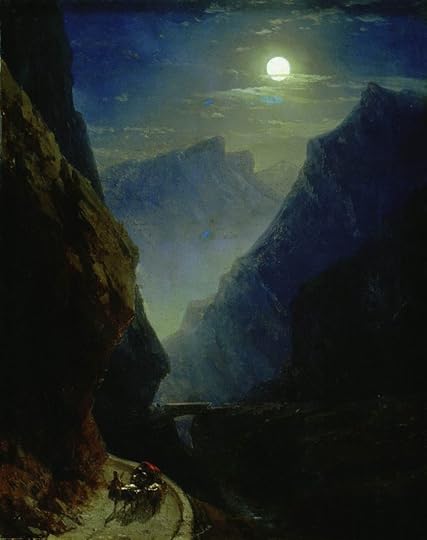
The Pale Lady is full of charming romantic clichés and actually, that was the only thing I enjoyed. For example, it was delectable to revisit the scenery so typical for the literature of Romanticism, which I adore, and to feel 'irresistible melancholy', for instance, admiring the Carpatian Mountains: 'Their storm-beaten peaks are lost in the clouds and shrouded in eternal snow; their boundless fir-woods bend over the burnished mirror of lakes that are more like seas, crystal clear waters which no keel has ever furrowed, no fisherman’s net ever disturbed.'
Ivan Aivazovski, Darial Gorge. Moon night.
Not only the views but also the atmosphere and even sounds are characteristic for the literature of this period: 'Then are heard mysterious noises in passages, howls in old, half-ruined towers, shakings of walls – so terrible and appalling that cot and castle are both left desolate'.
Probably Alexandre Dumas would have been baffled and hurt if he could have heard my muffled guffaws and giggles at theoretically most blood-curdling moments, instead of gasps, sighs and shrieks of terror. The borderline between loftiness and pompousness, affectation and ridiculousness, is thin and in my opinion, Dumas crossed it quite a few times. I remember his contagious sense of humour from The Three Musketeers so it was a sad surprise.
The topos of a vampire was quite important in the literature of Romanticism, in Poland it was even associated with patriotic themes. There is an exquisite study on this topic by Maria Janion, Wampir: Biografia Symboliczna. Nevertheless, I cannot help it: I find vampires not only horrible but also ludicrous and kitsch, the romantic ones included. Even the word 'vampire' sounds glitzy and pretentious to me.
These are the reasons for the sickly pallor of my enthusiasm for The Pale Lady.
A jovem Hedwige (a dama pálida) foge de seu país natal a Polônia, invadido pelos Russos, em uma viagem pela escuridão rumo a um mosteiro , onde sua mãe , já morta , um dia também ficara para da mesma maneira fugir da guerra. No caminho sua comitiva é assaltada por bandidos mas ela é salva e levada ao castelo dos Brankovan onde a bela cativa será alvo do amor e do ciúme de dois irmãos que a disputarão com cruéis consequências para todos. Um conto gótico com castelos escuros, misteriosos e vampirismo.
Pues qué os voy a decir 🩶🖤 Esta edición que yo tengo, se contienen dos relatos: -La Dama Pálida. -Historia de un muerto contada por él mismo.
🖤La dama pálida, es una gran historia de vampiros, con su castillo, con su monasterio, con una bellísima mujer y la lucha de dos hermanos por conquistar su corazón. Narrativa gótica por doquier, con una ambientación fantástica. No es un relato innovador, pero sí muy bien contado. Escrita en 1849, estuvo entremedias de dos clásicos: el vampiro de Polidori escrito en 1816 y Carmilla de Sheridan Le Fanu escrita en 1872.
“…pero estad tranquila, mataré este dolor, porque no quiero que él me mate a mí…”
“…era un terror espeluznante que recorría todo mi cuerpo, helándolo; y mezclado con ese terror una especie de sueño invencible, entorpecía mis sentidos, oprimiéndome el pecho, velándome los ojos…”
🩶Historia de un muerto contada por él mismo, puede ser que sea la mejor conversación que he leído jamás entre un personaje y Satán ¡Chapó!me quito el sombrero. Es brillante. Se pueden sacar tantas conclusiones tras haberlo leído que si alguien quiere compartirlas conmigo, ya sabéis. Este relato sí que me ha parecido innovador y podría aplicarse perfectamente a nuestro siglo actual😅. Este relato fue escrito en 1844.
“…que debía ser púdica como una santa y apasionada como una cortesana…”
¡Ay el Señor Dumas! Esto es escribir y narrar. No dudéis en leerlos si os gustan los relatos con ese uso de un lenguaje casi poético, que es bello per sé, que te deja embobado con ese aire antiguo, clásico, culto.
Courte nouvelle d’une centaine de pages de style romantico-fantastique du grand Dumas.
N’ayez pas trop d’attente sauf celle de passer un bon moment. Le génie de Dumas tient justement en ce que 100pages suffisent à poser un décor étrange « un château sombre sur les hauteurs des Carpates », une romance avec « le combat de 2 frères pour une belle », une ambience malaisante avec « les nuits froides d’Europe de l’Est du 18eme siècle et ses couvents et sanctuaires », du surnaturel du début à la fin dans la plus pure tradition du romanesque.
Si vous avez 1h à tuer (🧛🏼♂️) jetez vous dessus ! Mais dans la mesure où c’est génial c’est plutôt 1h à vivre 😉
horrible. i had a miserable time reading this… this book deserves the hate that “twilight” got. not only did i not care for the characters, a minute after finishing this book i forgot what it’s about… “Les deux frères devinrent amoureux de moi, chacun avec les nuances de son caractère.” is just so elena-gilbert-coded i wanted to scream. please forget that i said that this was the preface to “fifty shades of grey”, it’s exactly like “the vampire diaries”… and not in a good way! cringe. i won’t be reading dumas any time soon…
Un relato muy corto que me ha encantado, la prosa es preciosa y la ambientación gótica es siempre de mis favoritas, en definitiva un clásico de vampiros.
A pesar de ser tan cortito me ha gustado bastante. Es una historia interesante en la que tenemos un poco de todo: historia, aventuras, amor, algo de terror... Como es un libro escrito y basado en una época antigua para nosotros se nota que los personajes se comportan de una forma anticuada, pero eso es algo que vemos en muchos clásicos; aquí se nota más porque las cosas pasan muy rápido.
4,5 Esta edición (Ed. Eneida) contiene dos historias: La dama pálida e Historia de un muerto contada por él mismo. La primera me encantó. Me gustó muchísimo. No es la mejor obra que he leído del autor (ni la segunda o tercera), pero es muy entretenida y posee todo lo que uno puede encontrar en sus obras. La segunda no me ha maravillado tanto, pero tiene su encanto, aunque es más floja que la primera. Aún así fue una experiencia entretenida.
No tengo mucho que decir de este pequeño relato. La verdad es que me esperaba otra cosa de Dumas. En mi opinión fue demasiado sencillo, con una trama muy simple y para nada novedosa y unos personajes totalmente insulsos. Además creo que tiene un ritmo malísimo, porque la primera mitad es todo descripción de paisajes e historia y la segunda mitad la acción en sí. No sé, para un relato tan corto no creo que sea conveniente pasarse la mitad describiendo paisajes innecesariamente.
Le pongo un 1,5 porque en general el tono gótico me gustó, es algo que disfruto leyendo. Pero que sin duda hay otros relatos mucho mejores de este estilo.
Los Montes Cárpatos, príncipes de los Balcanes, vampiros, dos hermanos peleando por el amor de una mujer... todos los elementos de este relato me fascinaron. A pesar de que las descripciones son densas por pedazos, la atmósfera vampírica (sí, no sé cómo describirla de otra manera) que se va creando alrededor de la historia hace que te transportes al castillo en donde están Jadwige, Gregoriska y Kostaki y todo el tiempo estés esperando a la ansiada aparición del no-muerto.
"Restablecida mi salud, no he guardado de este acontecimiento más que esa palidez mortal que acompaña hasta la tumba a toda criatura humana que ha sufrido el beso de un vampiro".
Jamás imaginé que Dumas escribiera sobre vampiros. Esta historia se disfraza del típico romance y debate de amor de dos hombres por una mujer, pero va más allá de eso. La dama pálida nos va narrando su historia y cómo una experiencia extraordinaria, que involucra a estos dos jóvenes, la cambia para siempre.
Dumas crea un ambiente perfecto. El camino hacia el Castillo de los Brancovan y el mismo lugar en sí, todo nos abre paso a un desenlace vampírico y en cierta forma, oscuro.
Letto dal parrucchiere (vabbe' dovevo fare il colore quindi e' stata una seduta piu' lunga.) L'equivalente delle soap opera odierne: melodrammatico quanto basta, pieno di buoni e cattivi e damigelle in distress. Se avete bisogno di farvi il colore pure voi, leggetelo; altrimenti cercate qualcosa di piu' soddisfacente.
Este relato tiene de todo, sangre, conspiraciones familiares, doncellas en peligro y un ambiente gótico, realmente un clásico de la literatura de vampiros que todos debemos leer, comparto con ustedes mi reseña https://youtu.be/PW4qBklDcFA
J'ai aimé retrouver l'écriture de l'auteur, agréable et fluide, très XIXe siècle. Pour autant, l'histoire est assez typique voire stéréotypée, notamment dans la caractérisation des personnages : J'ai tout de même apprécié ma lecture, mais je ne suis pas sûre qu'elle me restera.
Creo que me ha quedado claro que los relatos no son para mí, por mucho que el autor sea Alexandre Dumas.
Este relato en concreto, al inicio se me hizo un poco pesado por descriptivo y finalmente me supo a poco por corto, es lo que tienen los relatos que se acaban antes de poder disfrutarlos realmente 😁
3,5 ⭐️ C’était très court mais étonnamment très sympa, très immersif et atmosphérique, j’ai beaucoup apprécié l’ambiance et le cadre dans ce château perdu dans les montagnes pleines de légende de Roumanie…
Alexandre Dumas é um dos meus escritores preferidos. Amei " Os três mosqueteiros" e " O conde Monte de Cristo". No entanto este conto não me maravilhou como as suas grandes obras. Gosto do ambiente gótico e também me interessou a história da dama polaca. Mas a caça ao vampiro e o romance dela com o cavalheiro romeno foi um pouco forçado