

What do you think?

Poetry and Politics
Selected and revised chapters from a work entitled ART AND PRUDENCE by Mortimer J. Adler originally published in 1937 by Longmans, Green and Co. This revision is published by arrangement with David McKay Co., Inc.
219 pages, Hardcover
First published June 15, 1937
About the author
Mortimer J. Adler
597 books1,092 followersNumerous published works of American educator and philosopher Mortimer Jerome Adler include
How to Read a Book
(1940) and
The Conditions of Philosophy
(1965).
This popular author worked with thought of Aristotle and Saint Thomas Aquinas. He lived for the longest stretches in cities of New York, Chicago, San Francisco, and San Mateo. He worked for Columbia University, the University of Chicago, Encyclopædia Britannica, and own institute for philosophical research.
Born to Jewish immigrants, he dropped out school at 14 years of age in 1917 to a copy boy for the New York Sun with the ultimate aspiration to a journalist. Adler quickly returned to school to take writing classes at night and discovered the works of Aristotle, Thomas Aquinas, John Locke, John Stuart Mill, and other men, whom he came to call heroes. He went to study at Columbia University and contributed to the student literary magazine, The Morningside, (a poem "Choice" in 1922 when Charles A. Wagner was editor-in-chief and Whittaker Chambers an associate editor). Though he failed to pass the required swimming test for a bachelor's degree (a matter that was rectified when Columbia gave him an honorary degree in 1983), he stayed at the university and eventually received an instructorship and finally a doctorate in psychology. While at Columbia University, Adler wrote his first book: Dialectic, published in 1927.
In 1930 Robert Hutchins, the newly appointed president of the University of Chicago, whom Adler had befriended some years earlier, arranged for Chicago’s law school to hire him as a professor of the philosophy of law; the philosophers at Chicago (who included James H. Tufts, E.A. Burtt, and George H. Mead) had "entertained grave doubts as to Mr. Adler's competence in the field [of philosophy]" and resisted Adler's appointment to the University's Department of Philosophy. Adler was the first "non-lawyer" to join the law school faculty. Adler also taught philosophy to business executives at the Aspen Institute.
Adler and Hutchins went on to found the Great Books of the Western World program and the Great Books Foundation. Adler founded and served as director of the Institute for Philosophical Research in 1952. He also served on the Board of Editors of Encyclopædia Britannica since its inception in 1949, and succeeded Hutchins as its chairman from 1974. As the director of editorial planning for the fifteenth edition of Britannica from 1965, he was instrumental in the major reorganization of knowledge embodied in that edition. He introduced the Paideia Proposal which resulted in his founding the Paideia Program, a grade-school curriculum centered around guided reading and discussion of difficult works (as judged for each grade). With Max Weismann, he founded The Center for the Study of The Great Ideas.
Adler long strove to bring philosophy to the masses, and some of his works (such as How to Read a Book) became popular bestsellers. He was also an advocate of economic democracy and wrote an influential preface to Louis Kelso's The Capitalist Manifesto. Adler was often aided in his thinking and writing by Arthur Rubin, an old friend from his Columbia undergraduate days. In his own words:
Unlike many of my contemporaries, I never write books for my fellow professors to read. I have no interest in the academic audience at all. I'm interested in Joe Doakes. A general audience can read any book I write—and they do.
Source: http://en.wikipedia.org/wiki/Mortimer...
This popular author worked with thought of Aristotle and Saint Thomas Aquinas. He lived for the longest stretches in cities of New York, Chicago, San Francisco, and San Mateo. He worked for Columbia University, the University of Chicago, Encyclopædia Britannica, and own institute for philosophical research.
Born to Jewish immigrants, he dropped out school at 14 years of age in 1917 to a copy boy for the New York Sun with the ultimate aspiration to a journalist. Adler quickly returned to school to take writing classes at night and discovered the works of Aristotle, Thomas Aquinas, John Locke, John Stuart Mill, and other men, whom he came to call heroes. He went to study at Columbia University and contributed to the student literary magazine, The Morningside, (a poem "Choice" in 1922 when Charles A. Wagner was editor-in-chief and Whittaker Chambers an associate editor). Though he failed to pass the required swimming test for a bachelor's degree (a matter that was rectified when Columbia gave him an honorary degree in 1983), he stayed at the university and eventually received an instructorship and finally a doctorate in psychology. While at Columbia University, Adler wrote his first book: Dialectic, published in 1927.
In 1930 Robert Hutchins, the newly appointed president of the University of Chicago, whom Adler had befriended some years earlier, arranged for Chicago’s law school to hire him as a professor of the philosophy of law; the philosophers at Chicago (who included James H. Tufts, E.A. Burtt, and George H. Mead) had "entertained grave doubts as to Mr. Adler's competence in the field [of philosophy]" and resisted Adler's appointment to the University's Department of Philosophy. Adler was the first "non-lawyer" to join the law school faculty. Adler also taught philosophy to business executives at the Aspen Institute.
Adler and Hutchins went on to found the Great Books of the Western World program and the Great Books Foundation. Adler founded and served as director of the Institute for Philosophical Research in 1952. He also served on the Board of Editors of Encyclopædia Britannica since its inception in 1949, and succeeded Hutchins as its chairman from 1974. As the director of editorial planning for the fifteenth edition of Britannica from 1965, he was instrumental in the major reorganization of knowledge embodied in that edition. He introduced the Paideia Proposal which resulted in his founding the Paideia Program, a grade-school curriculum centered around guided reading and discussion of difficult works (as judged for each grade). With Max Weismann, he founded The Center for the Study of The Great Ideas.
Adler long strove to bring philosophy to the masses, and some of his works (such as How to Read a Book) became popular bestsellers. He was also an advocate of economic democracy and wrote an influential preface to Louis Kelso's The Capitalist Manifesto. Adler was often aided in his thinking and writing by Arthur Rubin, an old friend from his Columbia undergraduate days. In his own words:
Unlike many of my contemporaries, I never write books for my fellow professors to read. I have no interest in the academic audience at all. I'm interested in Joe Doakes. A general audience can read any book I write—and they do.
Source: http://en.wikipedia.org/wiki/Mortimer...
Ratings & Reviews
Friends & Following
Create a free account to discover what your friends think of this book!
Community Reviews
Displaying 1 - 1 of 1 review

September 3, 2016
This book was originally published in 1937, and it is still so current, relevant, important and crucial to read, that everyone interested in poetry and art in general, or politics, or their interactions should take a good look at it. Besides, it is not complicated at all. It is very easy to follow and it is fantastic to feel the sensations as the brain cells create new connections thanks to this wonderful author.
This is the cover and editorial information of the book I read:
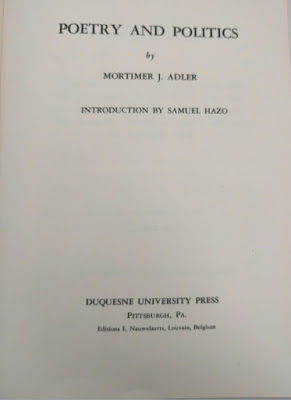
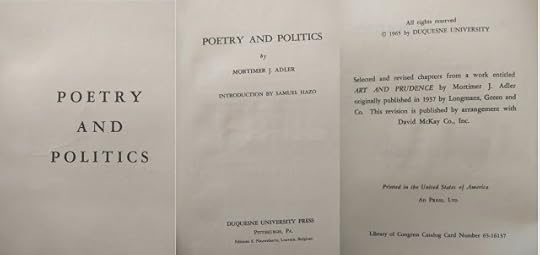
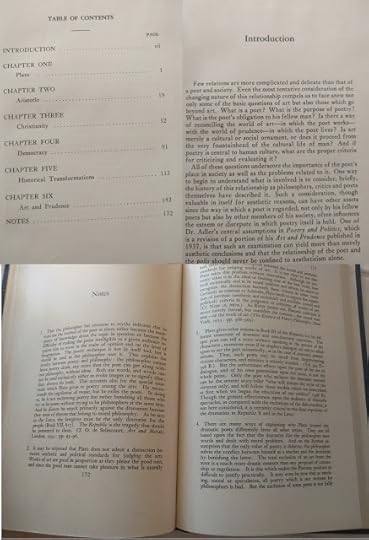
Here is the contents page, the introduction, where it is explained that this whole book is only a fraction of a greater work by Mr. Adler, who was devoted to the study of language in all its forms. He was a serious scholar and an admirable literary man.
I also took a picture of the notes section, so you can see how seriously this man took his work. Recall that this was just a little portion of his work; yet he fills out pages and pages with fascinating footnotes:
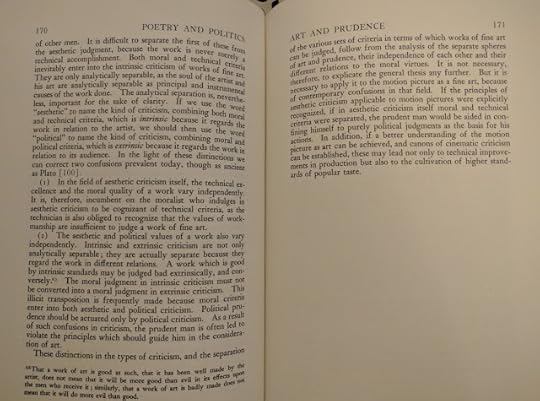
The author's question in this book is to see if arts, particularly Poetry are good or bad for the State. Do arts make the State more prone to corruption, promiscuity and debauchery or if on the contrary, arts promote beauty, good feelings, well being. He analyzes the philosophers, a religious and a political system, history and finally concludes that there is nothing good or bad, only the thought makes it. Below is the last page of the conclusion. I really liked and enjoyed this serious reading from a man that was more concerned about conveying a relevant message and less concerned about his own status as a celebrity. For literature and arts in general, almost all past time was better.
Psst! I have a blog too! Take a look here: http://lunairereadings.blogspot.com
This is the cover and editorial information of the book I read:


Here is the contents page, the introduction, where it is explained that this whole book is only a fraction of a greater work by Mr. Adler, who was devoted to the study of language in all its forms. He was a serious scholar and an admirable literary man.
I also took a picture of the notes section, so you can see how seriously this man took his work. Recall that this was just a little portion of his work; yet he fills out pages and pages with fascinating footnotes:

The author's question in this book is to see if arts, particularly Poetry are good or bad for the State. Do arts make the State more prone to corruption, promiscuity and debauchery or if on the contrary, arts promote beauty, good feelings, well being. He analyzes the philosophers, a religious and a political system, history and finally concludes that there is nothing good or bad, only the thought makes it. Below is the last page of the conclusion. I really liked and enjoyed this serious reading from a man that was more concerned about conveying a relevant message and less concerned about his own status as a celebrity. For literature and arts in general, almost all past time was better.

Psst! I have a blog too! Take a look here: http://lunairereadings.blogspot.com
Displaying 1 - 1 of 1 review