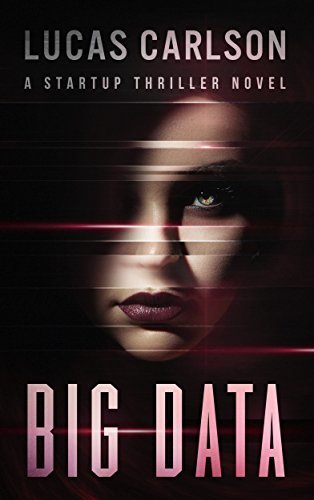
AN AMAZON #1 BESTSELLER CYBERPUNKIf you think artificial intelligence is dangerous, then you don’t know the real threat to humanity’s future… Luna Valencia is the founder of the hottest big data and artificial intelligence startup in history. She’s about to become incredibly rich and powerful. But just when she’s about to take her company public, her world begins to fall apart.
On the day of her startup’s IPO, a stock exchange shooter plummets Luna into a downward spiral toward a threat more menacing than she ever imagined possible. Faced with losing her company, her entire world, Luna searches for answers to a series of terrifying accusations. Failing to uncover the truth could destroy her company… but success would get her killed.
Big Data is a fresh approach to the artificial intelligence sci-fi thriller. If you like fast-paced action, heart-stopping tension, and tech-filled worlds set in the near future, then you’ll love Lucas Carlson’s latest novel.
Lucas Carlson is a bestselling novelist. He takes his first-hand experiences as an entrepreneur and computer programmer, and turns them into thrillers that pack a punch and are hard to put down.
His writing has often been compared to Michael Crichton, Joseph Finder, Harlan Coben and Blake Crouch. They deal with technology and business themes and how they affect society.
This book is about Artificial intelligence. Starts at the New York stock exchange floor. Taye run out of time, he is trying to worn Luna about her software is killing five million people more in a year. Is this population control? How do we prevent evil people from getting their hands on software that one day will destroy us. Cars, airplanes, hospitals, our appliances and homes, just a few for now are runs on software. In this story Gaia Wrath killing very efficiently, without any trace. This story kept me up, had to re read parts before writing a review, thank you Lucas Carlson.
Big Data is a maddening ride through our near future where artificial intelligence is incorporated in our lives to the point that people rely on its services more than on their natural instincts, reasoning and decision making. It serves us, it helps us, it cures us, and then it kills us...
This is exactly what happens when Luna Valencia's most-advanced supercomputer in history Ancien starts to refine and improve on its own code which can “solve many problems in the world of artificial intelligence without human assistance, interpretation, or intervention.” It is the holy grail in the world of computers, but it also is the weapon for mass murder in the world of humans.
Luna Valencia's own baby becomes her executor when it falls into the hands of Doug Kensington and Thor Massino, two ill-intentioned ambitious and unscrupulous people. There is no safe place for her or anyone, because suddenly “people are dying. Everybody. Everywhere. People are dying faster all over—in every region of the world—at a higher rate.”
On her quest to uncover the truth about mysterious deaths, Luna not only faces losing her company but is hunted and chased into walking the path covered with bodies and smeared with blood, both of the innocent and guilty ones. Even losing her own life is something she has to deal with in order to stop computers from killing people. The whole world is in grave danger.
In “a weird mash-up” of computers and people, “nobody was deciding who would die. Nor was anyone determining how these people would die. The computer figured out those parts on its own. But (...) it was human beings who created the intention to kill. Not the computer. The one thing nobody seemed to be able to synthesize with computers was the creative intention. The spark of why. More and more, any discrete task could be better accomplished by computers than by humans. But the intention behind the task, the creative force. That was still as mysterious and intractable as the soul.”
Lucas Carlson in this extremely exciting novel also doesn't lose a poetic expression during this fast and crazy artificial intelligence ride for life and death. He barely gives us a moment or two to catch our breath before we are thrown into another life-threatening situation in which someone is programmed to die. The thin line between our near future and actual reality becomes even thinner when we come to realize that technology already today is infused in so many aspects of our lives. We submit ourselves to it, we reap its fruits and we think we control it. Do we, indeed?
Alarm bells are ringing through all 400 pages of Big Data with the warning. We better snap out of our indifference and, as the author says in his afterword, ask ourselves, “how do we prevent bad people from getting their hands on software that could potentially destroy us? The world’s next generation of mega-weapons will be software. Code in machines. Machines that drive our cars, fly our planes, control our homes, run our hospitals, and do something new for us every day. (…) It is time that we, as a global human race, invent and adopt systems of technological checks and balances. Software is infinitely easier to infiltrate and steal than atomic bombs. And if we sit back and do nothing—if we just throw our hands up and ignore the problem—we will have to live with the consequences. (…) And what’s at stake is the very survival of the human race.”
Luna Valencia has created a platform that allows almost anyone in the world to have access to a supercomputer. This allows for great strides in almost everything that uses technology. It's everywhere, helping to make the world a better place... for now. On the day of their IPO, someone comes into the NYSE with a bomb strapped to their chest hoping to talk to Luna, to tell her about something she had no idea about. What follows is a technothriller where Luna and everyone around her is in danger at every turn from an invisible antagonist.
The narration by Robyn A Roth was well done. She gave the main character a great voice, and the others in the book were secondary characters. There's nothing wrong with that at all as the story revolves around on person. The audio quality left me a little upset. Listening to this in the car wasn't too bad, but if you listen to it on headphones there is a faint fuzzy background noise throughout the entire book. There were a few times that it went away, but only for a few words. I'm not sure if the narrator or the producer/production company is to blame for this, but if it's possible to clean it up, it might be worth the effort.
Lucas Carlson knows how to write. Big Data kept me interested from beginning to end, grabbing my attention and never letting it go. It's one of those books that the first chapter has you looking down the rabbit hole and the last chapter has you realizing that you've been reading the book all day. Honestly, it reminded me of a mix between Joseph Finder and Michael Crichton.
Big Data is extremely rooted in plausibility. It's just one of those stories that you read and think, well, let's hope that we're not shortsighted and ignore all of the warning signs.
I genuinely started this book and had a hard time putting it down. If you are familiar with other Carlson's other Startup Thriller "The Term Sheet", you won't be disappointed. And if you're new to his storytelling -- this is a great story to jump into. Non-stop action interweaving technology and the real world.
Big Data by Lucas Carlson will have you wondering if this is fact or fiction. Can computers be programmed to murder? Luna Valencia is the founder of the greatest Artificial Intelligence company. However, it has come under the control of some people who have ulterior motives and are seeking power instead of humanitarian uses for this powerful tool. Luna is also fighting for her life trying to save her company, and everyone else and the program she created is trying to kill her too.
This book will keep you turning pages, hoping that Luna can save everyone and wondering if this could really happen. The plot and characters are well developed. I highly recommend this thrilling book.
Not just an incredibly smart and beautiful woman, but one who can think on her feet.
Navigating the web of lies, betrayal, and deceit, this woman emerges victorious against her extremely powerful enemies, barely getting out alive, all through her wit.
With startling relevance to the modern world, and its tech oriented approach, this novel really strikes a cord, with a fresh, unique storyline. A must-read!
My first read from author Lucas Carlson raises the question, Why did I wait so long to read this book? I got it back in early December and there are so many books and so little time, I screwed up. Well-written, captivating characters, the storyline grabs you and runs away with you. I've already put another of his books at #1 on my TBR list.
Whole "Super intelligent AI will kill us all" theme is nothing new or original. Generally such stories can be divided into two groups, "AI will achieve sentience and decide to do something to humanity we won't like but AI will deem as necessary" and "people will abuse AI to achieve their nefarious goals because AI is neutral but humans suck". Both have been told and retold numerous times so it's really up to author to give readers some new angle to make story fresh. This book doesn't do that.
This book has three main issues. First one is pacing. Things just... happen. There is little logic or explanation behind events, they just happen because plot needs them to happen. People do things not because they are driven by some inner logic or because of who they are as person, they do it because plot needs them to do something so plot can move on. Which brings me to second point, characters. None of them are really developed and I had trouble sympathizing with them. They are step above cliches and stereotypes, but only a step. And third, probably most important one for book with this theme is that looks like author couldn't decide what kind of company we are dealing with here. At some point it's described as start-up, implying something small to medium sized. Then we learn there are actually numerous investors involved already and company has board of managers. Then we learn that company is dominating (or big player in) several sectors, such as health care, logistics, air traffic. And is big global player to boot.
And ending feels as if author re4ached certain number of pages and realized he has to wrap things up quickly, so everything just falls into place perfectly to give us ending we are supposed to have.
This is the second time I read book from Mr Carlson. And I really like his first one except the ending. But I can say that this is much better. It is much more polished except once again for the ending. Big Data is the sequel from Term Sheet with different main characters.
Big Data is in anyway much more different than Term Sheet. The only similarity they had is main antagonist and it is technology thriller. I can see that Mr Carlson have improved much since Term Sheet. You can feel the smoothness and it flows naturally. The characters are also much better. The characterizations is "cleaner" (read mature) than Term Sheet. Maybe because they are adult instead of teenager. But I am glad that Mr Carlson also include Term Sheet main characters even just for cameo. Make me happy because Term Sheet ending is a little too sad for my liking.
The story itself is very great. I really like it. My problem is there's certain character that I feel unnecessary. I mean I don't really understand his purpose in the story. Nevertheless, I still like this character, if only his role was given more consideration. Once again I say that I have problem with the ending. Actually there's nothing wrong with the ending. Instead it was a happy one. My discontent is it was quite weak. I mean with strong story and strong characters, it was quite a disappointment to have weak ending. There's not enough closure. But personally that's just me based on my experience reading story in the same genre. Anyway, I like that Mr Carlson finished the bad guy this time after what he did in Term Sheet and now Big Data. It was really poetic justice. Overall, I really love this story. And I really really enjoy the story. Cannot wait to read Mr Carlson next book.
Action, terrorism. Wow. loved the action and deceit in this story. If you are looking for action and intrique, this is the book for you. One woman's dream turned into a death machine. Making killing look like accidents Makes one wonder if this could happen now. Maybe it is and no one has figured it out yet.
Lucas Carlson is an amazing writer. Looking forward to his next book
I had previously read Big Data in eBook format and enjoyed it so that when I had the opportunity to hear the audio version, I was delighted This (new) review is for the Audiobook format, my original review follows.
( Format : Audiobook ) ""People are dying ... everybody, everywhere."" On the day that Luna Valencia is due to stand down as CEO of the company she had grown over the previous ten years, the ceremony is interrupted by a man with a gun - and a bomb. But he's no terrorist: just the opposite. He only wanted to speak to Luna and warn her of what he had discovered before it was too late.
This is a thought provoking, fast paced thriller which captivates the attention from the start. Seen mostly from the point of view of Luna and an old ex cop named Alex, the action is immediate and involving. Despite being about computer code and the outreach of the programmes, it is not filled with off putting jargon but, where needed, explanations are made simple enough for even a novice to grasp in a fascinating way. . The narrator, Robyn A. Roth, does a very good job. Surely one of the best of the female audio dramatists, she both reads the text in tune with the action and gives good voice to all of her characters and in particular to the main protagonist, Luna. It wasn't until the closing chapters that I began to have doubts. Nothing drastic, just a wobble in my suspension of disbelief. Somehow, the baddies were just that little bit too bad - or crazy. But it still does not negate the earlier excitement of the book which, given the rapid expanse and intelligence of our computer technologies is a very immediate one; and really emphasises the truth of the quotation at the very beginning of Big Data, The problem is not whether machines think, but whether men do." A recommended read/ listen
( Format : eBook ) "Hello...Is there a problem?" An exciting techno thriller which emphasises that for every good use to which a tool can be put there can also be an equally bad one. It is not the machine but the person directing it. People are dying at an unexpectedly high rate but all of the deaths seem to be from natural causes. They are not. So how? And why? A very interesting idea. Characterisation is reasonable but marred by the over the top villain. Never the less, well worth reading. I received a complimentary copy of Big Data. My thanks to the author
Great story about what happens when advanced technology is in the wrong hands. We all wonder about the recent advances and how it impacts. This story packs a punch!
This is the first book that I have read of Lucas Carlson's and it was very entertaining and well written. The storyline was very fast paced with characters that were well fleshed out. The descriptions of the places throughout the story made me feel like I was there. Big Data was a page turner from the very beginning and continued to the end..
The story was a take on the subject of computers that was fresh and made me think as I read. The suspense thriller was set in the world where a super intelligent computer was programmed to do unimaginable things. Luna Valencia, the woman who wrote the computer program, never thought it would be used for such evil. When Luna discovers the truth, only a select few share her view, but they are forced to run for their life. They are determined to find a way to end the madness.
By the time I got to the end of the book the storyline seemed quite real. Maybe it isn't as far fetched after all. You decide, it's well worth the read.
Luna Valencia is the CEO of Ancien. Ancien is a company that has developed a computer that has the capability to analyze every machine method of learning available. It is the smartest super computer and anyone can build applications on it. The company is about to go public and Luna is being forced out as CEO. On the floor of the stock exchange, just before the company can go public a young man appears. He has a gun and has a bomb strapped to his chest. The gun and bomb are both fake, he just wants Luna's attention. He has been trying to contact her for weeks and this is his desperate way to get an audience with her. He has uncovered something about Ancien that he thinks she needs to know. From this point on the action never stops!
There is a great cast of characters in this book and sometimes you aren't quite sure what side they are on. The action starts and takes you on a non stop roller coaster ride of greed and betrayal. This is a timely book with so much of our lives dependent on computers. Very interesting and original plot. There is a lot of technical language which was way above my head but it didn't take anything away from my enjoyment of the book. Thank you to the author for an advanced copy for a fair and honest review.
Luna Velencia started her own company out of a meek inheritence she received from her family. She built it up and it is the leading application company. But there is someone who needs her company really bad to do bad things to innocent people. She is ousted of her own company. Taye Flanagan is the one person who can stop this evil person, and has temporary. He needs Luna's help in getting Ancien back on track. Alex Sonne is an ex-cop, who is a part time p.i. and part time consulant for the police. His own son died way to early. Could it have been murder, and are these people responsible for his son's death? Can Alex, Luna, and Taye stop these bad people before more innocent people die? Read the book to find out. I was given a copy of this book for an honest and unbiased review. There is a lot of computer jarron in this book, but I understood it enough to get to the heart of the story.
This started out slowly for me but the more I read the more swept up I was and started practically speedreading to see what would happen next. A silicon valley startup's IPO is put on hold when the stock market's opening is interrupted by an armed gunmen. Although she'll now be wealthy beyond her dreams, Luna is being forced out of her own company; but is there a larger plot unfolding? And why has the world-wide death rate started climbing in every nation and every category? Inquiring minds read half the night to find out.
This was a good story. It had shocking moments and moments when you thought all was lost. But, their was always an intervening angel. No one got the girl in the end. And, a hero seems to have slipped. One thing that I didn't like about the story was that it was supposed to tell us what happened to the characters from Term Sheet. Well, we found out all about one but almost nothing on another. But this story was not really a sequel and it stood alone and did a good job of it.
This was a good story. It had shocking moments and moments when you thought all was lost. But, their was always an intervening angel. No one got the girl in the end. And, a hero seems to have slipped. One thing that I didn't like about the story was that it was supposed to tell us what happened to the characters from Term Sheet. Well, we found out all about one but almost nothing on another. But this story was not really a sequel and it stood alone and did a good job of it.
A true page tuner...written smart and not a book you will put aside and come back to, it grips you from the start to finish.
Things happen fast and at the same time the characters are well developed into a really great read -- I after I finished this book I passed it onto my daughter and she loved it because the concept of the technology was something believable in this fast pace world.
Big Data was a fantastically fun read - innovative, creative, interesting. It plays with the idea of using big data and computing for good, and the not-so-good. I ended up reading the whole book in one sitting, which is a rarity - and the warmest possible endorsement. Definitely read this book.
This is somewhat of a Technology thriller. Overall, it's a good read. It read quickly and was easy to digest. Without saying anything else. This is the most important take-away. It was interesting and written well enough to enjoy and consume quickly. I found that there were a lot of leaps of faith how some events unfolded. However, this was probably better than the other extreme of laborious details. It just seemed that there were a number of short cuts to jump from one thing to another. It introduces AI on a very basic level. It could have been a bit more technical. While I rooted for the protagonist, I felt she was somewhat naïve and pathetic in her ability to process what was going on and not throw herself into the hands of the bad guys. However, she was painted as highly technical and more of a software person than executive. In spite of that, I liked her and wanted her to overcome the bad guys. I felt the evil people got away with lots of stuff. I guess the police were incompetent. Again, overall I enjoyed it and would recommend.
A good thriller fiction. The plot starts with excitement and kept me engaged. I finished the book in 2 straight days. However the climax and the ending was a bit abrupt and on second thoughts- unbelievable. How can Doug get away brandishing a gun in public? How did he not see or hear the thing that killed him even with fog? How did such a big crash not take a few more lives? How did Luna get away easily and how did she prove she was innocent?
Overall a good read for the Christmas break. For a techie a light read. Others may love the thrill. Won on all points except the climax.
The message delivered is also strong - it is not technology that can harm us. Not even in the AI age but it is human intentions. And the lack of checks and balances to make sure that some humans don’t use the technology for their greed or perceived beliefs or conspiracies. Business leaders and technology experts have to be cognizant of this role and responsibility. As Spider-Man says “with great power comes great responsibility “! :)
The book explained aspects of technology well enough for a non-technical. Including details like metaprogramming, commit histories, and little technical details that add to the realism.
The story was a bit predictable for me, but I am a writer and former software engineer, so there are likely similarities in how we think. So, I can't count the author off for that. My books even focus on similar themes and cover the importance of software in shaping our world.
It was a very quick read and action-packed. I particularly enjoyed the parting thought after the ending.
What a great book! I always find these books a little scary as my mind wanders and thinks of what could actually happen in the real world. The characters were amazingly detailed without detracting from the story and the bad guys, whew, thank goodness this is a book and not real life (for now). Really great story and characters.
While I agree with author's assessment that humans are much more dangerous than AI, the novel itself is disappointing. The characters are wooden and one-dimensional, the pace is too quick to let you feel anything for them, there's no sympathy for the good guys, no hatred for the bad guys, stuff just happens then it ends.
For a much better startup novel, read "Kill Process" instead.
A nicely paced story about people and ai. But mainly about people. The story was strong enough that it helped carry the characters for me. In this era where we are suspicious of all power the main characters make the right choices and succeed in the end. I couldn’t put it down. I wish I could heal as quickly as these guys.
Be warned; this is a real page turner, with nary a break in the action. Th story was great, as was the storytelling. The only reason I didn’t give it five stars was I didn’t really feel that deeply about the characters, and the story seemed to wander a bit following the climax. Overall, though, a very good read hat should keep you up all night.
This is amazingly well written. Great plot, scary plot, great characters, uncomfortably good action, and a pretty good resolution. Read Term Sheet first to get the full impact.
With cyber crime so prevalent in today's media this was a timely read and also too plausible to make me comfortable. Despite the discomfort, I thoroughly enjoyed the book, especially the frequent twists and turns.
Very disappointed. Thought i was in for a near-future scifi novel, but turned out to be simple thriller, where the bad guys use a "big" computer. Storyline not very convincing, characters neither.