The Unfinished Nation, a concise survey of America's history, is known for Alan Brinkley's clear narrative voice and impeccable scholarship. The book presents a balanced picture that connects the newer histories of society and culture with the more traditional stories of politics, diplomacy, and great public events and individuals.
Alan Brinkley was an American political historian who has taught for over 20 years at Columbia University. He was the Allan Nevins Professor of History until his death. From 2003 to 2009, he was University Provost.
A standard text book for American History 13 March 2012
This was the text book that we used for American History at university, which now I come to think about it was a little surprising considering that despite our lecturer being a huge critic of the United States he selected a text book that has a happy ending. He did discuss this aspect of the book in one of his lectures, indicating that the books that do not have happy endings are generally not all that popular within the American educational system (which is not surprising because who is going to want to teach one's students that their nation is destined for rack and ruin). However, I do not live in the United States, nor did I go to university in the United States, but I still suspect there may be some pressure from the powers that be to use such text books.
Now, unfortunately I did not take any notes as to the text books that he referred to that did not have happy endings but I could imagine that such authors would be the likes of Howard Zinn and Noam Chomsky. The problem with those two is that their writings generally cannot be used as a text book for an American History course. Chomsky doesn't write text books but rather writes books dealing with various topics that he is passionate about. In his books he also tends to explore ideas that ultimately supports his argument rather that exploring the historical development of the nation. While he might reference events that occurred in the 1800s, his focus tends to be more on post-Vietnam America. He also has a strong interest in the Israel-Palastine conflict, so once again his writings tend not to be directly related to American history.
Howard Zinn is a lot different in that he is an American history lecturer (Chomsky is also an academic, but he is a linguist as opposed to an historian) and he has written text books (A People's History of the United States) however his focus tends to be on the average person than presidents, diplomats, and generals. He will look at various periods during the history of the United States from the bottom up as opposed to the top down, as well as exploring the many minority groups that exist within the United States. For instance, with regards to the American Rebellion, he will look at it from the view of the ordinary soldier who has been conscripted into the army and then forced to fight a war that benefits the wealthy land owners. His suggestion is that the rebellion came from the top and was a war of the propertied classes rather than any desire of the people to live in a democratic state. Indeed, when the constitution was drafted it was drafted with the male property owners in mind.
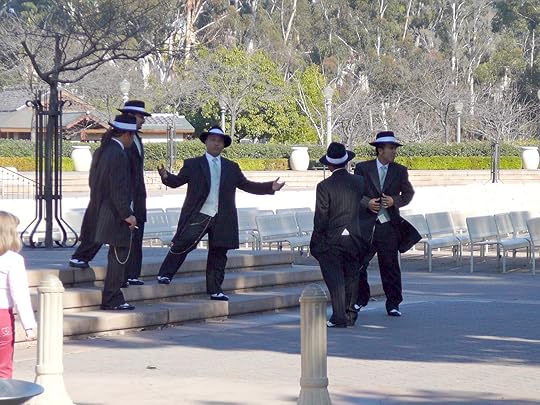
This text book is much more of a generalist text book, so when looking at the United States' involvement in World War II Brinkley is not looking at the soldiers storming the beaches at Normandy but rather the actions of the generals back in England (or at least sitting on their boats in the middle of the English Channel). He does explore some of the dichotomy's within America, such as the desire to be a land of the free, as long as you are a member of the WASP (White Anglo-saxon Protestant) culture. I clearly remember discussions regarding the Mexicans in Los Angeles during the war. In an effort to clean up the gangs the government decided to ban the Zoot Suit, so anybody caught wearing one (usually Mexicans) would be locked up. This was not the first time they did something like this. Earlier it is alleged that one of the factors leading to the criminalisation of marijuana was once again an excuse to lock up and deport Mexicans.
Oh, by the way, this is a zoot suit:
I shall finished off by jumping to the end of the book, namely the 90s, the era where the United States had won the cold war and now sat at the top of the global food chain. Brinkley looks forward to a United States growing stronger and more prosperous and becoming a beacon of freedom to the world. Obviously he could not look through the crystal ball to see September 11, the disputed election of George Bush, and the Iraq War. Nor could he envision the polarisation of the country, and the winding back of the rights of the citizens through wire tapping phones, or mockery of those who hold differing political views. There has always been a fear of Communism within the United States, but we also see that its political spectrum still takes a hard swing to the Right. Even Obama continues to pander to American Corporate interests with regards to his policy making. However, as time has moved on, the failure of the American corporate model has become evident with the complete collapse of the housing market in 2007.
This was my textbook for my American History: Reconstruction to the Present Course. As I am taking my final tonight, I figured now would be as good a time as any to write a review of this (I like reviewing textbooks, I know, I'm lame).
I really enjoyed reading the chapters out of this book, actually. It wasn't boring like most history textbooks can be. This was gripping and fascinating, but keep in mind that I'm also a working towards a degree in history and I really enjoy reading about history regardless of the source.
The only negative comment I can say about this textbook is that the chapters were incredibly long. Like some were near 80 pages long. That's just too much content pushed into one chapter. I think separating the chapters would have been easier for me to read in one sitting and I would have absorbed the material more.
I cannot believe how much I enjoyed a history book. Maybe my interests are getting refined but I know the author has alot to do with how enjoyable this read was. Just concise enough to move forward from early 15th century when Spanish and English settlers discovered and settled the land to the rise of the two party system and the development of the country from an undeveloped continent to a thriving, diverse, economic and cultural powerhouse, the history of America is truly a fascinating one
Easy to follow and understand despite being a non-fiction historical book, but hard to read because of the length of chapters. Very little bias was involved in the writing (however, a professor mentioned a little biased lean in the controversial information in terms of not presenting all views and speculations). Some sections are dull and packed with dates. Something that confused me was the organization of the information. It was organized politically rather than chronologically (with the exception of dividing the chapters by eras) so sections would mention dates far behind or beyond dates aforementioned. There are helpful images and lots of helpful information.
This book has accurate history and reads like a novel. It has interesting information. Also, mine actually has 808 pages. I felt like this book has several unnecessary people mentioned like actors or writers who don't really need to be mentioned in a history book.