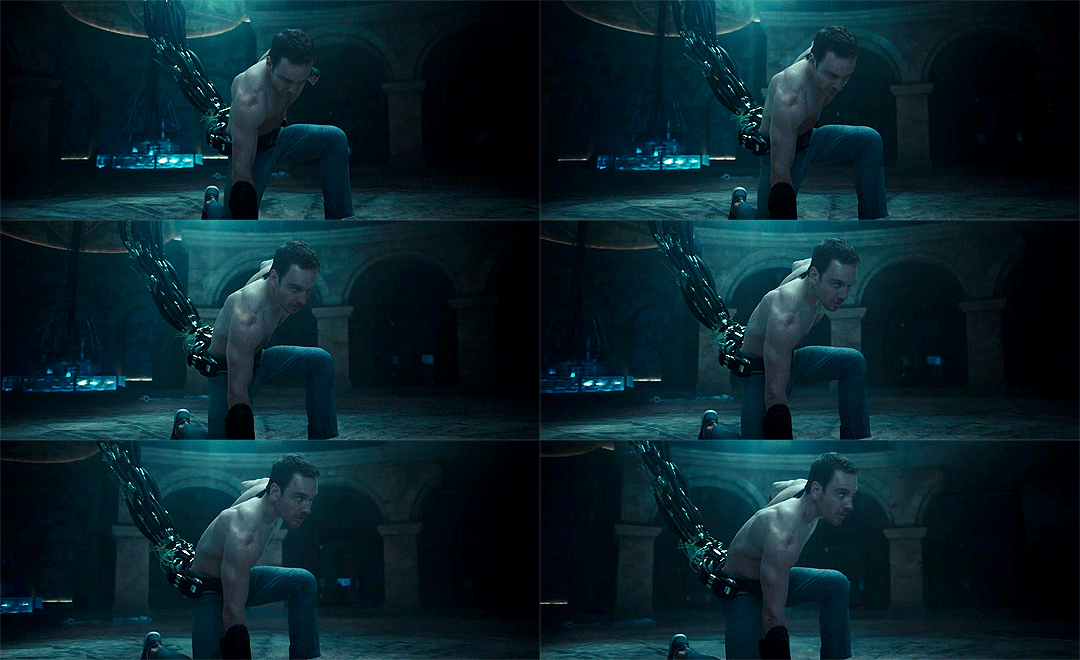
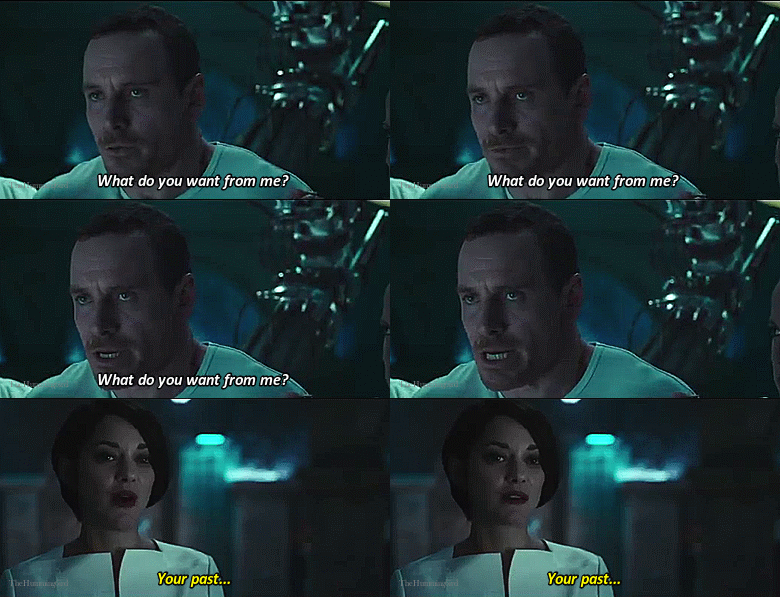
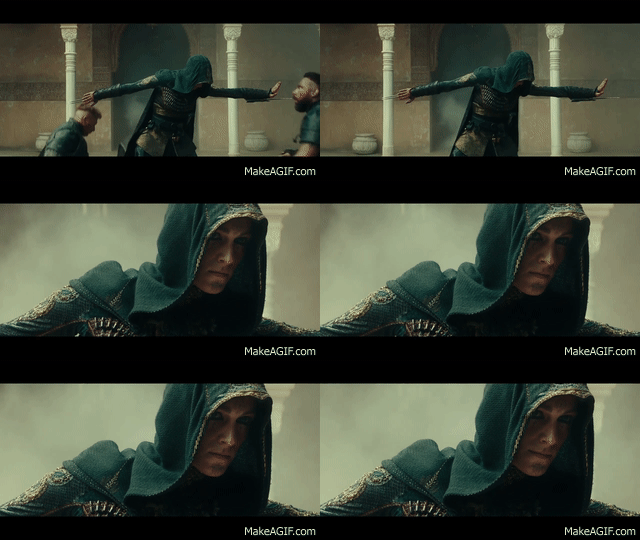
‘’Assassin’s Creed is getting its own movie.’’
I remember how thrilled I was when I first heard the news. For over a year or perhaps longer, I checked every bit of new information about the movie as soon as it was released.
Moreover, it would mean a new installment in the book series would be released. As a loyal reader of the Assassin’s Creed books, I was tempted to pick it up before the premiere. However, since the story would follow that of the movie, I did not buy it when it came out and ruin the surprise. Furthermore, it was written by Christie Golden and not Oliver Bowden, to whom’s writing I had become accustomed and came to love. This new writer caused a sense of scepticism and I decided to wait with the purchase.
When the film finally hit the screens, I immediately went to see it in the cinema. Friends and family were surprised and found it quite odd I was going alone, but I simply love going to the movies by myself.
Do not get me wrong, it was amazing to see the games being turned into this motion picture, but it lacked in some aspects. Especially when it came to the motivations of the characters. Although content with the result, I have played every AC except for the first one and Rogue and am a big fan of the series, I left the theatre feeling a bit disappointed.
My friend and I have this new tradition with which we give each other a book, that we requested, for our birthdays. I asked her to give me the movie tie-in of ‘Assassin’s Creed the movie’ and happily received a copy of it a week after the celebration (the delivery was very slow).
People often say that the book is better than the film. In this case I could not agree more with them, but even this book has it flaws.
Sometimes games are better left untouched.
Writer: Christie Golden
Pages: 319 pages
Published by: Penguin Books, 2016
Rating: 3 / 5
Story:
The story is about Callum Lynch, a delinquent who is about to be executed, but saved from death for unknown reasons and brought to the Abstergo Research Facility in Madrid.
It is here that he discovers his Assassin heritage via his ancestor Aguilar de Nerha who lived in Spain during the fifteenth century, and the ancient war between Templars and the members of the Brotherhood.
Doctor Sofia Rikkin makes use of the Animus in order to access Lynch’s memories to find the Apple of Eden, which contains the seed of mankind’s disobedience.
Nevertheless, as Callum discovers his roots, he himself changes as well. With the gathered knowledge and skills, he will continue the Assassin fight in the present day.

My take:
The main story was quite short, about 255 pages, but a pleasant read notwithstanding. The pace overall was good and never hastened.
Where the movie had its faults, the book made up for them by portraying the motivations each character had for certain actions and especially the relations between them. This, in turn, made the ending of the film more understandable and explained why Sofia is feeling what she does for Cal. I am sorry if that does sound very vague, but I want to keep this spoiler-free.
Besides Callum’s tale, there are also the ‘Regressions’. These short narratives tell you more about the side characters Moussa, Emir, Nathan and Lin, who are also subjects at the research facility.
Each tale couples back to the games, connecting the movie with the original franchise.
First off we have Nathan, whose ancestor is Duncan Walpole. If you have played ‘Assassin’s Creed 4: Black Flag’, you might remember that he is the man you chased right at the beginning of Edward Kenway’s story. We get to see why Walpole turned against the Creed, joined the Templars and came to the Caribbean.
Next there is Emir, who descended from Yusuf Tazim from ‘Assassin’s Creed: Revelations’. His account is about his youth in Constantinople, long before he met Ezio, and how he became a part of the Brotherhood.
The third story is about Moussa’s ancestor, Baptiste. He was a voodoo poisoner that took over the Brotherhood in ‘Assassin’s Creed: Liberation’ after his friend and old mentor died.
Last but not least, Lin and her ancestor Shao Jun, whom we have seen before in the short movie ‘Assassin’s Creed: Embers’ in which she trained under old Ezio Auditore and in ‘Assassin’s Creed Chronicles: China’.
You get more information about her life at court as Zhengde’s concubine before his death. After his passing she joined the Chinese Brotherhood, from which its Assassins saved her.
Characters:
The characters do take some getting to know, which is a good thing when it comes to books, because there is room to form them.
The Assassins:
Callum Lynch:
Callum Lynch transforms from a vengeful delinquent that is haunted by his past into an Assassin who is at peace with his history and brings the Brotherhood back in the modern era.
Moussa:
Moussa is one of the subjects at the research facility. At first he is very suspicious of Callum, but helps him nonetheless when they take over the Abstergo Research Facility and slowly begins to see him as an ally.
Nathan:
Nathan does not like Lynch at all and tries to kill him when the mutiny happens, in spite of the plan to get Callum to join the Assassins.
Emir:
Emir is a very neutral person and not much is known about him. He bonds with Nathan, Moussa and Lin to help Callum and escape Abstergo.
Lin:
Lin is distrustful of anyone and has a love for dancing with ribbons, which stems from her ancestor, Shao Jun. Apart from her feelings, she joins the others in the escape and joins Lynch’s side in his Templar hunt.
The Templars:
Sofia Rikkin:
Sofia Rikkin starts out on the side of the Templars, but she is a scientist first before truly one of them.
Throughout the story, as she gradually gets to know Callum and comes to care for him, despite her job forbidding her from doing so, you see her change her morals and lean more towards the Assassin’s philosophy.
Yet, after the death of her father, she has lost both parents to the Assassins. This leads her to fully join the Templars and continue her father’s work.
Alan Rikkin:
Alan Rikkin is the director of the Abstergo Industries, a member of the inner sanctum of the Templar Order and Sofia’s father.
He is manipulative, even towards his daughter, whom he wants to stand with him in everything he does, and an advocate of genocide on the Assassins.
The only thing he wants, is to acquire the Apple of Eden and bring glory to the Templars once more and he will not let anything get in the way of this.
Style and spelling:
This is the aspect where this work of fiction has the most flaws.
More than once things are misspelled. Take for example ‘warming to the idea’ instead of the correct form ‘warming up to the idea’ on page 317, ‘cooats’ instead of ‘coats’ on page 316 and writing ‘Third Watch’ when it should say ‘the Third Watch’ on page 314.
It is not only missing words that cause an issue, the name ‘Aguilar’ is often spelled as ‘Agular’. Sloppy, is all I can say about it.
Aside from this and already given above as an example, grammar and tenses are sometimes faultily used.
I do not know who edited the manuscript, but that person should have paid more attention to detail. The writer herself should also have been more aware of the mistakes that were made.
Conclusion:
The saying that the book is better than the movie certainly applies once again in this scenario. However, in my opinion, the games remain better than this big production, simply because the story is often better told than they were able to do in the motion picture.
Also, I like Oliver Bowden’s writing more than Golden’s. It contains way less mistakes and the tale is being told more properly and does the franchise more justice.
If you are looking for a fun and easy read that teaches you a bit of history at the same time, I highly suggest picking up one of the Assassin’s Creed books. You do not even have to have played the games to immerse yourself in the universe.
Just be mindful of the storytelling and only pick the ones up by mentor Bowden, because the novice Golden still has a long way to go before she can perfectly describe the leap of faith.