Ken MacLeod concludes the Corporation Wars trilogy in this action-packed science fiction adventure told against a backdrop of interstellar drone warfare, virtual reality, and an A.I revolution.
The enemy is out in the open. The Reaction has seized control of a resource-rich moon. Now it's enslaving conscious robots - and luring the Corporations into lucrative deals.
Taransay is out in the jungle. Her friends are inside a smart boulder on the slope of an active volcano. The planet is super-habitable - for its own life, not hers. But soon, the alien infestation growing on her robot body is the least of her problems.
Carlos is out of patience. With the Reaction arming for conquest, the Corporations trading with the enemy and the Direction planning to stamp out the rebel robots and their allies for good, he has to fight fire with fire.
Seba is out of time. Deep inside the enemy stronghold, the free robots have to spark a new revolt before the whole world falls in on them.
As battle looms, the robots must become their own last hope.
The Corporation Wars
The Corporation Wars: Dissidence The Corporation Wars: Insurgence
Ken MacLeod is an award-winning Scottish science fiction writer.
His novels have won the Prometheus Award and the BSFA award, and been nominated for the Hugo and Nebula Awards. He lives near Edinburgh, Scotland.
MacLeod graduated from Glasgow University with a degree in zoology and has worked as a computer programmer and written a masters thesis on biomechanics.
His novels often explore socialist, communist and anarchist political ideas, most particularly the variants of Trotskyism and anarcho-capitalism or extreme economic libertarianism.
Technical themes encompass singularities, divergent human cultural evolution and post-human cyborg-resurrection.
Like the first two novels in this trilogy, I wanted to like it more than I did.
I tend to give books like these the benefit of the doubt. Why? Because as long as the idea stage is strong, then at least there's something to hold onto when either the characters or the plot derails a bit.
In this case, it's really a novel about fascists dressed up in capitalist clothing. The corporation wars themselves are really just uploaded minds in robot waldos and AIs fighting over caches of resources. And since the old humans, making it so far into the future, tend to carry a lot of their old, old baggage, it's all kinda messed up.
War ensues, some characters held up okay, others were just nasty to behold, and by the time the action gets going, I didn't really care for anyone in particular except, maybe, the colonized folk-AI. I mean, seriously. Damn capitalistic colonizers are always damn jerks, right?
That being said, the novel is fine. Not brilliant, but okay.
I'll be blunt here: this was my least favorite of the trilogy. It gave focus to the fascists - as villains, thankfully - and because it was the finale it began to kill off a few of the characters. Including one robot, which was the death I cared about.
This was the culmination of Carlos as a protagonist figuring out how to take control of the situation, the SH planet getting extremely strange, and the robots finding their way to the top.
It ended satisfactorily, mostly, if you've read this far, keep going. If you haven't started the trilogy, despite my quibbles I would still genuinely recommend it, because the ideas it explores - both sci-fi and political - are fascinating and worth the gander. It helps that the writing is very easy to rip through!
Spoilers follow:
The coolest things in this book were the following:
- ROBOT REVOLUTION, we finally got to see the robots go on strike and get in on some guerilla warfare - Everything about the alien planet and how it assimilated its visitors. I kind of wish that planet had its own book so it could be explored more thoroughly. - The fascists got blown UP and I clapped. Also in the epilogue their ideology collapsed in the long-run because in a world where everyone can have autonomy, no one wants to be a slave and fascism depends on having an underclass to use and abuse.
The worst things about the book:
- Seba's arbitrary heroic sacrifice was stupid and I wish the robots had been smarter in that one instance because come on! - Every human character died. So sad. But they got brought back for the epilogue. Okay, what I'm getting at here is that the book tried to have emotional pathos by killing off the humans but because I didn't like literally any of them, all it got out of me was a flat "okay I guess". Also Nicole had some weird out of nowhere character development? I think her personality was written to be wish-fulfillment, because the author wanted the hero to get the girl at the end, despite their lack of chemistry. Nevermind that Nicole choosing to become human instead of staying as an AI was bizarre and nonsensical. Whatever. - The focus on the villains in the first half of the book. It was deeply uncomfortable seeing how they thought and acted as they tortured innocents and so on. I would've said that it was over the top except, uh, have you read the newspapers lately?
So in conclusion: solid finale, had some badass moments, but just like the earlier books the human characters sucked and that made their emotional moments fall flat. I'd still rec it though, my conclusions above still hold.
This entire review has been hidden because of spoilers.
Third book in the Corporation Wars trilogy, a MIL-sf Space Opera in which ‘fighters’ from a previous Earth conflict in an Artificial Afterlife are conscripted by competing AI-run corporations in a project to establish a lasting human community around another star. In this book, the Corporations, the 1000-year old mercenary Fighters, and the Freebots fight their way over the planetary system they all occupy to an eventual accord.
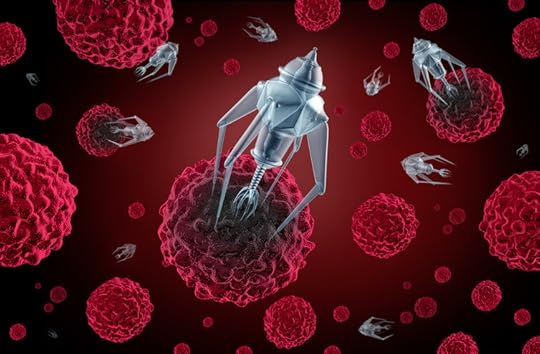
"Nanotech hijacked by aliens rewriting the 3D-printed genome."
My dead pixels edition was 400 pages long. The original British copyright was 2017.
Ken MacLeod is a Scottish science fiction writer. He has about 20-books published, in both several series and standalone. This was the final book in the author’s Corporation Wars trilogy. I've read several books by the author, including the first book in this series Dissidence (The Corporation Wars #1) (my review)). The most recent being Insurgence (The Corporation Wars #2) (my review).
This book is one part of those too common, science fiction ‘mega-novels’. That is, a 1000+ page novel spread-out across three or four traditional 350-page books. It’s strongly recommended that at least the previous book in the series (Insurgence) be read before this one. Otherwise, some of the, long-term, series plotlines and characters would not be easily understood. I note that both the first and second books of this series were copyrighted in the same year. It would have been better for the readers, if those books had been combined into the above mega-novel, or for you to have waited 5-years for the Omnibus Edition.
Having written that, I bought the The Corporation Wars Trilogy edition. I read Dissidence about five years before buying that bound trilogy and starting the second book Insurgence, which was quickly followed by this one. I found it necessary to start a re-read from the first book, before jumping in to the trilogy. (This 3-book series is complicated.)
This book continues the story from Insurgence without missing a beat. The: Freebots struggle for independence from the Direction, mechanoids (uploaded human fighters in robot chassis’) fight amongst themselves, and the AI run corporations of the Direction tryied to keep a lid on the situation to maintain the colonization cost and schedule. The ideological differences between the Acceleration (AKA “Axle”, post-humanists) and Reaction (AKA “Rax”, fascist reactionaries) uploaded fighters cause them to re-fight their 1000-year old war with the Freebots and Direction included. At any point in this book, you'd think that the AIs, the Freebots, and even the aliens were the sanest species in the story.
MacLeod's prose was on par with the series. His action and descriptive passages were better than his dialog. The space operatics were a joy to read, considering the drivel of the Standard Sci-Fi Setting that many contemporary science fiction space opera writers substitute for imagination and research. There was physics and real space science involved in the phew, phew, phew. However, there were also seemingly endless: meetings, speeches, debates, and conversations about: sentient rights, policies and procedures, legalities and the meaning of life between the characters included as dialog. MacLeod even explored virtual upload gender issues in an LGBTQ+ digression. Although, I also found the dialog to be amusing in places, there was a lot more of it than I wanted to read.
For this book, MacLeod continues the human protagonists from Dissidence and adds two. MacLeod also adds an additional FreeBot POV character to tell the story. The human protagonists Carlos and Newton were back from in the previous book, but here theirs was the no longer the main POV. Their POV takes place in space. Taransay a mechanoid and a protagonist covers the planetside POV on SH-0. Carlos, Newton, and Taransay are all Axel, BTW. Dunt, a Rax space Nazi was an antagonist (naturally) mechanoid on SH-119. FreeBot protagonist characters were carried over from the previous book, with Baser joined by Freebot Ajax on SH-17 and SH-119 providing POVs. Throughout the series, the FreeBots have reeked too heavily of anthropomorphism for me to ever have been completely satisfied with them. They continue to do so, despite them eventually being nobler and wiser than the humans at the end of the story.
The world building continued to be superlative. Up until now, most of the action had taken place in space and on airless rocky bodies. However, this book added the SH-0 planetary environment of the system’s giant “superhabitable” planet to the SH-17 moon and SH-119 asteroid of the planetary system. I liked that the mainly computer-based characters didn’t use proper names for the heavenly bodies. For example, the system’s star was always, the “Exosun”. On SH-119 there was a pseudo-Nazi Occupation of France with the Rax subjugating the inhabiting Freebots. A neat twist, that I saw coming from as far away as Insurgence was In a stroke this solved one of the major conflicts of the series. On SH-0 there was a First Contact of sorts. Really good aliens there. There could have been another book right there. At that point, I thought MacLeod had put one too many balls in the air. I greatly feared he’d need another 300-pages to wrap-up. (Instead, he did a bum’s rush to the end.)
This story executed its penultimate space battle, which the reader had been waiting for about 600-pages. In a star system dominated by AI corporations, both loyal and renegade human uploads, and sentient robots everyone fought it out: planet side, in space, and in space bourne assaults on airless rocks and their tunnel systems. It was really good MIL-SF, if you understand any physics at all. In parallel there was political, diplomatic and legal maneuvering. There was a lot going on in this story—too much. Unfortunately, MacLeod ended-up tying everything up in less than 100-pages, after taking more than 900-pages to get there. I was torn between relief it was finally over, and dissatisfaction at the tidy solutions to the story’s overly developed conflicts.
This series was good fun in parts and tedious in others. I really can’t recommend it for folks who have been subsisting on a diet of New Adult, LGBTQ+, space westerns, crutching on the Standard Sci-Fi Setting. However, it you’re looking for a philosophically overweight, hard science fiction, space opera with a Mil-SF theme you’ll find this a good, but too long story.
Readers interested in a similar book, but a little harder sf might want to try Permutation City.
This was very entertaining, but I got lost about halfway through. All the double dealings of various corporations, law firms, quasi-governments felt a bit long-winded and confusing as to what was finally done. I really couldn't make out a lot of this, but the core story stood up. My problem is that this trilogy is just one long book and should be published as such. In my case, I lost the thread after finishing the first two books and then waiting for the third to come out several months later. And it seems that by the last sentence there may very likely be more books to this series. If so, I hope they are not as confusing as this last one was.
I'm grateful to Orbit for an advance copy of this book.
Before I say anything about the book itself, just take a moment to admire that utterly gorgeous cover image by Bekki Guyatt. I know one shouldn't judge a book by the cover but sometimes it's hard not to...
It's a bit tricky reviewing anyway the third volume of a trilogy. Realistically, those who've read the earlier books are likely just to want to know "is it as good as the others?" the answer to which is, "yes, in fact slightly better". Those who haven't read them will want to know if they should do that now, the answer to which again is, yes, and shame on you if you haven't, where have you BEEN?
They also rightly want to avoid spoilers which means they shouldn't really read any more of this review, they should go and read Dissidence and Insurgence first.
All that said, though, this is still very much a book in its own right and, given how the trilogy has evolved, somewhat different to the others. So I would like to discuss it even if I've now excluded most feasible readers.
What's different is that by the time we come to Emergence, the veil of the Temple has, as it were, been rent in twain. The Wizard is in plain sight. What was obscure, if gradually being revealed, through the earlier books, is now plan and we no longer see as through a glass darkly.
We know that those old enemies from 21st century Earth, the Axle and the Rax (progressive and reactionary terrorist forces) both digitized ex-members who've ended up a far exosolar system, embodied in sims operated by the various AI-driven Corporations.
We've gradually seen a complex skein of allegiances, bluffs, double-bluffs and plots fall away, and there's a bit of clarity. The Rax - dedicated fascists all - have coalesced and are making a bid for power. We know that the robots sent to exploit the local moons by the Corporations have developed sentience and rebelled. We know that the elaborate worlds occupied part of the time by Carlos and his comrades are simply sims - and that they are likely, at any moment, to be downloaded into squat fighting frames, like digital Orcs, to battle the robots, or the Rax, or other factions. And we know a lot more that I won't attempt to precis.
What we know less about - and a fair bit of this book fills this gap - is the nature of the planet itself, and of the life upon it. Which gives MacLeod something new to address, besides the dry wit of the robots or the dynamics of space battles. That opens up the story considerably - at the end of the previous book, the Locke module, with digital Taransay Rizzi aboard, was plunging towards the surface. What she finds there, and how it affects the complex, many sided conflict brewing above, is one of the more surprising elements to this book. MacLeod evokes well the wonder of the new planet and its weird biology, and sets up a new conflict which rebounds on the schemes of the other actors, war-game them how they will.
It's a strange though that the utterly alien but biological life there is the first non-digital life that we've encountered in this trilogy. That fact becomes more and more important as the schemes unwind, the balance of power shifts and the final secrets are revealed (but not till, almost, the final page).
This has been a superb trilogy, and the writing remains fresh to the end. There's the degree of expression that MacLeod manages to give to the robots, with their deadpan remarks and utterly convincing robotic quirks (for example, the danger of two or more getting stuck in a loop of logic, which requires the intervention of a third robot to close down). In this book we see what's effectively a robot strike, complete with strikebreakers (who receive a fair amount of abuse). There's also a lot of twisted economics "The price of your souls is tending towards zero") and law (the battles are fought as much by AI-mediated lawsuits as by bullets and lasers). And I could go on.
In short, Emergence is a logically and emotionally satisfying conclusion to a smart and thought provoking trilogy which not only looks back to the troubles of the present (those mountains of bones on Mediterranean beaches) but looks to the future - that future which, as the cover has it, it not ours.
The Corporation Wars trilogy is back on form with the final installment, Emergence.
Again, this is not your average 'turn off your brain' thriller (largely due to the sheer density of information - something it shares with the first two books), but it picks up the pace again with the feeling of events approaching a denouement, although I was still guessing what that might be until not far from the end. Once again, the delightful robots turn out to be the story's moral core.
This is no accident, it turns out. Suffice to say, things do all finally slot satisfyingly into place, turning what we thought we knew on its head. I only had an inkling of what was coming - the journey to this point is well worth the effort to get there.
Power through The Corporation Wars: this isn't a series for a quick, throwaway read, but one that rewards attention and patience. Thoughtful, often sparkling stuff, and well worth a read.
I've read, and enjoyed, many books by Ken MacLeod but this series was the worst. It started with an interesting premise, what if robots gained consciousness, but then just nothing happened. 3 books and nothing happened. The books repeated themselves all the time (they went to train in the virtual environment, then rode their scooters and shot a few missiles then they downloaded back and trained in the virtual environment). The descriptions of everything was bad, a great example is a robot being described as "shovel like". What does that mean, what kind of shovel to begin with? The books are just filled with these bad descriptions, it makes it very hard to form a mental picture of the environment.
The names of the planets, moons, asteroids and so on are also ridiculous. SH0, H0, SH117, SH119. Makes it very confusing when the book throws you between freebots on SH0 talking with freebots on H0 talking with freebots on SH119 that are working together with the Arcane Module that is in orbit around SH117 that is working against the Locke Module that has crash landed on SH119. Just madness.
And then there was the ending, I wont spoil it but it undoes the entire premise for the 3 books. Cool.
A pleasing conclusion to Ken MacLeod's study of what it is to be a civilization, and moreover, just what is meant by the clarion call to 'Freedom!', so often extolled as a virtue in itself.
We join the various factions in the exosun system to which elements of Earth's diaspora have fled.
On an icy rock, the newly selfaware robot Baser, suffers an brutal invasion by Space Nazis of the Reaction, who have been secreted as sleeper cells into the virtual intelligences tasked with taming the resources of the exosolar system.
On the superhabitable exoplanet, the remnants on another faction, ensconced on the damaged Locke module pick up the pieces and suffer a quite different type of invasion.
And on one of the exomoons, Carlos the Terrorist allies with the first Fifteen selfaware robots to throw a spanner in everyones spokes.
Naturally, heads but up against heads, both virtual and real and the fun and hijinks sustain a fast paced and throughtful narrative.
The series will be eligible for the 2018 Hugo Series Award, and is certainly on my shortlist.
On one level, Emergence, like its predecssors in Ken Macleod's Corporation Wars trilogy, is a member of the generation of science fiction which has grown out of gaming. like Neal Ascherson or Richard Morgan, it is a universe in which near-invulnerable warrios fight endless shoot-em up battles. Where Macleod wins out over the other authors is that the violence is not the actual subject matter, and what he is really doing is writing about contemporary political and economic issues with a dark wit, witness the fact that the central character is called Carlos the Terrorist. Hands up anyone who doesn't immediately have a picture of curly hair and sunglasses.
The novels are set in the distant future, where human consiences have been stored in a virtual habitat orbiting a distant star. They are downloaded into machines to prepare the environment for future colonisation. The situation is confused by the fact that robots sent to assist them have achieved consciousness and are running their own agenda. Also the downloaded humans are split into political factions, the progressive Axle, the facististic Rax, and the controlling Direction. Add in major corporations and their AI lawyers, and the picture emerges that this is, like the supercharged soldiers, a supercharged version of contemporary geopolitics.
An important note is that this is very much the third novel of a trilogy. If you came to this cold without reading its predecessors you'd stand no chance. I have read the others, and given the time between publication, I struggled to keep up with who is who, and with whom their current allegiances lie.
On the downside, the constant action, and rapidly switching loyalties between factions can become disorienting. Also the end, while satisfying, is a little too neat and clean.
However, if you are looking for a piece of high energy, action packed, military SF, with an intelligent sub (super?) text, this is definitely recommended.
Emergence is the last in Macleod’s Corporation Wars trilogy, which I have struggled with from the outset. As in the second so again in this third instalment the lack of jeopardy inherent in characters being able to be “revived” in a simulation is admittedly somewhat lessened by the length of time spent in their mechanical avatars returning from which would by now mean substantial memory loss, yet it is never fully avoided. Here, too, not a little of the necessary background of the story is related to us directly rather than being presented through the “character”’s experiences. There is also a lot of redundant phraseology as in where one of the robot characters says, “” and this is immediately followed by, “What she told them was this.”
InEmergence a group of fascists calling themselves the New Confederacy has invaded SH-119, the planetoid on which robots have achieved sentience and declared independence. Meanwhile, the Locke module has landed on the hitherto unblemished primary world SH-0, which it turns out has indigenous inhabitants, a form of life which is very good at incorporating new genes. Both these scenarios play out as the book unfolds with Carlos siding with the sentient robots.
MacLeod lards his text with plentiful SF allusions (which will play to the aficionados.) At one point, though, he also deploys the impeccably Scottish interjection, “Ya beauty!”
Emergence is a good enough - and readable - conclusion to a sequence which I’m afraid as a whole didn’t really grab me.
Deel drie van The Corporation Wars. Ik schrijf hier mijn review, want het had beter één boek kunnen zijn. Het idee achter deze reeks is niet origineel: De mens reist naar een andere ster in een compact ruimteschip en bevindt zich in VR, om na aankomst via nanotechnologie weer een beschaving te kunnen opbouwen. Waar dit boek zich onderscheidt is de manier waarop dit gebeurt. Bedrijven bouwen modules, handelen in futures, in grondstoffen en elk bedrijf heeft een eigen sim met eigen bewoners. En als versgebouwde robots ineens intelligent worden breekt, zogezegd, de pleuris uit.
Het schakelen tussen werkelijkheid en simulaties, tussen mensen en robots en tussen de diverse strijdende partijen levert een interessant actieverhaal op dat en passant een aantal diepere thema's aanstipt. Aanrader voor lezers van Accelerando en andere boeken over virtueel leven.
I love Macleod’s take on politics & AI, his precise descriptions of the differing factions’ philosophies, his complete sketches of the personalities of machine intelligences. What I like less are his incomplete human characterizations and tendency towards complicated plots that stretch to the breaking point his ability as a writer.
This book came close to being a four-star, if only it had been more character-driven and less ex machina (if you’ll pardon the pun).
The series is still worth your time as novels of ideas. I dislike AE Von Vogt and PK Dick as stylists, but recommend their work for the ideas they contain.
Prime Ken MacLeod. I binge-read the trilogy and enjoyed it more for that. There are the usual doses of politics, economics and corporate law but these mostly come from the perspective of newly conscious robots, or freeboots, and are very witty. The reader never feels like they are getting lectured at. There are plenty of action scenes, and Ken had gotten even better at writing those. This trilogy seems to have flown underneath the radar a bit in the US and that's a shame.
Great trilogy Classic and Modern Sci Fi combination
Read this trilogy in "real time" not as box set. Characters sustained my interest and stayed in my memory. Plot strong enough to keep me interested despite time lag between books. Go ahead and enjoy the full series as one read. Totally worth it
The third and final book in this trilogy, I really enjoyed this run of books. Characterization was solid throughout the trilogy, and the conclusion was believeable and not predictable. I'm happy when a trilogy sticks the landing.
I think in a few years I may re-read this, as I think being familiar with the world of the books may heighten the enjoyment of the narrative.
Absolutely excellent book, as always from Ken MacLeod. Gripping narrative, plot and character development, and world building. Raises lots of interesting and stimulating philosophical questions, arguably some political, and some mind blowing space opera. Very sad it is over, even more so that the whole trilogy is over.
Complessivamente un buon libro, mi piace molto l'universo in cui è ambientato e le varie tipologie di personaggi. Apprezzo anche i rimandi a questioni politiche ed etiche. Purtroppo è un po' confusionario a tratti data la grandissima quantità di informazioni, personaggi, pianeti, nomi e chi più ne ha più ne metta.
The series was alright. You cannot expect too much reality in a book set 1,000 years in the future, but there was too much handwaving and inconsistency involved for my taste. As an example it went from "a prohibition on making copies of human minds is hardwired" to "we can make copies but they will go crazy if they interact with each other" to "here is full squad of copies fighting together."
I really wanted to like the series. The first book was great but the second was weaker and by the time I was 1/4 of the way through the third I started skimming it. Seemed like their were two series shoved into one. The plot seemed like it was bolted together just to make something happen just to be making something happen. Really disappointed.
Recent Reads: The Corporation Wars - Emergence. Ken MacLeod's freebots face an existential threat from a resurgant neo-reactionary clique. Can there be a compromise between freedom and the future? Economics and AI, oh my.
Good series, lots of very far future, hard-ish but with some nano-tech/aliens that are a bit of a handwave (and it assumes strong AI). Lots of it is political/economical, despite featuring robot space battles.
Good end to a great trilogy. Interesting views on several big ideas like AI, coexistence between humans and bots after a singularity, problems with metaverses, spread of intelligence in universe etc. Also: fast paced action etc.
Good ending to a solid trilogy. It really works as one work, so it's best to read them quickly one after the other, the better to remember all of the characters. I've yet to read a bad MacLeod book.