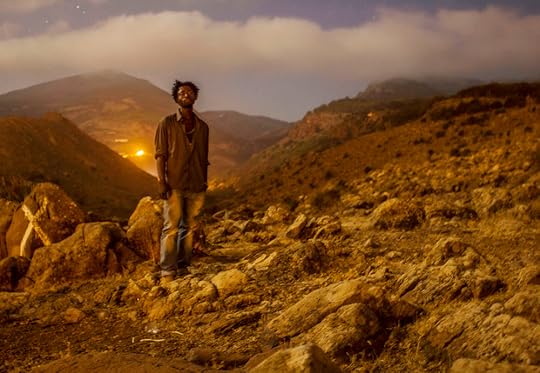
On Mount Gurugu, overlooking the Spanish enclave of Melilla on the North African coast, desperate migrants gather before attempting to scale the city's walls and gain asylum on European soil. Inspired by firsthand accounts, Juan Tomás Ávila Laurel has written an urgent novel, by turns funny and sad, bringing a distinctly African perspective to a major issue of our time.
Juan Tomás Ávila Laurel was born in 1966 in Equatorial Guinea. The Gurugu Pledge is his second novel, and follows his 2015 Independent Foreign Fiction Prize-shortlisted debut By Night The Mountain Burns, which was based on his memories of growing up on the remote island of Annobón. He made headlines in 2011 by embarking on a hunger strike, in an anti-government protest. He now lives exiled in Barcelona.
Jethro Soutar translates from Spanish and Portuguese. He has translated Argentinian and Brazilian crime novels, written two nonfiction books of his own, and recently co-edited The Football Crónicas, a collection of football writing from Latin America. He divides his time between London and Lisbon.
Juan Tomás Avila Laurel is Equatorial Guinea’s most important living writer, but he’s often been persecuted by his own state for his outspokenness regarding their blatant disregard of human rights. This week that disregard has turned dangerous, as Malabo’s infamous security forces have forced Avila Laurel, 48, into hiding for his work as activist. Avila Laurel had planned a sit-in protesting a recent wave of police brutality, and had requested official permission to stage the event, as required by national law. Soon after being denied the requested permission, Avila Laurel was informed that political party El Elefante y La Palmera [Elephant and Palm Tree], which had made the official request, had been declared dissolved by the Guinean government, and that he was one of several activists targeted for arrest without formal charges. The government crackdown centers on the political party El Elefante y la Palmera [Elephant and Palm Tree], known for its peaceful protests of police and government brutality, and is officially focused on the arrest of party founder Salvador Ebang Ela.
-A review copy was sent to me from Disclaimer Magazine in association with And Other Stories. The original review was posted here
The Review:
Authors that write novels about their own personal experience insert a new level of emotion and power into their writing. Juan Laurel immigrated to Spain in protest against the government in Equatorial Guinea. Just like the men in this book, he fled his mother country in search of asylum. His is another story against the backdrop of many who have wished for a better life away from the horrors of corrupt governments.
The novel begins with a group of men gathered around a campfire, and despite their very varied backgrounds and personal beliefs, they share a sense of kinship based upon the idea of immigration, of finally finding refuge in Europe. They are all fleeing from something, something that is haunting their steps. They gather at Mount Gurugu, and gaze at the Spanish enclave that is in the distance: their road to freedom. They tell stories and play football to pass the time, hoping for an opportunity to come their way. The stories are diverse in content; however, they all rest on the theme of escape, of a desire to enter a new land. The truth appears stretched at times and in one case the story sounded more like a moral allegory rather than a man’s personal experience. By doing so Laurel recognises that desperation brings men together: it makes them want to help each other and find freedom.
In the vein of Chinua Achebe’s Things Fall Apart, Laurel demonstrates the power and individuality associated with the African voice. Pseudo-cultures have formed within their gathering, and each story told at night reflects in the eyes of the listener. They have heard the story before because it is also their story: it is the story of the asylum seeker who has had to escape and is now being thwarted in an unjust world. Despite this though, they have no collective identity and as such often struggle to communicate with each other because they do not all share one unifying language. What Laurel shows is the individuality behind each member of the gathering; they share the same purpose but they have not all come from the same place with the same experience: they each have their own unique voice, and cannot be reduced down to a single label.
One question the men begin to ask themselves is one every immigrant must ask eventually: are they welcome in the new country? The locals around Gurugu treat them rather coldly. Some are kind, but some are completely fed up with what they perceive as a nuisance living on their doorstep. Europeans would be even less friendly by this logic. In this we see a distinctively African perspective on the situation. The aftermath of the European colonisation of Africa in the nineteenth century has allowed such political upheaval to arise, but the European powers are doing nothing to recognise it. By giving the African’s such a perspective here, Laurel touches upon humanitarian themes. His writing suggests that it is time to stand up and help rather than closing the doors.
And such a thing is so relevant today
In a Europe that allows the first country of contact to front the financial cost of refugees as per the outdate Dublin regulation, in a Europe that is clearly not unified, change needs to happen. These first countries are often the poorest, and simply cannot afford the refugees. They become unwelcoming and frustrated. In actual fact, Europe takes active efforts to prevent refuges form entering, effectively diverting them elsewhere with little thought of the consequences. What Laurel represents he is the need for change, a need for a wider aid effort and relief system. He represents the experience of the refugee who lacks such a thing. It is one thing to discuss the financial cost of immigration, but it is another thing altogether to speak of the real cost: the cost paid most dearly in human life.
Thus, the desperation of the men begins to speak for itself. I found it rather touching that each man secretly wished to get noticed for hid skills at football and as such get signed on to a major team, though the naivety of such a wish is testimony to the urgency of his situation. They want escape but they are penned up at Gurugu, and a tempest of emotional rage, anger and frustration is building up within them. Ever so slowly, and subtly, the tension is built upon as the novel progresses and by the end the dam is ready to burst. Laurel delivers the final push to freedom with dramatic urgency, once again demonstrating the need for change.
As ever the publisher And Other Stories have provided another excellent voice in translation, allowing its readers to understand the experience of others with a bit more clarity. I recommend this book to those interested in postcolonial theory and literature, and especially those who wish to understand the experience of the refugee in a world that refuses to help.
The story of a continent emptying itself in order to go to another one has to be told, and it has to be told where it's happening.
Juan Tomás Ávila Laurel is the first author from Equatorial Guinea that I have read, and thanks are due to the wonderful And Other Stories and to the translator, Jethro Soutar, for bringing his works into English. His previous novel By Night the Mountain Burns, from the same publisher and translator, was shortlisted for the 2015 Independent Foreign Fiction Prize and it will be interesting to see if this one figures in the 2018 awards.
Gurugu Pledge is set in ‘the residence’, a community of several hundred migrants from different countries in Africa living in the caves of Mount Gurugu, in Morocco but just above the Spanish enclave of Melilla, presenting one of the few land borders into Europe from Africa. Albeit accessing Melilla involves climbing high barbed wire fences guarded by both the Moroccan and Spanish authorities, or a dangerous swim around the coast.
See http://www.giuliomusi.com/photography... for a moving series of photos from the Malian community in the mountains and the real-life stories of some of those in the mountains.
The Gurugu Pledge isn't a novel driven by a strong plot, but rather is told largely by the tales the residents tell each other of their lives before they came to Gurugu, the reasons they left, often personal (as a proverb from the Zambezi basin, quoted by the narrator, one of those in the caves, has it: If you get lost on the forest and don't hear friendly voices calling you home, perhaps you shouldn't have left your house in the first place. ) and of their hopes for the future.
We lived in the forest and cooked enough to still be standing. We gathered firewood and went down into Farkhana to buy fish, or to pretend to buy fish in the hope that some charitable soul would give us some. Of course, if they did, it would always be the least substantial part, such as the head or the bones. But it would provide a little nourishment and warmth, and it was cold in the residence, much colder than on the banks of the River Ruo, where I was born, and saw others born, those I left behind to go in search of new rivers, different riverbanks.
After eating, assuming there was anything to eat, we warmed our hands over the fire, curled up on our cardboard, or under our blankets, and settled down to listen to people’s stories. […] Good folk like Peter. He had a beard from never shaving and he told us that in his village he’d been known as Ngambo. He said he’d once been a porter, though he didn’t say what of or who for; it was enough that he’d agreed to share his story. Ngambo told us he never intended to leave his country, he’d only done so because his father had been discriminated against. Whenever he mentioned his father he sat up, to make sure the details were understood, to make sure the man’s extraordinary good character was never in doubt.
Everyone on Mount Gurugu came from the heart of Africa, had a past like Peter Ngambo and a brilliant future that awaited them in Europe.
The stories which are told are at times rather exaggerated or even fantastical, and the telling is frequently interrupted by questions, commentary, even suggestions on how the tale might be improved, from their fellows. As one says:
Let me finish my story, we'll do the press conference afterwards. )
Football is also key to the residents lives, both to keep them warm in the cold (certainly by the standards of their countries of origin) evenings, and as a visible beacon of hope that black Africans can succeed in Europe. One suggests that if the Moroccan authorities ceded them the land, rather than harassed them, they could declare an independent People's Republic of Samuel Eto'o:
For the majority of those on Gurugu, Eto'o was an inspiration and beacon, even for those who intended to triumph in a field other than football. That's right, triumph. Do whatever or do everything, but do so triumphantly. Triumph might mean a phone call home, or a letter sent from a European address.
The second half of the novel introduces a plot of sorts, with an episode involving abuse of some of the minority of women in the camp, although the story is told in a very elliptical style.
Things happened, happened and had a veil drawn over them.
Of course, in a cave on top of a mountain it's not easy to put up veils, especially when some are quicker than others to realise that men are men, flesh and blood, and especially when those who realise has eyes and a tendency to look, for them they see more than they'd like to see and they realise that a man's small needs can lead him into big traps.
If anything this, and the ‘Pledge’ from which the novel takes its title, rather distracted from the more interesting approach of the aural histories, as did a slightly odd coda from the narrator providing his own commentary on what happened at the book’s end.
Overall – a worthwhile read as a novel in its own right, and an important story that needs to be heard. 3.5 stars.
On February 6, 2014, a tragedy at the Tarajal beach border near Ceuta set the grim foundation for this novel. Over 200 African migrants attempted to swim to the Spanish enclave of Ceuta, a gateway to Europe on the North African coast, but the Spanish Guardia Civil fired rubber bullets and smoke grenades, forcing them back to Morocco, even if wounded, actions survivors say caused panic and led to the deaths of 15.
The Gurugu Pledge unfolds in a migrant camp on Mount Gurugu, Morocco—a melting pot where Africans from a wide array of sub-Saharan countries, having already made the arduous journey to the mountain, now face the final hurdle of scaling the fence into Melilla, another Spanish enclave. They endure the cold, hunger, and the brutality of the Moroccan police. The author humanizes the migrants, offering a window into the reasons they leave their homes and all that is familiar, grappling with systemic violence and colonial legacies in their pursuit of a better life.
Ávila Laurel takes this foundation and crafts a narrative rooted in African oral tradition, flowing through fluid retellings by griot-like narrators, weaving individual stories,, fantastical elements, folklore, philosophical treatise on football, religion, and the plight of women into a cohesive whole. There are dialogues that happened, and dialogues that 'might have' happened. As if the author knew readers (who are mostly accustomed to western conventions of storytelling, lets be real 😂) will be questioning the narrative’s veracity, one of the character, aptly says “I have two strata of listeners and I address each in their own way.” His craft shines in a poem, mentioned casually early on, which subtly foreshadows and later unlocks the story’s climactic resolution through the migrants’ final pledge of defiance
The Gurugu Pledge underscores African resilience, as the narrator, building toward a mass crossing, reveals his reasons for leaving his homeland but justifies never crossing despite making the pledge. He remained on Mount Gurugu, his gaze turned towards the River Zambezi - a symbolic return home. This ending dismantles the notion of Europe as an utopia, exposing it as a harsh, unwelcoming and dangerous place. The griots’ narratives, blending humor, tragedy, and speculation, make the novel a profound reflection on the migrant experience, honoring their endurance and fragile hope.
I loved this book. The story is told on pieces, and obliquely, but forms a whole, though some pieces have to be "written in" by the reader.
This is a story about people arriving at a fence they cannot cross to lands that do not want them. The same lands that came to Afirca and so broke their homes that these people were set adrift.
The attempted migrations of Africans north to Europe is not some organized attempt to remake Europe, it is a wave of individual choices creating ad hoc groups, floating communities bound together only by some hope that somewhere there is a place where strongmen don't rape your wives, cut off your hand, burn your shop...
A sober book with funny moments. A short read but a long trip. For an American reader like me, ajourney to a place I didn't even know existed.
A bit of an eye-opener. You know that Africa is a continent and that there are many countries there, but somehow, when you hear "African immigrant" you often have this homogenous group in mind. This novel makes you realize how many of your preconceptions were just blatant ignorat idiocies. A serious and at times stomach turning book.
I am not sure this is a novel as claimed on the front, it's short and doesn't have a conventional story. But it was so interesting to read about the refugee crisis from an African POV, it's a hard story to read. Some of it reads like a folk tale and some is pure horror full of triggers for violence and rape. So be warned this isn't an easy read but it is worth it just to experience the other side of this issue. The discussion about football is especially good and I will be reading that bit again.
This will count for the read harder immigrant story.
I was surprised how much I enjoyed this novel after a tricky start where I put it down for a week or so and then came back to it. Mt Gurugu is in Morocco, a place where many African migrants gather before trying to scale the fence to a Spanish enclave below. It’s a melting pot, a melange of people from all over the continent. It weaves individual stories, folklore, a philosophical treatise on football, religion and the plight of women into a cohesive and well wrought whole.
I loved the dialogue-heavy first half of the novel as African migrants huddled around a cave on a mountain in Northern Morocco share tales. The story then turns even darker as women of the camp are victims of exploitation, many of the migrants attempt to scale a large fence separating Morocco from one of the city-states of Spain along the Mediterranean coast, and two bodies are left up there possibly lifeless.
Short and powerful, with tales of suffering that will linger.
A book that I can fairly say I appreciate more than I enjoyed. Also a book that I think was sometimes smarter than me, some of those metaphors I did not get. So much for an introduction but overall I think I can say 3* is fair.
Focusing on migrants coming from all over Africa to get hold up at Gurugu Mountain in Morocco, there the wait and try to figure out passage to Europe. The story is told in stories, characters sit down at night in the caves where the seek shelter and tell their stories of how they ended up here. With that we get a look at very different cultures and people who still end up all in the same place with the same goal. This book gives the anonymous group of migrants singular shapes and faces, they are not all the same but they have uniting elements to their stories, often the suppression by white people (sometimes in more direct, sometimes in more indirect but no less harmful terms). But it also looks critically at all the different cultures and the problems that lie within old-fashioned believes and traditions. For example, it was interesting how it looked at the treatment of women, they are not featured as characters themselves, they never get to tell a story for example, but I think this portrayal was meant as a criticism because Ávila repeatedly showed men's ignorance on women's issues and how they mistreat them and use custom as an excuse to not let them have a voice. But I think he maybe could have been a tad more obvious because for a while I was a bit furious about picture painted...
So, this was not an easy book. The story jumps from story to story told by the different migrants reflecting the African tradition of storytelling and relaying history through oral repetition. But with that you don't follow specific characters, we just pop in and out. The plot is not following an arc of typical novel kind and I struggled with that. I did not always like the reading experience while I was in the middle of it but now being done I actually like how this read sits with me. Weird book in that regard but I think it was good that I was pushed out of my typical reading patterns with this. That is partly the point of me picking up books from all around the world, to read different views. And yes, sometimes I will struggle or not like that but hopefully it will shape me along the road. Along those lines, this book was smarter than me and I sometimes lacked the cultural background to catch certain nuances but I think it can work as a reading stepping stone to become a smarter reader in the long run.
The last chapter was specifically harrowing when the first person narrator from the first chapter reappears and tells his story. Not just what has happened to him in the past but also the outlook on the migrants' future, the signals that white cultures and non-black cultures are sending them: it's crushing. So, again a book that I like much more now that I am done and reflect on it than sitting down and actually reading it. I don't think I cared much for the writing style but I do appreciate the insights I am taking away from this.
A novel written from the experiences of Juan Tomás Ávila Laurel living on Mount Gurugu in Morocco, waiting for an opportunity to cross the border, its fences, and gain official asylum in Melilla, Spain.
Laurel's wiring is infused suffering, reflection and anger; the novel portrays him and his journey as a solitary one, yet joined by hundreds of other migrants on this mountain, all of whom are seeking the same seemingly impossible feat of climbing the fence and landing on European soil.
The act of storytelling over fires in caves at night, frames his own narrative with the personal struggles of fellow migrants, resulting in a complex exploration of the migrant condition.
Indefinite periods of time spent on a mountain, highlights the wilderness as once again a place of refuge for those persecuted against by oppressive systems.
Football in this novel is shown to be an incredibly powerful game, with many migrants hoping to become footballers in Europe, because Laurel argues that is the only time Black people are seen and celebrated on TV.
The ending of this novel is Laurel's specific reason for leaving his home country, and then his justification for never crossing that fence, despite the pledge, and taking permanent home in the mountain. This I found interesting given the novel's form structured towards the mass crossing of the fence. So the ending instead serves to tear down the idea that Europe is a utopia; rather a harsh, unwelcoming and dangerous place, forcing Laurel to remain on the mountain further.
The main part I struggled with was the form of the novel, not at all the content. I think so many personal stories, as well as stories from different cultures, were discussed alongside the main 'plot' (but that term seems demeaning) that it felt incoherent. Yet these 'imperfections' of a literary novel, reflect the subject material is the author's (and more generally, the migrants') experiences of being without a place to call home and unable to move freely.
3.5 stars
[will come back to edit once I have gone through the notes, and parts I underlined!]
Review of the Gurugu Pledge by Juan Tomas Avila Laurel, translated by Jethro Soutar
This novel is set on the migrant camp on Mount Gurugu in northern Morocco overlooking the Spanish enclave Melilla.
There are various characters in it and the novel revolves about their life before they came to the camp and also life in the camp. Stories told include the superstitious one about a young girl who transforms in the blink of an eye to an elderly lady or the story of the former strongman of idi amin who turns up in a person's home town with his plundered millions or those of a couple of troublemaker.
Between these, the camp members also have football tournament (though the football isn't particularly good. It is more something to pass time) between teams representing their respective nations.
A lot of the dialogue is very good and humourous particularly the slagging between representatives of two teams.
Though there is also sombreness to the novel (particularly the final section) and Avila laurel does a great job (as does soutar) in the telling of the novel, I thought this was a very good novel and I liked it alot.
I loved the narrative, allowing the text to flow like oral history creation, irrespective of the truth of the stories, irrespective of whether it is the narrator 'speaking' or the characters. There is frequently a circular building of stories involving repetition and amplification that I don't think I've seen before in print. For the most part this obscured the didacticism that might otherwise have grated. These are tall tales woven into a collective truth that is harsh, and it is told in an uncompromising way, particularly damning of the hostility at the border, and recognizing the brutality and lawlessness on all sides when so many people are moved to flee. This book should change more minds than I fear it will. I'll be looking out for his other book, and for other books by this publishing house.
This is a great imprint with many works that are translated. I visit their website to find something to read for the Reading Envy summer challenge.
I first heard about the Spanish enclave of Melilla on This American Life. It is in Northern Africa, but is European soil. Many Africans make their way here to gain asylum.
This story focuses on refugees living on Mt. Gurugu which overlooks Melilla. They live on the fringes trying to determine when they can conquer the considerable border fence.
The narrative device is difficult to get into. Avila Laurel writes much of the story in dialogue between characters sharing their back stories. The more interesting parts take place in the spare narrative between these conversations which go into more detail about the politics and history of Africa and Melilla.
I finished it because it is a quick read, but I was hoping for a deeper dive into the characters' lives.
I would have liked to read it in the original Spanish but it has not been published yet, so English it is. Amazing portrait of the lives of African migrants living on Mount Gurugu, near the Spanish border in Melilla, one of the Spanish city-colonies in Northern Morocco. Several stories unfold as people tell their travels through Africa to reach Europe and have to deal with lack of food and medicines, harassment by the Moroccan police and the hope of climbing the wall that separates them from their dream of getting to Spain. Sad and deep.
Laurel provides a devastating account of African migrants trying to reach European soil, a powerful description of a group of strangers trying to create some semblance of a normal life despite their terrible circumstances, and a genuinely funny recounting of the way people tell the stories that define their lives. Although I wish the women were more than mere vessels for violence, I am grateful for Laurel's reporting about and insight into real-life events I knew nothing about.
I read this for my reading-of-the-world project (Equatorial Guinea). Although I understood the overall plot and thought the overall story to be a poignant combination of funny and sad, I also had a hard time following specific moments in the story and I think I may have missed a lot of the cultural humor. Overall, the structure of the story was strange to me and I never could get comfortable with it.
I wanted to like this book more than I actually did. The premises is so interesting, with African migrants living together close to the Spanish enclave of Melilla. It is relevant, and I do not doubt it is a very accurate depiction of life of these migrants, especially because the author went through a similar experience. But somehow it did not really do it for me.
[#110 Equatorial Guinea] This book is about a group of African migrants reuniting just about the Spanish enclave of Medilla in Morocco. The narrative feels very accurate and real ; you can tell the author knows what he's talking about. However, this book is more of a recollection of moments and lacks a real structure, which threw me off a little.
A sad book about people trying to enter Europe from a mountain in Morocco into the Spanish territory. The story of the Albino teacher was the hardest to endure listening to because sadly, the reality of the live lived by Albinos is heartrending.
A quick read and engaging in the way that it has been told.
Juan Tomas Avila Laurel has a fabulous way of telling a story , so I simply gulped down this book , having enjoyed his other work . Demanding we embrace the complex collective intelligence of the people living in the makeshift forest camp on the side of a mountain in Morocco he manages to write a novel with just the right balance of tragedy and humour.
I can’t lie, I found this so hard to get through in the first half but it definitely picked up as it went along and I found the final quarter really powerful. My main issue lies with the tangents that the narrative went on at times, which often seemed a little too extensive to really benefit the overall story. I did find it really interesting as a whole and the final scenes were very compelling.
Nothing particularly wrong with the book, hence my rating, just not something that's really catching my attention really which is a real shame considering this is my first book from Equatorial Guinea.
Brilliant read. This book was confrontational and engaging, provocative and comforting, a call to arms and a depressing dirge. I was made to feel the life lived large and small in a world completely foreign to me. Bravo.
I think I will have to reread it again sometime and think about it some more. Overall though I found it strong. The rumination on football was my favourite part. The last chapter was a punch to the gut.
Crackling with dark humour, rage and despair, The Gurugu Pledge gives a vivid and sobering insight into the monotony, furtiveness and fear of the displaced.