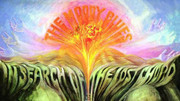
"A legendary steward of the hip musical world...Goldberg plunges into a thorough, panoramic account of the culture, politics, media, music and mores of the year to demolish the idea that it was trivial. He has researched and interviewed widely--his section on underground newspapers is impressively detailed--and he's been there with many of the principals through all these years...Goldberg's deep purchase on his subject and his storytelling ease make it fresh...Personal asides give the account intimacy...[The book proves] that so much activism and passion can be crowded into barely more than a single year. When Goldberg was writing his book, that might have been a useful message. Today, in Trump's America, with a fueled and gathering resistance, it is a potentially mirroring one." -- Sheila Weller, New York Times Book Review "[Goldberg's] newest book, In Search of the Lost 1967 and the Hippie Idea , explores and fuses together the musical, political and spiritual revolutions of the time into a narrative about a moment when 'there was an instant sense of tribal intimacy one could have even with a stranger.'" -- Rolling Stone "Goldberg brings a personal passion that itself illustrates the lasting resonance of the hippie era." -- Publishers Weekly "A reminiscence of the time that brought us Sgt. Pepper and the Summer of Love...A genial you-were-there memoir of a golden age." -- Kirkus Reviews "Written with the acuity of someone who lived through the times he writes about, this is a thoughtful and wide-ranging exploration not just of one year in history but also of a culture and a way of thinking that continues to reverberate today." -- Booklist "[Goldberg's] analysis of what it meant to be a hippie in 1967--sans cartoon clichés--recounts the pursuit of wisdom and joy, as well as a crazy quilt of counterculture cool. And despite the demarcation insisted on by some, he shows that spirituality, activism and business are not incompatible." -- High Times Danny Goldberg's new book is a subjective history of 1967, the year he graduated from high school. It is, he writes in the introduction, "an attempt at trying to remember the culture that mesmerized me, to visit the places and conversations I was not cool enough to have been a part of." It is also a refreshing and new analysis of the era; by looking at not only the political causes, but also the spiritual, musical, and psychedelic movements, Goldberg provides a unique perspective on how and why the legacy of 1967 lives on today. 1967 was the year of the release of the Beatles's Sgt. Pepper's Lonely Hearts Club Band , and of debut albums from the Doors, the Grateful Dead, Jimi Hendrix, Janis Joplin, among many others. In addition to the thriving music scene, 1967 was also the year of the Summer of Love; the year that millions of now-illegal LSD tabs flooded America; Muhammad Ali was convicted of avoiding the draft; Martin Luther King Jr. publicly opposed the war in Vietnam; Stokely Carmichael championed Black Power; Israel won the Six-Day War, and Che Guevara was murdered. It was the year that hundreds of thousands of protesters vainly attempted to levitate the Pentagon. It was the year the word "hippie" peaked and died, and the Yippies were born. Exhaustively researched and informed by interviews with Allen Ginsberg, Timothy Leary, Ram Dass, Tom Hayden, Cora Weiss, and Gil Scott-Heron (one of many of Goldberg's high school classmates who entered the culture), In Search of the Lost Chord is a mosaic of seminal moments in the psychedelic, spiritual, rock-and-roll, and political protest cultures of 1967.
Danny Goldberg is president and owner of Gold Village Entertainment, an artist management company; former CEO and founder of Gold Mountain Entertainment; former chairman and CEO of both Mercury Records and Artemis Records; former CEO of Air America; and frequent contributor to the Los Angeles Times, The Nation, Huffington Post, Dissent, Billboard, and many other outlets. He is the author of In Search of the Lost Chord, Bumping into Geniuses, and How the Left Lost Teen Spirit, and coeditor of It’s a Free Country. He lives in Pound Ridge, New York.
I was not there … after all a bit too young, but I picked up the music some years later. So, did they find it, The Lost Chord? We´ll never know. At the time there were harmony and disharmony galore and the quest for getting into the subconscious through whatever substance available may have contributed to just a tiny bit of confusion. Ginsberg preaching this, Leary claiming that – and a large group of young people who didn´t really care as long as they could have a good time … grooooovy man! Cold War – and tropical hot war in Vietnam – civil rights, women’s´ rights, the Korea war and McCarthyism and just a general generation gap all led up to a field, plowed and ready for counterculture and fertilized by acid and pot. Goldberg´s main theme IS the music and the performers, but he is giving it a context when meticulously going through all the events which led up to the fabulous 1967 and made it shine. Lots of loose ends are tightened up and lots of gossip, like who took acid with who (WHO) is offered and we get an overview of the most prominent “prophets” and the fractions of freaks, hippies, yippies and hangarounds.
I had just finished reading a book about the year 1969 when Amazon.com suggested a book about 1967. I read a sample then continued reading the book, which turned out to be well-written, interesting, and a trip down memory lane. I was especially intrigued that "the hippie idea" was part of the title because I certainly identified with the Hippies in the early 1970's and in many ways I still do.
The story begins on the streets of Haight-Ashbury in San Francisco with a great discussion of the players (Allen Ginsburg, the Jefferson Airplane, Jerry Rubin, Timothy Leary ...) and the scene in the first "Be-in" on January 14, 1967. Author Danny Goldberg moves next to exploring the effect of the media in depicting the new Hippie sub-culture, knowing that in a short time it would distort and co-opt the messages. There is a great discussion of Marshall McLuhan's ideas and a vivid revisit of the peak of an era when newspaper and popular magazine stories were a daily and important part of people's lives.
Next is a memory lane discussion of the incomparable music that provided the soundtrack of the counter-culture in 1967 - The Doors, Jimi Hendrix, The Grateful Dead, Simon and Garfunkel, Bob Dylan, and so many others. The description of the concerts at the Fillmore motivated me to spend some days listening to recordings of live concerts from the era.
The next few chapters focus on the political issues of the time, especially the awakening of black power and the resistance to the war in Vietnam. The descriptions and explanations of the political events were powerful as even a list of the names involved stirs up emotions - Stokely Carmichael, Muhammad Ali, Martin Luther King Jr., Black Panthers, Che Guevara, Eugene McCarthy, Huey Newton, Thurgood Marshall, Moshe Dayan.
My favorite chapter was entitled Flower Power, which began with a discussion of how yoga, meditation, and macrobiotic diet were leading ideas from eastern Asian countries that made major headway into Western culture in 1967, which was also the year spawned "the summer of love" in San Francisco, New York City and various places in between. This chapter was my validity test to see if Goldberg got the "hippie idea" right and I think he did. Essentially, Goldberg sides with Allen Ginsburg, who said at the time: "We have small community groups beginning to leave the money-wheel, and also beginning to leave the hallucination-wheel of the media, beginning to form ... tribal units, societies of their own." I was fortunate to connect to a late wave of this movement in the early 1970's when I lived on an commune devoted to organic farming in southern Missouri.
1967 was a momentous year - yes, I know they all are - and Danny Goldberg captures it in spirit, in stories, and in informative detail. It took me a month to read this book because I looked up a reference on every page to learn more about a person, event, or concept. I love this book.
A timely review of the seminal year 1967 from someone who was, if you will, "in the thick of things." Admirably objective but not unsentimental, Goldberg guides the reader through the socio-political hippie revolution, shattering illusions and preconceived notions all along the way.
I was ten years old in the “Summer of Love” of 1967 and mostly unaware—if not entirely blissfully—of the cultural and political turbulence rocking our nation far beyond the confines of my comfortable New England middle-class home, where the sounds of Buck Owens and the Buckaroos rose from our record player rather than that of Grace Slick and the Jefferson Airplane. Music industry veteran Danny Goldberg—author of In Search of the Lost Chord: 1967 and the Hippie Idea—was only seven years older than I in that pivotal year, but those few extra cycles of the sun put him dead center into an era that extolled youth and decried the over-thirty crowd. As such, Goldberg was both an observer and a participant in what was a radical, albeit fleeting, transformation of America that carved some indelible grooves in the nation, yet often feels as far distant from our times as the American Civil War. In his ambitious In Search of the Lost Chord, Goldberg delivers a well-written and wildly polychromatic snapshot of an epochal moment that is, alas, just about as tangential, unfocused and uneven as the year 1967 was. What Goldberg sets out to do is to describe with one single long rhythmic stroke of his pen all the concurrent aspects of the emerging counterculture that were manifested on both coasts: folk and blues morphing into a new brand of rock; antiwar activism ramping up to radical resistance; the civil rights struggle evolving into militant black power; the sexual revolution; pot and LSD and the drug scene; extreme variations in religion and spiritualism; a renaissance in art and literature; television and mass media; hippies and yippies standing against “the Man.” Sex, drugs, rock n’ roll. And much more. And a huge cast of characters. All in just over three hundred pages. Goldberg tries to do it all, to fit it all in, and of course falls short, but not for lack of effort. In the end, it reads like one long Rolling Stone article, which in style is certainly emblematic of the era he chronicles, a rough blend of memoir, history and anecdote. Looking back, it seems as if America was never the same after John F. Kennedy was murdered in November 1963, but all of the forces that defined the rest of the decade were roiling beneath the nation’s superficial complacency long before Dallas. The Eisenhower years were famously dubbed by one historian as “the time of the great postponement,” because Ike’s failure to act in so many critical arenas simply kicked a plethora of dangerous cans down the road in the fractured landscape of civil rights, urban decay, poverty, and other looming crises. JFK’s death led to the accidental presidency of the less cool-headed Lyndon Johnson, whose cavalier decision to introduce large-scale ground troops into Vietnam proved to be the grand hypocenter for a legion of foreshocks of coalescing discontent. 1967 was the year the veneers cracked spectacularly, unleashing elements equal parts utopian and malign, although that was hardly clear at the time, near the dawn of the “hippie idea.” The real faults ruptured the following year, in 1968, with anarchy and assassination. The problem with In Search of the Lost Chord is that it lacks historical context. Imagine a history of the Civil War that began with Fort Sumpter, with no backdrop to the Compromise of 1850, Bleeding Kansas, Dred Scott, John Brown or the election of 1860. Like those first shots at Sumpter, the ideas and events of 1967 were not products of a virgin birth, but emerged from a long gestation that Goldberg fails to probe. Another complaint is that while the narrative explores the counter-culture, there is almost no sense of what is going on in the rest of the nation or the rest of the world in 1967, with all of those people who were not hanging out with George Harrison or Jerry Garcia or Alan Ginsberg or Abbie Hoffman—with the vast majority of the country who were listening to Nancy Sinatra on the radio instead of Janis Joplin. Conspicuous in its absence is the larger picture of what was going on in the jungles of Vietnam, in the Cold War standoff with the Soviets, or with LBJ’s Great Society experiment; yet each and every one of these are critically related to the social revolution gaining ground in San Francisco, L.A., New York City and beyond. The audience to Goldberg’s book comes upon these various movements and the people that made them much like Gulliver washing up on a distant shore to find strange cities and exotic inhabitants like none he has ever encountered before. I lived through the era, so I recognized most, if not all of it. A reader of another generation would simply be lost. To his credit, Goldberg does include a timeline of 1967 events as appendix, although it is too brief and disconnected to the narrative to be of much use. More helpful perhaps would have been a biographical index of the large number of individuals who people this chronicle, since so many names are dropped it is a great challenge for the reader to recall all of them and their various connections. It is manifestly impossible to describe the LSD experience to someone who has never dropped acid. But you need not have lived through 1967 to study it as history. Goldberg is a fine writer, but he is no historian. Given the year and the topic, it may especially verge on cliché to describe Goldberg’s effort as kaleidoscopic, but nevertheless that is often what the narrative feels like, packed with so much material tossed at the reader from so many angles that in the end it is far stronger on content than on coherence. That may be more of the fault of the editor than of the author, but it remains a fault nonetheless. That is not to say I would advise against reading In Search of the Lost Chord, only that it cannot be your sole guide to 1967, because if it is, you will no doubt find yourself disoriented: it won’t be a bad trip, just a confusing one. In 1973, sixteen years old and wearing shoulder length hair, six full summers after the “Summer of Love,” I was among 600,000 people at Summer Jam at Watkins Glen—according to the Guinness Book of World Records the “largest audience at a pop festival” ever—listening to the Grateful Dead, the Band and the Allman Brothers. The chord of that hippie era I was trying to embrace was already lost to us, but we did not know it then. Nixon, who had come to represent all that was wrong with America, would resign the following year, in the wake of Watergate. But not even seven years later, Reagan was President and America rewound to Eisenhower. Revolution and renaissance were indefinitely postponed. A half-century later, we can perhaps remember 1967 best as a year that promised a great many possibilities, most of which went sadly unfulfilled. As this review goes to press, on the final day of 2017—perhaps the worst year in American history since 1968—the metaphorical “lost chord” of 1967 seems even further beyond our reach. Still, this has ever been a nation of reinvention, of reimagining ourselves, of stubborn and irrepressible optimism. Reading Goldberg’s book is a reminder that there was a time that optimism put on legs and took to the streets as well as the airwaves. We may never find that lost chord, but we may yet again strike a new one that carries longer and with more vigor, in the years to come.
[Note: I read an Advance Reader Copy edition of this book, as part of an Early Reviewer’s program.]
This is my second reading, and I appreciate the research the author did, and I appreciate the moving spotlight, but I don't believe the author needed to insert himself in the work.
In Search of the Lost Chord: 1967 and the Hippie Idea by Danny Goldberg is a magnificently in-depth and well-researched look back at the world of 50 years ago. Goldberg brings to life the hippie idea of peace and love, of ‘turn on, tune in, and drop out’ that reached its height in 1967. A fascinating read.
(Advance Reading Copy obtained by request from Edelweiss.)
Danny Goldberg has written a powerful book that will be of interest to readers of all ages who want to find out about the influences in the 1960's that impact our world today or who just want to have a fun time experiencing the sixties through the eyes of someone who is a perfect person to write this book. Danny Goldberg combines considerable experience within the music industry with significant experience in politics and social change into a book that is easy to read and profound in its insights.
There is a chapter titled Before the Deluge (1954-1966). Timothy Leary said, “If you want to understand the sixties, you need to understand the fifties.” For example, JD Salinger’s novel Catcher in the Rye “inspired millions of teenagers to mock ‘phonies.’”
There is a chapter on the media and the messages. Marshall McLuhan’s famous statement that “The medium is the message” is only one of McLuhan’s many contributions as laid out clearly by Goldberg. He also published, for example, The Gutenberg Galaxy in which he described the effects of television on the world.
In the chapter on Black Power the strength of Muhammed Ali was front and center. Goldberg included his famous quote, “No, I am not going ten thousand miles (to Vietnam) to help murder, kill, and burn other people to simply help continue the domination of white slave masters over dark people the world over. This is the day and age when such evil injustice must come to an end.” This quote was followed by singer/actor Harry Belafonte saying of Ali, “He was in many ways as inspiring as Dr. King, as inspiring as Malcolm. Out of the womb of oppression he was our phoenix…They could not break his spirit nor deny his moral imperative.”
In the chapter on Flower Power Goldberg wrote, “The lack of mutual respect between unions and the counterculture would be bad for both movements as the subsequent decades unfolded.” He surrounded that statement with examples.
As an influential senior record company executive, Goldberg inserted music from the sixties throughout the book to support the points he has made. To accentuate what he wrote about the hatred of Lyndon Johnson and his support of the Vietnam War Goldberg included the Tom Paxton song lyric, “Lyndon Johnson told the nation/have no fear of escalation/I am trying everyone to please. /Though it really isn’t war/ We’re sending fifty thousand more/To help save Vietnam from the Vietnamese.” Goldberg expanded on this music focus in his 2008 book, Bumping into Geniuses: My Life Inside the Rock and Roll Business.
Goldberg completes this comprehensive description of the sixties with a 1967 timeline and a detailed list of sources related to the story he has told.
As a boomer, some of this read was just the nostalgia of it all. However, I wanted more from the book. I wanted an argument as to what made the 60s so different. While the author provided history that I wasn't aware of during the time itself, I was a bit disappointed that more of the dots weren't connected.
En fin bok om hippiebevegelsen og året 1967, en bevegelse som skapte mange romantiske idéer om fred og kjærlighet både den gangen og i tiårene etterpå. Her får vi presentert det historiske bakteppet i etterkrigstidens USA. Med en sterk antikommunisme, McCarthyisme, rasisme og etter verdt krigføring i Vietman. Vi blir kjent med hippiebevegelsens foregangsfigurerer; forfattere som Allen Ginsberg og Ken Kesey. Skuespillere som Peter Fonda, Peter Coyote og Jack Nicholson. Og ikke minst aktørene innenfor pop og rock. Aller mest The Beatles, Grateful Dead og Jefferson Airplane.
Hippiebevegelsen viste seg å være kortlivet og myteomspunnet. Kanskje kvalte den seg selv i rus, vold, kommersialisme og indre stridigheter. Kanskje ble den knust av medier og myndigheter. Av brutalitet i møte med politi og rettsvesen. Kanskje ble bevegelsen aktivt forsynt med LSD av CIA som et ledd i ødeleggelsen av et samfunnsforstyrrende element, et syn som målbæres av noen av datidens aktører den dag i dag.
Forfatteren var selv til stede som tenåring under disse begivenhetene i 1967. Som forteller er han en relativt sindig og beskjeden observatør på utsiden, noe som gjør boken sympatisk og troverdig.
Indre stridigheter er nevnt. Disse var til stede i fullt monn innenfor bevegelsen. Sterke krefter ønsket aktiv bruk av vold for å møte brutaliteten i samfunnet. På den andre siden fantes Martin Luther King jr. som forfektet et fredsommelig standpunkt. "Darkness cannot put out darkness, only light can do that."
A dry and not particularly insightful overview, by which I mean it is a fine, Wikipedia-style compendium for future reference, geographically wider but temporally narrower than The Haight-Ashbury: A History. It is a history, and not a memoir, lacking enough personal aspect to differentiate it from many other journalistic reports of that era. The closest Danny himself comes is to disclose that while still in a New York City high school in 1967 he took acid at the movies, a teenage stunt that misses the entire character of "the hippie idea" he claims to be searching for.
It's nice to repeat how KMPX got its start (told in better detail in the Haight-Ashbury book), and hundreds of other factoids, but it's information that doesn't take you any deeper into knowing what it was all about. Even for its inclusiveness, the author left out many pieces of the puzzle, e.g. Raymond Mungo's Famous Long Ago: My Life and Hard Times with Liberation News Service and Hunter S. Thompson's Hell's Angels: A Strange and Terrible Saga.
I have thoroughly enjoyed my ‘Advance Reading Copy’ of IN SEARCH OF THE LOST CHORD: 1967 AND THE HIPPIE IDEA from Akashic Books. I jokingly told my husband the book could be our own memoirs! IN SEARCH OF THE LOST CHORD: 1967 AND THE HIPPIE IDEA by Danny Goldberg is a social and cultural and personal history of the year 1967. It is certainly concise, well-written and well-documented with just the right amount of personal thoughts and anecdotes. The book contains a Table of Contents; an Introduction; 9 chapters; an Epilogue; a 1967 Timeline; Sources and Acknowledgements. Danny Goldberg’s Introduction tries to define and describe the 1960’s. He graduated from Fieldston High School in New York City in 1967 and “the sixties had a lasting influence on me and many of my closest friends from that time.” (I would totally agree with that statement.) There were many ‘shadowy’ elements to the 1960’s and 1967, in particular - the black cloud of a military draft; the loss of faith in authority; civil rights’ changes and tensions; the Vietnam War; the “communal sweetness and tribal intimacy” of the hippie movement. There were so many significant events in 1967 (see the 1967 Timeline). The Human-Be In in Haight-Ashbury; musical milestones - Jefferson Airplane’s Surrealistic Pillow - Sgt. Pepper’s Lonely Hearts Club Band is released - the Monterey Pop Festival; the Summer of Love; anti-war protests; race riots; Muhammad Ali refuses the draft; debut of Rolling Stone magazine; drugs. It is mind-boggling that 1967 was such a busy social, political, musical, cultural year of changes! My reactions and favorite bits: p. 20 the Che Guevara reference “Forces in the government and corporate America conspired to crush the cultural rebellions, but they were aided by infighting on the political left, a syndrome which, legend has it, led Che Guevara to quip that if you asked American leftists to form a firing squad, they’d get into a circle. (I love that!) p. 21 “As the decades passed, the music of the period would prove to be the most resilient trigger of authentic memories.” (That is certainly true for me.) I liked Chapter 2 - Before the Deluge 1954-1966 I liked the tv and entertainment references - Rowen & Martin’s Laugh-In, Firesign Theatre, the musical HAIR, the Smothers Brothers Comedy Hour, The Beatles, Grace Slick (I could go on and on - all triggers for me) The references to Martin Luther King Jr., Robert Kennedy and Eugene McCarthy. The term ‘made out’ - one doesn’t hear that expression much anymore. The Epilogue with its references to The Whole Earth Catalog and Tom Hayden. Environmentalism, vegetarianism, health foods, pot, LSD, yoga, Eastern mysticism, free love, alternative media choices - making their way into the mainstream of cultural life. An excellent book. I think it’s time to listen to my Sgt. Pepper album!
In Search of the Lost Chord: 1967 and the Hippie Idea by Danny Goldberg is a contextualized snapshot of 1967 and from that snapshot a statement of what the "Hippie Idea" is, was, or might be. While music plays a large role in the book this is, as the title states, about the Hippie Idea and not just another book about the music of the time, so read the entire title before mistakenly buying a book about just music. That said, the hippie idea is so entwined with the music that this will lead to a better understanding of the music.
In presenting 1967 as the apex of the hippie moment Goldberg does a good job of going back and showing what ideas came before this moment. Those ideas were important for they both influenced the hippie idea as well as represent what the idea was trying to counter. The first couple of chapters present a broad background while each chapter presents a smaller, more focused, contextualization as it pertains to each topic.
The personal narrative that weaves through the book serves as a wonderful way to show that any sweeping statements about the period are bound to be flawed. Events and ideas were sweeping the country, no doubt, but at different speeds and with different manifestations. By highlighting his own experiences Goldberg illustrates just some of the ways that those ideas were taken in or resisted. For those of us with our own experiences of the period it provides yet another dimension to what we know (or think we know) about the time.
The strength of this book is less about any new information you might not have known and more about connecting the dots. Taking both what we already knew (which Goldberg expresses succinctly) and the new information we might not have known, then constructing a fabric of the country rather than simply a music snapshot or a political snapshot, or any other narrowly defined snapshot. When we see the commonalities between social, cultural, and political events and movements we get a better glimpse at what the Hippie Idea might have been.
I would recommend this to anyone interested in the history of the period, especially cultural history. It is also a wonderful trip down memory lane for many of us, reminding us of what we might have believed and hoped for at one time and maybe still do.
Reviewed from a copy made available by the publisher via LibraryThing Early Reviewers.
Goldberg mixes personal reminiscences and historical fact in an interesting and enlightening overview of the '60's counterculture and the "hippie" movement. He explains the social, cultural, artistic and political developments of the era, with particular attention to the San Francisco and New York City scenes. If he goes into perhaps more detail than one might really want regarding the various spiritual movements surrounding the era, the book nevertheless works as a solid, relatively short survey of the people and events which made this an important era. I thought that Goldberg does an excellent job with the difficult tactic of interweaving his own personal experience as a high school student in NYC and a Berkeley resident right after that (with a short stint at U Cal Berkeley); this brings a personal perspective, located at ground level, to the broader trends and developments that are described.
I do want to mention one small item in the book. I never paid much attention to the Muhammed Ali story. Goldberg in relatively short order lays out the story of Ali's refusal to be drafted, his reasons, the reaction to this and the consequences for Ali. I was not aware that Ali had been offered, but refused, a "way out" by the Army--they would conscript him but allow him to serve by engaging in exhibition boxing matches. Without overpraising Ali, Goldberg made me really appreciate Ali's integrity and moral courage.
combines archival research, interviews, and personal reminiscence to paint a picture of 1967. generally sympathetic to his fellow hippies and their ideals, which is a nice change of pace -- i can't remember when I last read something about Tom Hayden that wasn't entirely condescending, for instance.
he has a background in music journalism and gives a lot of emphasis to that slice of the pie, not always to great effect. He's so enamored of Dylan, for instance, that he just sputters to a halt at one point by saying there is nothing original to say about Dylan.
Writing about a year rather than a specific angle (anti-war protests, drugs, women's movement,......) or event [human be-in in San Francisco, the day before first Super Bowl!] makes for occasionally jarring juxtapositions as he travels quickly across subcultures and ideas -- here's a page on Stokely Carmichael and then a paragraph on Afros and then we're back to a Jimi Hendrix solo that blew everyone away and then.....
i guess this is not a new revelation, but times sure have changed. "police [were] described as 'pigs' for the first time in an SDS newsletter in September 1967, and [the group issued] a resolution condemning Jefferson Airplane for their Levi's commercials." (p. 257). As you may have heard, police-community relations remain a live issue, but i get the sense that 50 years of corporate shilling have kind of inoculated rock stars against the "sell out" charge for the most part.
Danny Goldberg presents a well-researched compendium of events that occurred in The United States during what he considered a momentous time in American History.
Inspired by his own individual memories and life changing influences Goldberg goes back in time to chronicle many of the key players and events of that year. Focusing on both political and cultural aspects he swings back and forth between the two coasts of the US. Much of the action he chronicles occurred in either San Francisco where the Diggers and Haight Ashbury held court or in New York City where the Easy Village, The Fugs, Allen Ginsberg and many others influenced the young of America to act.
Additionally, the role played by enlightenment, rather through drugs, agape, spiritual exploration and political awareness are highlighted. Martin Luther King, Timothy Leary and Richard Alpert (Ram Dass), Bobby Kennedy and so many others are mentioned for their contributions. Another major focus are musicians: Grateful Dead, Jefferson Airplane, The Beatles and others are part of this story.
An overall quick read, in the end it lacks depth, insight and overall historical and cultural significance. In some way it reads like a long Wikipedia article. Despite its limitations it is a fun read of a unique time in our cultural and political times, which in many ways still influence the arc of American history.
My teen years were spent in the 1960s, and that era has held a fascination for me ever since. I have an ever expanding shelf of books on the 60s. Danny Goldberg’s In Search of the Lost Chord: 1967 and the Hippie Idea will take its place among them. Goldberg, too, was a youth during the time, and his experiences were far closer to the hippie culture than I ever got. So much of his reporting comes from personal experience, and the rest is well-researched. I enjoyed reading the tales he spins. Some I had already heard; others were new to me. Goldberg covers every aspect of 1967, political, musical, cultural, and historical. I do have to say that his title misled me. I had hoped if he had gone “in search of the lost chord,” he would have gotten an answer. And, I suppose, he does offer answers, but I guess I wanted some sort of epiphany about the era, an explanation of why it has a hold on me personally. But perhaps I didn’t read closely enough, question myself deeply enough about what I read. For those who want an entertaining account of one year during the 1960s, a pivotal year, then this is a fine book.
Danny Goldberg has been in the music biz in various guises since the early 1970's: publicist (Led Zeppelin), record company President (Swan Song), chairman (Warner Brothers), owner (Gold Mountain records), manager (Bonnie Raitt, Nirvana and now Steve Earle, The Hives). In 1967, he was a high school student, like I, finding his way through music and the drugs. Through extensive research and interviews, he gives a cleared eyed view of the the year 1967, when flower power, black power, transcendentalism and more blossomed and then faded. I was just coming of age in 1967 and still remember the day I bought Sgt Pepper's Lonely Hearts Club Band (one of the first albums I bought with my allowance, saving up for weeks) Growing up in the suburbs meant it took a bit longer to get the word on what was going on, sometimes to the point that the going on done finished. Danny grew up in NYC in a socially progressive family and was in tune through his progressive high school and his parents network to events happening and could jump on the subway to get to them. For anyone interested in this era, one cannot go wrong to read this book. Highly recommended.
Goldberg focuses on one year, 1967, and uses it as a prism to explore what led up to it and what's happened since. He places some of the more notorious people and actions in a much broader and meaningful context.
Goldberg writes from a privileged position, since he was in high school at Fieldston at the time and his classmates included the children of some of the era's most influential people and kids who would go on to make marks on society in their own rights. I was (am) a couple of years younger and, in the Philadelphia suburbs, was removed from and often unaware of the people and history he describes.
A couple of criticisms: amid the history and analysis, Goldberg drops in periodic personal reflections that read like self-defense. No need. Also, less than thorough editing has resulted in some repetition from chapter to chapter: repeated identification of people who have already been introduced, quotations used multiple times, etc.
All in all, though, I enjoyed this book and recommend it.
I love pop culture of the sixties, especially the mid to late period where there is a huge explosion of creativity in Music, TV and Cinema. 50 years on, Danny Goldberg examines the different aspects that influenced, promoted and formed 1967 and the Summer of Love. After an initial introduction, Goldberg makes the brilliant decision to follow Timothy Leary advice, “If you want to understand the sixties, you need to understand the fifties.” This is a brilliant idea and not something that I've seen in a lot of books about the sixties and certainly set things up for what develops throughout the decade. The sixties was not made up of one thing but lots of separate ideas and ideals brought together. primarily in California, New York and London. Danny Goldberg looks into Anti-Vietnam War protests, The Civil Rights Movement, Psychedelics, Eastern Spirituality and a questioning of materialism as well as the influenc eof Music and the media in spreading these to a wider audience. It is brilliantly researched , well-balance and a must-read for anyone with an interest in sixties culture.
Personal and often beautiful articulation of the hippie dream from someone who lived through it. Goldberg is impressive in his coverage of the key events and personalities of the movement - the drugs, the music and the movers and shakers are all here. He is also very fair-minded in his assessments of the strengths and weaknesses of the dream. I love this era of Western history and particularly enjoyed the explanations of the links between the hippies and other social movements who were active at the time and both intersected and opposed the hippies. The influence of Eastern mystics and religions are also discussed in considerable detail. Rather than looking back in anger or cynicism, as would be tempting, given the lack of visible gains in regard to the hippie ideal, Goldberg writes from the perspective of someone who is obviously sympathetic to what the movement was trying to achieve and perhaps ultimately still believes will be achieved in the long run.
The "hippie idea" is much deeper than the superficial elements of the 1960s that feed off nostalgia. As Goldberg writes, it is about what it means to be a happy and good person. It's a connection to others. It's the moral imperative to fight for civil rights and against war. It goes beyond fame and fortune to include peace and love.
Goldberg has a fondness for 1967, making him a good author of this retrospective. He also has a fair sense of how to incorporate critiques of iconic groups and individuals of the era. And he insists on assessing radical politics of the time alongside the more well-known music of the period.
Movement organizers may not have had much use for the "hippie idea," but Goldberg makes a persuasive case that cynics shouldn't be so dismissive of the space that hippies opened up for radical activism.
1967 is a year Danny Goldberg considers pivotal. His research details the musical, political, spiritual, cultural landscape of '67. The lost chord of the title "in 1967 was the result of dozens of separate sometimes contradictory "notes" from an assortment of political, spiritual, chemical, demographic, historical and media influence that collectively created a unique energy." (pg 16-17)
This is an in depth study that may be a recall of those intimately familiar with the times or a chance for others to gain deeper understanding. The American Bohemian can be an intricate critter and this book effectively captures the hippie movement. Danny Goldberg leaves no stone unturned. He includes an extensive bibliography and a 1967 timeline.
This is definitely a well researched trip to the past.
Goldberg's idea of a "subjective history" is mostly a failure, but I don't doubt that he did his research. At times it feels like a loosely researched textbook - simply a laundry list of names, events and concepts that lack contextual placement. Also disappointing is his unfulfilled promise of personal inclusion. He puts himself in the story selectively, but I would have much preferred the entire focus of the book to be his perspective at the time. There are good moments, which makes the book not a total waste. Others have highlighted the book's discussion of intra-group fighting before and during the Be-In, as well as his thoroughly researched section on the underground press. I somewhat enjoyed his reckoning with the collapse of hippie-ism and whether he believes it was a success or failure or something in between.
I have always been interested in the "hippie era." I often describe my parents as "hippie sympathizers" because they were too young to have actually participated in any of the events described in this book. But they-especially my mother-brought much of the mind-set described in this book into my upbringing. I enjoyed learning about significant events of the era-some of which I knew about and some of which I didn't. I feel like I have a more wholistic understanding of where my mother is coming from and appreciate it-and her-all the more. I enjoyed the mix of subjective personal perspective and more objective historian perspective of the book. Really, I just enjoyed this and recommend it to anyone interested in the late 60s.
I think the only reason I didn't review this when I read it was that I was too busy with college to take my time. This is a snapshot of a part of the 60's that went to fast. Those of us who came after have heard about the 60's and the life of "Free Love" the hippies were living in California. This book gives you a good history of both the good and the bad of that time. I really recommend this book since most books only focus on the good or the bad and this book seems to give you a good idea of how it really was for those living in that era.
A rapid fire listing of many of the events of that pivotal year by one who was there. It’s fair enough as such, but the author seems too taken with his own experiences to step back and take a deeper and more critical examination of what happened, why it all came together right then, and the causes for the movement’s failure.
When he finally gets to his conclusions, he mentions a few criticisms of what happened and what went wrong, but quickly dismisses them without satisfactorily explaining why. And so we’re left with a year adrift, loosely tied to what led up to it and what followed, but not placed in any broader historical context.
when you first jump in it seems a disjointed story, bouncing from place to place seemingly without a shepherd or an organizational thread, but then the story begins to walk into a clearing, the voices and events painting a picture and spirit that can only be observed with the perspective of distance, and in the end the chord that is lost is like the passing of a dear friend, the memory of who, his potential and sensitivity and intellect and spiritual beauty makes you want to cry ... the chord lost is opportunity lost, and today, it feels permanent ... nice job Danny
This is a breezy review of the important movements that made the Sixties such an important cultural and political time in America. Goldberg's heart and criticisms are apparent yet they enhance the appreciation of the significant events of the time. It is not so much a nostalgic look at the era but a recognition and respect for the characters who contributed to what was best about those times.