"The Village Schoolmaster", or "The Giant Mole" ("Der Dorfschullehrer" or "Der Riesenmaulwurf") is an unfinished short story by Franz Kafka. The story, written in December 1914 and the beginning of 1915, was not published in Kafka's lifetime. It first appeared in Beim Bau der Chinesischen Mauer (Berlin, 1931). The first English translation by Willa and Edwin Muir was published by Martin Secker in London in 1933. It appeared in The Great Wall of China. Stories and Reflections (New York: Schocken Books, 1946).
Prague-born writer Franz Kafka wrote in German, and his stories, such as "The Metamorphosis" (1916), and posthumously published novels, including The Trial (1925), concern troubled individuals in a nightmarishly impersonal world.
Jewish middle-class family of this major fiction writer of the 20th century spoke German. People consider his unique body of much incomplete writing, mainly published posthumously, among the most influential in European literature.
His stories include "The Metamorphosis" (1912) and "In the Penal Colony" (1914), whereas his posthumous novels include The Trial (1925), The Castle (1926) and Amerika (1927).
Despite first language, Kafka also spoke fluent Czech. Later, Kafka acquired some knowledge of the French language and culture from Flaubert, one of his favorite authors.
Kafka first studied chemistry at the Charles-Ferdinand University of Prague but after two weeks switched to law. This study offered a range of career possibilities, which pleased his father, and required a longer course of study that gave Kafka time to take classes in German studies and art history. At the university, he joined a student club, named Lese- und Redehalle der Deutschen Studenten, which organized literary events, readings, and other activities. In the end of his first year of studies, he met Max Brod, a close friend of his throughout his life, together with the journalist Felix Weltsch, who also studied law. Kafka obtained the degree of doctor of law on 18 June 1906 and performed an obligatory year of unpaid service as law clerk for the civil and criminal courts.
Writing of Kafka attracted little attention before his death. During his lifetime, he published only a few short stories and never finished any of his novels except the very short "The Metamorphosis." Kafka wrote to Max Brod, his friend and literary executor: "Dearest Max, my last request: Everything I leave behind me ... in the way of diaries, manuscripts, letters (my own and others'), sketches, and so on, [is] to be burned unread." Brod told Kafka that he intended not to honor these wishes, but Kafka, so knowing, nevertheless consequently gave these directions specifically to Brod, who, so reasoning, overrode these wishes. Brod in fact oversaw the publication of most of work of Kafka in his possession; these works quickly began to attract attention and high critical regard.
Max Brod encountered significant difficulty in compiling notebooks of Kafka into any chronological order as Kafka started writing in the middle of notebooks, from the last towards the first, et cetera.
Kafka wrote all his published works in German except several letters in Czech to Milena Jesenská.
The Village Schoolmaster - The Giant Mole (Der Dorfschullehrer -Der Riesenmaulwurf) Ο δάσκαλος του χωριού - Ο γιγάντιος τυφλοπόντικας:
Η καλύτερη ερμηνευτική ανάλυση που βρήκα γι΄αυτό το διήγημα ανήκει σε μια Ελληνίδα, την Αλεξάνδρα Ρασιδάκη (επίκουρη καθηγήτρια γερμανικής και συγκριτικής γραμματολογίας στο Αριστοτέλειο Πανεπιστήμιο Θεσσαλονίκης, στο Τμήμα Γερμανικής Γλώσσας και Φιλολογίας) με τίτλο “Τα ζώα του Κάφκα” και περιλαμβάνεται στο “Έρευνες ενός σκύλου Και άλλα διηγήματα” Εκδόσεις Πατάκη, 2016. Εκεί επισημαίνει κάποια διηγήματα του Kafka, ένα εκ των οποίων είναι και ο “Τυφλοπόντικας” τα οποία ανήκουν στην ευρύτερη λογοτεχνική παράδοση η οποία παρωδεί τους επιστήμονες (πχ Bouvard et Pécuchet του Gustave Flaubert, Meister Floh και Haimatochare του E.T.A. Hoffmann κτλ). Τρελοί επιστήμονες, εκκεντρικοί επιστήμονες, ανίκανοι και άχρηστοι επιστήμονες ή όπως εύστοχα επισημαίνει η Ρασιδάκη:
"Η επιστήμη παύει να υπηρετεί την αλήθεια, δεν λειτουργεί ως εργαλείο απόκτησης γνώσεων και κατανόησης του κόσμου αλλά αντιθέτως γίνεται αυτοσκοπός, τυλίγοντας ερευνητές ( και αναγνώστες) σε ένα δίκτυ αλληλοαναιρούμενων πληροφοριών”.
Μια άλλη ενδιαφέρουσα εκδοχή που θα μπορούσε κάλλιστα να συμπληρώσει την πρώτη, είναι αυτή που αναφέρει ο Clayton Koelb στο Kafka: A Guide for the Perplexed, σχετικά με τις καλές προθέσεις οι οποίες ωστόσο μπορεί να καταλήξουν στο ακριβώς αντίθετο της εκάστοτε προσδοκώμενης έκβασης, όπως ακριβώς συνέβη ανάμεσα στον ίδιο τον συγγραφέα και τη Grete Bloch (φίλη της Felice Bauer) με την οποία ο Kafka διατηρούσε αλληλογραφία και στην οποία είχε κάνει το λάθος να εξομολογηθεί τις αμφιβολίες του για τον επικείμενο γάμο του και διάφορα αρνητικά σχόλια για την Felice. Για το τι συνέβη, όταν η αρραβωνιαστικιά έμαθε για όλα αυτά, υπάρχει μια καταγραφή στα ημερολόγιά του με ημερομηνία 23 Ιουλίου 1914 η οποία ξεκινάει με τη φράση “Το δικαστήριο στο ξενοδοχείο” (πρόκειται για το Askanischer Hof hotel στο Βερολίνο όπου οι τρεις τους συναντήθηκαν και ο Kafka άκουσε τα εξ αμάξης).
Λίγους μήνες αργότερα ο Kafka ξεκινάει το συγκεκριμένο διήγημα το οποίο θα εγκαταλείψει ημιτελές τον Ιανουάριο του 1915. Ένας ηλικιωμένος δάσκαλος ανακαλύπτει έναν γιγάντιο τυφλοπόντικα στο μικρό χωριό που εξασκεί το επάγγελμά του και όπου ζει με την πολυμελή οικογένειά του και καταγράφει την ανακάλυψή του σε μια μικρή επιστημονική εργασία. Η επιστημονική κοινότητα ωστόσο αντιμετωπίζει τα πορίσματά του με αδιαφορία. Ένας νεότερος σε ηλικία έμπορος αποφασίζει να τον υποστηρίζει αλλά αποτυγχάνει οικτρά βιώνει τη γελοιοποίηση από την πλευρά των ακαδημαϊκών αλλά και τις κατηγορίες του δασκάλου περί προσπάθειας υπονόμευσης του έργου του.
What would happen next? You would probably receive honorable mention, and that might perhaps benefit your profession too; people would say: 'Our village schoolmasters have sharp eyes'; and this journal, if journals have a memory or a conscience, would be forced to make you a public apology; also some well-intentioned professor would be found to secure a scholarship for you; it's possible that they may even get you to come to the city, find a post for you in some school, and so give you a chance of using the scientific resources of a city so as to improve yourself. But if I am to be quite frank, I think they would content themselves with merely trying to do all of this.
—excerpt from the Willa and Edwin Muir translation of "The Village Schoolmaster"
Other reviews have taken the notion of the mole literally, but the mole in the story is figurative. What do moles do? They dig holes and bury themselves in them. This story is critique of academia, and thus, the mole is a metaphor for a scholar: one who cannot deduce any answer with 100% accuracy, and so, they bury themselves in knowledge and drudgery, as a means of escaping the reality of the unanswerable.
Mr. Kafka lays critiques on those who receive honors and accolades over quotients that are not yet solved. The "mole" or absorption in such a life, is used as a means of escapism, the same as some employ fiction. The schoolmaster in the story desperately tries to hide the mole, because acknowledging the mole would render his life pointless.
“It’s amazing how the man who collected the money is able to keep an eye on everyone”
Once again one of his short stories -this one is unfinished- is about how society and culture suppress lower-class people. A schoolmaster who published a work about a giant mole that was previously published by another scholar but with improvements and details was dismissed, he is defending the truth about smth he discovers. Still, no one important listens to him, even the journal -which first made fun of the original Scholar who published his paper about the giant mole- is again making fun of him by saying that a mole is more important than anything else that you have to publish about it again? The issue of when and how he publishes his work becomes a part of why it’s dismissed, He published it too late, after someone already published the same thing they don’t look for errors or accuracy but who did it first. They believe it’s a repetition and old. And it’s published through small channels not through powerful institutions. The system judges his work “It came late, it came by the wrong person, and wrong place so it doesn’t matter” So once again Kafka criticizes the system, culture, and society of how they rule.
Who would have thought that there's a short story about a giant mole, huh? Whether the discovery is true or not, is what our hero need to investigate and make known.
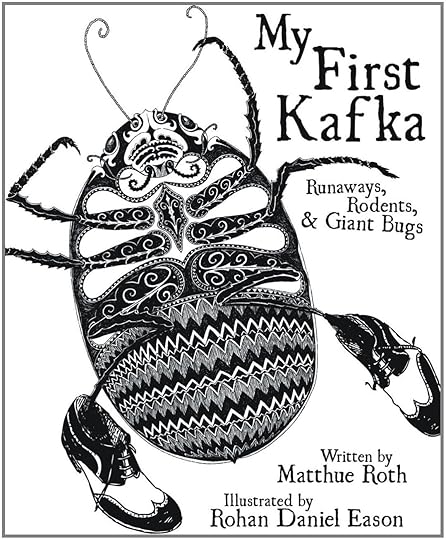
Well, as I was preparing to write my final commentary (for the time being) on the final of Kafka's rather bizarre short stories in the collection that I am reading, I came across this: Yes, it is a children's book called My First Kafka. Well, it seems that we can now add Franz Kafka to the ever growing list of children's authors, but then, when we consider the origin of many of our fairy tales, I am not surprised that sooner or later some rather interesting character, (in this case Matthue Roth) would turn Kafka's works into a collection of bedtime stories. Hey, considering how violent and sexually explicit Shakespeare can be I sometimes wonder if people in 1807 were screaming 'and what does Charles Lamb think he is doing!'. However, maybe I should say something about this particular work, and if you would like to read it on your Android device while sitting on the train going to work, you can find it here. So, has a friend of yours either seen something, or discovered something (such as, say, a UFO, or maybe a new scientific theory) and written a paper on it only to the scientific community laugh at him (or her) so you decided to then back your friend up by writing a paper that supports your friend's paper, and they end up all laughing at you. Well, that is what happens to the main characters is 'The Giant Mole' (or 'The Village Schoolmaster'). I know that I have had that happen to me, though I am generally the person writing the first paper, and I generally have nobody come along and support my suppositions. In a way Kafka is taking a swipe at the academic community in the way that it is basically, well, a bunch of people who all agree to support one idea and then turn around and laugh at anybody who suggests otherwise. In a way it is called peer review, and in Kafka's mind it is absurd, namely because a group of people get together and suggest, say, that everybody's relationship problems stem from a lusting after one's mother and a violent, if not jealous, reaction against their father (or at least that was what I believe was happening around Kafka's time, though I suspect that the instigator of that idea may have been the one being laughed at, but I cannot say for certain, and cannot be bothered looking it up on Wikipedia, but suspect you get my drift). Mind you, there is a lot of academia that is supported by evidence, but then evidence can also be interpreted, so just because somebody comes up with a mathematical theorem, and a proof to support that theorem, does not mean that that theorem is correct – hey, apparently it is possible to prove anything mathematically if you start off with the right hypothesis, or faulty logic as may be the case. So, once again we see the absurdity of academia rejecting a supposition that may just be true. Then the question is also whether this supposition is true because, well, it seems as if both parties only heard of the existence of the giant mole, but never actually saw it, but there may have seen circumstantial evidence of its existence, such as, say, its foot prints. However, it also seems that they have also been rejected out of hand because the peer group that decides whether the theory is to be accepted or not have determined, based on a little work of their own, to simply reject it out of hand.
thing I love about these short stories is that the writer must have had a point in mind,they wanted to get across,in order to go through the whole writing process.should it really matter if the book doesn’t get enough recognition,is the whole point of a thought,a discovery to only be noticed by an x amount of people or is it simply to get it out of your system to feel like one has added something to the nothing
I should start by saying that I didn’t really expect much when I began reading this story. I thought it would be something like “The Burrow” by the same author, but this one turned out to be slightly better and more engaging. I read it with genuine interest and can say that the mole in this work is an excellent metaphor for how one’s idea can be dismissed or not taken seriously — even when there are solid grounds for it. Formality and strict rules prevent recognition, and this hierarchy is clearly reflected in the words of the merchant (the narrator), who expresses it in his monologue. That monologue is filled with hopelessness, and the ending leaves the reader thinking that without connections, proper knowledge, and, of course, luck, your research will never gain the recognition it deserves. Overall, once again, we can observe Kafka’s implicit satirical tone toward bureaucracy, just as in his previous works with similar themes. Perhaps my thoughts came out a bit scattered, but I didn’t have any particularly strong impressions while reading.
I enjoyed this one more than The Burrow and Investigations of a Dog, I think because it dealt with human beings and the interactions between them - I think this is probably just more comfortable for me to read and doesn't require such an exercise of my brain, so maybe I'm just lazy. Kafka's absurdism is visible here, and I took from it - like in Investigations of a Dog - about the futility of our human investigations at times. I think it also speaks about our need for recognition, fame, notoriety, and power; the investigator in the short story says that he was writing in order to exalt the village schoolmaster, however he doesn't reference his original pamphlet and in fact hadn't really read it. I think this reflects the shame that people have in admitting that they want power and recognition, and the need to claim altruism.
Not his best story I know but if you read it through the context of a philosopher who came before him, Schopenhauer, it may shed light on the mole. The mole is an idea that Schopenhauer talked about in that it’s a hideous creature who despite its grotesque physique, still does everything in its power to survive and perpetuate itself in a type of hell that Kafka can relate to and perhaps tried to capture in this short read.
An interesting take on how dreams and desires quickly turn to obsessions and delusions as we let our imagination wander too far.
This causes the schoolmaster to loose sight of the actual task and truth which is that the mole is insignificant or not even real.
The narrator is particularly interesting as he himself does not know why he even pursued the task in the first place. With no clear goal or purpose how do you expect to succeed?
I haven't anything beautiful to crop out from the work, but rather a conclusion which evaded me at first, especially since the story is not completed. But as another user said, it seems like the schoolmaster in the story desperately tries to hide the mole, because acknowledging the mole would render his life pointless.
maybe the real mole was the friends we made along the way
(something about old and new generations something about good intentions and bad consequences something about small meaningless stuff turning into something life changing something about expectations and reality something about logical reasoning and hopes and human nature something about the unexplainable something about guilt)
“All that he was concerned with was the thing itself, and with that alone. But I was only of disservice to it, for I did not understand it, I did not prize it at its true value, I had no real feeling for it. It was infinitely above my intellectual capacity.”
sort of hilarious how the entire story is based on a giant mole. this definitely isn't new, but the narrator rambled quite a lot. the ending was pretty humorous.