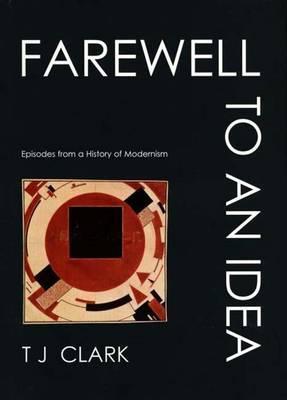
In this intense, far-reaching, and poignant book—a book that sums up the work of a lifetime—the acclaimed art historian T. J. Clark rewrites the history of modern art. With the fall of the Berlin Wall, he explains, the project called socialism may have come to an end at roughly the same moment as modernism. Did modernism and socialism depend on each other for their vitality—for their sense of the future and their wish to live in a fully material world? Have they died? Aware of modernism’s foibles and blind spots, but passionately attached to the movement’s wildness, Clark poses these fundamental questions in Farewell to an Idea.
Modernism, Clark argues, was an extreme answer to an extreme condition—the one Max Weber summed up as “the disenchantment of the world.” Clark focuses on instances of maximum stress, when the movement revealed its true nature. The book begins with Jacques-Louis David, painting at the height of the Terror in 1793, then leaps forward to Pissarro a hundred years later, struggling to picture Two Young Peasant Women ina way that agreed with his anarchist politics. Next the author turns in succession to Cézanne’s paintings of the Grandes Baigneuses and their coincidence in time (and maybe intention) with Freud’s launching of psychoanalysis; to Picasso’s Cubism; and to avant-garde art after the Russian Revolution. Clark concludes with a reading of Jackson Pollock’s tragic version of abstraction and suggests a new set of terms to describe avant-garde art—perhaps in its final flowering—in America after 1945. Shifting between broad, speculative history and intense analysis of specific works, Clark not only transfigures our usual understanding of modern art, he also launches a new set of proposals about modernity itself.
Timothy James Clark often known as T.J. Clark, is an art historian and writer, born in 1943 in Bristol, England.
Clark attended Bristol Grammar School. He completed his undergraduate studies at St. John's College, Cambridge University, he obtained a first-class honours degree in 1964. He received his Ph.D. in art history from the Courtauld Institute of Art, University of London in 1973. He lectured at the University of Essex 1967-1969 and then at Camberwell College of Arts as a senior lecturer, 1970-1974. During this time he was also a member of the British Section of the Situationist International, from which he was expelled along with the other members of the English section. He was also involved in the group King Mob.
In 1973 he published two books based on his Ph.D. dissertation: The Absolute Bourgeois: Artists and Politics in France, 1848-1851 and Image of the People: Gustave Courbet and the Second French Republic, 1848-1851. Clark returned to Britain from his position at the University of California, Los Angeles and Leeds University to be chair of the Fine Art Department in 1976. In 1980 Clark joined the Department of Fine Arts at Harvard University. Chief among his Harvard detractors was the Renaissance art historian Sydney Freedberg, with whom he had a public feud.
In 1988 he joined the faculty at the University of California, Berkeley where he held the George C. and Helen N. Pardee Chair as Professor of Modern Art until his retirement in 2010.
In 1991 Clark was awarded the College Art Association’s Distinguished Teaching of Art History Award. Notable students include Brigid Doherty, Hollis Clayson, Thomas E. Crow, Serge Guilbaut, Margaret Werth, Nancy Locke, Christina Kiaer, Michael Kimmelman, Michael Leja, John O'Brian, Bridget Alsdorf, Matthew Jackson, Joshua Shannon, and Jonathan Weinberg.
In the early 1980s, he wrote an essay, "Clement Greenberg's Theory of Art," critical of prevailing Modernist theory, which prompted a notable and pointed exchange with Michael Fried. This exchange defined the debate between Modernist theory and the social history of art. Since that time, a mutually respectful and productive exchange of ideas between Clark and Fried has developed.
Clark's works have provided a new form of art history that take a new direction from traditional preoccupations with style and iconography. His books regard modern paintings as striving to articulate the social and political conditions of modern life.
Clark received an honorary degree from the Courtauld Institute of Art in 2006. He is a member of Retort, a Bay Area-based collective of radical intellectuals, with whom he authored the book Afflicted Powers: Capital and Spectacle in a New Age of War, published by Verso Books.[1]
Heroic. Modernism does not exist in the academy anymore: In English language studies, the "field" of modernism has been parceled out to queer studies, women's studies, cultural studies, post-colonialism, etc. In art history, perhaps modernism has persisted as a curatorial project, but Clark's approach, taking in Freud, philosophy, literature, economics, and anthropology/sociology, is wide-ranging at the same time it's intense. His marxism (Clark was a Situationist in London in the Sixties, whose activism is discussed in Greil Marcus' Lipstick Traces) is reconstructed, however his passion for aesthetic formalism and its implications on Marx's utopian project is the great drama of ideas played out in this book. The Stevensian "Idea" of Clark's title may be no less than the radical political engagement in a formalism in the arts that gets at the form of forms which is, "what is it that only this art form (poetry/painting/music/the novel) can do," as well as, "What might the revolutionary project of this function be"? Or it might be, what are the contending modes of experience put aside in the experience of pleasure? What are ideas we have by now said Farewell to? I think this is a great work of criticism.
Modernism is today's heritage. It charted the terror and euphoria of bourgeois liberalism's immolation of the ancien régime. After two world wars and the atomic dust settled, the former won and the latter was so defaced it was as if it never happened. But the promise in the positive mode of Modernism was that, after this demolition, there would be a new world beyond history and the liberal state. This never happened, and today modernism still has movement, but as a corpse lashed to the ship of capitalism as it heaves on through the night. So here we are, a world between worlds, progress giving way to stasis, place giving way to nowhere. We are unrooted, free-floating, and waiting for the shore to arrive.
There's some tough sledding in here. A cursory understanding of Marx, Freud and Hegel might be required. Interestingly, it gets more opaque as the subject moves from post-impressionism to abstract expressionism. Some enlightening ideas on Cubism. I've always liked Cubism, but was confused why it has such prominence in greater modernism- Clark in high orthodox style makes a clear case.
I found the back third of the essays, particularly on Pollock, difficult to wrap my hands around. Or maybe what I did understand I found unsatisfying. The interesting thing is, it might be the more recent modes of Modernism that are actually more difficult to understand.
That is all to say that the second essay, "We Field Women" on Pissarro’s Young Peasant Women (1892), is probably the greatest piece of art writing I've ever read-an epic that charts the future growth of modernism and socialism as twins in the European mind while defining, beautifully, the themes of the pastoral. I can only describe it as Pericles' Funeral Oration for Modernism.
Just look at this rearguard defense of sentimentality:
"So peasant life was a screen, then, on which modernism projected its technical and expressive wishes? Well, yes. But this does not mean the screen was empty, or the projections made out of nothing. There was a form of life still actually existing in the nineteenth century (I know the word "peasant" sums it up too neatly) that stood in the way of modernity, and resisted the disenchantment of the world. Modernist values partly depended on an image of that life and its characteristic qualities. No doubt in the imaging process the qualities were idealized, or prettified, or sentimentalized. But those words are not final pejoratives. They may only describe the agony - the inevitable ruthlessness - involved in keeping a dream of humanity alive."
This is just as the subtitle suggests, "Episodes from the History of Modernism". It's a handful of moments in time that chart a spirit of the age leading to a destiny without shape. It's not a bird's-eye view or a total definition. It's a fractal look at the world we've inherited but struggle to describe. Clark reminds us where we came from and who we are.
Can be, at times, so illuminating on a number of topics (as Clark often is). "We Field-Women" is so magisterial that I literally dropped what I was doing and biked to the AGO to go look at a couple of Pissarro's field peasant paintings. And that's a painter I've never particularly enjoyed! Ultimately what I found was that Clark had given me an intellectual appreciation of the work previously unavailable to me, but my aesthetic experience of the work was relatively unchanged. What would it actually take to profoundly alter something like that? I would probably have to work in a field; modernism is, after all, contingent. Anyway I highly recommend this and basically anything else Clark has written
Guess I shouldn't be too surprised that a Marxist art historian would give a grim view of the history of art. But what a pompous a**! Read a little about Clark and you will find out about his intolerance and well known history for violating students' academic freedom.
And "I got that new book by TJ Clark, Farewell to an Idea. It made me feel like dirt. Painters don't look at paintings as social documents. We look at what we respond to, what we can steal, how a painting makes us feel." - Michael Goldberg.
An interesting and scholarly mind makes this a fun read, though i do not always agree with everything said here. What is good, is the depth of historical knowledge, especially in the chapters on David, Pissaro, Litsky and Malevich. Pollock is always fascinating, but cubism, i think is a false idol.
I take issue with this, Adorno’s quote there in, “Dissonance is effectively the same as expression, whereas consonance and harmony seek to soften and do away with it. Hence expression and illusion are fundamentally antithetical to one another. Expression is hardly conceivable except as an expression of suffering. Delight has shown itself to be inimical to expressing ( perhaps because there never was such a thing as delight). to say nothing of bliss, which is completely inexpressible.” This spoken as a depressive nihilist and embodies the more negative fruits of the modern tradition. Perhaps expression may be beside the point in states of bliss, but it does happen, which is why (some) concerts of classical music are enjoyable.
In the chapter on Pollock, Greenbergs’ quote about “seeking a resolution in expression of the absolute in which all relativities and contradictions are resolved or beside the point.” reminds me of my long standing affections for the possibilities of painting, which are now very unfashionable, if they are regarded at all.
Authors comments on Greenberg -in the tradition of modernism to “resist and exceed the normal understanding of the culture” requires a separate arena, or an arena conceptually differentiated from day to day life. It is in the so called “abstract” realm of painting that I find this possibility”. There has just got to be a better word for this sort of painting, which is anything but abstract!
Somewhere else in the text it mentions “”abstract painting setting itself to the task of canceling nature, and ending paintings relation to the world of things”, which seems to me ridiculous and falsely unrealistic, unless one is talking about minimalism. No, abstract painting is a realm very much connected to and evolving from nature, being as it is, constructed of paint/water, which is an elemental part of life itself. Abstract painting is one of numerous coping strategies for facing the onerous situations we are surrounded by, which are so because they are “anti-nature” at their core.
Meyer Shapiro, in a speech to congress, ....”.....in a society where all men can be free individuals, individuality must lose its exclusiveness and its ruthless and perverse character” well yes, in a society where “everyone is an artist”!
Painters will recognize the truth in this, from Pollock, “Self discipline (comes) I think, as a natural growth of a deeper, more integrated experience.”
Authors’ quote, “There is a kind of experience, these pictures say, that is vestigial. by the looks of it- unusable, marginal, uncanny in the limiting sense of the word- but at least the parent culture leaves alone. It is the kind of experience modern painting has often been forced back on (or i would say sought) :the only kind, so it believes, not colonized and banalized by the ruling symbolic regimes.” well, once upon a time, or still true?
The chapter on cubism was slow going, because of my basic distaste of it, partly because of remarks such as this. “Cubism is the last best hope for those that believe that modern art found its subject matter in itself- in its own means and procedures.” Well, no, I do not see surgical distortions as having much to do with “art found its subject matter in itself- in its own means and procedures”. Modern arts’ proclivities for wholeness and the integrity of its “own means and procedures” were distorted by surrealisms’ mechaninations and more importantly, definitions made by the marketplace. The “last best hope”has still to be achieved. The meditations of Kandinsky and the dance of Pollock have far more to do with arts “means and procedures” than Picassos’ work ever could.
I've only read about half the book, so that's what I'm commenting on.
The basic premise, as far as I understood it, is this: modernism (as in the styles and trends that characterized the modern era, including modern art) was an attempt to retain something sacred or mythic in a world that was becoming more and more secular. Along with this, modernism also wanted to find a system of representation that would directly reflect and communicate with the reality that people were living in (as opposed to the idealized images of pre-modern times). However, these two wishes could not be reconciled. Using a number of very specific examples, art historian TJ Clark explores how these conflicting wishes of modernism crop up again and again in history during moments of extreme conflict and change. And through this, he tries to get at what modernity (the modern era) was really all about.
My personal favourite, out of the chapters I've read, is the chapter on Kasimir Malevich and the Black Square. I have certainly developed a new understanding and appreciation for abstract art, and I know I will never be able look at a black square the same way ever again.
This is not a book for the casual reader. You really need a basic background in modern art history and preferably modern history as well to even begin to understand the things in this book. Clark does provide a lot of detailed background information on the society, history and politics surrounding each example but he never writes about it in any sort of easy-to-understand way, preferring to weave bits and pieces of information and references in and out of the text as he goes along. I had to do a lot of Googling and Wikipedia-ing as I read, although admittedly my knowledge of history was, and still is, quite limited. As much as I struggled with this book, I am very grateful to the professor (one of my faves!) who forced our class to read it. If you manage to get through even one chapter, I guarantee that it'll be very rewarding.
This book put me to sleep every night for a month. No joke, it was like a pill. Yet, I soldiered on, feeling that revelations were locked inside the meandering chapters. The author certainly chose fascinating episodes from the history of modernism in visual art: Cezanne's late works (the stiff and unappealing "Bathers"), El Lissitsky and Malevich on the eve of the Russian Revolution-- GREAT subjects, but sadly the writing is untterly convoluted, no sign of an editor whatsoever, and never was one more desperately needed. The real failure of the book, besides the lack of structure, is the missed opportunity to paint as vivid a picture of the times alongside the art that is the topic. A chapter on David's "Death of Marat" came closest to tying the subject to the turbulent era, but without a cogent summary of events it just left me hungry for something more properly written about the French Revolution. Onward....
This is a perhaps brilliant, but quirky and somewhat opaque book, an uneven surface of dense ropy coils of thought, one might say. At times the text veers into the land of art speak self parody, and suddenly flashes with either illumination, or an unusual insight. I am not sure that this book "explains" modern art to the general reader, its style is too much that of a kind of layering of metaphors that invites close reading, and demands active participation, and the patience to tolerate a style marked by nonsequiturs and meandering narrative. I am not sure I always agree with the author, but he has certainly given me a lot of food for thought. I will probably reread it again to gain a clearer understanding. I oscillated between irritation and enjoyment, so I thought it unfair to rank it as either 2 or 5 stars and settled on 3.
A sweeping and monumental work that baffled, moved, and inspired me. I took my time with this one, read it slowly, obsessively re-reading passages and entire chapters before allowing myself to proceed. I'll be returning to this for years to come.