Written for ages seven to ten, The Shakespeare Collection is an irresistible retelling of Shakespeare's most popular plays in storybook form. Written by experienced children's authors, the stories have been reviewed by Kathy Elgin of the Royal Shakespeare Company and contain extracts from the original texts. Illustrated with full-color and black-and-white drawings throughout, these lively books make Shakespeare accessible to a young audience, sparking a lifelong interest in the Bard and his world.
William Shakespeare was an English playwright, poet, and actor. He is widely regarded as the greatest writer in the English language and the world's pre-eminent dramatist. He is often called England's national poet and the "Bard of Avon" (or simply "the Bard"). His extant works, including collaborations, consist of some 39 plays, 154 sonnets, three long narrative poems, and a few other verses, some of uncertain authorship. His plays have been translated into every major living language and are performed more often than those of any other playwright. Shakespeare remains arguably the most influential writer in the English language, and his works continue to be studied and reinterpreted. Shakespeare was born and raised in Stratford-upon-Avon, Warwickshire. At the age of 18, he married Anne Hathaway, with whom he had three children: Susanna, and twins Hamnet and Judith. Sometime between 1585 and 1592, he began a successful career in London as an actor, writer, and part-owner ("sharer") of a playing company called the Lord Chamberlain's Men, later known as the King's Men after the ascension of King James VI and I of Scotland to the English throne. At age 49 (around 1613), he appears to have retired to Stratford, where he died three years later. Few records of Shakespeare's private life survive; this has stimulated considerable speculation about such matters as his physical appearance, his sexuality, his religious beliefs, and even certain fringe theories as to whether the works attributed to him were written by others. Shakespeare produced most of his known works between 1589 and 1613. His early plays were primarily comedies and histories and are regarded as some of the best works produced in these genres. He then wrote mainly tragedies until 1608, among them Hamlet, Romeo and Juliet, Othello, King Lear, and Macbeth, all considered to be among the finest works in the English language. In the last phase of his life, he wrote tragicomedies (also known as romances) and collaborated with other playwrights. Many of Shakespeare's plays were published in editions of varying quality and accuracy during his lifetime. However, in 1623, John Heminge and Henry Condell, two fellow actors and friends of Shakespeare's, published a more definitive text known as the First Folio, a posthumous collected edition of Shakespeare's dramatic works that includes 36 of his plays. Its Preface was a prescient poem by Ben Jonson, a former rival of Shakespeare, that hailed Shakespeare with the now famous epithet: "not of an age, but for all time".
My game plan for revisiting Shakespeare was to stream video of a staging of the play, listening and watching, while reading along to as much of the original text as was incorporated by the staging. Later, I read the entire play in the modern English version.
The staging I found for Macbeth was the 1971 film adaptation directed by Roman Polanski, adapted by Polanski & Kenneth Tynan and shot by Gilbert Taylor, the legendary director of photography on Dr. Strangelove, Repulsion and Star Wars. Starring Jon Finch as Macbeth and Francesca Annis as Lady Macbeth, the production is handsomely mounted, enthralling and spooky, no surprise since this was Polanski's follow-up to Rosemary's Baby.
Historians believe Shakespeare wrote Macbeth in 1606 for the King of Denmark on a visit to his brother-in-law King James I in London. Shakespeare may have drawn inspiration from Ralph Holinshed's Chronicles of England, Scotland and Ireland, which the Bard consulted often in his research. Macbeth ruled Scotland from 1040-1057 A.D. and per Holinshed, conspired with his wife, his aide Banquo and several others to murder Duncan, a rival chief with whom Macbeth held a grievance. Macbeth may have also consulted with "three women in evil apparel" who spun certain prophecies. Macbeth engaged in a series of murders to protect his rule and was eventually revenged by Duncan's son, Malcolm.
A reigning superstition in the theater is that Macbeth is so unlucky that to even utter the title or quote from it on stage will invite disaster. Among theater groups, referring to it as "The Scottish Play", "The Scottish Business" or simply "that play" are preferable to tempting fate by saying the name Macbeth. Constantine Stanislavski, Orson Welles and Charlton Heston all suffered some woe after a performance. Abraham Lincoln apparently read the play the night before his assassination. The bad luck is said to originate from the Witches Song in Act IV, Scene 1, which if the rumors are to be believed, has the power to literally raise hell. Or, the fact that the play is performed in dim lightning with heavy swordplay and stuntwork might account for the freak accidents associated with it.
The play lives up to its sinister reputation. It's one of the darkest and most potent dramas I've read.
Macbeth opens with three witches, the Weird Sisters, commiserating on a Scottish heath as a storm brews. King Duncan arrives on a battlefield with his sons Malcolm and Donalbain to be notified that a rebellion backed by the King of Norway has been repulsed by Macbeth, thane of Glamis. Macbeth and his fellow nobleman Banquo are stopped by the three witches after their great victory and issued a pair of prophecies: that Macbeth will assume the title of Thane of Cawdor and eventually, King of Scoland. A messenger then notifies Macbeth that due to his capture of the traitorous Thane of Cawdor, Duncan has bestowed upon him the villain's title.
In spite of his battlefield honors and favor of the king, Macbeth is none too pleased when Duncan announces that his son Malcolm will inherit the throne. Macbeth returns to his castle at Inverness, sharing with his wife Lady Macbeth that three witches have predicted his rise to power. The little missus doubts that her husband has the mettle to take what is his. When the king arrives to spend the night, Lady Macbeth hatches a plot to disable the king's bodyguards with drink, allowing her husband to slip into the king's room to murder him, laying the blame on the king's men.
Uncertain of his ability to commit regicide, Macbeth is pushed by his wife and manages to carry out the crime. He catches a break when the king's sons flee Scotland for their own protection, sewing suspicion that they may have killed their father. Macbeth is crowned king, but his celebration is short lived. Fearing that Banquo and his boy Fleance will ferret out Macbeth's guilt, he hires murderers to ambush father and son. Banquo is vanquished protecting his son, but during a banquet, Macbeth sees the ghost of his old friend at the table and makes a spectacle of himself, much to Lady Macbeth's displeasure.
Another nobleman, Macduff, distances himself from Macbeth, fleeing to England rather than risk attack. The king responds by sending murderers to slaughter Macduff's wife, children and servants. As forces gather against Macbeth, he pays another visit to the witches. They conjure three apparitions, which tell Macbeth to beware Macduff, that no one born of woman will harm Macbeth and that no harm will come to him until the forest of Birnam Wood advances on his castle. In spite of these predictions, Macbeth and his wife discover it's lonely at the top, and that fate works in mysterious ways.
Macbeth is a gangster movie. Unwilling to pay their dues, the thane of Glamis and his wife resort to violence to rise to the top in a fashion that Tony Montana would approve of. And in gangster movie style, the couple's unchecked ambition gets them exactly what's coming to them. The play is drenched in highland atmosphere, with witches, superstitions, skullduggery, hallucinations and duels. It's eerie, bloody and contains some of most powerful dialogue to be found in Shakespeare. Act V, Scene 5 is particularly memorable, with Macbeth realizing a little too late that "All our yesterdays have lighted fools the way to dusty death".
The dilemma faced by Macbeth and his wife -- whether to play the game or grab what's coming to them by any means necessary -- is more relevant to the human condition today than it was in 1040 A.D. The appearance of the witches and their cryptic predictions lend the play a dark and unsettling mood, as if Macbeth's plot had been seen from a hundred miles away and is going to end badly in spite of what his conscience is telling him. It's a quickly paced play with terrific inner monologue by Macbeth and Lady Macbeth as they debate their course of action and thrills as their plot meets its ends. The characters may not be the most complicated in Shakespeare, but they may be the most cursed.
MACBETH - Pussy-whipped Thane of Glamis, then Thane of Cawdor, and later, King of Scotland
Lay Macbeth - Scold of Glamis
King Dunkin - King of Scotland (played by Sheerluck in a crown)
Ban-quo, affectionately known as StatusQuo to his mates
Malcolm Donalbain Fleance MacDuff's son Young Siward ------------------------all played by What-son!?
A Baboon
And
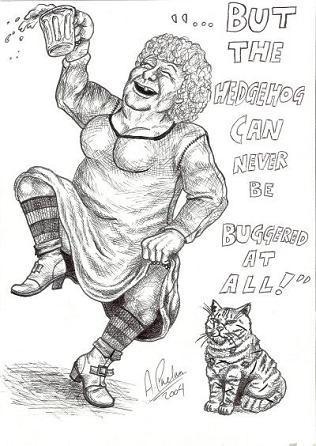
Nanny Ogg and her two Weird Sisters ::[image error]::
~~~~~~~~~~~~~~~~~~~~~~~~~~~~~~~~~~~~~~~~
NB - IN THIS STREAM OF CONCIOUSNESS-ESQUE RENDITION OF THE SCOTTISH PLAY, PLEASE TAKE IT AS FACT THAT ANY CHARACTER MENTIONED IS LOOKING STRAIGHT INTO THE CAMERA LENS, THEREFORE COMING EYEBALL TO EYBALL WITH YOUR GOOD SELF.
Mists and belching, dig-dip, digging. Thunder, lightening, dripping firs And a bevy or three. And singing.....
Nanny Ogg: How now brown cow, who comes this way? 'tis the Pussy-Whipped One And His side-kick Just as we foresaw, forsooth. And here the tale is told.
مسرحية "ماكبث" لويليام شكسبير هي مأساة عُرضت لأول مرة عام ١٦٠٦. عندما يتلقى جنرال اسكتلندي نبوءة من ثلاث ساحرات بأنه سيصبح ملكًا، تشتعل جذوة طموحه. وبتحريض من زوجته، يشق ماكبث طريقه إلى العرش عبر جرائم قتل وخيانة عنيفة. لكن الاستيلاء على السلطة يثبت أنه أسهل من الحفاظ عليها. يغرق الملك الجديد في دوامة من الذنب والشك، فينحدر إلى الطغيان والجنون، ويرتكب المزيد من جرائم القتل لتأمين منصبه. تُعد هذه المسرحية المظلمة، التي تستكشف قوة الطموح المفسدة، أقصر مآسي شكسبير وأكثرها عمقًا من الناحية النفسية. https://www.mediafire.com/file/crbkrz...
I definitely liked it, but not as much as Shakespeare's other plays. I loved how wicked and manipulative Lady Macbeth was. I hated Macbeth for his greed and being naive. Some lines in this play really spoke to me, like Macbeth's soliloquy about the dagger - I know it's not anything special, but he's talking about seeing something that you think is real but it is not in reality. I guess you can just see that speech from another perspective when taken out of context.
Update (2021): I always think of Macbeth as my favorite play by Shakespeare. My initial reaction is always different than the lingering effect.
As an adult reader, I am reading Shakespeare's play for the first time. About four scenes in, I started to feel frustrated with how much time it is taking me to grasp the language. I thought it might be a good idea to read a general, engaging overview before diving back into the original text. Enter: Coville's Macbeth picture book adaptation. This was an excellent introduction to the storyline of Macbeth, and I feel a lot more inspired to return to the play with these stunning visuals (by Gary Kelley) in mind.
2.5 stars I remember reading Macbeth in high school and not enjoying it as much as other Shakespeare works – mainly due to the harsh sounding Scottish language (or Scotch as the ‘pres’ says). Plus, I was not very literate in high school either, refusing to read anything.
But, I have been enjoying all the other Bruce Coville retellings of Shakespeare stories, so why stop! In any case, it’s good to hear these stories from a kid-point-of-view for people like me to understand them better. I did not enjoy Macbeth as much as I have enjoyed the other stories but it was ok. The next one we’re going to do is Midsummer Night’s Dream, I think.
Olsen, my eight-year-old son, will write a short review.
Olsen's rating 2 stars Olsen's review In giving this book 2 stars since Macbeth turned into a murderer and a bad guy.
This is a first-rate adaptation as far as the text goes; it was very well done.
The illustrations, with their shadowy, muted, reddish tones, went well with the somber, blood-stained storyline. The pictures of the witches, though, were ghastly to a nightmarish degree. 😱 I hated them!
Adam McKeown's adaptation ("The Young Reader's Shakespeare: Macbeth") is longer and more detailed, with illustrations less horrid, but this retelling by Coville is also a good place to start with mature students if you are studying Macbeth. (Macbeth is definitely not for young kids! 🙈) If, that is, you think they will be okay with the illustrations. I strongly recommend previewing this yourself before deciding.
Generally speaking, the Coville adaptations are great first picture books on the Bard's plays, if the students are old enough to tackle the difficult topics. McKeown's may be better for slightly older audiences or for those that prefer a chapter-format to a picture book. I do believe that well-written picture books can have great value for older students, and these aforementioned Shakespeare retellings make great introductions even for high school and adult audiences. Moving on to the full plays after getting to know the stories through adaptations can be immensely helpful.
I recommend both the Coville and McKeown books for intermediate Shakespeare studies, though it's probably overkill to use both for each play. I have enjoyed comparing and contrasting them! Still have a pair or two left to do. 🙂
Very good picture book adaptation of my favorite of Shakespeare’s plays. The story is simplified while keeping most of the intricacies of the plot intact, and much of the dialogue is straight or lightly changed Shakespeare. The narration also explains some of the stuff that, onstage, is worked out in asides or soliloquies. It’s well done.
The pictures are brilliant: moody and evocative of a gloomy medieval Scotland, and the eerie and uncanny elements—the witches, Banquo’s ghost, the three spirit messengers who prophesy Macbeth’s doom—are creepy without being outright scary. I think that’s the right way to do it, especially since this is geared toward introducing kids to the Bard.
As for my own kids, I think introducing is the right word. The eldest (age seven) got most of it but was fuzzy on some of the side characters, especially once Macduff, whose name was very similar to Macbeth to her, was intrigued. All of them liked the pictures and what they got of the story. It was a good bedtime read, and a good first taste of Shakespeare.
This version of Shakespeare’s tale of ambition, betrayal, war and witchcraft is splendidly redone. The author throws out most of the Bard’s language, keeping just enough to maintain its Shakespearean credit without making it too strange for children to grasp.
The illustrations are superb, the mainly sepia tones capturing the somber Scottish countryside. The backgrounds are simple with solid, plain geometric shapes to suggest a cavernous hallway, a king’s bedroom, a blasted heath, among other things. Mr. Kelley has a sure grasp of composition, form and color, as when we see curtains draping the tousled bedsheets of a dead, recumbent monarch, with pinkish hues gradually resolving into drips of blood down one arm and pooling on the floor.
This is a masterfully crafted version of the Scottish play, one good enough for children and adults.
Read this in preparation for seeing a production of ‘Sh!t faced Shakespeare’. Thank goodness for reading this! I was shockingly unfamiliar with Macbeth and having the ability to read the original (since that was what the play was in) and have the instant ‘translation’ so I actually knew what they were saying was so helpful. I went into the play wondering how in the world they were going to pull off turning it into a comedy (they did!) and being able to follow along with what they were saying and how they were keeping faithful to the play and making it funny at the same time. I totally plan on seeing their next production and reading this side by side for the next play as well.
I normally love Bruce Coville’s adaptations of the bard’s famous plays, however this one didn’t make me excited to read the original. Maybe once I have read Macbeth I will rethink my view on this rendition since I don’t yet know what was there for him to work from. The illustrations were however amazing.
This book was dark, and I mean that in a literal way. It is of course a darker, more intense story. But the artwork was gray and dark, and almost a little upsetting at some points. I don't think there was gore, but the witches were quite creepy! I wouldn't want younger kids reading this, even if it is a very simplified version with pictures.
This has to be the best Shakespeare play that I've read. I finally get the hype around him. The language and writing were simply phenomenal. I would say he's ahead of his time but then again he's THE Shakespeare. The simplified version made the process of reading this a whole lot easier and more enjoyable!
Coville's publications on the Bard are exceptionally well told and illustrated. They are fabulous introductions for youths to fall captive to Shakespeare's storytelling of the grisly and tragic.
Not bad. It's good for a retelling but it makes some assumptions about the characters' motivations that could be delved into when reading the source material.
I wanted to try out a classic, needless to say I did not like it very much. It jumped around alot and it was hard to follow but in the end I did understand it mostly. My favorite was the witches.






 ::? T'riffick!