

What do you think?

Complexity in Landscape Ecology
Interactions matter. To understand the distributions of plants and animals in a landscape you need to understand how they interact with each other, and with their environment. The resulting networks of interactions make ecosystems highly complex. Recent research on complexity and artificial life provides many new insights about patterns and processes in landscapes and ecosystems. This book provides the first overview of that work for general readers. It covers such topics as connectivity, criticality, feedback, and networks, as well as their impact on the stability and predictability of ecosystem dynamics. With over 60 years of research experience of both ecology and complexity, the authors are uniquely qualified to provide a new perspective on traditional ecology. They argue that understanding ecological complexity is crucial in today’s globalized and interconnected world. Successful management of the world's ecosystems needs to combine models of ecosystem complexity with biodiversity, environmental, geographic and socioeconomic information.
208 pages, Hardcover
First published January 1, 2006
About the author
David G. Green
40 booksLibrarian Note: There is more than one author in the GoodReads database with this name. See this thread for more information.
David Green is Professor of Information Technology at Monash University. His main research interest is complexity and all its implications.
* Complex systems
* Network theory
* Complexity in landscape ecology
* Artificial life
* Evolutionary computation
* Social networks
David Green is Professor of Information Technology at Monash University. His main research interest is complexity and all its implications.
* Complex systems
* Network theory
* Complexity in landscape ecology
* Artificial life
* Evolutionary computation
* Social networks
Ratings & Reviews
Friends & Following
Create a free account to discover what your friends think of this book!
Community Reviews
Displaying 1 - 2 of 2 reviews

August 23, 2020
Chapter One
Complexity is the richness and variety often seen in large systems. Species diversity is often used to represent complexity in ecosystems, but true complexity arises from the enormous number of ways to order combinations of objects.
simple assumptions about ecological systems can lead to disastrous mistakes in land management. Almost always, problems arise because the complexity of landscapes and ecosystems defeats our efforts to understand them as simple systems of cause and effect.
The underlying error in this ongoing catastrophe is “cause and effect” thinking: assuming that the forest ecosystem is a direct effect of suitable climate and soil conditions, rather than a complex, dynamic process in itself.
When people first began using computer models to study ecosystems, spatial interactions were largely ignored. Local interactions between individuals were assumed to be minor effects that would average out over time and space. Unfortunately, the assumption that local effects will average out over time and space is incorrect.
Interactions do matter, and local interactions can blow up to have large-scale effects. In ecological systems, many of these interactions are not simple, one-way cause and effect relationships, but complex feedback relationships
What is Complexity?
Variety and Form:
“complexity” to mean the richness and variety of form and behaviour that is often seen in large systems. The property that is most closely associated with complexity is emergence. To understand complexity in ecosystems, we need to learn how large-scale properties like these emerge from interactions between individuals.
Complex systems, however, are often unpredictable, rich in interactions, and large-scale properties of behaviour often emerges from those interactions.
What Makes Ecosystems Complex?
Measuring Diversity:
In landscape ecology, as in every area of science, there is a close relationship between theory and data. The theories that scientists develop are limited by the data available to them. Conversely, the data that scientists collect are determined by the theories that they wish to test and by the experiments, or observations that they carry out.
complexity really comprises two component strings: primary order (or ordered complexity), which is the set of rules describing pattern in a system, and secondary order, which describes the entropy, or random components.
Real complexity stems from the enormous variety of ways in which species combine and interact. Interactions between pairs of species can take many forms, such as predation, parasitism and competition.
Given the richness of ecological interactions, we cannot hope for a simple and general understanding of the behaviour of ecosystems. However, We can view ecological interactions as a network of connections, recognising that although complex systems are diverse, they also tend to share certain internal structures and processes that lead to consistent behaviours.
If patterns in space are important, then so too are patterns in time. Apparently random events, such as drought, flood and fire, each cause massive and unpredictable mortality, but also provide opportunities. Both the frequency and magnitude of environmental variations can strongly influence ecological structures.
Understanding the interaction between feedback processes and temporal and spatial variation within ecosystems has helped to resolve some key questions that cannot easily be approached empirically.
Simulation models in which sets of interacting populations are formed randomly predicted that systems with greater numbers of species are more likely to collapse, simply because there is a greater chance of forming positive feedback loops. Stability permits complexity.
Complexity Paradigm
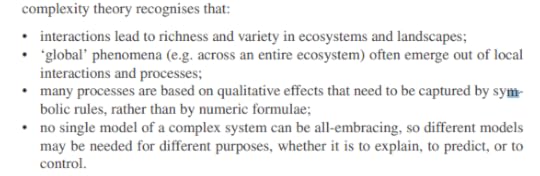
simulation is a tool that scientists can use to represent patterns and processes in nature. The difference is that equations are solved, whereas simulations are played out. Because complex systems are often inherently unpredictable, we examine scenarios instead of making forecasts. Instead of solving equations, we perform sensitivity analyses.
A new Ecology for a New Age
Learning what happens when you put things back together is what complexity research is all about.
Chapter Two
The patterns we see in the growth of a plant or the behaviour of animals can appear very complex, but there are often simple rules that underlie what we see. Simple rules of behaviour can explain many features of animal behaviour; multi-agent simulations use these rules to model community organisation and interaction with the environment.
If you are trying to understand the workings of a flock of birds, or of a forest ecosystem, then you can only get so far by studying more and more about the individuals. The way that living creatures interact, the properties that allow one plant to outgrow another, the relative speed of predator and prey are all characteristics that count on a larger scale.
self-organisation works, how a large number of individuals become organised into an ecosystem, a certain amount of abstraction is needed. Traditional models tend to gloss over processes that involve interactions at the level of local individuals or elements. Instead they tend to look either at the large scale, or else at the fine details. They tend to take a top-down view of how constraints act on individuals, rather than a bottom-up view of the effects that arise from interactions between individuals.
Three important features of plant structural development are modularity, iteration and recursion.
Modularity is important because we can model growth and development in terms of repeating
components without needing to consider cellular or other lower levels of biological organisation
iteration we mean that the same processes repeat over and over.
recursion or self-similarity we mean that developmental patterns can recur at increasingly lower levels (patterns repeated within patterns).
Animal Behaviour
Some of the great challenges of ecology are to identify processes that govern the ways animals behave and to understand the effects that arise from their interactions with each other and with their environment. Many aspects of animal behaviour arise from the need to survive in a complex environment.
A common finding in agent models is that the behaviour of a large-scale system emerges from the properties and interactions of many individual agents. intricate forms of order can emerge from relatively simple interactions between organisms with each other and with their environment. Global organisation is simply a by-product of local interactions.
Chapter Three
Complexity often arises in the way things are distributed in a landscape. Sampling is subject to scale and can display properties of fractals. Cellular automata, which represent a landscape as a grid of sites, are often used to model processes in landscapes. These models highlight the phase change that occurs between connected and fragmented landscapes.
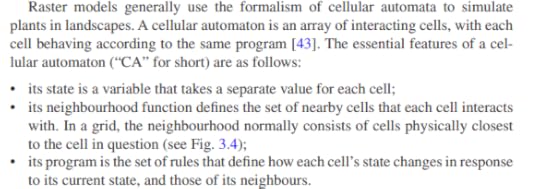
The most important feature of the CA model is the role of the neighbourhood. Any cell, taken in isolation, behaves in a certain simple way, just like a tree that grows by itself in a glasshouse. However, just as trees in a forest interact with each other to produce a rich variety of growth, form and dynamics, so it is the interactions of each cell with its neighbours that dominate the behaviour of a cellular automaton model.
regularities in the model tend to produce order. Starting from an arbitrary initial configuration, order usually emerges fairly quickly in the model. This order takes the form of areas with welldefined patterns. Ultimately most configurations either disappear entirely or break up into isolated patterns. These patterns are either static or else cycle between several different forms with a fixed period.
Ecologists have applied cellular automata models to many problems in landscape ecology. One common application has been to identify the way in which particular kinds of spatial patterns form. For example, a team of scientists used CA models to look at the vegetation patterns that resulted from the combination of tree growth rates and the killing capacity of the wind in the subantarctic forest of Tierra del Fuego. They were able to show that simulated patterns for heterogeneous forests with random age distributions matched the patterns observed in nature
Sampling and Scale
In landscapes, the patterns that we see are reflections of the processes that produced them. The distributions of plants and animals arise from a multitude of processes that we have to tease apart.
The essential problem of landscape complexity is that as often as not, complex processes leave behind complex patterns. To interpret a complex pattern often requires a lot of data.
Complexity in Spatial Processes
Spatial processes are inherently complex. In almost every case, spatial processes involve interactions between objects at different locations in a landscape. The patterns that we see in landscapes are often like frozen memories of the past.
To understand patterns such as these, we can model the processes that lead to them. One important class of processes is percolation. Percolation involves movement of a percolute through a surface or medium. Water seeping through cracks in rocks is one example. Several common landscape processes, both physical and biotic, are essentially percolation. These include the spread of epidemics, wildfire, pestilence, invasion of exotic species, diffusion of soil, water and nutrients, and the spread of new genotypes through a population.
Epidemic processes assume that a disturbance spreading across a landscape follows the path of least time from its starting point to any arbitrary location. The cellular automaton representation of landscapes described above readily lends itself to modelling epidemics, and other cases of percolation. Here we treat fire spread as an example of an epidemic-like (percolation) process
The most important insight to emerge from fire models is that if the fuel in the landscape is too patchy, then a fire will simply go out of its own accord. It does not just burn more slowly; it simply does not spread at all.
Many authors have applied cellular automata models to examine aspects of fire behaviour [6, 10, 21, 34, 37]. An important insight that arises from these models is that many spatial processes that appear to be very different often share deep similarities. Fire spread, for instance, belongs to a wider class of epidemic processes. Other examples of epidemics include the spread of disease, expansion of invading species, and the spread of insect pests and dieback [18].
Complexity in Spatial Patterns
Fractal Dimensions
The notion of “fractional dimension” provides a way to measure how rough fractal curves are. The idea of fractals is built on the assumption that patterns repeat at different scales, but in the real world, this is not necessarily true. Different processes influence patterns on different spatial scales.
No curve or surface in the real world is a true fractal; they are produced by processes that act over a finite range of scales only. Thus estimates of D may vary with scale, as they do in the above example. The variation can serve to characterize the relative importance of different processes at particular scales. Mandelbrot called the breaks between scales dominated by different processes “transition zones”.
The repeating nature of fractal patterns is intimately related to basic computation, which consists of repeating operations.
Fractals in nature arise from the action of specific processes. Fractal models capture roughness at different spatial scales.
Unlike theoretical models, natural processes operate only over a finite range of scales. For this reason the fractal dimension of many natural structures remains constant only over a limited range. Sometimes there are distinct breaks between scales, where one process ceases to become important and another becomes dominant.
Measuring Landscape Complexity
complexity implies a high degree of local interaction, but it is not always clear what those interactions are. A common approach to measuring landscape complexity is to look at structural complexity, especially the richness of habitats or land cover types, as well as their fragmentation, combinations and variations. Metrics of this kind are widely used in studies of complexity gradients.
Are Landscapes Connected?
If a landscape is fragmented, then barriers to movement between patches may reduce the ability to find enough food. But what does “connected” mean in a landscape?
We can define a set of sites in a landscape as connected if there is some process that provides a sequence of links from any one site to any other site in the set. In the CA formalism, connectivity is defined by the neighbourhood function. Two sites are directly connected if one belongs to the neighbourhood of the other. A region in a landscape is connected if we can link any pair of points in the region by some sequence of points (i.e. a path or “stepping stones”) in which each pair of points is directly connected.
Two objects are “connected” if some pattern or process links them. within a landscape arise either from static patterns (e.g. landforms, soil distributions, or contiguous forest cover) or from dynamic processes (e.g. dispersal or fire).
The relationship of the above results to other kinds of criticality [1] and to percolation theory is well known [35, 42]. As the name implies, percolation is about the flows of percolutes through a surface or medium. As we saw above, the ability of a percolute to spread through a medium depends on the formation of “edges” within a lattice, and is usually determined by density. A phase change occurs when a critical density is reached. It has been shown that all of these criticality phenomena stem from underlying properties of graphs (sets of nodes and edges) [13, 14].
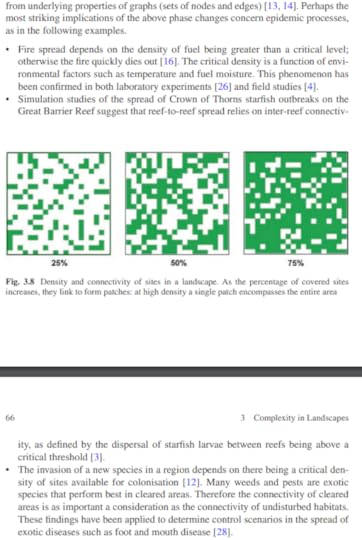
The key result to emerge from studies of connectivity is that landscapes can exist in two different phases: connected and disconnected [14]. The variability that occurs at the phase change means that the size and distribution of landscape patches become highly unpredictable when the density of active regions is at the critical level.
It is important to realise that habitat connectivity will vary from species to species. Just because one species finds a habitat connected does not mean that this is the case for all species.
populations may be fragmented even in the absence of corresponding landscape patterns. Similarly, environmental conditions may change, so populations may have been fragmented in the past
Complexity is the richness and variety often seen in large systems. Species diversity is often used to represent complexity in ecosystems, but true complexity arises from the enormous number of ways to order combinations of objects.
simple assumptions about ecological systems can lead to disastrous mistakes in land management. Almost always, problems arise because the complexity of landscapes and ecosystems defeats our efforts to understand them as simple systems of cause and effect.
The underlying error in this ongoing catastrophe is “cause and effect” thinking: assuming that the forest ecosystem is a direct effect of suitable climate and soil conditions, rather than a complex, dynamic process in itself.
When people first began using computer models to study ecosystems, spatial interactions were largely ignored. Local interactions between individuals were assumed to be minor effects that would average out over time and space. Unfortunately, the assumption that local effects will average out over time and space is incorrect.
Interactions do matter, and local interactions can blow up to have large-scale effects. In ecological systems, many of these interactions are not simple, one-way cause and effect relationships, but complex feedback relationships
What is Complexity?
Variety and Form:
“complexity” to mean the richness and variety of form and behaviour that is often seen in large systems. The property that is most closely associated with complexity is emergence. To understand complexity in ecosystems, we need to learn how large-scale properties like these emerge from interactions between individuals.
Complex systems, however, are often unpredictable, rich in interactions, and large-scale properties of behaviour often emerges from those interactions.
What Makes Ecosystems Complex?
Measuring Diversity:
In landscape ecology, as in every area of science, there is a close relationship between theory and data. The theories that scientists develop are limited by the data available to them. Conversely, the data that scientists collect are determined by the theories that they wish to test and by the experiments, or observations that they carry out.
complexity really comprises two component strings: primary order (or ordered complexity), which is the set of rules describing pattern in a system, and secondary order, which describes the entropy, or random components.
Real complexity stems from the enormous variety of ways in which species combine and interact. Interactions between pairs of species can take many forms, such as predation, parasitism and competition.
Given the richness of ecological interactions, we cannot hope for a simple and general understanding of the behaviour of ecosystems. However, We can view ecological interactions as a network of connections, recognising that although complex systems are diverse, they also tend to share certain internal structures and processes that lead to consistent behaviours.
If patterns in space are important, then so too are patterns in time. Apparently random events, such as drought, flood and fire, each cause massive and unpredictable mortality, but also provide opportunities. Both the frequency and magnitude of environmental variations can strongly influence ecological structures.
Understanding the interaction between feedback processes and temporal and spatial variation within ecosystems has helped to resolve some key questions that cannot easily be approached empirically.
Simulation models in which sets of interacting populations are formed randomly predicted that systems with greater numbers of species are more likely to collapse, simply because there is a greater chance of forming positive feedback loops. Stability permits complexity.
Complexity Paradigm
simulation is a tool that scientists can use to represent patterns and processes in nature. The difference is that equations are solved, whereas simulations are played out. Because complex systems are often inherently unpredictable, we examine scenarios instead of making forecasts. Instead of solving equations, we perform sensitivity analyses.
A new Ecology for a New Age
Learning what happens when you put things back together is what complexity research is all about.
Chapter Two
The patterns we see in the growth of a plant or the behaviour of animals can appear very complex, but there are often simple rules that underlie what we see. Simple rules of behaviour can explain many features of animal behaviour; multi-agent simulations use these rules to model community organisation and interaction with the environment.
If you are trying to understand the workings of a flock of birds, or of a forest ecosystem, then you can only get so far by studying more and more about the individuals. The way that living creatures interact, the properties that allow one plant to outgrow another, the relative speed of predator and prey are all characteristics that count on a larger scale.
self-organisation works, how a large number of individuals become organised into an ecosystem, a certain amount of abstraction is needed. Traditional models tend to gloss over processes that involve interactions at the level of local individuals or elements. Instead they tend to look either at the large scale, or else at the fine details. They tend to take a top-down view of how constraints act on individuals, rather than a bottom-up view of the effects that arise from interactions between individuals.
Three important features of plant structural development are modularity, iteration and recursion.
Modularity is important because we can model growth and development in terms of repeating
components without needing to consider cellular or other lower levels of biological organisation
iteration we mean that the same processes repeat over and over.
recursion or self-similarity we mean that developmental patterns can recur at increasingly lower levels (patterns repeated within patterns).
Animal Behaviour
Some of the great challenges of ecology are to identify processes that govern the ways animals behave and to understand the effects that arise from their interactions with each other and with their environment. Many aspects of animal behaviour arise from the need to survive in a complex environment.
A common finding in agent models is that the behaviour of a large-scale system emerges from the properties and interactions of many individual agents. intricate forms of order can emerge from relatively simple interactions between organisms with each other and with their environment. Global organisation is simply a by-product of local interactions.
Chapter Three
Complexity often arises in the way things are distributed in a landscape. Sampling is subject to scale and can display properties of fractals. Cellular automata, which represent a landscape as a grid of sites, are often used to model processes in landscapes. These models highlight the phase change that occurs between connected and fragmented landscapes.
The most important feature of the CA model is the role of the neighbourhood. Any cell, taken in isolation, behaves in a certain simple way, just like a tree that grows by itself in a glasshouse. However, just as trees in a forest interact with each other to produce a rich variety of growth, form and dynamics, so it is the interactions of each cell with its neighbours that dominate the behaviour of a cellular automaton model.
regularities in the model tend to produce order. Starting from an arbitrary initial configuration, order usually emerges fairly quickly in the model. This order takes the form of areas with welldefined patterns. Ultimately most configurations either disappear entirely or break up into isolated patterns. These patterns are either static or else cycle between several different forms with a fixed period.
Ecologists have applied cellular automata models to many problems in landscape ecology. One common application has been to identify the way in which particular kinds of spatial patterns form. For example, a team of scientists used CA models to look at the vegetation patterns that resulted from the combination of tree growth rates and the killing capacity of the wind in the subantarctic forest of Tierra del Fuego. They were able to show that simulated patterns for heterogeneous forests with random age distributions matched the patterns observed in nature
Sampling and Scale
In landscapes, the patterns that we see are reflections of the processes that produced them. The distributions of plants and animals arise from a multitude of processes that we have to tease apart.
The essential problem of landscape complexity is that as often as not, complex processes leave behind complex patterns. To interpret a complex pattern often requires a lot of data.
Complexity in Spatial Processes
Spatial processes are inherently complex. In almost every case, spatial processes involve interactions between objects at different locations in a landscape. The patterns that we see in landscapes are often like frozen memories of the past.
To understand patterns such as these, we can model the processes that lead to them. One important class of processes is percolation. Percolation involves movement of a percolute through a surface or medium. Water seeping through cracks in rocks is one example. Several common landscape processes, both physical and biotic, are essentially percolation. These include the spread of epidemics, wildfire, pestilence, invasion of exotic species, diffusion of soil, water and nutrients, and the spread of new genotypes through a population.
Epidemic processes assume that a disturbance spreading across a landscape follows the path of least time from its starting point to any arbitrary location. The cellular automaton representation of landscapes described above readily lends itself to modelling epidemics, and other cases of percolation. Here we treat fire spread as an example of an epidemic-like (percolation) process
The most important insight to emerge from fire models is that if the fuel in the landscape is too patchy, then a fire will simply go out of its own accord. It does not just burn more slowly; it simply does not spread at all.
Many authors have applied cellular automata models to examine aspects of fire behaviour [6, 10, 21, 34, 37]. An important insight that arises from these models is that many spatial processes that appear to be very different often share deep similarities. Fire spread, for instance, belongs to a wider class of epidemic processes. Other examples of epidemics include the spread of disease, expansion of invading species, and the spread of insect pests and dieback [18].
Complexity in Spatial Patterns
Fractal Dimensions
The notion of “fractional dimension” provides a way to measure how rough fractal curves are. The idea of fractals is built on the assumption that patterns repeat at different scales, but in the real world, this is not necessarily true. Different processes influence patterns on different spatial scales.
No curve or surface in the real world is a true fractal; they are produced by processes that act over a finite range of scales only. Thus estimates of D may vary with scale, as they do in the above example. The variation can serve to characterize the relative importance of different processes at particular scales. Mandelbrot called the breaks between scales dominated by different processes “transition zones”.
The repeating nature of fractal patterns is intimately related to basic computation, which consists of repeating operations.
Fractals in nature arise from the action of specific processes. Fractal models capture roughness at different spatial scales.
Unlike theoretical models, natural processes operate only over a finite range of scales. For this reason the fractal dimension of many natural structures remains constant only over a limited range. Sometimes there are distinct breaks between scales, where one process ceases to become important and another becomes dominant.
Measuring Landscape Complexity
complexity implies a high degree of local interaction, but it is not always clear what those interactions are. A common approach to measuring landscape complexity is to look at structural complexity, especially the richness of habitats or land cover types, as well as their fragmentation, combinations and variations. Metrics of this kind are widely used in studies of complexity gradients.
Are Landscapes Connected?
If a landscape is fragmented, then barriers to movement between patches may reduce the ability to find enough food. But what does “connected” mean in a landscape?
We can define a set of sites in a landscape as connected if there is some process that provides a sequence of links from any one site to any other site in the set. In the CA formalism, connectivity is defined by the neighbourhood function. Two sites are directly connected if one belongs to the neighbourhood of the other. A region in a landscape is connected if we can link any pair of points in the region by some sequence of points (i.e. a path or “stepping stones”) in which each pair of points is directly connected.
Two objects are “connected” if some pattern or process links them. within a landscape arise either from static patterns (e.g. landforms, soil distributions, or contiguous forest cover) or from dynamic processes (e.g. dispersal or fire).
The relationship of the above results to other kinds of criticality [1] and to percolation theory is well known [35, 42]. As the name implies, percolation is about the flows of percolutes through a surface or medium. As we saw above, the ability of a percolute to spread through a medium depends on the formation of “edges” within a lattice, and is usually determined by density. A phase change occurs when a critical density is reached. It has been shown that all of these criticality phenomena stem from underlying properties of graphs (sets of nodes and edges) [13, 14].
The key result to emerge from studies of connectivity is that landscapes can exist in two different phases: connected and disconnected [14]. The variability that occurs at the phase change means that the size and distribution of landscape patches become highly unpredictable when the density of active regions is at the critical level.
It is important to realise that habitat connectivity will vary from species to species. Just because one species finds a habitat connected does not mean that this is the case for all species.
populations may be fragmented even in the absence of corresponding landscape patterns. Similarly, environmental conditions may change, so populations may have been fragmented in the past

March 12, 2016
This was an interesting book that provides a basic discussion of how tools of complexity theory such as fractals, cellular automata and network theory can be used to simulate, analyze and study ecological systems. The discussion does not seem dumbed down, but it is still very accessible and does not require any background in complexity theory to understand. The book shows how systems built on simple rules can show incredibly complex behaviors that mirror natural phenomena. I was intrigued by the discussion of how the same simple cellular automata can be used to model wildfires, epidemics and a variety of other spreading phenomena and how the "patchiness" of the "fuel supply" is the primary determinant of whether the fire/epidemic spreads. Also interesting was the discussion of how the connectedness of a network spreads rapidly when connections reach a critical point and how the increase in connections increases the probability that positive feedback loops will develop that can cause the system to crash and burn. Over the week that I have been reading this book, I have found myself looking for things in my daily life that could be modeled as networks or as cellular automata, so it has definitely had an impact on my thinking. The second half of the book strays away from the main theme of using complexity theory in ecology and gets into a more general discussion of the role of technology in ecology and current problems of global ecology such as climate change. I found this part of the book to be a bit less interesting and rewarding, but still easy to read and containing some interesting information.
Displaying 1 - 2 of 2 reviews