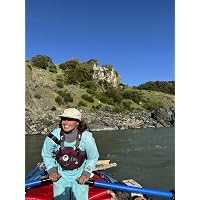
With plenty of sunscreen and a cold beer swaddled in his sleeping bag, writer and botanist Jim Malusa bicycled alone to the lowest point on each of six continents, a six-year series of “anti-expeditions” to the “anti-summits.” His journeys took him to Lake Eyre in the arid heart of Australia, along Moses’ route to the Dead Sea, and from Moscow to the Caspian Sea. He pedaled across the Andes to Patagonia, around tiny Djibouti in the Horn of Africa, and from Tucson to Death Valley. With a scientist’s eye, he vividly observes local landscapes and creatures. As a lone man, he is overfed by grandmothers, courted by ladies of the night in Volgograd, invited into a mosque by Africa’s most feared tribe, chased by sandstorms and hurricanes — yet Malusa keeps riding. His reward: the deep silence of the world’s great depressions. A large-hearted narrative of what happens when a friendly, perceptive American puts himself at the mercy of strange landscapes and their denizens, Into Thick Air presents one of the most talented new voices in contemporary travel writing.
I understand that this next statement may look like a backhanded compliment. But it (mostly) isn’t. This is a great book to pick up when you don’t have the brainpower to stay committed to a book. I started it two months ago and only read the first section or two, and then picked it up again this week without missing a beat. Because this book is neatly divvied up into 7 segments representing the 7 lowest points in the earth that Malusa biked through, each chapter was in its own little wrapper. And this is wonderful for me at this point in my life, because I can’t seem to put the emotional energy into engaging with a novel and really committing to it. But this is curse for this book, as well. Precisely the reason why I could pick it up after months without any problem is the same reason for how it is a wee bit weak: there’s a lack of continuity. The connections made between each of his trips are slim. I know he has a passion for roving, I know he struggles (but just a little bit) to leave his pregnant wife to travel for weeks to different hemispheres, and I know this was a job he got paid for. And I’m not saying that every good travel narrative has to have a laboring self-introspective-deep-awakening-moment or explain profound connections to the people and the land, I’m just pointing out that this one doesn’t. He rode a bike. He set up a tent. He ate some ramen. He rode the next day and drank a beer with a couple locals. He moved on. And in the next chapter he does the same things but in a different hemisphere.
There’s a lack of “story line” but he does have some great one-liners, I must say.
"A small yellow butterfly is dead on the road, one wing inexplicably intact and looking like a Post-it note stuck to the asphalt." My favorite line. At least that I read today.
I wonder if the book is the way it is because he wrote articles for Discovery while he was on the road. Maybe his articles were quite different, and perhaps he went into more detail and more continuity of story line for the online readers back home, and he wanted this book to be something different that what he had already produced once? There’s a really easy way to find this out, and that would be to look up his articles on Discovery’s archives. But I’m not gonna. At least not anytime soon. Maybe later.
The reason I picked this up in the first place was that the cover had a quote selling him as a favorite author of Barbara Kingsolver. I haven’t met a Kingsolver book I haven’t liked, so I thought if Malusa tickled her fancy, he would certainly tickle mine. It was entertaining. And I do love to live vicariously through people more adventurous than I.
Jim Mauser might be interested in the view from the Seven Summits, the highest points of each continent, were it not for the fact that they have accessibility issues. To Mauser, any place you can’t bike to isn’t worth bothering with. When Discovery offers to drop Mauser in the middle of nowhere and film him attempting to find his way back to civilization, Mauser has a better idea: why not finance and film his traveling to the seven lowest points on Earth – the seven anti-summits? And so he embarks on a six-continent journey (Antarctica lowest point being covered by a very large pile of ice), through war zones and Passover, assailed by dogs, hurricanes, and crowds of children joyfully attempting to stone him, to six of the lowest spots on Earth. Although his destinations are anticlimactic in the extreme, it’s the journeys getting there that makes this book. Mauser is rivaled only by Bill Bryson for the sheer entertainment value of his narrative, and is similar to him stylistically, but Mauser records his world journeys with a botanist’s eye. Those eyes are open to the full sweep of the glorious panorama of nature around them -- the wildly divergent climates, the abundance of mesmerizing and often lethal fauna. Central to Mauser's story, like many travelers' tales, are the people he meets along the way, their kindnesses and eccentricities recorded along the way. Mauser isn't quite as vulnerable as world trekkers; his anti-summits are made in six completely different legs that take the better part of a decade to complete, and his starting locations for each leg seemed to be a week away from his destination, at best. Even so, he's at considerable risk given his luck at pedaling into a place right before drama hits -- like a sudden case of the monsoon in South America -- and people around the world offer him friendly smiles and a stomach full of local cuisine. Into Thick Air is a fantastic cycle-touring book, treating the reader to a wide spectrum of human cultures and natural environments, with plenty of wry humor and scientific commentary on the way.
I have to admit that I was very intrigued by a man that decided to bicycle to the lowest depression in 6 continents. I am not even that big of a fan. I mean I ride the. Of course, but to travel on one? Heck no. I loved this book. The author provides a lot of information but it does not overwhelm you. He is also pretty funny. As I was reading this book I realized that the story was about the journey not about the getting there. He met some amazing people in his journeys. I loved his stories in Africa and Asia. They were my favorite because of the people that he met. Although I must say that I am not too keen on traveling to Ciaro anytime soon. He did have his trials for sure but the end result was wonderful. Any person that enjoys travel and embracing local culture should read this book. Actually anyone wanting a good story should read this book. I am so glad that I did. I am actually sad that it is over. I loved traveling alongside.
An entertaining and witty cycling travel adventure to the lowest point of six continents. The travelogue moves along at a good pace with many interesting accounts of people and places the author encountered during his journeys. The historical references were an added bonus.
Jim Malusa is only able to reach escape speeds with a Patagonian breeze at his back or on the last curve down to the Gulf of Aqaba. He presents an irresistible target as he pedals to the lowest points on six continents. This book is equally hard to pass up.
People seem to lie in wait for Jim. An Afar man who teaches English in Djibouti, an Australian family that lives in a “dust bowl shack with whip snakes in the outhouse and a pedal radio for communications,” and a Russian wedding party filling the only café in town, all ambush him and force their hospitality, food, water pipes, and drinks on him. The drinks often contain alcohol, which both delays him and slows his progress when he finally wobbles away. Jim faces many obstacles in his travels--missing his young family, battling headwinds, and struggling up hills--but only fails at one: resisting the temptation to stop and talk. And eat. And drink.
If you’re looking for a book on bicycle maintenance, this isn’t the book for you. On the other hand, there are useful tips: a good weld on the frame of your bike can hold from Moscow to the Caspian Sea (verified by Jim), and installing a second inner tube, and a second hole in the rim for the valve stem, will let you repair a flat without tools: just pump up the second tube (unverified).
If you want to know the best times to visit the most famous museums in the world, this isn’t the book for you. If you’re looking for a guide book to five star--no, four star-- no…OK, if you require any stars, or hot water, in your hotels, this isn’t the book for you.
If you’re looking for a fact-dense history of the areas Jim pedals through, this isn’t the book for you. On the other hand, he does provide intriguing factoids that could bolster street cred in the right circles: Henry David Thoreau endorsed celibacy, Moscow was twice burned by invaders in the 16th century, and the Las Vegas, NV Yellow Pages devoted 92 of those pages to Entertainment, Adult the day he visited.
My only warning is to think twice about reading Into Thick Air if those close to you already question your grip on reality. Your chuckles, guffaws, and belly laughs will confirm their suspicions.
I should start this by saying I'm not a fan of short stories. There's just something about the pacing that I don't like. I suppose that means I like a nice, long narrative to keep me company for the long haul. Ah well . . .
That said, Malusa is a good writer, without doubt. He has a knack for the pithy phrase and a biologist's eye for the flora and fauna, even when it's flattened on the road.
I'm sure the style of the book was affected by its origin as a Web 'zine through Discovery magazine. That format calls for short and sweet stories that won't necessarily appear as a continuous whole. I imagine Malusa had to do quite a bit of editing to get these bits together as an enjoyable whole.
I like the fact that he found a way to turn the usual adventure cycling thing on its head - it's not the heights but the depths. The fact that almost all of the sites of these depths are in deserts is interesting as well.
One of the best things about Into Thick Air is that it has spurred me to learn more about geology. I already have a thing for sand, oddly enough. Now I feel the need to go a bit further to learn how and where all that sand comes from. Malusa's descriptions of the geology he passes through, while scant in the overall work, certainly got my attention.
Another thing I liked about his work is the way he portrays the people he meets. All too often, bicycle tour books seem to be written by misanthropes. It's a pleasure to read about people who AREN'T trying to cause problems.
Overall I'd recommend this book, with the above caveats. Short story lovers should find this work quite engaging.
Jim Malusa, PhD, is a research scientist and botanist at the University of Arizona. He specializes in plant geography, fire science, and desert flora. With a CV like that, he might seem like an unlikely tour guide for a multi-continent biking expedition. Nonetheless, he proves to be a capable observer not just of the natural world, but also of people and cultures. More importantly, he demonstrates an engaging writing style and a wry sense of humor.
Malusa grew tired of hearing stories of people summiting the highest mountains in the world, climbing to unbelievable heights in the ice and the snow. A confirmed "desert man" who hates being cold, Malusa wondered why everyone tried to reach the highest places in the world, but no one ever went to the lowest places in the world. So he pitched an idea to the Discovery Channel: Would they pay him to ride his bike to the lowest point of each continent and write articles on what he saw and did? They agreed to fund the first expedition, a visit to Lake Eyre in Australia (49 feet below sea level), and decide from there whether further trips were worth the investment. Eventually, Malusa made it to all six inhabited continents, and each section of the book captures one of the six trips, done over the same number of years.
In most cases, Malusa flew to a point hundreds or even thousands of miles away from his final destination. He then biked through cities, towns, barren landscapes, and sometimes even across international borders to get to his final destination. The stories he tells along the way range from humorous to harrowing. He deals with Patagonian winds, Egyptian bureaucracy, African hospitality, Australian wildlife, and even finds himself at a Russian wedding celebration. The range of landscapes, people groups, and experiences is extraordinary and makes the reader appreciate the incredible beauty and diversity of our planet all over again. The actual arrival at the various "low point" destinations is often anticlimactic, although it is clear that Malusa feels a sense of peace and well-being in these locations. He seems to appreciate the quiet isolation that these remote and frequently deserted places offer.
Although primarily written as a travelogue and adventure book, there are recurring themes in Malusa's narrative. He writes about the local ecology, and how humans interact with it, an outgrowth of his scientific background. He also finds a common generosity of spirit across many cultures and people groups. I was reminded of the Mark Twain quote that "Travel is fatal to prejudice, bigotry, and narrow-mindedness," which seems to be proven multiple times over in this book. Malusa, biking across deserts, into cities, and through small communities from Djibouti to Chile, becomes a good will ambassador for the human race. He's not in a particular hurry, and his journeys are not as rigorous or demanding as climbing Mount Everest. But they seem like a whole lot more fun.
Book 62 of 2025 Yaaaay, pretty pleased I had a good book to reach my 2025 reading goal. And it was even a real book! After, I searched for more books by Mr. Malusa only to find this is it. I think I might have enjoyed some of his other work.
Into Thin Air, by the great Krakauer, is among my favorite books. That book was about Everest, so already I appreciated Malusa's homage to the highest peaks with his title. The difference: he's going to the lowest points. By bicycle. Mostly.
It was a bit of a hit-and-miss book. The opening chapters in Australia establish Malusa's chops as a knowledgeable and quite witty writer. I was disappointed, then, to find the Asia chapter basically sucked. A little bit of interest with the security stuff - and this was pre 9-11 - but still way flat compared to Australia. The South American stuff was also a little bland, except I learned about mate. Things picked back up in Europe, which was largely a trip through Russia. Pretty interesting descriptions of many places and people. His Africa chapters were brilliant and left me yearning for the khat I've never tried. He closes in North America, not far from his home. His descriptions of Americana, right after 9-11, seem spot on. And here he flexes his knowledge as a botanist.
They're cool stories: he finds a way to get paid (mostly) to ride his bike through these places. He makes sure to talk to locals and try local cuisine (but he is rarely without a beer). If you stop and Google some of the places/foods he's talking about, it really is an educational book that can also make you laugh out loud at times.
Lake Eyre, Australia - _49 Feet Turpan Depression- -500 Feet Caspian Sea of Russai- 92 Feet Lac Assal of Djibouti Africa - 502 feet Salina Grande, Argentina -140 feet Death Valley California- -282 feet Dead Sea of Jordan-350 Feet
What are all of these random places. The belly-buttons or Anti-Summits of the world, the lowest depression on each of the 7 continents (except Antarctica--that one can't be reached because it is buried in a mile of ice).
Jim Malusa bicycled to the lowest point on each of the continents in an interrupted 6 year "anti-expedition." He wrote a 321 page book to tell about it.
I give credit to Jim..he was out there in the desert, the salt, dodging cars, getting lost and finding his ways to these depressions. 5 stars for effort...but I think the idea of cycling to the belly buttons of the world--maybe was a better idea period. 3 stars...the writing was mediocre. He should thank his wife and kids and Discovery Online for allowing him to complete his expedition.
Oh, this was fine. It had moments of brilliance (the premise being one), but generally it didn’t knock my socks off. Am I getting snobby about my “quest and adventure” books? Perhaps. There was an ambivalence that I feel ran through this book. He was miserable, yet drawn out again and again. He hated the experience and was baffled by the people he met. He was on a bike adventure, but sure seemed to hitch a lot of rides… part of me is like, “what did you expect, dude?” Surely we all feel that way about Type 2 fun - it’s awful when it’s happening, but you look back on it with warmth. I didn’t feel the retrospective warmth in this one. I think there are better entries in this genre.
This may not really be a bike touring book as I was expecting, Jim does cycle but he get as closer as possible to the places he is going so his book is more about the experiences he lives, the people he meets and the country or places he visits. I really found interesting the way he organized the stories and how interesting the book is. Although many things ar out of date now in 2022(being the book from 2008 and the years he travelled even earlier) it's amazing to see other times with less resources. I did miss the fact there were no pictures on the book and that the official website where they should be, indicated at the end of the book, is no longer available.
4.5 stars. As a long-time highpointer, never again will I look down my nose at those seeking to visit low points of states, countries, or continents, as this author did. What adventures! Malusa's tales of his bike tours to reach the lowest elevation of 6 continents is a fascinating, informative, and often amusing journey. Lowpoint Adventures!
A superb book. If your hobbies include cycling, travelling and reading then you will love this book. It will take you all around the world on a cycle, right from the comfort of your armchair and inspire you to buy an atlas to prepare your cycling trip! Do read. The author has a very good sense of humour.
This is a non-fiction book that follows the writer as he rides his bicycle to the lowest places on all the continents. It describes the scenery, animals, weather and locals as he travels to such places to Russia, Djibouti, Argentina, Australia and others. It is told with quite a bit of humor.
I enjoyed this one. It was an interesting idea. I also liked how the author was so strictly tied to HAVING TO RIDE EVERY MILE OF THE WAY. If he got a little behind, he just hoped a ride to make up the difference. No way would I ever do something like this, but it was fun to read about.
I was really keen to read bike packing adventure but this is travelogue done the wrong way. Very ego-driven kind of writing and the way Jim Malusa describes Australia left me frustated. Not worth my time.
After just reviewing a book and saying that there aren't too many books that feature biking, I found this . . .
~~~~~~~~~~~~~~~~~~~~~~~~~~~~~~~~~~~~~~~~~~~~~~~~
OK, I have finished reading this one.
The title is a play on Jim Krakauer's "In Thin Air" about climbing Everest - some climbers set as a goal climbing the highest peaks on every continent. Malusa decides to accomplish the opposite - to bike by himself to the lowest point on six continents (he skips Antarctica). For the first four destinations, he had financial support from Discovery (Channel)Online; the last two he did on his own. (For Discovery he carried carried a satellite phone and laptop to upload photos and reporting.) I particular liked his description of his journey through Russia to the Caspian Sea and from Cairo to the Dead Sea. It's not a "gearhead" book about cycling - really, using a bike for transportation is a way of getting closer to the local population while traveling in an exotic setting where it seems an American on a bike is unexpected and able to make connections with folks easily.
And that's what much of the book is - relating stories of his interactions with the local population. In this Malusa is as good as Paul Theroux et al. A botanist by training, Malusa is also very good at describing his surroundings, particularly out in the wild - and since he spends much of his time in unusual places, that's good.
My only complaint is one I have about some contemporary travel/adventure titles - it isn't readily clear at the start when the journey (or in this case, journeys) took place. I suspect that authors of such books that describe trips that are more than a few years old are concerned that a browsing buyer will easily discern that the trips are "old" and not purchase the book. While the book was published in 2008, the first trip, to Australia, took place in 1997. (I think; he never says exactly, but it's possible to deduce from various evidence.) The second trip, to Russia, was in 1998 - a very different time for the relationship between the U.S. and Russian than now (and the year when my family and I lived for eight months in Russia). The last trip, to Death Valley, was in 2001 (or perhaps 2002).
The "age" of the trips is relevant in a number of different ways. I don't think some of his trips would be possible now in the post-September 11 world. Also, the attitude of many of the people he met while traveling would be different now. It would have made things simpler for the reader to make the timeline for his travels more clear.
Eventually I realized that the author and I are the same age - born in the "year of Sputnik" as he puts it.
I heard about this book on NPR, of course. It was on a list of great travel books, and it earned its spot. Rather than the lofty aspirations of those who hike "Into Thin Air" to the highest points in the world; the counter-cultural Jim Malusa does the opposite: he bicycles to the lowest point on each continent, or "Into Thick Air."
His book is part travel memoir, part natural history (he is a botanist by training), and part religious/political commentary on the regions that he travels through. These bring him through Egypt to the Red Sea (Asia), across Australia, through Russia to the Caspian Sea (Europe), across Patagonia (S. America), around Djibouti (Africa), and from his home in Tucson to Death Valley.
His storytelling is witty and insightful. He writes from the perspective of a respectful agnostic, who encounters many people of various religious backgrounds, though primarily Muslim (in Africa and Asia), who extend generous hospitality. His last trip is in N. America just after Sept. 11, 2001 and he is struck by the umbrella negative portrayal of Islam as a result of the events on that day. His own experience speaks to the contrary.
I particularly enjoyed his observations about the flora and fauna along the way, since there is some botany in my own blood. Riding through Patagonia, he refers back to the Voyage of the Beagle, and the famous naturalist who spent time trekking that same landscape.
He is lighthearted but also genuinely respectful of the people and cultures he encounters, telling their stories in the light of real experiences. I'll probably never trace his paths, but I'm glad to have done so vicariously through reading the book.
I'm so disappointed in this book because I was really really excited to read it. The odd idea is so interesting!! A book about going to the lowest places on earth by bike is much more appealing to me than books about hiking summits. Plus Barbara Kingsolver (one of my fav authors) said she thought of Jim Malusa as one of her favorites!!! Alas it felt very disingenuous to me, as if he went on the trips just so he could write about them later. He also seemed to whine a lot and wasn't very open minded, despite it being his idea to do these trips... Also each journey ended the moment he arrived at the destination; he hardly talked about them!!! For one destination he described the sunset when he arrived and then it was the next chapter. The writing was also terrible in some places, soooo cutesy I wanted to barf. He does this really annoying repetitive thing throughout the book. For example:
"In the United States, I said, such a thing is sometimes called 'new money.' 'It is the same in Egypt, except here we call it, "Recently Having Good."
(next paragraph) I was recently having good. Summoned to the telephone building..."
UGH!! WHY does he do that?? He wrote like that throughout the whole book!!!! I've never written a review this long, which is proof of how much this book bothered me. There were hardly any negative reviews on Amazon so I feel it is my duty to write this. For my own sake I have convinced myself that Barbara Kingsolver was handsomely paid to write that phony endorsement...
Since I am contemplating a trans-America bike tour, this book was of interest to me- but I can see it would be of little interest to many other readers.
Over a period of years, the author plans bike rides that will take him to the lowest points of the planet's continents; sometimes sponsored by the Discovery Channel and sometimes not.
He does a bang-up job describing the somewhat lifeless and dull scenery you'd expect in deep deserts and salt pans. (No mean feat; respect!)
He also does a thing that other authors have done before, but for some reason I never saw it: he comments on things he sees just by cataloging them. He gives you a wordless commentary- the complete opposite of punditry. For instance, he records the number of Entertainment, Adult ads in the Las Vegas Yellow Pages as compared to the few ads there for Automobiles, Physicians and Insurance. And to trump this, he points out that Attorneys outnumber them all. No comment, really- just one final quote: "Mainor and Harris. Putting the Personal Back into Personal Injury". Enough said, without being sued.
By the way, I loved his book's final quote. Here it is:
""As for me, I wanted to pedal my bike to the lowest points on earth. To my everlasting surprise, I did."
Into Thick Air is the result of the author's previously published articles written after bicycle trips to the lowest points on six continents. Obviously, each trip took much planning, research, and tenacity for one who was seeking to learn about self and the unique physical-cultural environments in each location. As such, this book reveals much about the author’s endurance and his ability to negotiate many challenges. The reader is overwhelmed with a collidescope of day-by-day observations and personal reflections. Random quotes are interspersed with personal concerns and historical information.
This book might be interesting for someone who has, or is contemplating, similar travel endeavors, but with the diversity of topics covered, the average reader might wonder about the author's intent. With the rapidly changing cultural and physical environments, individual chapters are relevant to the times when they were written. Most chapters were written soon after the author's experiences, so the book reads like a personal diary. With a little more distance and editing, the book would have more focus.
Malusa is a biologist and writer living in Tucson. He likes riding bikes and likes the desert and likes maps. He decides to take bike trips to the lowest point on each continent. I realized that I have a penchant for bike travel books and I particularly liked Malusa's book. He is generally prepared and is a good bicyclist with knowledge about how to care for his bike. He rarely complains about steep climbs but will note weather and wind as favorable or unfavorable. He truly loves sleeping outside but is totally willing to take a motel room when it makes sense. Best of all, he likes people and likes listening to people and is willing to try new foods and customs (like Khat) but does not become a proselyte for things just because they are new.
My favorite rides were to the lowest point in Africa in Djubouti and, surprising to me, his ride to Death Valley in North America. I would have liked more botanizing. The cumbersome access to the internet was a reminder of how far we have come technological and only occasionally annoying. I would read other things by Malusa.