Jump to ratings and reviews
Rate this book

In the Shadow of the Moon: The Science, Magic, and Mystery of Solar Eclipses

Rate this book
In anticipation of solar eclipses visible in 2017 and 2024, an exploration of the scientific and cultural significance of this mesmerizing cosmic display

Since the first humans looked up and saw the sun swallowed by darkness, our species has been captivated by solar eclipses. Astronomer and anthropologist Anthony Aveni explains the history and culture surrounding solar eclipses, from prehistoric Stonehenge to Babylonian creation myths, to a confirmation of Einstein’s theory of general relativity, to a spectacle that left New Yorkers in the moon’s shadow, to future eclipses that will capture human imaginations.
 
In one accessible and engaging read, Aveni explains the science behind the phenomenon, tracks eclipses across the ancient world, and examines the roles of solar eclipses in modern times to reveal the profound effects these cosmic events have had on human history. Colored by his own experiences—Aveni has witnessed eight total solar eclipses in his lifetime—his account of astronomy’s most storied phenomenon will enthrall anyone who has looked up at the sky with wonder.

328 pages, Hardcover

First published April 25, 2017

30 people are currently reading
596 people want to read

About the author

Anthony Aveni

19 books14 followers
Anthony Aveni is Russell Colgate Distinguished University Professor of Astronomy, Anthropology, and Native American Studies Emeritus at Colgate University. He helped to develop the fields of archaeoastronomy and cultural astronomy.

Ratings & Reviews

What do you think?
Rate this book

Friends & Following

Create a free account to discover what your friends think of this book!

Community Reviews

5 stars
20 (26%)
4 stars
29 (38%)
3 stars
21 (28%)
2 stars
5 (6%)
1 star
0 (0%)
Displaying 1 - 20 of 20 reviews
Profile Image for Vivian.
2,919 reviews485 followers
August 15, 2017
AUGUST 21ST 2017 IS THE ECLIPSE IN THE US.
NASA has some great INFORMATION and an APP/WEB SIMULATION


This work represents an extensive overview of world recollections of eclipses from oral, pictorial and written accounts. It explains the mechanics, the science of the events, but the focus is the experience as seen through the ages and across the varying cultures. Stylistically conversational, it is geared towards laypeople, and written to be intersectional combining: religion, astronomy, mythology. It draws on eyewitness accounts where available. Essentially, this is cultural astronomy.

Includes a review of extant eclipse records from Stonehenge, Babylonia, Ancient Greece, Judeo-Christian and Muslim, Chinese, Maya, and Aztec societies. The cultural importance within is emphasized. Briefly addresses the stewardship of Islamic astronomers as the critical link between ancient cultures and modern western cultures.

Walking a line between mystical and scientific with the observation that reconciling them may be a futile task since the objectives are different. This is a discussion of eclipses as science and cultural phenomena and how humankind progresses in its knowledge, understanding, and the regard of event. People have used the knowledge or fear of eclipses to manipulate followers. Offshoots of Christianity were validated by celestial events and epidemics as church leaders sermoned about the consequences of man's sin. Shawnee Doctrine garnered Native American resistance by "prophesying" a solar eclipse. Nat Turner gained followers' trust by foretelling an eclipse to galvanize a slave rebellion.

I knew more than I realized before reading this and thus, there weren't a great deal of aha moments for me, but it certainly highlighted our obsession with binaries and its origin: the sun and moon.


~Copy provided by NetGalley~
Profile Image for Owlseyes .
1,807 reviews308 followers
October 17, 2018
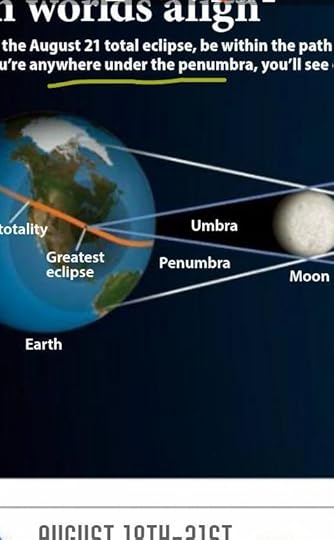
Looking forward to the 21st of August, a total solar eclipse, I think I need to read this book. Why so much frenzy and preparation and expectation? I wonder.

Solar events have meaning. So lunar ones.


(Astronomy magazine)

(Astronomy magazine)

"These late eclipses in the sun and moon portend no good to us. Though the wisdom of nature can reason it thus and thus, yet nature finds itself scourged by the sequent effects. Love cools, friendship falls off, brothers divide, in cities mutinies, in countries discord, in palaces treason, and the bond cracked ’twixt son and father. This villain of mine comes under the prediction—there’s son against father. The king falls from bias of nature—there’s father against child. We have seen the best of our time. Machinations, hollowness, treachery, and all ruinous disorders follow us disquietly to our graves."
Shakespeare's, King Lear, Act I, scene 2

"The sun shall be turned to darkness, and the moon to blood, before the great and awesome day of the Lord comes."
Joel 2:31
Maybe the work Aveni (as an astronomer) had with anthropologists made him take a more careful look into people's "beliefs".

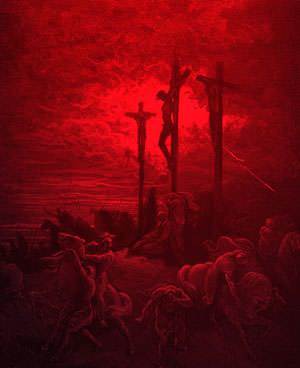
He starts in Stonehenge and follows the study of eclipses in the Greek science, in Babylonia, in Christianity (the "darkness of the Crucifixion") and into the approach of the phenomenon in the Chinese, Aztec and Mayan cultures. He knows what a scientific approach is. After the previous chapters in the Ancient world, he progresses into the Modern world; one, supposedly, truly scientific.

In the magic world he's pinpointing apparent contradictions. Like this one: in February the 4th of 1962, a total eclipse* happened in the South Pacific region; it was accompanied by a conjunction of 5 planets: Saturn, Jupiter and Mars on one side of the sun; and on the other side: Venus and Mercury.

As a result of the conjunction and the eclipse itself, an American psychic and astrologer called Jeanne Dixon** predicted that one child would be born somewhere in the Middle East region and would bring Peace in 1999. Yet for the same phenomenon the Indian astrologers predicted a "global disaster".

And, still, recently I bumped into this quote from the book of Celeste Teal ("Eclipses: predicting world events and personal transformation"): "By early September of 2001 I was still tabulating results of research from the early part of the twentieth century but I'd marked September 8-13, 2001, as a dangerous period for the United States going by the data gathered. Then came the events of September 11 ".

REAL or ALLEGORICAL?


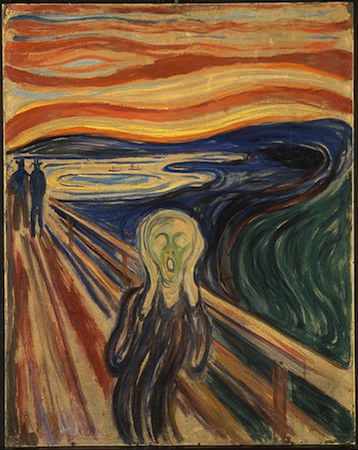
Aveni cannot really tell about the Star of Bethlehem or the Darkness of the Crucifixion; but he's got recourse to another event, Munch's painting The Scream, to justify his premise: something must have happened in the skies (in Jesus´ times).


It seems once the Norwegian painter was strolling with two friends and upon looking at the sky he felt so melancholic, overwhelmed by the colors in the sky, that he didn't proceed, but was left behind. Aveni connects that vision with the 1883, August 11, Krakatoa volcano eruptions in Indonesia.

But then there's the birth of Mohammad the prophet in year 570; here, in fact, a solar eclipse was attended in the year 569, November the 24th.

From the Chinese recordings, to the Aztec sacrifices and to the Mayan views, the collection of Aveni is great; as for the latter, someone recorded, to describe what happens during an eclipse: “being eaten, beaten and blinded by forces of the underworld”.


Aveni describes two eclipses under the Aztecan rule; one in April 13, 1325: when people made “noise” during the totality to scare the TZITZIMIME (demons); the other one in nowadays Mexico City, in August 8, 1496.

Following the Ancient ages, the author introduces the Modern ages. Special relevance is attributed to the work of the Islam writers, as well as those European scientists like Edmund Halley and others in the USA. Therefore, special chapters are dedicated to the New England eclipse of 1806 and the stern words of a reverend called Joseph Lathrop (on the obscurity of the moon and sun eclipses): “awfully portentous of some dire but unknown calamity”; the 1878 eclipse in Pike’s Peak; and the eclipse in New York central Park in 1925.

Truly, Aveni thinks that the study of eclipses is worthwhile, from a scientific standpoint, one easily concludes. Even animals’ behaviors don’t escape his scrutiny; and indeed he mentions lots of studies which prove animals behave differently during the eclipse: bees may return to the beehive, birds may fall, some other animals may stop doing what they were performing: dogs, as well as, ants. Interestingly, Aveni names that last chapter: ”Zoologists chasing shadows”.

CONCLUSION (?)

The author is really pro-bridging the “gulf” between the work of astronomers and the work of anthropologists. His was the try to bridge the gap between the objective and the subjective. Pinpointing the role of “superstition” Aveni still wonders: “who decides what’s rational?”. He’s got a confession: the eclipse’s darkness is a new type of darkness; it ain’t night, you easily figure.

He refers what the people of Suki (in Papua Guinea) told the Dutch in the 1960’s: souls leave the bodies and throw themselves into the sun or the moon; some may return, some, may not. Also, a lady in India would “bathe” after the eclipse. One most common reaction is to MAKE NOISE, whilst the sun diminishes….

“After all you must see for yourself”, says Aveni.

I could recall having watched Arthur Clarke commenting some years ago, live, from India (Hyderabad); while many were hiding inside their houses (with “fear”, according to Clarke) he and a few others were enjoying the progressive cooling and darkness appearing…as the cock sang.

MY conclusion

Don’t fall into the mistake of waiting for the day to “make noise”. As for magic, my guess is that it has already happened or will happen somehow in the near future (after the eclipse).

So, as for magic&mystery …you’ll never know; for sure.

Hold your soul.
28th July 2017.

UPDATE:

THE SOLAR ECLIPSE COULD MEAN DISASTER FOR TRUMP, ACCORDING TO ASTROLOGERS
in: http://www.newsweek.com/total-solar-e...


UPDATE:

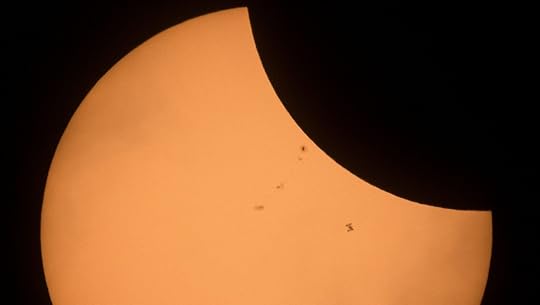
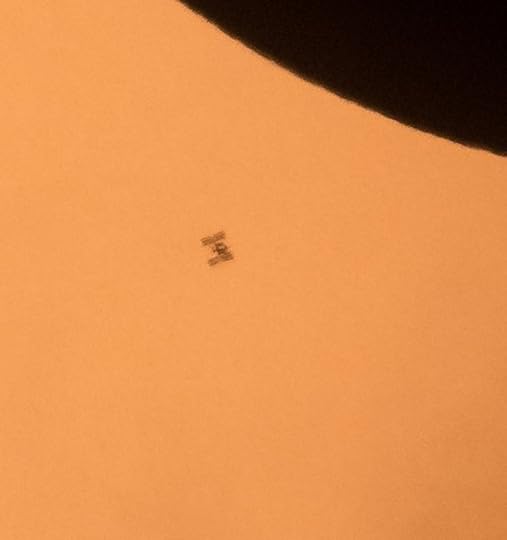
Now that the eclipse is gone, it would be good to present a selection of photos about it; for some it's been fun and awesome; to me, the most mysterious (?) meaningful photo is the last one: someone "stares it in the eye".


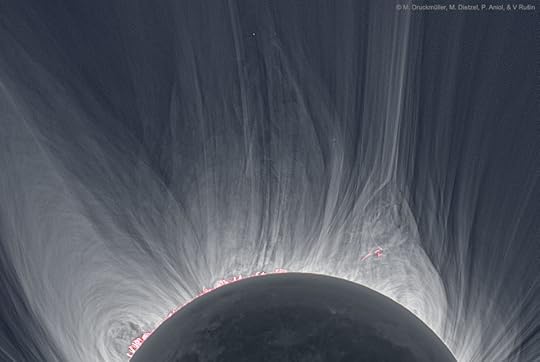
(sun corona)


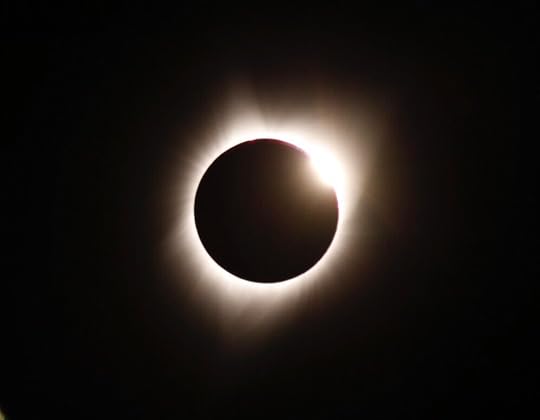
(sun diamond)


(ISS)


(ISS)


(stare it in the eye)

22nd of August 2017

UPDATE:

For 3 minutes they have stopped buzzing, now we know.
17th October 2018
https://elpais.com/elpais/2018/10/10/...

*Feb 4, 1962 7:10 PM Sun 15 Aqu 43 Conjunct Moon 15 Aqu 43(SE)

** "Dixon reportedly predicted the assassination of President John F. Kennedy." (in WIKI)
Profile Image for Joseph Hirsch.
Author 50 books134 followers
December 15, 2020
Sometimes interdisciplinarity is just invoked when a professor would prefer to pepper the coursework with some easier subjects in order to spare themselves (and their students) the effort involved in more rigorous study. Physics is hard, but the history of physics would involve a lot more reading than math.

Dr. Anthony Aveni's newly created field of "archaeoastronomy" might sound like a silly neologism or someone's way to conquer a Scrabble board, but it is actually an earnest investigation into the history of how people of the past viewed the heavens. This encompasses everything from religious rites to animal sleep-wake biorhythms, and the uses of the astral bodies for navigation and in the creation of calendars.

Dr. Aveni's investigation is underscored by a desire to find a concord between science and what we would consider superstition, so those wary of the humanities and steeped in the hard sciences may find his relativism off-putting or perhaps even a tad irresponsible. I found it fascinating and thought he maintained a steady balance while walking that precarious line once drawn by science fiction master Arthur C. Clarke between magic and science.

Even if you don't agree with Dr. Aveni's theory, though, there is enough solid history, archeological research, and established science on offer to satisfy those interested in the lives and endeavors of scientists (and shamans) throughout the ages. Recommended, with ample photos, illustrations, graphs, charts, and diagrams.
Profile Image for William Schram.
2,431 reviews99 followers
March 14, 2019
So I am going to tell you something unsurprising right now; I have never observed an actual eclipse. Lunar or Solar take your pick, I haven’t seen it. The next best thing does exist though. Through the book titled In The Shadow of The Moon by Anthony Aveni, we can live vicariously and discover the wonders of nature.

In the book, Aveni discusses the cultural and historical significance of eclipses. Some of this information is interesting, other bits of it raise questions on the reliability of human memory. For instance, the Ancient Greeks were a superstitious bunch when they were at war with other nations and city-states. Although the Ancient Greeks did have some knowledge of what caused eclipses and how they didn’t really mean anything, many people stuck to the old ways of irrationality and soothsaying. This may have caused Athens a war in at least one case.

However, our science-minded guide points out the inconsistencies in these accounts of the events. Since astronomical bodies like planets and the sun and so on follow set rules that are predictable, we can also go back several centuries or even several millennia to catch them in their lies. For instance, there was something about a battle foretold by the Persians and they lost the battle of Thermopylae or something. But the battle was one date and the only viable eclipses didn’t happen on those days.

Now you may argue something about different calendars, but these people are scientists. They took that into account. You may also argue that I got the prediction details incorrect, but you don’t seem to realize that it doesn’t really matter. Even to this day, there are people that believe in Astrology, that the sky holds meaningful information for us on this planet.

So Aveni goes through various cultures and how they related to eclipses. The Mayans seem to have been able to predict eclipses, and Stonehenge might have been some kind of eclipse prediction device. The Ancient Chinese people loved eclipses since they seemed to predict things, typically omens of disaster. This has changed somewhat, though we still have Astrology as I mentioned, and people who believe in spaceships that follow in the tails of comets. When it comes to all of that though, I suppose truth really is about the same as fiction. All in all, the book was okay. It was interesting in that it introduced me to a new field of study, where people connect Astronomy to Archaeology. It also showed that some people don’t realize that eclipses happen periodically.
Profile Image for Cesare Grava.
8 reviews1 follower
February 11, 2024
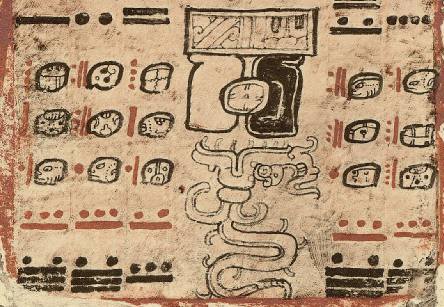
2.5 stars rounded down to 2. The book is great when it describes the geometry of the eclipses (did you know that eclipses are grouped into families?) and the awe they inspire ("Contact One"). But most of the other topics are poorly described. For example: the Dresden Codex ("Maya prediction"), the Antikythera ("Greek science"), and how the reactions of different societies to the eclipses help us to better understand these people ("eclipses in cultures"). And some chapters ("the crucifixion darkness") are downright boring.
131 reviews2 followers
February 2, 2017
Intriguing look at the anthropology behind solar eclipses: the watchers themselves, and our historic fascination and fears of one of the impressive astronomical events visible from Earth.
Profile Image for Lynee.
350 reviews12 followers
August 3, 2017
Very interesting! A good lead in to the 2017 solar eclipse. Stories, legends, and science all in one book.
Profile Image for Eyes Of .
85 reviews2 followers
May 17, 2019
On August 21st of 2017, I witnessed my first total solar eclipse. On a day with fickle weather, capitulating between haze, clouds, and rain, my family, friends, and I took a chance to stand in darkness like no other we had experienced. It was a nail-biter at the end, from the cheer that went up at first contact to hopes almost dashed when the fade of daylight began and the source of it all was obscured by clouds. The blanket cover blocking our view cleared at the last second, a breath before totality and it hit. The crowd roared, some cried, children shrieked. Some observers martyred themselves to take photos instead of gazing across the landscape at something so alien words often fail in its description. Some scrolled through their cell phones with a casual glance to the sky. One woman ate a sandwich, nose buried in a book.

I pondered those last two sky-gazers for weeks afterward as much as I puzzled over any local to me who had every opportunity to witness this event but brushed it off as if they could catch a matinee of it in the coming weeks to save a few bucks. Different strokes, I concluded. Human diversity.

For me, it changed a part of me, so much so that I read about solar eclipses as almost a guilty pleasure. I bought a telescope under the guise it was for my child to justify the cost and I've considered subscriptions to periodicals just for the hopes of keeping up-to-date on the 2024 eclipse. Reservations for it already made, thank you. I want that darkness, again.

So, when chance browsing at my local library turned up In the Shadow of the Moon, I snatched it up, delighted that it was a book not simply about the science of it all, but the culture as well. Cultural astronomy, as it was set forth, was asking the questions of past eclipses and the societies that viewed them in the same way I had about the woman eating a sandwich. What did they believe, how was it tied to their culture, the behavior of animals during eclipses and why it varies individual creature to creature, as well as how those variances and ancient intimacies affect modern societies today.

Organizationally, the book goes back and moves forward, from the earliest solar eclipse recordings, both factual and allegorical, and moves forward the current times. It isn't difficult to follow, but admittedly, there are a few jumps in subject matter that take a while to bring the reader full circle to the point that is trying to be made. The notes made throughout chapters and sections are also a lovely reference for the reader to dive further into topics not deeply covered in the book and I'm a sucker for source material.

In closing, I enjoyed this read from its correct assertion that humanity has moved away from being a part of nature, moving with it and shaped by it, as being something outside of it. We went from participants to observers. As Mr. Aveni remarks in his book, we are all trying to cope with scientific discovery correlating to our loss of intimacy in nature. His work illustrates how previous societies and cultures tied their worlds to that of the celestial heavens. Familiarity bound them both and those tethers have frayed.

I understand the sandwich woman, now, and the cell phone distraction as well as my matinee friends.

Recommended for those interested in astronomy from the bottom up, diggers into cultural anthropology, and the lady with the sandwich. I hope to see you in 2024 and if not, I hope your eyes are turned skyward in the darkness of totality, making the ties that bind.
3,334 reviews37 followers
July 25, 2017
This was timely! In just a couple more weeks there will be solar eclipse seen her in parts of the US! This is a great book to read before the event. Lots of info on how and when eclipses occur, how various cultures around the planet have viewed eclipses through history, and how they are viewed today. I just learned that NASA is recruiting people along the eclipse path this year to take note of the temperature for a study. I wish I was going to see the total eclipse, I'd participate in a heartbeat! Great read! If you're going to see the eclipse, you'll want to read this book before the event. If your not, the next total eclipse will be in 2024! There's still time to get this book and read it to be the next event!
I received a copy via Netgalley in exchange for a fair review.
Profile Image for C.A. Craven.
Author 2 books27 followers
June 5, 2017
(I won this book in a GoodReads giveaway.)

I have always been interested in astronomy, so I was looking forward to a book on eclipses. And this book does a great job, giving enough information to understand past and current events, without overwhelming an amateur stargazer with too much science-talk. It was a good overview of historical eclipses and records, moving to recent ones. The notes are in appendix form, not footnotes as I would prefer, and it was mostly written in a third-person historian tone so that sudden commentary from the author seemed a bit jarring, but overall a very, very good read.
Profile Image for Karen Christino.
Author 10 books80 followers
June 29, 2017
In the Shadow of the Moon is about not only eclipses, but also the people who study them. The author eloquently shares his own eclipse viewing experiences and presents others who’ve captured the spectacle in words. We learn about predicting eclipses through the centuries, from Stonehenge to Babylon, the ancient Greeks, Chinese and Maya, with detailed accounts of eclipse expeditions in the U.S. and abroad in more recent times. Full of insight and wit, Anthony Aveni’s eclipse book is part science history, part human interest, and captures the challenges of navigating capricious weather as well as the joy of encountering this rare natural phenomenon.
126 reviews
February 11, 2017
I won this book as a Goodreads contestant. I found this book to be an interesting mesh between past historical cultures and present society and how they viewed eclipses. The part of the book that studies how animals react to eclipses and in some cases not react at all very interesting. The book made me look back in my childhood and remember the few eclipses that I witnessed. I think I will never look at an eclipse again in the same way after reading this book. (And I don't mean without proper eye protection.)
Profile Image for Leanne.
831 reviews86 followers
August 30, 2017
Written by an astronomer who also holds an appointment in his university's department of anthropology, this book is really interesting not just about ancient and modern astronomy, but also about culture. John Dvorak's Mask of the Moon is similar to this book and I might recommend that one over Aveni's because it is so great on ancient Chinese astronomy. It was also less quirky and more wide-ranging. But that said, I'd like to read the author's book on time next!
Profile Image for John.
454 reviews1 follower
October 27, 2017
Very thorough explanation of how solar eclipses occur and how different cultures viewed them throughout history. The eclipses of the last 200 years in the states get a thorough detailing as well. An important book for someone looking to get a thorough education in solar eclipses.
Profile Image for Coral.
222 reviews3 followers
October 11, 2018
An interesting overview of solar eclipses. There is a chapter on the actual science behind them, but most of the book is focused on the cultural interpretations and reactions to them throughout the ages.
Profile Image for Kathy.
504 reviews7 followers
September 12, 2017
some interesting stuff. good. but not great, but then I'm picky
62 reviews
January 9, 2018
The content was mostly interesting, but there was a few too many tangents that could have been cut out. And why didn't he just show the math for predicting eclipses instead of describing it!
Profile Image for Bridgett Brown.
830 reviews48 followers
February 16, 2017
This was a pretty cool book. It shows how animals react to eclipses. Also how past historical cultures and our present society viewed them. I was interested in this book because of Stonehenge. I won this book in a Goodreads giveaway.
112 reviews
December 11, 2017
I enjoyed the historical information about eclipses and their impact on society, however I found portions of the book to be much less interesting. I also expected more info on the history of eclipses although the varied sources of information certainly made this difficult to write about.
Displaying 1 - 20 of 20 reviews

Can't find what you're looking for?

Get help and learn more about the design.