

What do you think?

Hellblazer #2
Hellblazer: The Devil You Know
This volume features some of Constantine's earliest adventures by writer Jamie Delano, including his first victory in the long war with the demon Nergal and an encounter with a strange woman who is the embodiment of the world's horrors, painted by V FOR VENDETTA co-creator David Lloyd.
Collects Hellblazer #10-13, Hellblazer Annual and The Horrorist #1-2.
Collects Hellblazer #10-13, Hellblazer Annual and The Horrorist #1-2.
264 pages, Paperback
First published May 2, 2007
About the author
Jamie Delano
465 books354 followersJamie Delano aka A. William James began writing comics professionally in the early 1980s. Latterly he has been writing prose fiction with "BOOK THIRTEEN" published by his own LEPUS BOOKS imprint (http://www.lepusbooks.co.uk) in 2012, "Leepus | DIZZY" in April 2014, and "Leepus | THE RIVER" in 2017.
Jamie lives in semi-rural Northamptonshire with his partner, Sue. They have three adult children and a considerable distraction of grandchildren.
Jamie lives in semi-rural Northamptonshire with his partner, Sue. They have three adult children and a considerable distraction of grandchildren.
Ratings & Reviews
Friends & Following
Create a free account to discover what your friends think of this book!
Community Reviews
Displaying 1 - 30 of 133 reviews

August 6, 2020
This was more hit-and-miss than volume 1, IMO, but I still loved quite a lot of it, and liked nearly all. You know you've found an author you connect with when the middling-to-negative reviews are criticising things you consider good features, not bugs.
Volume 2 is an odd compilation, made up of four single issue comics, #10-13, from late 1988, a 1989 annual (which if it was like 80s annuals for more innocent kids' publications, means produced in late 1988), and The Horrorist, a two-issue special from 1995, by which time Jamie Delano had stopped writing the main Hellblazer series.
I rather like the psychedelic-type sequences in 10 and 12 - of astral travel and being disembodied inside the 'electronic reality' (the early internet) - though it's clear from reviews that they aren't to every reader's taste. (But how much notice should I even be taking of all the 3-star reviews when there is a silent majority giving these collections ratings of 4-5 stars?) Whilst I liked the concepts and writing, I thought the artist was inevitably struggling to represent on a flat plane adventures and aspects of consciousness which would feel three-dimensional and movement-based, and be easier to convey in animation: what is here often feels like mere hints and prompts, for your imagination to run with, if it's your sort of thing.
Here it was easy to be reminded of that widely discussed comics topic of the 2010s, minor characters who die to fuel the story of the (white male) hero, and reflect how tedious that must have got when that was almost all there was to read and watch. Set alongside more recent, slightly more diverse superhero movies, where even if heroes are from different backgrounds, anonymous extras and minions are always dying in the background, it begins to look like a fundamental problem of individual and collective that is only ever partially resolvable (via more even representation) because most adventure stories are about individuals.
The Newcastle incident is central to Constantine's backstory, yet I've been wondering after reading #11 if the way it happened was a little too convoluted: that he was there on tour with his old band yet when it all happened, he had turned up at the club with several other people too. On the one hand, there can be convoluted backstories to real things and I like the realism of writers trying to reflect that. But when you are trying to tell a story in so few words, perhaps a layer of that sort of thing needs to be edited out?
At time of reading, I was curious about who - Alan Moore or Jamie Delano - introduced 'Newcastle' as the big scary thing in Constantine's backstory, and why. I've now seen it's in Swamp Thing 46 (1985), where the incident was said to have happened "last year", rather than in 1978, as it became in Hellblazer. I wanted to know if there was any reason he chose that city, the one that of all the major UK regional cities seems to get least national attention and to be in an abstract sense remote from most of the famous parts of "the North" still over a hundred miles further south (including Constantine's birthplace, Liverpool). But it was simple enough, it turns out: because Constantine's appearance was based on Sting, and Sting was from Newcastle. The city was part of the character's origin story, even though he wasn't from there himself - an example of how writers transpose real things to create characters.
I liked the way that through these issues, Delano was either creating visual ciphers for the character's dark memories, or showing a sense of him feeling taunted by the world, via the cans of Newcastle Brown Ale that keep appearing. (You wonder if they always actually were Newkie Brown, or if they are a reflection of Constantine worrying that beer cans and bottles will turn out to be it, because he doesn't want to see it - or if he's thinking that one he sees out of the corner of his eye is it, when it might actually be something else.)
But with the Newcastle incident suddenly so increased in its impact in issue 11 (compared to the brief, sardonically calm allusion in Swamp Thing) the apparent resolution in issue #12 ends up feeling rather unearned. There isn't a long narrative build up to show what it's been like for him being stuck with a probably unresolvable, horrendous fate, for ten years (even if there is something in the annual, and why would you read that between #11 and #12?) - nor how long he must have thought about some of what he does in #12. The panels on the concluding page are a curious mixture of capturing what it does feel like to be rid of something after a long period of struggle, and the kind of self-help talk that assumes all problems are inside the individual and not partly external. (Which, now that problem of therapy and self-help culture is more widely acknowledged, is odd to find in rather a political comic.)
I s'pose I should feel sorrier for him than I do - but right now all I really feel is a sort of empty light-headed relief.
It's as if the coils of a huge constricting snake that's been squeezing the life out of me for the past ten years had slipped away and I can breathe again.
For the first time since Newcastle, when I poisoned myself with a stupid lust for power, I'm conscious of standing on the brink of future rather than the tail of past.
I sought out my demon and conquered him, now if this species is going to have any chance of survival we all have to face the demons inside us.
We have to turn inwards. Enter the siege perilous, and wrestle. It's not those grotesque, tired institutions of heaven and hell that are the problem. It's the devils we know.
My favourite panels of writing in this collection follow shortly after that - near the beginning of Constantine's wandering at the seaside in #13 - describing childhood memories of a funfair ride:
We reeled out over the crowds on the spider. Vision smeared by G-force - streaking through galaxies of gaudy light, intoxicated by the hot-dog air. That's the sort of stuff I love in Delano's writing, where it hits exactly the right notes to be powerfully evocative and poetic, every word doing something, but it's not overdoing it either. Another panel I particularly liked was where it looks as if somebody else (Delano? Constantine? Both?) enjoyed Jonathan Livingston Seagull more than you're supposed to admit to now. (I did, but I don't think I've read it since I was a kid, partly because I don't want to spoil it, partly because I don't want the embarrassment.)
Delano loves metaphysical and dreamlike connections, so as Constantine is still processing his return to Newcastle and his flawed, destructive resolution of what happened there, the character falls asleep and dreams about a verbal echo: that common 1980s nightmare of the nuclear dystopia: blighted ruination, humans hoping to acquire gills, doomed isolates trying to find hope in reproduction and producing only death and mutants. The works. The Cold War may have just ended, but the nightmare idea remains in late 1988, in the presence of a nuclear power station across the bay.
For me, there's something that works very well about reading the now thoroughly-processed collective anxieties of 30 years ago, (whether they are similar to the present, or things now mostly out of mind) whilst trying to hear as little as possible about those of 2020.
Some reviewers have said these comics aren't funny, which I can't fathom. The bleakness - the right sort of bleakness for me - is punctuated every few pages by some pithy self-aware line or stupid pun that makes me hoot with laughter, these things being all the funnier in contrast to what is before and likely after. I can almost feel the dopamine surging when these things are at the right frequency.
In the annual, 'The Bloody Saint' Part One presents a rationale for Delano's writing style, which is a nice touch, to explain how this prose is attached to this character, whom others might have given a more hard-boiled style to go with his trenchcoat. He's psychologically more fragile, and more of a hippie, than would be assumed from his clothes. (And it must be intentional because Alan Moore, who originally created Constantine in Swamp Thing, nominated Delano to write the first Hellblazer comics.)
"Write it all down, they said, contain it. make some sense of it. But how can you make sense of the senseless or contain the seething universe?" (I found it interesting that "making sense of" was already such a key term psychologically in that context, as I didn't become aware of it that way until twenty years after this were written.) A couple of pages later, he's accepted it: "writing it down does channel the emotional rip-tides and provide a few calm eddies for thought. There's magic in the use of words."
Now I'm wondering if the trenchcoat and suit could be seen, at first, as an "act as if", a way to pass as and be reacted to as a different type of person, and work towards becoming him more of the time.
'The Bloody Saint' Part Two was a type of story I have a perennial weakness for: a character had an ancestor hundreds of years ago with similar talents. On top of that, Konstantyn was a pagan Romano-British warlord and sorceror holding out against Christianity, and Delano pays better attention to the history of the period than plenty of authors (who - and Good Omens, I'm looking at you here - seem to think it's not possible to make semi-humorous fantasy out of this era without dressing it up like the High Medieval when Mallory wrote Morte d'Arthur, a la Python). It's appropriately brutal and grubby and gnarled thanks to Bryan Talbot's art, and despite being written 30 years ago, fits well with current historical thinking on how conversion to Christianity was a political expedient for quite a lot of early medieval rulers. Likewise, Delano has noticed how some early medieval saints were merely those who were first and royal, and far from good. The way Konstantyn holds out against the new religion and eventually, strategically, decides to take it up, was reminiscent of the Christianisation of Lithuania in the 14th century.
However, despite certain visual absurdities (and some of the connections with mythical characters that may or may not have been satirical) this section needed more overt verbal humour. That's essential in anything of this sort after Douglas Adams' paragraphs in Hitchhiker's Guide to the Galaxy about the petty local council bureaucrat who was a direct male line descendant of Genghis Khan, never mind Blackadder. As much of the history was better than I'd have expected, odd blunders like mentioning the direwolf - a North American creature - and arguably the spelling of the ancestor's name, stood out.
I wasn't sure whether I would read The Horrorist yet, as it's a story from 1995, and I've already confused myself a bit with parallel reading of Constantine's adventures in 1985 Swamp Thing and 1988 Hellblazer. (The visual nature of comics, and the relative similarity of the art seems to make it harder to solidify a sense of what goes where, as I don't usually have a problem separating prose-only content written at different times but read close together.) But I wanted to finish the volume, and the art was different enough that I thought I could hold on to the idea of it as separate.
My review of The Horrorist is posted under the standalone comic for space reasons. This is another good thing I've just realised about comics collections. You can't do that if you say too much about a novel to fit in a GR review space.
(Following on from paragraph about hard-nosed masculine stories, Martin Amis and The Horrorist.) It was perhaps a very 1980s/90s type of narrative, on reflection. There are common motifs from those times that appear throughout this collection and which may only jump out as such if you remember then, or have read and watched a lot from it. Sometimes they are tiny mundane details, like the panel where a bystander has a carrier bag from Presto (a long-defunct UK supermarket) and is near a sign for a West London yoga centre. For me, absurdly mindblowing: two unconnected things twenty years and hundreds of miles apart in my own life suddenly shown in the same place. On a more fantastical level, Merlin's disembodied talking head is reminiscent of similar devices elsewhere like in The Man With Two Brains (1983) - as well as drawing on the Norse tale of Mimir and Odin (Odin of course a trickster type like, in their own ways Constantine and his ancestor) - and some extremely silly psychedelic sperm imagery of the opening sequence to Look Who's Talking (1989). And the cover to this collection (with the artist's signature dated 1994): my favourite of all the covers I've looked at so far in the old and new collections, because of my taste for edgy, irreverent religious imagery that was probably sparked by the media furore about Madonna's 'Like a Prayer' video in early 1989 (which itself started a wider pop-culture trend).
I am hoping that as I read more of the series I will have less to say each time. It's supposed to be one of the reasons I'm reading comics, because it's quicker. Even if the idea of character development over many instalments and a long period of time isn't something I'd previously reckoned on being so interesting (as someone who usually reads standalone novels).
(read & reviewed August 2020)
Volume 2 is an odd compilation, made up of four single issue comics, #10-13, from late 1988, a 1989 annual (which if it was like 80s annuals for more innocent kids' publications, means produced in late 1988), and The Horrorist, a two-issue special from 1995, by which time Jamie Delano had stopped writing the main Hellblazer series.
I rather like the psychedelic-type sequences in 10 and 12 - of astral travel and being disembodied inside the 'electronic reality' (the early internet) - though it's clear from reviews that they aren't to every reader's taste. (But how much notice should I even be taking of all the 3-star reviews when there is a silent majority giving these collections ratings of 4-5 stars?) Whilst I liked the concepts and writing, I thought the artist was inevitably struggling to represent on a flat plane adventures and aspects of consciousness which would feel three-dimensional and movement-based, and be easier to convey in animation: what is here often feels like mere hints and prompts, for your imagination to run with, if it's your sort of thing.
Here it was easy to be reminded of that widely discussed comics topic of the 2010s, minor characters who die to fuel the story of the (white male) hero, and reflect how tedious that must have got when that was almost all there was to read and watch. Set alongside more recent, slightly more diverse superhero movies, where even if heroes are from different backgrounds, anonymous extras and minions are always dying in the background, it begins to look like a fundamental problem of individual and collective that is only ever partially resolvable (via more even representation) because most adventure stories are about individuals.
The Newcastle incident is central to Constantine's backstory, yet I've been wondering after reading #11 if the way it happened was a little too convoluted: that he was there on tour with his old band yet when it all happened, he had turned up at the club with several other people too. On the one hand, there can be convoluted backstories to real things and I like the realism of writers trying to reflect that. But when you are trying to tell a story in so few words, perhaps a layer of that sort of thing needs to be edited out?
At time of reading, I was curious about who - Alan Moore or Jamie Delano - introduced 'Newcastle' as the big scary thing in Constantine's backstory, and why. I've now seen it's in Swamp Thing 46 (1985), where the incident was said to have happened "last year", rather than in 1978, as it became in Hellblazer. I wanted to know if there was any reason he chose that city, the one that of all the major UK regional cities seems to get least national attention and to be in an abstract sense remote from most of the famous parts of "the North" still over a hundred miles further south (including Constantine's birthplace, Liverpool). But it was simple enough, it turns out: because Constantine's appearance was based on Sting, and Sting was from Newcastle. The city was part of the character's origin story, even though he wasn't from there himself - an example of how writers transpose real things to create characters.
I liked the way that through these issues, Delano was either creating visual ciphers for the character's dark memories, or showing a sense of him feeling taunted by the world, via the cans of Newcastle Brown Ale that keep appearing. (You wonder if they always actually were Newkie Brown, or if they are a reflection of Constantine worrying that beer cans and bottles will turn out to be it, because he doesn't want to see it - or if he's thinking that one he sees out of the corner of his eye is it, when it might actually be something else.)
But with the Newcastle incident suddenly so increased in its impact in issue 11 (compared to the brief, sardonically calm allusion in Swamp Thing) the apparent resolution in issue #12 ends up feeling rather unearned. There isn't a long narrative build up to show what it's been like for him being stuck with a probably unresolvable, horrendous fate, for ten years (even if there is something in the annual, and why would you read that between #11 and #12?) - nor how long he must have thought about some of what he does in #12. The panels on the concluding page are a curious mixture of capturing what it does feel like to be rid of something after a long period of struggle, and the kind of self-help talk that assumes all problems are inside the individual and not partly external. (Which, now that problem of therapy and self-help culture is more widely acknowledged, is odd to find in rather a political comic.)
I s'pose I should feel sorrier for him than I do - but right now all I really feel is a sort of empty light-headed relief.
It's as if the coils of a huge constricting snake that's been squeezing the life out of me for the past ten years had slipped away and I can breathe again.
For the first time since Newcastle, when I poisoned myself with a stupid lust for power, I'm conscious of standing on the brink of future rather than the tail of past.
I sought out my demon and conquered him, now if this species is going to have any chance of survival we all have to face the demons inside us.
We have to turn inwards. Enter the siege perilous, and wrestle. It's not those grotesque, tired institutions of heaven and hell that are the problem. It's the devils we know.
My favourite panels of writing in this collection follow shortly after that - near the beginning of Constantine's wandering at the seaside in #13 - describing childhood memories of a funfair ride:
We reeled out over the crowds on the spider. Vision smeared by G-force - streaking through galaxies of gaudy light, intoxicated by the hot-dog air. That's the sort of stuff I love in Delano's writing, where it hits exactly the right notes to be powerfully evocative and poetic, every word doing something, but it's not overdoing it either. Another panel I particularly liked was where it looks as if somebody else (Delano? Constantine? Both?) enjoyed Jonathan Livingston Seagull more than you're supposed to admit to now. (I did, but I don't think I've read it since I was a kid, partly because I don't want to spoil it, partly because I don't want the embarrassment.)
Delano loves metaphysical and dreamlike connections, so as Constantine is still processing his return to Newcastle and his flawed, destructive resolution of what happened there, the character falls asleep and dreams about a verbal echo: that common 1980s nightmare of the nuclear dystopia: blighted ruination, humans hoping to acquire gills, doomed isolates trying to find hope in reproduction and producing only death and mutants. The works. The Cold War may have just ended, but the nightmare idea remains in late 1988, in the presence of a nuclear power station across the bay.
For me, there's something that works very well about reading the now thoroughly-processed collective anxieties of 30 years ago, (whether they are similar to the present, or things now mostly out of mind) whilst trying to hear as little as possible about those of 2020.
Some reviewers have said these comics aren't funny, which I can't fathom. The bleakness - the right sort of bleakness for me - is punctuated every few pages by some pithy self-aware line or stupid pun that makes me hoot with laughter, these things being all the funnier in contrast to what is before and likely after. I can almost feel the dopamine surging when these things are at the right frequency.
In the annual, 'The Bloody Saint' Part One presents a rationale for Delano's writing style, which is a nice touch, to explain how this prose is attached to this character, whom others might have given a more hard-boiled style to go with his trenchcoat. He's psychologically more fragile, and more of a hippie, than would be assumed from his clothes. (And it must be intentional because Alan Moore, who originally created Constantine in Swamp Thing, nominated Delano to write the first Hellblazer comics.)
"Write it all down, they said, contain it. make some sense of it. But how can you make sense of the senseless or contain the seething universe?" (I found it interesting that "making sense of" was already such a key term psychologically in that context, as I didn't become aware of it that way until twenty years after this were written.) A couple of pages later, he's accepted it: "writing it down does channel the emotional rip-tides and provide a few calm eddies for thought. There's magic in the use of words."
Now I'm wondering if the trenchcoat and suit could be seen, at first, as an "act as if", a way to pass as and be reacted to as a different type of person, and work towards becoming him more of the time.
'The Bloody Saint' Part Two was a type of story I have a perennial weakness for: a character had an ancestor hundreds of years ago with similar talents. On top of that, Konstantyn was a pagan Romano-British warlord and sorceror holding out against Christianity, and Delano pays better attention to the history of the period than plenty of authors (who - and Good Omens, I'm looking at you here - seem to think it's not possible to make semi-humorous fantasy out of this era without dressing it up like the High Medieval when Mallory wrote Morte d'Arthur, a la Python). It's appropriately brutal and grubby and gnarled thanks to Bryan Talbot's art, and despite being written 30 years ago, fits well with current historical thinking on how conversion to Christianity was a political expedient for quite a lot of early medieval rulers. Likewise, Delano has noticed how some early medieval saints were merely those who were first and royal, and far from good. The way Konstantyn holds out against the new religion and eventually, strategically, decides to take it up, was reminiscent of the Christianisation of Lithuania in the 14th century.
However, despite certain visual absurdities (and some of the connections with mythical characters that may or may not have been satirical) this section needed more overt verbal humour. That's essential in anything of this sort after Douglas Adams' paragraphs in Hitchhiker's Guide to the Galaxy about the petty local council bureaucrat who was a direct male line descendant of Genghis Khan, never mind Blackadder. As much of the history was better than I'd have expected, odd blunders like mentioning the direwolf - a North American creature - and arguably the spelling of the ancestor's name, stood out.
I wasn't sure whether I would read The Horrorist yet, as it's a story from 1995, and I've already confused myself a bit with parallel reading of Constantine's adventures in 1985 Swamp Thing and 1988 Hellblazer. (The visual nature of comics, and the relative similarity of the art seems to make it harder to solidify a sense of what goes where, as I don't usually have a problem separating prose-only content written at different times but read close together.) But I wanted to finish the volume, and the art was different enough that I thought I could hold on to the idea of it as separate.
My review of The Horrorist is posted under the standalone comic for space reasons. This is another good thing I've just realised about comics collections. You can't do that if you say too much about a novel to fit in a GR review space.
(Following on from paragraph about hard-nosed masculine stories, Martin Amis and The Horrorist.) It was perhaps a very 1980s/90s type of narrative, on reflection. There are common motifs from those times that appear throughout this collection and which may only jump out as such if you remember then, or have read and watched a lot from it. Sometimes they are tiny mundane details, like the panel where a bystander has a carrier bag from Presto (a long-defunct UK supermarket) and is near a sign for a West London yoga centre. For me, absurdly mindblowing: two unconnected things twenty years and hundreds of miles apart in my own life suddenly shown in the same place. On a more fantastical level, Merlin's disembodied talking head is reminiscent of similar devices elsewhere like in The Man With Two Brains (1983) - as well as drawing on the Norse tale of Mimir and Odin (Odin of course a trickster type like, in their own ways Constantine and his ancestor) - and some extremely silly psychedelic sperm imagery of the opening sequence to Look Who's Talking (1989). And the cover to this collection (with the artist's signature dated 1994): my favourite of all the covers I've looked at so far in the old and new collections, because of my taste for edgy, irreverent religious imagery that was probably sparked by the media furore about Madonna's 'Like a Prayer' video in early 1989 (which itself started a wider pop-culture trend).
I am hoping that as I read more of the series I will have less to say each time. It's supposed to be one of the reasons I'm reading comics, because it's quicker. Even if the idea of character development over many instalments and a long period of time isn't something I'd previously reckoned on being so interesting (as someone who usually reads standalone novels).
(read & reviewed August 2020)

September 16, 2018
After reading volume 1 of Hellblazer, I decided to read Alan Moore's Swamp Thing run before going any further because it fills in some of the blanks from Constantine's past that are otherwise a little confusing (such as why he has a group of ghosts following him around everywhere and how his girlfriend was killed).
Doing this also had another benefit, however, because I got to directly compare the two books back-to-back. While Moore's book was pretty trippy and revolutionary, it doesn't hold a candle to how Hellblazer screws with your head and subverts the traditional superhero comic. This series is REALLY out there, and it's really great because of that.
The highlight of this volume is the two part Horrorist story. It is totally bonkers in the best ways. Just imagine Hellblazer mixed with Marvel's adult MAX imprint and you will have a good idea of the kind of story they are going for here.
Doing this also had another benefit, however, because I got to directly compare the two books back-to-back. While Moore's book was pretty trippy and revolutionary, it doesn't hold a candle to how Hellblazer screws with your head and subverts the traditional superhero comic. This series is REALLY out there, and it's really great because of that.
The highlight of this volume is the two part Horrorist story. It is totally bonkers in the best ways. Just imagine Hellblazer mixed with Marvel's adult MAX imprint and you will have a good idea of the kind of story they are going for here.

March 5, 2009
"The Devil You Know" collects Hellblazer issues #10-13, plus the "Bloody Saint" from the Special, and both issues of The Horrorist.
Overall, this is a solid collection -- if for no other reason than it's great they're finally making an effort at collecting the earlier issues in a mostly complete way. It's only four issues, but it's a fairly important and interesting four issues, and it's padded with some good Hellblazer miscellany. The writing and storyline is good, and improves slightly from Book 1 (Hellblazer Original Sins). The art is still somewhat garishly colored (typical for the late 80s), but the art itself is improved as well.
The storyline mostly deals with Newcastle and its aftermath, as well as John's current troubles with the demon Nergal; this is the first three issues, #10, #11, and #12. #13 is a one-shot sort of filler story in which John has hallucinations or visions of a nuclear apocalypse while resting at the beach. The "Bloody Saint" annual is entirely about John's distant ancestor, the ruthless and cunning priest-king Con-Stan-Tyne, set probably in the 7th century or so, and it establishes a relationship with both Ravenscar and the Dragon. Finally the story of The Horrorist is the tale of a frigid winter and John's tracking of a destructively empowered African girl who recreates atrocities wherever she goes.
Honestly, though I'm glad it's out, it could have been pieced together a little better.
First of all, the inclusion of the Bloody Saint annual isn't terribly unfitting, but it would do better as a prelude to the next trade, Book 3 (Hellblazer The Fear Machine)... I say this because of the importance of the Dragon and the God/Goddess balancing elements in the Fear Machine storyline. I assume it was put here instead to act as padding for the mere four issues.
Secondly, the story of The Horrorist doesn't fit here, and should go somewhere else (it's been suggested it fits between issues #83 and #84). I assume it was just added as padding as well, but padding really isn't necessary -- other elements could have been added in.
For example: Since the Nergal storyline is the main focus, I think they should have included part of Brian Azzarello's "The First Time" story from "Hellblazer Secret Files", the bit where an 8-year-old John meets Nergal while watching them dredge a dead body from the river. Make it the first part of the book and then go into the issues, or put it after, either way.
Also, with the nuclear omens theme in issue #13, Grant Morrison's issues #25 and #26 could be included here, since they aren't part of the TPB for Book 4 (Hellblazer Family Man). This would be a bit of a stretch, since they were written more than ten issues later, but it's less a stretch than the inclusion of The Horrorist, and it makes more sense. Plus the storyline of those two issues is deliberately vague in terms of timeline and continuity with the rest of the series, since it was a guest-writer spot.
Finally, putting the story about John's old heroine-addict girlfriend who gets addicted to Morpheus' sand (Sandman #3) might have been a nice inclusion for the end of the book, though there is some debate about when that storyline occurred within the Hellblazer timeline.
Any of these could have been included more sensibly, and filled the book out enough to keep it from being a skinny one. The Morrison issues and the Gaiman Sandman cameo issue may have legal or financial complications that would prevent inclusion, but the Azzarello "Secret Files" story is a no-brainer and definitely should have been included.
However, aside from these niggling concerns about how the book could have been filled out more fittingly, it's still a really good book overall. The "Bloody Saint" story from the Hellblazer Annual is really pretty hard to find, so it's great to have it included, and as I said it's wonderful that they're finally going back and trying to put Jamie Delano's series-originating work into TPBs.
Next: Book 3 (Hellblazer The Fear Machine)
Overall, this is a solid collection -- if for no other reason than it's great they're finally making an effort at collecting the earlier issues in a mostly complete way. It's only four issues, but it's a fairly important and interesting four issues, and it's padded with some good Hellblazer miscellany. The writing and storyline is good, and improves slightly from Book 1 (Hellblazer Original Sins). The art is still somewhat garishly colored (typical for the late 80s), but the art itself is improved as well.
The storyline mostly deals with Newcastle and its aftermath, as well as John's current troubles with the demon Nergal; this is the first three issues, #10, #11, and #12. #13 is a one-shot sort of filler story in which John has hallucinations or visions of a nuclear apocalypse while resting at the beach. The "Bloody Saint" annual is entirely about John's distant ancestor, the ruthless and cunning priest-king Con-Stan-Tyne, set probably in the 7th century or so, and it establishes a relationship with both Ravenscar and the Dragon. Finally the story of The Horrorist is the tale of a frigid winter and John's tracking of a destructively empowered African girl who recreates atrocities wherever she goes.
Honestly, though I'm glad it's out, it could have been pieced together a little better.
First of all, the inclusion of the Bloody Saint annual isn't terribly unfitting, but it would do better as a prelude to the next trade, Book 3 (Hellblazer The Fear Machine)... I say this because of the importance of the Dragon and the God/Goddess balancing elements in the Fear Machine storyline. I assume it was put here instead to act as padding for the mere four issues.
Secondly, the story of The Horrorist doesn't fit here, and should go somewhere else (it's been suggested it fits between issues #83 and #84). I assume it was just added as padding as well, but padding really isn't necessary -- other elements could have been added in.
For example: Since the Nergal storyline is the main focus, I think they should have included part of Brian Azzarello's "The First Time" story from "Hellblazer Secret Files", the bit where an 8-year-old John meets Nergal while watching them dredge a dead body from the river. Make it the first part of the book and then go into the issues, or put it after, either way.
Also, with the nuclear omens theme in issue #13, Grant Morrison's issues #25 and #26 could be included here, since they aren't part of the TPB for Book 4 (Hellblazer Family Man). This would be a bit of a stretch, since they were written more than ten issues later, but it's less a stretch than the inclusion of The Horrorist, and it makes more sense. Plus the storyline of those two issues is deliberately vague in terms of timeline and continuity with the rest of the series, since it was a guest-writer spot.
Finally, putting the story about John's old heroine-addict girlfriend who gets addicted to Morpheus' sand (Sandman #3) might have been a nice inclusion for the end of the book, though there is some debate about when that storyline occurred within the Hellblazer timeline.
Any of these could have been included more sensibly, and filled the book out enough to keep it from being a skinny one. The Morrison issues and the Gaiman Sandman cameo issue may have legal or financial complications that would prevent inclusion, but the Azzarello "Secret Files" story is a no-brainer and definitely should have been included.
However, aside from these niggling concerns about how the book could have been filled out more fittingly, it's still a really good book overall. The "Bloody Saint" story from the Hellblazer Annual is really pretty hard to find, so it's great to have it included, and as I said it's wonderful that they're finally going back and trying to put Jamie Delano's series-originating work into TPBs.
Next: Book 3 (Hellblazer The Fear Machine)

March 4, 2009
Dear Vertigo: comics have little numbers on them. You'll note that they start at #1 continue on up to two hundred and something. When collecting them into graphic novels, start with number one, and go in sequential order.
In terms of content, this is a solid four or five stars. I've always had as much fondness for Delano's Constantine as for the more heralded Ennis and Ellis stories.
But oh lordy does this get deducted for continuing Vertigo's incredibly asinine decision to collect the Hellblazer back catalogue three random issues at a time (which, in all fairness, was made a long time ago, and they seem to have been trying to rectify since then). In this collection, we get issues #10-13, finally completing the storyline from Original Sins (collected FIVE years before this volume). Then there's Annual #1, which makes sense in that it was from the same time. And then there's the recent miniseries The Horrorist, published six years after the rest of the material in the book.
Even this incredibly goofy decision would be somewhat defensible if I'd ever seen a copy of Rake at the Gates of Hell for sale in an actual comic shop. But apparently, reprinting one of the most popular Hellblazer storylines ever is low priority.
(and don't even get me started on Hitman)
In terms of content, this is a solid four or five stars. I've always had as much fondness for Delano's Constantine as for the more heralded Ennis and Ellis stories.
But oh lordy does this get deducted for continuing Vertigo's incredibly asinine decision to collect the Hellblazer back catalogue three random issues at a time (which, in all fairness, was made a long time ago, and they seem to have been trying to rectify since then). In this collection, we get issues #10-13, finally completing the storyline from Original Sins (collected FIVE years before this volume). Then there's Annual #1, which makes sense in that it was from the same time. And then there's the recent miniseries The Horrorist, published six years after the rest of the material in the book.
Even this incredibly goofy decision would be somewhat defensible if I'd ever seen a copy of Rake at the Gates of Hell for sale in an actual comic shop. But apparently, reprinting one of the most popular Hellblazer storylines ever is low priority.
(and don't even get me started on Hitman)

May 16, 2021
The second volume of Hellblazer has its hits and misses. The first half of the book is really good and the second half is just ok.
John Constantine had a rough first volume. He's on his way back to life, but still has some issues to resolve. They range from the Swamp Thing to Nergal. This is the first half of the volume detailing JC's adventures. I rather liked this part and the JC/Nergal interactions, as well as the background as to what happened to Constantine in Newcastle when he was young. I really liked both those main stories.
The second part about the adopted girl who could make people see visions, I did not care for. There were parts that had potential, but on the whole it was a weak offering. The second volume falls short of the first, but is still a good volume overall.
The artwork is typical of its day and nothing to be impressed by. It works. The second volume felt underwhelming, here is to hoping volume three holds up better.
John Constantine had a rough first volume. He's on his way back to life, but still has some issues to resolve. They range from the Swamp Thing to Nergal. This is the first half of the volume detailing JC's adventures. I rather liked this part and the JC/Nergal interactions, as well as the background as to what happened to Constantine in Newcastle when he was young. I really liked both those main stories.
The second part about the adopted girl who could make people see visions, I did not care for. There were parts that had potential, but on the whole it was a weak offering. The second volume falls short of the first, but is still a good volume overall.
The artwork is typical of its day and nothing to be impressed by. It works. The second volume felt underwhelming, here is to hoping volume three holds up better.
July 19, 2020
Boy howdy is this trippy and certainly different from the more down-to-earth take that Garth Ennis and Warren Ellis brought to "Hellblazer". One of the stories here has been reprinted in the "Rare Cuts" anthology featuring stories through the comic's entire run: The one detailing the Newcastle Incident, which ended up traumatising John Constantine psychologically for the rest of his life to the point of still being brought up in new stories to this day. It's also by far the most conventional story found here, whatever that means by the standards of "Hellblazer".
"The Devil You Know" is full of acidhead cosmic mysticism in neon-fluorescent psychedelic colours. Among the storylines found here is a riff on William Gibson-style cyberpunk where Constantine takes on a demon infesting a computer mainframe complete with holographic virtual realities modelled on mid-1980's computer game graphics, as well as my personal favourite: A flashback to the swords-and-sorcery exploits of an Iron Age Celt ancestor of John Constantine! In that one, the genre shifts completely to Robert E. Howard style heroic fantasy and end ups being quite the competent entry in that genre.
As you can imagine, the content of this paperback is extremely 1980's almost reaching the same acute levels of "I can't believe it's not a parody" as early editions of Warhammer. I already mentioned the storyline that put an occult fantasy spin on the virtual realities described in Wm. Gibson's "Burning Chrome" and "Neuromancer", but there are also constant references to political events of the day such as the Falklands War and an in-story music video by a rock group John Constantine sung in that's basically one 80's music video cliché after another. This very much comes across as the kind of comics that Carl MacCoy and Jaz Coleman probably read in their spare time back then. Come to think of it, even the arc about the Iron Age warlord Constantine's descended from matches the popularity of heroic fantasy during the 1980's as demonstrated by the films "Conan the Barbarian" and "Excalibur".
This has a real "everything and the kitchen sink" feel often absent from newer Constantine comics I've read, also way weirder: I didn't quite know what to make of the "Horrorist" arc which is probably the longest myself and features by far the most experimental writing, but it has some amazing eerie high-contrast artwork. The story itself also predicts the mythos around the "black-eyed children" mythos whom real life paranormal investigators (e. g. Nick Redfern) have begun encountering in the 21st century. Not all of the stories here really clicked for me, but you can't accuse Jamie Delano for lacking in audacity!
"The Devil You Know" is full of acidhead cosmic mysticism in neon-fluorescent psychedelic colours. Among the storylines found here is a riff on William Gibson-style cyberpunk where Constantine takes on a demon infesting a computer mainframe complete with holographic virtual realities modelled on mid-1980's computer game graphics, as well as my personal favourite: A flashback to the swords-and-sorcery exploits of an Iron Age Celt ancestor of John Constantine! In that one, the genre shifts completely to Robert E. Howard style heroic fantasy and end ups being quite the competent entry in that genre.
As you can imagine, the content of this paperback is extremely 1980's almost reaching the same acute levels of "I can't believe it's not a parody" as early editions of Warhammer. I already mentioned the storyline that put an occult fantasy spin on the virtual realities described in Wm. Gibson's "Burning Chrome" and "Neuromancer", but there are also constant references to political events of the day such as the Falklands War and an in-story music video by a rock group John Constantine sung in that's basically one 80's music video cliché after another. This very much comes across as the kind of comics that Carl MacCoy and Jaz Coleman probably read in their spare time back then. Come to think of it, even the arc about the Iron Age warlord Constantine's descended from matches the popularity of heroic fantasy during the 1980's as demonstrated by the films "Conan the Barbarian" and "Excalibur".
This has a real "everything and the kitchen sink" feel often absent from newer Constantine comics I've read, also way weirder: I didn't quite know what to make of the "Horrorist" arc which is probably the longest myself and features by far the most experimental writing, but it has some amazing eerie high-contrast artwork. The story itself also predicts the mythos around the "black-eyed children" mythos whom real life paranormal investigators (e. g. Nick Redfern) have begun encountering in the 21st century. Not all of the stories here really clicked for me, but you can't accuse Jamie Delano for lacking in audacity!

March 2, 2010
This 2nd Hellblazer collection is all over the place. The first three issues wrap up the story started in Original Sins quite well. The next two are just puzzling and completely lost my interest. Then it wraps up with a 2-parter that has beautiful art, but the story feels like a cliche.

September 18, 2011
This collection contains three flavors of nihilism for your self-hating pleasure, three tones of world-weary disgust for your cynical, comic-book reading mind.
The first selection is my least favorite. Even though it seems like forever since I finished the previous Hellblazer collection, the conclusion of the carrying-over storyline still seems abrupt. What really bothers me about this selection though is the art. It seems Richard Piers Rayner is hell-bent on depicting every stupid, awkward, obnoxious and just plain dumb facial expression the human body is capable of. It's gross and embarrassing in a way undeserving of the gross tastes of Hellblazer.
Bryan Talbot's art, however, which serves to illustrate the first Hellblazer Annual, is always satisfying in its putrid grotesqueness, and fits the rich coloring and accompanying story like a severed head to rusty pike. This is also, not coincidentally, my favorite story of the lot: though it is ugly and as mean-spirited as the others, there was something interesting in its portrayal of the fall of magic and rise of man. Also, the framing story involves 1980's British politics, which I had no interest in whatsoever before reading Hellblazer gave me an entertaining perspective on the various injustices and events.
The final piece to this triptych of a comic book collection is the first two issues of The Horrorist, a limited series on Constantine illustrated beautifully by David Lloyd, and my first introduction to John Constantine long, long before I knew who he was. The story here is an ugly one, essentially the ultimate white guilt fable, and even though it is self-reverentially one it is no less bleakly self-righteous or unappealing.
Somewhere around the middle of the Hororist I thought to myself, "Why am I reading this? This is gross and mean-spirited and boring. I am not enjoying myself." I mean, Constantine is constantly pratting on in some purple-prosed manner why the world sucks and everybody sucks and the world is going to die because it sucks and etcetera. Why not throw in a joke issue every now and then? Even the darkest melancholic has mediocre days every once in a while. It's such a grim book it's grim to the point of devoiding and devaluing all other possible perspectives. It is a book geared to put you in the ugliest frame of mind, with no chance of recovery. It is proselytizing on obvious uglies and evils of the world, things most of us move beyond because there are other things out there, but it does not show those other things. It even adds made-up carnage to stack the deck in its negative-nelly view further. In that way it is maudlin meaningless, and not worth my time.
I know I complain about smugness a lot on here, but smugness in literature is one thing I can't stand. Unless it is an obvious pulp story, I hate to see broadly defined characters that are good and evil, or opinions that are good or evil, especially when the story in question represents itself to be held up to a higher standard than pulp. This doesn't mean that I only like wishy-washy literature: but when a story has bad people, I like it to be at least admitted that these people (or opinions) are bad only because of the limited scope of the protagonist, who are (quite reasonably) indebted to their own views, and not the limited scope of the actual author's mind.
Hellblazer is relentlessly smug. Everybody's a nitwit or a mother-fucker or a hypocrite or a devil or a racist or a sniveling angel. Everybody is guilty of something. And Constantine is like Socrates, calling everybody else out while admitting he's the worst one of all. It's a cheap way to gain the reader's sympathy but it works, until the constant purple-prosed droning on the way life sucks and is shit becomes a pill. And like a pill, or a smart friend who is fun for a while until all his harping becomes a nagging annoyance, I think Hellblazer is a novelty only good in small doses.
The first selection is my least favorite. Even though it seems like forever since I finished the previous Hellblazer collection, the conclusion of the carrying-over storyline still seems abrupt. What really bothers me about this selection though is the art. It seems Richard Piers Rayner is hell-bent on depicting every stupid, awkward, obnoxious and just plain dumb facial expression the human body is capable of. It's gross and embarrassing in a way undeserving of the gross tastes of Hellblazer.
Bryan Talbot's art, however, which serves to illustrate the first Hellblazer Annual, is always satisfying in its putrid grotesqueness, and fits the rich coloring and accompanying story like a severed head to rusty pike. This is also, not coincidentally, my favorite story of the lot: though it is ugly and as mean-spirited as the others, there was something interesting in its portrayal of the fall of magic and rise of man. Also, the framing story involves 1980's British politics, which I had no interest in whatsoever before reading Hellblazer gave me an entertaining perspective on the various injustices and events.
The final piece to this triptych of a comic book collection is the first two issues of The Horrorist, a limited series on Constantine illustrated beautifully by David Lloyd, and my first introduction to John Constantine long, long before I knew who he was. The story here is an ugly one, essentially the ultimate white guilt fable, and even though it is self-reverentially one it is no less bleakly self-righteous or unappealing.
Somewhere around the middle of the Hororist I thought to myself, "Why am I reading this? This is gross and mean-spirited and boring. I am not enjoying myself." I mean, Constantine is constantly pratting on in some purple-prosed manner why the world sucks and everybody sucks and the world is going to die because it sucks and etcetera. Why not throw in a joke issue every now and then? Even the darkest melancholic has mediocre days every once in a while. It's such a grim book it's grim to the point of devoiding and devaluing all other possible perspectives. It is a book geared to put you in the ugliest frame of mind, with no chance of recovery. It is proselytizing on obvious uglies and evils of the world, things most of us move beyond because there are other things out there, but it does not show those other things. It even adds made-up carnage to stack the deck in its negative-nelly view further. In that way it is maudlin meaningless, and not worth my time.
I know I complain about smugness a lot on here, but smugness in literature is one thing I can't stand. Unless it is an obvious pulp story, I hate to see broadly defined characters that are good and evil, or opinions that are good or evil, especially when the story in question represents itself to be held up to a higher standard than pulp. This doesn't mean that I only like wishy-washy literature: but when a story has bad people, I like it to be at least admitted that these people (or opinions) are bad only because of the limited scope of the protagonist, who are (quite reasonably) indebted to their own views, and not the limited scope of the actual author's mind.
Hellblazer is relentlessly smug. Everybody's a nitwit or a mother-fucker or a hypocrite or a devil or a racist or a sniveling angel. Everybody is guilty of something. And Constantine is like Socrates, calling everybody else out while admitting he's the worst one of all. It's a cheap way to gain the reader's sympathy but it works, until the constant purple-prosed droning on the way life sucks and is shit becomes a pill. And like a pill, or a smart friend who is fun for a while until all his harping becomes a nagging annoyance, I think Hellblazer is a novelty only good in small doses.

July 9, 2009
The varied stories and breathtaking art in this collection of Hellblazer were far more intense than I was prepared for. It's hard for me to digest the density and weight of each story found in a picture book just over a half inch thick, but it has confirmed my growing opinion that Jamie Delano's entire run of Hellblazer was the best, even considering my love and respect for Neil Gaiman[edited years later, after his harmful, despicable sins were revealed to the world], Warren Ellis, and Garth Ennis.
When I can afford to start collecting the trade paperbacks of my favourite comics, this will surely be one of the top volumes I'll pull out when I want to read aloud to somebody and make their jaws drop and their eyes water.
When I can afford to start collecting the trade paperbacks of my favourite comics, this will surely be one of the top volumes I'll pull out when I want to read aloud to somebody and make their jaws drop and their eyes water.
February 25, 2025
I get flashbacks every time I see a seagull now.
Read
May 11, 2021It is not often I cannot rate a book, comic book or anything similar - but this is one of these cases. Reading this volume was like tripping: good trips, bad trips, crazy highs, desperate lows and so, sooo much weirdness. Maybe it's the fact that I read it in a weird state, some 6 months into pandemic lockdown, while keeping crazy hours.
In any event, this comic talks largely about Thatcherian England, the yoke of religion and fanaticism, the indifference of consumerism and generally everything that was and still is wrong with the world, through an allegory of drug-induced magic and weird fiction.
I am not saying you will like it and I am not saying you won't, but a thinking person will NOT be able to ignore what it says.
In any event, this comic talks largely about Thatcherian England, the yoke of religion and fanaticism, the indifference of consumerism and generally everything that was and still is wrong with the world, through an allegory of drug-induced magic and weird fiction.
I am not saying you will like it and I am not saying you won't, but a thinking person will NOT be able to ignore what it says.

August 24, 2013
Nergal & Newcastle (10-12). These three issues really form the conclusion of the major arc from volume 1, and so should have gone there, especially the Swamp Thing related issue. Ah well. 10 and 12 focus on the Resurrection Crusade and Nergal and are nice issues. There's a bit too much philosophical wankery in issue #10, of the sort that sometimes spoils Delano's writing. However in the end it offers some nice closure, and #12 does so even moreso. They're good plot-heavy issues [7/10]. On the other hand Newcastle is superb, not just for its revelation of Constantine's past, but also for the way that it shows the past of Constantine's crew, carefully lifted from both Swamp Thing and Delano's own initial issues. The story has a great kick to it and remains one of the landmark Constantine tales. Comparing it to the tales of Constatine's past in the New 52, and it's obvious how much the newer Constantine pales before his older self [9/10].
On the Beach (13). This is Delano's first full-length story that puts imagery and philosophy ahead of any type of story. To my surprise I like it (and always have). It's beautiful and scary and freaky and memorable, even if it doesn't contribute to the overall Hellblazer story [8/10].
The Bloody Saint (Annual #1). This is a slow story, but it's an intriguing (first) look at the Constantine legacy, and also a nice translation of Constantine's own desires and goals into a different milieu. Overall, an in interesting look at the character and also a great preview of the some of the themes that show up in The Fear Machine [7/10].
The Horrorist. This story is all evocation. It's got beautiful artwork and beautiful text, and if the story is a bit simple, you don't really notice, for all the beauty that's going by [7/10]. On the downside, it's badly placed in this volume of Hellblazer as it's clearly about an older, more world-weary Constantine. it should have been placed in a collection following Ennis' run, which is when it was written.
Overall, this is another very good volume of Delano's Hellblazer -- though I find his monthly issues better than his longer form work, which tends to get a bit slow and talky ... and the contents of this volume are poorly integrated (with the previous volume, with the next volume, and with their place in Constantine's chronology). Pity that DC couldn't have gotten this all arranged better when they redid the Hellblazer collections.
On the Beach (13). This is Delano's first full-length story that puts imagery and philosophy ahead of any type of story. To my surprise I like it (and always have). It's beautiful and scary and freaky and memorable, even if it doesn't contribute to the overall Hellblazer story [8/10].
The Bloody Saint (Annual #1). This is a slow story, but it's an intriguing (first) look at the Constantine legacy, and also a nice translation of Constantine's own desires and goals into a different milieu. Overall, an in interesting look at the character and also a great preview of the some of the themes that show up in The Fear Machine [7/10].
The Horrorist. This story is all evocation. It's got beautiful artwork and beautiful text, and if the story is a bit simple, you don't really notice, for all the beauty that's going by [7/10]. On the downside, it's badly placed in this volume of Hellblazer as it's clearly about an older, more world-weary Constantine. it should have been placed in a collection following Ennis' run, which is when it was written.
Overall, this is another very good volume of Delano's Hellblazer -- though I find his monthly issues better than his longer form work, which tends to get a bit slow and talky ... and the contents of this volume are poorly integrated (with the previous volume, with the next volume, and with their place in Constantine's chronology). Pity that DC couldn't have gotten this all arranged better when they redid the Hellblazer collections.

June 29, 2018
One review I read about Jamie Delano described how he talks and talks but it feels like he is never getting to the point, or perhaps there isn't a point to begin with. This writing style existed since the first issue, but it continued to grow worse and worse. The second volume is still bearable, but it definitely is harder to read than the first.
The stories of the second volume are generally just fine, zed's story concludes in the first issue, followed by 3 one-shots. The only story that really matters is Newcastle (issue #11), a canon issue to Constantine's background, and generally one of the best issues. Then there is one issue that goes back to Ritchie who is still trapped in the computer where Constantine left him. That one is kinda fun. Finally, there is a disastrous hallucination issue that offers nothing but nonsense.
I never really understood the way the original Hellblazer was collected, but since the Horrorist was also collected in this volume, I went on and read it. It was boring and unnecessarily made into two issues instead of one, but its ending gave me a certain satisfaction; the kind of satisfaction you expect from Constantine.
I recommend this volume mainly because of Newcastle and Zed's conclusion, but Jamie Delano's bad writing begins to shine here and its light becomes blinding soon after!
The stories of the second volume are generally just fine, zed's story concludes in the first issue, followed by 3 one-shots. The only story that really matters is Newcastle (issue #11), a canon issue to Constantine's background, and generally one of the best issues. Then there is one issue that goes back to Ritchie who is still trapped in the computer where Constantine left him. That one is kinda fun. Finally, there is a disastrous hallucination issue that offers nothing but nonsense.
I never really understood the way the original Hellblazer was collected, but since the Horrorist was also collected in this volume, I went on and read it. It was boring and unnecessarily made into two issues instead of one, but its ending gave me a certain satisfaction; the kind of satisfaction you expect from Constantine.
I recommend this volume mainly because of Newcastle and Zed's conclusion, but Jamie Delano's bad writing begins to shine here and its light becomes blinding soon after!
June 9, 2011
I didn't read these when they originally came out, mostly backtracking right now. I think i finally understand what/who john constantine is now. What if a (mostly) immoral con man became a magician and suddenly had to deal with demons and giant celestial issues? The comic itself refer to him as the 'laughing magician', but his humor isn't that funny. Its more about cynicism and mockery. So why the hell am I reading these when I'm not very happy with them or the main character? I'm not sure. I'll read a few more.

August 4, 2013
Sometimes I liked it, and sometimes I hated it. mixed feelings about this book.

September 30, 2015
Good collections of short run (2-4 issue) story arcs, not needlessly complicated by an overarching narrative.

September 19, 2017
Really cool to see some of David Lloyd's superb artwork outside of V for Vendetta.
Really cool thematic bridges as well.
Two thumbs up kids.
Now get to reading!
Really cool thematic bridges as well.
Two thumbs up kids.
Now get to reading!

October 24, 2021
Hellblazer #10-13: 4,5+/5
Annual #1: 3/5
The Horrorist: 5/5
Well, that was messed up...
Annual #1: 3/5
The Horrorist: 5/5
Well, that was messed up...

September 7, 2018
Original Sins
So we pick up from where Original Sins left off and come to an end of Jamie Delano's first major storyline in the Hellblazer series. So let's go....
Sex and Death: John and Swamp Thing have come upon a way to fuck over both the Resurrection Crusade and the Damnation Army. But that'll involve a trip to the Astral Plane for John and a bit of rumpy-pumpy for Swamp Thing. Now if only John can avoid the fallout. This is the first comic we see where there is a massive shift in the art style and personally, I'm on the fence about it. In some ways, it's expressive and varied but it skirts the uncanny valley so much it's kind of weird. That being said, the artwork for the Astral Plane and Delano's dreamlike writing make up for it.
Newcastle: The Crusade done and the Army routed, Nergal's lingering threats make John remember Newcastle and where all this crazy shit in his life first started. This is an interesting one for me, because before this we never really understood John's life before Hunger. Seeing how his early years turned him into such a bastard and the lingering guilt hanging over his head (especially considering the ghosts of his past) made him what he is, was definitely a good idea. Although I'm still 50/50 on the artwork.
The Devil you Know: Nergal's fucking with John, making the demon blood in his veins tear him up from the inside out. John's running out of time, except Ritchie Simpson is back in the picture, giving John an ace up his sleeve. So we have a return to proto-cyberspace and honestly I have to say the artwork really let me down here. It doesn't feel as expressive or creative as it was the first time through. There's a lot of empty space and rough linework. It feels sloppy and bland to look at. The writing is good though and the conclusion feels appropriate and suitable, tying all relevant loose ends, allowing John to move on to new pastures.
On the Beach: John's having a bit of a walk along the beach, all while a group of protestors stand against a nuclear power plant built in their town. And then the power plant explodes. This one feels like an odd duck in the volume. You could take John out of the equation and replace him with some other character and it would hardly skip a beat. You can clearly see Delano's personal politics on full display here and while its not a bad story, its a little too on the nose to be anything but a distribe, albeit a beautifully poetic one.
The Bloody Saint: Set back when John was still in and out of Ravenscar Asylum, the story tells of John's struggling to deal with a changing world, his place in it and his connection to one of his ancestors, colourfully dubbed The Bloody Saint. This story is an interesting little piece. A bit of Arthurian legend here, a slap of dark fantasy there, Delano's trademark poetic writing and what do you get? An interesting if a little disjointed story about how sometimes the apple doesn't fall far. If I can say anything specific, it's that sometimes the art style looks a little too detailed. It ends up looking grotty.
The story ends with a little glimpse into what Mucous Membrane (John's former band) were like and honestly, I didn't care much for it. The art was decent but it just felt like song lyrics in the vein of the Sex Pistols, something I don't have a lot of interest in. Chalk this one up to personal taste.
The Horrorist: Something bad has come into the world. Something that embodies all the hatred, violence and cruelty of the world. Every war, every conflict, every rape and pillaging. It's turning the world upside down. And John has to find it. This is a separate issue that was bunched in with this volume and it's probably one of the best pieces I've read. The horror is on point, building the tension to sudden horrifying events that the artwork captures beautifully. Delano's prose is on point, haunting and cruel and beautiful all at the same time.
So that's it. Nothing spectacular. Nothing horrendous. The Horrorist was the best of the bunch. On the Beach was probably the weak link. See ya soon for The Fear Machine.
So we pick up from where Original Sins left off and come to an end of Jamie Delano's first major storyline in the Hellblazer series. So let's go....
Sex and Death: John and Swamp Thing have come upon a way to fuck over both the Resurrection Crusade and the Damnation Army. But that'll involve a trip to the Astral Plane for John and a bit of rumpy-pumpy for Swamp Thing. Now if only John can avoid the fallout. This is the first comic we see where there is a massive shift in the art style and personally, I'm on the fence about it. In some ways, it's expressive and varied but it skirts the uncanny valley so much it's kind of weird. That being said, the artwork for the Astral Plane and Delano's dreamlike writing make up for it.
Newcastle: The Crusade done and the Army routed, Nergal's lingering threats make John remember Newcastle and where all this crazy shit in his life first started. This is an interesting one for me, because before this we never really understood John's life before Hunger. Seeing how his early years turned him into such a bastard and the lingering guilt hanging over his head (especially considering the ghosts of his past) made him what he is, was definitely a good idea. Although I'm still 50/50 on the artwork.
The Devil you Know: Nergal's fucking with John, making the demon blood in his veins tear him up from the inside out. John's running out of time, except Ritchie Simpson is back in the picture, giving John an ace up his sleeve. So we have a return to proto-cyberspace and honestly I have to say the artwork really let me down here. It doesn't feel as expressive or creative as it was the first time through. There's a lot of empty space and rough linework. It feels sloppy and bland to look at. The writing is good though and the conclusion feels appropriate and suitable, tying all relevant loose ends, allowing John to move on to new pastures.
On the Beach: John's having a bit of a walk along the beach, all while a group of protestors stand against a nuclear power plant built in their town. And then the power plant explodes. This one feels like an odd duck in the volume. You could take John out of the equation and replace him with some other character and it would hardly skip a beat. You can clearly see Delano's personal politics on full display here and while its not a bad story, its a little too on the nose to be anything but a distribe, albeit a beautifully poetic one.
The Bloody Saint: Set back when John was still in and out of Ravenscar Asylum, the story tells of John's struggling to deal with a changing world, his place in it and his connection to one of his ancestors, colourfully dubbed The Bloody Saint. This story is an interesting little piece. A bit of Arthurian legend here, a slap of dark fantasy there, Delano's trademark poetic writing and what do you get? An interesting if a little disjointed story about how sometimes the apple doesn't fall far. If I can say anything specific, it's that sometimes the art style looks a little too detailed. It ends up looking grotty.
The story ends with a little glimpse into what Mucous Membrane (John's former band) were like and honestly, I didn't care much for it. The art was decent but it just felt like song lyrics in the vein of the Sex Pistols, something I don't have a lot of interest in. Chalk this one up to personal taste.
The Horrorist: Something bad has come into the world. Something that embodies all the hatred, violence and cruelty of the world. Every war, every conflict, every rape and pillaging. It's turning the world upside down. And John has to find it. This is a separate issue that was bunched in with this volume and it's probably one of the best pieces I've read. The horror is on point, building the tension to sudden horrifying events that the artwork captures beautifully. Delano's prose is on point, haunting and cruel and beautiful all at the same time.
So that's it. Nothing spectacular. Nothing horrendous. The Horrorist was the best of the bunch. On the Beach was probably the weak link. See ya soon for The Fear Machine.

January 1, 2022
It's a challenge to plug into Delano's wordy stream of consciousness style when the trend in comics writing has gone in a very different, minimalist direction since this was published, but it's worth the effort. What's striking is exactly how dark and casually transgressive the book is, and how politically engaged and angry it is. These are certainly qualities lacking in the rather gelded modern iteration of Constantine, and it's rewarding to go back to a time when the character wasn't essentially a paranormal romance protagonist.

November 30, 2023
screaming crying throwing up

July 25, 2017
2 of the stories were good the rest seemed to be bleak for the sake of bleakness....

October 10, 2019
In late August of 2018, my beloved old dog had her first seizure. Right there and then, I knew the clock was ticking and whatever she had would eventually kill her, which it did a year and four days later. During the time before her death, I went on a wild eBay and Amazon shopping spree. Some of the things I bought were Hellblazer graphic novels, such as Hellblazer: The Devil You Know. Why? Because when you're miserable, John Constatine makes for good company.

Honestly, when you're greiveing or dealing with really bad news, don't some books just seem too damn happy? You can't help but hope that a sudden terrorist attack hits these yokels that author any random self-help book.
You don't have to worry about Constantine (or any other character) getting too happy here. Here we have demons, crazy fundamentalists (are there any other kind, really?) and hospital stays. All in vintage DC Vertigo style. This is a key graphic novel in the series, explaining why (among other things) Constantinte never seems to age, so if you're wondering what the Hellblazer backstory is, go here.
This is the cover of the reprint edition, which is easier to get than the original edition.
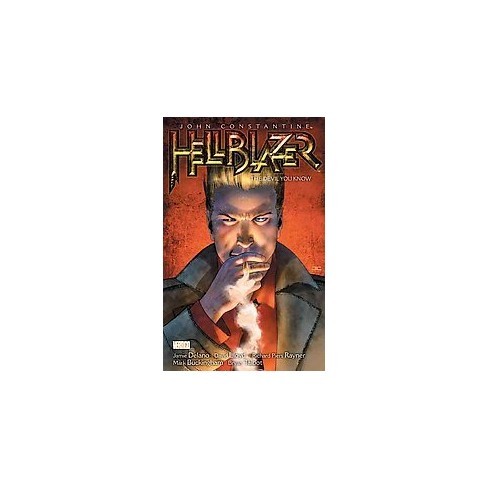
Honestly, when you're greiveing or dealing with really bad news, don't some books just seem too damn happy? You can't help but hope that a sudden terrorist attack hits these yokels that author any random self-help book.
You don't have to worry about Constantine (or any other character) getting too happy here. Here we have demons, crazy fundamentalists (are there any other kind, really?) and hospital stays. All in vintage DC Vertigo style. This is a key graphic novel in the series, explaining why (among other things) Constantinte never seems to age, so if you're wondering what the Hellblazer backstory is, go here.
This is the cover of the reprint edition, which is easier to get than the original edition.

December 9, 2018
Fragmented, a little confusing and somewhat boring. Didn't really find myself wanting to read this at all unlike the previous collection, which I devoured. The actual Hellblazer issues were quite alright, but nothing too special. I had much bigger expectations for Newcastle. The whole abused girl trope is just so old, I'd love to see someone come up with a new story for once.
I hated The Bloody Saints, it was just all around ugly, uninteresting and repulsive to me.
As for the Horrorist issues, I can't really decide yet whether I liked the story, it didn't really manage to suck me in emotionally and atmospherically as it was supposed to in order to work (but maybe I was still annoyed in the aftermath of The Bloody Saints and the fault might therefore be in me). I did enjoy the ambient art with amazing colour choices though.
I hated The Bloody Saints, it was just all around ugly, uninteresting and repulsive to me.
As for the Horrorist issues, I can't really decide yet whether I liked the story, it didn't really manage to suck me in emotionally and atmospherically as it was supposed to in order to work (but maybe I was still annoyed in the aftermath of The Bloody Saints and the fault might therefore be in me). I did enjoy the ambient art with amazing colour choices though.

December 8, 2009
although the character of john constantine developed slowly into one of the richest and most fulfilling personas in comic book history under the direction of garth ennis, the initial books written by jamie delano are lacking. they are poorly scripted and the artwork/storyboards seem amateurish and muddled. not worth the time.

November 25, 2014
That fever dream on the beach, yo....
I love this series something fierce. The art is pretty terrible (okay, not terrible, but very of an era and I don't love it). But I love Delano's writing so very much.
I love this series something fierce. The art is pretty terrible (okay, not terrible, but very of an era and I don't love it). But I love Delano's writing so very much.

June 6, 2019
FUCKING BRILLIANT, MATE!!

June 3, 2021
Muy bueno aunque no tanto como el volumen anterior.
Hellblazer: El diablo que ya conoces continua la historia de John Constantine justo donde se quedo el volumen pasado recopilando los números del 10-13, su primer anual y la mini serie de 2 númerosThe Horrorrist.
En general puedo decir que al igual que el primer compilatorio, cada número es autoconclusivo y va contando una desventura más de John aunque el tono cambia drásticamente. Pues exceptuando el número 10 donde cierran el arco con Swamp Thing y el 12 donde le dan un final a su rivalidad con el demonio Nergal, el resto de historias se sienten inconexas, apenas sin seguir algun hilo y solo muestran a John vagando por ahi invitando al lector a reflexionar a través de las imagenes tan crudas.
La playa y The horrorist hablan abiertamente de la energia nuclear y el sufrimiento de los niños africanos que se ven envueltos en guerrillas respectivamente, pero como dije antes; ahora la crítica social se siente algo forzada a diferencia de los primeros 9 números donde los problemas del mundo eran un tema recurrente más no el espectáculo central.
Sin duda alguna creo que lo mejor de este tomo compilatorio fue el número 11 donde por fin nos enteramos de que fue lo que pasó en Newcastle y lo que le dio sus traumas a Constantine y claro la miniserie de The Horrorrist que a pesar de lo ya antes mencionado es imposible que su narrativa y sus horripilantes imagenes te dejen indiferente.
Si eres fan de Constantine tambien te recomiendo este libro, a pesar de todo creo que vale mucho la pena aunque el estilo de Jamie Delano cambiara tanto...
Hellblazer: El diablo que ya conoces continua la historia de John Constantine justo donde se quedo el volumen pasado recopilando los números del 10-13, su primer anual y la mini serie de 2 númerosThe Horrorrist.
En general puedo decir que al igual que el primer compilatorio, cada número es autoconclusivo y va contando una desventura más de John aunque el tono cambia drásticamente. Pues exceptuando el número 10 donde cierran el arco con Swamp Thing y el 12 donde le dan un final a su rivalidad con el demonio Nergal, el resto de historias se sienten inconexas, apenas sin seguir algun hilo y solo muestran a John vagando por ahi invitando al lector a reflexionar a través de las imagenes tan crudas.
La playa y The horrorist hablan abiertamente de la energia nuclear y el sufrimiento de los niños africanos que se ven envueltos en guerrillas respectivamente, pero como dije antes; ahora la crítica social se siente algo forzada a diferencia de los primeros 9 números donde los problemas del mundo eran un tema recurrente más no el espectáculo central.
Sin duda alguna creo que lo mejor de este tomo compilatorio fue el número 11 donde por fin nos enteramos de que fue lo que pasó en Newcastle y lo que le dio sus traumas a Constantine y claro la miniserie de The Horrorrist que a pesar de lo ya antes mencionado es imposible que su narrativa y sus horripilantes imagenes te dejen indiferente.
Si eres fan de Constantine tambien te recomiendo este libro, a pesar de todo creo que vale mucho la pena aunque el estilo de Jamie Delano cambiara tanto...

March 13, 2020
After a promising start, wherein we see the Newcastle incident mentioned repeatedly in volume one, this volume gets caught up in trying to use mythology and dream imagery to tell fairly mundane stories.
Delano is a great writer but using a Dream Sequence for most of an issue is pretty lazy, especially when it's too make a very generalized point about environmentalism. I know this is Early Days in comics trying to send this sort of message, but Delano was fully capable of using demons to make his point, or just, you know, showing a rain of birds, or the actual effects of radioactivity, rather than having Constantine dream of bad things happening in the environment.
The annual, in which we see the Constantine of Merlin's time was excruciating. Too long a tale with no payoff.
The Horrorist storyline at the end was beautifully rendered by David Lloyd but didn't have the crust storytelling if they previous volume.
This is still with picking up if you're a John Constantine fan or just a devotee of early Vertigo, but it's not as vital and intriguing as its predecessor.
Delano is a great writer but using a Dream Sequence for most of an issue is pretty lazy, especially when it's too make a very generalized point about environmentalism. I know this is Early Days in comics trying to send this sort of message, but Delano was fully capable of using demons to make his point, or just, you know, showing a rain of birds, or the actual effects of radioactivity, rather than having Constantine dream of bad things happening in the environment.
The annual, in which we see the Constantine of Merlin's time was excruciating. Too long a tale with no payoff.
The Horrorist storyline at the end was beautifully rendered by David Lloyd but didn't have the crust storytelling if they previous volume.
This is still with picking up if you're a John Constantine fan or just a devotee of early Vertigo, but it's not as vital and intriguing as its predecessor.

Read
December 27, 2021For some reason I thought there were going to be vampires in this volume? There are not, but there is a) one of the most horrifying single issues of a comic I've ever read in the form of a flashback to the Newcastle incident (and this is coming from someone who has read the flesh harp issue of WicDiv) b) a very strange annual story about King Arthur c) an issue about a nuclear meltdown that kind of reads like the writer was on drugs and d) a two-issue story about some kind of ice demon that I did not retain anything from. Anyway, a bit of a mixed bag but GEEZ I will not be forgetting the Newcastle stuff any time soon.
Displaying 1 - 30 of 133 reviews