

What do you think?
Library of America #137
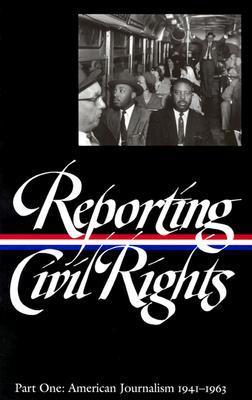
Reporting Civil Rights, Part One: American Journalism 1941-1963
From A. Philip Randolph's defiant call in 1941 for African Americans to march on Washington to Alice Walker in 1973, "Reporting Civil Rights" presents firsthand accounts of the revolutionary events that overthrew segregation in the United States. This two-volume anthology brings together for the first time nearly 200 newspaper and magazine reports and book excerpts, and features 151 writers, including James Baldwin, Robert Penn Warren, David Halberstam, Lillian Smith, Gordon Parks, Murray Kempton, Ted Poston, Claude Sitton, and Anne Moody. A newly researched chronology of the movement, a 32-page insert of rare journalist photographs, and original biographical profiles are included in each volume
Roi Ottley and Sterling Brown record African American anger during World War II; Carl Rowan examines school segregation; Dan Wakefield and William Bradford Huie describe Emmett Till's savage murder; and Ted Poston provides a fascinating early portrait of Martin Luther King, Jr. In the early 1960s, John Steinbeck witnesses the intense hatred of anti-integration protesters in New Orleans; Charlayne Hunter recounts the hostility she faced at the University of Georgia; Raymond Coffey records the determination of jailed children in Birmingham; Russell Baker and Michael Thelwell cover the March on Washington; John Hersey and Alice Lake witness fear and bravery in Mississippi, while James Baldwin and Norman Podhoretz explore northern race relations.
Singly or together, "Reporting Civil Rights" captures firsthand the impassioned struggle for freedom and equality that transformed America.
Roi Ottley and Sterling Brown record African American anger during World War II; Carl Rowan examines school segregation; Dan Wakefield and William Bradford Huie describe Emmett Till's savage murder; and Ted Poston provides a fascinating early portrait of Martin Luther King, Jr. In the early 1960s, John Steinbeck witnesses the intense hatred of anti-integration protesters in New Orleans; Charlayne Hunter recounts the hostility she faced at the University of Georgia; Raymond Coffey records the determination of jailed children in Birmingham; Russell Baker and Michael Thelwell cover the March on Washington; John Hersey and Alice Lake witness fear and bravery in Mississippi, while James Baldwin and Norman Podhoretz explore northern race relations.
Singly or together, "Reporting Civil Rights" captures firsthand the impassioned struggle for freedom and equality that transformed America.
996 pages, Hardcover
First published January 6, 2003
About the author
Clayborne Carson
100 books51 followersClayborne Carson is professor of history at Stanford University, and director of the Martin Luther King, Jr., Research and Education Institute. Since 1985 he has directed the Martin Luther King Papers Project, a long-term project to edit and publish the papers of Martin Luther King, Jr.
Ratings & Reviews
Friends & Following
Create a free account to discover what your friends think of this book!
Community Reviews
Displaying 1 - 10 of 10 reviews

August 24, 2013
A Priceless Documentary Of America's Struggle For Civil Rights -- 1
America's largest, most continuous, and most pressing domestic issue has been the treatment it has accorded black Americans. Similarly, the most important and valuable social movement in our country in the Twentieth Century was the Civil Rights movement which began, essentially, in the 1940's with WW II, received its focus with the Supreme Court's decision in Brown v. Board of Education in 1954, and continued through the 1950s 60s, and 70s.
The Library of America has published a two-volume history of the American Civil Rights Movement which focuses on contemporaneous journalistic accounts. The LOA's collection centers around the March on Washington in August 1963 which opens the second volume. The publication of the volumes, indeed, was timed to coincide with the 40th Anniversary of the March on Washington. This March is best known for Dr. Martin Luther King's "I have a Dream" speech.
The first volume of the series, which I am discussing here, begins in 1941 and ends in the middle of 1963. In consists of about 100 articles and essays documenting the Civil Rights struggle during these momentous years. Given the centrality of the March on Washington to the collection, the volume opens with a "Call to Negro America" dated July 1, 1941 calling for 10,000 Black Americans to march on Washington D.C. to secure integration and equal treatment in the Armed Forces. Philip Randolph, then the President of the Brotherhood of Sleeping Car Porters" was primarily responsible for this attempt to organize the 1941 march, and he participated prominently 22 years later in the 1963 March on Washington.
The volume documents other ways in which Civil Rights activities in the 1940s foreshadowed subsequent events. For example, an article details how Howard University students used the "sit-in" technique to desegregate Washington D.C. restaurants beginning in 1942. (see Pauli Murray's article on p. 62 of this volume). The sit-in technique was widely used beginning in the early 1960s to desegregate lunch counters in Southern and border states. Many articles in this volume document these later sit-ins and their impact, as well as the original sit-in organized by Pauli Murray.
Among the many subjects covered by this book are Thurgood Marshall's early legal career for the NAACP, the Supreme Court's decision in "Brown", the lynching of Emmett Till in 1954 and the acquittal of the guilty parties by an all-white Mississippi jury, the Montgomery Bus Boycott, in which Martin Luther King first gained prominence, of 1956, the integration of Little Rock High School in 1957, the lunch counter sit-ins that I have already mentioned, the "Freedom Rides" the admission of James Meridith to the University of Mississippi in 1962, the Birmingam riots, and the murder of Medgar Evars, Missippi Field Secretary for the NAACP. on June 12, 1962. There is a great deal more, and the articles given in the volume address Civil Rights in the North as well as in the South.
The immediacy and eloquence to this collection
give the reader the feel of being there and participating at the time. The cumulative effect of reading the book through is moving and powerful. By reading the book cover-to-cover and as the articles are presented the reader will get a better feel for the Civil Rights Movement and Era that can be gotten anywhere else. The book records a seminal Era in our Nation's history and an idealism and a spirit that is difficult to recreate or recapture.
I would like to point out some of the longer articles that the reader should notice in going through the book. I enjoyed James Poling's 1952 essay "Thurgood Marshall and the 14th Amendment" which chronicles Marshall's early career. Another important essay is William Bradford Huie's "Emmett Till's Killers Tell their Story: January, 1956." which recounts the confession to Till's murder of the individuals acquitted by the Mississippi jury. Robert Penn Warren's 1956 book-length essay "Segregation: the Inner Conflict in the South" is reprinted in the volume in full. A lengthy excerpt from James Baldwin's 1962 "The Fire Next Time" recounts Baldwin's meeting with Elijah Muhammad and his thoughts about the Black Muslim Movement. Norman Podhoretz's 1963 essay "My Negro Problem and Ours" remains well worth reading. Probably the most significant single text in this volume is Martin Luther King's "Letter from the Birmingham Jail" written in 1963. In this famous letter, Dr. King responds eloquently to criticism of his movement and his techniques voiced by eight Birmingham clergymen. The letter is a classic, not the least for Dr. King's writing style.
The book includes a chronology which will help the reader place the articles in perspective, and biographical notes on each of the authors. I turned to the biographies and the chronology repeatedly as I read the volume. The Library of America has also posted excellent study material for this book and its companion volume on its Website.
This book documents American's history and our country's continuing struggle to meet and develop its ideals.
Robin Friedman
America's largest, most continuous, and most pressing domestic issue has been the treatment it has accorded black Americans. Similarly, the most important and valuable social movement in our country in the Twentieth Century was the Civil Rights movement which began, essentially, in the 1940's with WW II, received its focus with the Supreme Court's decision in Brown v. Board of Education in 1954, and continued through the 1950s 60s, and 70s.
The Library of America has published a two-volume history of the American Civil Rights Movement which focuses on contemporaneous journalistic accounts. The LOA's collection centers around the March on Washington in August 1963 which opens the second volume. The publication of the volumes, indeed, was timed to coincide with the 40th Anniversary of the March on Washington. This March is best known for Dr. Martin Luther King's "I have a Dream" speech.
The first volume of the series, which I am discussing here, begins in 1941 and ends in the middle of 1963. In consists of about 100 articles and essays documenting the Civil Rights struggle during these momentous years. Given the centrality of the March on Washington to the collection, the volume opens with a "Call to Negro America" dated July 1, 1941 calling for 10,000 Black Americans to march on Washington D.C. to secure integration and equal treatment in the Armed Forces. Philip Randolph, then the President of the Brotherhood of Sleeping Car Porters" was primarily responsible for this attempt to organize the 1941 march, and he participated prominently 22 years later in the 1963 March on Washington.
The volume documents other ways in which Civil Rights activities in the 1940s foreshadowed subsequent events. For example, an article details how Howard University students used the "sit-in" technique to desegregate Washington D.C. restaurants beginning in 1942. (see Pauli Murray's article on p. 62 of this volume). The sit-in technique was widely used beginning in the early 1960s to desegregate lunch counters in Southern and border states. Many articles in this volume document these later sit-ins and their impact, as well as the original sit-in organized by Pauli Murray.
Among the many subjects covered by this book are Thurgood Marshall's early legal career for the NAACP, the Supreme Court's decision in "Brown", the lynching of Emmett Till in 1954 and the acquittal of the guilty parties by an all-white Mississippi jury, the Montgomery Bus Boycott, in which Martin Luther King first gained prominence, of 1956, the integration of Little Rock High School in 1957, the lunch counter sit-ins that I have already mentioned, the "Freedom Rides" the admission of James Meridith to the University of Mississippi in 1962, the Birmingam riots, and the murder of Medgar Evars, Missippi Field Secretary for the NAACP. on June 12, 1962. There is a great deal more, and the articles given in the volume address Civil Rights in the North as well as in the South.
The immediacy and eloquence to this collection
give the reader the feel of being there and participating at the time. The cumulative effect of reading the book through is moving and powerful. By reading the book cover-to-cover and as the articles are presented the reader will get a better feel for the Civil Rights Movement and Era that can be gotten anywhere else. The book records a seminal Era in our Nation's history and an idealism and a spirit that is difficult to recreate or recapture.
I would like to point out some of the longer articles that the reader should notice in going through the book. I enjoyed James Poling's 1952 essay "Thurgood Marshall and the 14th Amendment" which chronicles Marshall's early career. Another important essay is William Bradford Huie's "Emmett Till's Killers Tell their Story: January, 1956." which recounts the confession to Till's murder of the individuals acquitted by the Mississippi jury. Robert Penn Warren's 1956 book-length essay "Segregation: the Inner Conflict in the South" is reprinted in the volume in full. A lengthy excerpt from James Baldwin's 1962 "The Fire Next Time" recounts Baldwin's meeting with Elijah Muhammad and his thoughts about the Black Muslim Movement. Norman Podhoretz's 1963 essay "My Negro Problem and Ours" remains well worth reading. Probably the most significant single text in this volume is Martin Luther King's "Letter from the Birmingham Jail" written in 1963. In this famous letter, Dr. King responds eloquently to criticism of his movement and his techniques voiced by eight Birmingham clergymen. The letter is a classic, not the least for Dr. King's writing style.
The book includes a chronology which will help the reader place the articles in perspective, and biographical notes on each of the authors. I turned to the biographies and the chronology repeatedly as I read the volume. The Library of America has also posted excellent study material for this book and its companion volume on its Website.
This book documents American's history and our country's continuing struggle to meet and develop its ideals.
Robin Friedman

May 2, 2010
My S.F. Chronicle review from 2003:
To try to reckon with the power of this remarkable, two-volume collection from the Library of America, "Reporting Civil Rights," it might be helpful to do a little thought experiment: Imagine what it would do to George W. Bush to read these two fat volumes.
The question is not whether the book would change Bush. Oh no. That much is certain. The question is whether, in a real sense, he could even survive the experience. Bush, like many Americans, has staked much on a good-natured lack of awareness of what it is like to live at the opposite end of the power spectrum from the one he has always known. Bush's charm, such as it is, rests on the impression he conveys of being eminently comfortable with this stunted perspective. He seems to like who he is, in short, and not to fear all that he fails to be.
No one who reads -- not skims -- all 1,982 pages of this kaleidoscope of writings on America's greatest struggle of self-definition can come away without a deeply humbling sense of that human quality that most unites us all: the certainty that we all have a knack for fooling ourselves and finding ways to justify everything from petty slights to grievous harm.
The point is not to pick on Bush. Nor is it to kick fresh life into that pathetic old zombie, white liberal guilt. The ultimate subject of this collection is not the ways in which some of us have failed others but rather the way that we as a people have failed ourselves. It's a theme not without relevance here at the outset of the 21st century.
"Buchenwald was one of the worst things that ever happened in the entire history of the world," James Baldwin wrote nearly 40 years ago in "Nobody Knows My Name." "The world has never lacked for horrifying examples; but I do not believe that these examples are meant to be used as justification for our own crimes. This perpetual justification empties the heart of all human feeling. The emptier our hearts become, the greater will be our crimes."
Baldwin, it may go without saying, is one of the stars of this collection of 188 pieces of writing, some of them book excerpts, but most newspaper and magazine journalism. That is because the tone of pain and outrage and hard-
won clarity that defines his work comes across here differently than when it stands alone. Here it comes almost as a relief, after so many numbing and disturbing details, rather than a challenge.
What the collection can offer the reader is something no mere book can: membership (albeit it only honorary, or provisional membership) in a community.
No reader, especially no white reader, can ever really know what it felt like to be forced to the back of the bus, or whacked on the head or just plain ignored. But by getting to know the people who played the major roles in the civil rights struggles of the '40s, '50s and '60s, a reader can at least come a little closer to gaining a lasting sense of what those struggles meant and how they can never really be over.
Alice Walker, author of "The Color Purple," wraps up the collection with a 1973 New York Times Magazine article in which she explores a variation on this theme. "When Hamilton Holmes and Charlayne Hunter were first seen trying to enter the University of Georgia, people were stunned: Why did they want to go to that whitefolks' school? . . . I had watched Charlayne and Hamp every afternoon on the news when I came home from school. Their daring was infectious."
The reader might not have watched on television but can claim an intimate knowledge of what Hunter's experience was like. Her account of her 1961 experiences has a simplicity and ingenuousness that makes its small, human details more powerful and unforgettable. The night a mob gathers outside her dorm room, and someone breaks her window with a Coke bottle, sending shards of glass all over her clothing, she finds herself musing not on hate but human kindness.
"(O)ne of the most genuine persons it has been my good luck to meet came down and began talking to me," she writes. "Though it was clear that she herself was nervous, she did all she could under the circumstances to take my mind off what was going on. . . . After she had left I wondered how many people, myself included, would have had the courage to do what she had done."
Much later, a weary Stokely Carmichael pauses in 1967 to look back at all the battles fought earlier in that difficult decade. He talks to Gordon Parks about the fatal church bombings in Birmingham, Ala., in 1963, and by this point, those are much more than buzzwords to the reader. The 15 sticks of dynamite tossed into the 16th Street Baptist Church that year killed four young girls -- Cynthia Wesley, 14, Denise McNair, 11, Carole Robertson, 14, and Addie Mae Collins, 14. Claude Wesley wandered around after the blast, looking for his daughter, done up like the others in her Sunday best, and finally went to the hospital.
"They asked me if my daughter was wearing a ring," Wesley told reporter Karl Fleming. "I said yes, she was, and they pulled her little hand out and the little ring was there."
Carmichael also talks to Parks about the famous murder of three civil rights workers near Philadelphia, Miss., the next summer, and again the names Michael Schwerner, Andrew Goodman and James E. Cheney are much more than mere bits of data. We can almost see, again, the look on Sheriff Lawrence Rainey's face as Schwerner's widow, Rita, sits down with him in his car, and even though he won't look at her or address her directly, tells him: "I feel that you know what happened. I'm going to find out if I can. If you don't want me to find out, you'll have to kill me."
As Carmichael talks to Parks, who was with Malcolm X's widow and children the night he was killed, the reader starts to feel, like actual physical pressure, the weight of these and so many other inhuman episodes.
"Stokely recalled how in Montgomery he had broken after seeing a pregnant black woman knocked head over heels by water jetting from a fire hose, and other men and women being trampled by police horses," Parks notes. " 'Suddenly, ' he said, rubbing his eyelids, 'everything blurred. I started screaming and I didn't stop until they got me to the airport. That day I knew I could never be hit again without hitting back.' "
From there it was a short step to black power and a distancing from King's nonviolent strategies, and another short step to Huey Newton, Bobby Seale and the Black Panthers ("Every time you go execute a white racist Gestapo cop, you are defending yourself," Newton tells the Times Magazine in 1967.)
Hitting back meant full-scale rioting -- with fires, snipers and looting -- in Watts and other L.A. neighborhoods, in Newark, N.J., and, most horrifically,
in Detroit, all of which is painstakingly recorded here. Bob Clark, covering the Detroit riots for Ebony, is arrested, even though he has a press pass, and tells of sadistic beatings in the filthy cell where he and the others are kept,
and of a black sniper in their midst, telling them, "Man, I got four of them" -- meaning white people, most likely police officers -- "last night! I sat up there with my bottle of wine and they didn't know what was happening."
The collection is not without flaws. Despite the obvious care and debate that went into choices about how much attention to give which people and events, Malcolm X somehow gets short shrift. To cite the space given to him, only seven lines are required in the index; the King references occupy 54 lines.
A February 1965 Village Voice interview with Malcolm, shortly before his death, offers a moving portrait of his complexities. "I care about all people, but especially about black people," he says. "I'm a Muslim. My religion teaches me brotherhood, but doesn't make me a fool."
That's not to take anything away from the collection, merely to note that anyone who takes it seriously -- and that ought to be everyone -- can't help but have strong feelings about the choices that shaped it.
Overall, though, the vastness of the panorama surveyed is a statement unto itself. Not only the famous civil rights episodes of the '60s, but also glimpses of the '40s and the '50s, add up to the readerly equivalent of a headache. It's too much! Too many petty put-downs and slights. Too much pointless and cowardly violence. Too much gradualism, and way too many deaths. But that, of course, is just the point:
"For years, I labored with the idea of reforming the existing institutions of the society, a little change here, a little change there," King tells David Halberstam in May 1967, a year before he was killed. "Now I feel quite differently. I think you've got to have a reconstruction of the entire society,
a revolution of values."
Or, as Fanny Lou Hamer tells Jerry DeMuth in May 1964, "All my life I've been sick and tired. Now I'm sick and tired of being sick and tired."
A reader knows what she means.
Steve Kettmann, a former Chronicle reporter, lives in Berlin and reviews regularly for The Chronicle.
This article appeared on page M - 1 of the San Francisco Chronicle
Read more: http://www.sfgate.com/cgi-bin/article...
To try to reckon with the power of this remarkable, two-volume collection from the Library of America, "Reporting Civil Rights," it might be helpful to do a little thought experiment: Imagine what it would do to George W. Bush to read these two fat volumes.
The question is not whether the book would change Bush. Oh no. That much is certain. The question is whether, in a real sense, he could even survive the experience. Bush, like many Americans, has staked much on a good-natured lack of awareness of what it is like to live at the opposite end of the power spectrum from the one he has always known. Bush's charm, such as it is, rests on the impression he conveys of being eminently comfortable with this stunted perspective. He seems to like who he is, in short, and not to fear all that he fails to be.
No one who reads -- not skims -- all 1,982 pages of this kaleidoscope of writings on America's greatest struggle of self-definition can come away without a deeply humbling sense of that human quality that most unites us all: the certainty that we all have a knack for fooling ourselves and finding ways to justify everything from petty slights to grievous harm.
The point is not to pick on Bush. Nor is it to kick fresh life into that pathetic old zombie, white liberal guilt. The ultimate subject of this collection is not the ways in which some of us have failed others but rather the way that we as a people have failed ourselves. It's a theme not without relevance here at the outset of the 21st century.
"Buchenwald was one of the worst things that ever happened in the entire history of the world," James Baldwin wrote nearly 40 years ago in "Nobody Knows My Name." "The world has never lacked for horrifying examples; but I do not believe that these examples are meant to be used as justification for our own crimes. This perpetual justification empties the heart of all human feeling. The emptier our hearts become, the greater will be our crimes."
Baldwin, it may go without saying, is one of the stars of this collection of 188 pieces of writing, some of them book excerpts, but most newspaper and magazine journalism. That is because the tone of pain and outrage and hard-
won clarity that defines his work comes across here differently than when it stands alone. Here it comes almost as a relief, after so many numbing and disturbing details, rather than a challenge.
What the collection can offer the reader is something no mere book can: membership (albeit it only honorary, or provisional membership) in a community.
No reader, especially no white reader, can ever really know what it felt like to be forced to the back of the bus, or whacked on the head or just plain ignored. But by getting to know the people who played the major roles in the civil rights struggles of the '40s, '50s and '60s, a reader can at least come a little closer to gaining a lasting sense of what those struggles meant and how they can never really be over.
Alice Walker, author of "The Color Purple," wraps up the collection with a 1973 New York Times Magazine article in which she explores a variation on this theme. "When Hamilton Holmes and Charlayne Hunter were first seen trying to enter the University of Georgia, people were stunned: Why did they want to go to that whitefolks' school? . . . I had watched Charlayne and Hamp every afternoon on the news when I came home from school. Their daring was infectious."
The reader might not have watched on television but can claim an intimate knowledge of what Hunter's experience was like. Her account of her 1961 experiences has a simplicity and ingenuousness that makes its small, human details more powerful and unforgettable. The night a mob gathers outside her dorm room, and someone breaks her window with a Coke bottle, sending shards of glass all over her clothing, she finds herself musing not on hate but human kindness.
"(O)ne of the most genuine persons it has been my good luck to meet came down and began talking to me," she writes. "Though it was clear that she herself was nervous, she did all she could under the circumstances to take my mind off what was going on. . . . After she had left I wondered how many people, myself included, would have had the courage to do what she had done."
Much later, a weary Stokely Carmichael pauses in 1967 to look back at all the battles fought earlier in that difficult decade. He talks to Gordon Parks about the fatal church bombings in Birmingham, Ala., in 1963, and by this point, those are much more than buzzwords to the reader. The 15 sticks of dynamite tossed into the 16th Street Baptist Church that year killed four young girls -- Cynthia Wesley, 14, Denise McNair, 11, Carole Robertson, 14, and Addie Mae Collins, 14. Claude Wesley wandered around after the blast, looking for his daughter, done up like the others in her Sunday best, and finally went to the hospital.
"They asked me if my daughter was wearing a ring," Wesley told reporter Karl Fleming. "I said yes, she was, and they pulled her little hand out and the little ring was there."
Carmichael also talks to Parks about the famous murder of three civil rights workers near Philadelphia, Miss., the next summer, and again the names Michael Schwerner, Andrew Goodman and James E. Cheney are much more than mere bits of data. We can almost see, again, the look on Sheriff Lawrence Rainey's face as Schwerner's widow, Rita, sits down with him in his car, and even though he won't look at her or address her directly, tells him: "I feel that you know what happened. I'm going to find out if I can. If you don't want me to find out, you'll have to kill me."
As Carmichael talks to Parks, who was with Malcolm X's widow and children the night he was killed, the reader starts to feel, like actual physical pressure, the weight of these and so many other inhuman episodes.
"Stokely recalled how in Montgomery he had broken after seeing a pregnant black woman knocked head over heels by water jetting from a fire hose, and other men and women being trampled by police horses," Parks notes. " 'Suddenly, ' he said, rubbing his eyelids, 'everything blurred. I started screaming and I didn't stop until they got me to the airport. That day I knew I could never be hit again without hitting back.' "
From there it was a short step to black power and a distancing from King's nonviolent strategies, and another short step to Huey Newton, Bobby Seale and the Black Panthers ("Every time you go execute a white racist Gestapo cop, you are defending yourself," Newton tells the Times Magazine in 1967.)
Hitting back meant full-scale rioting -- with fires, snipers and looting -- in Watts and other L.A. neighborhoods, in Newark, N.J., and, most horrifically,
in Detroit, all of which is painstakingly recorded here. Bob Clark, covering the Detroit riots for Ebony, is arrested, even though he has a press pass, and tells of sadistic beatings in the filthy cell where he and the others are kept,
and of a black sniper in their midst, telling them, "Man, I got four of them" -- meaning white people, most likely police officers -- "last night! I sat up there with my bottle of wine and they didn't know what was happening."
The collection is not without flaws. Despite the obvious care and debate that went into choices about how much attention to give which people and events, Malcolm X somehow gets short shrift. To cite the space given to him, only seven lines are required in the index; the King references occupy 54 lines.
A February 1965 Village Voice interview with Malcolm, shortly before his death, offers a moving portrait of his complexities. "I care about all people, but especially about black people," he says. "I'm a Muslim. My religion teaches me brotherhood, but doesn't make me a fool."
That's not to take anything away from the collection, merely to note that anyone who takes it seriously -- and that ought to be everyone -- can't help but have strong feelings about the choices that shaped it.
Overall, though, the vastness of the panorama surveyed is a statement unto itself. Not only the famous civil rights episodes of the '60s, but also glimpses of the '40s and the '50s, add up to the readerly equivalent of a headache. It's too much! Too many petty put-downs and slights. Too much pointless and cowardly violence. Too much gradualism, and way too many deaths. But that, of course, is just the point:
"For years, I labored with the idea of reforming the existing institutions of the society, a little change here, a little change there," King tells David Halberstam in May 1967, a year before he was killed. "Now I feel quite differently. I think you've got to have a reconstruction of the entire society,
a revolution of values."
Or, as Fanny Lou Hamer tells Jerry DeMuth in May 1964, "All my life I've been sick and tired. Now I'm sick and tired of being sick and tired."
A reader knows what she means.
Steve Kettmann, a former Chronicle reporter, lives in Berlin and reviews regularly for The Chronicle.
This article appeared on page M - 1 of the San Francisco Chronicle
Read more: http://www.sfgate.com/cgi-bin/article...

June 13, 2011
The history of the early Civil Rights Movement in the present tense. The first of two volumes on the mid-twentieth century movement (as distinct from the "long civil rights movement" posited by Jacquelyn Dowd Hall), RCM is a sterling collection of newspaper and magazine articles, supplemented by excerpts from books and memoirs. Beginning with A. Phillip Randolph's proposed March on Washington, which led to FDR's Executive Order 8802 banning desegregation in defense industries, the volume chronicles the chaotic evolution of the movement through the individual breakthroughs represented by Jackie Robinson, the NAACP-sponsored legal challenges culminating in the Brown decision, the Montgomery boycott, the largely successful counterattack by white supremacists in the late 1950s, and the renewed energy of the sit-ins and freedom rides. The last two articles in the volume, which takes the story through mid-1963, sound cautionary notes. The first focuses on the failure of the Albany (Georgia) Movement to attain its goals, largely as result of Albany Police Chief Laurie Pritchett's co-optation of Martin Luther King's approach to "theatrical non-violence) and the outbreak of major violence in Cambridge, Maryland, which presages the riots in northern and western cities which would soon become common.
The most important thing to be gained from reading these pieces, as opposed to the many excellent histories of the Movement, is that it reminds us that at the time, no one knew whether, or to what degree, the Movement would succeed. The key word's contingency. America generally seems content with a triumphalist memory of the Movement as a success, which, Obama aside, leaves out the day-to-day circumstances of life in very large swathes of black America (and raises questions of the relationship between class and race). It's often presented, and celebrated on MLK Day, as a story of moral redemption, in which "liberal" America responds to the call of King to correct unfortunate injustices (which happened long ago and far away, i.e. in the South). RCM makes it clear that the moral dimension of the Movement, while important to individuals both black and white, played a secondary role in the federal government's grudging support for desegregation. The most important factors--you can choose which order to list them in--were the international struggle for the allegiance of the emerging nations of Asia and Africa--the CRM takes place at the height of the Cold War); and the economic realities of Southern life, especially the dependence of white middle class families on cheap black labor and the desire of southern businessmen to shed an image of barbarism which discouraged businesses from building plants, etc.
I'm a major fan of the Library of America, and especially the "Reporting" volumes which include Reporting Vietnam, Reporting World War II, and The Debate on the Constitution. RCM may be the best of them all. That's because the list of "literary" writers in the volume includes Ralph Ellison, Anne Moody (Coming of Age in Mississippi), Robert Penn Warren (Segregation), John Seinbeck, Langston Hughes and James Baldwin (several brilliant essays and the entire text of the major section of The Fire Next Time).
The shortcoming of the volume is built into the series format and can't really be separated from its strengths. There's no framing essay and readers will have to pick out the currents noted above on their own. Anyone plunging into the volume without a sense of both the general Movement story *and* what's referred to as the "New Civil Rights History" (which has shifted focus from male leaders, legal battles and the televised campaigns in places like Montgomery and Birmingham to the "organizing tradition," the crucial role of women, and the cultural weapons used in areas where the TV cameras never went) is likely to emerge with a fragmented sense of what mattered and why. This isn't a criticism of the editorial team headed by Clayborne Carson and David Garrow, but both are associated with the older movement history.)
For non-specialists--and I *do* recommend RCM for general readers--the best approach is probably to read it alongside (or in sequence with) a standard movement history--Taylor Branch's trilogy on the King years beginning with Parting the Waters deserves its status as standard--and a sampling of the New Civil Rights History pioneered by John Ditmar (Local People), Charles Payne (I've Got the Light of Freedom), and Danielle McGuire whose brilliant "At the Dark End of the Street" I'm using as the supporting text for the two RCM volumes in my seminar on Soul Music and the Civil Rights Movement.
The most important thing to be gained from reading these pieces, as opposed to the many excellent histories of the Movement, is that it reminds us that at the time, no one knew whether, or to what degree, the Movement would succeed. The key word's contingency. America generally seems content with a triumphalist memory of the Movement as a success, which, Obama aside, leaves out the day-to-day circumstances of life in very large swathes of black America (and raises questions of the relationship between class and race). It's often presented, and celebrated on MLK Day, as a story of moral redemption, in which "liberal" America responds to the call of King to correct unfortunate injustices (which happened long ago and far away, i.e. in the South). RCM makes it clear that the moral dimension of the Movement, while important to individuals both black and white, played a secondary role in the federal government's grudging support for desegregation. The most important factors--you can choose which order to list them in--were the international struggle for the allegiance of the emerging nations of Asia and Africa--the CRM takes place at the height of the Cold War); and the economic realities of Southern life, especially the dependence of white middle class families on cheap black labor and the desire of southern businessmen to shed an image of barbarism which discouraged businesses from building plants, etc.
I'm a major fan of the Library of America, and especially the "Reporting" volumes which include Reporting Vietnam, Reporting World War II, and The Debate on the Constitution. RCM may be the best of them all. That's because the list of "literary" writers in the volume includes Ralph Ellison, Anne Moody (Coming of Age in Mississippi), Robert Penn Warren (Segregation), John Seinbeck, Langston Hughes and James Baldwin (several brilliant essays and the entire text of the major section of The Fire Next Time).
The shortcoming of the volume is built into the series format and can't really be separated from its strengths. There's no framing essay and readers will have to pick out the currents noted above on their own. Anyone plunging into the volume without a sense of both the general Movement story *and* what's referred to as the "New Civil Rights History" (which has shifted focus from male leaders, legal battles and the televised campaigns in places like Montgomery and Birmingham to the "organizing tradition," the crucial role of women, and the cultural weapons used in areas where the TV cameras never went) is likely to emerge with a fragmented sense of what mattered and why. This isn't a criticism of the editorial team headed by Clayborne Carson and David Garrow, but both are associated with the older movement history.)
For non-specialists--and I *do* recommend RCM for general readers--the best approach is probably to read it alongside (or in sequence with) a standard movement history--Taylor Branch's trilogy on the King years beginning with Parting the Waters deserves its status as standard--and a sampling of the New Civil Rights History pioneered by John Ditmar (Local People), Charles Payne (I've Got the Light of Freedom), and Danielle McGuire whose brilliant "At the Dark End of the Street" I'm using as the supporting text for the two RCM volumes in my seminar on Soul Music and the Civil Rights Movement.

June 15, 2012
People often wonder what the difference between history and narrative is. This two volume set of the best in-the-moment writing about the Civil Rights Movement will show you. You'll likely never read a newspaper (or your favorite news app) the same way again. The breadth of coverage is admirable and the balance between pro and anti everything is careful.
November 13, 2023
A must for anyone interested in the Civil Rights movement and an excellent introduction. This is a collection of mostly contemporaneous news accounts and magazine articles. Unlike many accounts of the movement, it starts in 1941, with A Philip Randolph and Walter White’s cancellation of a March on Washington in exchange for Roosevelt’s executive order pro hiring race discrimination in defense contracts. Highlights include Anthony Lewis’ deadpan account of Eisenhauer’s Little Rock address noting that Robert E Lee’s picture was just off camera and Joe Azbell’s astonished report of the 1955 Holt Street meeting as he heard the speech of a minister whose name he did not know. The articles do not cover every aspect of the movement, but drop in at various point to give a close up view of a particular event.

May 11, 2018
This ought to be required reading.

August 25, 2026
Way more relevant today than it should be.

February 3, 2008
Library of America. Excellent anthology of news articles, essays, and excerpts from memoirs on the subject of the civil rights movement. Major writers, including Ralph Ellison, Langston Hughes, Robert Penn Warren, John Steinbeck, and James Baldwin appear. So do columnists like Murray Kempton, Claude Sitton, Anthony Lewis, Carl Rowan, Harrison Salisbury, Hodding Carter and young reporters who became famous journalists / columnists like Hedrick Smith, David Halberstam, Ted Poston. There are also selections by Martin Luther King, Bayard Rustin, Fannie Lou Hamer, James Peck and other activists of the time. Part One correctly begins with articles set in World War II, where segregation in the military and discrimination in defense work sparked protests, riots, and legal action, and ends in the wake of Medgar Evers’s assassination. It covers Supreme Court decisions, Emmett Till’s murder, the Montgomery Bus Boycott, the Freedom Rides, sit-ins and marches in Birmingham, Albany, Greensboro, Jackson, St. Augustine, and other locales, including some northern, school desegregation fights in Little Rock, New Orleans, and the universities of Mississippi and Alabama, and many other landmark events in what some have called the Second American Revolution. Presented in chronological order the collective story builds like a great epic and countless individual pieces carry profoundly beautiful, heroic, moving, enraging accounts. Reporting Civil Rights is the third in the Library of America’s Reporting series. The other two are Reporting World War II and Reporting Vietnam. I’ve read the former and Reporting Civil Rights is as strong and as informative and intriguing as the World War II anthologies. (There is also a one-volume anthology of writing on Baseball, which is also excellent.)

March 23, 2015
I don't think I've ever read a most frustrating book to the end, and there's still a second volume to read!
I read this book because all I know about the civil rights era is what the history books have sanitized and related. But reading the articles and essays that came out as the events were happening brought the events to life in a way that, for me, was maddening and depressing to think of how people could treat other humans. I suppose I shouldn't be surprised, having seen the horrible ways people still treat others, but this was almost sickening. I'll need a long break before I even try volume two.
I read this book because all I know about the civil rights era is what the history books have sanitized and related. But reading the articles and essays that came out as the events were happening brought the events to life in a way that, for me, was maddening and depressing to think of how people could treat other humans. I suppose I shouldn't be surprised, having seen the horrible ways people still treat others, but this was almost sickening. I'll need a long break before I even try volume two.

Want to Read
December 21, 2016#UnderstandingOppression
Reporting Civil Rights, Part One: American Journalism 1941-1963 (Library of America) by Clayborne Carson | The Library of America's two-volume collection of the best reporting from 1941 through 1973, history in its first draft. #civilrightsmovement
Reporting Civil Rights, Part One: American Journalism 1941-1963 (Library of America) by Clayborne Carson | The Library of America's two-volume collection of the best reporting from 1941 through 1973, history in its first draft. #civilrightsmovement
Displaying 1 - 10 of 10 reviews