This volume contains H. G. Wells' 1921 work, "The Grisly Folk." It concerns itself with the concept of Neanderthals, exploring their differences to our ancestors, the time when they existed, their use of tools, the supposed inevitability of their meeting the earliest men, and what might have happened to them. Interesting and thought-provoking, "The Grisly Folk" is recommended for those with an interest in pre-history, and is not to be missed by fans and collectors of Wells' work. Herbert George Wells (1866 - 1946) was a prolific English writer who wrote in a variety of genres, including the novel, politics, history, and social commentary. Today, he is perhaps best remembered for his contributions to the science fiction genre thanks to such novels as "The Time Machine" (1895), "The Invisible Man" (1897), and "The War of the Worlds" (1898). "The Father of Science Fiction" was also a staunch socialist, and his later works are increasingly political and didactic. Many vintage books such as this are becoming increasingly scarce and expensive. We are republishing this book now in an affordable, modern, high-quality edition complete with a specially commissioned new biography of the author.
Herbert George Wells was born to a working class family in Kent, England. Young Wells received a spotty education, interrupted by several illnesses and family difficulties, and became a draper's apprentice as a teenager. The headmaster of Midhurst Grammar School, where he had spent a year, arranged for him to return as an "usher," or student teacher. Wells earned a government scholarship in 1884, to study biology under Thomas Henry Huxley at the Normal School of Science. Wells earned his bachelor of science and doctor of science degrees at the University of London. After marrying his cousin, Isabel, Wells began to supplement his teaching salary with short stories and freelance articles, then books, including The Time Machine (1895), The Island of Dr. Moreau (1896), The Invisible Man (1897), and The War of the Worlds (1898).
Wells created a mild scandal when he divorced his cousin to marry one of his best students, Amy Catherine Robbins. Although his second marriage was lasting and produced two sons, Wells was an unabashed advocate of free (as opposed to "indiscriminate") love. He continued to openly have extra-marital liaisons, most famously with Margaret Sanger, and a ten-year relationship with the author Rebecca West, who had one of his two out-of-wedlock children. A one-time member of the Fabian Society, Wells sought active change. His 100 books included many novels, as well as nonfiction, such as A Modern Utopia (1905), The Outline of History (1920), A Short History of the World (1922), The Shape of Things to Come (1933), and The Work, Wealth and Happiness of Mankind (1932). One of his booklets was Crux Ansata, An Indictment of the Roman Catholic Church. Although Wells toyed briefly with the idea of a "divine will" in his book, God the Invisible King (1917), it was a temporary aberration. Wells used his international fame to promote his favorite causes, including the prevention of war, and was received by government officials around the world. He is best-remembered as an early writer of science fiction and futurism.
He was also an outspoken socialist. Wells and Jules Verne are each sometimes referred to as "The Fathers of Science Fiction". D. 1946.
This 100 year old short story about early humans meeting Neanderthals in Europe in prehistoric ages is a fascinating view of the state of science at the time HG Wells wrote this story.
It's a short passage about homo sapiens migrating from Africa and meeting his European 'relative', the neanderthal who is so different, scary and dangerous to the early humans that they hunt them down and make their species go extinct.
Some parts are scientifically incorrect (it takes place in a valley that is the dried up Mediterranean sea, but that was about 5 million years ago, much earlier than the time homo sapiens and neanderthals supposedly met.). Also, it does not take into consideration that the species did interbreed and that we (modern humans) do have neanderthal genes as well.
But what I did find fascinating was the assumption that our modern perception of monsters, ogres and giants might actually derive from the time when humans and neanderthals shared their habitat in Europe.
"The Grisly Folk" is H.G. Wells' phrase for the Neanderthal peoples, as the author imagines the encounters between Neanderthals and early homo sapiens. Although Wells' depictions of these early peoples doesn't quite live up to what we know about these peoples today, this was still a fun read for me. Wells depicts the Grisly Folk as primitive, solitary, and deadly enemies of modern humans. There's a scene when a band of humans spot one of the Grisly Folk in the distance, and it had me giggling and thinking of the old comedic movie, "When Women Had Tails."
The brothers surveyed the wide prospect earnestly.
“Ugh!” said one abruptly and pointed.
“Ugh!” cried his brother.
The eyes of the whole tribe swung round to the pointing finger.
I've sometimes been struck by the inability to articulate, at which point I will look at my children, point to what I want, and eject an "ugh" or two. Works every time!
ENGLISH: This essay-story, published in 1921, tells an imaginative story about the first contact among Neandertal and modern humans in Europe. It is a little dated, but not much. And it introduces an interesting and improbable hypothesis about the origin of fairy tales about ogres who devour children.
ESPAÑOL: Este ensayo-cuento, publicado en 1921, es un relato imaginativo sobre el primer contacto entre los neandertales y los humanos modernos en Europa. Está un poco anticuado, pero no mucho. El cuento introduce una interesante e improbable hipótesis sobre el origen de los cuentos de hadas sobre ogros que devoran niños.
HG Wells labelled the Neanderthals "the grisly folk". For him they were little more than beasts best exterminated by our ancestors homo sapiens as they arrived in Europe. Wells states "The true man must have come into the habitat of the Neanderthaler, and the two must have met and fought. Some day we may come upon the evidences of this warfare." well H. G. they certainly did come into contact since "we all have a little Neanderthal in us. The amount varies a bit, from less than a percent to likely over 2 percent, depending on our heritage. East Asians seem to have the most Neanderthal DNA in their genomes, followed by those of European ancestry. Africans, long thought to have no Neanderthal DNA, were recently found to have genes from the hominins comprising about 0.3 percent of the genome. That genetic material is the result of interbreeding between our two groups at some point in the past." https://www.discovermagazine.com/plan... I wonder what Wells would have thought about this?
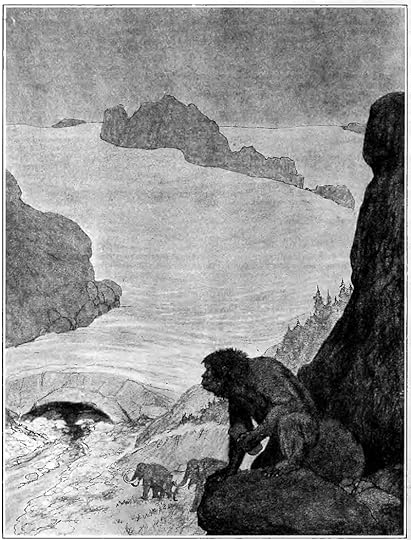
Illustration from the Saturday Evening Post, Jan 21, 1911, for the article The Grisly Folk and Their War With Men Author H. G. Wells and Illustrator Charles Livingston Bull. He lived in a Bleak Land on the Edge of the Snows and Glaciers That Were Even Then Receding Northward
"The true man must have come into the habitat of the Neanderthaler, and the two must have met and fought. Some day we may come upon the evidences of this warfare."
Contrary to another’s review there was no mention of Africa… They probably did have tattoos, both prophylactic and remedial. Socialist groupthink (what they call “science”) prefers the herd mind over individuality, but nothing has ever been invented by a group, unless lynchings and other acts of mob violence count. All and all, pretty good speculation for Well’s generation (to use socialist groupthink). Note: The Atkinson referred to in reference to the feminine origin of certain tabus was probably Thomas Witlam Atkinson (1799-1861) noted traveller and travel author.