

What do you think?

This Impossible Light
Fifteen-year-old Ivy’s world is in flux. Her dad has moved out, her mother is withdrawn, her brother is off at college, and her best friend, Anna, has grown distant. Worst of all, Ivy’s body won’t stop expanding. She’s getting taller and curvier, with no end in sight. Even her beloved math class offers no clear solution to the imbalanced equation that has become Ivy’s life.
Everything feels off-kilter until a decision to change the way she eats gives her a boost in confidence and reminds Ivy that her life is her own. If she can just limit what she eats—the way her mother seems to—she can stop herself from growing, focus on the upcoming math competition, and reclaim control of her life. But when her disordered eating gives way to missed opportunities and a devastating health scare, Ivy realizes that she must weigh her mother’s issues against her own, and discover what it means to be a part of—and apart from—her family.
Everything feels off-kilter until a decision to change the way she eats gives her a boost in confidence and reminds Ivy that her life is her own. If she can just limit what she eats—the way her mother seems to—she can stop herself from growing, focus on the upcoming math competition, and reclaim control of her life. But when her disordered eating gives way to missed opportunities and a devastating health scare, Ivy realizes that she must weigh her mother’s issues against her own, and discover what it means to be a part of—and apart from—her family.
339 pages, Hardcover
First published June 6, 2017
Ratings & Reviews
Friends & Following
Create a free account to discover what your friends think of this book!
Community Reviews
Displaying 1 - 30 of 163 reviews

May 3, 2017
From the YouTube slam poetry star of Shrinking Women (more than 5 million views!) comes a novel in verse about body image, eating disorders, self-worth, mothers and daughters, and the psychological scars we inherit from our parents.
I've listened to Myers slam poem countless times in the past, so I was beyond ecstatic to see her name grace the cover of this novel in verse. And just like her spoken word hit me harder than I expected, so did This Impossible Light.
The story begins with Ivy starting her sophomore year of high school after a hard-hitting summer where changed in her life: her parents' divorce, her older brother, Sky, moving out, her best friend, Anna, being back from her three-month visit in Paris, but still feeling miles away.
Hoping for a fresh start with the new school year, Ivy quickly discovers that things aren't always as simple as they seem. And with so many things in life being out of her control, Ivy decides to take hold of the one thing she can dictate: her body.
“If I tell you,
will you listen?”
This powerful exploration of body image, depression, eating disorders, loneliness is guaranteed to stay in my memory for a long, long time to come. Its relentless truth felt like a much-needed and healing read for my past self.
And as always, my favorite show, Skam, was brought to mind with the mentions of these topics. But with this book I just wished we could’ve gotten a similar scene as the one of Vilde and Noora noticing and supporting one other through their struggles in season two:
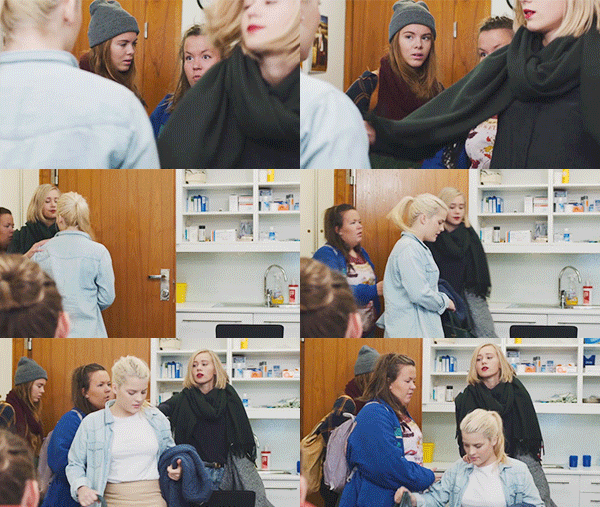
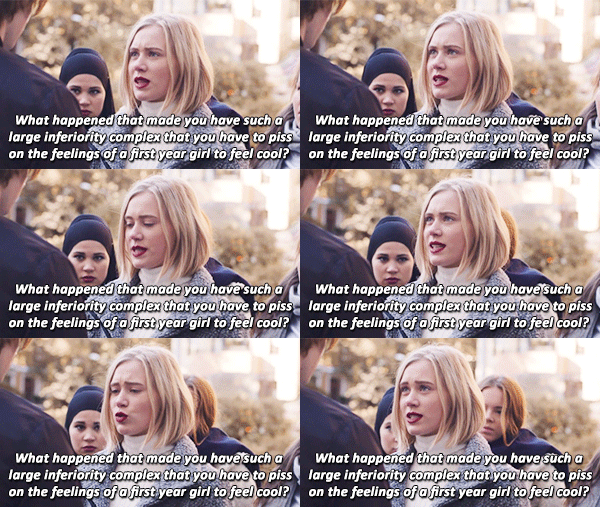
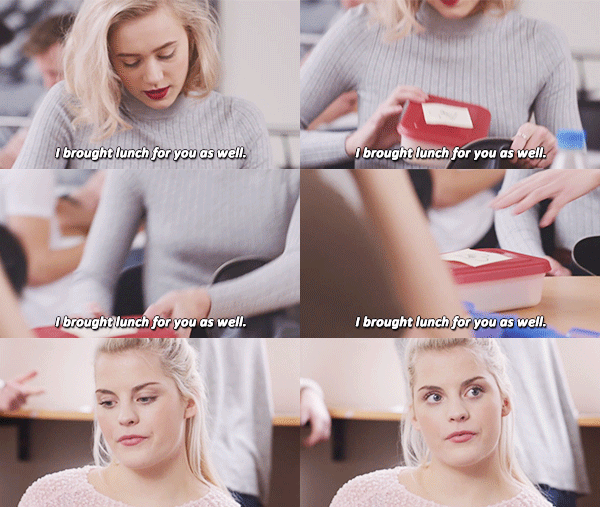

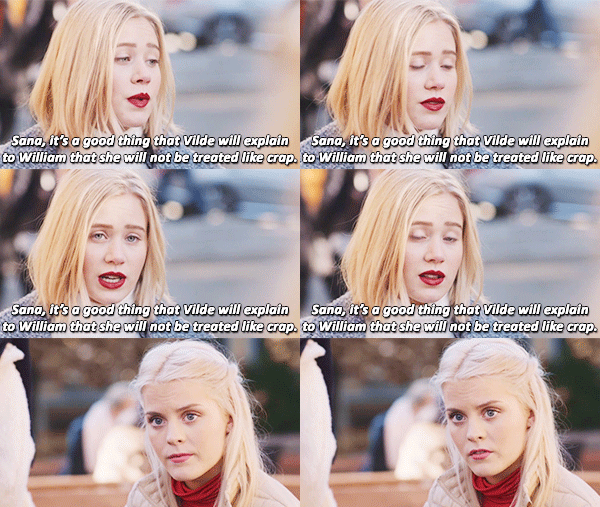
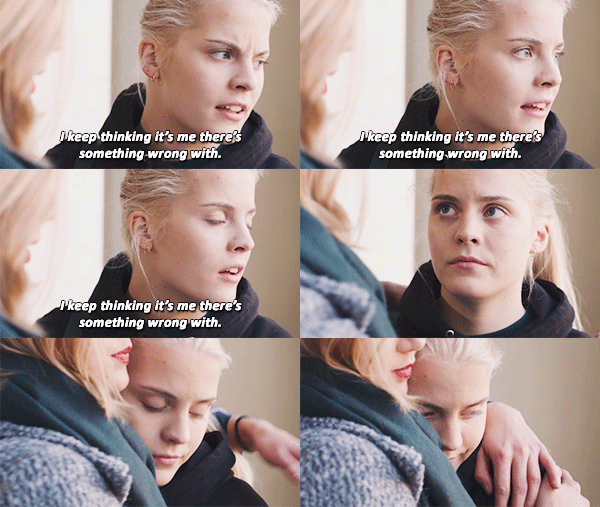


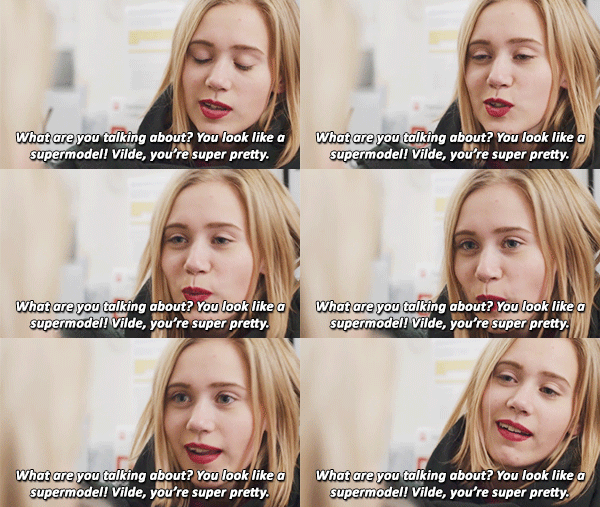
Our main character was drifting away from everyone and rarely speaking, and it physically hurt me to see her go through all of it alone. Which reminds me of another fitting quote from the aforementioned TV series:
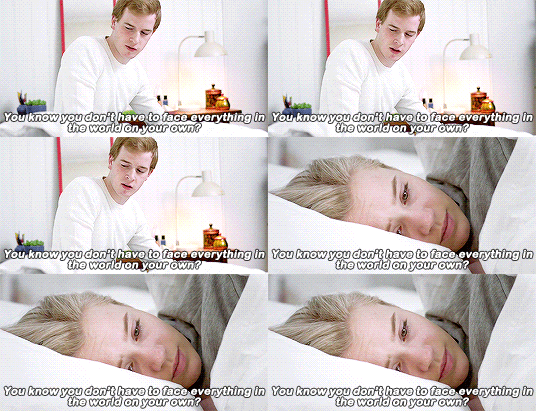
Lily Myers takes notices of the small pains and little lonelinesses I've felt so strongly in the past, and it really shook me to my core to experience them now through Ivy. Also, the top-notch writing and poetry in this book was utterly phenomenal, and I just want to shout it from the rooftops. But for now, I'll settle with sharing some of my favorite bits and pieces in here:
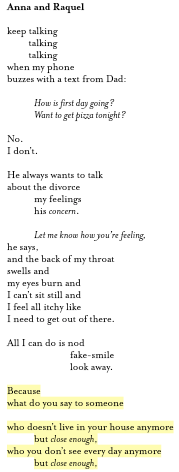
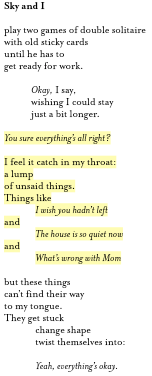
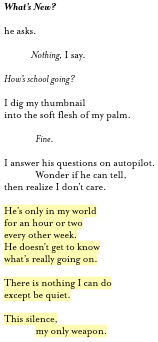
This really hit me hard.
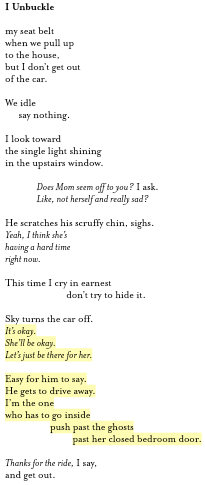
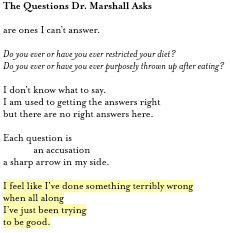
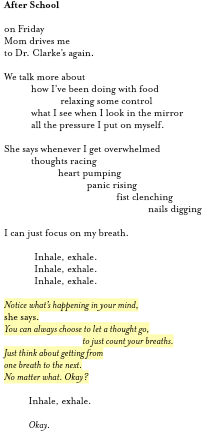


All in all: This was a surprising read for me since I wasn't expecting to love so damn much about it, like the fact that it focused solely on Ivy's journey without adding any unnecessary romances into it. And the fact that we got to see her process towards recovery with the help of family and friends. Plus, it was a quick read because of the poetry format. I was mesmerized, to say the least.
ARC kindly provided by the publisher in exchange for an honest review.
Expected publication: June 6th, 2017
5/5 stars
Note: I'm an Amazon Affiliate. If you're interested in buying This Impossible Light, just click on the image below to go through my link. I'll make a small commission!

This review and more can be found on my blog.
I've listened to Myers slam poem countless times in the past, so I was beyond ecstatic to see her name grace the cover of this novel in verse. And just like her spoken word hit me harder than I expected, so did This Impossible Light.
The story begins with Ivy starting her sophomore year of high school after a hard-hitting summer where changed in her life: her parents' divorce, her older brother, Sky, moving out, her best friend, Anna, being back from her three-month visit in Paris, but still feeling miles away.
Hoping for a fresh start with the new school year, Ivy quickly discovers that things aren't always as simple as they seem. And with so many things in life being out of her control, Ivy decides to take hold of the one thing she can dictate: her body.
“If I tell you,
will you listen?”
This powerful exploration of body image, depression, eating disorders, loneliness is guaranteed to stay in my memory for a long, long time to come. Its relentless truth felt like a much-needed and healing read for my past self.
And as always, my favorite show, Skam, was brought to mind with the mentions of these topics. But with this book I just wished we could’ve gotten a similar scene as the one of Vilde and Noora noticing and supporting one other through their struggles in season two:
Our main character was drifting away from everyone and rarely speaking, and it physically hurt me to see her go through all of it alone. Which reminds me of another fitting quote from the aforementioned TV series:
Lily Myers takes notices of the small pains and little lonelinesses I've felt so strongly in the past, and it really shook me to my core to experience them now through Ivy. Also, the top-notch writing and poetry in this book was utterly phenomenal, and I just want to shout it from the rooftops. But for now, I'll settle with sharing some of my favorite bits and pieces in here:
This really hit me hard.
All in all: This was a surprising read for me since I wasn't expecting to love so damn much about it, like the fact that it focused solely on Ivy's journey without adding any unnecessary romances into it. And the fact that we got to see her process towards recovery with the help of family and friends. Plus, it was a quick read because of the poetry format. I was mesmerized, to say the least.
ARC kindly provided by the publisher in exchange for an honest review.
Expected publication: June 6th, 2017
5/5 stars
Note: I'm an Amazon Affiliate. If you're interested in buying This Impossible Light, just click on the image below to go through my link. I'll make a small commission!
This review and more can be found on my blog.

June 16, 2017
Review soon.

June 8, 2017
This is a book that will work for a lot of readers. If you're into verse, I think you should pick this up. Sadly, I don't think it was for me.
Novels in verse just hardly ever land for me. I usually like poetry in verse, but after a few of these, I realized they all sounded exactly the same. None had depth beyond “words said in a pretty way”. I don't hate free verse poetry; in fact, I quite enjoy the hard emotions behind it. But here's the catch; it needs to have emotions. But the language here isn't poetry. I like free verse because it invites feelings in me. These words incited nothing in me; not feelings, not love for any of the characters.
The main character narrating this piece is hopelessly generic. There's this trend in YA literature of writing generic characters so anyone can relate to the story. I get it. I just don't particularly like it. Characters like this end up seeming like plot devices, not people.
Unfortunately, in a story depending mostly on a stylistic method to stand out, my dislike for stories told in verse poetry overtook my opinion. As an overall story, this was quite compelling. While I found the characters fairly generic, they were all likable enough. The portrayal of eating disorders is very good, going off what I've read before about portrayal. It's not a bad book. It just wasn't for me.
Novels in verse just hardly ever land for me. I usually like poetry in verse, but after a few of these, I realized they all sounded exactly the same. None had depth beyond “words said in a pretty way”. I don't hate free verse poetry; in fact, I quite enjoy the hard emotions behind it. But here's the catch; it needs to have emotions. But the language here isn't poetry. I like free verse because it invites feelings in me. These words incited nothing in me; not feelings, not love for any of the characters.
The main character narrating this piece is hopelessly generic. There's this trend in YA literature of writing generic characters so anyone can relate to the story. I get it. I just don't particularly like it. Characters like this end up seeming like plot devices, not people.
Unfortunately, in a story depending mostly on a stylistic method to stand out, my dislike for stories told in verse poetry overtook my opinion. As an overall story, this was quite compelling. While I found the characters fairly generic, they were all likable enough. The portrayal of eating disorders is very good, going off what I've read before about portrayal. It's not a bad book. It just wasn't for me.

June 4, 2023
couldn’t get over the format, but the math metaphors made up for it. cannot believe someone else also thought of my personal cringy math analogies; i genuinely thought I was original for that LOL

September 17, 2017
This Impossible Light is a beautiful story about struggling with your image. A girl is trying very hard to live up to the picture perfect image that she has created for herself, and as a result falls down a very dark path with her physical health. She develops an eating disorder. The portrayal of the MCs ED is the only saving grace of this book. The rest of the story fell really flat for me.
This story does hit a lot on the head when describing the internal battle that someone who has an eating disorder may experience, there were a few spots that I really felt connected too. But unfortunately other than that, the story was lacking a lot. It was beautifully written, but ultimately it was pretty unremarkable. Nothing about this story is memorable. If I didn’t connect to it, I probably would have DNFed it because it was generic and boring.
My biggest issue with this book was how simple it made everything surrounding eating disorders seem. It made it appear so easy to hide, so easy to start, so easy to decide when enough is enough. But honestly it is a lot more complicated than that. I’m honestly so surprised at how the author nails the portrayal of ED on the head and then misses so much at the end, it could be to leave this as an optimistic ending for others who suffer in ways similar to the MC, but it just made the entire process feel to clean and simple for me.
This book was okay, it was just missing something for me.
This story does hit a lot on the head when describing the internal battle that someone who has an eating disorder may experience, there were a few spots that I really felt connected too. But unfortunately other than that, the story was lacking a lot. It was beautifully written, but ultimately it was pretty unremarkable. Nothing about this story is memorable. If I didn’t connect to it, I probably would have DNFed it because it was generic and boring.
My biggest issue with this book was how simple it made everything surrounding eating disorders seem. It made it appear so easy to hide, so easy to start, so easy to decide when enough is enough. But honestly it is a lot more complicated than that. I’m honestly so surprised at how the author nails the portrayal of ED on the head and then misses so much at the end, it could be to leave this as an optimistic ending for others who suffer in ways similar to the MC, but it just made the entire process feel to clean and simple for me.
This book was okay, it was just missing something for me.

January 6, 2018
Incredibly powerful verse about eating disorders, mother/daughter relationships, and the impact of diverse.
Required purchase for middle and high school libraries.
Required purchase for middle and high school libraries.

May 29, 2017
Lily Myers does such a great job of really pulling you into Ivy's head in "This Impossible Light" and showing the way her self-image and sense of stability slowly crumble as she falls deeper into the stages of her eating disorder. This is a quick read, but a very effective one. I love the way Ivy reflects on very small details... family vacations... a fish shaped waffle iron that made Saturday mornings cozy... Myers does an outstanding job at making the comforting life she's mourning tangible and oh so easy to picture.
Disclaimer: I received a free copy of this book from the author.
Disclaimer: I received a free copy of this book from the author.

February 24, 2018
Will write a review tomorrow. Just saying right now that this book is so beautifully written and no words that I could possibly come up with would equal to how this book made me feel.

August 25, 2017
Just finished This Impossible Light by Lily Myers and I had tears in my eyes.
My heart is still as soft as a marshmallow.
I instantly fell in love with this book. It took me about two pages when I felt this warm, loving and exciting rush running through my body, wrapping me up like a blanket and letting me sigh with the knowledge that YES, this book will be wonderful.
I wasn't let down.
This Impossible Light is about 15-year-old Ivy who is Perfect Girl. She has the best grades, loves math, has a best friend and a loving family. But then everything changes and suddenly her family breaks apart and that best friend isn't really herself anymore. Ivy tries to hold on to her Perfect Girl image until bit by bit everything around her starts affecting her mind, her body, her way of thinking when ever she looks in the mirror.
Lily Myers is best known for her YouTube Poetry Slam performance "Shrinking women"; a poem about learning how to not take up too much space in the world, how to “filter,” how to accommodate.
Her performance is so honest and relatable it went viral and was viewed by more than 5 million people. This Impossible Light is her first novel.
One of the things that makes this book so special is the formatting.
It's like another performance from Lily with only the reader as an audience. It's told like a poem without dancing around words or drifting off the point.
She created Ivy, a smart girl who felt safe in her bubble until it pops and suddenly her life she thought she knew is being torn apart. It isn't until Ivy looks at herself with different eyes. Her body seems to grow in all the wrong places. She wants to look different, like the other girls in school or in magazines. Thin and beautiful. As a Perfect Girl she knows how to work hard to archive the best grades so loosing weight shouldn't be a problem.
But her obsession becomes critical.
I am glad that this book exists. It addresses a topic that's so common in our society. The obsession to slim down, to look perfect, maybe better than the girl/boy next to us. It's so easy to slip on a side where food no longer seems edible but dreadful. Pressuring yourself to eat or eating everything at once only to force it out of your stomach right after.
This Impossible Light is a reminder of how easy one can fall on a path like that and how dangerous it is to stumble back off. I believe this book is both a guidance and an eye-opener. Beautifully written in the soft but honest voice of Lily Myer reminding us that body image, eating disorders, and the scars we inherit from our parents aren't topics we should bottle up in ourselves. Learning how to love and live and accept our body in the lovely form it is are the messages she has written between the lines.
My heart is still as soft as a marshmallow.
I instantly fell in love with this book. It took me about two pages when I felt this warm, loving and exciting rush running through my body, wrapping me up like a blanket and letting me sigh with the knowledge that YES, this book will be wonderful.
I wasn't let down.
This Impossible Light is about 15-year-old Ivy who is Perfect Girl. She has the best grades, loves math, has a best friend and a loving family. But then everything changes and suddenly her family breaks apart and that best friend isn't really herself anymore. Ivy tries to hold on to her Perfect Girl image until bit by bit everything around her starts affecting her mind, her body, her way of thinking when ever she looks in the mirror.
Lily Myers is best known for her YouTube Poetry Slam performance "Shrinking women"; a poem about learning how to not take up too much space in the world, how to “filter,” how to accommodate.
Her performance is so honest and relatable it went viral and was viewed by more than 5 million people. This Impossible Light is her first novel.
One of the things that makes this book so special is the formatting.
It's like another performance from Lily with only the reader as an audience. It's told like a poem without dancing around words or drifting off the point.
She created Ivy, a smart girl who felt safe in her bubble until it pops and suddenly her life she thought she knew is being torn apart. It isn't until Ivy looks at herself with different eyes. Her body seems to grow in all the wrong places. She wants to look different, like the other girls in school or in magazines. Thin and beautiful. As a Perfect Girl she knows how to work hard to archive the best grades so loosing weight shouldn't be a problem.
But her obsession becomes critical.
I am glad that this book exists. It addresses a topic that's so common in our society. The obsession to slim down, to look perfect, maybe better than the girl/boy next to us. It's so easy to slip on a side where food no longer seems edible but dreadful. Pressuring yourself to eat or eating everything at once only to force it out of your stomach right after.
This Impossible Light is a reminder of how easy one can fall on a path like that and how dangerous it is to stumble back off. I believe this book is both a guidance and an eye-opener. Beautifully written in the soft but honest voice of Lily Myer reminding us that body image, eating disorders, and the scars we inherit from our parents aren't topics we should bottle up in ourselves. Learning how to love and live and accept our body in the lovely form it is are the messages she has written between the lines.

June 20, 2017
First things first: I received this book through NetGalley.
Trigger warning: eating disorder.
Summary: Fifteen-year-old Ivy's world is in flux. Her dad has moved out, her mother is withdrawn, her brother is off at college, and her best friend, Anna, has grown distant. Worst of all, Ivy's body won’t stop expanding. She's getting taller and curvier, with no end in sight. Even her beloved math class offers no clear solution to the imbalanced equation that has become Ivy’s life.
Everything feels off-kilter until a skipped meal leads to a boost in confidence and reminds Ivy that her life is her own. If Ivy can just limit what she eats—the way her mother seems to—she can stop herself from growing, focus on the upcoming math competition, and reclaim control of her life. But when her disordered eating leads to missed opportunities and a devastating health scare, Ivy realizes that she must weigh her mother's issues against her own, and discover what it means to be a part of—and apart from—her family.
This book. THIS BOOK!!!
This book totally caught me off guard. Once again it's one of those books that I got from Netgalley, forgot about it and then started reading it without reading the summary again and didn't know what to expect.
The book deals with some tough topics but I think, they are handled really sensitive and respectful. The writing was so damn beautiful. Seriously, some of these moments in Ivy's life were so painful but they were written in the most beautiful way.
Poetry is my new favorite thing but I only ever read books with lots of different poetry, this time it was a whole book, a whole story. And it was beautiful.
It was super easy to get into, I started the book and pretty soon was half way through it. The characters were wonderful and so fleshed out.
Aaaah, I just love this book so much, it made me feel all the things and I highly recommend it.
Trigger warning: eating disorder.
Summary: Fifteen-year-old Ivy's world is in flux. Her dad has moved out, her mother is withdrawn, her brother is off at college, and her best friend, Anna, has grown distant. Worst of all, Ivy's body won’t stop expanding. She's getting taller and curvier, with no end in sight. Even her beloved math class offers no clear solution to the imbalanced equation that has become Ivy’s life.
Everything feels off-kilter until a skipped meal leads to a boost in confidence and reminds Ivy that her life is her own. If Ivy can just limit what she eats—the way her mother seems to—she can stop herself from growing, focus on the upcoming math competition, and reclaim control of her life. But when her disordered eating leads to missed opportunities and a devastating health scare, Ivy realizes that she must weigh her mother's issues against her own, and discover what it means to be a part of—and apart from—her family.
This book. THIS BOOK!!!
This book totally caught me off guard. Once again it's one of those books that I got from Netgalley, forgot about it and then started reading it without reading the summary again and didn't know what to expect.
The book deals with some tough topics but I think, they are handled really sensitive and respectful. The writing was so damn beautiful. Seriously, some of these moments in Ivy's life were so painful but they were written in the most beautiful way.
Poetry is my new favorite thing but I only ever read books with lots of different poetry, this time it was a whole book, a whole story. And it was beautiful.
It was super easy to get into, I started the book and pretty soon was half way through it. The characters were wonderful and so fleshed out.
Aaaah, I just love this book so much, it made me feel all the things and I highly recommend it.

January 12, 2018
This was like a better version if “the sky between you and me”, which I’m not even going to bother to tag because honestly, I hated it.
So this book! I loved it, and I hated it and I was kinda not that interested. But I wish I was. So that’s a good thing? I’m going to put this as a 4 star read bc of the fact that it’s better than a lot I’ve read before ! also, Lily Myers youtube slam poetry is amazing and I highly reccomend watching that :)
So this book! I loved it, and I hated it and I was kinda not that interested. But I wish I was. So that’s a good thing? I’m going to put this as a 4 star read bc of the fact that it’s better than a lot I’ve read before ! also, Lily Myers youtube slam poetry is amazing and I highly reccomend watching that :)
April 24, 2018
The book, This Impossible light, by Lily Myers is about a girl who's parents got divorced all of a sudden and it caused a huge problem in her life. It's an unfinished novel but there wasn't any big mistakes I caught. The main character in the story is Ivy. The summer her parents got divorced she started feeling alone and that everyone was leaving her. She felt alone, because when her best friend Ana came back from Paris, she was a whole new different person. They both started to shift apart when Ivy needed her the most. Her older brother Sky moved out because he was going to college so he really didn't feel the impact like Ivy did. Her mother, the person she looked up to the most, was depressed because her husband left her so she started pushing away her daughter. The feeling of being alone and wanting everything to go back to the way it was led Ivy to depression, a food eating disorder, and the "smart girl" to start failing school. However though an accident happens and Ivy ends up in the hospital. The doctors told her parents about what was going on. Her mom got her help and she also knew she couldn't push her away so she got her act together. At the end of the story Ivy and her mom got their bond back and so did her and Ana. Overall it was a really interesting story.

January 15, 2018
If you've not seen the YouTube video of Lily Myers performing her slam poem "Shrinking Woman," stop what you're doing and watch it right now. I added her first novel in verse to my TBR pile as soon as I heard she had a book coming out. While it didn't provoke the same strong reaction I have to "Shrinking Woman," there are enough glimmers of genius to keep me a fan. I'd love to read a non-verse novel by her. Fingers crossed she'll have the opportunity to write one!
June 28, 2017
(Originally posted on https://mackinbooksinbloom.com/2017/0...)
Summer is an exciting time working in Classroom Services here at Mackin. With the end of one school year comes the a fresh start to the new one as teachers revamp their classrooms and add updated titles to their classroom libraries. At the heart of each classroom library list that I recommend to teachers is the philosophy that students must be able to see themselves in the books they’re reading. We build lists that are culturally diverse and representative of the hard issues teenagers face daily.
In the new novel in verse This Impossible Light (2017) by Lily Myers, 15-year-old Ivy is facing challenges many teens can find all too relatable. Opening the novel, we learn that Ivy’s father recently left her mom—coinciding with her brother’s departure to college and her best friend’s summer vacation to Paris. Ivy is left alone in the once lively, now empty house; it’s just Ivy and her mother who isn’t at all the same.
To make matters worse, at the start of the new school year, Ivy’s best friend Anna is back from Paris and seems to be completely changed. She has a new friend and a new love for drinking at parties. Ivy can’t fit in like other girls. She feels too big—too tall and too wide.
Ivy becomes obsessed with controlling her life. If she works harder, studies harder, bikes harder, and eats less—then she will be thin, and she will earn the scholarship she needs to get out of the house like her brother did. Somehow, though, through her struggle to gain control, Ivy is losing control more than ever.
There are so many reasons this book belongs in classroom libraries. As a teenager, like many teens, I also struggled with my relationship with food. The way Ivy describes how she feels about food reminds me about my same struggles—telling me how realistically Myers represents the emotions involved in eating disorders. I also see important questions teenagers need to discuss including the complications of friendships over time and the complications when parents are no longer perfect.
Ivy’s love for math adds a whole new dynamic to this book, opening up some interesting cross-curricular activities involving math.
Finally, novel in verse is an important text-structure which teenagers need to experience. It can sometimes be intimidating to read in verse, but this novel is an easy and quick read that will leave students with new reading skills under their belts. The form also allows plenty of opportunities for teachers to pick apart the text into small sections for students to analyze in a close-reading session.
While I highly recommend this novel for high school classroom libraries and for teachers to consider making available to students for literature projects, I was not blown away by every aspect of the novel. I felt a flatness in the relationships within this novel. While I understood that Ivy and Anna were once best friends, I never got the chance to see the raw happy friendship in the novel. I never quite felt the relationship in a way that would have added depth. I also would have liked to see another level to Ivy. The entire novel is written in a very depressed tone—I would have loved to see more of Ivy before she was depressed so that I could have really felt like I knew her as a friend. Instead, I only saw her depression, taking away from really knowing her entire character.
Again, I do highly recommend adding this book to your high school classroom library for the upcoming year. This novel opens up much needed space to talk about relationships, body image, and eating disorders. Also, I don’t mean to overlook what a great opportunity this book creates for a cross-curricular activity with a math class. It could be so much fun to apply some of the math Ivy mentions in the novel. As someone who’s not a math wiz, and can’t go into much detail here, but I’m sure your next door math teacher could help and would love to get involved. Also don’t forget that this novel offers teenagers a new writing style to analyze, and it’s a quick and easy read.
Enjoy!
Summer is an exciting time working in Classroom Services here at Mackin. With the end of one school year comes the a fresh start to the new one as teachers revamp their classrooms and add updated titles to their classroom libraries. At the heart of each classroom library list that I recommend to teachers is the philosophy that students must be able to see themselves in the books they’re reading. We build lists that are culturally diverse and representative of the hard issues teenagers face daily.
In the new novel in verse This Impossible Light (2017) by Lily Myers, 15-year-old Ivy is facing challenges many teens can find all too relatable. Opening the novel, we learn that Ivy’s father recently left her mom—coinciding with her brother’s departure to college and her best friend’s summer vacation to Paris. Ivy is left alone in the once lively, now empty house; it’s just Ivy and her mother who isn’t at all the same.
To make matters worse, at the start of the new school year, Ivy’s best friend Anna is back from Paris and seems to be completely changed. She has a new friend and a new love for drinking at parties. Ivy can’t fit in like other girls. She feels too big—too tall and too wide.
Ivy becomes obsessed with controlling her life. If she works harder, studies harder, bikes harder, and eats less—then she will be thin, and she will earn the scholarship she needs to get out of the house like her brother did. Somehow, though, through her struggle to gain control, Ivy is losing control more than ever.
There are so many reasons this book belongs in classroom libraries. As a teenager, like many teens, I also struggled with my relationship with food. The way Ivy describes how she feels about food reminds me about my same struggles—telling me how realistically Myers represents the emotions involved in eating disorders. I also see important questions teenagers need to discuss including the complications of friendships over time and the complications when parents are no longer perfect.
Ivy’s love for math adds a whole new dynamic to this book, opening up some interesting cross-curricular activities involving math.
Finally, novel in verse is an important text-structure which teenagers need to experience. It can sometimes be intimidating to read in verse, but this novel is an easy and quick read that will leave students with new reading skills under their belts. The form also allows plenty of opportunities for teachers to pick apart the text into small sections for students to analyze in a close-reading session.
While I highly recommend this novel for high school classroom libraries and for teachers to consider making available to students for literature projects, I was not blown away by every aspect of the novel. I felt a flatness in the relationships within this novel. While I understood that Ivy and Anna were once best friends, I never got the chance to see the raw happy friendship in the novel. I never quite felt the relationship in a way that would have added depth. I also would have liked to see another level to Ivy. The entire novel is written in a very depressed tone—I would have loved to see more of Ivy before she was depressed so that I could have really felt like I knew her as a friend. Instead, I only saw her depression, taking away from really knowing her entire character.
Again, I do highly recommend adding this book to your high school classroom library for the upcoming year. This novel opens up much needed space to talk about relationships, body image, and eating disorders. Also, I don’t mean to overlook what a great opportunity this book creates for a cross-curricular activity with a math class. It could be so much fun to apply some of the math Ivy mentions in the novel. As someone who’s not a math wiz, and can’t go into much detail here, but I’m sure your next door math teacher could help and would love to get involved. Also don’t forget that this novel offers teenagers a new writing style to analyze, and it’s a quick and easy read.
Enjoy!

October 9, 2020
I enjoyed this book.
...
Wow, what an engaging review. Maybe I should expand on that, eh?
I picked this one up on impulse while I was at the library the other week. Usually, I come prepared with the titles and call numbers of a few books and don't really need to browse (which in these pandemic conditions is definitely the way to go) but since the library wasn't busy at all I decided to take a stroll through the teen section.
The cover caught my attention and then the prose did the rest of the heavy lifting. I really enjoyed novels in verse, even if (as another reviewer accurately commented) they're just “words said in a pretty way”. In this instance, I felt that Myers' choice to approach the topic of mental health and eating disorders through lyrical writing was an empathetic and compassionate one. Ivy's descent into the depths of her disease were believable and humanely written, and I found that I could empathize with her even though I've never struggled with those same issues myself.
The mother/daughter dynamic was also a powerful one for me. I have a great relationship with my mom and found myself feeling extremely heartbroken that Ivy's own relationship was deteriorating in front of her eyes. That situation was the most impactful for me and proved to be a strong addition to the rest of her story.
A quick read that had me rooting for a character who just needed to feel loved - a theme that's very relevant in our isolated world right now.
...
Wow, what an engaging review. Maybe I should expand on that, eh?
I picked this one up on impulse while I was at the library the other week. Usually, I come prepared with the titles and call numbers of a few books and don't really need to browse (which in these pandemic conditions is definitely the way to go) but since the library wasn't busy at all I decided to take a stroll through the teen section.
The cover caught my attention and then the prose did the rest of the heavy lifting. I really enjoyed novels in verse, even if (as another reviewer accurately commented) they're just “words said in a pretty way”. In this instance, I felt that Myers' choice to approach the topic of mental health and eating disorders through lyrical writing was an empathetic and compassionate one. Ivy's descent into the depths of her disease were believable and humanely written, and I found that I could empathize with her even though I've never struggled with those same issues myself.
The mother/daughter dynamic was also a powerful one for me. I have a great relationship with my mom and found myself feeling extremely heartbroken that Ivy's own relationship was deteriorating in front of her eyes. That situation was the most impactful for me and proved to be a strong addition to the rest of her story.
A quick read that had me rooting for a character who just needed to feel loved - a theme that's very relevant in our isolated world right now.

June 6, 2017
I'm a big fan of "Shrinking Women" and was excited when I learned earlier this year that Myers would have a book coming out.
I finally got the chance to read that book today and was once again stunned by the beauty of her careful, precise prose.
Ivy's story is a familiar one, with divorce and the changing dynamics of friendships adding new complications to the habits/issues we learn from our parents.
I appreciate the Myers and her publishers included resources for those who may be experiencing eating disorders and disordered eating behavior. I hope that anyone who reads this and finds Ivy's experience to feel close to home that you're able to focus on the tools she's able to use by the end of the story in order to once again be able to find peace in your body and to know that you are already enough.
I finally got the chance to read that book today and was once again stunned by the beauty of her careful, precise prose.
Ivy's story is a familiar one, with divorce and the changing dynamics of friendships adding new complications to the habits/issues we learn from our parents.
I appreciate the Myers and her publishers included resources for those who may be experiencing eating disorders and disordered eating behavior. I hope that anyone who reads this and finds Ivy's experience to feel close to home that you're able to focus on the tools she's able to use by the end of the story in order to once again be able to find peace in your body and to know that you are already enough.

July 23, 2017
I thought this novel was done well. I know some people might not like it because it was written in verse but I tend to enjoy novels like this. I thought the Eating disorder rep was done well too. I like how it showed the characters life slowly deteriorating. It was reminiscent to my own high school experience. I was an excellent student and then Junior year I started struggling a lot more with my mental health and school slowly took a back seat.
I do kind of feel like it wrapped up a little bit too nicely but that did not take away from my enjoyment of the novel. I hope to read more by this author in the future.
I do kind of feel like it wrapped up a little bit too nicely but that did not take away from my enjoyment of the novel. I hope to read more by this author in the future.

June 18, 2017
I don’t really read poetry, and sure I’m bad at it as I’m not the kind of reader to linger on every word and phrase (I like to be swept along for a journey), but I really enjoyed this.
It was a painful read and the unusual writing amplified this deeply emotional story that was utterly heart breaking.
So many important issues are brought up in this book - body imagine, family, friends, loneliness, eating disorders, depression – yet it never felt “overcrowded".
Stunning.
It was a painful read and the unusual writing amplified this deeply emotional story that was utterly heart breaking.
So many important issues are brought up in this book - body imagine, family, friends, loneliness, eating disorders, depression – yet it never felt “overcrowded".
Stunning.

June 18, 2017
Written in verse, this tells the story of 15 year old Ivy as she tries to navigate her way through her parents divorce, her BFF slipping away from her, her body changing, and keeping up appearances as the Smart Girl in school. A poignant tale that I related to on multiple levels.

January 5, 2018
A beautiful novel in verse dealing with eating disorders, depression, alcohol use and friendship. It’s heavy but hopeful.

May 29, 2023
so many feelings, so much understanding of everything
August 9, 2017
Meh. I fully support the topic of eating disorders, but the execution of it was subpar and cliched. Thankfully, this is a very quick read, (the book is written in verse) so I could get on with my life.
This book is about the life of Ivy, whose life is going through So Many Hard Events. Her parents are just divorced, her best friend has left her, and Ivy struggles with the u attainable idea of perfection. She becomes obsessive about eating and exercise, and her life soon spirals out of control. In the end, she gets help for her bulimia, reconnects with her friend, and grows closer with her mom.
This was satisfying in the way that there was a happy ending (or at least a happier ending), but the conflict was trite. I feel like I've read this book many times before, in the forms of Falling into Place by Amy Zhang, or books by Laurie Halse Anderson. Eating disorders are no joke, but as much as I appreciate Myer's mention of them, but other books were just better. If you're looking for a short, uplifting, and informative read, this could work.
This book is about the life of Ivy, whose life is going through So Many Hard Events. Her parents are just divorced, her best friend has left her, and Ivy struggles with the u attainable idea of perfection. She becomes obsessive about eating and exercise, and her life soon spirals out of control. In the end, she gets help for her bulimia, reconnects with her friend, and grows closer with her mom.
This was satisfying in the way that there was a happy ending (or at least a happier ending), but the conflict was trite. I feel like I've read this book many times before, in the forms of Falling into Place by Amy Zhang, or books by Laurie Halse Anderson. Eating disorders are no joke, but as much as I appreciate Myer's mention of them, but other books were just better. If you're looking for a short, uplifting, and informative read, this could work.

May 6, 2017
**Thanks to NetGalley for providing a free copy of THE IMPOSSIBLE LIGHT in exchange for my honest review**
If you're expecting anything similar to Laurie Halse Anderson or Ellen Hopkins, you'll be sorely disappointed. Novels in verse need to be more than prose formatted to look like poetry. With verse, every word needs to be meaningful and important to the plot or character, to advance the story or knowledge of the narration.
For the most part, the quality of Lily Myers writing feels bland and unoriginal. While she occasional pens a gem, the surrounding rusty metal turns the skin green. I enjoyed the math and science metaphors, the strongest part of Myer's writing.
Ivy, the unoriginal narrator, quickly develops an eating disorder after her parents divorce and her best friend changes. The same story has been told so many times it has become cliché.
THE IMPOSSIBLE LIGHT is mercifully a very quick read. I can't think of a reason to recommend.
If you're expecting anything similar to Laurie Halse Anderson or Ellen Hopkins, you'll be sorely disappointed. Novels in verse need to be more than prose formatted to look like poetry. With verse, every word needs to be meaningful and important to the plot or character, to advance the story or knowledge of the narration.
For the most part, the quality of Lily Myers writing feels bland and unoriginal. While she occasional pens a gem, the surrounding rusty metal turns the skin green. I enjoyed the math and science metaphors, the strongest part of Myer's writing.
Ivy, the unoriginal narrator, quickly develops an eating disorder after her parents divorce and her best friend changes. The same story has been told so many times it has become cliché.
THE IMPOSSIBLE LIGHT is mercifully a very quick read. I can't think of a reason to recommend.

May 16, 2023
Honestly, I didn’t think I’d like it at first, but by the end it was truly one of my favorite books!

August 31, 2017
The story: Ivy is a smart girl, even though her world seems to be crumbling around her. Her parents have divorced, dad has a new girlfriend, her brother has moved out, and her mother seems to be drowning in depression. Worst of all, Ivy feels that she's getting too tall, too round, too different from the way she was when things were going right. The only way Ivy can seem to cope with her out-of-control world is to control everything she CAN: the number of calories she eats, the amount of exercise she gets. When her compulsions start controlling HER, how can she fix it--when fixing herself was what started everything in the first place?
June Cleaver's ratings: Language PG; Violence G; Sexual content G; Nudity G: Substance abuse PG-13; Magic & the occult G; GLBT content G; adult themes (eating disorders, mental illness, depression, divorce) PG-13; overall rating PG-13.
Liz's comments: The reader spends about half the story thinking, "No! Don't do it!" Ivy, although smart academically, is easy prey for her compulsions. Readers will empathize, and cheer for her when she starts making steps toward recovery. Her life will never go back to the way it was, but there's hope that she'll be able to deal with the way it is now. This novel in verse is a fast read, and a compelling look at the difficulties of living with an eating disorder.
June Cleaver's ratings: Language PG; Violence G; Sexual content G; Nudity G: Substance abuse PG-13; Magic & the occult G; GLBT content G; adult themes (eating disorders, mental illness, depression, divorce) PG-13; overall rating PG-13.
Liz's comments: The reader spends about half the story thinking, "No! Don't do it!" Ivy, although smart academically, is easy prey for her compulsions. Readers will empathize, and cheer for her when she starts making steps toward recovery. Her life will never go back to the way it was, but there's hope that she'll be able to deal with the way it is now. This novel in verse is a fast read, and a compelling look at the difficulties of living with an eating disorder.

December 17, 2022
This book was very good, and good if you want a quick read. But I do think that the author left out a lot about ivy’s struggles, and I didn’t feel super connected to her the whole time. I do feel like the book went over a lot of deep topics, but didn’t display the topics entirely. The story was written beautifully though, and there were a lot of things that connected to each other in the story. I recommend to anyone looking for a quick young adult book that also looks into meaningful topics.

March 22, 2018
Synopsis
This Impossible Light is a young adult novel in verse about Ivy, a fifteen year-old whose body betrays her as it grows, takes up the space left behind by her shrinking mother, leaving father, and missing best friend. As Ivy strives to perfection she comes to the seemingly logical conclusion that perfect lives in a place that can only be reached by restricting food and hours of biking up Seattle’s endless hills.
Before I go further I will explicitly say that this book, while beautiful and a book I think is a must-read—particularly for those who are or know teenage girls—comes with a giant trigger warning for disordered eating.
Shrinking Women
This Impossible Light is Meyers’s first novel, grown from the themes of her award-winning slam poetry piece, Shrinking Women, about the accidental inheritance of the women in her family, the messages passed along like the uneaten bread crumbs along the path. She’s also published a few articles online and in anthologies, largely about modern feminism.
Novel in Verse
I have not picked up many novels in verse, with Brown Girl Dreaming one of the first (if not the first) I can remember reading. I’ve never been a particular fan of most poetry—I enjoy it but I always feel like I’m trying really hard to like it more than I actually do. (The struggles of the book-snob life are real.) With well done novels in verse, I don’t run into the problems I do with other poetry—there are metaphors, sure, and there is meaning beyond the immediate words—but there is also a plot and character development so I feel like I can see where the poem is going and the message its conveying. I know the point of view of the speaker, I know her struggles and the supporting characters in her life. So when she tells me something, I know more of what she is saying that just the words on the page. Her life gives me the background I need to see the metaphor. With this foundation, I can appreciate the cadence and the crescendos—I can appreciate the poetry as poetry.
This Impossible Light satisfied my taste in novels in verse—the writing was spot on, the word choice itself fairly straightforward and easy enough for a middle schooler, though thematically (both for the disordered eating and kids that party their way into alcohol poisoning), I wouldn’t recommend this book until 8th grade. It had the cadence of a spoken word poem, with many poems standing alone with an internal crescendo. The individual sections themselves built to internal conclusions, with the poems speeding up, feeling more frantic, as Ivy’s loses hold on the control she’s desperately seeking to gain by restricting her food.
So was everyone else really being this “bad” in high school?
It has seemed that over the last several months, every book I read set in high school features kids partying and/or sleeping around. My first thought is usually that I’m getting old and kids these days are drinking way more and having more sex than we were in high school. Shortly after this thought comes a sneaking suspicion that probably everyone else was drinking this much and having (almost) this much sex and just no one was talking to me about it because I would absolutely have judged them for it (I wasn’t very kind in high school). It’s funny how reading YA has made me realize how sheltered my own high school existence was—sheltered both by my parents and by the other kids leaving me out of things. (It’s okay. I eventually turned out alright.)
Here too I identify with Ivy. She was actually invited to the party (I was too—exactly one time) and drank a little bit before deciding it wasn’t for her. I deeply appreciated that Myers’s main character wasn’t into drinking, that she felt left out and somehow younger than everyone else when she made this choice. This resonated with what I remember feeling in high school. In many ways, Myers undercurrent of self-acceptance and self-love in This Impossible Light extends not only to Ivy’s body but also to her likes and dislikes. That math worksheets or watching movies with your mom can be an entirely acceptable way to spend a weekend.
Control
From experience the “good girl” thing becomes a double-edged sword. On the one hand, knowing that you’re a math nerd at heart can be a thing to embrace, though the line between self-nerd-love and defining yourself as the perfect mathlete, perfect scholar, perfect daughter can be razor sharp.
Though I never really fell prey to true disordered eating, I can identify with Ivy’s desperate need for control. I am a perfectionist at heart—if I’m perfect, if the world I order is perfect, then no one can be disappointed. There is no room for upset—either literal or emotional—from me or anyone else. Indeed, this need for control, the high-achieving perfectionism as a response to a less than perfect home life (which, side note—no one’s home life is ever perfect. That’s a myth we should just give up now) made Ivy seem familiar, as if I were looking at a version of myself in high school. I do not think this need for control is unusual and, though I have absolutely nothing to back this up beyond my own subjective experience, I think it is likely that this sort of desire for control lies at the heart of most high-achiever girls. That “perfectionism” is just a pretty word we use to describe someone with an intense need to control their environment and themself.
Recommended
As I indicated early on, I do think this is a novel most people should read—particularly anyone who teaches or interacts with teenagers. There is no right way to be a person when you’re a teenager—you can love what you love and hate what you hate—but the struggle is not having those things become what defines you. Part of the way you learn to love yourself without having the things you love become the things that rule your life (whether that be math or boys or both) is by having teachers, parents, and friends who walk that line with you—who show you where the difference is between healthy self-love and unhealthy obsession. Books like This Impossible Light can be signposts on that journey—both for the teenage girl and for the adults in her life. If you are in a place where you can read a book about disordered eating that includes the internal monologue of the person caught up in it, then this is a book I highly recommend.
Notes
Published: June 6, 2017 by Philomel Books (@philomel), imprint of Penguin Random House (@penguinrandomhouse)
Author: Lily Myers
Date read: February 3, 2018
Rating: 4 stars
If you enjoyed this review, check out more at http://lisaannreads.com
This Impossible Light is a young adult novel in verse about Ivy, a fifteen year-old whose body betrays her as it grows, takes up the space left behind by her shrinking mother, leaving father, and missing best friend. As Ivy strives to perfection she comes to the seemingly logical conclusion that perfect lives in a place that can only be reached by restricting food and hours of biking up Seattle’s endless hills.
Before I go further I will explicitly say that this book, while beautiful and a book I think is a must-read—particularly for those who are or know teenage girls—comes with a giant trigger warning for disordered eating.
Shrinking Women
This Impossible Light is Meyers’s first novel, grown from the themes of her award-winning slam poetry piece, Shrinking Women, about the accidental inheritance of the women in her family, the messages passed along like the uneaten bread crumbs along the path. She’s also published a few articles online and in anthologies, largely about modern feminism.
Novel in Verse
I have not picked up many novels in verse, with Brown Girl Dreaming one of the first (if not the first) I can remember reading. I’ve never been a particular fan of most poetry—I enjoy it but I always feel like I’m trying really hard to like it more than I actually do. (The struggles of the book-snob life are real.) With well done novels in verse, I don’t run into the problems I do with other poetry—there are metaphors, sure, and there is meaning beyond the immediate words—but there is also a plot and character development so I feel like I can see where the poem is going and the message its conveying. I know the point of view of the speaker, I know her struggles and the supporting characters in her life. So when she tells me something, I know more of what she is saying that just the words on the page. Her life gives me the background I need to see the metaphor. With this foundation, I can appreciate the cadence and the crescendos—I can appreciate the poetry as poetry.
This Impossible Light satisfied my taste in novels in verse—the writing was spot on, the word choice itself fairly straightforward and easy enough for a middle schooler, though thematically (both for the disordered eating and kids that party their way into alcohol poisoning), I wouldn’t recommend this book until 8th grade. It had the cadence of a spoken word poem, with many poems standing alone with an internal crescendo. The individual sections themselves built to internal conclusions, with the poems speeding up, feeling more frantic, as Ivy’s loses hold on the control she’s desperately seeking to gain by restricting her food.
So was everyone else really being this “bad” in high school?
It has seemed that over the last several months, every book I read set in high school features kids partying and/or sleeping around. My first thought is usually that I’m getting old and kids these days are drinking way more and having more sex than we were in high school. Shortly after this thought comes a sneaking suspicion that probably everyone else was drinking this much and having (almost) this much sex and just no one was talking to me about it because I would absolutely have judged them for it (I wasn’t very kind in high school). It’s funny how reading YA has made me realize how sheltered my own high school existence was—sheltered both by my parents and by the other kids leaving me out of things. (It’s okay. I eventually turned out alright.)
Here too I identify with Ivy. She was actually invited to the party (I was too—exactly one time) and drank a little bit before deciding it wasn’t for her. I deeply appreciated that Myers’s main character wasn’t into drinking, that she felt left out and somehow younger than everyone else when she made this choice. This resonated with what I remember feeling in high school. In many ways, Myers undercurrent of self-acceptance and self-love in This Impossible Light extends not only to Ivy’s body but also to her likes and dislikes. That math worksheets or watching movies with your mom can be an entirely acceptable way to spend a weekend.
Control
From experience the “good girl” thing becomes a double-edged sword. On the one hand, knowing that you’re a math nerd at heart can be a thing to embrace, though the line between self-nerd-love and defining yourself as the perfect mathlete, perfect scholar, perfect daughter can be razor sharp.
Though I never really fell prey to true disordered eating, I can identify with Ivy’s desperate need for control. I am a perfectionist at heart—if I’m perfect, if the world I order is perfect, then no one can be disappointed. There is no room for upset—either literal or emotional—from me or anyone else. Indeed, this need for control, the high-achieving perfectionism as a response to a less than perfect home life (which, side note—no one’s home life is ever perfect. That’s a myth we should just give up now) made Ivy seem familiar, as if I were looking at a version of myself in high school. I do not think this need for control is unusual and, though I have absolutely nothing to back this up beyond my own subjective experience, I think it is likely that this sort of desire for control lies at the heart of most high-achiever girls. That “perfectionism” is just a pretty word we use to describe someone with an intense need to control their environment and themself.
Recommended
As I indicated early on, I do think this is a novel most people should read—particularly anyone who teaches or interacts with teenagers. There is no right way to be a person when you’re a teenager—you can love what you love and hate what you hate—but the struggle is not having those things become what defines you. Part of the way you learn to love yourself without having the things you love become the things that rule your life (whether that be math or boys or both) is by having teachers, parents, and friends who walk that line with you—who show you where the difference is between healthy self-love and unhealthy obsession. Books like This Impossible Light can be signposts on that journey—both for the teenage girl and for the adults in her life. If you are in a place where you can read a book about disordered eating that includes the internal monologue of the person caught up in it, then this is a book I highly recommend.
Notes
Published: June 6, 2017 by Philomel Books (@philomel), imprint of Penguin Random House (@penguinrandomhouse)
Author: Lily Myers
Date read: February 3, 2018
Rating: 4 stars
If you enjoyed this review, check out more at http://lisaannreads.com

April 17, 2017
*Book Received in Exchange for Honest Opinion/Review*
Heavy, dense, thought-provoking, and hauntingly accurate, Lily Myers takes a look into the dramatic, ugly, and damaging world of eating disorders. The verse is elegant and powerful, and the story line will draw you in. If you are looking for a light read, this book is not your book. This book is a lot, and I will even admit that I had to read it with breaks because it will bring you down before it lifts you back up.
Lily Myers painfully captures eating disorders to a T. From the need for control, to the downward spiral, to the daily battle to just try. As someone who has struggled with an eating disorder, this book is the truth. No matter how sad, and heart-breaking it is, its a daily battle and struggle. The inner demons that Ivy struggles should resonate among all women who have ever looked in the mirror and struggled with the reflection they saw staring back at them. It is also a chilling reminder that while Ivy was battling so many demons, those who loved her most couldn't even tell. She wore her mask well, and as a result left me with my emotions raw.
This book is weighing heavily on my soul, but as I close the last page, I am feeling one last remaining emotion, hope. I feel comfort knowing Ivy is attempting to find resolution in life, and knowing that it is okay to relinquish some of the control, if only for a little bit.
Heavy, dense, thought-provoking, and hauntingly accurate, Lily Myers takes a look into the dramatic, ugly, and damaging world of eating disorders. The verse is elegant and powerful, and the story line will draw you in. If you are looking for a light read, this book is not your book. This book is a lot, and I will even admit that I had to read it with breaks because it will bring you down before it lifts you back up.
Lily Myers painfully captures eating disorders to a T. From the need for control, to the downward spiral, to the daily battle to just try. As someone who has struggled with an eating disorder, this book is the truth. No matter how sad, and heart-breaking it is, its a daily battle and struggle. The inner demons that Ivy struggles should resonate among all women who have ever looked in the mirror and struggled with the reflection they saw staring back at them. It is also a chilling reminder that while Ivy was battling so many demons, those who loved her most couldn't even tell. She wore her mask well, and as a result left me with my emotions raw.
This book is weighing heavily on my soul, but as I close the last page, I am feeling one last remaining emotion, hope. I feel comfort knowing Ivy is attempting to find resolution in life, and knowing that it is okay to relinquish some of the control, if only for a little bit.

May 18, 2017
It's not very easy to review a book that ended up affecting you more than you thought it would. I have nothing but positive things to say about this book.
The Impossible Light is a novel in verse that follows a 15 year old girl named Ivy. She just went through what could be the worst summer of her life where her parents' divorce made her see another version of her mom -silenced and ready to crumble-, which is a very sad thing. She also lost her best friend that came from Paris a totally different and changed person and her brother Sky moved out on top of it all. So she was left all by herself to face all of this, alone. Poor Ivy just wanted to get back the "Before" version of her life but she knows that it can't happen and that it's not really up to her. She knows she has no control over what's happening to her and so try to imagine the aftermath of losing this much so fast and not being able to do anything about it. Horrible, right?
I couldn't put it down aside from the times where I needed a pause to retrieve myself, to feel and to think. (No, you're the one who's been crying!) It was very captivating from start to finish. This book is definitely not your go-to light read. It tackles lots of difficult subjects such as the relationship between us and our body image and how it could deeply affect us, eating disorders, depression, broken families and friendships and the scars we inherit from these last two.
Before getting into this book, I didn't understand eating disorders that much. Of course, the book didn't deliver a textbook definition of what an eating disorder is but at least, I got a little bit more familiar with it and I got to know what it's like and how it can destroy a person. I haven't personally experienced suffering from an eating disorder so I can't really say whether it's accurate or not but I am familiar with depression and anxiety and I know what It's like to lose control and to try to get it back by controlling a very specific thing that will give you the illusion of control but in real, is just breaking you. It's probably why I felt a lot for Ivy and a great part of this book felt very relatable. It happens to be a great sign because my main problem with novels written in verse is the fact that I can't get attached to the characters and therefore can't feel empathy towards them. But let me tell you, Lily Myers just knows how to choose the right words to describe in a very realistic way the mind of a 15 year old teenager going through divorce , an ED and a need of control. And this is what the novel is all about: Ivy's journey.
This wasn't my first novel written in verse but this is definitely one of the very few that I loved so I was pleasantly surprised. It is divided into six "chapters": Unknown Variables, Compression, Half-Life, Limits, Discontinuous Function, Exponential Growth. I love how these chapters were given titles related to Ivy's favorite class: Calculus. I know that Compression and Half-Life are more related to Physics but I guess Smart Girl must've had a thing for Physics too or Science in general. I also love how at the end of the book, a list of additional resources were given about eating disorders along with body-positive blogs and websites. It's genuine.
The Impossible Light is a novel in verse that follows a 15 year old girl named Ivy. She just went through what could be the worst summer of her life where her parents' divorce made her see another version of her mom -silenced and ready to crumble-, which is a very sad thing. She also lost her best friend that came from Paris a totally different and changed person and her brother Sky moved out on top of it all. So she was left all by herself to face all of this, alone. Poor Ivy just wanted to get back the "Before" version of her life but she knows that it can't happen and that it's not really up to her. She knows she has no control over what's happening to her and so try to imagine the aftermath of losing this much so fast and not being able to do anything about it. Horrible, right?
I couldn't put it down aside from the times where I needed a pause to retrieve myself, to feel and to think. (No, you're the one who's been crying!) It was very captivating from start to finish. This book is definitely not your go-to light read. It tackles lots of difficult subjects such as the relationship between us and our body image and how it could deeply affect us, eating disorders, depression, broken families and friendships and the scars we inherit from these last two.
Before getting into this book, I didn't understand eating disorders that much. Of course, the book didn't deliver a textbook definition of what an eating disorder is but at least, I got a little bit more familiar with it and I got to know what it's like and how it can destroy a person. I haven't personally experienced suffering from an eating disorder so I can't really say whether it's accurate or not but I am familiar with depression and anxiety and I know what It's like to lose control and to try to get it back by controlling a very specific thing that will give you the illusion of control but in real, is just breaking you. It's probably why I felt a lot for Ivy and a great part of this book felt very relatable. It happens to be a great sign because my main problem with novels written in verse is the fact that I can't get attached to the characters and therefore can't feel empathy towards them. But let me tell you, Lily Myers just knows how to choose the right words to describe in a very realistic way the mind of a 15 year old teenager going through divorce , an ED and a need of control. And this is what the novel is all about: Ivy's journey.
This wasn't my first novel written in verse but this is definitely one of the very few that I loved so I was pleasantly surprised. It is divided into six "chapters": Unknown Variables, Compression, Half-Life, Limits, Discontinuous Function, Exponential Growth. I love how these chapters were given titles related to Ivy's favorite class: Calculus. I know that Compression and Half-Life are more related to Physics but I guess Smart Girl must've had a thing for Physics too or Science in general. I also love how at the end of the book, a list of additional resources were given about eating disorders along with body-positive blogs and websites. It's genuine.

June 10, 2017
I was given an early copy of this book to review by the publisher on Netgalley. All thoughts and opinions are my own.
This Impossible Light is a book written in verse by the spoken-word poet Lily Myers. It talks about themes that include: disordered eating, divorce, depression, anxiety, friendships, family relationships, and isolation. There are so many things talked about in this book, but these are the major themes.
Ivy is a "smart girl." She's always gotten all A's, had a loving family, and her best friend Anna by her side. Her world shatters during the summer after 9th grade when her mother and father announce they're getting divorced, her older brother Sky moves away to culinary school, and her best friend Anna returns from 3 months in Paris, seeming really different than before. Ivy struggles to accept these changes, but takes comfort in her calculus class where her teacher enrolls her in a math competition. But even math can't help her feel in control, and so she starts to watch what she's eating and start exercising all day every day until these things take over her life.
I found this book to be very good and it made me quite emotional in some places. I found that this was a realistic depiction of an eating disorder (bulimia and anorexia) as well as a realistic portrayal of anxiety and depression. In general, this book is just a really good portrayal of a hard time in someone's life, and I think it's something that people can relate to.
This book is also very easy to read. I started and finished in a day. I think novels written in verse are some of the easiest to read and it's very accessible. I thought the style was good and the novel didn't suffer for the style in the slightest. There's also an introduction to each section with a math term which I didn't really get because math is definitely not my strong suit but I'm sure people who love math will find it a nice little addition.
The only negative I've found in this book is just that it's nothing new. I feel like I've read this book before, in this same format, about these same issues. It reminds me of an Ellen Hopkins book. So I gave it a 4 stars because I felt like it was still good, just not unique.
Overall, I enjoyed this book and I would recommend it because of all the positive things that I found in it. The themes are important and well-done, and the style is easy to read. There's honestly no reason to not read this book.
This Impossible Light is a book written in verse by the spoken-word poet Lily Myers. It talks about themes that include: disordered eating, divorce, depression, anxiety, friendships, family relationships, and isolation. There are so many things talked about in this book, but these are the major themes.
Ivy is a "smart girl." She's always gotten all A's, had a loving family, and her best friend Anna by her side. Her world shatters during the summer after 9th grade when her mother and father announce they're getting divorced, her older brother Sky moves away to culinary school, and her best friend Anna returns from 3 months in Paris, seeming really different than before. Ivy struggles to accept these changes, but takes comfort in her calculus class where her teacher enrolls her in a math competition. But even math can't help her feel in control, and so she starts to watch what she's eating and start exercising all day every day until these things take over her life.
I found this book to be very good and it made me quite emotional in some places. I found that this was a realistic depiction of an eating disorder (bulimia and anorexia) as well as a realistic portrayal of anxiety and depression. In general, this book is just a really good portrayal of a hard time in someone's life, and I think it's something that people can relate to.
This book is also very easy to read. I started and finished in a day. I think novels written in verse are some of the easiest to read and it's very accessible. I thought the style was good and the novel didn't suffer for the style in the slightest. There's also an introduction to each section with a math term which I didn't really get because math is definitely not my strong suit but I'm sure people who love math will find it a nice little addition.
The only negative I've found in this book is just that it's nothing new. I feel like I've read this book before, in this same format, about these same issues. It reminds me of an Ellen Hopkins book. So I gave it a 4 stars because I felt like it was still good, just not unique.
Overall, I enjoyed this book and I would recommend it because of all the positive things that I found in it. The themes are important and well-done, and the style is easy to read. There's honestly no reason to not read this book.
Displaying 1 - 30 of 163 reviews