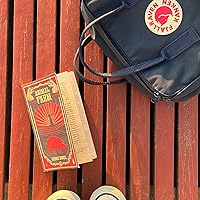
The edition I read was the one published in the United States by Viking. At the tale-end of the book industry's golden era, this edition was printed on very sturdy paper. Each story title had an ornate design below it and the jacket was in shades of green and gold, with white lettering. It did not look like what's shown in the thumbnail on Goodreads.
To the book itself. R.K. Narayan gathered these stories in 1985, when he was almost 80 years old. He states in his introduction that the stories here were from the previous four decades. Two of them were written in 1985. Most of the stories are between four and seven pages. Some of the very short ones are fairly clearly the work of a newspaperman; these seem to be on a par with O. Henry. Chekov, of course, was a newspaperman as well, and the story "Dodu" is as much a masterpiece of compression as anything Chekov produced. It is deeper than many of the other stories. Its focus on a boy with ambition and imagination is compelling, and it becomes poignant as his family's conformity manifests itself. But there's more to the story than that, and it is achieved in a mere six pages.
The centerpiece of this collection is 'Annamalai," the story of a master and servant. It is narrated by a well-off single man of indeterminate age and an elderly man who offers to tend to his garden for room and board. What strikes me is that, as sympathetic as the narrator is toward his servant, the cultural gap between the two men keeps the narrator from being able to help the servant at a crucial moment. It is the most detailed character study in the book. At twenty-six pages, it reads like a short novella, as opposed to a long short story. A shocking moment of modernity comes through this tale which otherwise reads like a folk-tale. The servant, Annamalai, comes home after a night of chatting with friends. The narrator tells us:
"I asked casually, 'What is your news today?' and he answered without stopping, 'News? I don't go hunting for it, but I overheard that the chief ruler of America was killed today. They said something like Kannady [which means glass in Tamil]; could any man give himself such a name?'
"When I realized the import of his casual reference, I said, 'Look, was it Kennedy?'
"'No, they said Kannady, and someone shot him with a gun and killed him, and probably they have already cremated him.' When I tried to get more news, he brushed me off with 'Don't think I go after gossip, I only tell you what approaches my ears...and they were all talking...'
"'Who?' I asked.
"'I don't know who they are. Why should I ask for names? They all sit and talk, having nothing else to do.'"
This story was published in ENCOUNTER, according to the copyright page, and I think ENCOUNTER was an American magazine. A few other stories in UNDER THE BANYAN TREE hint at particular political moments, but as an American, the one moment which was thrown into high relief for me was Kennedy's death on November 22nd, 1963. While most of the stories make passing reference to the railroad or to transportation by bus, there are only a few to which I can point which seem definitely to occur after Indian independence: "Half A Rupee Worth," about a successful purveyor of rice who finds himself suddenly having to yield to government price controls is one, "Nitya" another (if only because the main character is a young man whose parents want him to get his very long hair cut) and "Annamalai," which obviously happens during and after 1963. "Another Community" takes place at a named time, "October, 1947." Its main character is alarmed that there are secret meetings in his town. He is dreading the coming of October 29th, less than a week away. Narayan starts the story with references to newspapers love of the phrases "One Community" and "Another Community." A Google search tells me the Indo-Pakistani War of 1947-1948 began on October 22nd of 1947. India became independent at midnight on August 15th, 1947. A reader from India would have a better idea than I of the significance of the upheaval in late October, 1947 which the main character is panicked about. My main point is that the reference to John F. Kennedy in "Annamalai" reached me in a way I think many of the other stories could have reached me had I a sense of 20th century Indian history.
There is a humanism in this collection which shines throughout. A theme is the individual's attempts to maintain dignity under every circumstance.