

What do you think?

Con Đường Thoát Hạn
Nhắc đến Israel, người ta sẽ nghĩ ngay đến tinh thần "khởi nghiệp" của những người dân Do Thái bất diệt, bền bỉ. Dù ngoại cảnh có hỗn loạn đến đâu, dù thiên nhiên không ưu đãi cho họ nhiều điều kiện thuận lợi, Israel vẫn vươn lên mạnh mẽ qua biết bao hành trình khó khăn, khắc nghiệt từ những ngày đầu phục quốc cho đến khi xây dựng đời sống xã hội. Câu chuyện về "Quốc gia khởi nghiệp" Israel lại được kể tiếp trong những trang văn giản dị chứa đựng những thông điệp lớn lao trong tác phẩm "Con đường thoát hạn" - một anh hùng ca về "thung lũng Silicon" của thế giới.
Không giống như Việt Nam, Israel không sở hữu nguồn tài nguyên nước dồi dào và hệ thống sông ngòi, kênh rạch phong phú – mà ngược lại, có tới 60% diện tích là hoang mạc, lại bị bao vây ba bề bốn bên bởi những quốc gia thù địch. Thế nhưng, người Israel đã tìm ra cách tự “sản xuất” ra nước thông qua những biện pháp sáng tạo và liều lĩnh. Đó là Nước sạch được khử mặn từ nước biển, là nước lợ đã qua một hệ thống lọc phức tạp, thậm chí là nước thải sinh hoạt (nước cống) được xử lý tinh vi để có thể dùng tưới tiêu cho nông nghiệp hay cho những mục đích sinh hoạt thông thường khác... Năm 2013, người Israel đã tuyên bố : nguồn nước của họ không còn phụ thuộc vào thiên nhiên nữa ! Nước chính là cứu cánh, là phép màu mở ra cánh cửa nông nghiệp, kinh tế, ngoại giao cho Israel. Israel hiện sản xuất nước dư thừa cho nhu cầu nội tại và còn xuất khẩu đều đặn 24/7 sang cho các nước láng giềng, Palestine và Jordan, là vũ khí hòa bình của Israel cho tình trạng đối đầu Iran-Israel, Israel-Trung Quốc và một số các quốc gia khác, trở thành một « ngành kinh doanh toàn cầu », đòn bẩy cho kinh tế Israel phát triển.
Bằng những nghiên cứu tỉ mỉ và với hàng trăm cuộc phỏng vấn, Siegel đã mô tả sinh động cách mà Israel đã vượt qua các cuộc khủng hoảng nước của riêng mình, biến bất lợi thành lợi thế, đồng thời hỗ trợ các quốc gia khác trong việc xử lý và bảo tồn nguồn nước. Với 12 chương sách được bố cục một cách khoa học, cuốn sách kể về cả một lịch sử và hành trình thần kỳ của Israel trong hành trình chinh phục thiên nhiên, mang đến cho bạn những góc nhìn bao quát, một tư duy nhất quán, là kim chỉ nam về một nền quản trị nước đầy trí tuệ.
Cũng như lời của Shimon Tal, nguyên chủ nhiệm Ủy ban Nước Israel đã nói: "Cách thức quản lý nước của một quốc gia nói lên nhiều điều về quốc gia đó.", đây là câu chuyện không chỉ dành cho những người nghiên cứu về thủy lợi và nông nghiệp, nó còn là câu chuyện dành cho tất cả những người quan tâm về việc kiến tạo một tương lai phát triển và bền vững cho đất nước.
Không giống như Việt Nam, Israel không sở hữu nguồn tài nguyên nước dồi dào và hệ thống sông ngòi, kênh rạch phong phú – mà ngược lại, có tới 60% diện tích là hoang mạc, lại bị bao vây ba bề bốn bên bởi những quốc gia thù địch. Thế nhưng, người Israel đã tìm ra cách tự “sản xuất” ra nước thông qua những biện pháp sáng tạo và liều lĩnh. Đó là Nước sạch được khử mặn từ nước biển, là nước lợ đã qua một hệ thống lọc phức tạp, thậm chí là nước thải sinh hoạt (nước cống) được xử lý tinh vi để có thể dùng tưới tiêu cho nông nghiệp hay cho những mục đích sinh hoạt thông thường khác... Năm 2013, người Israel đã tuyên bố : nguồn nước của họ không còn phụ thuộc vào thiên nhiên nữa ! Nước chính là cứu cánh, là phép màu mở ra cánh cửa nông nghiệp, kinh tế, ngoại giao cho Israel. Israel hiện sản xuất nước dư thừa cho nhu cầu nội tại và còn xuất khẩu đều đặn 24/7 sang cho các nước láng giềng, Palestine và Jordan, là vũ khí hòa bình của Israel cho tình trạng đối đầu Iran-Israel, Israel-Trung Quốc và một số các quốc gia khác, trở thành một « ngành kinh doanh toàn cầu », đòn bẩy cho kinh tế Israel phát triển.
Bằng những nghiên cứu tỉ mỉ và với hàng trăm cuộc phỏng vấn, Siegel đã mô tả sinh động cách mà Israel đã vượt qua các cuộc khủng hoảng nước của riêng mình, biến bất lợi thành lợi thế, đồng thời hỗ trợ các quốc gia khác trong việc xử lý và bảo tồn nguồn nước. Với 12 chương sách được bố cục một cách khoa học, cuốn sách kể về cả một lịch sử và hành trình thần kỳ của Israel trong hành trình chinh phục thiên nhiên, mang đến cho bạn những góc nhìn bao quát, một tư duy nhất quán, là kim chỉ nam về một nền quản trị nước đầy trí tuệ.
Cũng như lời của Shimon Tal, nguyên chủ nhiệm Ủy ban Nước Israel đã nói: "Cách thức quản lý nước của một quốc gia nói lên nhiều điều về quốc gia đó.", đây là câu chuyện không chỉ dành cho những người nghiên cứu về thủy lợi và nông nghiệp, nó còn là câu chuyện dành cho tất cả những người quan tâm về việc kiến tạo một tương lai phát triển và bền vững cho đất nước.
504 pages, Paperback
First published October 6, 2015
About the author
Seth M. Siegel
7 books45 followersSeth M. Siegel is a serial entrepreneur, water activist and a New York Times bestselling author. In addition to his books, Seth is a Senior Fellow at the University of Wisconsin’s Center for Water Policy. His commentary on a range of topics has appeared in many leading publications, including The New York Times, The Wall Street Journal and The Washington Post. Seth has spoken on water issues at more than 325 venues in 68 cities, 26 states and on four continents–and during the Coronavirus lockdown to dozens of others via video.
Ratings & Reviews
Friends & Following
Create a free account to discover what your friends think of this book!
Community Reviews
Displaying 1 - 30 of 154 reviews

September 16, 2020
This book is both eye opening and inspirational. Being a young farmer in this age of farming where innovation drives you forward while being in constant touch with nature and your surroundings, water is never far from my mind. And being in the midst of the worst drought in people's memory makes water an everyday worry for us. Israel has since before independence been planning ahead in their water infrastructure and has been able to "make the desert bloom" because of this. They have also become the first nation to be independent of nature for it's water supply by not only one or two things, but by a combination of many that can back each other up if one fails and by an entire nation pulling in the same direction, and have thereby created a water surplus with which they can help their Arab neighbors, even though this is always a challenge because of politics where ideology trumps common-sense on the part of some of the neighbors. Water innovations has in recent decades become a major export for Israel and has built ties through water diplomacy with countries earlier opposed to Israel and hopefully more will follow, especially our country South Africa.
Now Israel is a small and educated nation, but should serve as an example for all nations around the world as to what can be done on a bigger scale, and not all the innovations that fits Israel will work in all environments, but there are so many that some will help other countries. This book should be read by all politicians and major role players to see how we can stave of the looming water-crisis that will befall our planet in the coming years so that we can be ready to overcome it and save humanity.
I always like to think that we on the farm try and save as much water as possible and try to maximize our use of it, but after reading this I know there are lots more we can do and this is why this book is so inspiring.
This is a must read for everyone, as water is a world crisis!!
Now Israel is a small and educated nation, but should serve as an example for all nations around the world as to what can be done on a bigger scale, and not all the innovations that fits Israel will work in all environments, but there are so many that some will help other countries. This book should be read by all politicians and major role players to see how we can stave of the looming water-crisis that will befall our planet in the coming years so that we can be ready to overcome it and save humanity.
I always like to think that we on the farm try and save as much water as possible and try to maximize our use of it, but after reading this I know there are lots more we can do and this is why this book is so inspiring.
This is a must read for everyone, as water is a world crisis!!

March 5, 2016
Water and Israel, a story too good to be true. Indeed, Israel has provided itself and the world with innovative techniques to optimize water use. But at what expense? The water rich resources from West Bank and Jordan Valley are used by illegal settlers and carried to mainland Israel, and as such millions of Palestinians are deprived from the natural resources that are rightfully theirs. As far as readability and information on water policies this book is both accessible and a great resource, but it's full of repetitive glorifying the Israeli mayam miracle. To the extent of another hallelujah book of this sort "Start up nation". In other words, "Let there be water" is one-sided and definitely doesn't provide the reader with an honest picture of the politicized regional water problem.

February 15, 2016
I think this is an essential book all leaders from the Mayor of San Diego to the governors of the southwestern states as well as many other states should read. I'd like to send a marked copy to Governor Snyder, where an Israeli water official pointed out that another reason besides the security Israel has to keep in mind is security from toxins. The Israelis have done remarkable things to deal with water. A tiny country in the middle of a desert region, surrounded by water thirsty enemies and filled with refugees from the Holocaust, Soviet Union, etc over the decades, spent a lot of money and thought on how to deal with water. And did succeed magnificently! Now Israel can export water. As well as water intensive crops. And probably most importantly, water expertise. The author comes across as rather laudatory, but then, there is plenty of reason for that. An area that has very little water resource is now a water exporter and a leader in all things connected with water. Drip irrigation was invented by the Israelis. They are experts in desalinization. They have processed their sewage so 80% of the water can be reclaimed and hope to reach 90% soon. They use much of the reclaimed water from sewage for agriculture. They have bred plants that can manage just fine in higher sodium water. If we Californians copied just a few of what the Israelis have done, I don't think we'd have a water crisis at the moment. They have freed their country from worrying about drought because they have enough water to manage even if in the midst of one. One of the most fundamental differences is that all Israelis are taught from babyhood on that water must not be wasted. Also, water is controlled by the Israelis as a public good and under state control, not cities, other districts, or individuals as here in California anyway. I am enthusiastic enough that I'm recopying this review on FB which I never do. I strongly encourage people to read this and tell others about this book!

October 29, 2015
This book contains a fascinating perspective on Israel and its people that we don't usually get through the media. I was drawn in by the natural challenges faced by the people of the region and the success that they have found in dealing with their water issues. I was surprised and pleased to see that though the author dealt with the political situation in Israel, it did not overshadow his main premise of water challenges across the globe and how countries and peoples can find solutions through the example of Israelis both average and extraordinary.

May 5, 2017
I think here in Egypt we have to learn from Israeli experience in this field . With technological innovations , political foresight and powerful public mindfulness combined with a great water management , Israele enjoys now water abundance.
A good book read it and know what science can do for a country.
A good book read it and know what science can do for a country.

July 4, 2018
Informative. I knew nothing about water treatment. This speaks of the use of technology in the deserts of Israel to allow clean water. It goes through both psychology as well as the various parts of water treatment. I thinks it’s relevant because where this is needed most are unstable areas. Israel is not so stable bs Dev countries who might preach about water quality. Def worth a read if you’re interested in the topic.

January 26, 2018
Despite what may not appear to be a gripping subject, this was fascinating.

October 4, 2020
This is a great book for someone who wants to know something about water managment. Israel really mastered this, its very informative and well written. It is also very interesting how they use water diplomacy and what role water actually played when Israel was born. From the technical point of view it is a 4 stars book. However, this is a 1 star book from the political point of view. Very biased and one sided. Palestine's lack of water because of Israel is already well known and Israel should not be presented as a very generous country if they provide now water to Palestinians for better price.
October 19, 2015
A description of hope for the future
The news media in the United States has publicized the recent major droughts in Texas and California, but the problem regarding a lack of water is global. Around the world, the overwhelming majority of people do not have a dependable supply of clean and safe drinking water. One of the main trigger mechanisms of the current bloody civil war in Syria was a lengthy drought and the same situation has fueled the conflict in South Sudan. Potential conflicts are developing between China and India, Egypt and Ethiopia, China and Vietnam and Turkey and Arab countries over announced plans to build dams on rivers that supply water to different countries downstream. Many people have convincingly argued that the major wars of the immediate future will be over water rights.
There is one place where the management of water resources has led to increased cooperation between hostile neighbors and that is between Israel and her Arab neighbors. During the gestational period of the Israeli nation, the far-sighted leaders understood that there could be no Israel without a solution to the problem of limited water. This book describes the history, technological advances and consequences of Israel adopting a national water use policy.
There are two main principles to the Israeli water policy, the first is the national policy that no water is physically handled without it being metered and paid for. Rain that naturally lands on your land is free, but if you capture it or the dew running off of your roof, you must pay for it. All citizens are constantly being reminded of the need for efficient use of water in the country. A national controlling board made up of qualified technocrats independent of political control makes the decisions regarding water use.
The second primary principle is the “all of the above” approach to the development and maintenance of water resources. Everything from water extracted by sewage treatment to desalinization plants to drip irrigation to more traditional water management have been enacted and efficiently executed. One of the major international exports of Israel is their expertise in the management of water resources.
One of the most pleasing details of the program is that Israel provides water to Jordan and the Palestinian territories, in fact it is one of the few ways in which they cooperate. There has been an ebb and flow to the diplomatic isolation of Israel over the years, in many cases it was the desire for Israeli expertise in water management that was the first step in the renewal of relations.
One of the fascinating sections was the description of Israeli involvement in the creation of major water management projects in Iran under the Shah. Iran is a country with limited water resources and the Israelis helped develop water management infrastructure in Iran that is still being used thirty years after the Shah was overthrown.
Given all of the major problems, it is easy to be pessimistic about the future course of conflicts over water. While Israel is a small country and not all that they have done can be implemented elsewhere, reading this book gives the reader a reason for optimism for the future. When the alternatives are new water technologies or the ancient solution of armed conflict, it is nice to know that there is a potential for a technological solution.
This book was made available for free for review purposes and this review also appears on Amazon.
The news media in the United States has publicized the recent major droughts in Texas and California, but the problem regarding a lack of water is global. Around the world, the overwhelming majority of people do not have a dependable supply of clean and safe drinking water. One of the main trigger mechanisms of the current bloody civil war in Syria was a lengthy drought and the same situation has fueled the conflict in South Sudan. Potential conflicts are developing between China and India, Egypt and Ethiopia, China and Vietnam and Turkey and Arab countries over announced plans to build dams on rivers that supply water to different countries downstream. Many people have convincingly argued that the major wars of the immediate future will be over water rights.
There is one place where the management of water resources has led to increased cooperation between hostile neighbors and that is between Israel and her Arab neighbors. During the gestational period of the Israeli nation, the far-sighted leaders understood that there could be no Israel without a solution to the problem of limited water. This book describes the history, technological advances and consequences of Israel adopting a national water use policy.
There are two main principles to the Israeli water policy, the first is the national policy that no water is physically handled without it being metered and paid for. Rain that naturally lands on your land is free, but if you capture it or the dew running off of your roof, you must pay for it. All citizens are constantly being reminded of the need for efficient use of water in the country. A national controlling board made up of qualified technocrats independent of political control makes the decisions regarding water use.
The second primary principle is the “all of the above” approach to the development and maintenance of water resources. Everything from water extracted by sewage treatment to desalinization plants to drip irrigation to more traditional water management have been enacted and efficiently executed. One of the major international exports of Israel is their expertise in the management of water resources.
One of the most pleasing details of the program is that Israel provides water to Jordan and the Palestinian territories, in fact it is one of the few ways in which they cooperate. There has been an ebb and flow to the diplomatic isolation of Israel over the years, in many cases it was the desire for Israeli expertise in water management that was the first step in the renewal of relations.
One of the fascinating sections was the description of Israeli involvement in the creation of major water management projects in Iran under the Shah. Iran is a country with limited water resources and the Israelis helped develop water management infrastructure in Iran that is still being used thirty years after the Shah was overthrown.
Given all of the major problems, it is easy to be pessimistic about the future course of conflicts over water. While Israel is a small country and not all that they have done can be implemented elsewhere, reading this book gives the reader a reason for optimism for the future. When the alternatives are new water technologies or the ancient solution of armed conflict, it is nice to know that there is a potential for a technological solution.
This book was made available for free for review purposes and this review also appears on Amazon.

June 8, 2015
Fascinating -- micro history of water in Israel with applied solutions to regional spots all over the world including the U.S. Reads like a novel....

January 25, 2018
Considering Israel's climate, population size, access to rivers and lakes, and relationship with its neighbors, the country ought to be enormously insecure about water security. Instead, throughout their history, Israel has put a strong emphasis on water security, and today is a world leader in water recovery, conservation, and management.
This book goes into detail on a wide variety of initiatives that explain how Israel got where it is, but the most important drivers have been:
- Pricing water at it's true cost (most governments subsidize water to be effectively free)
- Being diligent about maintaining water infrastructure
- Establishing a powerful and independent government authority that has complete control over the entire water value chain, and investing 100% of water sales back into the program
- Putting almost all of its agricuture on drip irrigation
- Making huge investments in desalination
Israel has always been motivated to conserve water and invest in water security. In fact, in 1939 (before Israel was even incorporated), the UK decreed that Jews should stop relocating to Palestine, because the region could not support the strain on water supplies.
Some random facts I found interesting:
-600 million people experience water shortages today.
-Raising a pound of beef takes 17x more water than growing a pound of corn
-Much water around the world is lost from shoddy infrastructure. London loses 30% of it's water. Chicago 25%. Many places in the middle east and china lost upwards of 60% of their water due. I remember incredible loses of water in LA last year when a pipe burst near UCLA
-The population of Israel nearly doubled in the first 6 years of its existence, so there were enormous strains on infrastructure
-Adjusting for inflation, Israel spent 6x more building the National Water Carrier than the US did building the Panama Canal.
-Cutting water losses by a few % points is normally enough to offset the water creation of an entire giant water desal platn
-Drip irrigation saves 50-60% of the water used by flood irrigation. Plants also grow faster with regular irrigation from drip as opposed to flood
-Drip irrigation also reduces runoff of fertilizer, which with flood irrigation ends up in lakes and rivers, spurring blue-green algae blooms that destorys those ecosystems
-Only ~5% of irrigated agricultural fields use drip irrigation and <20% use any irrigation at all
-Israeli agriculture has reduced the amount of fresh water it uses by ~60%
-Rain capture is actually a pretty unsanitary and expensive way of supplying water, as opposed to sewage treatment. The main reason is sewage treatment is far more regular, predictable, and easy to college and divert. These features make the water very attractive to farmers
-A reservior with a capacity of ~800 million gallons flow per year can cost ~$10M to build
-About 35% of household water use is for flushing toilets
-Sumerian civilization fell in part because the irrigation methods of their agrictulture gradually added too much salt in the soil to grow anything
-On average between 70% and 90% of the contents of orally ingested medicines get absorbed by the body, the rest is excreted and end up in our water system. We're not yet sure of the magnitude of the impact on our environment
-Reverse osmosis through membrane filtration is the dominant desal methodology, and is how 60% of desal plants around the world operate
-The global water industry has annual sales of $600bln, making it bigger than biotech and telecomm, and only slightly smaller than pharma. 75% of those sales are for legacy utility systems, the rest for high tech
-Very cool company Takadu uses big data for water infrastructure management. Israel's water utility served as a great first customer / business incubator
-Israel took a cue from Thatcher and privatized many of its government programs in the 1990s (national airline, state owned banks, telephone monopoly, and a water infrastructure advisory group that was profiled in the book)
This book goes into detail on a wide variety of initiatives that explain how Israel got where it is, but the most important drivers have been:
- Pricing water at it's true cost (most governments subsidize water to be effectively free)
- Being diligent about maintaining water infrastructure
- Establishing a powerful and independent government authority that has complete control over the entire water value chain, and investing 100% of water sales back into the program
- Putting almost all of its agricuture on drip irrigation
- Making huge investments in desalination
Israel has always been motivated to conserve water and invest in water security. In fact, in 1939 (before Israel was even incorporated), the UK decreed that Jews should stop relocating to Palestine, because the region could not support the strain on water supplies.
Some random facts I found interesting:
-600 million people experience water shortages today.
-Raising a pound of beef takes 17x more water than growing a pound of corn
-Much water around the world is lost from shoddy infrastructure. London loses 30% of it's water. Chicago 25%. Many places in the middle east and china lost upwards of 60% of their water due. I remember incredible loses of water in LA last year when a pipe burst near UCLA
-The population of Israel nearly doubled in the first 6 years of its existence, so there were enormous strains on infrastructure
-Adjusting for inflation, Israel spent 6x more building the National Water Carrier than the US did building the Panama Canal.
-Cutting water losses by a few % points is normally enough to offset the water creation of an entire giant water desal platn
-Drip irrigation saves 50-60% of the water used by flood irrigation. Plants also grow faster with regular irrigation from drip as opposed to flood
-Drip irrigation also reduces runoff of fertilizer, which with flood irrigation ends up in lakes and rivers, spurring blue-green algae blooms that destorys those ecosystems
-Only ~5% of irrigated agricultural fields use drip irrigation and <20% use any irrigation at all
-Israeli agriculture has reduced the amount of fresh water it uses by ~60%
-Rain capture is actually a pretty unsanitary and expensive way of supplying water, as opposed to sewage treatment. The main reason is sewage treatment is far more regular, predictable, and easy to college and divert. These features make the water very attractive to farmers
-A reservior with a capacity of ~800 million gallons flow per year can cost ~$10M to build
-About 35% of household water use is for flushing toilets
-Sumerian civilization fell in part because the irrigation methods of their agrictulture gradually added too much salt in the soil to grow anything
-On average between 70% and 90% of the contents of orally ingested medicines get absorbed by the body, the rest is excreted and end up in our water system. We're not yet sure of the magnitude of the impact on our environment
-Reverse osmosis through membrane filtration is the dominant desal methodology, and is how 60% of desal plants around the world operate
-The global water industry has annual sales of $600bln, making it bigger than biotech and telecomm, and only slightly smaller than pharma. 75% of those sales are for legacy utility systems, the rest for high tech
-Very cool company Takadu uses big data for water infrastructure management. Israel's water utility served as a great first customer / business incubator
-Israel took a cue from Thatcher and privatized many of its government programs in the 1990s (national airline, state owned banks, telephone monopoly, and a water infrastructure advisory group that was profiled in the book)
April 14, 2016
It was fascinating to learn how Israel, through a variety of methods decreased its dependence on scant rainfall and became a country of abundant water. It is the only country in the world that has less desert today than it did 100 years ago. On the way it developed new methods of farming and irrigation, desalination, and reclamation of water. It even exports water to neighboring areas. The author even discusses how other water-starved areas, like southern California, can help themselves by adopting some of Israel's strategies.
September 23, 2015
A must read for everyone as Israel's water story is a lesson for the entire world to learn from. The author tells the tale of Israel's approach to water conservation and supply from all angles: geopolitical, scientific. And environmental.

July 28, 2021
Книжка "Нехай буде вода" розповідає про те, яким же чином посушливий Ізраїль дає собі раду з водою. Вирощує та експортує прекрасні врожаї. Не має жодних проблем з комунальним водним господарством. Розбиває водні парки серед пустелі.
Найцікавіші тут перші два розділи. У першому розказується, яку велику роль зіграло водне питання та проблема нестачі води на зарі часів, під час створення держави Ізраїль. Адже британці, під протекторатом яких тоді знаходилась Палестина, обмежували кількість евреїв-імігрантів саме через впевненість, що посушлива земля не прогодує велику кількість людей. Натомість євреї створили Національний водогін. Історія його побудови – це просто якийсь захопливий трилер.
Подальший розділ – як саме влаштоване ізраїльське водне господарство – не менш цікава. Вся вода у Ізраїлі – державна власність, включно з дощовою, що впала у відро на задньому дворі. Проблема управління всією цієї водою дуже нагадувало наші політичні баталії. Врешті-решт ізраїльтяни не тільки націоналізували всю воду, вони також централізували управління і вивели його з-під політичного впливу.
Далі доволі послідовно розповідається про таке: винахід та запровадження крапельного поливу, труднощі, які при цьому виникали і як їх долали; очистка стічних вод та їх подальше використання; використання солонуватої води з підземних горизонтів; опріснювання морської води та опріснювальні заводи – як вони працюють і як ця ідея взагалі пробила собі шлях. Дуже цікавий розділ про різні штуки, пов’язані з муніципальним використанням води, тарифами, обліком, усуненням протікань. Все це звучить, на вашу думку, дуже нудно? Чорта з два! Це просто гімн людської винахідливості, наполегливості та розуму. Герої книжки - вчені, інженери, творці, політики та лобісти, які борються за воду, свої ідеї, гроші – вони справді «чіпляють». Це найкраща частина книги.
Окремо мене зацікаволи про ізраїльські проекти відновлення малих річок. Тут історія дуже схожа на українську. Довгі роки у річку Яркон зливали різний непотріб. А потім під час великих міжнародних спортивних змагань під делегаціями іноземних спортсменів зруйнувався мост, і люди попадали у річку. Декілька спортсменів померло у лікарнях просто тому, що наковталися з Яркону води. От після цього всі і забігали. Цікаво, що проекти щодо річок та їх рекультівації почалися лише тоді, коли Ізраїль подолав всі основні проблеми нестачі води та почав отримувати її надлишок, який можна було пустити у річки. І це до біса сумно. Тобто річки всіх цікавлять у останню чергу, і дивлячись як поводяться з ними у нас, розумієш, що люди всюди однакові.
Велика третя частина книги «Світ за кордонами Ізраїлю» трохи інша. Там багато міжнародної політики, зокрема висвітлюється водне питання у контексті взаємодій з Іраном, Палестиною, Іорданією, Сполученими Штатами, Китаєм та африканськими країнами. Ця частина не позбавлена цікавості, але виглядає як розгорнутий рекламний буклет на міжнародній торгівельній виставці. Автор «в лоба» вихваляє ізраїльські досягнення і не соромиться використовувати найвищу ступінь, розповідаючі про ізраїльські інновації, стартапи, інженерні підходи, вчених та вчених-підприємців. Продираючись через рекламне лушпиння, я намагалася прикидати – що з того, що описує автор, пасувало б для України, а чого «не може бути, бо не може бути ніколи». Це дуже повчальне читання. А головний висновок сумний – підтримка іновацій, можливість ризикувати, різні форми партнерства держави та бізнесу, зацікавленність «комунальників» та дуже високі тарифи на воду (як піднімали на неї ціну до реальної вартості – це окрема історія у книзі) – все це дуже складно уявити в Україні. Але деякі речі могли б спрацювати.
Цю книжку треба на стіл до кожного чиновника та депутата, аби хоч приблизно уявляли собі, як цивілізована маловодна країна крутиться, ніби вужак на пательні, аби вирішити проблему критичного ресурсу.
Найцікавіші тут перші два розділи. У першому розказується, яку велику роль зіграло водне питання та проблема нестачі води на зарі часів, під час створення держави Ізраїль. Адже британці, під протекторатом яких тоді знаходилась Палестина, обмежували кількість евреїв-імігрантів саме через впевненість, що посушлива земля не прогодує велику кількість людей. Натомість євреї створили Національний водогін. Історія його побудови – це просто якийсь захопливий трилер.
Подальший розділ – як саме влаштоване ізраїльське водне господарство – не менш цікава. Вся вода у Ізраїлі – державна власність, включно з дощовою, що впала у відро на задньому дворі. Проблема управління всією цієї водою дуже нагадувало наші політичні баталії. Врешті-решт ізраїльтяни не тільки націоналізували всю воду, вони також централізували управління і вивели його з-під політичного впливу.
Далі доволі послідовно розповідається про таке: винахід та запровадження крапельного поливу, труднощі, які при цьому виникали і як їх долали; очистка стічних вод та їх подальше використання; використання солонуватої води з підземних горизонтів; опріснювання морської води та опріснювальні заводи – як вони працюють і як ця ідея взагалі пробила собі шлях. Дуже цікавий розділ про різні штуки, пов’язані з муніципальним використанням води, тарифами, обліком, усуненням протікань. Все це звучить, на вашу думку, дуже нудно? Чорта з два! Це просто гімн людської винахідливості, наполегливості та розуму. Герої книжки - вчені, інженери, творці, політики та лобісти, які борються за воду, свої ідеї, гроші – вони справді «чіпляють». Це найкраща частина книги.
Окремо мене зацікаволи про ізраїльські проекти відновлення малих річок. Тут історія дуже схожа на українську. Довгі роки у річку Яркон зливали різний непотріб. А потім під час великих міжнародних спортивних змагань під делегаціями іноземних спортсменів зруйнувався мост, і люди попадали у річку. Декілька спортсменів померло у лікарнях просто тому, що наковталися з Яркону води. От після цього всі і забігали. Цікаво, що проекти щодо річок та їх рекультівації почалися лише тоді, коли Ізраїль подолав всі основні проблеми нестачі води та почав отримувати її надлишок, який можна було пустити у річки. І це до біса сумно. Тобто річки всіх цікавлять у останню чергу, і дивлячись як поводяться з ними у нас, розумієш, що люди всюди однакові.
Велика третя частина книги «Світ за кордонами Ізраїлю» трохи інша. Там багато міжнародної політики, зокрема висвітлюється водне питання у контексті взаємодій з Іраном, Палестиною, Іорданією, Сполученими Штатами, Китаєм та африканськими країнами. Ця частина не позбавлена цікавості, але виглядає як розгорнутий рекламний буклет на міжнародній торгівельній виставці. Автор «в лоба» вихваляє ізраїльські досягнення і не соромиться використовувати найвищу ступінь, розповідаючі про ізраїльські інновації, стартапи, інженерні підходи, вчених та вчених-підприємців. Продираючись через рекламне лушпиння, я намагалася прикидати – що з того, що описує автор, пасувало б для України, а чого «не може бути, бо не може бути ніколи». Це дуже повчальне читання. А головний висновок сумний – підтримка іновацій, можливість ризикувати, різні форми партнерства держави та бізнесу, зацікавленність «комунальників» та дуже високі тарифи на воду (як піднімали на неї ціну до реальної вартості – це окрема історія у книзі) – все це дуже складно уявити в Україні. Але деякі речі могли б спрацювати.
Цю книжку треба на стіл до кожного чиновника та депутата, аби хоч приблизно уявляли собі, як цивілізована маловодна країна крутиться, ніби вужак на пательні, аби вирішити проблему критичного ресурсу.
November 30, 2015
As the human population of the earth continues to grow, environmental constraints have become a an increasing concern. Being able to harvest enough healthy food and sufficient access to clean water have been two key areas of focus over the years for the world's poor, but often a back-burner issues for many in the wealthy industrialized world.
Unfortunately, recent droughts have exposed weaknesses in even the wealthiest and most advanced nations.
Given water's critical requirement in sustaining life, its absence poses an immediate and potential life-threatening risk to the many millions of people on the planet. What has been absent from the many discussions and debates are solutions to the limitations of potable water.
Siegel's book is one that addresses these issues, focusing on Israel as a case study. The book provides a historical overview of the Country's various plans and programs to maximize the utilization of this scarce resource. Rather than delving deeply into any one program, the reader gains a broad perspective of how Israel has interwoven government programs, private businesses, and disparate parts of society, from agriculture to individual consumers, to form a web with the goal of increasing the Country's water supply. But this is not a book that provides either a deep engineering or political analysis. It's notability is showing how the various parts create a greater sum of the whole.
While one can complain about the 'sunny' attitude taken by the author, the fact is, Israel has had multiple and notable successes in this field worthy of emulation. Both within the country and abroad, improving the water supplies of disparate nations, including China, pre-1979 revolutionary Iran, and various states in Africa.
Closer to home, the book unveils how despite the political animosity, and even blatant hatred of the Jewish state by its neighbors, Israel's government has worked to improve the water resources of Jordan and the Palestinian Authority. Israelis have a right to be proud of such achievements.
Unfortunately, recent droughts have exposed weaknesses in even the wealthiest and most advanced nations.
Given water's critical requirement in sustaining life, its absence poses an immediate and potential life-threatening risk to the many millions of people on the planet. What has been absent from the many discussions and debates are solutions to the limitations of potable water.
Siegel's book is one that addresses these issues, focusing on Israel as a case study. The book provides a historical overview of the Country's various plans and programs to maximize the utilization of this scarce resource. Rather than delving deeply into any one program, the reader gains a broad perspective of how Israel has interwoven government programs, private businesses, and disparate parts of society, from agriculture to individual consumers, to form a web with the goal of increasing the Country's water supply. But this is not a book that provides either a deep engineering or political analysis. It's notability is showing how the various parts create a greater sum of the whole.
While one can complain about the 'sunny' attitude taken by the author, the fact is, Israel has had multiple and notable successes in this field worthy of emulation. Both within the country and abroad, improving the water supplies of disparate nations, including China, pre-1979 revolutionary Iran, and various states in Africa.
Closer to home, the book unveils how despite the political animosity, and even blatant hatred of the Jewish state by its neighbors, Israel's government has worked to improve the water resources of Jordan and the Palestinian Authority. Israelis have a right to be proud of such achievements.
May 22, 2020
Enjoyable read.
I enjoyed the contextualization of Israeli water scarcity (and innovation) within the narrative arc of their nation's history.
This is a double-edged sword, because there are very solid ideas, but most are very specific to the Israeli context in my opinion. Some, like real water pricing and drip irrigation in agriculture, are more agnostic (in fact, my home state of Andhra Pradesh heavily subsidizes drip irrigation) and are valuable lessons for the rest of the world.
Others, like a centralized and independent Israeli Water Authority, are great for Israel's case because they founded their country with it built in, but I feel that there's too much inertia in developed nations to adopt a similar model.
As we rapidly approach water scarcity, moreso in the Global South, we must adopt a similar mentality towards integrated water resource conservation and innovation. This is a great book for you if:
- you're new to the arena of water policymaking, and want to be knowledgeable about how it can be integrated on a macroeconomic level, i.e., it doesn't just have to be a municipal utility; it can be a cohesive national strategy (granted, it's more about Israel's water planning history, but there are still some valuable lessons)
- when you're feeling down and in the doldrums about an impending water crisis, because Israel proved they could do it in an arid land. They made the desert bloom :)
I enjoyed the contextualization of Israeli water scarcity (and innovation) within the narrative arc of their nation's history.
This is a double-edged sword, because there are very solid ideas, but most are very specific to the Israeli context in my opinion. Some, like real water pricing and drip irrigation in agriculture, are more agnostic (in fact, my home state of Andhra Pradesh heavily subsidizes drip irrigation) and are valuable lessons for the rest of the world.
Others, like a centralized and independent Israeli Water Authority, are great for Israel's case because they founded their country with it built in, but I feel that there's too much inertia in developed nations to adopt a similar model.
As we rapidly approach water scarcity, moreso in the Global South, we must adopt a similar mentality towards integrated water resource conservation and innovation. This is a great book for you if:
- you're new to the arena of water policymaking, and want to be knowledgeable about how it can be integrated on a macroeconomic level, i.e., it doesn't just have to be a municipal utility; it can be a cohesive national strategy (granted, it's more about Israel's water planning history, but there are still some valuable lessons)
- when you're feeling down and in the doldrums about an impending water crisis, because Israel proved they could do it in an arid land. They made the desert bloom :)

November 5, 2023
As a microhistory of high-tech Israeli water innovation? 5 stars. And a solid 5 stars, too - the kind that I only give where the author goes above and beyond by identifying trends and connections that a mere factual analysis wouldn't piece together.
But as a broader political analysis of how Israel has wielded water as both carrot and stick in its foreign policy efforts? 2 or 3 stars. About a third of this book was dedicated to Israel's use of water as a diplomatic tool, and it honestly went better than I expected from a book with a clear Israeli-apologist perspective. But it shocks the conscience to address this topic without also addressing the hard line Israel has taken in water "negotiations". Yes, Israel sells water to Gaza (when it's not blockaded). And yes, Israel has made efforts to improve Gazans' desalination abilities. But those efforts have certainly not occurred in a vacuum, and it feels unreasonable to present them as representative of Israel's water policy without also mentioning the ways in which Israel has forcibly, and against international law, limited the territories' access to natural water resources.
3.5/5.
But as a broader political analysis of how Israel has wielded water as both carrot and stick in its foreign policy efforts? 2 or 3 stars. About a third of this book was dedicated to Israel's use of water as a diplomatic tool, and it honestly went better than I expected from a book with a clear Israeli-apologist perspective. But it shocks the conscience to address this topic without also addressing the hard line Israel has taken in water "negotiations". Yes, Israel sells water to Gaza (when it's not blockaded). And yes, Israel has made efforts to improve Gazans' desalination abilities. But those efforts have certainly not occurred in a vacuum, and it feels unreasonable to present them as representative of Israel's water policy without also mentioning the ways in which Israel has forcibly, and against international law, limited the territories' access to natural water resources.
3.5/5.
July 9, 2018
My rating is based on the timeliness of the issue of water security and how to achieve it, which this book elucidates. A must-read for anyone who is concerned about our future.

May 20, 2020
Một cuốn sách tuyệt vời về rất nhiều mặt: (Bỏ qua các vấn đề liên quan đến chính trị và những cáo buộc về việc Israel cướp đi nguồn nước sạch của Palestine qua các hoạt động quân sự, kinh tế và chính trị được nêu ra từ các nguồn ngoài cuốn sách):
- Cung cấp một cái nhìn khá toàn diện về cách thức Isreal "thoát hạn" từ nỗ lực của chính phủ và người dân suốt nhiều thập kỷ. Tự cung tự cấp nước cho quốc gia qua các giải pháp quản lý và công nghệ.
- Quảng bá hình ảnh quốc gia. Sự nỗ lực trong hợp tác bình ổn chính trị đời sống người dân với các nước trong khu vực Ả Rập như Palestine and Jordan. Đồng thời, chia sẻ và hỗ trợ các nước trên thế giới về công nghệ, cách thức quản lý và sử dụng nước.
"Làm cho sa mạc nở hoa" là một kỳ tích mà Israel đã đạt được và điều này giúp thế giới có cái nhìn lạc quan về viễn cảnh nước trong tương lai khi mà con người đang đối mặt với những vấn đề nghiêm trọng về hạn hán, ô nhiễm, biến đổi khí hậu gây cạn kiệt nguồn nước.
* Tận dụng tất cả các nguồn nước hiện có trong tự nhiên và nguồn nước thải để đưa vào sử dụng. Không có bất cứ giọt nước nào là vô ích và không có bất cứ giọt nước nào bị lãng quên:
- Bơm và lọc nước tự nhiên từ các tầng ngậm nước, giếng, sông, và Biển hồ Galilee.
- Khoan giếng sâu để lấy nước lợ.
- Xử lý gần như tất cả nước thải sinh hoạt tớ mức tinh khiết nhất và tái sử dụng cho cây trồng.
- Tích trữ và sử dụng lại nước mưa.
- Khử mặn nước biển.
* Vì nông nghiệp là ngành tiêu tốn nước lớn nhất nên Israel đầu tư vào việc nghiên cứu và phát triển các giải phát giúp giảm thiểu tối đa lượng nước trong ngành này:
- Phát triển các giống cây ưa nước mặn: Tạo các giống cây trồng sinh trưởng tốt với nước chứa một lượng muối nhất định.
- Chuyển đổi nông nghiệp sang việc trồng các loại cây tiết kiệm nước: Tạo ra các giống cây trồng có thể giảm các phần không cần thiết của cây như lá, thân cây, rễ cây, những phần tiêu tốn nước mà không tạo sản phẩm.
- Sử dụng tưới nhỏ giọt triệt để trong nông nghiệp: Tưới nhỏ giọt giúp tiết kiệm nước và gia tăng năng suất cây trồng.
* Đầu tư công nghệ và chi phí vào việc quản lý sử dụng nước hiệu quả. Đảm bảo tối đa lượng nước không bị mất đi một cách lãng phí:
- Yêu cầu tất cả các thiết bị ( đặc biệt là bồn cầu) phải có hiệu suất tiết kiệm nước cao.
- Thay thế cơ sở hạ tầng trước khi xuất hiện rò rỉ và sửa chữa tức thì khi rò rỉ xuất hiện.
* Nâng cao ý thức của người dân về nước. Nước là tài sản quốc gia đồng thời thuộc sở hữu quốc gia. Trong khi nhiều quốc gia coi nước là nguồn tài nguyên “trời ban” và không để tâm đến việc quản lý sao cho hiệu quả cho đến khi họ không có nước để dùng, thì Israel đã sớm ý thức được giá trị và tầm quan trọng của nước đối với vận mệnh quốc gia và con người. Tất cả mọi nơi trên Israel đều treo các áp phích băng rôn hay thông báo về việc tiết kiệm nước.
- Không khuyến khích cảnh quan công viên và nhà ở tiêu tốn nước ngoại.
- Giáo dục trẻ em về giá trị của việc tiết kiệm nước.
- Thu phí sử dụng nước để khuyến khích hiệu quả sử dụng: Khi mà hầu hết các quốc gia có chế độ bao cấp về nước thì Israel lại áp dụng việc thu phí hoàn toàn với người sử dụng nước. Họ phải trả toàn bộ chi phí cho từng giọt nước mà họ dùng. Người dân tìm cách để giảm thiểu chi phí cho bản thân mà vẫn đảm bảo nhu cầu sống với nước. Tiêu dùng nước của Israel nhờ vậy mà đã giảm được đến 20%.
* Israel cũng không ngừng nghiên cứu và phát triển các giải pháp công nghệ mới giúp duy trì và phát triển nguồn nước. Một quốc gia với những con người khởi nghiệp và không bao giờ thỏa mãn. Điều này cũng được coi là đóng góp lớn nhất của người Do Thái cho thế giới. Một tinh thần luôn hướng về phía trước và không ngừng phát triển.
- Gieo mây để tăng cường lượng mưa.
- Khích lệ tài chính cho các công nghệ tiết kiệm nước.
- Thử nghiệm các ý tưởng giảm sự bay hơi
- Cung cấp một cái nhìn khá toàn diện về cách thức Isreal "thoát hạn" từ nỗ lực của chính phủ và người dân suốt nhiều thập kỷ. Tự cung tự cấp nước cho quốc gia qua các giải pháp quản lý và công nghệ.
- Quảng bá hình ảnh quốc gia. Sự nỗ lực trong hợp tác bình ổn chính trị đời sống người dân với các nước trong khu vực Ả Rập như Palestine and Jordan. Đồng thời, chia sẻ và hỗ trợ các nước trên thế giới về công nghệ, cách thức quản lý và sử dụng nước.
"Làm cho sa mạc nở hoa" là một kỳ tích mà Israel đã đạt được và điều này giúp thế giới có cái nhìn lạc quan về viễn cảnh nước trong tương lai khi mà con người đang đối mặt với những vấn đề nghiêm trọng về hạn hán, ô nhiễm, biến đổi khí hậu gây cạn kiệt nguồn nước.
* Tận dụng tất cả các nguồn nước hiện có trong tự nhiên và nguồn nước thải để đưa vào sử dụng. Không có bất cứ giọt nước nào là vô ích và không có bất cứ giọt nước nào bị lãng quên:
- Bơm và lọc nước tự nhiên từ các tầng ngậm nước, giếng, sông, và Biển hồ Galilee.
- Khoan giếng sâu để lấy nước lợ.
- Xử lý gần như tất cả nước thải sinh hoạt tớ mức tinh khiết nhất và tái sử dụng cho cây trồng.
- Tích trữ và sử dụng lại nước mưa.
- Khử mặn nước biển.
* Vì nông nghiệp là ngành tiêu tốn nước lớn nhất nên Israel đầu tư vào việc nghiên cứu và phát triển các giải phát giúp giảm thiểu tối đa lượng nước trong ngành này:
- Phát triển các giống cây ưa nước mặn: Tạo các giống cây trồng sinh trưởng tốt với nước chứa một lượng muối nhất định.
- Chuyển đổi nông nghiệp sang việc trồng các loại cây tiết kiệm nước: Tạo ra các giống cây trồng có thể giảm các phần không cần thiết của cây như lá, thân cây, rễ cây, những phần tiêu tốn nước mà không tạo sản phẩm.
- Sử dụng tưới nhỏ giọt triệt để trong nông nghiệp: Tưới nhỏ giọt giúp tiết kiệm nước và gia tăng năng suất cây trồng.
* Đầu tư công nghệ và chi phí vào việc quản lý sử dụng nước hiệu quả. Đảm bảo tối đa lượng nước không bị mất đi một cách lãng phí:
- Yêu cầu tất cả các thiết bị ( đặc biệt là bồn cầu) phải có hiệu suất tiết kiệm nước cao.
- Thay thế cơ sở hạ tầng trước khi xuất hiện rò rỉ và sửa chữa tức thì khi rò rỉ xuất hiện.
* Nâng cao ý thức của người dân về nước. Nước là tài sản quốc gia đồng thời thuộc sở hữu quốc gia. Trong khi nhiều quốc gia coi nước là nguồn tài nguyên “trời ban” và không để tâm đến việc quản lý sao cho hiệu quả cho đến khi họ không có nước để dùng, thì Israel đã sớm ý thức được giá trị và tầm quan trọng của nước đối với vận mệnh quốc gia và con người. Tất cả mọi nơi trên Israel đều treo các áp phích băng rôn hay thông báo về việc tiết kiệm nước.
- Không khuyến khích cảnh quan công viên và nhà ở tiêu tốn nước ngoại.
- Giáo dục trẻ em về giá trị của việc tiết kiệm nước.
- Thu phí sử dụng nước để khuyến khích hiệu quả sử dụng: Khi mà hầu hết các quốc gia có chế độ bao cấp về nước thì Israel lại áp dụng việc thu phí hoàn toàn với người sử dụng nước. Họ phải trả toàn bộ chi phí cho từng giọt nước mà họ dùng. Người dân tìm cách để giảm thiểu chi phí cho bản thân mà vẫn đảm bảo nhu cầu sống với nước. Tiêu dùng nước của Israel nhờ vậy mà đã giảm được đến 20%.
* Israel cũng không ngừng nghiên cứu và phát triển các giải pháp công nghệ mới giúp duy trì và phát triển nguồn nước. Một quốc gia với những con người khởi nghiệp và không bao giờ thỏa mãn. Điều này cũng được coi là đóng góp lớn nhất của người Do Thái cho thế giới. Một tinh thần luôn hướng về phía trước và không ngừng phát triển.
- Gieo mây để tăng cường lượng mưa.
- Khích lệ tài chính cho các công nghệ tiết kiệm nước.
- Thử nghiệm các ý tưởng giảm sự bay hơi

July 9, 2023
Water shortages are government issues and Israel is living proof. How does a country in the desert have a water surplus even during drought cycles? This is a fascinating case study of how innovation and malevolent governing can solve issues of global resources. It is also a great reminder that water can bring about peace and global cooperation or just the opposite. There is a lot to be hopeful for in this book but for this to work in other countries, it would mean removing politics from water decisions and making citizens pay the actual price of water. I’m not optimist about that happening in most places sadly.

June 4, 2021
Not having a scientific bent, I thought this might require discipline to get through, but I instead, the writing kept me thoroughly engaged. The subject is important and the innovations the book describes are fascinating. Everyone should read this.

November 20, 2022
An agriculture solution and how a small country where 60% of its geographic are deserts could survive and provided clean water to its residents and even exporting to other countries.

January 5, 2020
Unlike in the US, where water is a personal property right, in Israel all water ownership and usage is controlled by the government acting in the interest of the people as a whole. Available water is then allocated according to what is seen as the best use. (16)
Israel is “a Western country and we embrace the idea of Individualism here. But there are some areas where the kibbutz approach makes the most sense. With water, collective ownership is one of the reasons why we are able to be a villa in a surrounding jungle.” (18)
Israelis have accepted a trade-off. They have surrenced private ownership and the benefits of a market economy in water for a system that offers universal access to high-quality water. (18)
Israel’s water system may be the most successful example of socialism in practice anywhere in the world today. (18)
WIth an understanding that unused water was needlessly flowing to the sea and thereby being wasted, [Eric] Johnson agreed to significantly increase Israel’s share of the water so that Israel could make productive use of it. (36)
Whether landing a man on the moon or rebuilding after a terrible hurricane, large infrastructure projects that are completed on time and on budget give the larger public a feeling of civic pride and enhance national identity. They also provide a widespread sense that other communal challenges can be overcome, and can unify a country. (37)
To give a sense of the scope and expense of the project, on a per capita basis, adjusted for inflation, Israel spent six times more building the National Water Carrier than the US did building the Panama Canal, which, when constructed, “was the most expensive public works project in American history.” (37)
One keen observer, David Pargament, said, “Imagine there was a decision to regulate trees, but that one government ministry had control over the leaves, another over the branches, another the bark, another the trunk, another the roots and yet one more, the shade of the tree. That’s what happened here.” (42)
The Water Commission was renamed the Israel Water Authority, and it was given real authority. Power was transferred from the political level to a technocratic one. With politics taken out of the decision-making process, the newly empowered entity could make decisions without fear of being overridden by politicians who wanted to score points with voters or simply accumulate power. (44)
“They see the rain and think that water is free. And they are right. That water is free. But safe, reliable, always available water is not free and cannot be free. Building infrastructure to get clean water to your home isn’t free, and treating sewage so no one gets sick from it isn’t free, and developing desalinated water plants to bring us through a drought isn’t free.” (44)
The effect of introducing real pricing for farms and homes almost immediately changed usage levels. With no rationing or limit on supply, real pricing induced consumers to cut their use of household water by sixteen percent. (45)
Jerusalem has a water system that goes back hundreds of years and a history to the dawn of time. In fact, the municipal water corporation there is called Hagihon, a reference to the siege of the ancient city of Jerusalem that was broken twenty-seven hundred years ago by the construction of a tunnel to the Gihon spring. (50)
Irrigating a plant drop by drop limits evaporation and delivers the water that the plant needs directly at its roots. The water savings are significant - only four percent of the water is lost to evaporation ort unnecessary absorption into the soil. (57)
“We lived by strict principles, and one of them was that we will only do what we can do ourselves. We would not hire workers. Since we couldn’t do it ourselves, we decided to give it away. [said Ruth Keren about Netafim]. (61)
Second, drip irrigation will produce a larger harvest and usually a higher-quality one, as well. Regardless of growing conditions or the salinity of the water, drip irrigation nearly always produces a larger crop than does flood- or sprinkler-irrigated crops in a comparable environment. Harvest of double or more are now standard. (63)
Drip irrigation is a solution to the fertilizer-incited algae colonies, Instead of randomly distributing fertilizer on fields, drip irrigated plants often receive a mixture of water and water-soluble fertilizer in a process called fertigation, a new word coined by combining fertilizer and irrigation. (64)
Once there is a cost to farmers for the water they use - as is the case in Israel - farmers will have an incentive to modernize their farms and to use all kinds of technology to preserve water and to purify marginal water. Among other changes, this will likely catalyze a broad and global transition from flood irrigation to drip irrigation. (73)
No other country makes the reuse of its sewage a national priority as does Israel. Over 85 percent of the nation’s sewage is reused. (76)
Israel’s farms still make use of a great deal of freshwater, but treated sewage now makes up about a third of the national water used in agriculture, or about twenty percent of all water used for all purposes. (84)
By comparison, Spain is second in the world of reuse of reclaimed water with around twenty-five percent, even if most affluent countries like the US reuse less than ten percent. (84)
Israel was the first in the world to adopt the mandatory use of dual-flush toilets, a device claimed to have been invented in Israel. Plasson, an Israeli company, had been manufacturing plastic toilets since 1973. (89)
Israel is the only country in the world which has less area covered by desert today than fifty years ago. (98)
Success in desalination would produce important benefits for Israel in helping to fulfill the Zionist goal of building a secure, self-sufficient economy and society that would be a magnet for Jews worldwide. Lacking adequate natural water from rain and rivers, the nation’s growing water deficit would be an impediment to both its economic vitality and, as important, its ability to absorb new waves of Jews resettling in Israel. (100)
With Ashkelon, Palmachim, Hadera, Soreq, and a Mekorot-managed plant in Ashdod, along with RO desalination plants for brackish water, Israel now produces nearly five hundred million gallons of freshwater from salty sources every day. (122)
“Even when we were cutting other parts of the national budget, we moved forward with infrastructure for desalination. It lets us control our destiny, something important for any country, but especially for us for as long as we are surrounded by enemies. (123)
Under its 1994 peace treaty with the Kingdom of Jordan and the 1995 Oslo II Agreement with the Palestinian Authority, Israel provides water to each… The interdependence of the parties will create new opportunities for coexistence and possibly even serve as a prelude to warmer relations. (124)
With desalination, water has become a purely economic issue. Water is no longer a question of how, but how much. If you think of water as something to be manufactured, it exclusively becomes a question of cost. You can get the quantity and quality of water you want, provided you are prepared to pay for it. (126)
It will take human intervention to improve what human activity and abuse earlier made worse; but it will always be a balance between economic interests and environmental restoration. (138)
Further, having no significant storage facility for its water, the kingdom [of Jordan] also worked out an arrangement with Israel to store its water reserves from the Yarmouk River - a Lower Jordan River tributary under the control of the Kingdom that defines its northern border with Syria - in the Sea of Galilee. Jordan is permitted to withdraw its stored reserves from that body of water at will. (141)
The largest economic segment, even before independence, was the service sector. More than half of the economy was tied to education, medicine, research, and financial services. Although no one knew it at the time, these (and related) business categories would put Israel in a good position for a world whose affluent nations were moving to service economies. (156)
Seventy-five percent of those sales are generated by what might be called “old” or “dumb” waster: valves, pipes, pumps, and most of what utilities do. The other twenty-five percent in revenues are for high-tech products - areas like technology, desalination, membranes, leak minimization, drip irrigation, filtration, water security, and valve-to-control-room communications - which are the future of the water industry. In each of those areas, Israel excels. (157)
HydroSpin utilizes the water that flows through ordinary water popes. As the water flows, it comes in contact with a very small rotating wheel. That wheel generates electrical current in the same way that a river does, just in micro-sized amounts. (166)
Whether in Gaza or the West Bank, they know that no matter how bad a drought may be or no matter what they do with their water, they know they will never go without water as long as Israel’s water inventory is a deep as it is today. (174)
“Even if Palestinians have justified complaints about the amount of water and about water pressure, it is still better quality and quantity that what is found in most of the Arab world, and even in parts of Eastern Europe. (176)
Many Palestinian water professionals disagree with what has been labeled an antinormalization campain - namely, the PA’s policy of noncooperation with Israel on water issues - but few are prepared to speak publicly and confront the stance. (177)
Before Israel is likely to permit Hamas an unfettered right to import items like cement and metal pipes that could be used either for civilian purposes (like a desalination plant or a wastewater-treatment plant) or to build weapons or military infrastructure (like rockets, missiles, and tunnels), Israel would want to be sure none of the imported products would be used to wage war against them. For now, Hamas hasn’t agreed to modify its refusal to recognize Israel or to demilitarize Gaza. (181)
Ninety percent of the Kingdom of Jordan is uninhabited, and most of it gets a lot of sun. Jordan is a logical home for a regional photovoltaic solar grid, and could provide the land for it. The Palestinians could provide the rain that falls over the mountains of the West Bank, along with the high-quality agricultural land that they have. When Gaza gets a desalination plant, it could add that to the mix, too. And Israel could provide desalinated water and the water technology it has developed, including the safe extraction of water from the aquifer. (194)
“Everyone seemed to admire Israel and appreciate that we were an ancient civilization like theirs [Chinese]. The only thing that surprised them was how small Israel was. They would joke that the entire population of Israel could check into a Chinese hotel.” (198)
Israeli hydrologists, water engineers, planners, and others became so numerous and so enmeshed in Iran’s water exploration and infrastructure that the majority of the water projects in Iran from 1962 until the 1979 Islamic Revolution were managed by Israelis. Geopolitically, for Israel the alliance with Iran served to counterbalance the hostility of the Arab states while lessening Israel’s regional isolation - at least for as long as the cooperative relationship continued. (202)
“We called our efforts development cooperation and never called it aid,” says Ambassador Yehuda Avner. “We were there to help by teaching and training, but not by providing financial assistance.” (208)
The second motivation was their pride in Israel, Zionism, and Jewish tradition. “Everywhere we went we wanted people to know we were from Israel and that we were Jews. We wanted our work to remind everyone that this is what Israel does. And because we were from Israel, we demanded of ourselves that wherever we went, we’d always behave at our best. (214)
Shimon Peres, Israel’s former president, told an interviewer while still in office that “the greatest Jewish contribution to the world has been dissatisfaction” which, he said, “is bad for the country’s leaders, but very good for science and progress. (235)
The following elements are separately and together a key to understanding Israel’s philosophy (and success) in water:
The Water Belongs to the Nation - Even in their dynamic, free-market country, Israelis believe public ownership and government management of water achieve the best outcomes for all (235)
Cheap Water is Expensive - The most important reason for setting water and sewage fees at their real price is to let market forces work. Real pricing encourages consumers to use all of the water they need, but not more. Israel has shown real pricing to be the most effective conservation tool of all. (237)
Use Water to Unify the Country - regardless of where they live, all consumers pay the same price for their water. (238)
Regulators, Not Politicians - Because of electoral reality, elected officials around the world are usually reluctant to spend more on water. The benefits of new water infrastructure aren’t felt until long into the future, probably after the elected official is gone from office, or at least form that office. Raising taxes or issuing bonds now to pay for expensive water infrastructure for which credit will be given to a successor makes little political sense… To keep special interest groups and friends of elected officials from getting favored treatment and to keep spending on infrastructure, technology, and innovation high, Israel decided to keep politics and politicians out of water decision making. (240)
Create a Water-Respecting Culture
All of the Above - Consider what Israel does in pursuit of clean, safe, available anytime water (241):
Pumps and purifies natural water from its aquifers, wells, rives, and the Sea of Galilee.
Desalinates seawater.
Drills deep wells to get brackish water.
Develops seeds that thrive on salty water.
Treats nearly all of its sewage to a high level of purity and reuses it on crops.
Captures and reuses rainwater.
Discourages landscaping of parks or homes that consume freshwater.
Seeds rain clouds to enhance rainfall.
Demands all appliances (especially toilets) be hyper water efficient.
Replaces infrastructure before leaks begin and promptly fixes leaks when they appear.
Educates schoolchildren as to the value of water conservation.
Prices water to encourage efficiency.
Gives financial incentives for technologies that save water.
Experiments with ideas to reduce evaporation.
Transformed its agriculture to grow water-efficient crops.
Uses drip irrigation for most of its agriculture.
Israel is “a Western country and we embrace the idea of Individualism here. But there are some areas where the kibbutz approach makes the most sense. With water, collective ownership is one of the reasons why we are able to be a villa in a surrounding jungle.” (18)
Israelis have accepted a trade-off. They have surrenced private ownership and the benefits of a market economy in water for a system that offers universal access to high-quality water. (18)
Israel’s water system may be the most successful example of socialism in practice anywhere in the world today. (18)
WIth an understanding that unused water was needlessly flowing to the sea and thereby being wasted, [Eric] Johnson agreed to significantly increase Israel’s share of the water so that Israel could make productive use of it. (36)
Whether landing a man on the moon or rebuilding after a terrible hurricane, large infrastructure projects that are completed on time and on budget give the larger public a feeling of civic pride and enhance national identity. They also provide a widespread sense that other communal challenges can be overcome, and can unify a country. (37)
To give a sense of the scope and expense of the project, on a per capita basis, adjusted for inflation, Israel spent six times more building the National Water Carrier than the US did building the Panama Canal, which, when constructed, “was the most expensive public works project in American history.” (37)
One keen observer, David Pargament, said, “Imagine there was a decision to regulate trees, but that one government ministry had control over the leaves, another over the branches, another the bark, another the trunk, another the roots and yet one more, the shade of the tree. That’s what happened here.” (42)
The Water Commission was renamed the Israel Water Authority, and it was given real authority. Power was transferred from the political level to a technocratic one. With politics taken out of the decision-making process, the newly empowered entity could make decisions without fear of being overridden by politicians who wanted to score points with voters or simply accumulate power. (44)
“They see the rain and think that water is free. And they are right. That water is free. But safe, reliable, always available water is not free and cannot be free. Building infrastructure to get clean water to your home isn’t free, and treating sewage so no one gets sick from it isn’t free, and developing desalinated water plants to bring us through a drought isn’t free.” (44)
The effect of introducing real pricing for farms and homes almost immediately changed usage levels. With no rationing or limit on supply, real pricing induced consumers to cut their use of household water by sixteen percent. (45)
Jerusalem has a water system that goes back hundreds of years and a history to the dawn of time. In fact, the municipal water corporation there is called Hagihon, a reference to the siege of the ancient city of Jerusalem that was broken twenty-seven hundred years ago by the construction of a tunnel to the Gihon spring. (50)
Irrigating a plant drop by drop limits evaporation and delivers the water that the plant needs directly at its roots. The water savings are significant - only four percent of the water is lost to evaporation ort unnecessary absorption into the soil. (57)
“We lived by strict principles, and one of them was that we will only do what we can do ourselves. We would not hire workers. Since we couldn’t do it ourselves, we decided to give it away. [said Ruth Keren about Netafim]. (61)
Second, drip irrigation will produce a larger harvest and usually a higher-quality one, as well. Regardless of growing conditions or the salinity of the water, drip irrigation nearly always produces a larger crop than does flood- or sprinkler-irrigated crops in a comparable environment. Harvest of double or more are now standard. (63)
Drip irrigation is a solution to the fertilizer-incited algae colonies, Instead of randomly distributing fertilizer on fields, drip irrigated plants often receive a mixture of water and water-soluble fertilizer in a process called fertigation, a new word coined by combining fertilizer and irrigation. (64)
Once there is a cost to farmers for the water they use - as is the case in Israel - farmers will have an incentive to modernize their farms and to use all kinds of technology to preserve water and to purify marginal water. Among other changes, this will likely catalyze a broad and global transition from flood irrigation to drip irrigation. (73)
No other country makes the reuse of its sewage a national priority as does Israel. Over 85 percent of the nation’s sewage is reused. (76)
Israel’s farms still make use of a great deal of freshwater, but treated sewage now makes up about a third of the national water used in agriculture, or about twenty percent of all water used for all purposes. (84)
By comparison, Spain is second in the world of reuse of reclaimed water with around twenty-five percent, even if most affluent countries like the US reuse less than ten percent. (84)
Israel was the first in the world to adopt the mandatory use of dual-flush toilets, a device claimed to have been invented in Israel. Plasson, an Israeli company, had been manufacturing plastic toilets since 1973. (89)
Israel is the only country in the world which has less area covered by desert today than fifty years ago. (98)
Success in desalination would produce important benefits for Israel in helping to fulfill the Zionist goal of building a secure, self-sufficient economy and society that would be a magnet for Jews worldwide. Lacking adequate natural water from rain and rivers, the nation’s growing water deficit would be an impediment to both its economic vitality and, as important, its ability to absorb new waves of Jews resettling in Israel. (100)
With Ashkelon, Palmachim, Hadera, Soreq, and a Mekorot-managed plant in Ashdod, along with RO desalination plants for brackish water, Israel now produces nearly five hundred million gallons of freshwater from salty sources every day. (122)
“Even when we were cutting other parts of the national budget, we moved forward with infrastructure for desalination. It lets us control our destiny, something important for any country, but especially for us for as long as we are surrounded by enemies. (123)
Under its 1994 peace treaty with the Kingdom of Jordan and the 1995 Oslo II Agreement with the Palestinian Authority, Israel provides water to each… The interdependence of the parties will create new opportunities for coexistence and possibly even serve as a prelude to warmer relations. (124)
With desalination, water has become a purely economic issue. Water is no longer a question of how, but how much. If you think of water as something to be manufactured, it exclusively becomes a question of cost. You can get the quantity and quality of water you want, provided you are prepared to pay for it. (126)
It will take human intervention to improve what human activity and abuse earlier made worse; but it will always be a balance between economic interests and environmental restoration. (138)
Further, having no significant storage facility for its water, the kingdom [of Jordan] also worked out an arrangement with Israel to store its water reserves from the Yarmouk River - a Lower Jordan River tributary under the control of the Kingdom that defines its northern border with Syria - in the Sea of Galilee. Jordan is permitted to withdraw its stored reserves from that body of water at will. (141)
The largest economic segment, even before independence, was the service sector. More than half of the economy was tied to education, medicine, research, and financial services. Although no one knew it at the time, these (and related) business categories would put Israel in a good position for a world whose affluent nations were moving to service economies. (156)
Seventy-five percent of those sales are generated by what might be called “old” or “dumb” waster: valves, pipes, pumps, and most of what utilities do. The other twenty-five percent in revenues are for high-tech products - areas like technology, desalination, membranes, leak minimization, drip irrigation, filtration, water security, and valve-to-control-room communications - which are the future of the water industry. In each of those areas, Israel excels. (157)
HydroSpin utilizes the water that flows through ordinary water popes. As the water flows, it comes in contact with a very small rotating wheel. That wheel generates electrical current in the same way that a river does, just in micro-sized amounts. (166)
Whether in Gaza or the West Bank, they know that no matter how bad a drought may be or no matter what they do with their water, they know they will never go without water as long as Israel’s water inventory is a deep as it is today. (174)
“Even if Palestinians have justified complaints about the amount of water and about water pressure, it is still better quality and quantity that what is found in most of the Arab world, and even in parts of Eastern Europe. (176)
Many Palestinian water professionals disagree with what has been labeled an antinormalization campain - namely, the PA’s policy of noncooperation with Israel on water issues - but few are prepared to speak publicly and confront the stance. (177)
Before Israel is likely to permit Hamas an unfettered right to import items like cement and metal pipes that could be used either for civilian purposes (like a desalination plant or a wastewater-treatment plant) or to build weapons or military infrastructure (like rockets, missiles, and tunnels), Israel would want to be sure none of the imported products would be used to wage war against them. For now, Hamas hasn’t agreed to modify its refusal to recognize Israel or to demilitarize Gaza. (181)
Ninety percent of the Kingdom of Jordan is uninhabited, and most of it gets a lot of sun. Jordan is a logical home for a regional photovoltaic solar grid, and could provide the land for it. The Palestinians could provide the rain that falls over the mountains of the West Bank, along with the high-quality agricultural land that they have. When Gaza gets a desalination plant, it could add that to the mix, too. And Israel could provide desalinated water and the water technology it has developed, including the safe extraction of water from the aquifer. (194)
“Everyone seemed to admire Israel and appreciate that we were an ancient civilization like theirs [Chinese]. The only thing that surprised them was how small Israel was. They would joke that the entire population of Israel could check into a Chinese hotel.” (198)
Israeli hydrologists, water engineers, planners, and others became so numerous and so enmeshed in Iran’s water exploration and infrastructure that the majority of the water projects in Iran from 1962 until the 1979 Islamic Revolution were managed by Israelis. Geopolitically, for Israel the alliance with Iran served to counterbalance the hostility of the Arab states while lessening Israel’s regional isolation - at least for as long as the cooperative relationship continued. (202)
“We called our efforts development cooperation and never called it aid,” says Ambassador Yehuda Avner. “We were there to help by teaching and training, but not by providing financial assistance.” (208)
The second motivation was their pride in Israel, Zionism, and Jewish tradition. “Everywhere we went we wanted people to know we were from Israel and that we were Jews. We wanted our work to remind everyone that this is what Israel does. And because we were from Israel, we demanded of ourselves that wherever we went, we’d always behave at our best. (214)
Shimon Peres, Israel’s former president, told an interviewer while still in office that “the greatest Jewish contribution to the world has been dissatisfaction” which, he said, “is bad for the country’s leaders, but very good for science and progress. (235)
The following elements are separately and together a key to understanding Israel’s philosophy (and success) in water:
The Water Belongs to the Nation - Even in their dynamic, free-market country, Israelis believe public ownership and government management of water achieve the best outcomes for all (235)
Cheap Water is Expensive - The most important reason for setting water and sewage fees at their real price is to let market forces work. Real pricing encourages consumers to use all of the water they need, but not more. Israel has shown real pricing to be the most effective conservation tool of all. (237)
Use Water to Unify the Country - regardless of where they live, all consumers pay the same price for their water. (238)
Regulators, Not Politicians - Because of electoral reality, elected officials around the world are usually reluctant to spend more on water. The benefits of new water infrastructure aren’t felt until long into the future, probably after the elected official is gone from office, or at least form that office. Raising taxes or issuing bonds now to pay for expensive water infrastructure for which credit will be given to a successor makes little political sense… To keep special interest groups and friends of elected officials from getting favored treatment and to keep spending on infrastructure, technology, and innovation high, Israel decided to keep politics and politicians out of water decision making. (240)
Create a Water-Respecting Culture
All of the Above - Consider what Israel does in pursuit of clean, safe, available anytime water (241):
Pumps and purifies natural water from its aquifers, wells, rives, and the Sea of Galilee.
Desalinates seawater.
Drills deep wells to get brackish water.
Develops seeds that thrive on salty water.
Treats nearly all of its sewage to a high level of purity and reuses it on crops.
Captures and reuses rainwater.
Discourages landscaping of parks or homes that consume freshwater.
Seeds rain clouds to enhance rainfall.
Demands all appliances (especially toilets) be hyper water efficient.
Replaces infrastructure before leaks begin and promptly fixes leaks when they appear.
Educates schoolchildren as to the value of water conservation.
Prices water to encourage efficiency.
Gives financial incentives for technologies that save water.
Experiments with ideas to reduce evaporation.
Transformed its agriculture to grow water-efficient crops.
Uses drip irrigation for most of its agriculture.

November 28, 2019
Although tiny, Israel is a nation with a fairly varied geography. A shard that runs from basalt to salt to sand, it runs down a river-fed mountainous north by way of its Mediterranean coast on the west to the desert south with access to the Indian Ocean by way of the Red Sea at the point of Eilat, from which its eastern border with Jordan can be drawn northward via a rift valley that lies below sea level until its terminus in a vast, dead, and ever-drying lake. From there, it's northward again along the Jordan River to the lush Kinneret and further to Lebanon, Syria, and the Golan Heights. Since a strategic construction raid staged over a Yom Kippur midnight in 1946 instantly established a few farms and the basis of a legitimate claim, literally half of Israel's land mass has been the parched Negev. Much of what remains is semi-arid at best.
Ancients described Israel as the land of milk and honey with the same marketing panache that led Vikings to brand Greenland. In fact, so great are regional water challenges that colonial economists thought no more than two million people could inhabit the entire area of Palestine (see the infamous 1939 British White Paper). Making matters worse, the modern state of Israel has remained largely politically isolated, surrounded for nearly its entire history by adversaries, if not outright enemies, including hostile entities who have not only made her the target of repeated war but who also refused even to formally acknowledge her existence. In this southwestern arc of a marginally fertile crescent, survival has ever been thirsty work.
Seth Siegel here documents how pre-state Zionists established a water-conserving culture that, alongside infrastructural investments, restless technological innovation, and accompanying administrative machinery, have not only met but exceeded these challenges. The author reports how Israel has placed itself at the global vanguard of water policy, developing as of 2015* a surplus for a population now nearly five times that of the original British estimate. Israelis accomplished this via various extraction techniques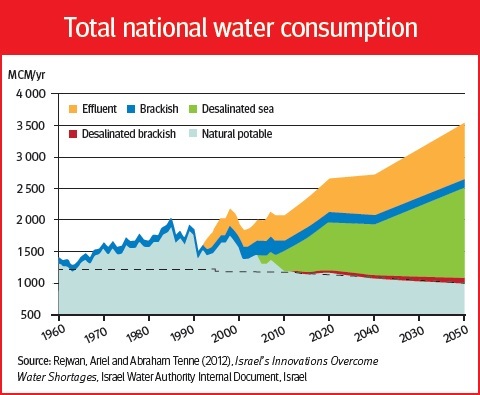 , sharing both hard-won knowledge and excess as a diplomatic wedge to other parched places (including Iran, Jordan, China, and California, among many developing nations south of the equator via continuous NGO outreach). It's a triumph of human achievement that comes as quite a comfort in the face of climate change at the end of these 2010s, with the asterisked caveat that Israel's water security has backslid significantly over the past 5 years since this book's publication. I am told that the present five-year-long drought is partly due to decreased rainfall but also partly to the success of the author in quenching existentialist concerns.
Okay, but what did Israelis do for water that others might replicate their success? For starters, they nationalized its ownership. Thanks to the water law, the state alone got authority to claim, collect, tax, regulate, and oversee distribution of every drop that falls onto Israeli streets, farms, and rooftops, laps its shores, or runs within the national boundaries. They built upon a culture of conservation founded in Biblical tradition dating back to the Zionist pre-state era, and perpetuated it through rigorous curricula at all grade levels. Their systematic approach extended to economics as well, as the Israeli Water Authority -- a national, apolitical bureaucracy charged with oversight of the unitary utility Mekorot -- ensured that pricing would reflect the total cost of operation (so, the infrastructure, maintenance, testing, treatment, well drilling, desalinization, and waste removal in addition to the cost of pumping and administrative overhead).
Israel's farms favor planting of brine-tolerant seeds and deploy a network of targeted drip irrigation in lieu of the wasteful flooding and spraying so common elsewhere in the world. Rivers have been diverted through reservoirs and down a central spinal pipeline called the National Water Carrier for maximum efficiency. Computers help people monitor the entire system to prevent and respond to leakage. Even rain clouds have yielded to human control, routinely succumbing to a seeding process designed to wring every passing drop.
This is all tremendously impressive, but do you need to read this book to appreciate it? Should you? Um… not really, not so long as this informative link exists, which covers everything I've already reviewed. Sadly, this book is nearly as arid as its subject matter. I went into it anticipating an engineering story along the lines of The Great Bridge, however, unlike David McCullough's robust history of the Roeblings, Siegel's work lacks any sense of suspension or suspense. The presentation of cloud seeding is a textbook-like example of missed narrative opportunity. At page 147, Siegel writes:
Israel's water story is deeply interesting. Alas, Seth Siegel's shallow approach is booorrrrinnnnnggggg. Well, well, well.
Ancients described Israel as the land of milk and honey with the same marketing panache that led Vikings to brand Greenland. In fact, so great are regional water challenges that colonial economists thought no more than two million people could inhabit the entire area of Palestine (see the infamous 1939 British White Paper). Making matters worse, the modern state of Israel has remained largely politically isolated, surrounded for nearly its entire history by adversaries, if not outright enemies, including hostile entities who have not only made her the target of repeated war but who also refused even to formally acknowledge her existence. In this southwestern arc of a marginally fertile crescent, survival has ever been thirsty work.
Seth Siegel here documents how pre-state Zionists established a water-conserving culture that, alongside infrastructural investments, restless technological innovation, and accompanying administrative machinery, have not only met but exceeded these challenges. The author reports how Israel has placed itself at the global vanguard of water policy, developing as of 2015* a surplus for a population now nearly five times that of the original British estimate. Israelis accomplished this via various extraction techniques
, sharing both hard-won knowledge and excess as a diplomatic wedge to other parched places (including Iran, Jordan, China, and California, among many developing nations south of the equator via continuous NGO outreach). It's a triumph of human achievement that comes as quite a comfort in the face of climate change at the end of these 2010s, with the asterisked caveat that Israel's water security has backslid significantly over the past 5 years since this book's publication. I am told that the present five-year-long drought is partly due to decreased rainfall but also partly to the success of the author in quenching existentialist concerns. Okay, but what did Israelis do for water that others might replicate their success? For starters, they nationalized its ownership. Thanks to the water law, the state alone got authority to claim, collect, tax, regulate, and oversee distribution of every drop that falls onto Israeli streets, farms, and rooftops, laps its shores, or runs within the national boundaries. They built upon a culture of conservation founded in Biblical tradition dating back to the Zionist pre-state era, and perpetuated it through rigorous curricula at all grade levels. Their systematic approach extended to economics as well, as the Israeli Water Authority -- a national, apolitical bureaucracy charged with oversight of the unitary utility Mekorot -- ensured that pricing would reflect the total cost of operation (so, the infrastructure, maintenance, testing, treatment, well drilling, desalinization, and waste removal in addition to the cost of pumping and administrative overhead).
Israel's farms favor planting of brine-tolerant seeds and deploy a network of targeted drip irrigation in lieu of the wasteful flooding and spraying so common elsewhere in the world. Rivers have been diverted through reservoirs and down a central spinal pipeline called the National Water Carrier for maximum efficiency. Computers help people monitor the entire system to prevent and respond to leakage. Even rain clouds have yielded to human control, routinely succumbing to a seeding process designed to wring every passing drop.
This is all tremendously impressive, but do you need to read this book to appreciate it? Should you? Um… not really, not so long as this informative link exists, which covers everything I've already reviewed. Sadly, this book is nearly as arid as its subject matter. I went into it anticipating an engineering story along the lines of The Great Bridge, however, unlike David McCullough's robust history of the Roeblings, Siegel's work lacks any sense of suspension or suspense. The presentation of cloud seeding is a textbook-like example of missed narrative opportunity. At page 147, Siegel writes:
Since the late 1950s, Israel has been seeding clouds with silver iodide in the winter months to enhance the amount of rainfall. By the 1960s, Israel had put a lot of resources into testing rain-cloud seeding and developed world-renowned expertise in how and when to seed. It is believed that cloud seeding may add as much as eighteen percent to the rainfall over the Sea of Galilee watershed and about ten percent to what falls on the lake itself. The technique may be adding as much as ten billion gallons of water a year to the lake. At a cost of only about $1.5 million for the annual Mekorot cloud-seeding operation, this is very inexpensive water.No, I'm not excerpting. That's it. That's all Siegel has to say about cloud-seeding in his entire book. There's no discussion of the technology's inventors, its precursors, the underlying theory or science that supports it, any trials and errors, false-starts, dependencies, or other possible avenues for drama. Nor does Siegel consider to address whether or how Israel has managed the wellspring of possible legal, religious, or philosophical objections or constraints to seeding including riparian rights, pollutant effects, and any consequences for dry, downwind neighbors. What's true for the (lack of) seeding detail applies to most of the rest of his aqua tale. Oh, sure, there's a cute bit around page 62 about how anticorporate, socialist kibbutzim shared as opposed to capitalized on Simcha Blass's drip irrigation patent, but by and large, the author presents a myriad of aquatechnologies without consideration of any conflict.
Israel's water story is deeply interesting. Alas, Seth Siegel's shallow approach is booorrrrinnnnnggggg. Well, well, well.

July 8, 2022
Một quyển sách rất hay. Nó cho thấy tầm nhìn dài hạn của Chính phủ, tầm quan trọng của R&D, và đặc biệt là vai trò của các nhà nghiên cứu.
Israel, bất chấp những khó khăn về mặt địa lý, đã sử dụng công nghệ để tái tạo và kiểm soát nguồn nước, trở nên chủ động trong việc phát triển và sử dụng nguồn tài nguyên có hạn này. Hiệu quả của việc phối hợp các chủ trương của Chính phủ, sự tập trung của các nhà khoa học, vốn đầu tư của tư nhân, truyền thông thay đổi nhận thức người dân, và yêu cầu trả tiền hoàn toàn cho nước, đã đưa đến một Israel không phu thuộc vào thiên nhiên trong việc cung ứng nước toàn dân. Sự thành công của Israel còn là tương lai của nhân loại, khi việc sử dụng hiệu quả nước chính là chìa khóa cho sự vững bền.
Điểm yếu của quyển sách này là phần đầu - mô tả bối cảnh - khá dài dòng và mệt mỏi, sau đó là đến phần cuối - hiệu quả về ngoại giao - không thực sự cuốn hút (chấp nhận thực tế thì nguồn thông tin này khó có thể công khai). Phần giữa về sự đầu tư cho nước của toàn dân Israel, chiếm khoảng 70-80% của cuốn sách, đã mang lại trải nghiệm tuyệt vời.
Israel, bất chấp những khó khăn về mặt địa lý, đã sử dụng công nghệ để tái tạo và kiểm soát nguồn nước, trở nên chủ động trong việc phát triển và sử dụng nguồn tài nguyên có hạn này. Hiệu quả của việc phối hợp các chủ trương của Chính phủ, sự tập trung của các nhà khoa học, vốn đầu tư của tư nhân, truyền thông thay đổi nhận thức người dân, và yêu cầu trả tiền hoàn toàn cho nước, đã đưa đến một Israel không phu thuộc vào thiên nhiên trong việc cung ứng nước toàn dân. Sự thành công của Israel còn là tương lai của nhân loại, khi việc sử dụng hiệu quả nước chính là chìa khóa cho sự vững bền.
Điểm yếu của quyển sách này là phần đầu - mô tả bối cảnh - khá dài dòng và mệt mỏi, sau đó là đến phần cuối - hiệu quả về ngoại giao - không thực sự cuốn hút (chấp nhận thực tế thì nguồn thông tin này khó có thể công khai). Phần giữa về sự đầu tư cho nước của toàn dân Israel, chiếm khoảng 70-80% của cuốn sách, đã mang lại trải nghiệm tuyệt vời.

December 21, 2025
A good read on how Israel solved it's water problems being a desert country and how it is providing new technologies in water management to the world. Must adapt lessons for Indians also as we are moving towards water scarcity as our population is widely growing and cities are getting bigger. Our politicians, Bureacrates, People must understand the present water conditions we are facing and need to act immediately to avoid further damage in future.
June 7, 2024
I love learning about Israel . After a trip I took last year, I became more interested in environmental issues . This book was such a great chance to learn . Nonfiction , but extremely engaging . We cant live without water and it affects our lives in so many ways , this was a great times we .

September 4, 2024
I think the topic is super interesting. Israel’s holistic water strategy is admirable for its scale and scope: from cultivating water preservation culture, to providing legal frameworks, to setting up administrative protocols throughout each phase of water production and consumption, to perfecting such key technologies as desalination and drip irrigation. I believe Isarael’s water success is a prime example of how a nation’s environmental strategy should work. It should start with solving basic problems but in the most rigorous way as possible, so that everyone can understand it, are willing and have easy ways to participate in it, and can all benefit from it. This is as opposed to some vague goals such as reducing carbon footprint or quite honestly, the grandeur movement of fossil fuel boycott.
However, the writing should have stuck to the book’s non-fiction nature. Facts and numbers should have been leveraged more; certain technologies could have been explained in more detail. The author was caught romanticizing and glorifying certain stories a bit much.
However, the writing should have stuck to the book’s non-fiction nature. Facts and numbers should have been leveraged more; certain technologies could have been explained in more detail. The author was caught romanticizing and glorifying certain stories a bit much.
February 4, 2019
Siegel outlines the many innovations Israel has made in the field of water and suggests that the rest of the world could benefit from its wisdom. Israel has exported its water know-how and technology to places like Africa, Iran (before the Islamic Revolution), and California.
Among Israel's supply-side measures are:
* Desalination of seawater
* Desalination of brackish water in the desert
* Intense use of wastewater (85% is reused)
Among demand-side measures:
* Inculcation of a conservation ethos, extending even to schoolchildren and tourists
* Drip irrigation (invented in Israel)
* Full-cost pricing of water, even for agriculture
Siegel seems to have a bias toward free-market, capitalist solutions to water problems, but he admits that some of Israel's innovations were developed by government programs (such as the National Water Carrier, the backbone of pipelines carrying water from north to south) and by kibbutzim, collective farms (such as Netafim, the drip irrigation pioneer).
He also admits that Israel came comparatively late to the idea of protecting its environmental water, but says that the development of the innovations listed above means that less water is taken from Lake Kinneret (the Sea of Galilee), the Jordan River, and smaller streams.
Siegel doesn't have much to say about groundwater. He says that the brackish water extracted in the Arava desert is ancient water, which seems unsustainable in the long run. I think he also glosses over the disputes between Israelis and Palestinians over the West Bank aquifer.
However, he ends with a vision of Israelis, Palestinians, and Jordanians treating their lands as a common watershed with each providing what they can and all getting what they need. Even the Dead Sea could be saved from drying up. If all that happened, that surely would be a miracle.
Among Israel's supply-side measures are:
* Desalination of seawater
* Desalination of brackish water in the desert
* Intense use of wastewater (85% is reused)
Among demand-side measures:
* Inculcation of a conservation ethos, extending even to schoolchildren and tourists
* Drip irrigation (invented in Israel)
* Full-cost pricing of water, even for agriculture
Siegel seems to have a bias toward free-market, capitalist solutions to water problems, but he admits that some of Israel's innovations were developed by government programs (such as the National Water Carrier, the backbone of pipelines carrying water from north to south) and by kibbutzim, collective farms (such as Netafim, the drip irrigation pioneer).
He also admits that Israel came comparatively late to the idea of protecting its environmental water, but says that the development of the innovations listed above means that less water is taken from Lake Kinneret (the Sea of Galilee), the Jordan River, and smaller streams.
Siegel doesn't have much to say about groundwater. He says that the brackish water extracted in the Arava desert is ancient water, which seems unsustainable in the long run. I think he also glosses over the disputes between Israelis and Palestinians over the West Bank aquifer.
However, he ends with a vision of Israelis, Palestinians, and Jordanians treating their lands as a common watershed with each providing what they can and all getting what they need. Even the Dead Sea could be saved from drying up. If all that happened, that surely would be a miracle.

February 28, 2016
Water availability is already a precious resource in much of the world, and many areas are struggling to meet their needs. For example, some have blamed the origins of the ongoing political unrest in Syria on the sustained drought over the past several years. California and the southwest regions of the United States have imposed water restrictions on their citizens and industries due to continuing water shortages. Likewise, Brazil is dealing with ongoing water shortages, even though they continue to have a generous rainfall. And as as bad as this water problem may be today, it is only projected to get worse in the coming decades in many regions due to the effects of a changing climate. So Countries which have succeeded in managing their water resources have valuable lessons to share. One of these countries is Israel. Many, if not most of us, are aware of the fact that Israel has made the desert bloom, transforming an arid, infertile land into an agricultural oasis in the Middle East. How they did that is a story worth telling, and Seth Siegel does just that in his book, "Let There Be Water".
Siegel shows what can be accomplished when mankind is faced with this type of challenge. Israel today supports a population of approximately 8-1/2 million people. Yet when the land of Palestine was under the British Mandate after the First World War, it was thought to be able to support only a very limited population, perhaps around two million, due to its desert-like setting with very limited water. "Let There Be Water" discusses how the government of Israel has transitioned from a water-challenged land to a water exporter. This was accomplished even though the country was half desert, rainfall has diminished since the state was founded, and their population increased ten-fold. Mr. Siegel describes how they were able to convert much of the desert into farming communities by utilization of brackish water, by developing drip-irrigation techniques, by instilling a water-saving mentality among their citizens, by utilizing waste water conversion, developing desalination plants, creating new farming techniques and new seeds for their arid climate, etc. It provides a very hopeful and optimistic view for the future as water becomes even more of a prescious and limited resource for the global community.
While many countries have developed a relationship with Israel to copy their water management techniques, those techniques and attitudes may be slow to be accepted in the United States. Even in my State of California, where we've been in a severe drought condition for several years and water restrictions have been imposed, many people seem reluctant to change their water use habits. Generations of Americans have been brought up to appreciate our "inexaustible" resources, our abundance of riches, our blessings living in this "land of plenty", and conserving and restricting access to natural resources is an unnatural concept. Many have come to believe that we're "exceptional", that our God-given natural resources can be used without regard to any finite limits, and the free market is the best management policy. So this book, talking about how government policy, and not individuals or the free market, was used to transform Israel from a desert land to a Country which exports water and water-technology may be a hard sell for many.
Yet Siegel provides a road map of how water can be conserved without harming the citizens or the economy. Almost all the the techniques discussed in the book can be used in other areas around the world. However, success is dictated by several factors, not the least of which is educating the public and our elected leaders, research and development funding, and a political climate which allows elected officials to work together for the public good. "Let There Be Water" is an excellent guide showing how all this can be accomplished.
Siegel shows what can be accomplished when mankind is faced with this type of challenge. Israel today supports a population of approximately 8-1/2 million people. Yet when the land of Palestine was under the British Mandate after the First World War, it was thought to be able to support only a very limited population, perhaps around two million, due to its desert-like setting with very limited water. "Let There Be Water" discusses how the government of Israel has transitioned from a water-challenged land to a water exporter. This was accomplished even though the country was half desert, rainfall has diminished since the state was founded, and their population increased ten-fold. Mr. Siegel describes how they were able to convert much of the desert into farming communities by utilization of brackish water, by developing drip-irrigation techniques, by instilling a water-saving mentality among their citizens, by utilizing waste water conversion, developing desalination plants, creating new farming techniques and new seeds for their arid climate, etc. It provides a very hopeful and optimistic view for the future as water becomes even more of a prescious and limited resource for the global community.
While many countries have developed a relationship with Israel to copy their water management techniques, those techniques and attitudes may be slow to be accepted in the United States. Even in my State of California, where we've been in a severe drought condition for several years and water restrictions have been imposed, many people seem reluctant to change their water use habits. Generations of Americans have been brought up to appreciate our "inexaustible" resources, our abundance of riches, our blessings living in this "land of plenty", and conserving and restricting access to natural resources is an unnatural concept. Many have come to believe that we're "exceptional", that our God-given natural resources can be used without regard to any finite limits, and the free market is the best management policy. So this book, talking about how government policy, and not individuals or the free market, was used to transform Israel from a desert land to a Country which exports water and water-technology may be a hard sell for many.
Yet Siegel provides a road map of how water can be conserved without harming the citizens or the economy. Almost all the the techniques discussed in the book can be used in other areas around the world. However, success is dictated by several factors, not the least of which is educating the public and our elected leaders, research and development funding, and a political climate which allows elected officials to work together for the public good. "Let There Be Water" is an excellent guide showing how all this can be accomplished.
Displaying 1 - 30 of 154 reviews