

What do you think?

Blind Outlaw
A blind outlaw horse is tamed by a boy who can not speak.
Unknown Binding
First published January 1, 1980
About the author
Glen Rounds
150 books11 followersGlen Harold Rounds was a distinguished American writer and illustrator whose career spanned over six decades, during which he wrote and illustrated more than 100 books. Known for his vivid storytelling and masterful illustrations, Rounds garnered over 25 literary awards, cementing his legacy as one of the prominent children's authors and illustrators of his time.
Born in a sod house near Wall, South Dakota, Rounds had a rugged childhood that involved various jobs such as baker, cook, and ranch hand, alongside adventures in the carnival and logging industries. His early years on a Montana ranch provided a rich foundation for the characters and landscapes that would appear in his later works. Rounds was drawn to art from a young age, and after studying painting and drawing at the Kansas City Art Institute and the Art Students League of New York, he spent time touring the Western U.S. with fellow student Jackson Pollock and their teacher, Thomas Hart Benton. It was during this period that Rounds began his lifelong pursuit of illustrating stories.
Rounds’ breakthrough came with Ol' Paul, the Mighty Logger (1936), a collection of Paul Bunyan stories he largely created himself. The book's success launched his career, and he went on to write and illustrate numerous titles, including The Blind Colt (1941) and the Whitey series, which featured a young Montana cowboy. His works often explored themes of the American West, wildlife, and the natural world, with a unique ability to convey both humor and pathos through his illustrations and writing.
Throughout his career, Rounds introduced a variety of beloved characters, including Mr. Yowder, the itinerant sign painter, and his books continued to win critical acclaim. Even in his later years, after arthritis forced him to switch to drawing with his left hand, Rounds remained a prolific creator. His last book, Beavers (1999), was lauded for its informative and succinct prose, paired with illustrations that demonstrated his enduring skill and patience.
Rounds received numerous accolades, including the Kerlan Award (1980) and the North Carolina Award for Literature (1981). He was also inducted into the North Carolina Literary Hall of Fame in 2002, shortly before his death. His works continue to be celebrated for their captivating illustrations and stories that bring the American landscape and its characters to life.
Born in a sod house near Wall, South Dakota, Rounds had a rugged childhood that involved various jobs such as baker, cook, and ranch hand, alongside adventures in the carnival and logging industries. His early years on a Montana ranch provided a rich foundation for the characters and landscapes that would appear in his later works. Rounds was drawn to art from a young age, and after studying painting and drawing at the Kansas City Art Institute and the Art Students League of New York, he spent time touring the Western U.S. with fellow student Jackson Pollock and their teacher, Thomas Hart Benton. It was during this period that Rounds began his lifelong pursuit of illustrating stories.
Rounds’ breakthrough came with Ol' Paul, the Mighty Logger (1936), a collection of Paul Bunyan stories he largely created himself. The book's success launched his career, and he went on to write and illustrate numerous titles, including The Blind Colt (1941) and the Whitey series, which featured a young Montana cowboy. His works often explored themes of the American West, wildlife, and the natural world, with a unique ability to convey both humor and pathos through his illustrations and writing.
Throughout his career, Rounds introduced a variety of beloved characters, including Mr. Yowder, the itinerant sign painter, and his books continued to win critical acclaim. Even in his later years, after arthritis forced him to switch to drawing with his left hand, Rounds remained a prolific creator. His last book, Beavers (1999), was lauded for its informative and succinct prose, paired with illustrations that demonstrated his enduring skill and patience.
Rounds received numerous accolades, including the Kerlan Award (1980) and the North Carolina Award for Literature (1981). He was also inducted into the North Carolina Literary Hall of Fame in 2002, shortly before his death. His works continue to be celebrated for their captivating illustrations and stories that bring the American landscape and its characters to life.
Ratings & Reviews
Friends & Following
Create a free account to discover what your friends think of this book!
Community Reviews
Displaying 1 - 14 of 14 reviews

November 28, 2020
A beautiful book. Simple, rather peaceful and wonderful to read. Glen Rounds' illustrations at the bottom of almost every page were perfect additions to the story. I hadn't realised that this was the third in the series until after I had finished it. It worked well as a stand-alone, but I do want to read the first two and and then re-visit this one. Glen Rounds is now a name I will be on the lookout for!
🐴🐇
🐴🐇

January 25, 2017
I love Glen Rounds. Have I ever mentioned that? Well, if I have, I apologize for the repetition but I love Glen Rounds. I love his simple and yet complex prose. It's like he writes in prose-form haikus. The little sketches on the bottom of the pages make it seem that he was bursting with his story so much that he had to sketch and write on the same page while the fire was hot.
In this case, here is the story of what happens when a blind range horse meets a mute boy working at a ranch. At least -- I hope this is what happened. That's when you know you've come across a really good story -- you wish it was true.
And as to the Blind Horse's color, it seems to be either mouse dun with a dark head

or grulla (which I think is pronounced "gru yah". Here's a grulla with a dark head:
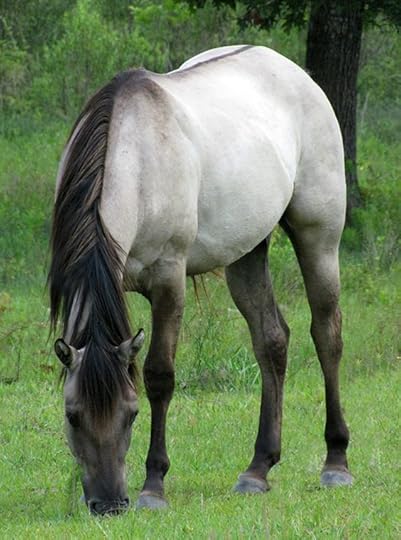
Here's a cover similar to my library's copy:

In this case, here is the story of what happens when a blind range horse meets a mute boy working at a ranch. At least -- I hope this is what happened. That's when you know you've come across a really good story -- you wish it was true.
And as to the Blind Horse's color, it seems to be either mouse dun with a dark head
or grulla (which I think is pronounced "gru yah". Here's a grulla with a dark head:
Here's a cover similar to my library's copy:

October 18, 2018
A blind horse, which had been wandering the wilderness, gets caught up in a ranch round-up. When the ranch owner decides the horse isn't worth his time or trouble, he allows a non-verbal ranch boy try to tame the horse. This is a very sweet story. Rounds writes in a quiet style befitting the characters' personalities. This book teaches a lesson in patience, perseverance, and positive thinking.

March 1, 2013
This was a pretty slow moving story, but I thought it was good. It illustrated that we all have value and use even with our imperfections, rough history or whatever. The patience and care that the boy showed toward the horse was pretty amazing. And it paid off in the end.

May 17, 2020
3 1/2 (but 4 here on GR since I we can't do 1/2 stars). Only issue is that I read the first two books right before reading this one, and there is zero explanation in this one of how the horse was no longer at the previous ranch with Whitey and the old timer and the dog. I realize it's a few years later, but it just seemed like a big gap to me and super obvious if you are someone who read all of these in a row.

June 18, 2020
I read this book to my grandkids, I found it hard to understand some of the terms used, unless you are familiar with ranching, you don’t know what “dollar towels” and some other terms are.
But it is a sweet story about a boy who can’t talk who tames a blind horse. The kids enjoyed it.
But it is a sweet story about a boy who can’t talk who tames a blind horse. The kids enjoyed it.

July 24, 2017
Fun, quick read and great for little kids. A little repetitive at times, however, this appears to be intentional for the purpose of the plot.
February 26, 2018
This story is very special - there is no bad person in the story. A cool story about a nameless mute boy who has his way with animals.
September 30, 2015
I received the book for free through Goodreads Giveaways. This book is simple, without many names, but it is intriguing. Boy works hard but doesn't speak. The Blind Outlaw is a horse no one wants. The two become friends and the boy earns him as his very own horse. I love the story, all the problems, and the great ending, having to imagine that they do well in their lives after leaving the ranch. Great book!

September 27, 2016
This story is told almost as a legend. It has very little dialog and none of thr characters have names.
But that is also what draws you in. You have to settle in to this quiet story about a mute boy that has amazing abilities with animals. Before he even gets a chance with the Blind Outlaw he has already tamed a magpie, a coyote cub and a nest of baby bunnies. The men on the ranch knew he was a natural for gentling the blind horse.
Such a sweet story of trust and patience.
But that is also what draws you in. You have to settle in to this quiet story about a mute boy that has amazing abilities with animals. Before he even gets a chance with the Blind Outlaw he has already tamed a magpie, a coyote cub and a nest of baby bunnies. The men on the ranch knew he was a natural for gentling the blind horse.
Such a sweet story of trust and patience.
February 15, 2012
A wonderful story of a deaf-mute boy training a blind horse. The two learn to work together and trust. A brilliant example of everyone being able to work together and overcoming physical disabilities.
June 24, 2011
With Katie May 2011

April 10, 2013
Deaf mute boy training a blind horse...
One story that my daughter & I enjoyed reading
One story that my daughter & I enjoyed reading
Displaying 1 - 14 of 14 reviews