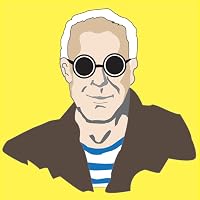
Fifteen years after Alexander left his wife and young child to pursue the life of an artist in Paris, his son Felix is on his doorstep, looking for answers. On a journey through smoky jazz bars, artists’ studios and along the banks of the Seine, Felix meets the father he never knew, and in doing so, comes to question some lifelong assumptions.
Oliver Cable was born to English parents in Holland and currently lives in London. As a result, he’s not entirely sure where he’s from. In the ten years since writing his first poem, he’s written short-form poetry and prose, inspired and influenced by jazz, travel and the absurdity of daily life. After following a Creative Writing course at UEA, he turned his hand to writing longer pieces, but to this day still enjoys a good four-line poem.
Having once sat drinking under a full moon on Sacré-Cœur’s steps, I immediately identified with this gem of a first novel set in the Paris streets. It is a sensitive story about a young man, Felix, who comes to meet, challenge and discover the father, Alexander, he has never known. In doing so, he is forced to question some of his own most staunchly held beliefs.
If the first few chapters feel slightly tentative, it is almost as if the author is wrestling with what sort of book he has inside himself. Then father and son finally meet and, as they explore their budding relationship, the writing becomes more assured. At times the prose truly catches alight, flaming brightly in passages describing Paris’s live jazz scene and Alexander’s regular haunts. The writing works best when, rather than trying to comment on the city or its tourists, the author simply slows his heartbeat to listen to the dark river running through himself and annotates its sounds, more in the nature of a poet than a narrator. The prose is strongest when focussing on those first tentative steps in a relationship – between father and son, or between new lovers.
With so many novels being bashed out these days by writers aiming to publish a couple of kilos of pulp each and every business quarter, it is a relief to find a writer who cares about his craft, as Cable clearly does. I look forward to his next book.
New favourite book! (previously Paulo Coelho's The Fifth Mountain).
Initially skeptical about the plot and writers style, I couldn't have been more wrong. If you're thinking "ugh, yet another tired attempt at the father-son reunion thing, how boring" YOU ARE WRONG. If you're thinking "I don't know this author, he's probably rubbish" YOU ARE WRONG.
I read Fresh Air and Empty Streets in one sitting, which is rare for me. Everything from the language and print to the plot and themes is absolutely bang on! Its an age old wisdom that big cities have their own rhythm and this book perfectly captures the beat of Paris. No matter where you are when you read this, you'll swear you can smell croissants in the distance and hear the faint sound of a jazz band playing...
An amazing little book. I am just sitting here, with the finished book in my hands, wondering what just happened to me. The words the author has written are clean and simple yet they hit my heart like a hammer, in that I had almost given up writing and painting and now I know that I never can. Art is too much a part of me and I understand that now. Thank you Oliver Cable.
This booked completely floored me (in a good way). I found it spoke to me in a way no other book has. The author painted a picture which kept me involved.
This book captured the energy of youth discovering life. It's a book about art and artists, father's and sons and about being honest with others and true to yourself. There's much to think about in it. The author carries it off with lots of flourish, sometimes a little too much, but it's not careless just enthusiastic.
Fifteen years after Alexander left his wife and young child to pursue the life of an artist in Paris, his son Felix is on his doorstep, looking for answers. On a journey through smoky jazz bars, artists’ studios and along the banks of the Seine, Felix meets the father he never knew, and in doing so, comes to question some lifelong assumptions.
This is a novella and at 140 pages long, a very easy quick read. The brevity offered by the form of a novella is fitting for the style of Cable's writing as the story focuses on a particular event in a short space of time. The prose ebbs and flows in a way that matches the meandering of the Seine as Felix ponders, muses, explores and questions his relationship with his father amongst other things.
Cable's prose is distinctive and echoes the patterns and conventions of much more established writers who focus on moments in time, delving deeper into a character rather than rushing along with a plot. He clearly has a gift for description and observation. I liked the use of personification with "the clock shuffled along to its arranged meeting time," and then his detail about Felix: "His hair stood up in unruly clumps, shooting off in every which way in a desperate attempt to leave the wasteland that was his body......his skin resembled Arctic snow in the sun."
When Felix meets his father, Cable cleverly captures the similarities between the two men who have had so little contact.
"In that split second before any of them opened their mouths, Felix saw his shaggy brown hair, his dark eyebrows and his height back in the man in front of him."
The references to Paris are used not just to place the reader securely in the setting of the action, but also to create atmosphere. The church of Sacre-Coeur is used several times to conjure strong images of the city. In this story the location is as much of a character as Felix and Alexander.
This is Cable's debut and although it is polished, there were a few sentences that still felt a little clunky and occasionally Cable fell back on a cliche which stood out against the rest of his carefully considered language. However, this is his first book and I'm sure Cable will develop with everything he continues to publish.
It is easy to read the book in one sitting. There are no chapters and only "pauses" between paragraphs and within the narrative flow. It didn't feel necessary to break away from reading as I think the atmosphere of the novel carries you along in a slightly dreamlike state.
I don't want to say too much else as it is a short novel and really needs little explanation. If you enjoy a poetic style of writing, overflowing with description and imagery, a coming of age style voice and some interesting observations about the bigger issues and ideas in life, then you will enjoy this book. I would categorise it as literary fiction.
In his debut novella Fresh Air And Empty Streets Oliver Cable takes us on a meandering tale of loss, anger, reconciliation and self-discovery along the river Seine in Paris.
Felix has travelled to Paris to meet the father who left him and his mother when he was a young child to pursue his dream of being an artist in Paris. Felix, understandably, finds it difficult to fathom why his father, Alexander, left him all those years ago and feels a degree of animosity towards him. What he doesn’t expect is to make discoveries about himself, his beliefs and to feel an empathy with the man who caused him and his mother so much pain and heartache.
It is clear through his prose that Oliver has a deep love for jazz, art and literature and through these mediums Felix discovers things about himself he wasn’t expecting. As he becomes involved in his father’s artistic lifestyle he begins to understand the power of the pull of Alexander’s creative side and realises that there are always more than one perspective, whether that be of events, life and the arts. Felix is searching for his father but the ultimate search is for himself. Oliver uses a lot of dream sequences to convey to the reader how Felix is feeling at the time and make sense of his feelings.
Oliver is a poet at heart and this comes through in his writing. He captures the essence of Paris whilst also capturing the loneliness Felix feels when he initially arrives in the city. The joy of this book is through the descriptions and the self discoveries that Felix makes rather than any fast paced excitement or drama. He sums up perfectly how I feel about reading and why I love hearing of other people’s interpretations of the written word;
‘ “I consider that the beauty of a painting - it can be anything to anyone. Come to think of it, that holds true for music, literature, dance, you name it. People will look at it through their own frame of reference. Of course they’ll read something else into it than you will.” ’
This is a steady paced book in which the joy comes through the beauty of the prose. If you enjoy books that take more of a philosophical perspective and rely heavily on descriptions of music, surroundings and art to convey the emotions of the character rather than high drama than you will enjoy it.
A beguiling short read quite unlike anything I have read recently, Fresh Air And Empty Streets took me on an evocative journey through the jazz bars of Paris and made me think about how what you believe to be true is never as straight forward as you think. An accomplished debut novel.
Thank you to Oliver Cable for the copy of the book in exchange for my review.