Jump to ratings and reviews
Rate this book

Midwinter Break

Rate this book
A retired couple, Gerry and Stella, travel to Amsterdam for a holiday to refresh the senses, do some sightseeing, and generally take stock of their lives. Their relationship seems easy, familiar—but over its course we discover the deep uncertainties between them.


Gerry, once an architect, is forgetful and set in his ways. Stella is tired of his lifestyle and angry at his constant undermining of her religious faith. Things are not helped by memories that resurface of a troubled time in their native Ireland. As their vacation comes to an end, we understand how far apart they are—and can only watch as they struggle to save themselves.


Bernard MacLaverty is a master storyteller, and this is the essential MacLaverty novel: compassionate observation, elegant writing, and a heartrending story. It is also a profound examination of human love and how we live together—a chamber piece of resonance and power.

243 pages, Hardcover

First published August 22, 2017

622 people are currently reading
6020 people want to read

About the author

Bernard MacLaverty

52 books199 followers
Bernard MacLaverty was born in Belfast in 1942 and lived there until 1975 when he moved to Scotland with his wife, Madeline, and four children. He has been a Medical Laboratory Technician, a mature student, a teacher of English and, for two years in the mid eighties, Writer-in-Residence at the University of Aberdeen.

After living for a time in Edinburgh and the Isle of Islay he now lives in Glasgow. He is a member of Aosdana in Ireland and is Visiting Writer/Professor at the University of Strathclyde.

Currently he is employed as a teacher of creative writing on a postgraduate course in prose fiction run by the Research Institute of Irish and Scottish Studies at the University of Aberdeen.

He has published five collections of short stories and four novels. He has written versions of his fiction for other media - radio plays, television plays, screenplays. Recently he wrote and directed a short film 'Bye-Child'

Ratings & Reviews

What do you think?
Rate this book

Friends & Following

Create a free account to discover what your friends think of this book!

Community Reviews

5 stars
1,032 (18%)
4 stars
2,132 (39%)
3 stars
1,614 (29%)
2 stars
481 (8%)
1 star
178 (3%)
Displaying 1 - 30 of 739 reviews
Profile Image for Maureen .
1,712 reviews7,496 followers
August 16, 2017
Irish born Stella and Gerry are at a crossroads in their lives. Approaching their late sixties, they no longer share common interests - Gerry has his drinking, whilst Stella has her religion, a faith which has never deserted her, even at the lowest point in her life. They may not share common interests, but they still share intimacies that come from a long marriage, from knowing a person as well as you know yourself - the way Gerry still takes Stella's hand when crossing the road, or the habit they have of sharing a kiss whenever they're in an elevator.

As the story begins, Stella and Gerry are about to take a trip to Amsterdam, and it's told with an unflinching honesty that I found heartbreaking. The small silences that older marriages are comfortable enough to endure, become virtual non communication for them. Stella has her own agenda for this trip, which doesn't include her husband, while Gerry is happy to be left to his drinking ( secret or otherwise ).


I liked the way the author gave snippets of information in the form of flashbacks, especially to the 'troubles' in Northern Ireland, and the dreadful day when Stella became one of the many statistics of the troubles, fortunately one who lived to tell the tale.

The writing is simply exquisite, and captures so well the problems that come with age, not just in medical terms, but also how the passing years bring about a need to re-examine life and decisions. The author has told the story with love and compassion, and there was a particular scene that takes place in Anne Frank's house in Amsterdam, involving an earring, that makes me want to weep just thinking about it - so moving.

Bernard MacLaverty's insight into love in later years is simply beautiful to witness. I want to gather his words into a great big hug and keep them close forever!

*Thank you to Netgalley and Random House UK, Vintage Publishing for my ARC in exchange for an honest review*
Profile Image for Fergus, Weaver of Autistic Webs.
1,270 reviews18.4k followers
March 7, 2025
Bernard MacLaverty has written, with this book, an utterly compelling and disarmingly human novel in which each one of us will see parts of ourselves.

I read it during one of my recurrent February doldrums, and I have to put down to that fact a resultant inertia and demotivation in its perusal.

And, well, I saw a bit of my my own sometime cynicism and lack of enthusiasm in this middle-aged couple. Touché.

However, their tragic aporia in the face of the husband’s alcoholism is largely overridden by the beautiful finesse in MacLaverty’s evocation of the innate Dutch spirit of place on their getaway, and the depth and muted delight with which the bleak remnant of their mutual love still glows.

But it probably is a story with too much emotional anxiety for younger readers, unless their mature sensitivity warrants the reading.

This relationship is at times jarring and icy, though without much self-knowledge it’s little wonder.

For self-knowledge so often brings new openness to love in its fruitful wake. Once its thunderheads of revelation have passed.

For when you arrive at the threshold of advanced age, you can no longer just go through the motions. If your life’s real enough at that stage you only see through yourself too easily...

I was quite lucky in my own case, for the past 21 years have been split roughly in two: the first 11 years were a culminative process of self-revelation, resulting in a 10-year painful process of re-alignment with the world.

The male protagonist here badly needs, like I needed, to re-align himself with the world. His alcoholism, though, is preventing the requisite prelude to that process from starting: self-knowledge. So we’re seeing a gradual fade-out.

So that, unconsciously, is the situation here, especially in the old male protagonist. He’s not yet inwardly mature enough, despite his veneer of worldly cynicism, to face the music of his own conviction.

Or tough enough. Encountering your devils is no treat. This is a time, if ever there was one, for a renewal of vision and vigor, folks.

With the stress of my own burnout my moorings to the world came loose (no one can tell you about that vision of hell which comes to the truly ingenuous!). But that vision must be faced.

THAT’s how hard it is to be reborn after such a dark eclipse of Goodness as burnout. And the soul of the male protagonist of Midwinter Break is now being tipped into its fire...

Will the couple’s unvoiced love pull him through?

Well, what’s so achingly apparent here is the reality of the affection that still mitigates the inner conflict of their lonely life together. I keep thinking these these folks only need a little push!

And isn’t that what midwinter breaks are for?
***

But it’s the sense of anguish in their mutual distancing that gave me the greatest uneasiness. It prevented me from rating this book with a full five stars. It’s a personal thing.

The story’s atmospheric beauty of description - both of middle-aged affection and exquisite details of the Amsterdam locale (and particularly the scene at the Rijksmuseum) - as well as its perfectly orchestrated characterization (two lives lived from the Inside Out!) compelled me to give it, at the very least, a grateful four stars.

It’s bitter realism may excoriate us, but it’s a wonderfully written novel, written with great elegance and acumen.
Profile Image for Paromjit.
3,080 reviews26.3k followers
September 10, 2017
This is a profoundly moving and perceptive examination of the anatomy of a long marriage. Gerry and Stella Gilmore are retired, now living in Scotland, and facing the midwinter of their lives and their marriage. Gerry, once an architect, a mediocre one in his estimation, cannot get through a day without his drinking but his love for his wife is plain to see. Stella was a teacher, but her son and grandson live in Canada, leaving her feeling she needs more in her life and Gerry is not enough. They fly to Amsterdam, ostensibly for a long weekend, with Stella harbouring a hidden agenda. They explore the city both as a couple and separately. Stella feels the best of her was inspired by her Catholic faith, and she is in search of a more spiritual religiously guided life. On a previous visit to the city, she encountered the Dutch order of the Beguines. Gerry has never taken her religious faith seriously, and as she contemplates a different future, an honest look at each other and their marriage is inevitable.

Gerry and Stella have an ease with each other that speaks of an intimate, close and long relationship, enjoying an active sex life with each other. Along with this are their incommunicative silences, secrets, deceptions and everyday frustrations with each other. The compromises that go into the reality of a marriage are beautifully captured. Both remember events from the Irish troubles, that Stella was personally affected by when she was pregnant. Her body has the physical and emotional scars from what happened to her. Her focus on a religiously devoted life is driven by a pledge Stella is haunted by and feels she failed to honour. This becomes clear as Stella becomes aware that the future she is planning may be out of her reach. What is to become of her? What choices will Stella make? Will their marriage survive?

The story takes place over the 4 days of the Amsterdam break. MacLaverty writes with depth and sensitivity about the strengths and frailties of a marriage entering its twilight years. His psychological understanding of his characters and relationships has a truly authentic feel and is what makes this book such a superb accomplishment. His approach is understated, this is not a novel with drama or fast pacing. If that is what you are looking for, you will be disappointed. A thought provoking and brilliant read. Many thanks to Random House Vintage for an ARC.
Profile Image for Elyse Walters.
4,010 reviews11.9k followers
May 17, 2017
Bernard MacLaverty is an Irish author - new to me. His writing is impeccable and intimate. He paints a clear portrait of a retired middle age married couple.
However, although I appreciate the authors understanding of this relationship - which we observed up close and personal - I didn't actually enjoy the plot or the themes in this novel. My own personal beliefs are so very different from both Stella and Gerry - I didn't have much empathy for them.
I've read many books about married couples- young couples, aging couples..etc. that I have related to. This is not one of them.

Ambivalence between Gerry and Stella embody them as a couple. Neither one seems happy yet they are 'connected-at-the-hip' through years of habit and familiarity.
They are both off in there own heads - having their secretive conversations with their own inner voice about one another. Their communication skills do not empower each other. The independent choices of comforts they each reach for were bleak and gloomy. In my opinion drinking and religion (both) - if obsessive -can disempower a relationship. Gerry liked to drink. Stella liked religion - Both of their passions were causing harm to their relationship.
I felt the whole theme around religion and drinking was as as dreary, dark and cold as the rainy day in Amsterdam - when Gerry and Stella first arrived.

Flashbacks of a shocking-frightening-painful experience from years ago explains the troubles that show up in this marriage. The characters are believable, human, with faults and strengths......
There is love, loss, and resilience......but I found much of the story dreadful! (Just personal taste- but please note: I do think it's beautifully written)

3.5 stars for excellent writing- great descriptions- a sincere issue this couple needed to grapple with (although I HATED THE CHOICES MYSELF - AS I PERSONALLY DON'T VALUE RELIGION OR DRINKING IN THE WAY THIS COUPLE DID) ......

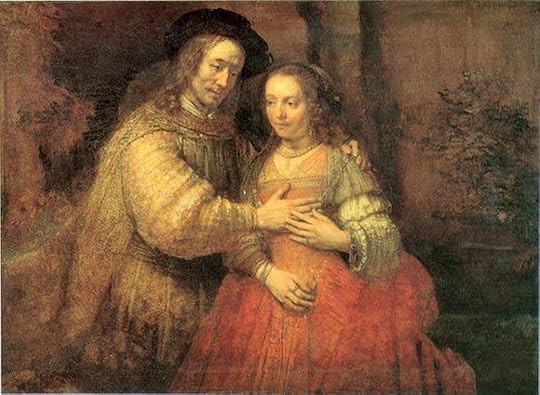
A favorite Plus for me: I enjoyed walking through the galleries at the Rijksmuseum. There was a painting of "The Jewish Bride", by Rembrandt. Loved it!

Thank You W.W. Norton & Company, Netgalley, and Bernard MacLaverty
Profile Image for Diane S ☔.
4,901 reviews14.6k followers
September 3, 2017
Stella and Gerry, married for forty years, in the retirement years of their life, one son, one grandson. They take a weekend trip, leaving Scotland, and heading to Amsterdam. Gerry thinks it is just for time away, change of pace, but Stella has other motives, a discontent in her life and a spiritual promise made during a time of heartbreaking distress. Gerry drinks too much, is often dismissive of her faith, and Stella wants there to be something more before her life ends.

A quiet novel, a reflective one as we are privy to the thoughts of both Gerry and Stella as they look back in time. Unresolved issues, misunderstandings, and where each see their lives and each other. Touching novel, maybe because I too will be married for 35 years, husband retired, more time behind us than before, I felt this book and the struggles of this pair. Hard to be married for a long time, without having something unresolved. The things that don't get said, present here in this novel, things Gerry doesn't say to Stella, and should. Her hopes for her life and what she needs from Gerry to continue their lives together.

As they visit different parts of Amsterdam, eat at various places, they take stock of their true feelings. Beautiful, beautiful language.

"The end of the daylight striking the glass obliquely created a glittering, grisaille effect. Like ground glass, a layer of dust activated by almost horizontal light transformed the window into Waterford crystal. No expense soared for the Irish pub of Amsterdam. The admission and exclusion of light."

Wonderfully descriptive, and an elegant and honest look at a couple in their twilight years

ARC from edelweiss..
Profile Image for Fionnuala.
886 reviews
Read
February 18, 2018
This love story about a retired couple is full of paradox. It appears quite light but it is surprisingly deep. It seems quite ordinary but its impact is extraordinary. It is funny and serious, a sad book and a happy book at the same time. A book mainly about Him yet predominantly about Her. A book about a shared life that is not really shared at all.

I figured near the beginning that this Him & Her story wouldn't suit me. I wasn't interested in knowing that She says her prayers every night before getting into bed with her hot water bottle, or that He, who never prays, sits up all night with his whiskey bottle instead. And even though I related slightly better to Him than to Her, I just couldn't get interested in the clues to unhappiness that were scattered everywhere. Clues such as artificial tears and cracks in masonry.

But somewhere along the way, in the space between one line and the next, there was an inexplicable shift in my thinking. I still don't know how it happened, but by the end of the book, I had become completely involved in both the story and the writing, picking up on the author's clues eagerly, and even anticipating the words that would come next.
As He chants a litany of praise to Her, for example, I was thinking, That's a hymn - a Him to Her! And then He says exactly that! It was as if the story was a crossword, and I had learned to figure it out.

That was quite a miraculous turnaround, you might say sceptically. And I'm inclined to be sceptical about it myself - I've never had much time for the miraculous.
But miracle-like happenings can insert themselves into the smallest spaces - think of the wonder of the midwinter sun slicing through the prehistoric underground chamber at Newgrange:


Bernard McLaverty shines a light into the hidden spaces of a shared life and the result is quite wonderful.
Profile Image for Dolors.
605 reviews2,812 followers
November 26, 2022
If Grace Notes was a symphony, Midwinter Break is a fugue.
A quiet, intimate composition built in the two voices of an Irish elderly couple who spends a long weekend in Amsterdam after the Christmas holidays.
Gerry and Stella have been married for more than 40 years, raised a son who now lives in Canada, had careers in architecture and teaching and now face that stage of life where old age marks the pace of their daily life.
Stella, a devout Catholic, patient and compromising.
Gerry, a lively man who drinks far too much but denies having a problem.
They co-exist in their individual cocoon and share only the necessary, keeping their distance in a shared loneliness that has started to be too evident to ignore.

McLaverty’s title is doubly intended. What might be Gerry and Stella’s “midwinter break” might also refer to a possible rupture in their marriage, and it is through a long list of the minuscule trifles of daily life that we get as close as we could get to the reality of married life, to the burdens of a joint history that makes words inadequate, to the lazy companionship that evolves into silence, to the shocking realization that “this is it”, this is what life has to offer…and what now?

This is my second novel by this Irish author and recurrent themes seem to be ever present in his novels: the inevitable distance that grows between couples, the destructive power of alcohol that haunts men of all ages, the religious prejudice in Northern Ireland and the violence that marked the years of a generation.
MacLaverty is a meticulous, unhurried writer. His prose is pregnant with symbolism. Even Joycean at times. Stella needs to lubricate her dry eyes and Gerry seems unable to stop his uncalled tears, an indication of their divergent personalities and the huge chasm that his marriage has become.
A dance alternating intimacy and separation, a meditation on the challenges of growing old next to a person who has become soulmate and stranger at once, an unflinching glance at the indignities of domestic miseries, this novel makes for a compulsory reading at any stage of life.
Profile Image for Gumble's Yard - Golden Reviewer.
2,189 reviews1,796 followers
February 6, 2019
The family is raised, the work’s done. That can’t be it, can it? There’s ten or twenty years left over, as it were. We’ve cut the life of our cloth wrongly. It doesn’t fit …. I have a sense of drift. I want to do something with the time I have left. Other than watch you drink


This book is the story of a midwinter break taken in Amsterdam by a retired couple Gerry and Stella – Gerry and Stella are a Northern Irish Catholic Couple now living in Glasgow.

The title however also conveyed to me the essence of the book – Stella is conscious that she is in the midwinter of her life (their only son living in Canada with his wife and son), contemplates a break in their relationship (driven by Gerry’s alcoholism) and a move to a religious community (due to her sense of an unfilled promise made to God years earlier).

A beautifully understated novel and a brilliant portrait of a long relationship, a relationship forever changed by one event, but which is then worked out over years, a relationship of two people simultaneously so close that they sub-consciously anticipate each other’s wants, thoughts and needs and yet seemingly irreconcilably distant each with their own thoughts, desires and secrets.

He believed that everything and everybody in the world was worthy of notice, but the person beside him was something beyond that. To him her presence was as important as the world. And the stars around it. If she was an instance of the goodness in this world then passing through by her side was miracle enough
Profile Image for Agnieszka.
259 reviews1,130 followers
March 12, 2019

In every relationship,’ said Stella, ‘there’s a flower and a gardener. One who does the work and one who displays.

At first nothing heralded this book would be such rewarding experience. The story about ageing couple seldom seems to have something revealing to offer. Gerry and Stella. He's a retired architect and university lecturer, she used to be a school teacher. They come from Ireland though by now they spent quite a chunk of their lives in Scotland. They're catholics though Gerry doesn't take it seriously any more. He also drinks too much while Stella is in search for something that could provide her more fulfillment in the last part of her life and lessen sense of emptiness and futility. And a few day vacation in Amsterdam during winter season seems to be a longed-for occasion. Because Stella, apart from visiting museums, wandering through the city and enjoying leisure days, appears to have a plan.

I truly don't know how MacLaverty did it. How from such cliched motives he managed to create something so fresh and not banal at all. How from these unrefined ingredients he prepared such an extraordinary feast. And I don't know either why the novel so resonated with me. Was it because it being well written or perhaps the prevailing factor was my age that made me more willing to looking back at what had happened to me and how I handled some stuff or in some cases how I didn't.

I enjoyed the novel immensely. I liked all cultural references to architecture and paintings MacLaverty pointed there and I truly felt for the protagonists. By turns I was surprised, at times slightly bored or simply amused by their daily rituals yet still I cared for them. I was touched by Gerry's protectiveness and could understand Stella's requirements either. I liked it was tender but deprived of sentimentality. I would hate to be put in the middle of melodrama.

Initially I slightly gravitated towards Gerry, not because he seemed to me more fragile or easier to hurt, no, not at all, rather due to Stella's activities. She was so preoccupied with her target, so determined and her mind seemed to be perfectly made. I thought about Gerry to be more relatable and didn't mind his drinking though I could see a problem in the long run. From the other hand I didn't share Stella's interests neither her religiousness. And yet I felt close to her. At first glance the protagonists felt so easy to read and still remained complex and full of contradictions. In fact I'm still mulling over the fact that the novel on such an unadventurous and trite theme can be so satisfying and inspiring read. It takes a true master to convey the story where seemingly nothing happens like pure roller coaster of emotions and feelings.
Profile Image for BlackOxford.
1,095 reviews70.3k followers
February 27, 2018
All Women Marry Beneath Themselves

Like the Shakers, the Beguine movement was an attempt to provide some institutional respite for women in a world dominated by men, their narcissistic violence, and chronically inadequate women’s toilet facilities. The Begijnhof in Amsterdam is a vestige of this movement, which is probably no less necessary today than it was in medieval society.

Gerry is a boor and a functional alcoholic. Stella is spiritually-minded and feels dis-valued. They have reached that stage in their marriage in which a gentle sniping and comforting ritual is as intimate as it gets. Both self-medicate to relieve disappointment with their lives: he with booze; she with an idea of escape into a refuge like the Beguines. Both want a different life. She is obviously the more competent at living.

As an intact antique city, Amsterdam evokes not just the past but specific memories for Gerry and Stella. “There was a time when Stella and he were congruent,” muses Gerry. Especially when they shared a trauma to which they both had to adapt. Is there anything more than that stale shared past to keep them together?

On the other hand, “What was love but a lifetime of conversations. And silences. Knowing when to be silent. Above all, knowing when to laugh.” Could there actually be more to look forward to in old age than this? Perhaps this is the implication of MacLaverty’s references to Faulkner’s As I Lay Dying - it’s all more than a little neurotic but somehow it works.
Profile Image for Barbara.
321 reviews388 followers
February 28, 2021
Gerry and Stella Gilmore have been married for decades. They share many memories, fond ones and troubling ones. Shared habits, jokes and endearments are indications of their love and caring. Can a shared history bring contentment, or was Chaucer correct when he said, "Familiarity breeds contempt"?( and he didn't state that during the pandemic restrictions!) Can a married couple have too much time together? Can that couple spend many years together and still not know what is in the other's heart?

MacLaverty is a keen observer. His examination of marital love with its fissures and flaws, its good times and difficult times are outstanding. In the cold, dark days of midwinter, against the vivid descriptions of icy Amsterdam, MacLaverty portrays the possible cooling of a marriage on the brink - the brink of deeper understanding or death.

This is a sad and yet hopeful novel. It is not sentimental but completely realistic, no 'and they lived happily ever after', but intermittent happiness is possible for this older couple. Their marriage is not the fairytale version, but it is one shared by more than a few.

Midwinter Break was written seventeen years after his last novel. I am anxious to read some earlier work by this fine writer.
Profile Image for Barbara.
1,898 reviews25 followers
March 10, 2019
Mac Laverty is a writer of gorgeous prose, and deeply thoughtful novels. His latest novel strengthens his reputation as an exceptional writer. Stella and Gerry are a retired couple in their 70’s. Mac Laverty spreads details about their lives throughout the book rather than giving them to the reader upfront. They now live in Glasgow and have been there for several decades. Stella grew up in a large Catholic family in rural Northern Ireland and was the only student in her school to go on to get a university degree. She became a teacher at a girls’ comprehensive school in Belfast, where she and Gerry met at a dance. Gerry, also Catholic, studied architecture at a technical school in Belfast. He lacked the drive or perhaps talent to become an architect and ended up a university lecturer. They have one son, and one grandson. They live in Canada, and that distance is a source of heartbreak for Stella.

The book takes place during a trip the couple make to Amsterdam in January. The trip was Stella’s idea, and she has a purpose, which she doesn’t share with Gerry. Gerry is a “secret” drinker, and he works hard to hide his drinking from his wife. In this kind of situation, often the drinker believes others are unaware of their addiction. Both have their secrets, which is pushing them apart. Amsterdam in January is an unusual choice for a getaway, but Mac Laverty portrays the city not as dim and cold in the winter light, but as a place of discovery, and hidden corners.

While Gerry sleeps and drinks, Stella goes off on her own, looking for something she won’t share. Of the two, Stella continues to practice her Catholic faith, which Gerry has turned his back on.

She wanted to live the life of her Catholicism. This was where her kindness, if she had any, her generosity, her sense of justice had all come from. And her humility, she must not forget humility. Catholicism was her source of spiritual stem cells.

Gerry, always the architect, studies the buildings, and reflects.
He tried to build a picture of this landscape before the snow. And when he succeeded in doing so, he subtracted the buildings. Dismantling them, andimagined how it would have looked centuries ago…

As the story unfolds, the reader learns what drove Stella and Gerry out of Belfast. It was a single horrific event that continues to haunt each of them in different ways. As Gerry retreats into alcoholism, Stella considers a life without him. But this is a couple who deeply love each other.
It is a short trip that leads both of them to face their fears, their secrets, and the meaning of the lives they have lived.

Thanks to Net Galley for sharing a copy of this book for review.
Profile Image for Hugh.
1,293 reviews49 followers
October 15, 2018
MacLaverty doesn't write novels very often - this is only the second since the Booker shortlisted Grace Notes in 1997 (the only other one I have read). Once again this is a beautifully poised story of a crisis in a long lasting marriage.

Like its author, its protagonists moved from Ulster to Scotland to escape the Troubles. They are spending a short winter holiday in Amsterdam. Both have secrets - the atheist architect Gerry tries and largely fails to conceal the extent of his drinking, and Stella is considering leaving him to find a purer life in a Catholic religious community and has planned the trip to allow herself to investigate it.

The causes of this crisis are revealed slowly, and have their roots in events that occurred in Belfast in the 70s. Coming so soon after reading two books by Anna Burns, MacLaverty's very different approach to talking about the Troubles was an intriguing contrast. The central relationship is beautifully nuanced and touching.
Profile Image for Dean.
538 reviews135 followers
January 11, 2018
Novels like "Midwinter Break" by MacLaverty are the reason because I've became an ardent and passionate reader!!!
Gerry and Stella a couple for decades make a trip to Amsterdam and must confront the shadows and hurts lurking in the past....

They must cope with the fact that events and decisions made deliberately in the past have not lost their shaping power at all.
Gerry try to find solace with alcohol, and Stella search for meaning leads her to a devout religious life;
but in the end they both find themselves in a struggling involving their relationship and more than that, even the destiny of their souls...

After having read "Midwinter Break" by MacLaverty, I must say that I have discovered a new favorite author of mine.
Narrated with a full and rich description-power dealing with ordinary everyday items and concerns, MacLaverty leads the reader in a subtle way to deeper and higher meanings full of heavy and crushing emotions...
Love and respect for each other, as also the uncovering and exposition of our human weaknesses are items masterfully dealt with in "Midwinter Break"!!

Let me say frankly and honestly, that this novel although a quiet one, will not fail to left his deep traces in the hearts of the reader.
Sensitive written, with insight in what it means to be humans and full saturated with an almost nostalgic and poetic flair...
I really are so happy at the beginning of the year to have had such an amazing reading experience!!

Full recommendation to all of you my friends, with five stars...

Dean;D


Profile Image for Dianne.
676 reviews1,225 followers
November 5, 2017
This is the story of Gerry and Stella, in their early sixties, off on a 4-day holiday to Amsterdam. They are at pivotal moment in their lives and their marriage. Gerry is an alchoholic and Stella is fed up and looking to lead a more purposeful and spiritual life.

This was well-written but it really dragged for me, especially toward the end. I don't know how Gerry and Stella felt, but this seemed like the longest vacation in history. Too much blah blah blah. The last quarter of the book was more skimmed than read.

Liked it, but didn't love it.
Profile Image for Tony.
1,030 reviews1,911 followers
January 22, 2018
Gerry and Stella. They are an old married couple. Well, pensioners anyhow. They are Irish but then there was an incident and now they live in Glasgow. She was a teacher; he an architect. He is an alcoholic; she is devout. There is a fissure in their marriage. This is a story about a trip they take to Amsterdam. There will be flashbacks, teasingly and piecemeal, about the incident. We follow them, together and alone, among the Dutch, and it is ours to wonder if they will still be together at journey's end.

On the flight over, Stella starts to tell, cryptically, why she wants to return to Amsterdam, where she last visited thirty years before. It's storyboarding, Gerry says.

'Storyboarding?'
'It's a movie term. They draw a comic first -- then film it. It's a way of setting out exactly what you want to happen.'
'I like that word,' said Stella.


The storyboarding of this book, the comic first, may seem well-worn if not trite. As plots go, there are only two endings after all and maybe the reader will care if they are still a couple at the end. But maybe not.

Never mind that. What carries the book is the language. There's the lilt, as when Stella says to Gerry in the airport: You'd be a great one to send for sorrow. And dialogue that informs:

'Just before we lighten up -- where do you want to be buried?'
Gerry rolled his eyes and shrugged.
'And you? At home or in Scotland?' he asked.
'Scotland
is home now,' she said.
'Would you mind if I, or my ashes, was buried with you?'
'If you're still drinking I don't want you next nor near me.'
'I'll definitely have given it up by the time I'm dead.'
'In that case . . .' She smiled. 'I'll move over.'


Gerry could glibly say: Moderation in all things . . . especially moderation.

And from Stella: If you could only see yourself. You used to be so kind and considerate. What's happened to you? You're nothing but appetite.

Yet, from I, the reader, I don't think that's an accurate judgment. Gerry seemed plenty kind and considerate to me. He just was very medicated. But he wasn't a bad man, and he was still palpably in love. And even when drunk he would buy little endearments.

All of which got me thinking about husbands and wives; about living with disapproval; about a woman's needs.

They are stranded in the airport when they hoped to return. Gerry, alone, starts to itemize the many things about Stella that he loves, a one-sided ledger. Stella hides in a ladies room stall where no one can hear her soliloquy:

Can there be so many women in a similar position? Widows, the brutalised, women in need of a room of their own . . .

Yes, authors get channeled. Painters, too. Because you can't go to Amsterdam without a trip to a museum. And so Stella and Gerry stand together, in a crowd, and look:


That's the storyboarding.

'There's a great tenderness in him,' she said. 'You can see he cherishes her. . . . But she's not so sure. Shy, yes. Sure, no.' . . . She pointed out the groom's hand around the woman's shoulder and his other hand resting on her breast. The bride's touch on the groom's hand.
'She's allowing him to have his hand there,' she whispered. 'And her other one's protecting her stomach.'
'Yes.' Gerry nodded.
'Somehow the hands seem too big.'
'Nonsense.'
'It's the subject of the painting -- the woman's permission -- and it's in the hands,' she said. 'He can do what he likes with them, Rembrandt can.'


And so can MacLaverty.

Profile Image for Karen.
1,044 reviews127 followers
May 18, 2017
MIDWINTER BREAK BY BERNARD MACLAVERTY
Spoiler Alert--You may not want to continue reading this review before you read the book.
This is a story written with compassion and love. It is about a married retired couple named Gerry and Stella. There is a lot of peace and tranquility in terms of the way Bernard Maclaverty has written this lovely novel. The two main character's Gerry and Stella are from Ireland who now live in Scotland. Gerry used to be an architect and Stella was a school teacher. They are in their twilight years of their lives and marriage. They have one son named Michael and one grandchild named Toby who reside in Canada.

Stella and Gerry decide to take a four day trip to Amsterdam where Stella who is very religious looks for a sanctuary to live. Stella and Gerry both experience flashbacks of the day Stella was shot in the stomach while pregnant with their only son by the IRA in Ireland. The story of that day is written seamlessly into the narrative. The bullet did not harm her unborn child since it was a gun shot wound that entered Stella's stomach and exited without harming her baby. Stella is knocked to the ground and makes a vow to God that she will devote her life to serving him if her unborn child and herself live. Stella and Michael miraculously are not injured from the gunshot wound. The outcome is that Stella can not have any more children.

Gerry is drinking whisky and water every time he thinks Stella is not aware of what he is doing. Stella is aware of Gerry's alcoholism and her reason for going to Amsterdam is to keep the vow that she made to God and to leave her marriage to Gerry. Stella is interested in joining and living with a group in the Netherlands called the Beguines. The Beguines are a member of the dutch sisterhood, formed in the twelfth century, and not bound by vows. When Stella looks into this sisterhood, she finds out that the last sister in this group died in 1971. There still is a group that exists however you have to be between age 30 and 65 and it is costly.

Stella has to make a decision and she tells Gerry that she wants to sell their home and get two separate places to live when they return home. There are many things to love about this book. I loved the courage that Stella exudes by making a decision to want more out of life than just settling to stay in a marriage where she is no longer happy. I loved both characters and the realism that is written about their relationship. Gerry really admires Stella and is a kind person, he has a drinking problem. The author is talented in weaving a contemporary story about real people with real problems.

I don't want to tell what decision is made. Does Stella and Gerry stay together or do they separate? Does Gerry think he has a problem with alcohol? Is Gerry willing to admit he has a problem? I think the author did an excellent job of describing the different countries. It is a quiet but powerful story that is realistic and timely. It takes place in winter but you can smell the flowers and hear the birds.

Thank you to Net Galley, Bernard Maclaverty and W.W. Norton & Company Publishing for providing me with my digital copy for a fair and honest review.
Profile Image for Barbara .
1,841 reviews1,511 followers
November 29, 2017
“Midwinter Break” is a quiet, beautiful novel about empty nesters that take a long weekend holiday. Author Bernard MacLaverty writes restrained yet intimate prose allowing the reader to be part of the holiday.

Gerry and Stella Gilmore set off from their home in Scotland to travel to Amsterdam. Although told in third person, the writing is such that it’s a personal experience. The reader feels each characters experience and is akin to a fly on the wall. It is proven that both Gerry and Stella have strong feelings for each other. Yet Stella, who is devout in her faith, is searching for a more meaningful life than her current existence. Meanwhile, Gerry, who loves Stella more than she understands, has no clue that Stella is searching.

A strong difference in their marriage is Stella’s devotion to her faith and Gerry’s indifference (to the point of mocking) of her faith. This difference is amplified when Gerry drinks, which is a lot. Stella is tired of his drinking. There was a pivotal event in their marriage that both are struggling with, and that the reader learns in bits and pieces through flashbacks. The event affected each in different ways. The novel is short, 243 pages, and is a story of four days of their marriage. In those pages, and through those four days, the reader experiences another pivotal moment in the Gilmore marriage.

The marriage is strong and Gerry and Stella are interesting. For example, Stella believes that in every marriage there is a gardener and a flower. One must determine which one they are. Also, I love that they have allow an “ailment hour” each evening. Their inner musings alone are reasons to read this novel.

I highly recommend this one. I adore MacLaverty’s literary ease in story telling. It’s an emotional story and rewarding to read.
Profile Image for Emilio Berra.
305 reviews284 followers
May 6, 2020
Vacanza ad Amsterdam
Bellissimo romanzo del noto scrittore irlandese MacLaverty.
Una normale coppia di pensionati irlandesi ora residenti in Scozia. Cattolici : lei praticante e di profonda spiritualità ; lui, no.
Entrambi docenti. Un figlio in Canada, sposato e con un bambino.
Sulla tacita scelta di lei, partono per una vacanza invernale ad Amsterdam. Lei conserva da decenni un segreto, a cui la città olandese non è del tutto estranea.
Apparentemente una coppia affiatata e serena. Ma due aspetti minano la loro armonia : il non sufficiente rispetto del marito verso la vita religiosa della moglie e la dipendenza dell'uomo dall'alcolismo.

Lui "aveva smesso di di fare quasi tutto . Eccetto bere" . "Lei era nota per essere un'organizzatrice, quel tipo di donna che accetta le sfide" : gestiva importanti attività.
"A casa andavano a letto a orari diversi - si concedevano il proprio spazio, per dirla nel linguaggio corrente" .
"Che cambiamento poteva affrontare lei, alla sua età? Anche solo pensare di andarsene sembrava impossibile". E poi "cos'era l'amore se non una vita di conversazioni. E di silenzi". Però, " ci sono delle domande, che esigono delle risposte. (...) Come si fa a vivere una buona vita?".

Una bellissima scrittura minimalista, moderna, che si legge con grande piacere. Poi i fatti dell'Irlanda del Nord entrati direttamente nella vita dei protagonisti, lasciandovi il segno.
E il segreto, che lei custodisce in sé da decenni.
Profile Image for Rebecca.
4,185 reviews3,448 followers
September 6, 2017
In MacLaverty’s quietly beautiful fifth novel, a retired couple faces up to past trauma and present incompatibility during a short vacation in Amsterdam. The limited time span and settings – the couple’s home in Glasgow plus various locations in Amsterdam, mostly interiors – are qualities that would lend themselves well to a film or theater adaptation. The author’s determination to follow these characters through all the wearisome tasks of travel, including airport check-in, getting on a train, finding their hotel, etc., means the narrative turns mundane at times. Luckily, flashbacks and glimpses into the characters’ thoughts open up a new dimension so readers should not feel they are stuck with a boring old couple on a staid holiday.

My overall response was one of admiration for what this couple has survived and sympathy for their current situation – with hope that they’ll make it through this, too.

See my full review at BookBrowse. (See also my article on the Beguines, a lay religious order.)
Profile Image for Tooter .
589 reviews304 followers
November 27, 2017
2.5 Stars rounded down. This book really dragged for me....not enough to DNF it but enough to keep hoping it would end soon so I could start another book.
Profile Image for Peter Boyle.
581 reviews742 followers
July 8, 2018
Gerry and Stella are a retired couple from Northern Ireland, now living in Glasgow. They've had successful careers in architecture and teaching, and raised a son who lives in Canada. Stella is a devout Catholic who enjoys cryptic crosswords. Gerry is a professional cynic, and likes to tease his wife about her religious fervour. He has also developed a serious drinking problem, though he would be the last person to admit it. They take a winter trip to Amsterdam. Gerry assumes it is just another holiday, but he soon discovers that Stella has ulterior motives.

Though the pair still have a loving relationship, this marriage is in its dying embers. Stella faces up to the facts, she feels she has more life left to live rather than watching Gerry drink himself to death. "We've cut the cloth of our lives wrongly," she tells her husband. "It doesn't fit. I have at least - but I don't know about you." Gerry is both stunned and bemused by his wife's outburst. He needs a drink more than ever before.

We also learn that their lives have been marked by an event that happened in Belfast many years ago. It is one of the reasons for Stella's unshakable faith in God. But what she doesn't realise is that the incident is also the main cause of Gerry's alcoholism. The memories of that day are too much to bear and he drinks to blot them out. If only he would tell his wife about these painful thoughts and let her know how much she means to him, maybe they could work things out.

There isn't a whole lot of action in Midwinter Break. Instead, it is a tender portrait of a marriage and the intricacies of love. Bernard MacLaverty also examines the issues of old age and alcoholism with a keen eye. Maybe when I'm in the winter of my own years, I'll have more of an appreciation for a story like this. But these two characters and the problems they face feel utterly real, and that is a testament to the author's unquestionable talent.
Profile Image for SueLucie.
473 reviews19 followers
June 28, 2017
How emotionally draining this book turned out to be. It touched me on levels I hadn’t even considered before, perhaps because I am fast approaching the age of Gerry and Stella, and have also been married ‘for a protracted period’.

It’s a fact, people change over time. They develop new interests or existing ones come more to the fore and might not be shared with a long-term partner. Personality foibles that seem charming and perfectly tolerable in youth can become irritating, or it may be that partners become less accommodating of each other.

Gerry and Stella separately have come to wonder what they have done with their lives. Gerry’s years as an architect have not left a noticeable mark on the landscape - disappointed, he has withdrawn into short temper, insensitivity and disdain for others, and too much drink. In Stella’s case, a resurgence of the religious faith of her childhood, shrugged off in early adulthood, is causing her to question whether it’s not too late to live a better life, make some kind of difference to the world around her. Their interests seem to be diverging so widely that they need to consider whether they can continue together.

We witness their weekend in Amsterdam in heartbreaking detail - their very different agendas, the little (and not so little) deceptions, their relief when a confrontation is avoided and a few hours alone achieved - yet their underlying love for each other glimmers on. The author’s insight is absolute. The incident with the earring in the Anne Frank house will stay with me forever. The writing is out of this world - I can’t believe I haven’t come across his work before but I’ll be seeking out his previous novels as a matter of urgency.

Thanks so much to Random House Vintage via NetGalley for the opportunity to read and review.
Profile Image for Stephen Clynes.
656 reviews41 followers
November 9, 2017
Follow Gerry and Stella Gilmore as they go on a short break away to Amsterdam.

I found Midwinter Break a refreshing change from your average run-of-the-mill mix of novels. It is a love story but not with young, vibrant, enthusiastic twenty year olds. Gerry and Stella are a retired couple who have been married for many, many years. I thought Bernard described the dynamics of having been married together for a very long time spot on. I really engaged with Gerry and Stella, it was all those little things that couples share subliminally in their married lives. Because of their age, they share mutual things, some of which brought a big smile to my face. They have a routine and rather than drag out the whole day, they restrict themselves to an “ailment hour”, when they are free to discuss their aches and pains!

There is lots of good dry humour sprinkled through this story, for example…

They approached the main terminal, protected behind stainless-steel bollards. ‘This must have cost millions,’ Gerry shouted above the noise of their cases. ‘What’s to stop a motorbike bomber going between the bollards?’

In WH Smith’s Gerry bought a packet of Werther’s Original. He’d kid her on that he forgot. Then surprise her just before take-off.

‘D’you like these?’
She held up a cellophane pack from Marks & Spencer.
‘What are they?’
‘New pyjamas.’
‘Black?’
‘As sin.’
He raised an eyebrow and looked up at her.
‘Why? Did you think it’d be a turn-on - like sleeping with a priest?’
‘Priests usually have enough independence to choose their own pyjamas.’

Stella took her purse and approached the counter. She returned carrying Gerry’s drink and a jug. Gerry lifted his glass and looked at the measure.
‘A well-built ant could piss more.’
‘I asked for a double.’
‘You’re learning.’
‘Killing you with kindness.’

‘I’ve missed the Ailment Hour.’
‘We can do a two-hour stint tomorrow. If you feel well enough.’
‘I’ve got these strange hairs growing beneath my watch…’
‘I was only joking.’

I liked how Midwinter Break focused on just Gerry and Stella. I got the impression that I went away with them to Amsterdam and that I was part of the party. This novel also explored Gerry’s relationship with alcohol and Stella’s relationship with Catholicism. Bernard has an extensive use of vocabulary and I liked his use of detail regarding Gerry’s old job as an architect, the troubles that took place in Northern Ireland and the questioning of religion by both Gerry and Stella.

However, this is essentially a love story but has very little in the way of a plot. There are no big surprises and the reader peacefully bumbles along with Gerry and Stella. All very nice in a very leisurely way, a few drinks, some meals and a nice stroll around Amsterdam. Yes, Bernard does the married life thing very well indeed but this does not lead to an exciting read. It is engaging and comfortable but it is not edge of seat stuff. I wondered where this story was going and expected something big to happen at the end. The ending was disappointing but I found Midwinter Break to be a GOOD read that I will give 4 stars.

Thanks to NetGalley and the publisher Random House UK, Vintage Publishing for giving me a copy of this book on the understanding that I provide an honest review.
Profile Image for Susan.
1,060 reviews198 followers
August 12, 2017
3.5 stars

This is a beautifully written story of a middle-aged couple who are at the point of their lives where they are wondering what is next. They are examining if this is all there is. The writing is beautiful and the depiction of marriage in the little shared intimacies people share in long relationships. I was so touched that he took her hand stepping off curbs and kissed in elevators.

Both people are coping with their own crutches. Sheila's is religion and Gerry's is "secret" drinking. Both are incredibly annoying to me. Gerry's addiction is so realistically depicted that I almost craved a drink. I am not a drinker but an addiction is an addiction and I smoked. I recognized the craving and the silent fear of running out of supplies. Gerry is always looking for the next bottle. There was a spot when he sits down for coffee and instantly wants a cigarette even though he hasn't smoked in 20 years that was so realistic that it almost brought me to my knees. I have that sensation and have had to give up coffee.

They go for a mini vacation to Amsterdam in January which is surprising to me. Who wants to go to cold weather on a vacation but Sheila has an idea she wants to investigate. As they explore the city they re-examine their lives and choices in life. After a horrific incident in Belfast they have moved to Glasgow. Their only child and grandchild lives in Toronto, Canada. What do they want to do with the final pages of their story?

It was rather bleak as they examine their crutches in detail and, frankly, a little off-putting to me. Still it is beautifully written and such an accurate portrayal of a marriage and compromises made. It really makes you wonder how you will spend the last part of your life and what is truly important.

Thanks to Net Galley for a copy of this book in exchange for a review.
Profile Image for G.H. Eckel.
Author 2 books145 followers
February 13, 2018
Most people love this novel and I see why. The writing is good, the characters interact intimately, and all of us have been through the ups and downs of a relationship. What didn't work for me was the story line, which has to do with me not the novel. An older, married couple find themselves in an empty nest. He's alcoholic and dependent on her. She's decided to devote herself to religion because of a deal she cut with God 25 years ago. They're on vacation and she decides she wants to join a sisterhood, meaning, adios alcoholic husband. So, the meat of the book is the wife's displeasure with the husband. They're on a four day break, a midwinter break, when the prospect of divorce comes to the forefront. The only drama in the book then is will she or will she not leave him.


I won't give away the answer but I guess, for me, although there are wonderful points of togetherness, there are far more moments of the wife belittling the husband and the husband being a turd by failing to take control of his actions. So, the pain of a marriage on the rocks is not an exciting topic for me. I ended up not being sympathetic toward the alcoholic or the nasty wife. We've all been through impossible times in relationships and, for some of us, those relationships have not survived. So, as readers, we get it and follow along. But it was a painful read for me. Again, that's just me, not the novel. The majority of readers have enjoyed this failing relationship and found truth in the ugliness. So, you'll probably like the novel; it's just not my favorite topic.

Profile Image for Ace.
453 reviews22 followers
June 24, 2019
Profile Image for Ingrid.
1,552 reviews127 followers
January 30, 2019
3.5 stars
I thought it was a sad story overall. About life, the finitude of it and how you almost lose each other along the way although you still love each other, because you find it difficult to reach out.
I had to smile about the things connected with aging that I recognized and Amsterdam was very well described.
Profile Image for Doug.
2,547 reviews913 followers
December 9, 2025
Update: Well, now they HAVE made a film of it - starring Lesley Manville and Ciarin Hinds - which is excellent casting, maybe even better than my suggestion! Coming out in Feb. 2026, and I'll have to do a reread before then! https://www.youtube.com/watch?v=TKcLe...

An astonishing, beautifully rendered portrait of a marriage unraveling in late middle age, MacLaverty's novel is destined to make my top 5 list for the year. His absolute control of his material is masterful, and how this failed to make the Booker longlist this year is beyond comprehension. Oddly, since the set-up (elderly couple going on holiday to sort out problems in their long marriage) reminded me initially of the 2014 movie 'Le Week-end', I pictured the actors from that (the estimable Jim Broadbent and Lindsay Duncan) as Gerry & Stella - and should a movie ever be made from this (and it would be excellent!), they wouldn't be the worst casting I can think of. Regardless, and despite the fact that the emphasis on Catholicism, alcoholism, and the Irish 'Troubles' has no real resonance for me, I found myself completely absorbed - to the point that I found myself chortling heartily in some parts and getting misty-eyed at others. Unhesitatingly recommended to all.
Profile Image for Roger Brunyate.
946 reviews741 followers
May 2, 2018
 
Threescore Years and Then . . . ?
And did you get what
you wanted from this life, even so?
I did.
And what did you want?
To call myself beloved, to feel myself
beloved on the earth.
This poem, "Late Fragment" by Raymond Carver, is just about the last thing he ever wrote. Bernard MacLaverty quotes it near the end of his beautiful novel, and it distills the essence of the entire book. But it comes at a moment of despair; any transcendence is hard won and must be taken partly on faith. The spiritual arc of the book and its necessary incompletion are both perfect. Having said that, I could end my review. But won't; there is much else to say.

======

Gerry and Stella Gilmore, both retired, long married, and still more or less in love, fly from Glasgow to Amsterdam for a long weekend, the Midwinter Break of the title. It is her idea, to work out what comes next in their lives (or perhaps just in hers); he goes along for the ride. But behind this bare summary lies an account of two intertwined lives that will surely work its magic on any reader old enough to have reached a similar place. And on that, I have to say that I started ahead of the curve. Like the author and his characters, I was born in Northern Ireland (and was caught in the middle of the same Belfast bombings described from a distance in the book). Like them, I later moved to Glasgow. Like them, I have made several visits to Amsterdam. And we all must be of the same generation, past our threescore years and ten and wondering what comes next.

Another thing I love about the novel is MacLaverty's brilliant use of cultural references. Not for nothing is Gerry an architect and Stella an English teacher. It is she who conjures up Carver in crisis and turns to memories of Faulkner's As I Lay Dying. He is the visual one, Amsterdam coming to vivid and sometimes surprising life as seen through his eyes. And of course MacLaverty's. In the rest of this review, I want to show how the author uses outward images, evoked through magnificent prose, to chart the course of the inner lives of Gerry and Stella. As when they go to the Rijksmuseum and stop before Rembrandt's so-called Jewish Bride:


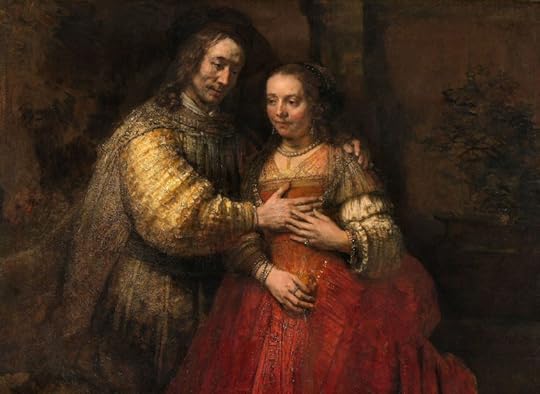
There was a crowd gathered around it. It was huge, big as a hoarding, a great slash of browns and yellows and reds. Two figures, a man and a woman on the edge of intimacy, or perhaps just after, about to coorie* in to one another. Hands. Hands everywhere. A painting about touch. Stella joined the crowd and wormed her way to the front. Gerry watched her bite her lip as she gazed. She became aware of Gerry watching her. He excused himself and threaded his way to her side.

'Well?'

'There's a great tenderness in him,' she said. 'You can see that he cherishes her.'
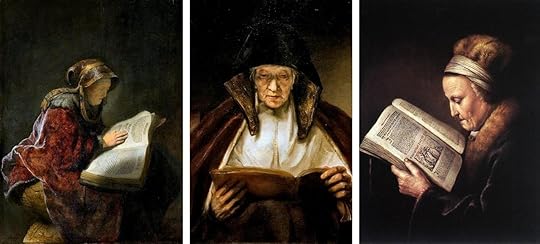
Stella sits down to rest while Gerry wanders off. On an opposite wall, she sees a large painting of a woman reading. Later, she tries to buy a postcard of it, but they are sold out. The assistant offers her a different version. "There are many old women reading," she says. And indeed there are: two by Rembrandt and one by Gerrit Dou at least. I find it interesting that MacLaverty should devote a full page to the picture of the beginning of a marriage, but treat as commonplace the subject of a woman nearing the end of one. Threescore years and then… what?


======

This is also a novel about religion. Both Gerry and Stella are cradle Catholics, but while he has mostly rejected the faith, she increasingly relies on the practice of hers:
She wanted to live the life of her Catholicism. This was where her kindness, if she had any, her generosity, her sense of justice had all come from. And her humility, she must not forget humility. Catholicism was her source of spiritual stem cells. They could turn into anything her spiritual being required.
Stem cells, of course, belong to the embryo; they are all possibility, looking forward. Stella's crisis is as much a spiritual as a marital one. While nearly all of Gerry's monologues look backwards—anything beyond the immediate present being obliterated by his excessive drinking—she looks forward to a future she cannot see, asking questions that have no easy answers. What is her purpose in life? What is her debt to God, and how may she repay it in practical terms?

On their first morning, skipping breakfast, Stella slips away on an errand of her own, looking for a hard-to-find doorway in a secluded street:
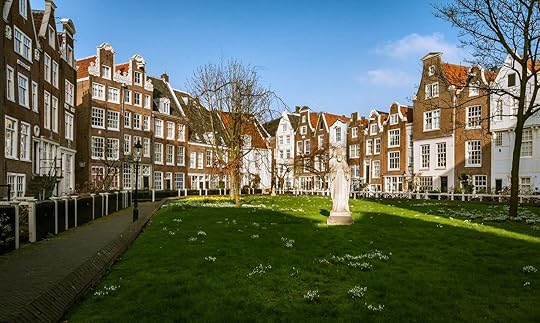
There was a brick archway which led to a dark passage. She hesitantly walked its dry length, hearing her own footsteps echoing. The passageway led out into a space which took her breath away. The notion of being born came to her. […] Grass, winter trees, a ring of neat ancient houses with their backs to the world, all looking inwards—like covered wagons pulled into a circle—creating their own shelter. An inner court or Roman atrium. In the centre of the green space stood a Christ-like statue facing a red-brick church. It was the same place she had seen on her computer screen at home. And the silence was the same. The passageway she had come through had edited out the noise of Amsterdam—the trains, the trams, the cars, all gone. As if to emphasise the quiet, some sparrows cheeped within the enclosure of houses.
The place is not named at first, but I recognized it: the Begijnhof, the ancient community of Beguines, or secular nuns committed to a life of faith and service, though without taking final vows. Stella's several visits there, alone or with Gerry, are touching but also heartbreaking.



And Gerry's memories also include an "inner court or Roman atrium," further evidence of MacLaverty's extraordinary control of images:
A thing that really took his breath away was Norman Foster's roof over the Great Court of the British Museum—the audacity and brilliance of it. The approach inside the building from a periphery of darkness into the thrilling light at its centre—the largest covered square in Europe—was utterly wonderful. If it was about anything, architecture was about shedding light.
Looking for a photo, though, I was equally struck by the cylindrical structure in the middle, which relates to a building in Ireland that Gerry worked on, Burt Chapel in Donegal by the architect Liam McCormick. And to its inspiration, the circular Iron Age fort of Grianan Aileach, further up the hill, a marvelous rhyming of three round objects.



So again, Gerry's thoughts move back in time, to the beginning of his courtship. But the words he remembers are Stella's—not the present Stella seeking refuge in a walled enclosure, but a young woman looking out over half of Ireland. It is a reminder that, whatever torment this book may bring, it remains a love story:
But Stella was more interested in the view. Give or take some trees and a road or two, she said, it was what you would have seen two thousand years ago. With one slow turn of the head you could see the counties of Donegal, Derry and Tyrone, with Lough Swilly and Lough Foyle in the middle of it all. It made her feel glad to be Celtic. Silence in such a place, at such a height, is hard to come by because the wind is always there bluffing your ears into thinking there is no noise. Maybe the bleat of a sheep and no sheep to be seen. She put her hand in the air to find the wind's direction. Stella. A star with her hair blowing. Eclipsing all else. Her hand in the air.
======

I was recommended this book by a fellow Goodreader and expert on all things to do with Northern Ireland, Barbara. She had read my review of another novel in which people from Northern Ireland go to Amsterdam for a weekend break, The Light of Amsterdam by David Park. A good book, but she was right to say that MacLaverty's is even better. Then I was nudged into getting it by the extraordinary review by Fionnuala, which is a fascinating account of its page-by-page transformation of her mind. Click on the names above to read their reviews; they are well worth it.

* "Coorie" is a dialect Scots word, meaning to cuddle.
Displaying 1 - 30 of 739 reviews

Join the discussion

Can't find what you're looking for?

Get help and learn more about the design.