Jump to ratings and reviews
Rate this book

Unknown Universe

Rate this book
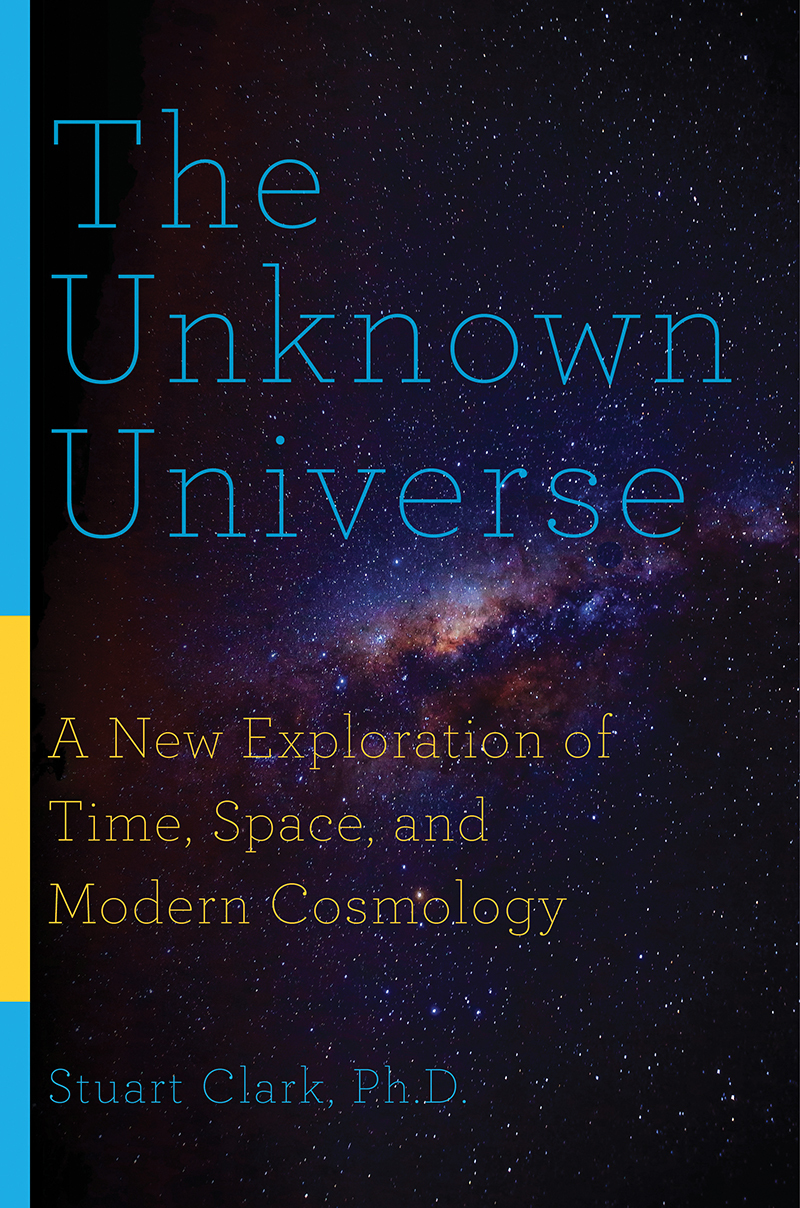
A groundbreaking guide to the universe and how our latest deep-space discoveries are forcing us to revisit what we know―and what we don't. On March 21, 2013, the European Space Agency released a map of the afterglow of the Big Bang. Taking in 440 sextillion kilometres of space and 13.8 billion years of time, it is physically impossible to make a better we will never see the early universe in more detail. On the one hand, such a view is the apotheosis of modern cosmology, on the other, it threatens to undermine almost everything we hold cosmologically sacrosanct.  The map contains anomalies that challenge our understanding of the universe. It will force us to revisit what is known and what is unknown, to construct a new model of our universe. This is the first book to address what will be an epoch-defining scientific paradigm shift. Stuart Clark will ask if Newton's famous laws of gravity need to be rewritten; if dark matter and dark energy are just celestial phantoms? Can we ever know what happened before the Big Bang? What’s at the bottom of a black hole? Are there universes beyond our own? Does time exist? Are the once immutable laws of physics changing?

312 pages, Paperback

First published September 10, 2015

76 people are currently reading
1506 people want to read

About the author

Clark

400 books

Ratings & Reviews

What do you think?
Rate this book

Friends & Following

Create a free account to discover what your friends think of this book!

Community Reviews

5 stars
181 (28%)
4 stars
298 (47%)
3 stars
131 (20%)
2 stars
15 (2%)
1 star
3 (<1%)
Displaying 1 - 30 of 80 reviews
Profile Image for Melora.
576 reviews168 followers
March 21, 2017
A very nicely done survey of astronomy, physics, and cosmology, focusing largely on history and personalities, but with enough science that I'd probably have done better to read with my eyes and not my ears! As usual with the science books I choose to listen to while I walk my goofy dog, the narrator inevitably was explaining some complicated space-time-particle-curve thing at the moment my poor dog spotted a toddler (they're all really golden retriever devouring aliens, in disguise, doncha know?) and bolted in terror, dragging me in his wake, and causing me to lose track of quarks, light years, etc. Still, even allowing for the bits I got lost at, and the author really does present the “big picture” without cluttering things up with math and chemistry, so it truly is my dog's fault (or, possibly, mine) that I got lost at all, this is a very enjoyable look at theories of time, space, the origins and fate of the universe, and everything, from early days up to the present.
Profile Image for Charlene.
875 reviews704 followers
June 30, 2020
I honestly have no idea how to rate this book. It sat in my library for more than 2 years because I didn't realize I had bought it. When I first started reading, I thought, 'This might be the best book I have ever read." Clark's passion for science history is not only oozing from every single page, but the historic details upon which he chose to focus were slightly more obscure than the many authors who had previously covered the same topics  ad nauseam. In addition to treating his reader to lesser known details about these histories, somehow these less talked about tidbits ended up being far more interesting and relevant than we readers usually receive. The reason for this is that Clark is obviously obsessed, in the best possible way, with how the human collective mind works. I could not help but  picture him as a person who has obsessive and uncontrolled thoughts about how human knowledge and technology came to be. I can never stop my brain from asking these questions, and reading Clark made me feel as if I had found "my people". 

Stuart Clark is an incredible historian who largely focused on how humans got it wrong, in many cases so wrong, but how those "wrong" thoughts eventually got us to a here and now, in which we are able to understand so much about the mysterious and complex universe around us. 

One of the best histories involved James Jeans and Arthur Eddington. Eddington wanted to build models to begin to understand the nature of stars.  Vehemently opposed to this "unscientific" manner of exploration, Jeans fought hard against Eddington and his models, going so far as to suggest since physics lacked the tools to gain a complete and precise knowledge of stars, then physics could not claim to have any knowledge of stellar processes.  But, Eddington's models -- though speculative -- were scientific tools and they led to the field of theoretical astrophysics. There is little I love more than a debate over methods. This part of the book was incredibly satisfying because I had not read a history this detailed of James Jeans.

When Clark tackled the subject of information by using the well worn example of Alice and Bob, he told the same story as every other author but quipped that when Alice and Bob compared their results and, because of Einstein's relativity theory, saw different outcomes, Alice's frustration with Bob made her rethink her life choices. It was a pretty good physics joke that made me laugh out loud while reading. It would be hard to say how much I enjoyed the first part of Clark's book. 

But then when I read Clark's discussions of both climate change and MOND, I was really shocked by his wording and what he chose to write about and, more importantly, what he chose not to write about. When discussing climate change, Clark used phrasing that went something like, "The party line is" that humans are responsible for climate change. The party line is??? No. Humans have been and continue to contribute to climate change. It's not a party line. It's science. Even if other things (like sunspots) contribute, humans are still hastening climate change. So using words like, 'The party line is," have no place in a science book. They have a place in a book written by a Trumpet. Clark went on to focus a lot on solar contribution to climate change. (If you want an excellent discussion on sunspots and climate change, I highly recommend, 'Nature's Third Cycle' by Arnab Rai Choudhuri). I am not suggesting he is a climate change denier. I am suggesting he should be very clear about the science of human contribution to climate change and choose language that doesn't lend itself to use from climate change deniers. Similarly, Clark is very taken with MOND. He does not do a good job of explaining the evidence for dark matter. Not only that, if he is going to argue for MOND, it seems unhelpful to argue for ideas of MOND pre 2010. I think it would be far more helpful to try to argue against dark matter by explaining Erik Verlinde's entropic gravity idea. It cannot account for what is observed in the CMB, but at least it is an interesting way to start to rethink our ideas about gravity and dark matter. I found Clark's discussion of MOND to be lacking. 

I am not suggesting that books should not debate the dark matter evidence. They should. In fact, I am hoping upon hope that Verlinde or other researchers will come up with some gravity related observation or calculation that would be consistent with what we see in the CMB. I am very excited about the 2020 Euclid Mission and cannot wait for details to emerge. I would love to see our current ideas about gravity upended. I have no personal need to keep the idea of dark matter alive. I favor almost any entropic/ emergent theory and am happy to replace dark energy with entropic gravity, if someone can actually make it work. I just do not think Clark did an adequate enough job discussing dark matter, gravity (entropic gravity), and MOND. 

So, I guess I highly recommend the first part of the book and recommend against spending your time reading the second half of the book? 
Profile Image for Beauregard Bottomley.
1,226 reviews843 followers
May 23, 2017
This is the best popular science book I've ever read. The author is really good at explaining the complex, but that's not the only reason I loved this book. He does something that I haven't yet seen anyone else do so far. He knows how to talk about the holes that are in science but doesn't tear apart the science that allows us to see the holes in the first place, no mean task.

He'll make the statement that black holes mean that there are holes in the universe and that there are holes in our understanding of the universe because the mathematics breakdown there. The currently agreed upon consensus understanding of how really smart people understand the universe may not always be the correct way of seeing the world. Dark Matter, Dark Energy are place holders (as Neil deGrasse Tyson says they can just as easily be called Fred and Barney for all we know), and as the current debate raging in the latest "Scientific American" on Inflation Theory being a real scientific theory or being an amorphous blob there are good arguments for both perspectives. This book is written so that anyone can understand what the issues are and why they matter and what are some of the reasonable alternatives even if they might sound goofy.

The author is good at what he does. Observers of the universe want to know the why (the theory), and they also want to know the how (the model). Eddington (and Kepler) both built models. Newton (and Einstein) build a theory. Time to Newton is absolute to Einstein its an illusion (relative). He gets into all of these fine details, explains better than almost any one and makes me incredibly grateful to be alive now days when our understanding about the world is getting cooler and cooler every day. There is nothing more exciting than the Planck map of the universe, and for fellow geeks who can make that kind of statement this book will teach you something you didn't already know.

I really loved this book and would highly recommend it for anyone.
Profile Image for Laura.
209 reviews9 followers
April 17, 2017
I enjoyed this book more than I thought I would. Granted, I know next to nothing on the universe, so there was a lot of unknown for me! As a novice in all things physics and cosmology, I found Stuart Clark's explanations easy to follow. The histories of the early astronomers were entertaining. The last three chapters were my favorites in the book. The fact scientific society seems to have gotten stuck in the "dark matter is real and explains everything" trope is a bit unsettling. Could there be other reasons for the way things are other than dark matter? Multi-verse perhaps? Maybe we should not assume that these theories are anything more that theories and quit teaching them as hard science.
Profile Image for Lis Carey.
2,213 reviews137 followers
March 14, 2017
It's been fun, over the past few years, reading accounts of recent developments in physics, astronomy, and cosmology. The universe doesn't look the way we thought it did at the start of the 20th century. There are many galaxies, not just one. The universe is expanding. There doesn't appear to be enough matter--enough ordinary matter--to keep the galaxies together, and the rate at which the universe is expanding appears to be accelerating.

The explanations offered for these last two developments are dark matter and dark energy. In this case, "dark" merely means that we do not have the faintest idea what they really are. We can't detect them. They don't seem to interact with ordinary matter at all. Except they hold galaxies together and expand the universe...

Dark matter and dark energy are hypotheses that explain the observed facts, but so far there's no direct evidence for either. Stuart Clark discusses the problems with this, as well as the other ways in which recent observations, including a high-resolution photograph of the earliest part of the universe we can detect, have produced findings that just don't fit well at all with the current "standard model" in physics.

He thinks we're due for a paradigm shift.

Realizing Earth orbits the sun, not the other way around, was a paradigm shift. Realizing our galaxy isn't the whole universe was a paradigm shift. At some point soon, he thinks, some young scientist somewhere will look at our current standard model, and throw out a basic assumption we all currently take for granted.

His story of the history of physics, astronomy, and cosmology is lively and interesting, and he makes a compelling case for the need for a new paradigm that allows us to explain our current observations of the universe without the current multiple fudge factors needed to make our equations work.

It's a fascinating book.

I bought this audiobook.
Profile Image for Diana Long.
Author 1 book37 followers
February 5, 2018
I am always fascinated when it comes to the cosmos and this book appealed to me as soon as I saw it, needless to say it more than satisfied by expectations. Always looking forward to the newest theories made by science I was eager to contemplate what they had to say. The more we know about the universe the more questions we seem to have. It is no doubt now that the universe is expanding but up until what point seems to be the question, if there was a Big Bang Theory will there some day be the Big Crush, when the universe collapses in on itself...well not for a long time at least. I really enjoyed listening and thinking about this work and will most likely spend time listening to it often.
Profile Image for John.
120 reviews7 followers
September 10, 2016
Based on the title I thought this book was going to cover all the most recent breakthroughs and controversies of modern cosmology. No. Not by a long shot. This was more a cliff notes version of the history of cosmology going all the way back to the ancients. There was very little on the cool new stuff like dark matter, dark energy, black holes...etc. For this I was very disappointed and felt misled.
Profile Image for Lara.
4,212 reviews346 followers
April 8, 2018
This one ended up being way more interesting than I at first thought it would be!

I've read kind of a lot of books on space and physics and am pretty darn familiar with the general history at this point, and so when Clark started talking about Copernicus I was like, "ohhhhh god, here we go through the whole story of the Earth actually rotates around the sun omg that you get in every single book about space ever!" But I found that Clark made different connections and covered things from different angles than I'm used to seeing, and so even though most of the information related here was not new to me, it still felt fresh and engaging. So well done, Stuart Clark!

I also liked that he seems pretty WTF about some of the weirder, super complicated theories that have been practically set in stone in many minds already, despite the lack of any actual evidence or ability to test them, and talks about how we're in danger of getting stuck in these few avenues of study and closing ourselves off to other possibilities out of...well, laziness, basically, is how it comes across. He talks a lot about how once an idea becomes so entrenched people just stop looking for other solutions, and he seems to think the astronomical community has become kinda stagnant. Which is interesting to me! I haven't really read any other books where someone really questions the current state of cosmology.

Anyway, I found it entertaining, informative and relatable, and I'd definitely be up for reading more Stuart Clark at some point.
Profile Image for Waco Glennon.
179 reviews4 followers
May 14, 2017
Over the years, I have studied Cosmology quite a bit. I love the stars and astronomy, but I was always more of a physicist than an astronomer. Due to my previous readings and such, I found this book to be a decent survey of the subject.

Having said that, there are certain things about this book that I liked very much.

Dr. Clark delved into some of the background information of the scientists involved. Giving these details makes the scientific conclusions and puzzles are brought into stark relief.

Second, the writing is clear and approachable. For anyone trying to capture the last 1oo years of cosmology, this, in my opinion, is a great introduction. Layer upon layer, the author builds up concepts. These concepts are then combined to explain new details of the universe. Because Dr. Clark takes his time and writes clearly, the new details are easier to understand. I appreciate this very much, because, cosmology is ultimately trying to answer the hardest question there is: Why are we here?

Finally, I think cosmology is a very important subject. Dr. Clark gives the subject its due regard.

I think this book is worth your while if you are interested in the topic.
Profile Image for Menglong Youk.
409 reviews69 followers
August 31, 2017
3.5/5 stars

"The Unknown Universe" does a great job at explaining the boundary between the known and the unknown of modern physics and cosmology in an understandable language to the public; however, it does not add any new information that is different from the books I've read over the year.

If you're new to modern physics and cosmology, I indeed recommend this book to you, but if you are already familiar with science and recent announcements regarding the subjects, you can skip this one.
Profile Image for Jeanette Lukens.
488 reviews
December 31, 2018
This was basically a history of cosmology. I found the author to be a little bit pessimistic or cynical. I think the author's main point was that breakthroughs in cosmology (and physics in general) have come when scientists take on a whole new perspective and it is time for a new perspective to resolve this dark matter and dark energy rubbish. (He never actually called it rubbish, but I think maybe he wanted to.)
Profile Image for Barb.
934 reviews54 followers
April 25, 2019
I just can't get enough of this topic. I really enjoyed listening to this and learned quite a lot. I stopped several times to jot down notes regarding things I wanted to look into more. As much as I enjoyed this, it did take me a while to get used to the narrator. He didn't do a bad job narrating but sometimes the way his inflection seemed odd and I keep trying to figure out from where I knew his voice.
Profile Image for Loraine.
253 reviews18 followers
April 14, 2017
Thoroughly enjoyed this. Learned much. I'd say at least a third of the science is all new to me and yet I enjoyed learning it. Perfect backgrounds led the way, perfect chain of ideas from one to the next. I've been entertained as much as taught.

I have other books by this author that I've not had time to read yet. They are moving up in the to-read list
Profile Image for Kim.
329 reviews16 followers
June 7, 2017
I felt pretty smart a few years ago after reading Richard Panek’s book The Four Percent Universe. That book was a report on the latest breakthroughs in cosmology. After careful measurements of the speed at which the universe is expanding it was determined that the forces involved required more mass in the universe than we could account for. Specifically, we (meaning scientists and I gratuitously add the royal “we”) could only measure 4% of the star stuff that would be driving that expansion. The remaining 96% must be something we can’t see all lumped into the description of dark matter and dark energy.

Now it’s six years later and Stuart Clark, who reports on science for The Guardian, says that this may be a matter of bad math, specifically that we’re using the universal constant (that was a tweak to begin with) and we’re more faced with a dilemma of needing better calculations than trying to find things we can’t see. Within a few years, according to one scientist, no one will be talking about dark matter.

This is a personal disappointment in having a tidbit of knowledge swept away that both drove women to the other end of a crowded bar and bored my grandchildren to tears.

There is much more to the book than this one fact, though it is held out as bait to draw the reader to the last chapter. Like many other popular science books on the subject the author is apparently required by law to retell the history of physics, so we are reintroduced to Galileo, Kepler, Newton, Halley, Farraday, and dozens of others as a way of telling how we arrived where we are today. Even though I read a book like this once or twice a year the stories are enjoyable and rereading them helps cement ideas in my admittedly non-physicist brain. Some of the stories were new to me as well and the world of physics geniuses can be pretty bizarre and entertaining.

Almost every chapter introduces a new topic, with things ranging from gravitational waves to string theory to the ultimate end of the universe, due much later than you or I need to worry about it. Clark is used to writing for a general audience so while the concepts can be complex and challenging one never feels lost or in deep water … or space if you want to keep the metaphors clean. Having to unlearn things regularly is the price we pay for science progress. This book will have absolutely no impact on my life other than satisfying the childhood urge to ask “why” and hope for answers, whether looking at a butterfly or the Milky Way. A book like this once in awhile is the grownup version of asking a parent “why”. If you try to keep that sense of curiosity alive in your own heart this is a worthwhile book.
Profile Image for Mike.
302 reviews14 followers
May 12, 2018
People who believe they are ignorant of nothing have neither looked for, nor stumbled upon, the boundary between what is known and unknown in the universe.

- Neil deGrasse Tyson, Astrophysics for People in a Hurry

If this quote by NDT might describe you, or you are just someone who wonders what we really don't know about the universe, then Stuart Clark is ready to help you cross that boundary.

Science has been able to discover and describe a lot about the universe and how it works. The current theories and models seem so close to being right. They are able to explain so many observations and have been able to make many correct predictions. However, there are numerous challenges within the current models and theories. Some of these challenges are significant enough that they may require serious reexamination of the assumptions behind them.

Only when they must choose between competing theories do scientists behave like philosophers - Thomas Kuhn

This book takes us on a historical tour of physics and cosmology starting with Kepler and Newton and progressing right up to the modern era. The explanations of the major concepts are clear and should help most readers understand the state of cosmology. When there are areas in which the current thinking in science is challenged by observations or lack of data, the book really shines. Clark presents not only the widely held idea but some of its competitors.

For example, the observed rotation of stars in spiral galaxies doesn't match what the gravitational theories of Newton/Einstein predict. The current solution is to assume the gravitational theories are correct and add more matter than is measured/calculated to get the equations to work. This is where Dark Matter comes from. It is what makes the math work given what we observe. The search is now on for this unseen matter but so far there is a lack of evidence for its existence. Alternative ideas (like MOND), which are less popular, take another approach. They seek to change our understanding of gravity to account for the observations without using Dark Matter.

While this book made for a great listen, the content may be more readily understood by reading it.
Profile Image for David.
55 reviews1 follower
January 6, 2017
Most physicists believe they know everything. One of the very few who realize that there are huge gaps in what we know and possibly what can be known.

The WMAP space probe measured the cosmic background radiation. Yet there were still many unanswered questions. Then the Planck spacecraft brought the best data yet. Planck's detector was cold, 0.1 deg Kelvin, so as to get the best measurements, probably the coldest thing in the universe! It basically verified WMAP and gave little new information. As Clark says, we are not at the limits of technology; but the limits of physics. We will probably never get better data. The study of physics may be reaching the limit of what can be known as well. (In order to test the next step in the unification of basic forces, we would need a particle accelerator that reaches from earth to the nearest star.)

Dark matter is something that can't be seen or detected (that's why its dark), yet physicists claim that it is real because it may explain some phenomena we see like spiral galaxies whose outsides spin at the same speed as the core. Of course, that dark matter would have to be spread out in just a certain fashion. Every test for dark matter has turned up nothing, yet few realize that this will soon cause a physics crisis.

Interesting read with different details of physics history; but the core of the book is what we don't know.
Profile Image for Maurizio Codogno.
Author 66 books143 followers
May 3, 2018
La casualità delle mie scelte di lettura ha fatto sì che mi capitassero due libri di cosmologia di fila. In questo caso Clark fa una trattazione molto più ampia di quella di Balbi: non che si debba o voglia fare una graduatoria, perché i due approcci sono completamente diversi. Clark scrive molto bene ed è chiara la sua volontà di raccontare quello che succede ora nella cosmologia, e d'altra parte questo è il suo lavoro di scrittore scientifico. Quindi localmente è tutto bello e comprensibile, oltre che posto in un contesto storico che fa apprezzare meglio le cose e condito da aneddoti gustosi in stile americano come l'incontro brussellese tra Einstein e Lemaître. Quando però la lettura termina, rimane un senso di vuoto, non dovuto alla vastità dell'universo quanto alla eterogeneità dei temi trattati. La mia sensazione è che Clark abbia ripreso quanto aveva scritto sulle riviste e l'abbia inciccito; ma non l'ha ripensato in modo unitario. Risultato? Si scoprono tante nozioni puntuali, ma l'universo resta ancora più sconosciuto. Una nota positiva: è bello leggere di come gli scienziati lavorano, facendo ipotesi sempre più indirette. Spesso noi crediamo che quello che dicono gli scienziati siano verità assolute: qui si vede che non è proprio così. Buona la traduzione di Valeria Lucia Gili.
Profile Image for Jeremy Bonnette.
258 reviews3 followers
January 11, 2017
Excellent book! Stuart Clark's writing style takes a topic that can be difficult to catch on to and makes it seem easy to grasp. Still, there are sections regarding quantum physics that I don't fully comprehend. Nonetheless, I enjoyed reading about it and furthering my knowledge to a small degree.

4.2 out of 5 stars
Profile Image for Doctor Moss.
582 reviews36 followers
January 12, 2018
Clark’s book combines a basic survey of cosmology with, in its final chapters, introductions to some of the unsolved problems. Those final chapters give a pretty good rundown of how we got ourselves into difficulties for which very jarring and disruptive ideas, like dark matter and dark energy, appear as theoretical solutions. Clark’s emphasis, rightly I think, is on the problems or mysteries to which those ideas are purported answers rather than to the sensationalism of the ideas themselves. This is in keeping with his wary attitude toward mathematical or theoretical “discoveries” for which we, at least for now, lack observational evidence.

As science books go, this is a very quick read. That’s not to say that the topics discussed are simple. But the treatment is quick. Clark keeps everything at a conceptual level — you won’t find equations, or much mathematical talk of any complexity at all.

Within those constraints, I think he does well. He doesn’t go deeply into topics, but he does provide the basis from which someone, even a relative novice, could explore farther, armed with a big picture understanding.

Clark has a “great scientist” way of telling the story of cosmology. I don’t think he’s committed to a “great man” theory so much as to an appealing way to tell the story. He will go from scientist to scientist — James Bradley, Hippolyte Fizeau, Michael Faraday, James Clerk Maxwell, Albert A. Michelson, Albert Einstein, . . . — telling of each one’s part in the bigger story. The trick is to weave those people into a coherent, continuous story, and I think he does that pretty well.

One thing I have to say the book lacks is any illustrations or diagrams. For example, Clark provides an interesting discussion of various historical methods for measuring the speed of light, but I found myself sketching my own diagrams to gain clarity. His explanations are relatively clear, but a diagram would help a great deal. Michelson-Morley’s method is a good example, but also Fizeau’s spinning cogwheel method — something I wasn’t familiar with at all.

One theme that Clark pursues throughout the book is that of theoretical vs. observational physics (and astronomy). He identifies Arthur Eddington’s construction of a theory of how stars produce energy, in response to James Jeans’ position that answering the question was beyond the reach of observation. Instead, as Clark says, Eddington “reverse-engineered” a solution — he built a model of what we cannot observe to explain what we can observe.

Such an approach is not entirely new. You could cast Kant’s explanation of how the solar system formed — his “nebular hypothesis” (also described by Clark) — as a similar modeling of what is beyond observation. But I think Clark’s point may be that the approach is rampant in contemporary physics and cosmology. Physicists regularly theorize about such things as dark matter, and then go to look for them. Rather than following the path of old fashioned scientific method — observe and then theorize — physicists routinely reverse the order — theorize and then observe.

In fact, that approach has had some very significant successes. The recent detection of gravitational waves confirmed their long-thought theoretical existence. Black holes were discovered mathematically long before actually being observed.

And the relationship between theorizing and observing is, in reality, much more complex. Often observations produce surprising results — for example, recent observations of the rate of the universe’s expansion. Those observations defied expectations, providing evidence that the universe’s expansion is speeding up rather than slowing down, as had been thought due to straight-forward considerations of gravity. Then the theorizing begins — what could explain the surprising results? And the theorizing posits unobserved mechanisms, or forces, e.g., dark energy. And then, in turn, we have to ask what telltale observations would support the theory, and observation kicks back in.

But there is of course a danger of severing the tie between theorizing and observing, taking theoretical derivations, like dark energy or dark matter, to be bona fide discoveries of real phenomena regardless of the lack of any actual observations. And Clark warns of that tendency in contemporary cosmology.

I’ve gone into a little more depth than I might have. I don’t want to give the impression that this is a difficult, academic book. Clark is a clear writer, and readers of a pretty wide range of previous knowledge of cosmology will get a lot out of this book.
Profile Image for Nilesh Jasani.
1,207 reviews230 followers
May 10, 2017
This is a short book. It has two purposes. Its length is such that it ends up doing justice to neither.

The topic of the history of physics, astronomy and cosmology is vast by itself. While the author has an engaging style, the work here does not scratch the surface of the historic tale that begins with at least Copernicus to now. There are numerous extremely good popular books written on this in the last ten years. It is quite difficult for any new writers to better the efforts of Green, De Grasse, Weiner, Carroll and the likes given that history does not change and finding another viewpoints or analogies become exponentially difficult. This book does not even attempt new perspectives and suffers tremendously because of the space given to various subjects.

Quite likely, the historic discussion is just a prelude to what the author really want to say: that dark matter and dark energy do not exist and most scientists are on a wild goose chase. In that case, the prelude was too long at over 80% of the book while the meat was too little. The author claims that general relativity, quantum physics, cosmological principle that mass/energy distribution is homogeneous and isotropic at the large scale etc are not completely valid. The author subsequently asserts that the solutions to dark matter and dark energy are within these principles' or their equations' inadequacies. All this could be true (and at least all this is extremely fascinating), but the treatment afforded to such extraordinary claims is not even a decent Wiki-length.

There is something quite radical towards the end, which makes the entire book somewhat worthwhile but overall, the book is just too short.
Profile Image for Barbor Ka.
69 reviews14 followers
January 21, 2022
This is a decent history of exploration and explaining of the universe. And even though it contains a lot of stories of scientific discovery, backstories of impotrant thinkers and their thoughts and it attempts to paint a complex picture of what we actually know so far, it remains strangely frustrating in its superficiality. At some places it gives you painful unnecesary uninteresting details personal to the author, at some places it offers too little depth, especially in describing key theories and views. Sometimes the book is rather chaotic and the associations are not that smooth. Even the philosophical implications at the end did not have the impact that was probably intended.
Some of it was maybe lost in translation though...
I am personally not much fond of the author's style of popularising science, but there were some nice original thoughts and concepts and connections he made. it made me excited about the topic once again (which is probably what it is mainly about anyway)

Major takeout: What we know, works only kind of sort of sometimes and to broaden our understanding of the world a paradigm shift is needed.
Also, don't get too cocky about what you know today, tomorrow it very possibly will be disproven and clinging on a certain model will only delay your search for the truth...
Profile Image for Jonathan.
30 reviews
February 3, 2020
As always continuing on the theme of space, time and quantum theory stuff.

I don’t really know how to feel about this book, it has its wonderful moments but there are also a few problems with it too.

It’s a relatively light book, not too long and can be read within a week or less. Sometimes the language can be clumsy and it detracts from the overall point, but overall I found it pleasant and easy to read.

This is a solid book on the history of cosmology and physics I would say, and you do learn a lot from the chapters that it entails. However, the major issue I have with this book is how it is marketed physically.

It comes off as very sensationalist, and I have issues with the synopsis at the back. It gives of the impression that it answers questions such as “what is a black hole” and “can we ever know what happened before the Big Bang”, however sadly it does not.

Although it eludes to such questions that boggle the mind of everyone, it’s disappointing that ultimately it’s answers that are contained in the book can be summarised as well don’t know yet’.

However I do believe this is more at fault with the agent rather than the author to boost sales.

But I do wish you could be more specific with ratings, as this for me is a 3.5*.
Profile Image for Chris Esposo.
680 reviews56 followers
November 15, 2021
This book is a competently written brief history of cosmology, that focuses only a bit on modern cosmology, and much of the volume of the text on classical and historical narratives of physics as a discipline. In fact, having read a few of these general physics texts at this point, I’ve noted that the historical narratives are often very similar between any two books in the sub-genre. In particular, I found the forays on the historical physics found in this book to intersect with corresponding chapters in Lawrance Krauss’ “The Greatest Ever Told - So Far”.

Much like that book, we are treated with exposition on the development of physics that hit on all of the usual characters of Galileo, Newton, Hailey, Einstein, Edington etc. Not to say it’s not a good history, just a well trodden one. Unlike Krauss’ book, not much of the mechanism of physics or cosmology is ever attempted to be communicated beyond a very brief conceptual manner, so to me that’s an automatic detriment to the text. Besides those facts, I think the book would be a good text for someone who wants a “PBS Nova” quickie exposition on cosmology. However, for those that are interested in more, this is an easy pass. Conditional recommendation.
Profile Image for Terry.
508 reviews20 followers
August 18, 2017
When I saw this book on my list of texts I had yet to review, I was embarrassed for remembering none of it. This sometimes happens when the book is very short, very long, or I read it during a time when I'm doing a lot of other things. I even went to the extent of re-reading it after feeling the embarrassment of not remembering. Stil, having read it twice, I'm hardpressed to think of much that I rememeber even after a second go. With a title like "The Unknown Universe" I was hopeful for a discussion of open topics in astronomy but there really wasn't. The book was a padestrian and not particularly inspired discussion of the tools that have been used to extend our understanding of the cosmos. It's a topic a lot of other books have covered and this one lacked the interesting details, wise context, or writing skill to innovate in the genre.

You can do worse, but you can also likely do better.
Profile Image for Hank.
1,035 reviews110 followers
February 14, 2019
Clark turns out to be a dark matter, dark energy skeptic, I didn't see that coming. He lays out a pretty good case and I have been drinking the cool-aid up until now. I guess it is time to re-evaluate.

This is a very accessible (read understandable) discussion of our current knowledge and lack of knowledge of the universe. The background material and run up is all focused on the big bang with expanding universe and what we think we know. Even though I have read several books on the same rough subject, I enjoyed how Clark communicates the information and his discussion of our Universe.

Highly recommended for anyone wanting to go 1/2 a step beyond Astrophysics for People in a Hurry with a much narrower focus
169 reviews
February 28, 2018
Entertaining and provocative examination of what we do NOT know about our universe. I loved Clark's honest discussion about the scientific method and even the limits of science. He even suggests that under the inflation theory of the origin of the univerise, it is likely impossible that we will ever know what came before inflation, since the process obliterated the condition of the universe before the event. In other words, we can never know the true origins of our existence. Clark clearly demonstrates that we have thought we've known everything about a topic (e.g. Newton and gravity) before the theory was demonstrated to be flawed and limited (theory of general relativity). I love this stuff, and this book was fun.
Profile Image for Amir Gadhvi.
88 reviews
May 4, 2022
I've read quite a few books on time, space and the origins of the universe. However, this one doesn't quite live to the promise of it's title.

There is a lot of information in the book the book provides, some if it that I had a hard time understanding in previous books, but it jumps around history and different topic with no clear flow. I found it a biit poorly organized and written. A large portion of the book is dedicated to the author's personal narratives as a science journalist and research he did. Still was worth a read. However, there are many other books on the universe what are far better.
Profile Image for 11811 (Eleven).
663 reviews164 followers
May 5, 2017
This was exploding with mind blowing content but the author did a good job of bringing it down to my level so by the end I only felt slightly dumber than I did at the beginning.

Space time, black holes, string theory. All things I can still barely wrap my head around. The universe possibly collapsing in on itself? That idea was particularly crazy. That's not supposed to happen for a million years though which would put me in... say... my late forties (I'm not very good at math either.)

Good stuff! Recommended to the scientifically curious and National Geographic couch potatoes.
Profile Image for Ashley.
69 reviews13 followers
February 3, 2018
This is an interesting, brief history of the major events and figures in the fields of astronomy and astrophysics, but there's actually very little about what remains unknown; most of the same information is covered in Richard Holmes' Age of Wonder and the recent version of Cosmos on television with Neil DeGrasse Tyson, so if you're familiar with those there isn't much here to learn; only the last third of the book covers recent discoveries in more depth. (Conversely, if you're not familiar with those works, this is a great primer.)
Displaying 1 - 30 of 80 reviews

Can't find what you're looking for?

Get help and learn more about the design.