The author of the magisterial A Biographical Guide to the Great Jazz and Pop Singers now approaches the great singers and their greatest work in an innovative and revelatory way: through considering their finest albums, which is the format in which this music was most resonantly organized and presented to its public from the 1940s until the very recent decline of the CD. It is through their albums that Ella Fitzgerald, Frank Sinatra, Peggy Lee, Sarah Vaughan, Nat King Cole, Judy Garland, and the rest of the glorious honor roll of jazz and pop singers have been most tellingly and lastingly appreciated, and the history of the album itself, as Will Friedwald sketches it, can now be seen as a crucial part of musical history. We come to understand that, at their finest, albums have not been mere collections of individual songs strung together arbitrarily but organic phenomena in their own right. A Sinatra album, a Fitzgerald album, was planned and structured to show these artists at their best, at a specific moment in their artistic careers.
Yet the albums Friedwald has chosen to anatomize go about their work in a variety of ways. There are studio and solo albums: Lee's Black Coffee, June Christy's Something Cool, Cassandra Wilson's Belly of the Sun. There are brilliant collaborations: famous ones--Tony Bennett and Bill Evans, Louis Armstrong and Oscar Peterson--and wonderful surprises like Doris Day and Robert Goulet singing Annie Get Your Gun. There are theme albums--Dinah Washington singing Fats Waller, Maxine Sullivan singing Andy Razaf, Margaret Whiting singing Jerome Kern, Barb Jungr singing Bob Dylan, and the sublime Jo Stafford singing American and Scottish folk songs. There are also stunning concert albums like Ella in Berlin, Sarah in Japan, Lena at the Waldorf, and, of course, Judy at Carnegie Hall. All the greats are on hand, from Kay Starr and Carmen McRae to Jimmy Scott and Della Reese (Della Della Cha Cha Cha). And, from out of left field, the astounding God Bless Tiny Tim. Each of the fifty-seven albums discussed here captures the artist at a high point, if not at the expected moment, of her or his career. The individual cuts are evaluated, the sequencing explicated, the songs and songwriters heralded; anecdotes abound of how songs were born and how artists and producers collaborated. And in appraising each album, Friedwald balances his own opinions with those of musicians, listeners, and critics. A monumental achievement, The Great Jazz and Pop Vocal Albums is an essential book for lovers of American jazz and popular music.
Another of those big books which will take years to read and absorb. This really fills a gap for me – there are any number of guides to albums from the rock (post Elvis) period. This book covers the earlier stuff, from the 40s up to the early 60s.
In great, exhausting but delightful detail. Each album gets a historical introduction, the singer, composers and accompanists are all placed in context, and only then does WF dive into a track by track consideration of the album. Every song is turned into a mini-essay. The music is celebrated and explored without beating the non-musician reader up with technical terms. Even if you don’t love, maybe even don’t like this or that album (Blue Rose by Rosemary Clooney was not for me) it’s still interesting stuff.
So this is a book music fans can wallow around in for hours & hours.
Of the 57 albums WF writes about in detail the majority are from the years 1955 to 1962. The big interpreters of the Great American Songbook (I wish there was a better name for it) are all here – Tony Bennett, Sinatra, Nat King Cole, Louis Armstrong, Ella Fitzgerald, Judy Garland, Lena Horne, Mel Torme, Billie Holiday, Peggy Lee, Chet Baker, Nina Simone, Sarah Vaughan, Dinah Washington. Ain’t nobody going to argue with any of those. But then he promotes into the category of “great” a handful of singers who maybe never really had an especially glowing reputation and certainly never get mentioned in hip circles no more : Rosemary Clooney, Jo Stafford, Kaye Starr, and yes, Doris Day and yes, yes, Bing Crosby.
(Jo Stafford - she really wasn't a goddess, just a great singer, but in them days they thought they had to goddess them up for the photoshoot.)
Then we get a layer of hard core jazzers and popstrels I had never paid any attention to before now – June Christy, Blossom Dearie, Marilyn Maye, Jimmy Scott, Billy Eckstine, Matt Dennis, Bobby Troup, Johnny Hartman, Bobbie Short.
I am working my way through this vast book but slowly. WF has already introduced me to a couple of great albums I would never have heard of/bothered my pretty head about – Modern Sounds in Country and Western Music by Ray Charles (1962) was one – Ray Charles is for me one of those taken-for-granted situations. Yes, we all know he was one of the all time beloved voices but I for one just never listened to him aside from What’d I Say and Hit the Road Jack. But now I have – wow! And the other guy was likewise kind of yeah-yeah-whatever, Tony Bennett – the oldest crooner on the planet, the coolest guy alive (now that Leonard Cohen’s dead) but eh, maybe a bit boring and predictable. Now I have heard The Tony Bennett/Bill Evans Album, praise the Lord, I’m converted to the church of Bennett! Guy’s brilliant! As is Bill Evans (piano)!
There are ups and downs to be experienced in this epic musical journey. I already knew & loved Jo Stafford but listening to WF’s chosen Doris Day albums (Day by Day and Day by Night) was not a good experience. Like her 50s Hollywood image, her voice is too perfect, too controlled. But then came an album I had heard of but never heard, Judy at Carnegie Hall – what could possibly go wrong – it’s Judy Garland. Turned out that by 1962 all she could do was shriek and blare and vibrato a song to death, Judy who in the 40s only had to sing two notes to overturn your heart.
The strangest choice he throws in here, and I’m sure it’s just to aggravate the pompous, is God Bless Tiny Tim by Tiny Tim (1968). Ha haah! I already had this album and it’s a masterpiece of alternative thinking, not to say alternative singing. Mr Tim has about four voices he uses, including the well known very frightening falsetto. The “normal” baritone he can switch on if he so pleases is perfectly pleasant – he’s like a musical poster boy for multiple personality disorder. I too recommend Tiny Tim!
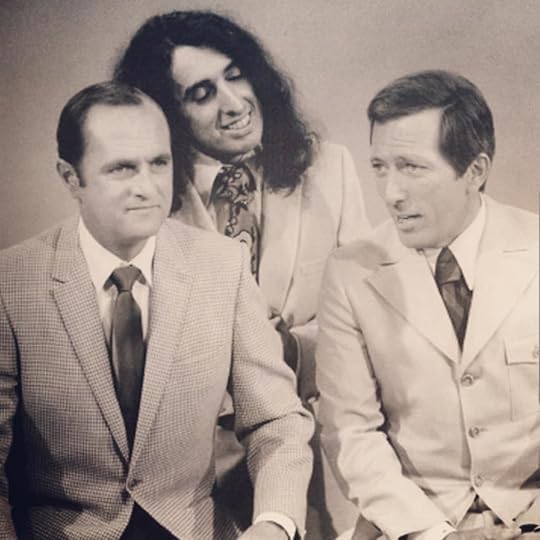
Tiny with another singer Andy Williams, who did not make it into this book.
I am including myself in a large group that would check the box, “I may not know a lot about music but I know what I like.”
What that means, for me, is that there is a lot about music that I DON’T KNOW IF I LIKE. Here comes Will Friedwald with some strong opinions about over fifty jazz and pop albums that HE likes and he believes YOU should be willing to try.
Some of the artists (Barb Jungr), I was not familiar with. While others (Ray Charles, Frank Sinatra) I have been listening to all my life. Yet, I learned something new and important about all the artists while reading this book. I wonder if others feel the same, since none of my GR friends have put up a review.
I am going to include the following lengthy quotation because it should give you both a sense of Friedwald’s style and because it “opened my ears.”
“Light has weight. It ws Albert Einstein who first put forward that particular scientific theory, and it’s since been proven: sunshine has mass and is affected by the force of gravity.
“The popular arts could use an Einstein of their own. In music, film and theater there’s a tendency to think of the brighter, sunnier moods and a more upbeat attitude as having so little weight as to be entirely frivolous---it’s the darker moods that are somehow perceived to have significance. Nearly everyone agrees that comedy is harder to do than drama, yet the Academy Awards, infamously, almost never go to comedies, and in England, Laurence Olivier is knighted relatively early in his career while Noel Coward and Rex Harrison have to wait until they’re old men for the same recognition. In the musical theater, the big awards and major accolades go to the dark brooding dramas of Stephen Sondheim rather than the diva-driven comedies of jerry Herman, even though Herman is a composer with just as much craft---and certainly more melody---than Sondheim…
“Doris Day, traditionally, has on the whole been taken a lot less seriously than singers of comparable stature who happen to have a lot more turbulence in their careers, Like Edith Piaf, Billie Holiday and Judy Garland. All three of them sang no shortage of upbeat, cheerful songs, but they all were tragically self-destructive in their personal lives. Somehow, it’s easier to regard a diva as a great artist if she’s always on the verge of doing herself in---paging Amy Winehouse.
“…It was Billie Holiday and Frank Sinatra who pioneered the concept of the slow ballad in twentieth century pop…Sinatra’s classic ‘concept’ albums were coming in two distinct flavors: they were either slow and sad or fast and estatic.
“ Then in 1956-58, a new kind of slow was brought forward by Doris Day and Nat King Cole…These releases showed that “slow” no longer had to be automatically heavy and sad. Slow could be sexy and romantic. A song could now be upbeat philosophically, even cheerful, no matter what the tempo was…”
This is the context that Friedwald offers along with some strong opinion. I may not know a lot about music, but I found it very satisfactory.
Few music critics are as persuasive, knowledgeable and passionate as Will Friedwald. He's also supremely ambitious: after writing more than 200 biographies for his essential 2010 book, A Biographical Guide to the Great Jazz and Pop Singers, he has chosen another Herculean task. In THE GREAT JAZZ AND POP VOCAL ALBUMS, Friedwald showcases 53 of the best of the 20th century.
Friedwald offers fascinating stories about how each album was made. Ella Fitzgerald and Louis Armstrong recorded all 11 tracks of "Ella and Louis" in one day. Doris Day and Robert Goulet never met while recording Irving Berlin's "Annie Get Your Gun"--Day recorded her vocals in California and Goulet did his in New York. Friedwald succinctly appraises each album track by track. Readers also learn about the evolution of the long-playing record and the careers and lives of each artist.
Some artists earn recognition several times over. Louis Armstrong, Doris Day and Jo Stafford each have three albums on the list. Frank Sinatra, Ella Fitzgerald, Nat King Cole, Sarah Vaughan, Bing Crosby and Peggy Lee show up twice. Other artists include Chet Baker, June Christie, Billie Holiday, Ray Charles, Dinah Washington, Bobby Short and Tiny Tim, who receives a spirited defense. Friedwald is an irresistible mixture of enthusiastic fan and erudite historian. He describes Judy Garland's "Judy at Carnegie Hall" as "That rare moment in the cultural firmament when pop music became something like Henry V's victory on St. Crispin's Day." This outstanding reference guide will be a boon to music retailers: Friedwald's intoxicating descriptions will create new music fans and invigorate older ones.
Will Friedwald's passionate, persuasive and irresistible guide to the best jazz and pop vocal albums is essential reading for music lovers.
In a volume chockfull of historical details about who was the motivating force for organizing and getting an album recorded and what the unifying thread was and who was in on the sessions for which cut and how the singer's personal life and professional arc was working out at the moment and on and on and on, 400 double-column pages of small print about 51 vocal albums (that's an average of nearly 8 pages per album!), there is a mystifying and crucial omission. The author fails to give a track listing for each album.
At one point we can even catch him complaining about how the Japanese reissue ruined an album by putting all the tracks in the chronological order of their having been recorded rather than the order selected by the artist to give the album its flow. And yet he doesn't bother to give us that information for a single one of the albums he goes on about at such great length. I find this ludicrous and exasperating.
When I picked the book up, I was merely hoping for some recommendations for some good albums I hadn't listened to already, and I concede that I am successfully getting those recommendations. But when an album title is available in a half dozen different reissue formats, and when (in 2018) our access to this music is mostly through the one-song-at-a-time model of modern internet distribution, I most emphatically want to know what the original track listing was for every single one of these albums, and he simply. Does. Not. Tell me.
This book was a useful guide as I explored jazz vocal albums over the past several months. I appreciated the thoughtful selections, anecdotes, and even the more surprising choices (see: Tiny Tim). But unfortunately, the more I read, the more distracted I was by the author's asides:
"'Dream a Little Dream of Me' would be a biggie for Mama Cass in 1968 (she was quite a biggie herself)" (p89)
"Somehow, it's easier to regard a diva as a great artist if she's always on the verge of doing herself in - paging Amy Winehouse." (p96)
"Did Irving Berlin ever write another song like 'I'm an Indian Too?' ... I love the song, but I have to admit I would cringe if I were watching it next to a Navaho. Likewise, I would have a hard time sitting next to Gloria Steinem watching the show's climactic scene ..." (p109-110)
"At the end of her long career, Carmen McRae began to develop a reputation for being, well, not to put too fine a point on it, a bitch." (p234)
These were times reading this book when I would cringe, not because I was sitting next to someone who might be offended, but because I believe that it's not necessary to joke about her size when describing Cass Elliot or use the word "bitch" when writing about Carmen McRae. These tropes should have been retired during these women's lives, and they most certainly should have been retired in 2017, when this book was published.
I have a weakness for media guides. Leonard Maltin's Movie Guide, the Penguin Guide to Jazz - I've owned multiple copies of each. I picked up this book at a library sale, and I couldn't be more impressed with the scholarship, detail and apparent effortlessness of Friedwald's study. Listening to each album as I read the author's entry on it - a total of 51 albums, most from the 1940-1960s, although the final entry gets into the new century - I not only learned a lot but was introduced to a variety of albums and artists I'd never heard before.
"The Great Jazz and Pop Vocal Albums" is a feast for music lovers, and Friedwald is now at the top of my list when looking for good writing about jazz vocalists.
There are two ways you can view a music fan and author whose personal library includes more than 180 Chet Baker albums: Either this is someone who has absolutely nothing else to do in his life or it's a music geek who may offer some otherwise unknown and unappreciated insight into the world of jazz and pop vocalists. I choose to think of Will Friedwald, whose bona fides as a music writer is beyond question, as the latter.
It seems that the older I get, the further back my musical interests lie. (That sounds like something your parents would say.) My wife and I have enjoyed, along with a martini or two, many of the greats for decades, including Frank, Tony, Ella, Louie, Johnny, Duke, Count, Mel, Chet, Nat, Peggy, Sarah, Dinah, Billie and many more, and have even had the pleasure of seeing Messrs. Sinatra and Bennett live. ("Live at the Sands" and "Live at Carnegie Hall" are among our favorite recordings of each.) Much of the pleasure of being fans of jazz and the American songbook is coming across heretofore "unknown" recordings of these greats, many of which seemed to go out of print after the first issue.
When it comes to the unknown and the obscure, Mr. Friedwald possesses a pipeline to an endless source of musical treasures, an equally endless fascination with their histories and a seemingly facile manner of transcribing his observations in a manner that engages and educates.
Other readers and reviewers have accurately described the nuance with which he reviews these 57 albums, so I won't belabor that point other than to say it made me listen to several of the 57 we already possessed with a slightly keener ear. His research into the songwriters, arrangers, musicians, sessions, solos, etc. goes well beyond the prolific liner notes that originally accompanied many of them. (Having written liner notes for 500 recordings--an art unto itself that's practiced not nearly enough with contemporary recordings--he knows what's expected and how to exceed that.)
Perhaps the greater tribute is the fact that his critiques made me want to sample the majority of the albums he reviews, some by artists of whom I'd never heard. (Why haven't I heard of Matt Dennis before?) What's more, I added eight or nine to our library (mostly through Amazon when original copies couldn't be found on eBay), and I feel certain there will be more. The hunt, after all, is really what brings so much of the joy to listening to and sharing these discoveries with fellow music fans.
Pour yourself a martini and start reading. Better still, buy a few of these albums, pour yourself a martini and start listening.
I was all set to give this 5 stars. It's the only book I know of that dives deeply and intelligently into some of the great records of the jazz & pop vocal genre. There's also much welcome context on the recording industry in the 1940s and 50s, and the development of the long-player medium (no, rock musicians didn't invent the concept album).
It all went sour for me in the book's last entry, a review of Cassandra Wilson's Belly of the Sun album from 2002. The first track on that record is a cover of The Band's "The Weight", a song about which Friedwald makes the following statements:
1. "... which (The Band) performed famously at Woodstock."
The Band's set at Woodstock is anything but "famous". It's not a part of the original film or soundtrack LPs. Friedwald just seems to have a stereotyped layman's connection of The Band to Woodstock. Small point which I could've let go, but he goes on.
2. "... nearly everyone knows its "hook" - which is "Take a load off, Annie" ... "
This is not a typo as he repeats this once more before the sentence is through. Come on, Will. Even Cassandra is clearly saying "Fanny".
3. "... and the end result is that we actually listen to the lyrics more than we do in any other performance of the song, particularly those by The Band."
Particularly?! Ok, I would agree the average karoke audience probably only knows the chorus. But to suggest that Levon Helm and Rick Danko (not to mention Mavis and Pops Staples who sing a verse each on the stellar Last Waltz version) didn't have enough vocal presence and feel to focus our attention on the lyrics is inane. Friedwald cleary should have stated "I" instead of "we".
4. "When The Band perform it, it's kind of a group chant; when Wilson sings it, it becomes a genuine song."
Nothing against Wilson's version, but again ... this wasn't a genuine song until she sang it???
5. "... I've barely ever listened to The Band ... "
You've inadvertently made that evidently clear Mr. Friedwald.
As a big fan of The Band, I admit he hit a nerve. It was just disappointing after almost 400 pages of open-minded and entertaining critique.
This was an invaluable follow up to Will Friedwald’s magisterial “A Biographical Guide to the Great Jazz and Pop Singers” (which I am nearing the end of after five years of off and on reading!) in which the author elevates from his earlier work the most perfect 50+ albums from almost the same number of artists. Many of the singers and albums are well known, and joyfully there are quite a few that were new discoveries for me, and I consider myself pretty knowledgeable already. An example of the latter case is the marvelous Cassandra Wilson who Friedwald closes out with on her “Belly of the Sun.” This last album of blues-inflected songs was revelatory to listen to, and it was produced in an abandoned train station in August in the heart of Mississippi, and like the finest wines produced from grapes grown in the harshest climates, the music on this album one imagines is similarly raised to a higher plane. Over the last year, my playlists have expanded with either song selections or entire albums. I recommend when reading, you take it one chapter a week to allow opportunity for focused listening. I can happily recommend “The Great Jazz and Pop Vocal Albums.”
I gave this book three stars because I think that Friedwald loses the thread a little too often. He's very knowledgeable about jazz and popular music and what I thought would be something a little more definitive turns out to be, to a larger degree than I like, about his personal likes and dislikes. That said, I learned a lot about popular and jazz music and the people who sing and play it, produce, write it and promote it. I was inspired to download Tiny Tim's first album because, although it's a personal like of Friedwald's, he convinced me that it was worth a listen. And it is! I also bought music by people I;ve never heard of - in other words: people who did not make his list but from his description of the artists and their music they would be worth listening to. And they were. Of course, I love this music and not everyone does. Still, it's a good, entertaining and informative book. Just know that some parts are a slog. If YOU love jazz and pop of the mid to late 20th century and a little beyond, you'll like the book.
Have been working my way through this book for over a year .Listening to each album as I work through the book . The book superbly illustrates that music is ultimately subjective. The book is ideal for someone who wants to explore the Jazz genre in more depth .
The book focuses on what to my ears are absolute classics : Ray Charles Modern sounds in Country and Western ,Nat King Cole After Hours , Billie Holliday Lady in satin , Frank Sinatra In the Wee Small Hours & Songs for Swinging Lovers . The book also flags some albums that didn't appeal such as Tiny Tim's first album and Della Rese "Della Della Cha Cha Cha " and much more in between . For those wanting to explore the Jazz catalogue and discover new artists well worth a read .
The author has written such an extremely wordy book in order to prove his taste, sensitivity and knowledge in pop and jazz music that after a while what really comes across is his pomposity.