

What do you think?

All the Sad Young Literary Men
A portrait of young adulthood at the opening of the 21st century, this novel follows Sam, Mark, and Keith, as they overthink their college years, underthink their love lives, and struggle through the encouragement of the women who love and despise them to find a semblance of maturity, responsibility, and even literary fame.
256 pages, Hardcover
First published January 1, 2008
About the author
Keith Gessen
39 books206 followersKeith Gessen was born in Moscow in 1975 and came to the United States with his family when he was six years old. He is a co-founder of the literary magazine n+1 and the author of the novels All the Sad Young Literary Men and A Terrible Country. He has written about Russia for the London Review of Books, n+1, the Nation, the New Yorker, and the New York Times Magazine, and has translated or co-translated several books from Russian, including Voices from Chernobyl by Svetlana Alexievich, There Once Lived a Woman Who Tried to Kill Her Neighbor's Baby by Ludmilla Petrushevskaya, and It's No Good by Kirill Medvedev. He is also the editor of the n+1 books What We Should Have Known, Diary of a Very Bad Year: Confessions of an Anonymous Hedge Fund Manager, and City by City. He lives in New York with his wife, the author and publisher Emily Gould, and their son, Raphy, who likes squishy candy.
Ratings & Reviews
Friends & Following
Create a free account to discover what your friends think of this book!
Community Reviews
Displaying 1 - 30 of 302 reviews
June 10, 2008
Ha ha ha ha ha. No.
Where to even begin? Sure, there were some funny lines, particularly in the "His Google" chapter, but for the most part this book is terribly flawed. Since Gessen isn't above using charts and bulleted lists in his book, I won't refrain from using them here.
This book:
1. has a complicated relationship with irony. Late in the book, the narrator describes one character's inability to understand what another character is saying. "His English was good but it was not good enough to detect when Sam was kidding, or half kidding, or maybe a quarter kidding, if at all--in fact very few people's English was that good, which may have indicated a problem less with their English than with Sam." The same could be said of the author's writing. Are we supposed to have sympathy for his characters, these unhappy narcissists who trudge through their 20s fighting off Humility? We can't know, because Gessen doesn't make an effort to render these characters real. The three voices are indistinguishable. But oh! Is their similarity Gessen's attempt at illustrating something about our generation? You, the reader, must simply decide whether or not to give him the benefit of the doubt.
2. attempts to address the political in a gimmicky and unsatisfying way (not unlike another n+1 editor). On page 211, one character muses, "Ultimately these historical parallels were of limited use in figuring out your personal life." Indeed! And while surely it was entertaining enough for the writer to invent characters who compared their lives to historical events, the jokes got lost in the delivery.
3. serves up particularly flawed female characters. On page 40, in reference to a line of partially italicized dialogue from one female character, the narrator writes: "All the women in Sam's life italicized things." Yes, and they must, because without their italics, the female characters are so flat that their motivations and intonations are indiscernible. With a few exceptions (explained in exposition, natch), the lithe, gorgeous ladies who populate ASYLM exist either (a) to merely laugh at jokes and flatter, in which case they are quickly trampled because the men become bored, or (b) to shame the men into impotency by being too intelligent or too beautiful.
4. is just plain old poorly written, due to jarring shifts in POV, misplaced clauses, and transitions that are not at all supported by plot or character.
The book gets two stars because it does have one very redeeming quality: Gessen has created a very accurate portrait of an era. The Age of Hubris.
Where to even begin? Sure, there were some funny lines, particularly in the "His Google" chapter, but for the most part this book is terribly flawed. Since Gessen isn't above using charts and bulleted lists in his book, I won't refrain from using them here.
This book:
1. has a complicated relationship with irony. Late in the book, the narrator describes one character's inability to understand what another character is saying. "His English was good but it was not good enough to detect when Sam was kidding, or half kidding, or maybe a quarter kidding, if at all--in fact very few people's English was that good, which may have indicated a problem less with their English than with Sam." The same could be said of the author's writing. Are we supposed to have sympathy for his characters, these unhappy narcissists who trudge through their 20s fighting off Humility? We can't know, because Gessen doesn't make an effort to render these characters real. The three voices are indistinguishable. But oh! Is their similarity Gessen's attempt at illustrating something about our generation? You, the reader, must simply decide whether or not to give him the benefit of the doubt.
2. attempts to address the political in a gimmicky and unsatisfying way (not unlike another n+1 editor). On page 211, one character muses, "Ultimately these historical parallels were of limited use in figuring out your personal life." Indeed! And while surely it was entertaining enough for the writer to invent characters who compared their lives to historical events, the jokes got lost in the delivery.
3. serves up particularly flawed female characters. On page 40, in reference to a line of partially italicized dialogue from one female character, the narrator writes: "All the women in Sam's life italicized things." Yes, and they must, because without their italics, the female characters are so flat that their motivations and intonations are indiscernible. With a few exceptions (explained in exposition, natch), the lithe, gorgeous ladies who populate ASYLM exist either (a) to merely laugh at jokes and flatter, in which case they are quickly trampled because the men become bored, or (b) to shame the men into impotency by being too intelligent or too beautiful.
4. is just plain old poorly written, due to jarring shifts in POV, misplaced clauses, and transitions that are not at all supported by plot or character.
The book gets two stars because it does have one very redeeming quality: Gessen has created a very accurate portrait of an era. The Age of Hubris.

January 24, 2009
I wanted to like this book more. Based on the five star system, I have to give it a three. In reality it's a weak three and a half stars, maybe a three point four stars.
The book is about a three (I think, I was thinking of this book about an hour after finishing it, and I was trying to think how many different main characters are there, and I had a hard time thinking if there were three or four, I'm pretty sure it's three though) sad young men. I don't know if I'd call him literary men, but as a title it sounds better than All the Sad Young Intellectual Men or something like that. The book follows the trajectories of three men in the college/early twenties/grad school days. They are all part of that subculture of people who believe that ideas and books matter, and who are wrapped up in the world and probably even believe that long discussions about the Russian Revolution or the social theories of Focault are important things and that they aren't living in some self-imposed ghetto that is quite out of touch with the real world (me being a former full-time resident of this ghetto and still living on the fringes of it don't mean this in a totally condescending way, but when I think of a lot of the talk that passed as conversation when I was in grad school 1.0 I have to wonder what kind of world we really thought we were living in). These bright young men are also emotional cripples who see their lives passing in front of them, and dread the idea of being alone, not living up to their potential, feeling that maybe their ideas are only idealistic baggage that won't be allowed on the next connecting flight, and for the life of them feel they are old and past their prime at the ripe old ages of say mid to late twenties.
All of this is familiar territory for me, fuck I could even easily put myself into any of these people's places, but with maybe a little less ambition and a healthy dose of melancholy or depression or whatever you'd call it (something strangely absent from any of the male main characters, but present in some of the females (strange that I thought of this, since sad is in the title, and they are kind of sad, but sad in a way that doesn't seem ingrained, more just sad at the state they are in, which is different I think from having a general melancholy view of the world, does this make sense?). Just shift away the focus from history and philosophy and add some extra self doubt and I think I could be a stand in for one of these guys.
Normally a book that I can in many ways relate to so heavily would garner at least four stars. The feeling that something is being written for you, and that you 'get it' where other's might just be tourists is usually a strong motivation to really like something. And I tried to really like this quick and pretty enjoyable book. The problem I had was that all the characters (the three main story lines, or was it four?) all sounded the same. I had a hard time sometimes remembering which story line was going on since they all kind of blended into one voice. Granted only one of the main stories was told in the first person, and there were more than enough differences in the characters to tell them apart in the details, but the entire feel of all three of them was too similar. Usually at the beginning of a chapter it would take me a few pages before I realized which hapless sad young man I was reading about.
Spoiler? - Maybe not much of one. Actually not really.
My other main problem with the book was that for almost 3/4's of the book the characters had almost nothing to do with one another, they seemed like three different stories that were similar and took place in the same era but didn't come together. Then the author decided to bring them all together with some very weak ties that felt sort of like a relationship deus ex machina. I guess the three story lines needed to be brought together, but the way that it happened was kind of contrived. I love books where disparate story lines are able to be brought together, and most of my favorite books use this technique, say something like Magnetic Field(s) or anything by Richard Powers, but in those cases it doesn't feel like the author had written a few different stories and now needs to put them together and call them a novel.
I guess in the end I enjoyed the book, but I think it needed to be developed more both in it's voice and in the overall structure. On the plus side it's use of the history of Communism as a device to show the failings in the characters' lives was a nice touch. Oh, and from the beginning of the review, my objection to the title. None of the characters seem especially literary as opposed to being very historical and political. But I'm just splitting hairs there.
The book is about a three (I think, I was thinking of this book about an hour after finishing it, and I was trying to think how many different main characters are there, and I had a hard time thinking if there were three or four, I'm pretty sure it's three though) sad young men. I don't know if I'd call him literary men, but as a title it sounds better than All the Sad Young Intellectual Men or something like that. The book follows the trajectories of three men in the college/early twenties/grad school days. They are all part of that subculture of people who believe that ideas and books matter, and who are wrapped up in the world and probably even believe that long discussions about the Russian Revolution or the social theories of Focault are important things and that they aren't living in some self-imposed ghetto that is quite out of touch with the real world (me being a former full-time resident of this ghetto and still living on the fringes of it don't mean this in a totally condescending way, but when I think of a lot of the talk that passed as conversation when I was in grad school 1.0 I have to wonder what kind of world we really thought we were living in). These bright young men are also emotional cripples who see their lives passing in front of them, and dread the idea of being alone, not living up to their potential, feeling that maybe their ideas are only idealistic baggage that won't be allowed on the next connecting flight, and for the life of them feel they are old and past their prime at the ripe old ages of say mid to late twenties.
All of this is familiar territory for me, fuck I could even easily put myself into any of these people's places, but with maybe a little less ambition and a healthy dose of melancholy or depression or whatever you'd call it (something strangely absent from any of the male main characters, but present in some of the females (strange that I thought of this, since sad is in the title, and they are kind of sad, but sad in a way that doesn't seem ingrained, more just sad at the state they are in, which is different I think from having a general melancholy view of the world, does this make sense?). Just shift away the focus from history and philosophy and add some extra self doubt and I think I could be a stand in for one of these guys.
Normally a book that I can in many ways relate to so heavily would garner at least four stars. The feeling that something is being written for you, and that you 'get it' where other's might just be tourists is usually a strong motivation to really like something. And I tried to really like this quick and pretty enjoyable book. The problem I had was that all the characters (the three main story lines, or was it four?) all sounded the same. I had a hard time sometimes remembering which story line was going on since they all kind of blended into one voice. Granted only one of the main stories was told in the first person, and there were more than enough differences in the characters to tell them apart in the details, but the entire feel of all three of them was too similar. Usually at the beginning of a chapter it would take me a few pages before I realized which hapless sad young man I was reading about.
Spoiler? - Maybe not much of one. Actually not really.
My other main problem with the book was that for almost 3/4's of the book the characters had almost nothing to do with one another, they seemed like three different stories that were similar and took place in the same era but didn't come together. Then the author decided to bring them all together with some very weak ties that felt sort of like a relationship deus ex machina. I guess the three story lines needed to be brought together, but the way that it happened was kind of contrived. I love books where disparate story lines are able to be brought together, and most of my favorite books use this technique, say something like Magnetic Field(s) or anything by Richard Powers, but in those cases it doesn't feel like the author had written a few different stories and now needs to put them together and call them a novel.
I guess in the end I enjoyed the book, but I think it needed to be developed more both in it's voice and in the overall structure. On the plus side it's use of the history of Communism as a device to show the failings in the characters' lives was a nice touch. Oh, and from the beginning of the review, my objection to the title. None of the characters seem especially literary as opposed to being very historical and political. But I'm just splitting hairs there.

April 19, 2008
I was actually very embarrassed asking where I could find this book in my local Borders, because I'd forgotten the name of the author (which sounds strangely like "keep guessing") and because I find the name of the book, despite its being a Fitzgerald allusion, rather regrettable. So when Frank started reading it to me, we were both surprised and confused to find we actually liked the writing and found Gessen much more talented than his n+1 co-editor Benjamin Kunkel, who'd previously been over-hyped and proven a great disappointment (I foolishly had bought Kunkel's book, thinking it would be much discussed).
What's also unfortunate is that my brother, who attended a reading of this book, said that Gessen read aloud the passage about compulsively checking his Google ranking, which wasn't at all a representative or worthy passage to read. Why couldn't Gessen have begun at the beginning? Was he trying to appeal to a broader, more internet-oriented audience? Perhaps beginning on page 1 is too predictable?
Well, so far, I'm a third through an still very interested and not repelled by what reviewers in the press were put off by. I also found it strange one reviewer made a point of disliking how the characters in this book all attended "big name" colleges. Well, what are you supposed to do if you attended Harvard and are writing a fictionalized account of your college friends? Research SUNY-Binghamton or Queens College? Is it a crime to write about the privileged? Certainly, now I can see Gessen's affinity for Fitzgerald, if I don't in his voice.
As much as I hate Sam, the failed writer obsessed with his Google count, I love when he's on a date with Katie and it's taking forever to walk her home: "Now it was two, it was past two, and soon it would be dawn and his penis would turn into a pumpkin . . ." What an image!
But after 116 pages, it's starting to annoy me more. If these characters put more effort into their work and less into being sleazy guys, they'd get more more done and get more girls. And why must everyone in this book be an aspiring or successful writer? Is life broken down so easily for Gessen?
Some traces of Don DeLillo and Philip Roth peep in. Not necessarily a good thing. Why must everyone in the book be a firstgeneration Russian-Jew. Couldn't one be a Russian, one Jewish, and one just a random American? Two thirds of the way through, all the characters seem the same to me. Too many sweaty alcoholics in this. My guess is Gessen is a sweaty alcoholic.
Spoiler? Debatable)
Final analysis: Nothing happens in this book. People meet and break up, book deals are made and lost, lives occasionally cross, and some hair is lost, but no insight is gained, no probing questions considered. As Frank puts it, "When you lack psychological depth, you have to make mountains out of shit." Let's call this a hill of shit: a mountain is too great of an achievement.
What's also unfortunate is that my brother, who attended a reading of this book, said that Gessen read aloud the passage about compulsively checking his Google ranking, which wasn't at all a representative or worthy passage to read. Why couldn't Gessen have begun at the beginning? Was he trying to appeal to a broader, more internet-oriented audience? Perhaps beginning on page 1 is too predictable?
Well, so far, I'm a third through an still very interested and not repelled by what reviewers in the press were put off by. I also found it strange one reviewer made a point of disliking how the characters in this book all attended "big name" colleges. Well, what are you supposed to do if you attended Harvard and are writing a fictionalized account of your college friends? Research SUNY-Binghamton or Queens College? Is it a crime to write about the privileged? Certainly, now I can see Gessen's affinity for Fitzgerald, if I don't in his voice.
As much as I hate Sam, the failed writer obsessed with his Google count, I love when he's on a date with Katie and it's taking forever to walk her home: "Now it was two, it was past two, and soon it would be dawn and his penis would turn into a pumpkin . . ." What an image!
But after 116 pages, it's starting to annoy me more. If these characters put more effort into their work and less into being sleazy guys, they'd get more more done and get more girls. And why must everyone in this book be an aspiring or successful writer? Is life broken down so easily for Gessen?
Some traces of Don DeLillo and Philip Roth peep in. Not necessarily a good thing. Why must everyone in the book be a firstgeneration Russian-Jew. Couldn't one be a Russian, one Jewish, and one just a random American? Two thirds of the way through, all the characters seem the same to me. Too many sweaty alcoholics in this. My guess is Gessen is a sweaty alcoholic.
Spoiler? Debatable)
Final analysis: Nothing happens in this book. People meet and break up, book deals are made and lost, lives occasionally cross, and some hair is lost, but no insight is gained, no probing questions considered. As Frank puts it, "When you lack psychological depth, you have to make mountains out of shit." Let's call this a hill of shit: a mountain is too great of an achievement.
November 29, 2008
Gessen clearly illustrates everything wrong with his generation of writers: an awkward desire to be vicious, but without the skill or introspection to do any real damage. It's like saying "You're an unmotivated loser for living in your parents basement. I'll be by Friday for dinner. Your mom knows I'm vegan, right?"
Also, all the lady characters are underdeveloped and horribly irritating.
Also, all the lady characters are underdeveloped and horribly irritating.

March 15, 2019
This book's title is better than the book itself.
The book was published in 2008. I'd been reading reviews of the author's new book, A Terrible Country. Then, paradoxically, after reading some not-so-glowing reviews of this one, I decided to read it. The title, which I remembered having heard of, was what did it.
The book has its moments. It is essentially a series of connected short stories varying among the three protagonists, young males who were of college age in the late '90s when the book begins, and who, ten years later, are still having trouble getting off dead center. Most of the stories wend their circuitous way to some little twist with a punch to it, but not enough to carry the book.
The book is very male but in a way that makes it repellent rather than lovable by the female readership. The book is very Jewish*, and the young men are indeed ahead of their time, although in the sense of canaries in the coal mine of masculinity. Presumably (since I still haven't read it) the protagonists are in desperate need of 12 Rules for Life: An Antidote to Chaos . If the author wanted to be Roth-like in his soliloquies, he's not.
*The reason for going into the particular is that if the author goes deep enough in the right way (or, maybe, is lucky), he or she can reach a rich vein of the universal. But in the case of this book, that didn't happen.
On the other hand, the book wasn't too long or too hard to get through.
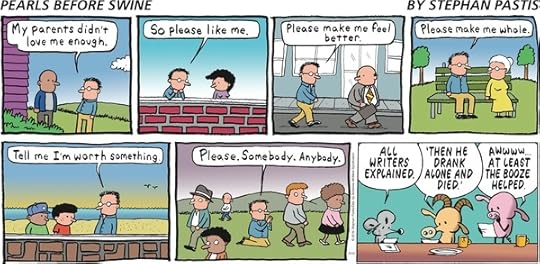
Stephan Pastis' Pearls Before Swine comic strip for March 10, 2019, struck me as beautifully apropos:
The book was published in 2008. I'd been reading reviews of the author's new book, A Terrible Country. Then, paradoxically, after reading some not-so-glowing reviews of this one, I decided to read it. The title, which I remembered having heard of, was what did it.
The book has its moments. It is essentially a series of connected short stories varying among the three protagonists, young males who were of college age in the late '90s when the book begins, and who, ten years later, are still having trouble getting off dead center. Most of the stories wend their circuitous way to some little twist with a punch to it, but not enough to carry the book.
The book is very male but in a way that makes it repellent rather than lovable by the female readership. The book is very Jewish*, and the young men are indeed ahead of their time, although in the sense of canaries in the coal mine of masculinity. Presumably (since I still haven't read it) the protagonists are in desperate need of 12 Rules for Life: An Antidote to Chaos . If the author wanted to be Roth-like in his soliloquies, he's not.
*The reason for going into the particular is that if the author goes deep enough in the right way (or, maybe, is lucky), he or she can reach a rich vein of the universal. But in the case of this book, that didn't happen.
On the other hand, the book wasn't too long or too hard to get through.
Stephan Pastis' Pearls Before Swine comic strip for March 10, 2019, struck me as beautifully apropos:

May 30, 2008
The biggest disappointment about this book is not the obvious fact that Gessen could just barely fictionalize three different aspects of himself (obsessive Jew, obsessive Russophile, obsessive politically minded do-gooder smart person) and pass them off as distinct characters, but rather that the novel--about extremely ambitious yet frustrated and self-defeating people--is itself so unambitious. At about 250 pages and with a weird skinny trim size, it's well written but not daring or adventurous or wowing. Literary, sure; young and male, undoubtedly; but mostly sad.
May 23, 2008
as somebody who didn't get any work whatsoever until i changed my email address from post.harvard.edu to gmail.com, who can vouch for the knot of humility and vanity and realness and self-mythology and narrow-minded outsider resentment and self-loathing one can find himself in upon graduation--ultra records wouldn't even hire me, ultra fucking records!--i am riding hard for this book. one of the best articulations of this very real problem i know i went through at school, and which i know others who went to good schools had to work through as well. you're white, you come from more/less nada, you don't know how to dress yourself, your parents didn't go to school, and then you meet some ridiculously wealthy and probably smoking legacy admit from some manhattan day school everybody's heard about but you. suddenly you're embarrassed of how little you know, how unsophisticated you are, how all your suit jackets are five sizes too big, but at the same time you want to shove it up everybody's ass: Against All Odds, I Made It, I Did It On My Own Merit. but so like anybody gives a shit! like anybody's supposed to be impressed with that. and so here are those eight years after commencement. three characters getting past the fact that nobody cares, that they're owed nothing; getting past the humiliation of thinking they were ever owed anything in the first place; willing themselves into tragedies because that's what they've read great young men do.

October 15, 2010
This book -- expectations for this book weren't so high thanks to so many low-star reviews on here. But, hey, it exceeded expectations. This book -- it's not a novel or a collection of linked stories. It's autofiction in which a consistent authorial presence presents itself in three barely characterized characters, each with more similiarities than differences, each with girlfriends differentiated mostly by their names (this surely intentional undercharacterization interestingly blurs the edges between author, characters, and -- most importantly -- sad young literary readers, women and men alike). The chapter called "Isaac Babel" -- about a young writer's encounters with an older writer and a sense of the young writer's inevitable assumption of the older writer's role -- this chapter is excellent, five stars, maybe up there with "Guy de Maupassant," a Babel story referenced in the chapter. Toward the end, a chapter set in the West Bank dropped this one down to three stars for me -- I skimmed it a little. But mainly I liked reading about my demographic: eg, bits about dreams/aspirations, girlfriends and ex-girlfriends, gyms, youthful self-comparisons with major past achievers, old cars, old friends marrying and making more and more money as one scrimps solo after graduate school, online and old-fashioned dating, and the sense of being too old before one's even anywhere near old. Was charmed by a classy old-school "Fitzgeraldian spirit" syntax tic -- a tic involving em dashes and repetitions, exactly like this sentence. Charmed also by the juxtaposition of Lenin et al. and the Russian Revolution etc with the characters and their situations. Disregard all reviews on here that compare this to Franzen or DeLillo or that say this book lacks ideas -- those reviewers didn't really read the book (and/or haven't read DeLillo or Franzen). There's not much plot, but there are tons of ideas and insights and asides, consistently rendered with intelligence and charm. In a somehow non-nauseating way, it's like chick lit for the n + 1 set. The title probably should have been "All the Sad Young Male Political Journalists," but that's not a catchy enough play on the early Fitzgerald story collection. Anyway, this book -- this book's certainly a good read for sad young -- and young-ish -- literary men (and, sadly perhaps, for them and them only, most likely). 3+ stars, rounded up because I'd like to see more books that feel real like this.
November 8, 2014
I enjoyed it more than I expected thanks to all the low star ratings. Confused over-educated twenty-somethings struggling with life and love in the 90s. A least it felt real.

September 15, 2008
Another summer reading recommendation from my boss, he billed this one as "literary candy," a description that I whole-heartedly repeat to you all. The strangely-titled book (reference to Fitzgerald, yet again!) follows a group of Harvard students who are swiftly cast out into the real world full of ideas and passion and nonsensical senses of self worth. Gessen does a good job of making these guys lovable, even as you realize that you'd probably hate any one of them if you overheard them bloviating in a Williamsburg bar somewhere. Gessen, an editor of the literary magazine "n+1" knows the hipster culture and he knows that people love to hate them because they so intensely love themselves, but at the same time we're entranced the moment they offer to let us into their strange, solipsistic little worlds.
It helps that all of these guys seem to have good hearts, and they wear them on their sleeves. The book is ultimately more of a collection of love stories than anything else - each of the sad, young literary men are profoundly perplexed by the fairer sex - in a way that reminded me happily of the naive loves in Fitzgerald's best stories (Ice Palace, May Day, Babylon Revisited). He also manages to thematically tie these romances into the intellectual struggles of the men. One of my favorite characters is a Jewish academic who gained himself a reputation as the future author of a Great Modern Zionist Epic before he's even ever heard of Leon Uris or Exodus. His problem is that he does not really understand Israel or the Palestinians at all, so whenever he begins arguing for Israel, he swiftly winds up conceding Eastern Jerusalem. But the best part of this story is the way Gessen mirrors the intellectual issues with the romantic ones. The character is likewise torn between two women, whom he emails frequently, even as he goes to Israel at long last to decide once and for all how he feels about the conflict (and the women).
Gessen also seamlessly incorporates a very modern, tech-savvy world for these young intellectuals, who may simultaneously have their heads stuck in Marxist tracts. One character is worried about the shrinking "size of his Google" (how many hits come up when he searches for his own name). He also keeps us rooted firmly in the new century by referencing the world politics of the past decade. In one memorable scene a character proposes to his girlfriend as Al Gore is named President. She accepts, feeling hope for the future, but then calls off the engagement as the Recount begins and Bush steps into power. The book is incredibly clever in moments like these.
Unfortunately it isn't always so clever or lively. Some of the characters fall very flat in comparison to others - in particular the one who speaks in the first person and seems to be a stand-in for Gessen himself. The book is told in chapters that alternate between the characters, so when you're away from a good one and in a bad one, it can feel irrelevant and tedious. Though there are overlaps, the book also never allows these main characters to reunite, and I found myself wishing for some scene where all these sad, young, literary men would come together at some Fitzgerald convention in Park Slope, where they'd tell stories of their loves and their wars.
It helps that all of these guys seem to have good hearts, and they wear them on their sleeves. The book is ultimately more of a collection of love stories than anything else - each of the sad, young literary men are profoundly perplexed by the fairer sex - in a way that reminded me happily of the naive loves in Fitzgerald's best stories (Ice Palace, May Day, Babylon Revisited). He also manages to thematically tie these romances into the intellectual struggles of the men. One of my favorite characters is a Jewish academic who gained himself a reputation as the future author of a Great Modern Zionist Epic before he's even ever heard of Leon Uris or Exodus. His problem is that he does not really understand Israel or the Palestinians at all, so whenever he begins arguing for Israel, he swiftly winds up conceding Eastern Jerusalem. But the best part of this story is the way Gessen mirrors the intellectual issues with the romantic ones. The character is likewise torn between two women, whom he emails frequently, even as he goes to Israel at long last to decide once and for all how he feels about the conflict (and the women).
Gessen also seamlessly incorporates a very modern, tech-savvy world for these young intellectuals, who may simultaneously have their heads stuck in Marxist tracts. One character is worried about the shrinking "size of his Google" (how many hits come up when he searches for his own name). He also keeps us rooted firmly in the new century by referencing the world politics of the past decade. In one memorable scene a character proposes to his girlfriend as Al Gore is named President. She accepts, feeling hope for the future, but then calls off the engagement as the Recount begins and Bush steps into power. The book is incredibly clever in moments like these.
Unfortunately it isn't always so clever or lively. Some of the characters fall very flat in comparison to others - in particular the one who speaks in the first person and seems to be a stand-in for Gessen himself. The book is told in chapters that alternate between the characters, so when you're away from a good one and in a bad one, it can feel irrelevant and tedious. Though there are overlaps, the book also never allows these main characters to reunite, and I found myself wishing for some scene where all these sad, young, literary men would come together at some Fitzgerald convention in Park Slope, where they'd tell stories of their loves and their wars.

March 31, 2008
So since I am a (still) recovering Gawker addict, I had to wait a while to read this. I guess there's supposed to be some kind of unspoken feud between n + 1 and McSweeney's, and since McSweeney's is one of my favorites, I had to let my knee-jerk hate-inclination subside, in order to give this book a fair chance. In fact, I wound up coming full circle, and was really looking forward to finally reading this, assuming it was going to be really smart and good.
Well. It was neither as bad as I'd feared or as good as I'd hoped. I wish I'd reviewed it a few weeks ago, right after I'd finished it, since honestly I've already kind of forgotten it. Which is a pretty bad sign.
I don't know, I mean he's of a time and of a type, right? Reminded me of The Corrections (but a little better) and Indecision (but a bit worse). It's a story about mostly nothing, by which I mean it's a bunch of twenty-something New Yorkers just moving through their post-collegiate lives and trying to find happiness and fulfillment and some kind of success. It follows a few of them for several years, through parties and jobs and marriage and getting stoned and traveling and going to grad school and having sex and being sad. That's kind of it. There's the requisite part where one of them goes overseas (to Israel, here), which I think is supposed to elevate the story out of that "twenty-something New Yorkers trying to figure out their lives" category, and kind of did, I guess, but only for a minute.
Meh. It was fine; some of the language is nice, the characters are pretty good, but it's really all very self-absorbed, very trivial. In the first chapter there are some pictures and tables thrown in at an attempt I guess to be clever? But it's not carried through and so just winds up being kind of vague and unclear. Overall a letdown, I guess.
Well. It was neither as bad as I'd feared or as good as I'd hoped. I wish I'd reviewed it a few weeks ago, right after I'd finished it, since honestly I've already kind of forgotten it. Which is a pretty bad sign.
I don't know, I mean he's of a time and of a type, right? Reminded me of The Corrections (but a little better) and Indecision (but a bit worse). It's a story about mostly nothing, by which I mean it's a bunch of twenty-something New Yorkers just moving through their post-collegiate lives and trying to find happiness and fulfillment and some kind of success. It follows a few of them for several years, through parties and jobs and marriage and getting stoned and traveling and going to grad school and having sex and being sad. That's kind of it. There's the requisite part where one of them goes overseas (to Israel, here), which I think is supposed to elevate the story out of that "twenty-something New Yorkers trying to figure out their lives" category, and kind of did, I guess, but only for a minute.
Meh. It was fine; some of the language is nice, the characters are pretty good, but it's really all very self-absorbed, very trivial. In the first chapter there are some pictures and tables thrown in at an attempt I guess to be clever? But it's not carried through and so just winds up being kind of vague and unclear. Overall a letdown, I guess.

September 28, 2014
This book doesn't pass the Bechdel test. That's a dealbreaker for me. Women here are interchangeable placeholders, and many of the women are passed from character to character throughout the book. We're not supposed to be interested in their inner lives.
Much of the prose is nice. I read most of this in one sitting. It's nicely written, but not something I would revisit.
A final note of interest: this book is only six years old, but appears to be written in another age with respect to its curiousity towards cell phones and the internet. It was written just before everything changed, it seems.
Much of the prose is nice. I read most of this in one sitting. It's nicely written, but not something I would revisit.
A final note of interest: this book is only six years old, but appears to be written in another age with respect to its curiousity towards cell phones and the internet. It was written just before everything changed, it seems.

July 21, 2013
I will likely not remember much about this book in a couple weeks - Gessen is safe in the middle-class white guy loveless existential New England here's-an-ironic-exclamation-point! (Joshua Ferris, Sam Lipsyte) canon. But I like those fellas just fine. I wasn't compelled to read this and got sidetracked by a horror anthology (my own fault - who wants to read about a depressed grad student in Syracuse when a) the reader herself is a depressed grad student and b) Harlan Ellison's 'I Have No Mouth and I Must Scream' aka HOLY GOD WTF NIGHTMARES is available?!) but when I picked this back up, it was a refreshing break from the other book I'm reading, Ben Marcus's psycho-pedia (psycho encyclopedia) "The Age of Wire and String." And then there was this:
"We hurt one another. We go through life dressing up in new clothes and covering up our true motives. We meet up lightly, we drink rose wine, and then we give each other pain. We don't want to! What we want to do, what one really wants to do is put out one's hands--like some dancer, in a trance, just put out one's hands--and touch all the people and tell them: I'm sorry. I love you. Thank you for your email. Thank you for coming to see me. Thank you. But we can't. We can't...And so, thwarted, we inflict pain. That's what we do. We do not keep each other company. We do not send each other cute text messages. Or, rather, when we do these things, we do them merely to postpone the moment when we'll push these people off, and beat forward, beat forward on our little raft, alone."
Gessen is a tremendous writer and I look forward to his next novel - hopefully I will not be a depressed grad student by then.
"We hurt one another. We go through life dressing up in new clothes and covering up our true motives. We meet up lightly, we drink rose wine, and then we give each other pain. We don't want to! What we want to do, what one really wants to do is put out one's hands--like some dancer, in a trance, just put out one's hands--and touch all the people and tell them: I'm sorry. I love you. Thank you for your email. Thank you for coming to see me. Thank you. But we can't. We can't...And so, thwarted, we inflict pain. That's what we do. We do not keep each other company. We do not send each other cute text messages. Or, rather, when we do these things, we do them merely to postpone the moment when we'll push these people off, and beat forward, beat forward on our little raft, alone."
Gessen is a tremendous writer and I look forward to his next novel - hopefully I will not be a depressed grad student by then.

April 6, 2011
All the Sad Young Literary Men by Keith Gessen made a big splash when it came out a few years ago. I remember that. I also remember lots of complaints about it being too self-consciously self-conscious. Also self-indulgent. In that odd sense of ruminating on one's suffering that is caused (mostly) by oneself. One's drinking, not committing enough to relationships.
I think all of the above is true. Nonetheless, I really, really enjoyed this book. I found it funny and kind of true and, did I say, funny?
And a lot of it takes place in New York City.
And I've read a lot of reviews on GR with the same complaints and I find myself nodding at the reviews and laughing in some kind of agreement.
But then I have to admit, I liked the writing a lot. I was interested in the 3 main male characters (even if they really are sort of only one actual person and not very distinguishable from each other-I liked him in his different guises). And if the book didn't make me laugh out loud, it did make me smile. Often.
So I'd recommend it, if you like reading about boy-men trying to figure out their lives during their twenties & mostly making mistakes and behaving badly but able to endlessly articulate their feelings and thoughts on the subject.
Which apparently I do.
I think all of the above is true. Nonetheless, I really, really enjoyed this book. I found it funny and kind of true and, did I say, funny?
And a lot of it takes place in New York City.
And I've read a lot of reviews on GR with the same complaints and I find myself nodding at the reviews and laughing in some kind of agreement.
But then I have to admit, I liked the writing a lot. I was interested in the 3 main male characters (even if they really are sort of only one actual person and not very distinguishable from each other-I liked him in his different guises). And if the book didn't make me laugh out loud, it did make me smile. Often.
So I'd recommend it, if you like reading about boy-men trying to figure out their lives during their twenties & mostly making mistakes and behaving badly but able to endlessly articulate their feelings and thoughts on the subject.
Which apparently I do.

July 27, 2011
This book was beyond terrible. I'm truly sorry I bought it, and if I could get my money back in some way, I would. It's incredibly pretentious, but not even in a way where I have to at least grudgingly admit that it's well-written, or funny, or intelligent, or insightful... because this book is none of those things. So on top of NOT being the least bit smart or funny or insightful it's painfully pretentious. It's also banal and flat-out boring. The characters in this book are the same annoying guys the literary world has been saddled with for decades, and I just can't take anymore. They all read like they're probably just whiny wank-fest navel-gazing facets of their authors. I don't think I can possibly say enough about how crappy and mediocre this book was, and I don't really have the energy to try. When I think about it, I fall into a stupor wondering how it is that things like this ever get published, and that line of thinking almost inevitably ends with me lamenting but also feeling increasingly like I understand why print media is dying. THIS BOOK IS NOT WORTH THE PAPER IT IS PRINTED ON, AND TIME SPENT READING IT IS TIME FROM YOUR LIFE WASTED.
Read
August 26, 2024I have been robbed of all naivety

August 25, 2014
A novel pretty much designed for me: all of the characters (who are in fact one; thinly disguised autobiographical iterations whom I still had difficulty telling apart by the book's end) are solipsistic, awkward, obsessively bookish young white males who intersperse dating failures and study of obscure history/economics/politics with angst about their direction in life. And in that respect it works. I get a kick out of vicariously living my ideated Brooklyn lifestyle of lit parties, cheap theatre and foreign film, unironic discussion of Marxism, and the Indian summer of grad school in the humanities.
Still, Gessen - a founding editor of the soi-disant reincarnation of the Partisan Review, n + 1 - writes like the person he is: an enormously overeducated social critic and Russian history expert, and not a fiction writer. A natural pairing to this is last year's The Love Affairs of Nathaniel P., which wears its literary and intellectual references much more lightly, and passes on the momentum conserved into character building and plot. There are only a number of times that a protagonist can compare his relationship to the Menshevik revolutionaries before the reader's patience wanes.
In brief: three young men endure conflict about their love lives, a dissertation and the defence thereof, the Israeli-Palestinian conflict, being a young writer, and the Bush administration. Paper-thin references to real life people (Noam Chomsky, Al Gore and his daughter,Saul Bellow oops, apparently someone called Lee Siegel) and newspapers (Dissent, The "so-called liberal" New Republic) abound. There isn't much else to it. If you're interested in this scene and these types of people, then you'll probably be pleased with this book. Which I was.
Still, Gessen - a founding editor of the soi-disant reincarnation of the Partisan Review, n + 1 - writes like the person he is: an enormously overeducated social critic and Russian history expert, and not a fiction writer. A natural pairing to this is last year's The Love Affairs of Nathaniel P., which wears its literary and intellectual references much more lightly, and passes on the momentum conserved into character building and plot. There are only a number of times that a protagonist can compare his relationship to the Menshevik revolutionaries before the reader's patience wanes.
In brief: three young men endure conflict about their love lives, a dissertation and the defence thereof, the Israeli-Palestinian conflict, being a young writer, and the Bush administration. Paper-thin references to real life people (Noam Chomsky, Al Gore and his daughter,

November 29, 2012
Ladies and gentlemen, I present to you the intellectual Jonathan Tropper. His debut novel is authored by the scholar's scholar, the Harvard grad's Harvard grad. And while these characters are neither relateable to most people nor very likeable, Gessen does manage to entertain. Truthfully, this book did not deserve four stars. This book was a solid 3.6, maybe even a weak 3.7, but Goodreads does not allow for decimal points, and so I rounded up.
It's an entertaining novel that Gessen has written, and one that doesn't take long to read. Some of the parts, especially Mark's are among the funniest passages I've come across in ages (I found the "my Google is shrinking" scene to be especially comic). It is deserving of the "unambitious" label it has received by many people, but I wonder if that's only because of Gessen's n+1 background. Most novelists aren't subjected to such criticism, and I think it's unfair to assume every novel that's published is going to be the new Recognitions.
What I did not like, decidedly, about the book was Gessen's affinity for taking stabs at other writers. In one scene, two characters snicker at John Irving and there is an attack on the wardrobe choices of the late Christopher Hitchens. Gessen has some nerve to be criticizing writers who have achieved far more than he has, and, truthfully, are far better than him.
In any case, I was satisfied by All The Sad, Young, Literary Men. It was not The Great American Novel, but I am looking forward to Gessen's next book nonetheless.
It's an entertaining novel that Gessen has written, and one that doesn't take long to read. Some of the parts, especially Mark's are among the funniest passages I've come across in ages (I found the "my Google is shrinking" scene to be especially comic). It is deserving of the "unambitious" label it has received by many people, but I wonder if that's only because of Gessen's n+1 background. Most novelists aren't subjected to such criticism, and I think it's unfair to assume every novel that's published is going to be the new Recognitions.
What I did not like, decidedly, about the book was Gessen's affinity for taking stabs at other writers. In one scene, two characters snicker at John Irving and there is an attack on the wardrobe choices of the late Christopher Hitchens. Gessen has some nerve to be criticizing writers who have achieved far more than he has, and, truthfully, are far better than him.
In any case, I was satisfied by All The Sad, Young, Literary Men. It was not The Great American Novel, but I am looking forward to Gessen's next book nonetheless.

February 8, 2011
Ugh. I got about 50 pages into this book and realized I didn't care about any of the characters at all. In fact, I found them all totally insufferable. If it had been an ordinary day, I would've pretty much abandoned the book right then. But I was on jury duty, sitting in an uncomfortable chair in City Hall, with no clear end to the day and no other books with me. So I kept on. Eventually, at about the 150 page mark, I began to care about the characters a little. After jury duty ended, I decided to finish the book, expecting that as I went on, I would care about the characters more and more. That never happened. I never cared about them more than a little. Wow, were they irritating. Maybe they were supposed to be, but that doesn't exactly make them any more fun to read about. And what was up with the photos at the beginning? Did Keith Gessen intend to put photos all through the book, but eventually realized it was a stupid idea? It is a stupid idea, mind you, but he should have removed the ones from the beginning of the book, to make it all a little less random.
In the second half of the book, there were a few good lines, even moving, touching lines, scattered here and there. That only made things worse. It made it seem like there was a legitmately good book in there somewhere, and it never made it out. Pass on this one.
In the second half of the book, there were a few good lines, even moving, touching lines, scattered here and there. That only made things worse. It made it seem like there was a legitmately good book in there somewhere, and it never made it out. Pass on this one.

August 10, 2008
This is not a bad book. I thought it offered a fairly convincing depiction of what I observe around me most days here in the subways, parks, and especially cafés of Brooklyn, USA. But that's the problem: I would never imagine writing a novel of potential mild interest to so few. The audience that might actually find this book a good, even compelling read, may perhaps only be found in a few forward-thinking but sleepy literary outposts like Trondheim or Aarhus (and I may well be doing these Nordic college towns a disservice here), comfortable (albeit chilly) environments in which a significant number of young fluent-English-reading men of letters may actually have little enough to worry or enthuse about to be capable of considering the early midlife crises of depressed young men with aspirations to love and publish in Northeastern metropolitan areas and of course, especially, in New York City, relatively glamorous and moderately inspirational. Perhaps nowhere else in the world could anyone be bothered.
I did, however, think the part where Sam goes to Israel was pretty exciting.
I did, however, think the part where Sam goes to Israel was pretty exciting.

November 4, 2008
I first encountered this book through a review in Slate, and it was of relatively little interest. Cut forward to a long, dismal drive from my sister's high school graduation back to my college. It was Saturday night, the girl I'd been seeing wasn't picking up her phone, and I was staring down the Iowa blacktop listening to a long, unhappy reading from this very book on NPR. I decided to buy a 40.
And remarkably, that's how I felt whenever I read this. It was affecting, but I can say it's only affecting because of my present circumstances: 21, in a gentrifying neighborhood in a major city far from home, working temp jobs, immature, unable to hold down a relationship. On the whole, the writing is pleasantly Franzen-esque, but there is very little progression, just some miserable sketches of people who remind me of people I know. If you're a sad young literary man, then go for it. Otherwise, I'm not sure how much you'll get out of it.
And remarkably, that's how I felt whenever I read this. It was affecting, but I can say it's only affecting because of my present circumstances: 21, in a gentrifying neighborhood in a major city far from home, working temp jobs, immature, unable to hold down a relationship. On the whole, the writing is pleasantly Franzen-esque, but there is very little progression, just some miserable sketches of people who remind me of people I know. If you're a sad young literary man, then go for it. Otherwise, I'm not sure how much you'll get out of it.
June 15, 2010
I'm not an expert in Russian literature by any means, so this could be way off base, but I see a similar tone in All the Sad Young Literary Men to some of the great Russian short stories. A detached Life is Absurd! Men are fools! Women are fools for letting their men be fools! minimalism. That's why, even though I can't say that I loved this book and agree with a lot of the criticisms (all three boys sound the same, etc.), I feel bad for Gessen because I think that at another time his book might have been more successful. This kind of writing is just not that fashionable right now, honestly.
I give it only 3 stars because I like my satire (all my novels really) a little more pointed and ambitious... because I am a pathetic American.
I give it only 3 stars because I like my satire (all my novels really) a little more pointed and ambitious... because I am a pathetic American.

April 10, 2008
Check out the review at the Hipster Book Club.
Basically, it started out making me wanting to hurt the characters and the author for being such snobby little whiners, but by the end...well, I still thought they were snots, but I felt like I understood them better and was more forgiving.
Basically, it started out making me wanting to hurt the characters and the author for being such snobby little whiners, but by the end...well, I still thought they were snots, but I felt like I understood them better and was more forgiving.

October 5, 2021
Yes, the prose can be pompous at times, and the storyline chaotic, but Gessen has a keen eye for the difficulties of growing up in the 21st century. No solutions are given, but I found many situations to be painfully recognisable, in both a funny and melancholic way. If you are able to look past its flaws, this is an intriguing read.

November 1, 2021
The top reviews here seem oddly hostile. Oh well. It's an enjoyable debut, unless variations on the theme of "Navel-Gazing White Male Ponders His Place in the Humanities" sends you into fits of conniption.
Read
August 2, 2023And still the trash got picked up, and the subways kept running.

Read
March 12, 2024sloppy reading about twenty-something men fucking around? left-wing and right-wing and palestine and israel and bolshevik and menshevik and they all merge together-

February 23, 2011
Someone I follow on Twitter posted a link to someone else’s blog where the author was providing book recommendations for anyone and everyone who commented based on the last five books each person had read. It was an incredible performance—over one hundred people commented, and each recommendation provided was unique and something the guy had read. Intrigued and impressed, I posted my last five and received Keith Gessen’s All the Sad Young Literary Men as a recommendation.
It’s pretty good. There were several moments that I greatly enjoyed, but there were also parts that really frustrated me, and even some things that I simply did not understand. The book reminds me of the Milan Kundera books I’ve read (The Book of Laughter and Forgetting and The Unbearable Lightness of Being) in that they are located at the intersection of character/identity, love/relationships, and politics. In ATSYLM, these issues are all equally important and interrelated for the three characters we follow. This was part of what I did not understand; there’s a lot in this book about early 20th Century Russian politics (the Bolsheviks) and the Israel/Palestine conflict in the 1990s and 2000s—neither of which I can even pretend to know anything about. I tried to take it in stride and just pick up what I could, but I felt like I was missing out on something important. I studied Kundera’s The Book of Laughter and Forgetting in a college course and the political background was quite significant to the novel. I don’t think it’s as critical in Gessen’s novel, but it certainly plays a large role.
There are nine chapters in ATSYLM, each focused on one of three characters—Keith, Sam, or Mark. In a way, the book almost feels more like a collection of short stories, especially in the way each chapter ends. They have that somewhat unresolved ending that I always feel when reading a short story; you get a portrait of a character and not much more—no grand, sweeping, tie-it-all-up conclusions or anything like that. These three characters are quite similar—most notably in how outrageously earnest they all are. At times I found I could relate—some of the depictions of college life and expectations and girls and stuff were spot on—but these guys’ seriousness occasionally became annoying. It reminded me a bit of the movie Metropolitan, though less… not “whimsical”… I guess I’ll say “happy.” There is a feeling of inevitability in ATSYLM; the characters seem doomed to be melancholy. If they’d just chill out for a second and just take things as they come and not think too much!!! I saw a lot of collegiate Mike Knepper in this book, and I’m really glad to say that I feel like I don’t relate to Keith, Sam, and Mark quite as strongly now as I would have a year or two ago.
So, I mostly enjoyed the book but occasionally got frustrated with it. This book is first and foremost interested in and concerned about character, from which I personally feel a bit detached. I think that many readers will find Gessen’s observations about people—not only the three sad young literary men but also their roommates and girlfriends and others—quite insightful, accurate, and enjoyable, if you’re into those kinds of observations. I myself have always been a little confused by character sketches—in books but also and more often in real life. My friends will tell me stories about other people and describe individuals in various ways, and I really have a tough time grasping the descriptions and forming a picture or idea of this person, whereas others I know can connect and understand what the storyteller is trying to get at right away. I guess I have a hard time placing people into “types.” I’ve thought about this issue quite a bit; I wonder what it says about me individually and socially. And, how would someone describe me when relating a story to a different group of people? “This kid Mike Knepper, he’s the kind of guy who…” I’m not really worried or concerned about how other people present me or generalize me. I’m just somewhat curious, because I have a hard time making those kinds of statements about people myself, or understanding them about others when they are told to me. Anyways, I’m rambling now.
It’s pretty good. There were several moments that I greatly enjoyed, but there were also parts that really frustrated me, and even some things that I simply did not understand. The book reminds me of the Milan Kundera books I’ve read (The Book of Laughter and Forgetting and The Unbearable Lightness of Being) in that they are located at the intersection of character/identity, love/relationships, and politics. In ATSYLM, these issues are all equally important and interrelated for the three characters we follow. This was part of what I did not understand; there’s a lot in this book about early 20th Century Russian politics (the Bolsheviks) and the Israel/Palestine conflict in the 1990s and 2000s—neither of which I can even pretend to know anything about. I tried to take it in stride and just pick up what I could, but I felt like I was missing out on something important. I studied Kundera’s The Book of Laughter and Forgetting in a college course and the political background was quite significant to the novel. I don’t think it’s as critical in Gessen’s novel, but it certainly plays a large role.
There are nine chapters in ATSYLM, each focused on one of three characters—Keith, Sam, or Mark. In a way, the book almost feels more like a collection of short stories, especially in the way each chapter ends. They have that somewhat unresolved ending that I always feel when reading a short story; you get a portrait of a character and not much more—no grand, sweeping, tie-it-all-up conclusions or anything like that. These three characters are quite similar—most notably in how outrageously earnest they all are. At times I found I could relate—some of the depictions of college life and expectations and girls and stuff were spot on—but these guys’ seriousness occasionally became annoying. It reminded me a bit of the movie Metropolitan, though less… not “whimsical”… I guess I’ll say “happy.” There is a feeling of inevitability in ATSYLM; the characters seem doomed to be melancholy. If they’d just chill out for a second and just take things as they come and not think too much!!! I saw a lot of collegiate Mike Knepper in this book, and I’m really glad to say that I feel like I don’t relate to Keith, Sam, and Mark quite as strongly now as I would have a year or two ago.
So, I mostly enjoyed the book but occasionally got frustrated with it. This book is first and foremost interested in and concerned about character, from which I personally feel a bit detached. I think that many readers will find Gessen’s observations about people—not only the three sad young literary men but also their roommates and girlfriends and others—quite insightful, accurate, and enjoyable, if you’re into those kinds of observations. I myself have always been a little confused by character sketches—in books but also and more often in real life. My friends will tell me stories about other people and describe individuals in various ways, and I really have a tough time grasping the descriptions and forming a picture or idea of this person, whereas others I know can connect and understand what the storyteller is trying to get at right away. I guess I have a hard time placing people into “types.” I’ve thought about this issue quite a bit; I wonder what it says about me individually and socially. And, how would someone describe me when relating a story to a different group of people? “This kid Mike Knepper, he’s the kind of guy who…” I’m not really worried or concerned about how other people present me or generalize me. I’m just somewhat curious, because I have a hard time making those kinds of statements about people myself, or understanding them about others when they are told to me. Anyways, I’m rambling now.

June 1, 2015
Con este título tan prometedor, pensé que sería una novela que marcaría una etapa de mi vida o que, por lo menos, tenía muchísimo que ofrecer. No fue así. A pesar de que me resultó entretenido, carece de cohesión para hacerla una gran novela. A mí me enganchó, pero sólo por el hecho de querer terminarlo en un santiamén.
La novela gira en torno a tres personajes: Mark, Sam y Keith. Los tres son unos veinteañeros con esperanzas de hacer grandes cosas, pero, realmente, son unos fracasados. Piensan demasiado y no tienen éxito en sus relaciones amorososas. Ni en nada. Así que, a primer momento (y a segundo y a tercero), son unos imbéciles que quieren ser cosas que saben que nunca serán. Tratan de corregirse pero, simplemente, caen en los mismos errores, una y otra vez.
Mi gran problema es que Todos los jóvenes tristes y literarios podría tener unas cincuente páginas menos y muchos menos personajes. Mark, Sam y Keith parecen ser el mismo personaje multiplicado por tres. Los tres son la misma persona pero con historias y conflictos diferentes. Los tres se relacionan con lo judío, son universitarios y viven en Nueva York. Los tres creen que serán lo mejor del mundo, pero no lo son.
Pensé que la narración sería un poco mejor. Incluso pensé que me pintarían una Nueva York triste y gris, pero ni eso. Todo se centra en los personajes imbéciles que no tienen la capacidad de madurar. Simplemente me hubiese gustado una narración más agradable, pero lo que entiendo que quiso hacer Gessen fue representar la vida no deseada de estos jóvenes. No entendí, de todas formas, las foto de Clinton y Al Gore, de Lewinski, de Lincoln. No tiene ningún sentido para mí. No representan nada para la historia.
Lo bueno y lo que me gustó fue que me sentí un poco identificada. Sé lo que es querer un futuro prometedor y lleno de grandes cosas, pero entiendo que eso no se le da a todo el mundo. Aquí, en la novela, no se le da a sus protagonistas. Y está bien. Hay que aprender a vivir con ello. De resto, siento que son unos chiquillos en cuerpos de adultos. Me hubiese gustado que los protagonistas hubieran aprendido a vivir más con el pesimismo. Y una cita que me gustó:
Finalmente, supongo que Gessen está personificado en el personaje de Keith, pues es el único personaje que habla en primera persona. La novela tiene varios atisbos de súper inteligencia intelectual que no cae mal pero que suele ser un poco forzado. Me recuerda un poco a esas comedias románticas que no tienen buenas críticas en el cine. También me recuerda un poco a Palahniuk, pero un poco más light. Estuvo bien, pero es bastante olvidable y puedes morir sin haberlo leído. Definitivamente, si Keith Gessen escribe todo así, no volvería a leer más nada de él. Ni que sea uno de los jóvenes más brillantes de su generación.
PD: Necesito la media estrellita en goodreads. Admito que Todos los jóvenes tristes y literarios es más un 2,75.
La novela gira en torno a tres personajes: Mark, Sam y Keith. Los tres son unos veinteañeros con esperanzas de hacer grandes cosas, pero, realmente, son unos fracasados. Piensan demasiado y no tienen éxito en sus relaciones amorososas. Ni en nada. Así que, a primer momento (y a segundo y a tercero), son unos imbéciles que quieren ser cosas que saben que nunca serán. Tratan de corregirse pero, simplemente, caen en los mismos errores, una y otra vez.
Mi gran problema es que Todos los jóvenes tristes y literarios podría tener unas cincuente páginas menos y muchos menos personajes. Mark, Sam y Keith parecen ser el mismo personaje multiplicado por tres. Los tres son la misma persona pero con historias y conflictos diferentes. Los tres se relacionan con lo judío, son universitarios y viven en Nueva York. Los tres creen que serán lo mejor del mundo, pero no lo son.
Pensé que la narración sería un poco mejor. Incluso pensé que me pintarían una Nueva York triste y gris, pero ni eso. Todo se centra en los personajes
Lo bueno y lo que me gustó fue que me sentí un poco identificada. Sé lo que es querer un futuro prometedor y lleno de grandes cosas, pero entiendo que eso no se le da a todo el mundo. Aquí, en la novela, no se le da a sus protagonistas. Y está bien. Hay que aprender a vivir con ello. De resto, siento que son unos chiquillos en cuerpos de adultos. Me hubiese gustado que los protagonistas hubieran aprendido a vivir más con el pesimismo. Y una cita que me gustó:
- Cuando eres joven - dijo Morris, mirando por la ventana, dándonos la espalda -, y vas a lo tuyo, y lo tienes todo por delante y a todos a tu alrededor, no conoces a nadie más, y miras a los demás con sus vidas jodidas, y sabes que harás las cosas de otra manera, sabes que lo conseguirás y lo consigues. Eres más amable, más simpático, más listo. Y un buen día observas que has hecho todo lo que dijiste que ibas a hacer, pero, de alguna manera, te has olvidado de algo, pasó algo en el ínterin y todo el mundo ha desaparecido, todo es diferente, y miras a tu alrededor y te das cuenta de que te has jodido la vida igual que todos los demás idiotas. Y eso es lo que hay. (p.89)
Finalmente, supongo que Gessen está personificado en el personaje de Keith, pues es el único personaje que habla en primera persona. La novela tiene varios atisbos de súper inteligencia intelectual que no cae mal pero que suele ser un poco forzado. Me recuerda un poco a esas comedias románticas que no tienen buenas críticas en el cine. También me recuerda un poco a Palahniuk, pero un poco más light. Estuvo bien, pero es bastante olvidable y puedes morir sin haberlo leído. Definitivamente, si Keith Gessen escribe todo así, no volvería a leer más nada de él. Ni que sea uno de los jóvenes más brillantes de su generación.
PD: Necesito la media estrellita en goodreads. Admito que Todos los jóvenes tristes y literarios es más un 2,75.

September 20, 2012
Gessen was supposed to be the next big lit star, but the portion of the lit world he was aiming at was nursing the hangover they'd developed with Dave Eggers. Speaking of Eggers, I find some of the slack writing found in Eggers' You Shall Know Our Velocity in the "Sam" portion of ATSYLM that is set in Israel. Certainly if he'd written something that became as trendy as Eggers' A Heartbreaking Work of Staggering Genius his name would be on everyone's tongue. But this book didn't have the power to create that situation. Whatever.
I like coming of age stories (although by their post grad years I guess the characters -- Mark, Keith and Sam -- pretty much already came) but it was interesting to remember that Gessen had fairly recently been through the college gauntlet. I got the impression that with a bit more distance of years youthful missteps in the writing could have been avoided. Did he really need three main characters, who all basically do the same stuff with only slight variation? One strong character and a hundred pages lopped off from this would have made a strong Saul Bellowesque novella. Give Gessen points for good black humor (don't soil your underwear if an Israeli tank is bearing down on you) take a couple away for writing ticks, a la repetition of the phrase "but what's more."
I'm aware that Gessen's generation is something of a throwback to the old days' version of sensitive literatis: drunk, depressed and complaining about absolutely every aspect of the world that somehow doesn't groove to their personal beat. Sad literary men indeed. But being youthful post-college guys, they can't be really meaningfully sad, a la Scott Fitzgerald's persona in The Crack-Up, so I guess we'll have to settle for complaining. (All The Whining Young Literary Men sort of rings a cracked bell though, doesn't it?)
Alright, I'm done with the nit-picking. I did like the book. And the author's voice, though it wavered here and there, was appealing. I even had a few epiphanies when he allowed me to connect my own college experiences to the stories within the novel. A few more would have been nice though.
This book will appeal to the same types as the main characters, might not appeal much to women and certainly should be avoided by the beach read crowd. As for the world history and current event stuff that's sort of strapped to the narrative creating a cushion around the characters in case they seem too one dimensional (stopping story progress such as it is and only slightly helping to delineate said characters): it may appeal to someone, though I wonder who that might be.
I like coming of age stories (although by their post grad years I guess the characters -- Mark, Keith and Sam -- pretty much already came) but it was interesting to remember that Gessen had fairly recently been through the college gauntlet. I got the impression that with a bit more distance of years youthful missteps in the writing could have been avoided. Did he really need three main characters, who all basically do the same stuff with only slight variation? One strong character and a hundred pages lopped off from this would have made a strong Saul Bellowesque novella. Give Gessen points for good black humor (don't soil your underwear if an Israeli tank is bearing down on you) take a couple away for writing ticks, a la repetition of the phrase "but what's more."
I'm aware that Gessen's generation is something of a throwback to the old days' version of sensitive literatis: drunk, depressed and complaining about absolutely every aspect of the world that somehow doesn't groove to their personal beat. Sad literary men indeed. But being youthful post-college guys, they can't be really meaningfully sad, a la Scott Fitzgerald's persona in The Crack-Up, so I guess we'll have to settle for complaining. (All The Whining Young Literary Men sort of rings a cracked bell though, doesn't it?)
Alright, I'm done with the nit-picking. I did like the book. And the author's voice, though it wavered here and there, was appealing. I even had a few epiphanies when he allowed me to connect my own college experiences to the stories within the novel. A few more would have been nice though.
This book will appeal to the same types as the main characters, might not appeal much to women and certainly should be avoided by the beach read crowd. As for the world history and current event stuff that's sort of strapped to the narrative creating a cushion around the characters in case they seem too one dimensional (stopping story progress such as it is and only slightly helping to delineate said characters): it may appeal to someone, though I wonder who that might be.
Displaying 1 - 30 of 302 reviews