

What do you think?
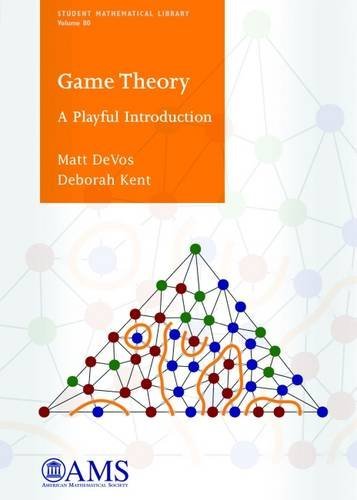
Game Theory: A Playful Introduction
This book offers a gentle introduction to the mathematics of both sides of game combinatorial and classical. The combination allows for a dynamic and rich tour of the subject united by a common theme of strategic reasoning. The first four chapters develop combinatorial game theory, beginning with an introduction to game trees and mathematical induction, then investigating the games of Nim and Hackenbush. The analysis of these games concludes with the cornerstones of the Sprague-Grundy Theorem and the Simplicity Principle. The last eight chapters of the book offer a scenic journey through the mathematical highlights of classical game theory. This contains a thorough treatment of zero-sum games and the von Neumann Minimax Theorem, as well as a student-friendly development and proof of the Nash Equilibrium Theorem. The Folk Theorem, Arrow's voting paradox, evolutionary biology, cake cutting, and other engaging auxiliary topics also appear. The book is designed as a textbook for an undergraduate mathematics class. With ample material and limited dependencies between the chapters, the book is adaptable to a variety of situations and a range of audiences. Instructors, students, and independent readers alike will appreciate the flexibility in content choices as well as the generous sets of exercises at various levels.
- GenresMathematics
343 pages, Paperback
Published December 27, 2016
Ratings & Reviews
Friends & Following
Create a free account to discover what your friends think of this book!
Community Reviews
Displaying 1 - 2 of 2 reviews

December 14, 2024
An important caveat: I only glossed over the second half of the book because I am mainly interested in two-player, zero-sum games.
With that said, I found the authors’ approach very interesting and different from other introductory books I have read in the area. First, this is the only book I’ve encountered that introduced combinatorics and normal games. Other game theory books I’ve read have skipped these kinds of games entirely. The authors do point out that they are talking about different fields. Second, this is the only book I’ve encountered that relied on vector and matrix math for explanations and proofs. I found that difference very interesting and helpful. Not only did I get to remind myself how matrix multiplication works, this approach gave me a different perspective on some of the same game theory problems and concepts. Third, they often introduce and rely on mathematical proofs. I found their moves from specific examples to general proofs to be helpful. At times, the math was more than I could handle but I felt that their explanations were plain enough that, when I didn’t understand notation or concepts, I could easily find more basic information elsewhere.
All in all, I found this book to be significantly different from other introductory game theory texts, almost always in positive ways. Because it is written from a mathematical perspective, I found it to be on the outer edge of introductory texts and I don’t think I could appropriately call it non-technical but it is close to that. Since it is on the edge of both introductory and non-technical, I don’t recommend starting your study of game theory here but it is definitely worth reading to expand your understanding.
With that said, I found the authors’ approach very interesting and different from other introductory books I have read in the area. First, this is the only book I’ve encountered that introduced combinatorics and normal games. Other game theory books I’ve read have skipped these kinds of games entirely. The authors do point out that they are talking about different fields. Second, this is the only book I’ve encountered that relied on vector and matrix math for explanations and proofs. I found that difference very interesting and helpful. Not only did I get to remind myself how matrix multiplication works, this approach gave me a different perspective on some of the same game theory problems and concepts. Third, they often introduce and rely on mathematical proofs. I found their moves from specific examples to general proofs to be helpful. At times, the math was more than I could handle but I felt that their explanations were plain enough that, when I didn’t understand notation or concepts, I could easily find more basic information elsewhere.
All in all, I found this book to be significantly different from other introductory game theory texts, almost always in positive ways. Because it is written from a mathematical perspective, I found it to be on the outer edge of introductory texts and I don’t think I could appropriately call it non-technical but it is close to that. Since it is on the edge of both introductory and non-technical, I don’t recommend starting your study of game theory here but it is definitely worth reading to expand your understanding.

December 19, 2022
approccio un po' diverso alla teoria dei giochi
La cosa più strana di questo libro è che parte con la teoria combinatoria dei giochi, che sono davvero in pochi ad associare alla teoria classica (e in effetti i giochi sono di tipo completamente diverso). I primi quattro capitoli sono così dedicati a giochi come Nim e Hackenbush e al teorema di Sprague-Grundy, ben noti a chi abbia letto Winning Ways for Your Mathematical Plays. La parte di teoria dei giochi classica giunge fino ai giochi cooperativi e a un accenno ai giochi a più persone, terminando - spiazzando un'altra volta chi arriva alla teoria dei giochi dall'economia - al teorema di impossibilità di Arrow. Alcune parti più tecniche sono lasciate in appendice per i più coraggiosi. Devo dire che ho molto apprezzato questo approccio, proprio perché permette di vedere le cose in modo diverso dal solito.
La cosa più strana di questo libro è che parte con la teoria combinatoria dei giochi, che sono davvero in pochi ad associare alla teoria classica (e in effetti i giochi sono di tipo completamente diverso). I primi quattro capitoli sono così dedicati a giochi come Nim e Hackenbush e al teorema di Sprague-Grundy, ben noti a chi abbia letto Winning Ways for Your Mathematical Plays. La parte di teoria dei giochi classica giunge fino ai giochi cooperativi e a un accenno ai giochi a più persone, terminando - spiazzando un'altra volta chi arriva alla teoria dei giochi dall'economia - al teorema di impossibilità di Arrow. Alcune parti più tecniche sono lasciate in appendice per i più coraggiosi. Devo dire che ho molto apprezzato questo approccio, proprio perché permette di vedere le cose in modo diverso dal solito.
Displaying 1 - 2 of 2 reviews