

What do you think?

The Frozen Thames
A groundbreaking, genre-bending new work from one of Canada’s most respected writers.
In its long history, the River Thames has frozen solid forty times. These are the stories of that frozen river.
And so opens one of the most breathtaking and original works being published this season. The Frozen Thames contains forty vignettes based on events that actually took place each time the river froze between 1142 and 1895. Like a photograph captures a moment, etching it forever on the consciousness, so does Humphreys’ achingly beautiful prose. She deftly draws us into these intimate moments, transporting us through time so that we believe ourselves observers of the events portrayed. Whether it’s Queen Matilda trying to escape her besieged castle in a snowstorm, or lovers meeting on the frozen river in the plague years; whether it’s a simple farmer persuading his oxen the ice is safe, or Queen Bess discovering the rare privacy afforded by the ice-covered Thames, the moments are fleeting and transformative for the characters — and for us, too.
Stunningly designed and illustrated throughout with full-colour period art, The Frozen Thames is a triumph.
From the Hardcover edition.
In its long history, the River Thames has frozen solid forty times. These are the stories of that frozen river.
And so opens one of the most breathtaking and original works being published this season. The Frozen Thames contains forty vignettes based on events that actually took place each time the river froze between 1142 and 1895. Like a photograph captures a moment, etching it forever on the consciousness, so does Humphreys’ achingly beautiful prose. She deftly draws us into these intimate moments, transporting us through time so that we believe ourselves observers of the events portrayed. Whether it’s Queen Matilda trying to escape her besieged castle in a snowstorm, or lovers meeting on the frozen river in the plague years; whether it’s a simple farmer persuading his oxen the ice is safe, or Queen Bess discovering the rare privacy afforded by the ice-covered Thames, the moments are fleeting and transformative for the characters — and for us, too.
Stunningly designed and illustrated throughout with full-colour period art, The Frozen Thames is a triumph.
From the Hardcover edition.
192 pages, Paperback
First published October 16, 2007
About the author
Helen Humphreys
31 books437 followersHelen Humphreys is the author of five books of poetry, eleven novels, and three works of non-fiction. She was born in Kingston-on-Thames, England, and now lives in Kingston, Ontario, Canada.
Her first novel, Leaving Earth (1997), won the 1998 City of Toronto Book Award and was a New York Times Notable Book of the Year. Her second novel, Afterimage (2000), won the 2000 Rogers Writers' Trust Fiction Prize, was nominated for the Commonwealth Writers' Prize, and was a New York Times Notable Book of the Year. Her third novel, The Lost Garden (2002), was a 2003 Canada Reads selection, a national bestseller, and was also a New York Times Notable Book of the Year. Wild Dogs (2004) won the 2005 Lambda Prize for fiction, has been optioned for film, and was produced as a stage play at CanStage in Toronto in the fall of 2008. Coventry (2008) was a #1 national bestseller, was chosen as one of the top 100 books of the year by the Globe & Mail, and was chosen one of the top ten books of the year by both the Ottawa Citizen and NOW Magazine.
Humphreys's work of creative non-fiction, The Frozen Thames (2007), was a #1 national bestseller. Her collections of poetry include Gods and Other Mortals (1986); Nuns Looking Anxious, Listening to Radios (1990); and, The Perils of Geography (1995). Her latest collection, Anthem (1999), won the 2000 Canadian Authors Association Award for Poetry.
Helen Humphreys's fiction is published in Canada by HarperCollins, and in the U.S. by W.W. Norton. The Frozen Thames was published by McClelland & Stewart in Canada, and by Bantam in the U.S. Her work has been translated into many languages.
Her first novel, Leaving Earth (1997), won the 1998 City of Toronto Book Award and was a New York Times Notable Book of the Year. Her second novel, Afterimage (2000), won the 2000 Rogers Writers' Trust Fiction Prize, was nominated for the Commonwealth Writers' Prize, and was a New York Times Notable Book of the Year. Her third novel, The Lost Garden (2002), was a 2003 Canada Reads selection, a national bestseller, and was also a New York Times Notable Book of the Year. Wild Dogs (2004) won the 2005 Lambda Prize for fiction, has been optioned for film, and was produced as a stage play at CanStage in Toronto in the fall of 2008. Coventry (2008) was a #1 national bestseller, was chosen as one of the top 100 books of the year by the Globe & Mail, and was chosen one of the top ten books of the year by both the Ottawa Citizen and NOW Magazine.
Humphreys's work of creative non-fiction, The Frozen Thames (2007), was a #1 national bestseller. Her collections of poetry include Gods and Other Mortals (1986); Nuns Looking Anxious, Listening to Radios (1990); and, The Perils of Geography (1995). Her latest collection, Anthem (1999), won the 2000 Canadian Authors Association Award for Poetry.
Helen Humphreys's fiction is published in Canada by HarperCollins, and in the U.S. by W.W. Norton. The Frozen Thames was published by McClelland & Stewart in Canada, and by Bantam in the U.S. Her work has been translated into many languages.
Ratings & Reviews
Friends & Following
Create a free account to discover what your friends think of this book!
Community Reviews
Displaying 1 - 30 of 246 reviews

September 8, 2024
4.5 stars
short review for busy readers:
This illustrated volume of very short stories focuses on each of the 40 known times the River Thames has frozen solid -- an event we are told will never happen again*
Basing the stories on historic fact and including many fine details, Canadian author Helen Humphrey shows, often in a poignant fashion, how all of London came together on the ice. From royalty down to the doomed-to-hang, from farmers to the residents of London Bridge, they all were both captivated and terrified by the freezing of nature.
When the temperatures drop that low, death, starvation and unemployment is not far behind. But so is the springtime and the thaw.
These are the major themes of the stories: death, rebirth and the far-reaching, often unforeseen, changes both bring with them.
This is a book to keep on the shelf to savour, coming back to again and again to read just a few pages. A delight!
*due to modern bridge construction along the Thames and the physics of a faster flowing river, not global warming as you might immediately think.
short review for busy readers:
This illustrated volume of very short stories focuses on each of the 40 known times the River Thames has frozen solid -- an event we are told will never happen again*
Basing the stories on historic fact and including many fine details, Canadian author Helen Humphrey shows, often in a poignant fashion, how all of London came together on the ice. From royalty down to the doomed-to-hang, from farmers to the residents of London Bridge, they all were both captivated and terrified by the freezing of nature.
When the temperatures drop that low, death, starvation and unemployment is not far behind. But so is the springtime and the thaw.
These are the major themes of the stories: death, rebirth and the far-reaching, often unforeseen, changes both bring with them.
This is a book to keep on the shelf to savour, coming back to again and again to read just a few pages. A delight!
*due to modern bridge construction along the Thames and the physics of a faster flowing river, not global warming as you might immediately think.

July 8, 2020
A nice book, both in its layout and content. Forty vignettes (episodes) cover the ongoing activity that takes place on or around the river Thames. Most of the vignettes take place in London. The time period covered is from 1142 to 1885, and one gets a brief history lesson (kings and queens and plagues) as well as a feel for what every-day life was like across all those centuries — via the vignettes that are presented for each of the 40 times in its recorded history the Thames river has frozen solid.
There were many interesting facts to digest — one was presented at the very end when the author states that because of the dredging of the river and reconstruction of the London Bridge the consequent increased flow of the river prevented it from ever completely freezing over in London again. Actually the way the last story was written it was unclear to me when the last time the river Thames froze solid, but it appears to have been shortly after 1831. No matter…the book was interesting and a pleasant read. The edition I read from was a later edition (2009, Delacorte Press)…the first edition was published in 2007 by McClelland and Stewart (Canada).
Reviews:
From two blogsites:
https://peekingbetweenthepages.com/20...
https://thereadersaffair.wordpress.co...
There were many interesting facts to digest — one was presented at the very end when the author states that because of the dredging of the river and reconstruction of the London Bridge the consequent increased flow of the river prevented it from ever completely freezing over in London again. Actually the way the last story was written it was unclear to me when the last time the river Thames froze solid, but it appears to have been shortly after 1831. No matter…the book was interesting and a pleasant read. The edition I read from was a later edition (2009, Delacorte Press)…the first edition was published in 2007 by McClelland and Stewart (Canada).
Reviews:
From two blogsites:
https://peekingbetweenthepages.com/20...
https://thereadersaffair.wordpress.co...

February 13, 2015
Big family weekend so this book with it's short, three to four page vignettes was just perfect. Whenever I got the chance I picked this up and read one. All true stories of occurrences in different time periods when the Thames River froze solid. All in the wonderful prose of this amazing author, a win win situation.
September 4, 2024
Frozen in Time
A review of the Emblem Editions paperback (October 7, 2008) of the original McClelland & Stewart hardcover (October 16, 2007).
This is a delightful series of short vignettes, 2-3 pages or so each. They are snapshots of events, usually based on some historic record, which Helen Humphreys has then fictionalized to tell as a short story. It starts with Empress Matilda's escape over the frozen river Isis (the name of the Thames in Oxford) in 1142. It carries on with either events involving Royalty or with common people and merchants. Many of these centre around the Frost Fairs of entertainments organized on the frozen river. The final year portrayed is 1895.
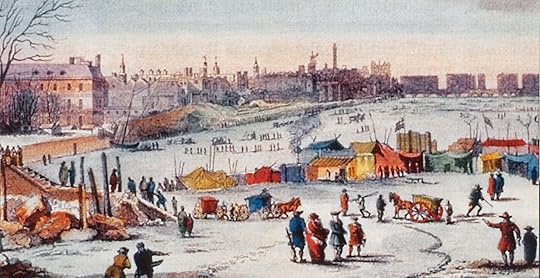
Thames Frost Fair (1683-84) painting by Thomas Wyke. Image sourced from Historic-UK.
The river was wider and moved slower in those days. The old London Bridge also acted as a barrier and would slow the waters further, allowing the freeze to happen in the main channel. Although the newer London Bridges allow for faster water passage and make for a narrowed river, there are still sections that freeze over, see the photo below for instance.
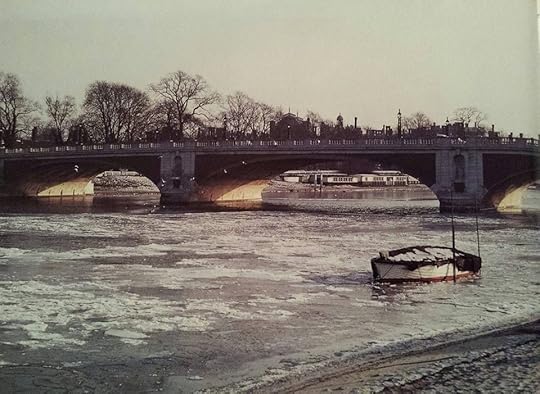
A section of the frozen Thames in the winter of 1962-63. Image sourced from Pinterest.
Footnote, Trivia and Links
* The Thames would have of course have frozen over many times before the year 1142 which is the first year of the 40 used in this book. So it would be more accurate to say 40 times since 1141 perhaps, or 40 times in the historical records of the last millennium. The Wikipedia article about Thames Frost Fairs mentions a freeze in the year 695 for instance.
Read more about the Thames Frost Fairs at a Wikipedia article here.
A review of the Emblem Editions paperback (October 7, 2008) of the original McClelland & Stewart hardcover (October 16, 2007).
In its long history, the river Thames has frozen solid forty times. These are the stories of that frozen river.* - The book's Introduction.
This is a delightful series of short vignettes, 2-3 pages or so each. They are snapshots of events, usually based on some historic record, which Helen Humphreys has then fictionalized to tell as a short story. It starts with Empress Matilda's escape over the frozen river Isis (the name of the Thames in Oxford) in 1142. It carries on with either events involving Royalty or with common people and merchants. Many of these centre around the Frost Fairs of entertainments organized on the frozen river. The final year portrayed is 1895.
Thames Frost Fair (1683-84) painting by Thomas Wyke. Image sourced from Historic-UK.
The river was wider and moved slower in those days. The old London Bridge also acted as a barrier and would slow the waters further, allowing the freeze to happen in the main channel. Although the newer London Bridges allow for faster water passage and make for a narrowed river, there are still sections that freeze over, see the photo below for instance.
A section of the frozen Thames in the winter of 1962-63. Image sourced from Pinterest.
Footnote, Trivia and Links
* The Thames would have of course have frozen over many times before the year 1142 which is the first year of the 40 used in this book. So it would be more accurate to say 40 times since 1141 perhaps, or 40 times in the historical records of the last millennium. The Wikipedia article about Thames Frost Fairs mentions a freeze in the year 695 for instance.
Read more about the Thames Frost Fairs at a Wikipedia article here.

March 4, 2012
Rating: 3.5* of five
The Book Report: It is a matter of historical record that the Thames, giant river and estuary that drains the heart of Southern England, has frozen solid forty times in the span of record-keeping that we possess. Author Humphreys sets about telling the story of these extraordinary events, one at a time, and in a very compressed and taut way, by giving us brief slices of the lives of people experiencing the once-in-a-lifetime event. Each of these stories is very, very short, and often accompanied by lovely historical illustrations of the Thames and of the Frost Fairs that took place on the mighty river.
My Review: This is a physically beautiful book. The paper is heavy matte-coated stock, perfect for the illustrations and the nature of the text. It's all too rare to find such a lovely match between subject and medium coming from a major US publishing house. I was pleasantly surprised by this.
I was a little less pleasantly impressed by the somewhat smug little Author's Note, in which Humphreys says that, due to the exigencies of global warming, she's trying with this set of stories to preserve “...the idea of ice {in} our consciousness.”
Oof.
One whole star off for hubris, and for the slightness of the edifice built in memoriam for the concept of ice. Much much more would be required to capture an essence of the vast power of ice. Enough to say that this book is meant to capture some of the experience of ice as a transformative force. Going that extra length to make it so global...well, that's just too far, too much, and too bad.
The Book Report: It is a matter of historical record that the Thames, giant river and estuary that drains the heart of Southern England, has frozen solid forty times in the span of record-keeping that we possess. Author Humphreys sets about telling the story of these extraordinary events, one at a time, and in a very compressed and taut way, by giving us brief slices of the lives of people experiencing the once-in-a-lifetime event. Each of these stories is very, very short, and often accompanied by lovely historical illustrations of the Thames and of the Frost Fairs that took place on the mighty river.
My Review: This is a physically beautiful book. The paper is heavy matte-coated stock, perfect for the illustrations and the nature of the text. It's all too rare to find such a lovely match between subject and medium coming from a major US publishing house. I was pleasantly surprised by this.
I was a little less pleasantly impressed by the somewhat smug little Author's Note, in which Humphreys says that, due to the exigencies of global warming, she's trying with this set of stories to preserve “...the idea of ice {in} our consciousness.”
Oof.
One whole star off for hubris, and for the slightness of the edifice built in memoriam for the concept of ice. Much much more would be required to capture an essence of the vast power of ice. Enough to say that this book is meant to capture some of the experience of ice as a transformative force. Going that extra length to make it so global...well, that's just too far, too much, and too bad.

July 7, 2018
In its long history, the river Thames has frozen solid forty times. These are the stories of that frozen river.
Beginning with 1142 and ending in 1895, Helen Humphreys, via forty short vignettes, weaves a historical event around each freezing of the river. A unique and well-crafted book on an unusual event that made for an interesting read.
Beginning with 1142 and ending in 1895, Helen Humphreys, via forty short vignettes, weaves a historical event around each freezing of the river. A unique and well-crafted book on an unusual event that made for an interesting read.

October 18, 2011
This is a short book which I was drawn to in large part due to my love for all things English. In brief vignettes, it presents tales drawn from the 40 episodes in which the Thames has frozen from 1142 to 1895. There is historical record for some of this and wonderful imaginings for others.
In 1565,
"The ice is quiet and demands the same. That is why the
Queen likes to journey out onto it in the mornings with
with only me as company, because it is the closest she
ever gets to being alone. The ice is like a whisper,
constantly shushing us into its silence."
In 1649, it was a very different time in England's history:
"To kill one's king is a solemn business. Even though
many wanted him dead, I can attest that there was not a
man who was not saddened by the sight of the sovereign's
head upon the block. We need to believe in the power
and justice of the Crown, and when that is thrown into
question, so too is everything else and we are as we
are---sailing down a frozen river with a headless man
at the helm."
And at one of the several documented Frost Fairs", in 1684:
"An entire village has been built upon the ice. Booths have
been made from blankets and the oars of the watermen....
There are coffee houses and taverns, booths that sell
slabs of roast beef. An ox has been roasted whole, and
and a printing press has been set up so that one can have
one's name printed in this place where men so oft were
drowned."
The history of these 40 freezes tells much of the history of England and its people of all classes, for the Thames was an integral part of the life of the country and its citizens.
Recommended for Anglophiles!
In 1565,
"The ice is quiet and demands the same. That is why the
Queen likes to journey out onto it in the mornings with
with only me as company, because it is the closest she
ever gets to being alone. The ice is like a whisper,
constantly shushing us into its silence."
In 1649, it was a very different time in England's history:
"To kill one's king is a solemn business. Even though
many wanted him dead, I can attest that there was not a
man who was not saddened by the sight of the sovereign's
head upon the block. We need to believe in the power
and justice of the Crown, and when that is thrown into
question, so too is everything else and we are as we
are---sailing down a frozen river with a headless man
at the helm."
And at one of the several documented Frost Fairs", in 1684:
"An entire village has been built upon the ice. Booths have
been made from blankets and the oars of the watermen....
There are coffee houses and taverns, booths that sell
slabs of roast beef. An ox has been roasted whole, and
and a printing press has been set up so that one can have
one's name printed in this place where men so oft were
drowned."
The history of these 40 freezes tells much of the history of England and its people of all classes, for the Thames was an integral part of the life of the country and its citizens.
Recommended for Anglophiles!

November 20, 2025
An unusual book, with stories (based on real events) from each of the 40 times the River Thames has frozen solid, from the years 1142 to 1895.
On many of these occasions, life sprung up on the frozen river: frost fairs with a Main Street lined with booths, with pubs and festivities, a roasted ox and a printing press, libations and liberties.
Much hardship too arose during these hard frosts: ferry men without occupation, a struggle to deliver coal and other necessities normally arriving to the city by barge.
There are personal stories here, and the context of history. There is a little bit of everything. Humphreys intended the book to be "a long meditation on the nature of ice." Ice is transient and unpredictable, and the frozen river —a solid fluid— is a marvellous metaphor.
Not a book one can plow through, but is one to savour.
On many of these occasions, life sprung up on the frozen river: frost fairs with a Main Street lined with booths, with pubs and festivities, a roasted ox and a printing press, libations and liberties.
Much hardship too arose during these hard frosts: ferry men without occupation, a struggle to deliver coal and other necessities normally arriving to the city by barge.
There are personal stories here, and the context of history. There is a little bit of everything. Humphreys intended the book to be "a long meditation on the nature of ice." Ice is transient and unpredictable, and the frozen river —a solid fluid— is a marvellous metaphor.
Not a book one can plow through, but is one to savour.

December 23, 2013
Well this was quite a delightful little read. A slim little hardback with beautiful illustrations taken from classic works of art – I read most it the day before Christmas Eve during a very lazy day of reading. I have to thank Jane of Fleurinherworld whose review of this book made me quite literally leap over to Waterstones site to buy it immediately.
“In its long history, the river Thames had frozen solid forty times. These are the stories of that frozen river”
In forty gorgeous little vignettes Helen Humphreys charts the story of a river, the story of London especially and in sense of England across seven centuries. It is in part a work of the imagination – although many of the stories are based on fact, on the ups and downs of various Royal courts, the frost fairs and plagues that are known to have taken place.
“…The river is a wild thing and this cannot be forgotten because, if it is, the Thames will simply arch its back and throw anything off that tries to tame it.”
In these stories we meet Queen Matilda attempting to escape from her besieged castle, Henry VIII riding across the frozen river highway, on the day of Katherine of Aragon’s death – with rumours circulating that Henry already tires of Anne Boleyn. We witness the corpse of Charles I being taken across the ice in his coffin following his beheading, lovers meeting during the plague years, farmers and wherrymen desperate to see the ice melt that threatens their livelihood. Frost fairs spring up on the ice, small towns of stalls and side shows – new business brought by the ice.
what is remarkable about the Frost Fair is that it does not operate by the same rules that govern life on land. It is a frozenthames3phenomenon and is therefore free of the laws and practices of history. The poor and the rich alike inhabit the same space, participate in the same sports and diversions, are, for a very brief moment in time, equal citizens of a new and magical world.”
Each scene is a perfect little snapshot of a moment in time – a moment in the extraordinary life of a river that froze – you need to read the final piece to discover why we know the Thames will never freeze again. Alongside these stories Helen Humphrey’s offers us a minute exploration of the very nature of ice itself.
“But I am learning that each ice, each freeze, is different from the one before. That freeze was hard and smooth. This one is uneven, spongy underfoot, covered with snow. I cannot even see the ice itself and so only half believe it is there. But when I turned and saw my footprints filling with water, I knew that, not only is the ice there, but the river is there as well.”
Helen Humphrey’s often lyrical prose paints extraordinarily vivid, wintery historic scenes, with Oxen, bears and even elephants lumbering across the ice. A ship anchored to a pub, pulls the building over as the river starts to thaw, birds fall frozen out of the sky, skaters with small animal bones secured to the bottoms of their boots to help them slide across the ice.
What a great little find this was, certainly an attractive book to keep and savour.
“In its long history, the river Thames had frozen solid forty times. These are the stories of that frozen river”
In forty gorgeous little vignettes Helen Humphreys charts the story of a river, the story of London especially and in sense of England across seven centuries. It is in part a work of the imagination – although many of the stories are based on fact, on the ups and downs of various Royal courts, the frost fairs and plagues that are known to have taken place.
“…The river is a wild thing and this cannot be forgotten because, if it is, the Thames will simply arch its back and throw anything off that tries to tame it.”
In these stories we meet Queen Matilda attempting to escape from her besieged castle, Henry VIII riding across the frozen river highway, on the day of Katherine of Aragon’s death – with rumours circulating that Henry already tires of Anne Boleyn. We witness the corpse of Charles I being taken across the ice in his coffin following his beheading, lovers meeting during the plague years, farmers and wherrymen desperate to see the ice melt that threatens their livelihood. Frost fairs spring up on the ice, small towns of stalls and side shows – new business brought by the ice.
what is remarkable about the Frost Fair is that it does not operate by the same rules that govern life on land. It is a frozenthames3phenomenon and is therefore free of the laws and practices of history. The poor and the rich alike inhabit the same space, participate in the same sports and diversions, are, for a very brief moment in time, equal citizens of a new and magical world.”
Each scene is a perfect little snapshot of a moment in time – a moment in the extraordinary life of a river that froze – you need to read the final piece to discover why we know the Thames will never freeze again. Alongside these stories Helen Humphrey’s offers us a minute exploration of the very nature of ice itself.
“But I am learning that each ice, each freeze, is different from the one before. That freeze was hard and smooth. This one is uneven, spongy underfoot, covered with snow. I cannot even see the ice itself and so only half believe it is there. But when I turned and saw my footprints filling with water, I knew that, not only is the ice there, but the river is there as well.”
Helen Humphrey’s often lyrical prose paints extraordinarily vivid, wintery historic scenes, with Oxen, bears and even elephants lumbering across the ice. A ship anchored to a pub, pulls the building over as the river starts to thaw, birds fall frozen out of the sky, skaters with small animal bones secured to the bottoms of their boots to help them slide across the ice.
What a great little find this was, certainly an attractive book to keep and savour.

May 8, 2013
The river Thames has frozen solid forty times in known history. The Old London Bridge had many arches which slowed the river, allowing the water to freeze in exceptionally cold weather. Frost Fairs were set up in London on the frozen Thames with booths, pubs, and concerts. The Londoners enjoyed skating, and sailing on boats outfitted with wheels. The weather also caused starvation and freezing of animals, birds, and some unfortunate people. Workers who depended on the river for income, such as the watermen and fishermen, were unable to buy food.
This small charming book contains forty vignettes based on the freezing of the Thames. Art from seven centuries is used as illustrations on its thick glossy pages. It provides food for thought about how helpless we can be against the forces of nature. Although it is a fictional book, it weaves historical events from the 12th-19th Centuries into the stories. The Thames was dredged and a new bridge with fewer arches was built in 1831, so the river has never frozen solid in London again.
This small charming book contains forty vignettes based on the freezing of the Thames. Art from seven centuries is used as illustrations on its thick glossy pages. It provides food for thought about how helpless we can be against the forces of nature. Although it is a fictional book, it weaves historical events from the 12th-19th Centuries into the stories. The Thames was dredged and a new bridge with fewer arches was built in 1831, so the river has never frozen solid in London again.

November 28, 2021
What a little gem of a book! (I’m not belittling it, it really is a tiny book.) Forty perfect vignettes, one for each year in recorded history that the Thames froze over. Some first-person, living voices, some expansive examinations of ice-centric life in London that particular year; a glossary, many illustrations and paintings. The voices are, without exception, intimate and inviting. This is a Jewish man in London in 1655, who has been living all his life disguised as a Spaniard, since Judaism has been outlawed in England since the year 1290:
It is an enormous ship and it is completely frozen into the ice... The ship was made for one thing and encountered another. Water is not recognizable as ice. But perhaps, even with the hole in its side, the ship will still float when the ice releases it. This is what I want - release. I can feel the tight grip of the ice around me, around my life, and what I want, this evening by the edge of the river, is to be cast back upon the water, to be set free.And a few years later, a clergyman leaving his post due to Charles II's ludicrous and hypocritical restrictions on the Church of England:
...there are the skaters. They have gone upriver and are now swooping back down towards me. They soar like birds, like I have always imagined the spirit soars when it is in the presence of the Lord. They move like they have no burdens, no worries, as if their lives do not cost them their lives.Priceless and perfect and brief, and I’m sorry it’s over.

November 7, 2021
Dopo il suo "Cani Selvaggi", letto anni fa ma ancora ben impresso nell'animo, qualcosa di completamente diverso.
Quello che non cambia è il fatto che l'autrice è anche- forse soprattutto - una poetessa, e si percepisce.
Idea originalissima, alcuni di questi "racconti bonsai"sono davvero stupendi.
L'edizione (solo in lingua originale) è un altro gioiellino.
Quello che non cambia è il fatto che l'autrice è anche- forse soprattutto - una poetessa, e si percepisce.
Idea originalissima, alcuni di questi "racconti bonsai"sono davvero stupendi.
L'edizione (solo in lingua originale) è un altro gioiellino.

July 2, 2018
40 short vignettes, many 3 pages long of the Thames River's freezing over and the people it affected: from the 12th to the 19th centuries. We see several historical names, for instance Matilda fleeing from her cousin, Stephen, and someone watching Henry VIII in his coach on the ice. There are several Frost Fairs, where a whole fair is held on the ice. Most of the stories concern the common people with a narrator, simply called "I". A family rescues freezing birds. A man tries to get his oxen across the ice. In the last story a new bridge is built and unlike the old one, permits the water to flow faster and doesn't dam it up like the original bridge, so the river hasn't frozen in over 100 years. A sweet little book with many color illustrations.

February 7, 2015
This was a great book to read this time of the year... everything's frozen over here too, and these 40 vignettes around events and people between 1142 and 1895. Some of the stories were based on actual events that took place during the years when the Thames froze. Although the stories are all different, the Thames plays a central part in the tragedies, daring escapes, acts of kindness, and stoic determination of the people living during those times.
I think the talent of Ms Humphreys shines in how vividly she paints the scenes and her characters in such short stories. I also really like the illustrations that accompanied some of the stories.
I think the talent of Ms Humphreys shines in how vividly she paints the scenes and her characters in such short stories. I also really like the illustrations that accompanied some of the stories.

February 20, 2017
Perfect for winter bedtime reading, this beautiful little book of fictional vignettes describes occasions when the Thames froze over, sometimes for weeks at a time; some of the brief entries are based on actual events, and all are beautifully written.
While I was captivated by the festivals occasionally celebrated right on the ice, there were a couple of stories that will particularly stay with me. The first of these was one that I read more than a year ago, when I started the book, and is a first-person narrative by a woman looking for her lover who has promised to meet her on the ice. It is 1363 and the woman addresses her narrative to the man she seeks, as she wonders whether he will show up; her concern—he has been caring for family members dying of plague—contrasts with the merry feasts all around her—full of bonfires and food—right on the ice.
The other story that I loved comes at the end, and begins with a girl waking up on a still-dark morning, wedged between her two sisters in bed. She hears a bird singing; it seems so close. And it is close—it's sitting right on the post at the foot of the bed. The family has taken in a pair of robins—as have many families—to keep them safe and warm during an especially cold winter. The girl looks forward to the robins' eggs hatching, but in the meantime enjoys their song. This tale—which ostensibly took place in 1880—made me smile.
The spareness of Helen Humphreys's writing is perfect for the subject, and this book—purchased at my long-lamented and beloved Locust Books before it closed—is simply exquisite to hold and peruse, and to read. It's certainly not for everyone, but it was perfect for me.
While I was captivated by the festivals occasionally celebrated right on the ice, there were a couple of stories that will particularly stay with me. The first of these was one that I read more than a year ago, when I started the book, and is a first-person narrative by a woman looking for her lover who has promised to meet her on the ice. It is 1363 and the woman addresses her narrative to the man she seeks, as she wonders whether he will show up; her concern—he has been caring for family members dying of plague—contrasts with the merry feasts all around her—full of bonfires and food—right on the ice.
The other story that I loved comes at the end, and begins with a girl waking up on a still-dark morning, wedged between her two sisters in bed. She hears a bird singing; it seems so close. And it is close—it's sitting right on the post at the foot of the bed. The family has taken in a pair of robins—as have many families—to keep them safe and warm during an especially cold winter. The girl looks forward to the robins' eggs hatching, but in the meantime enjoys their song. This tale—which ostensibly took place in 1880—made me smile.
The spareness of Helen Humphreys's writing is perfect for the subject, and this book—purchased at my long-lamented and beloved Locust Books before it closed—is simply exquisite to hold and peruse, and to read. It's certainly not for everyone, but it was perfect for me.

April 3, 2021
The River Thames has frozen solid forty times.
When you consider that this mighty river has for centuries been a main thoroughfare through the city of London, you can imagine how temporarily life changing these events must have been for the Londoners who used the river for transport, and whose livelihoods depended on it.
Author Helen Humphreys travels through history, telling her readers a different story for each time this mighty river is changed from a fast flowing thoroughfare, to a solid expanse, causing problems for some, but opportunities for others.
Royalty, lovers and farmers, writers, mothers and sons, and more....so many different people, all with interesting stories of how the icy transformation of the Thames changed their lives.
This is such an interesting and unusual, beautifully illustrated little book....
When you consider that this mighty river has for centuries been a main thoroughfare through the city of London, you can imagine how temporarily life changing these events must have been for the Londoners who used the river for transport, and whose livelihoods depended on it.
Author Helen Humphreys travels through history, telling her readers a different story for each time this mighty river is changed from a fast flowing thoroughfare, to a solid expanse, causing problems for some, but opportunities for others.
Royalty, lovers and farmers, writers, mothers and sons, and more....so many different people, all with interesting stories of how the icy transformation of the Thames changed their lives.
This is such an interesting and unusual, beautifully illustrated little book....

December 29, 2018
I really enjoyed this collection of supershort historical tales based on each of the 40 recorded times the Thames froze solid.
Some of the writing suffered from the burden of trying to communicate historical facts as context - and took you out of the moment of the characters into more of a text book vibe. But on the other hand, there was so much interesting information dropped into the stories that it was all I could do to resist going down some historical research rabbit holes to learn more.
Some of the writing suffered from the burden of trying to communicate historical facts as context - and took you out of the moment of the characters into more of a text book vibe. But on the other hand, there was so much interesting information dropped into the stories that it was all I could do to resist going down some historical research rabbit holes to learn more.

Want to Read
January 26, 2015So as I was making my preparatory run to the grocery store and (more importantly) the library before our first big winter storm, I found this appropriate little book on my library's featured book shelf.

August 27, 2021
I think, this book is a masterpiece, it hits every spot. In terms of language, plot, rhyme, general idea it is absolutely flawless.
In addition to spotless literary style, it can be seen as a kind of a historical textbook, covering life in London through the ages, giving a broad picture of feelings and aspirations, habits and customs. Some vignettes portray historical figures, some - ordinary people, and though it seems that the vignettes are short standalones, they are somehow connected, one is woven into another, like in a sonnet sequence. It's hauntingly beautiful.
For me it's A Perfect Book and unforgettable reading experience
In addition to spotless literary style, it can be seen as a kind of a historical textbook, covering life in London through the ages, giving a broad picture of feelings and aspirations, habits and customs. Some vignettes portray historical figures, some - ordinary people, and though it seems that the vignettes are short standalones, they are somehow connected, one is woven into another, like in a sonnet sequence. It's hauntingly beautiful.
For me it's A Perfect Book and unforgettable reading experience
April 9, 2021
This was a super quick read and I ended up liking it more than I thought I would. Learned some interesting things about life during the forty different times that the Thames froze over.

February 12, 2025
rly cool concept, easy to read a few of the stories every night before bed. so cool and lucky to read this this year while the canal is open too!

May 5, 2025
This little book offers a most delightful collection of stories about actual events that took place every time the Thames River froze between 1142 and 1895. I can only describe this book as a real treasure. I will be dipping into this one again and again. I’m so glad I found it!

April 11, 2010
This is a very unusual book of vignettes, none of them more than three or four pages, all centered around the forty times in recorded human history that the Thames has frozen. Most of the vignettes are inspired by actual events, which makes them all the more interesting, and the author tells us in a note that she intended the book to be a meditation on ice. The book definitely offers views of ice in all of its incarnations. It acts as a bridge between land masses and classes of people; it creates a magical and festive environment; it kills through both drowning and pure frigid chill; it stops the very heart of London by stopping the movement of the river.
Throughout the book there are scattered prints, paintings, and even one photograph of the frozen Thames. London is my favorite city in the world, and imagining it with ice choking the Thames gave me a whole new perspective on both the Thames and on the history of London. The author tells us that, when the original London Bridge was dismantled and sent to Arizona, the much lighter and more open new London Bridge allowed the tides to move more freely. As a result, the Thames will never freeze in London again. London has seen its last Frost Festival, as well as its last death by ice-crossing.
This is the kind of strange little book that will be best appreciated by those who love rivers, London, or both. The vignettes are so short that it's difficult to become immersed in any of them as a story, so they must be appreciated on a more intellectual level. Some understanding of the geography around the Thames, as well as of British history, will also enhance enjoyment of this one-of-a-kind volume.
Throughout the book there are scattered prints, paintings, and even one photograph of the frozen Thames. London is my favorite city in the world, and imagining it with ice choking the Thames gave me a whole new perspective on both the Thames and on the history of London. The author tells us that, when the original London Bridge was dismantled and sent to Arizona, the much lighter and more open new London Bridge allowed the tides to move more freely. As a result, the Thames will never freeze in London again. London has seen its last Frost Festival, as well as its last death by ice-crossing.
This is the kind of strange little book that will be best appreciated by those who love rivers, London, or both. The vignettes are so short that it's difficult to become immersed in any of them as a story, so they must be appreciated on a more intellectual level. Some understanding of the geography around the Thames, as well as of British history, will also enhance enjoyment of this one-of-a-kind volume.

January 12, 2018
A beautiful and intriguing little book. I gave it four stars instead of 5 because it is more of a snack than a full-course meal. Each story is 3-4 pages long, fiction, but mostly based on documented events. I would have loved more historical and scientific background as a companion to each vignette. But as it is, it makes a nice meditative read on a cold night. I especially loved the story about the boy who thawed frozen birds, still alive, that had fallen from the sky covered in ice, and the story of the family that had taken two robin redbreasts into their home to shelter for the winter.
Source: Library book.
Description: In its long history, the river Thames has frozen solid forty times. These are the stories of that frozen river. Contains forty vignettes based on events that actually took place each time the historic Thames froze solid, spanning more than seven centuries—from 1142 to 1895—and illustrated with stunning full-color period art. Whether we’re viewing the magnificent spectacle of King Henry VIII riding across the ice highway (while plotting to rid himself of his second wife) or participating in a joyous Frost Fair on the ice, joining lovers meeting on the frozen river during the plague years or coming upon the sight of a massive ship frozen into the Thames…these unforgettable stories are a triumph of the imagination as well as a moving meditation on love, loss, and the transformative powers of nature.
Source: Library book.
Description: In its long history, the river Thames has frozen solid forty times. These are the stories of that frozen river. Contains forty vignettes based on events that actually took place each time the historic Thames froze solid, spanning more than seven centuries—from 1142 to 1895—and illustrated with stunning full-color period art. Whether we’re viewing the magnificent spectacle of King Henry VIII riding across the ice highway (while plotting to rid himself of his second wife) or participating in a joyous Frost Fair on the ice, joining lovers meeting on the frozen river during the plague years or coming upon the sight of a massive ship frozen into the Thames…these unforgettable stories are a triumph of the imagination as well as a moving meditation on love, loss, and the transformative powers of nature.

February 24, 2017
"The Frozen Thames" - written by Helen Humphreys and published in 2009 by Delacorte Press. This lovely collection of 40 vignettes describes the Thames River in London during each of the years it has frozen, stretching from 1142 to 1895. Humphreys uses a painterly approach that intermingles glimpses of historical events with the unvarnished consequences of a major thoroughfare being encased in ice. Several themes are repeated in the stories and serve to link them together, especially the fate of birds. "The birds fall from the trees....Solid and flightless, they fall to the ground like dark, feathered apples, with exactly that weight, the weight of an apple." Although the Frost Fairs were a unique and sometimes frivolous response to the suddenly solid Thames, many Londoners were adversely affected - "A great many people are unable to work because of the cold and the frozen river." These vignettes highlighted for me many noteworthy times in English history, particularly the ghostly escape of Matilda who was besieged by her cousin Stephen. See Chadwick's "Lady of the English" for a great re-telling of her life. This little book was a satisfying helping of place-centered history that I'm glad I read (thanks to Cleveland Public Library for sharing four copies for our book group).

September 5, 2012
3.5
The Frozen Thames was an interesting, unique little read. My first surprise was when the hardback was only the size of my hand. This would make a nice gift. Thick, glossy pages. There are some cute pictures (not as many as I expected though from other reviewers.) This consists of 40 very short stories based on actual events from 1142 and 1895. Some stories I knew from history (Matilda escaping) some were simply cute, other's interesting (ex: commoners waiting for a glimpse of King Henry VIII's carriage on the frozen river) other's simply skimmable. I wasn't aware when the Thames froze that villages and markets were built upon it. I enjoyed this and I think anyone who loves English history would also. My only turnoff was in the author's notes when she started talking about environmental issues. How ice will one day be extinct, which is why she wrote the book. It just put an odd spin on it which I didn't like.
The Frozen Thames was an interesting, unique little read. My first surprise was when the hardback was only the size of my hand. This would make a nice gift. Thick, glossy pages. There are some cute pictures (not as many as I expected though from other reviewers.) This consists of 40 very short stories based on actual events from 1142 and 1895. Some stories I knew from history (Matilda escaping) some were simply cute, other's interesting (ex: commoners waiting for a glimpse of King Henry VIII's carriage on the frozen river) other's simply skimmable. I wasn't aware when the Thames froze that villages and markets were built upon it. I enjoyed this and I think anyone who loves English history would also. My only turnoff was in the author's notes when she started talking about environmental issues. How ice will one day be extinct, which is why she wrote the book. It just put an odd spin on it which I didn't like.

April 11, 2013
An unusual book - I loved the concept, a story for each of the times the Thames froze over between 1142 and 1895. Short vignettes, really, like a snapshot of the time and person. I enjoyed the kaleidoscope of characters Humphreys gave us - from famous folk to carters and thieves. My favorite piece was the 1809 one in which a miller's son rescues a flock of frozen birds by cupping each one in his hands and breathing on them. He rescued 27 rooks, 90 larks, a pheasant and a buzzard hawk. The stories are based on true events.

September 21, 2010
I cannot rate this highly enough. Beautifully and sensitively written collection of vignettes about the times the Thames has frozen over. I had a vested interest in this book as it was part of my research for something I was writing, but it deserves a much wider readership. Brilliant example of a whole world conveyed in a few choice words, lots of conceptual and meditative ideas aptly put.

October 19, 2016
This book is a collection of short stories whose setting is based on the Thames during times when the river was frozen. It is a series of very brief vignettes reflecting the lives of those who depended on the river. Each reminded me of Haiku. A setting, character development, situation and then...philosophical reflection. Each is a jewel! Helen Humphreys is a master of language and story.
January 26, 2018
A small marvel of a book, compact in size and style. Humpreys has created forty vignettes, each one taking place during one of the forty occasions that the river Thames froze between 1142 and 1895 – thus presenting an impressive range of settings, characters, and stories (not to mention the accompanying period art). A unique and very enjoyable book.
Displaying 1 - 30 of 246 reviews