Bestselling author David Ewing Duncan takes the ultimate high-tech medical exam, investigating the future impact of what's hidden deep inside all of us
David Ewing Duncan takes "guinea pig" journalism to the cutting edge of science, building on award-winning articles he wrote for Wired and National Geographic, in which he was tested for hundreds of chemicals and genes associated with disease, emotions, and other traits. Expanding on these tests, he examines his genes, environment, brain, and body, exploring what they reveal about his and his family's future health, traits, and ancestry, as well as the profound impact of this new self-knowledge on what it means to be human.
David Ewing Duncan (San Francisco, CA) is the Chief Correspondent of public radio's Biotech Nation and a frequent commentator on NPR's Morning Edition. He is a contributing editor to Portfolio, Discover, and Wired and a columnist for Portfolio. His books include the international bestseller Humanity's Epic Struggle to Determine a True and Accurate Year (978-0-380-79324-2). He is a former special producer and correspondent for ABC's Nightline, and appears regularly on CNN and programs such as Today and Good Morning America.
David Ewing Duncan is the author of seven books including the worldwide bestseller Calendar. He is Chief Correspondent of public radio's Biotech Nation, a commentator on NPR's Morning Edition, and a contributing editor and a columnist for Conde Nast Portfolio. He has been a contributing editor to Wired, Discover and Technology Review, and has written for Harper s, The Atlantic, Fortune, and many other publications. He is a former special correspondent and producer for ABC Nightline and a correspondent for NOVA s ScienceNOW! He has won numerous awards including the Magazine Story of the Year from the American Association for the Advancement of Science. He lives in San Francisco and is the Director of the Center of Life Science Policy at UC Berkeley. "
This book was good, but it was either written too early — or perhaps it was written with the wrong perspective.
The basic concept: the author put himself through as many of the next generation medical tests as he could, in three primary areas: genetics, toxicology, and neurology. Some of these tests are available to the average patient/consumer under limited circumstances, but the majority are out of reach. This might simply be due to cost, but others are still so experimental the implications of their results aren’t even well understood by the scientists, much less doctors and patients.
In theory, what made the book more than just a litany of tests was the personal impact on a human: the author. He worked hard to make us understand when he feared the results, when the test itself was onerous, how he felt when taking a test that might tell him bad news without recourse to treatment. Sometimes that worked, but more often his experiences as “the experimental man” were too distant and abstract. He was and remains, after all, a fundamentally healthy middle-aged man.
The best part of the book was the description of the various tests and the growing realization of how much things are changing. In the next decade or so, these tests will reveal aspects of what is going on inside us that would have been inconceivable just a decade or so ago. How are these very expensive tests going to be made available? Some are already on the consumer market, others require a doctor’s request. But what if the testing companies become like the drug companies and encourage us to push and shove our doctors into requesting tests we might not need? What will this do to already critical health care costs?
The book’s other strong point was when the tests the author took shed light on his brother’s health problems, or on his daughter’s future health. This allowed him to dip his toe into the dilemma of knowledge without power. Some tests partially explained what was ailing his brother, but provided absolutely no promise of help, much less health. Other tests hinted his daughter might face serious problems in the future—but was this knowledge a boon or a burden?
Unfortunately, most of the rest of the book ended up a litany of exams taken for no real reason by a healthy person. Perhaps it was written too early: in a few more years when these tests are closer to having a real impact on a large number of people this would have been a more interesting and informative litany. Or perhaps the perspective was wrong: he could have found other cases similar to his brother’s, involving people with real problems which these tests might soon be able to help with—or at least better illuminate. There would have been much more drama, although perhaps also more heartbreak.
For anyone interested in what kind of medical science we’re heading for, this is still a worthwhile book, despite its limitations.
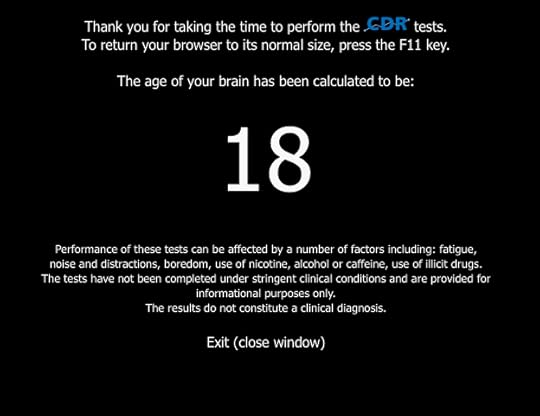
P.S., for amusement only: I took one of the online cognitive tests pointed to in the book (via www.experimentalman.com) entitled “What’s the Age of Your Brain?” and received the pleasant if somewhat startling result that the brain in my fifty-year-old body is a mere 18 years old.
David Ewing Duncan (caveat, I know him personally), is an excellent science journalist who has written myriad pieces of short- and long-form journalism for The Atlantic, The New York Times and elsewhere. However his skills begin to fade when applied to writing entire books. In some ways, he is a victim of his own prescience, exploring this particular theme (someone who experiments with, and quantifies, every aspect of his natural existence) 3-5 years before the birth of the "Quantified Self" movement, personal genome sequencing, and the general culture of over-sharing that now pervades our texting, friending generation. Nonetheless there is some great science here, along with clear expositions on genetics, population biology and statistics. Duncan wisely leans toward the personal, discussing his family's ancestry and its implications for his health and well-being. Overall, a fascinating insight into the coming science of quantified health, wellness and real-time social tracking that is rapidly turning each of us into self-reporting experiments.
I think this is a great book idea. However, as a doctor who practices personalized medicine, I find that the author fell short on what could have been said about being a proactive patient. For example: there's a lot about gene testing, but genes are not the whole story on health and disease. Certain genes play important roles, true, but master genes and supergenes stretches the science. And, some clinically important gene mutations are minimally covered or left out, like methylenetetrahydrofolate reductase (MTHFR), the rate-limiting enzyme in the methyl cycle that is encoded by the MTHFR gene. Such omissions make me think that evidenced-based clinically useful information got overlooked. Still, it's a fascinating book, and the parts on accumulation of toxic chemicals are important, but it's definitely not a manual on personalized medicine for the proactive patient.
The author takes one or more of most of the new types of genetic / imaging / blood / etc. tests currently on the market, and some not yet available at large. And determines, in a nutshell, that they are mostly just about impossible to make sense of at this time. Confirming what I already expected, and saving me the hassle and expense.
There is lots of text of the sort "my test revealed that I have a value of 375 for X, whereas the average person has 225, which seems to indicate that I have a higher risk for Y. But this the other test I told you about in the last chapter shows I have a reduced risk for Y." But, there is enough interesting stuff interspersed to make the book worthwhile overall.
Lucky David got to find out whether his genes predispose him to risk-taking/aversion, and how fast his body processes mercury, and whether he's likely to become addicted to drugs. They tested his body burden of environmental chemicals. He tried to cross-reference the genetics stuff with the environmental stuff... but it's too early in the game. So, a great idea for a book, but ultimately a little bit of a tease. Raises a lot of interesting questions about what the future of healthcare might look like (if we don't fry and dry ourselves off the planet before then, that is.)
Didn't get a chance to read the whole book. It's just a fact-finding experiment for the author to map out his genes, chromosomes, etc. to detect variations, negatives about his body. Almost going too far ( imho ) in terms of finding one's defects. I, think he mentioned with the battery of tests i.e. - catscans, mri's, bloodwork, doctor visits it would have costed him several hundred of thousand of dollars ( however, most of the costs were free of charge ).
I had a chance to meet this author, who has a certain proclivity toward diagnostic testing like none I've met before. 22 hours in a CT scan? No thanks.... I especially enjoy how he explains complex scientific terms in simple English. If you've ever considered dropping a few hundred dollars to find out your genetic predisposition for disease, read this first!