

What do you think?

St Petersburg: Three Centuries of Murderous Desire
From Peter the Great to Putin, this is the unforgettable story of St Petersburg – one of the most magical, menacing and influential cities in the world.
St Petersburg has always felt like an impossible metropolis, risen from the freezing mists and flooded marshland of the River Neva on the western edge of Russia. It was a new capital in an old country. Established in 1703 by the sheer will of its charismatic founder, the homicidal megalomaniac Peter-the-Great, its dazzling yet unhinged reputation was quickly fashioned by the sadistic dominion of its early rulers.
This city, in its successive incarnations – St Petersburg; Petrograd; Leningrad and, once again, St Petersburg – has always been a place of perpetual contradiction. It was a window on to Europe and the Enlightenment, but so much of the glory of Russia was created here: its literature, music, dance and, for a time, its political vision. It gave birth to the artistic genius of Pushkin and Dostoyevsky, Tchaikovsky and Shostakovich, Pavlova and Nureyev. Yet, for all its glittering palaces, fairytale balls and enchanting gardens, the blood of thousands has been spilt on its snow-filled streets. It has been a hotbed of war and revolution, a place of siege and starvation, and the crucible for Lenin and Stalin’s power-hungry brutality.
In St Petersburg, Jonathan Miles recreates the drama of three hundred years in this absurd and brilliant city, bringing us up to the present day, when – once more – its fate hangs in the balance. This is an epic tale of murder, massacre and madness played out against squalor and splendour. It is an unforgettable portrait of a city and its people.
St Petersburg has always felt like an impossible metropolis, risen from the freezing mists and flooded marshland of the River Neva on the western edge of Russia. It was a new capital in an old country. Established in 1703 by the sheer will of its charismatic founder, the homicidal megalomaniac Peter-the-Great, its dazzling yet unhinged reputation was quickly fashioned by the sadistic dominion of its early rulers.
This city, in its successive incarnations – St Petersburg; Petrograd; Leningrad and, once again, St Petersburg – has always been a place of perpetual contradiction. It was a window on to Europe and the Enlightenment, but so much of the glory of Russia was created here: its literature, music, dance and, for a time, its political vision. It gave birth to the artistic genius of Pushkin and Dostoyevsky, Tchaikovsky and Shostakovich, Pavlova and Nureyev. Yet, for all its glittering palaces, fairytale balls and enchanting gardens, the blood of thousands has been spilt on its snow-filled streets. It has been a hotbed of war and revolution, a place of siege and starvation, and the crucible for Lenin and Stalin’s power-hungry brutality.
In St Petersburg, Jonathan Miles recreates the drama of three hundred years in this absurd and brilliant city, bringing us up to the present day, when – once more – its fate hangs in the balance. This is an epic tale of murder, massacre and madness played out against squalor and splendour. It is an unforgettable portrait of a city and its people.
560 pages, Hardcover
First published June 26, 2018
Ratings & Reviews
Friends & Following
Create a free account to discover what your friends think of this book!
Community Reviews
Displaying 1 - 30 of 51 reviews

June 11, 2021
Genesis of a Metropolis
In 438 pages (plus another +/- 200 pages of Notes, Bibliography and Pictures) Jonathan Miles writes the biography of Petersburg/Petrograd/Leningrad/St Petersburg. The history that he writes about starts in 1698 and finishes in 2017. There are three parts to the book: 1698-1825, 1825-1917, 1917-2017. The author shows how in each of these eras much happened in various fields such as architecture, the arts, the sciences, etc. BUT much blood was shed as well.
1698-1825
Peter Alexeivich Romanov (1672-1725), better known as Peter the Great started the metaphorical ball rolling. He travelled to various countries,such as Holland where, even though he was Tsar of Russia, he worked at a shipyard (he was keen to learn about ship building), and he had other Russian apprentices in different places learning all aspects of ship building. The Dutch were prosperous and had advanced printing techniques, etc. in which he was interested, but they were cruel too: “…in December 1697, the City Fathers of Amsterdam had invited the tsar to witness a public branding, beating, hanging and beheading.” Peter was keen to learn everything he could. ”The tsar reportedly drank thirty to forty glasses of wine a day and still remained sharp.” If that were true it would be astounding if he could manage to do anything, never mind learn. The very tall tsar paid astronomical amounts for a large number of items to add to his collections. His travels also took him to England. There are various other details of Peter’s life.
Next comes the description of how the city was founded, and Mr Miles sorts out fact from ”hokum”. The site Peter chose was a swamp, which resulted in the city being inundated by severe flooding from time to time. Thousands were employed, but many perished in the miserable conditions and they were put in sacks and buried in the foundations. Besides swarms of mosquitoes, packs of wolves came calling. The author does a great job of not only providing facts but also creating descriptions of what conditions were at the time. There are amusing tales of goings-on at Peter’s court, and not such amusing tales: “In 1718, Peter lured his son, the tsarevich Alexei, back from exile and promptly imprisoned him in the Peter and Paul Fortress. During his interrogation by torture, the tsar, who made quite a hobby of pulling teeth, personally tore off his son’s nails.”
The first part continues with the reigns of Catherine I, Peter II, Anna, Ivan VI, Elizabeth, Peter III, Catherine the Great, Paul I and Alexander I. Catherine I was Peter the Great’s second wife. Some improvements were made during her reign, but the bloodshed continued. She led such a dissolute life that “Weakened by alcohol poisoning, asthma and venereal disease, Catherine caught a chill in that habitual death-trap of Russian rulers, the Blessing of the Waters on the Feast of Epiphany. After a prolonged illness, she died on 6 May 1727.” Anna did a great deal for the performing arts. BUT she created a department that specialised in using red hot irons and cutting the tongues of those who fell foul of the rules (and sometimes those who didn’t.) Catherine the Great had a long reign, had many lovers, spoke French, German and Russian, corresponded with Voltaire as well as Denis Diderot who visited the city in 1773. She created a foundling hospital, a schooling system with specially trained teachers, etc. and an Accademy of Arts was established. “Writing to Grimm in 1790, she boasted, ‘My museum in the Hermitage – not counting the paintings and the Raphael loggias – consists of 3,800 books, four rooms filled with books and prints, 10,000 engraved gems, approximately 10,000 drawings and a natural science collection that fills two large halls.’” But things were by no means perfect during her reign, and she spent money prodigiously. Alexander I was tsar at the time of Napoleon’s defeat in 1812.
1825-1917
Under Nicholas I the court took a backseat with regard to improving the city and its facilities. However, railways were built and it was possible to travel by rail between Petersburg and Moscow. Writers and intellectuals became influential. Alexander Pushkin wrote poetry that was “…critical of authority and scathing about serfdom.” Some of these works are discussed in the context of their criticism. Writers gathered to discuss a variety of topics: “At the Wolff & Béranger café on the corner of the Moika, an informal literary circle gathered, which included Lermontov, Pushkin and Nikolai Chernyshevsky. It was there that Pushkin met his second before his fatal duel.” Andrei Biely who wrote the excellent novel Petersburg which was first published in 1913 is referred to several times in Jonathan Miles’s book. The performing arts were buzzing; Molière and Shakespeare were performed as well as Carl Maria von Weber’s opera Die Freischütz. Glinka composed opera, and ”Franz Liszt dazzled audiences in April 1842.” Clara Schumann performed and Hector Berlioz conducted concerts. Ballet became very skilled.
There were some disasters, including a massive fire at the Winter Palace.

Cholera epidemics killed a large number of people. It was also an oppressive reign during which many, including author Feodor Dostoevsky, were incarcerated and in some cases executed. ”Writing a few years before Nicholas died, the Russian historian Timofey Granovsky saw Russia as ‘nothing but a living pyramid of crimes, frauds and abuses, full of spies, policemen, rascally governors, drunken magistrates and cowardly aristocrats’.”
There were several attempts on the life of the next tsar, Alexander II, and finally he was assassinated. His successor Alexander III had a short reign as he died of an illness.
The arts continued to flourish during the last part of the nineteenth century, with Wagner’s entire Ring Cycle being performed. He was not the only visitor, as several prominent artists performed in the capital. The Russian artists dazzled too. There are far too many of them to mention here. The latter part of the nineteenth century and the initial decade of the twentieth century saw many innovations in various fields.
The final tsar was the unfortunate Nicholas II, and the second part of this book continues through the bloody year of 1905, WWII and right up to the Russian Revolution. The events and politics leading up to the year 1917 are discussed in some detail.
1917-2017
The city had now become Petrograd to sound Russian rather than the German sounding Petersburg. In 1918 Nicholas II and his family were murdered at Ekaterinburg. In that year Moscow became the capital. Later under Joseph Stalin’s leadership Petrograd became Leningrad, and eventually it changed again to the present name of St Petersburg.
The politics and purges of this period are described, and it was once again the writers and poets who expressed their dismay. Several of them were imprisoned and/or sent to prison camps in Siberia. Leningrad was very hard hit by WWII, and its citizens suffered terribly when the German Army besieged the city for 900 days, with the deliberate policy of starving the residents.
A host of famous and infamous people appear in the final section of the book. The major events, innovations and art of the city during the twentieth century and beyond to the year 2017 are discussed.
###
Throughout the book the author demonstrates that bloodshed went hand in hand with innovation and excellence in many fields including the arts. St Petersburg is a city with an interesting and bloody past.
The book is full of entertaining (or sometimes gruesome) snippets, and I love the wonderful illustrations of which there are many. There are extensive notes and a bibliography.
The Winter Palace
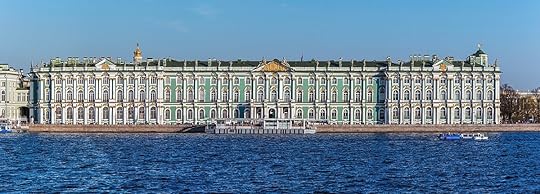
In 438 pages (plus another +/- 200 pages of Notes, Bibliography and Pictures) Jonathan Miles writes the biography of Petersburg/Petrograd/Leningrad/St Petersburg. The history that he writes about starts in 1698 and finishes in 2017. There are three parts to the book: 1698-1825, 1825-1917, 1917-2017. The author shows how in each of these eras much happened in various fields such as architecture, the arts, the sciences, etc. BUT much blood was shed as well.
1698-1825
Peter Alexeivich Romanov (1672-1725), better known as Peter the Great started the metaphorical ball rolling. He travelled to various countries,such as Holland where, even though he was Tsar of Russia, he worked at a shipyard (he was keen to learn about ship building), and he had other Russian apprentices in different places learning all aspects of ship building. The Dutch were prosperous and had advanced printing techniques, etc. in which he was interested, but they were cruel too: “…in December 1697, the City Fathers of Amsterdam had invited the tsar to witness a public branding, beating, hanging and beheading.” Peter was keen to learn everything he could. ”The tsar reportedly drank thirty to forty glasses of wine a day and still remained sharp.” If that were true it would be astounding if he could manage to do anything, never mind learn. The very tall tsar paid astronomical amounts for a large number of items to add to his collections. His travels also took him to England. There are various other details of Peter’s life.
Next comes the description of how the city was founded, and Mr Miles sorts out fact from ”hokum”. The site Peter chose was a swamp, which resulted in the city being inundated by severe flooding from time to time. Thousands were employed, but many perished in the miserable conditions and they were put in sacks and buried in the foundations. Besides swarms of mosquitoes, packs of wolves came calling. The author does a great job of not only providing facts but also creating descriptions of what conditions were at the time. There are amusing tales of goings-on at Peter’s court, and not such amusing tales: “In 1718, Peter lured his son, the tsarevich Alexei, back from exile and promptly imprisoned him in the Peter and Paul Fortress. During his interrogation by torture, the tsar, who made quite a hobby of pulling teeth, personally tore off his son’s nails.”
The first part continues with the reigns of Catherine I, Peter II, Anna, Ivan VI, Elizabeth, Peter III, Catherine the Great, Paul I and Alexander I. Catherine I was Peter the Great’s second wife. Some improvements were made during her reign, but the bloodshed continued. She led such a dissolute life that “Weakened by alcohol poisoning, asthma and venereal disease, Catherine caught a chill in that habitual death-trap of Russian rulers, the Blessing of the Waters on the Feast of Epiphany. After a prolonged illness, she died on 6 May 1727.” Anna did a great deal for the performing arts. BUT she created a department that specialised in using red hot irons and cutting the tongues of those who fell foul of the rules (and sometimes those who didn’t.) Catherine the Great had a long reign, had many lovers, spoke French, German and Russian, corresponded with Voltaire as well as Denis Diderot who visited the city in 1773. She created a foundling hospital, a schooling system with specially trained teachers, etc. and an Accademy of Arts was established. “Writing to Grimm in 1790, she boasted, ‘My museum in the Hermitage – not counting the paintings and the Raphael loggias – consists of 3,800 books, four rooms filled with books and prints, 10,000 engraved gems, approximately 10,000 drawings and a natural science collection that fills two large halls.’” But things were by no means perfect during her reign, and she spent money prodigiously. Alexander I was tsar at the time of Napoleon’s defeat in 1812.
1825-1917
Under Nicholas I the court took a backseat with regard to improving the city and its facilities. However, railways were built and it was possible to travel by rail between Petersburg and Moscow. Writers and intellectuals became influential. Alexander Pushkin wrote poetry that was “…critical of authority and scathing about serfdom.” Some of these works are discussed in the context of their criticism. Writers gathered to discuss a variety of topics: “At the Wolff & Béranger café on the corner of the Moika, an informal literary circle gathered, which included Lermontov, Pushkin and Nikolai Chernyshevsky. It was there that Pushkin met his second before his fatal duel.” Andrei Biely who wrote the excellent novel Petersburg which was first published in 1913 is referred to several times in Jonathan Miles’s book. The performing arts were buzzing; Molière and Shakespeare were performed as well as Carl Maria von Weber’s opera Die Freischütz. Glinka composed opera, and ”Franz Liszt dazzled audiences in April 1842.” Clara Schumann performed and Hector Berlioz conducted concerts. Ballet became very skilled.
There were some disasters, including a massive fire at the Winter Palace.
Cholera epidemics killed a large number of people. It was also an oppressive reign during which many, including author Feodor Dostoevsky, were incarcerated and in some cases executed. ”Writing a few years before Nicholas died, the Russian historian Timofey Granovsky saw Russia as ‘nothing but a living pyramid of crimes, frauds and abuses, full of spies, policemen, rascally governors, drunken magistrates and cowardly aristocrats’.”
There were several attempts on the life of the next tsar, Alexander II, and finally he was assassinated. His successor Alexander III had a short reign as he died of an illness.
The arts continued to flourish during the last part of the nineteenth century, with Wagner’s entire Ring Cycle being performed. He was not the only visitor, as several prominent artists performed in the capital. The Russian artists dazzled too. There are far too many of them to mention here. The latter part of the nineteenth century and the initial decade of the twentieth century saw many innovations in various fields.
The final tsar was the unfortunate Nicholas II, and the second part of this book continues through the bloody year of 1905, WWII and right up to the Russian Revolution. The events and politics leading up to the year 1917 are discussed in some detail.
1917-2017
The city had now become Petrograd to sound Russian rather than the German sounding Petersburg. In 1918 Nicholas II and his family were murdered at Ekaterinburg. In that year Moscow became the capital. Later under Joseph Stalin’s leadership Petrograd became Leningrad, and eventually it changed again to the present name of St Petersburg.
The politics and purges of this period are described, and it was once again the writers and poets who expressed their dismay. Several of them were imprisoned and/or sent to prison camps in Siberia. Leningrad was very hard hit by WWII, and its citizens suffered terribly when the German Army besieged the city for 900 days, with the deliberate policy of starving the residents.
A host of famous and infamous people appear in the final section of the book. The major events, innovations and art of the city during the twentieth century and beyond to the year 2017 are discussed.
###
Throughout the book the author demonstrates that bloodshed went hand in hand with innovation and excellence in many fields including the arts. St Petersburg is a city with an interesting and bloody past.
The book is full of entertaining (or sometimes gruesome) snippets, and I love the wonderful illustrations of which there are many. There are extensive notes and a bibliography.
The Winter Palace

September 8, 2024
As a whole, St Petersburg is a decent history of the eponymous city. The book is strongest in its coverage of the tsarsist period. Subsequent sections seem a bit too focused on the City's arts scene.
September 29, 2019
3.5 Stars!
“The fortress was completed in five months. The bodies of workers killed by malaria, scurvy, dysentery or Swedish attack were wrapped in muslin sacks and packed into cavities in the foundations. Reasonable estimates for the human cost of the initial building of St Petersburg run to 30,000 deaths.”
How is that for symbolism?... Someone once described it as “A city created by a drunken man trying to walk a straight line.” Many books on Russian history, like so many Russian novels, can often appear a bit daunting, especially when you hold that weighty doorstop in your hands for the first time, it can seem like your own crime and punishment, (your only crime to open the first page and your punishment being to read it to the last), but thankfully this is another one of those entertaining and accessible pathways to a rich, surreal and fascinating world of the city of St Petersburg.
“Loaded rifles were placed all over the Winter Palace, so that Anna, on a sudden whim, could fling open a window and pick off the sparrows, cranes and magpies soaring overhead.”
As well as all the monarchs, dictators and other clowns posing as leaders, we see appearances from the likes of Rasputin, Nijinsky, Stravinsky, Tchaikovsky, Trotsky, Tolstoy, Dostoyevsky, Gogol and Gorky as well as many others who helped contribute to the renowned culture of the city.
We see that like most over privileged elites anywhere in the world, they really are just like bratty, spoiled children who are too used to getting their own way, pin balling between tantrums, debauchery, ennui and random acts of cruelty. Life was incredibly cheap in this part of the world and every time we hear that ominous phrase, “They caught a chill.” We know that another death is just around the corner.
“Peter developed a great lust for the Countess Elizabeth Vorontsova, who spat, stank, had a squint and was covered with smallpox scars. More positively, she loved to drink and exhibited a great eagerness for sex with the high-pitched, lank-haired grand duke.” I’d love to see such a frank and amusing examination on the current circus of royals who haunt Buckingham Palace and beyond. But its random passages like this, which make this really entertaining.
Peter the Great’s many horrendous acts and crimes are picked out in here, possibly the most shocking of all is the description we get of him torturing and killing his own son?...We learn that sometimes wolves could be seen roaming in broad daylight thirty to forty strong. In 1715 a woman was devoured by a pack of wolves within sight of Prince Menshikov’s palace. The settlement also suffered three sizeable floods within its first three years of existence, with water rising more than two and a half metres.
“It was there that Casanova saw children being baptised in a hole cut through the ice below. He watched, horrified, as a baby slipped through the priest’s hands into oblivion, and was much surprised to find the parents in ‘an ecstasy of joy…certain that the babe had been carried straight to heaven.”
This gives us a telling insight into how appealing the place was to live in. Though it’s hard to fathom just how insane the idea of building such a large settlement in what is now St Petersburg. To try and put it in some perspective, the city lies around 59.9 latitude. The city of Glasgow is around 55.8. So St Petersburg lies somewhere between the Orkneys and the Shetland islands at the far end of the British Isles, which gives us some idea of just how inhospitable the climate really is.
Miles really captures the turbulent and surreal origins of the city with a warm mixture of slapstick humour and bewildering facts. He has a gift for good story telling within the historical frame which makes this glide along nicely from the opening pages. We get a real sense for the absurdity and the obsession which drove Peter the Great towards the founding of St Petersburg.
The sheer scale and extent of the madness, violence, cruelty and decadence which reigned for so long over St Petersburg is absolutely incredible. This book conjures up scenarios that fall somewhere between the darker passages of The Bible and Hieronymous Bosch with a hangover. Towards the end of the book he shifts focus and takes a broader approach looking at Russia as a whole and ties it back to the city. A most eye opening read.

Read
May 23, 2018Yes, perhaps it was the "three centuries of murderous desire" that caught my eye - a subtitle I hope one day to borrow for my first autobiography. But this is exactly the sort of non-fiction I enjoy, a detailed study of an unknown unknown. Sure, I was dimly aware of Russia's sometime capital in its capacity as literary and revolutionary backdrop, and some of its name changes, but otherwise it had never even occurred to me that I didn't know much about it. And while the book is littered with the typos and glitches apparently endemic to modern publishing, Miles does an excellent at capturing the alternate squalor and grandeur of the city, and at bringing to (often revolting) life those who inhabit it, or merely intersect with those who do - so while I knew that van Leeuwenhoek was a pioneer in the investigation of microscopic life, I was not aware quite how ready he was to make himself his own spectacularly gross laboratory. We open, inevitably, on the city's founder, Peter the Great. What kind of man builds a 'window on the West' on land that's frozen half the year and swampy the rest? A new, modern face for Russia which is founded on 30,000 corpses, with plenty more to come? Well, I already knew a little of Peter from his London sojourn, but he sounds like the archetype of the large adult son. This is a nightmare version of The Windsors' take on Prince Harry, happy to turn mass executions into a drinking game - #bantz - or fatally inflate a guy's bowels with a bellows - #madman - or pursue an envoy who didn't want to down a litre and a half of vodka up a ship's rigging, booze at his belt and giant cup in hand - #absoluteledge. A nightmare in most respects, Quixotic in his siting of his new city...and yet still somehow not wholly dislikeable. After all, for all his sins he was as happy to take up an axe himself in making a ship as slaying an enemy. Menshikov, his right-hand man and chief kleptocrat, was a pieman promoted to the highest office on account of having a smart yet respectful riposte when he met Peter in the street. For the monarch delighted in promoting drinking buddies and the manifestly unsuitable to great offices, sometimes with surprisingly good results - and other times not. One wonders briefly whether Theresa May's cabinet is inspired by a copy of Management Secrets of Peter the Great. See also the bit where Peter is outraged by corruption, and plans to execute all peculating officials - but the Procurator General explains "we all steal. Some take a little, some take a great deal, but all of us take something' How things change, or not.
A recurring note in the story is the way that the city represents Russia's doomed efforts to catch up with the West - who, like the mean kids at school, keep changing the rules on what's in whenever Russia has just bought a new bag, or calendar. I knew about Russia having Julian long after we went Gregorian, but not that only under Peter had they even gone Julian - 1700 would otherwise have been 7208, dated of course from the creation of the world (meaning even that date didn't match the not-remotely-ridiculous calculations of the notorious Bishop Ussher). The modern oligarchs' attempts to spend their way to taste turn out to have a long history, with even the great Hermitage gallery initially stuffed by vulgar over-purchase of art. And as grand collections are assembled and mighty edifices erected, wolves roamed the streets, devouring the citizenry, many of whom had only moved there under compulsion. At the smaller level, giardia was endemic, with other epidemics joining in fairly frequently, and roughly one major flood a year - "the site was - as the poet Anna Akhmatova later put it - 'particularly well suited to catastrophe'."
Not that it was enough for the environment to be hostile: Peter's successors were mostly at least as terrible as he was when considered as bosses. Consider the jealous empress Elizabeth, shaving heads of the other women at court and then giving them shit wigs, like the Blackadder take on her namesake. Nor did the spirit of drunken excess ever take much of a break between Peter's All-Joking, All-Drunken Synod of Fools and Jesters and the later antics of Rasputin (surveillance reports of whom measured his intoxication on a four point scale: 'very', 'absolutely', 'completely' and 'dead drunk'). I was particularly taken with the Neapolitan violinist who married a goat for a lark. The overall effect is often piratical - grand buildings crumbling, elegant outfits grown old and tatty, a society desperate to keep up appearances but without the economical base to do so in any sane way. Again, one might suggest that little has changed, though the picture is much less gender-normative than recent reinventions of Russian history might suggest: casual homosexual dalliances were unremarkable for either sex; the female rulers and aristocrats were as voracious in their consumption of lovers and booze as the men, and as into antics which are fun to read about but would have been a right pain in practice. Still, I suppose deceit and autocracy have also their fashions - and even among the tsars you'd get the odd one who was inflexible and sober, and as such every bit as much of a danger as the manic pissheads. Then too, consider how seldom any of their paranoia was well-directed; long before Stalin decided that the only person he did trust was Hitler, you have Empress Anna, leaving loaded firearms all over the palace because the risk of assassins was less significant to her than the chance to take more impromptu potshots at wildlife.
And so we stagger through the decades of palace coups, Decembrists, repression and unrest. The Romanovs give way to the Communists and then to the new breed of kleptocrat, but one suspects that a few centuries down the line this distinction will be considered as niche and specialist a distinction as one ancient Egyptian dynasty giving way to the next. For those at the bottom of the heap, little changes, unless it's going from bad to worse. The city's Second World War siege must be the nadir, though - encapsulated in the note regarding the two different Russian words for cannibalism, depending on whether or not you killed them specially. And yet, set against that, the heroism, the Shostakovich symphony played over the loudspeakers which convinced awed German soldiers that they could never take this city. I think this was the point where I most understood why Miles had written a book about a city which, a lot of the time, he really doesn't seem to much like. Indeed, he's seldom shy about expressing his sentiments in terms which verge on the uncomfortably pseudo-objective. In his defence, it's often at least amusing, for instance the description of Chernyshevsky as "positively the worst significant novelist in Russian literature". Elsewhere, though...look, I realise this is an odd thing to say regarding one of the absolute worst people in history, but there were times when I felt Miles might have been overdoing the anti-Stalin sentiment. Still, there are harder crimes to forgive, and I did like the quotation from Koestler: "within the short span of three generations the Communist movement had travelled from the era of the Apostles to that of the Borgias".
So where do those three centuries leave us? I have a note: "the inequality at least as grave as under the old regime". Which I think was about the transition from hereditary to Party autocrats, but works just as well for the shift to whatever you want to call the current system in Russia. And while Miles obviously makes note of the city's role as Putin's nursery, there's always that problem of ending a non-fiction book whose story is still clearly ongoing. Still, it's hard to think of a better place at least to pause it than the quote on the last page, referring to "Chaadaev's celebrated statement that Russia exists simply to alert the world that its way of doing things should be avoided, whatever the cost". Just a shame that their bots and fake news factories now seem to have snookered the world into doing exactly that.
A recurring note in the story is the way that the city represents Russia's doomed efforts to catch up with the West - who, like the mean kids at school, keep changing the rules on what's in whenever Russia has just bought a new bag, or calendar. I knew about Russia having Julian long after we went Gregorian, but not that only under Peter had they even gone Julian - 1700 would otherwise have been 7208, dated of course from the creation of the world (meaning even that date didn't match the not-remotely-ridiculous calculations of the notorious Bishop Ussher). The modern oligarchs' attempts to spend their way to taste turn out to have a long history, with even the great Hermitage gallery initially stuffed by vulgar over-purchase of art. And as grand collections are assembled and mighty edifices erected, wolves roamed the streets, devouring the citizenry, many of whom had only moved there under compulsion. At the smaller level, giardia was endemic, with other epidemics joining in fairly frequently, and roughly one major flood a year - "the site was - as the poet Anna Akhmatova later put it - 'particularly well suited to catastrophe'."
Not that it was enough for the environment to be hostile: Peter's successors were mostly at least as terrible as he was when considered as bosses. Consider the jealous empress Elizabeth, shaving heads of the other women at court and then giving them shit wigs, like the Blackadder take on her namesake. Nor did the spirit of drunken excess ever take much of a break between Peter's All-Joking, All-Drunken Synod of Fools and Jesters and the later antics of Rasputin (surveillance reports of whom measured his intoxication on a four point scale: 'very', 'absolutely', 'completely' and 'dead drunk'). I was particularly taken with the Neapolitan violinist who married a goat for a lark. The overall effect is often piratical - grand buildings crumbling, elegant outfits grown old and tatty, a society desperate to keep up appearances but without the economical base to do so in any sane way. Again, one might suggest that little has changed, though the picture is much less gender-normative than recent reinventions of Russian history might suggest: casual homosexual dalliances were unremarkable for either sex; the female rulers and aristocrats were as voracious in their consumption of lovers and booze as the men, and as into antics which are fun to read about but would have been a right pain in practice. Still, I suppose deceit and autocracy have also their fashions - and even among the tsars you'd get the odd one who was inflexible and sober, and as such every bit as much of a danger as the manic pissheads. Then too, consider how seldom any of their paranoia was well-directed; long before Stalin decided that the only person he did trust was Hitler, you have Empress Anna, leaving loaded firearms all over the palace because the risk of assassins was less significant to her than the chance to take more impromptu potshots at wildlife.
And so we stagger through the decades of palace coups, Decembrists, repression and unrest. The Romanovs give way to the Communists and then to the new breed of kleptocrat, but one suspects that a few centuries down the line this distinction will be considered as niche and specialist a distinction as one ancient Egyptian dynasty giving way to the next. For those at the bottom of the heap, little changes, unless it's going from bad to worse. The city's Second World War siege must be the nadir, though - encapsulated in the note regarding the two different Russian words for cannibalism, depending on whether or not you killed them specially. And yet, set against that, the heroism, the Shostakovich symphony played over the loudspeakers which convinced awed German soldiers that they could never take this city. I think this was the point where I most understood why Miles had written a book about a city which, a lot of the time, he really doesn't seem to much like. Indeed, he's seldom shy about expressing his sentiments in terms which verge on the uncomfortably pseudo-objective. In his defence, it's often at least amusing, for instance the description of Chernyshevsky as "positively the worst significant novelist in Russian literature". Elsewhere, though...look, I realise this is an odd thing to say regarding one of the absolute worst people in history, but there were times when I felt Miles might have been overdoing the anti-Stalin sentiment. Still, there are harder crimes to forgive, and I did like the quotation from Koestler: "within the short span of three generations the Communist movement had travelled from the era of the Apostles to that of the Borgias".
So where do those three centuries leave us? I have a note: "the inequality at least as grave as under the old regime". Which I think was about the transition from hereditary to Party autocrats, but works just as well for the shift to whatever you want to call the current system in Russia. And while Miles obviously makes note of the city's role as Putin's nursery, there's always that problem of ending a non-fiction book whose story is still clearly ongoing. Still, it's hard to think of a better place at least to pause it than the quote on the last page, referring to "Chaadaev's celebrated statement that Russia exists simply to alert the world that its way of doing things should be avoided, whatever the cost". Just a shame that their bots and fake news factories now seem to have snookered the world into doing exactly that.

February 8, 2020
In "St Petersburg: Three Centuries of Murderous Desire" Jonathan Miles has taken up a remarkable task to describe St Petersburg form the birth of the city until the present day. The idea itself is of course fantastic. I have always seen cities, especially grand cities that St Petersburg surely is, like living organisms. Ever-changing, always reflecting the happiness and state of its inhabitants. Always greater than the sum of their parts. A single house can tell you so many stories let alone the whole city itself.
Of course, 560 pages (the English edition - I read it in Estonian) is not nearly enough for three centuries of St Petersburg history. Perhaps one 500 page volume for each century would have been sufficient. Also, this book is not written by a historian specialised in Russian history and you could tell that when reading.
Despite that, I found it succeeded in what it aimed to do. It gave a general overview touching all the tsars (the better-known ones got more chapters) and all the major historical events in St Petersburg. It also always tried to give a brief overview of the cultural history of the city - some information on writers, artists, musicians who were active during that time. And most importantly it gave a pretty good idea what the overall atmosphere, vibe and conditions were for regular people on each century. This I think was what made the made the book good enough to forgive the very generalised approach. As a reader, I got to know about the conditions of daily life during the time when the city was built, when the tensions were building up and what it was like under a totalitarian regime.
All the information was not new to me, for example, the part of building the city I was familiar with before thanks to Robert K. Massie's fantastic Peter The Great biography I read a few years ago. Also, the Soviet time's hardships were nothing new as I have heard about that from a very direct source - my parents. And about the revolution(s) I just read a book about. Still, it was good to have one continuous narrative written in a readable style that manages to keep the readers' attention throughout the book.
Miles' book will probably be a bit repetitive for those well versed in Russian history but I think it is a good read for those with not much background information. It is also not the best book to give you an idea of the "Russian spirit" - for example, Helen Rappaport who writes about Russian history extensively has grasped it better (as a foreigner). The only things I thought missing was the general overview of the current state of Russia was in before Peter started building the city - just a few pages would have been enough.
Of course, 560 pages (the English edition - I read it in Estonian) is not nearly enough for three centuries of St Petersburg history. Perhaps one 500 page volume for each century would have been sufficient. Also, this book is not written by a historian specialised in Russian history and you could tell that when reading.
Despite that, I found it succeeded in what it aimed to do. It gave a general overview touching all the tsars (the better-known ones got more chapters) and all the major historical events in St Petersburg. It also always tried to give a brief overview of the cultural history of the city - some information on writers, artists, musicians who were active during that time. And most importantly it gave a pretty good idea what the overall atmosphere, vibe and conditions were for regular people on each century. This I think was what made the made the book good enough to forgive the very generalised approach. As a reader, I got to know about the conditions of daily life during the time when the city was built, when the tensions were building up and what it was like under a totalitarian regime.
All the information was not new to me, for example, the part of building the city I was familiar with before thanks to Robert K. Massie's fantastic Peter The Great biography I read a few years ago. Also, the Soviet time's hardships were nothing new as I have heard about that from a very direct source - my parents. And about the revolution(s) I just read a book about. Still, it was good to have one continuous narrative written in a readable style that manages to keep the readers' attention throughout the book.
Miles' book will probably be a bit repetitive for those well versed in Russian history but I think it is a good read for those with not much background information. It is also not the best book to give you an idea of the "Russian spirit" - for example, Helen Rappaport who writes about Russian history extensively has grasped it better (as a foreigner). The only things I thought missing was the general overview of the current state of Russia was in before Peter started building the city - just a few pages would have been enough.

April 5, 2018
Good book marred by factual errors (Pearl Harbor in 1942 seriously? Lenin’s mislabeling the Mensheviks repeated as truth. Tsar’s abdication site incorrect). Too bad because otherwise a good read

December 29, 2022
Классная книга! I thoroughly enjoyed the nuance of Russia this writing style captured. Lots of interesting anecdotes that tied together throughout the book, without overbearing descriptions. I felt like it was a colorful journey rather than the arduous slog it could have been, spanning more than 300 years of St. Petersburg's history. I particularly enjoyed the art history that is often neglected in these types of books - and how art, such as ballet and music, tied to the political system this genre generally solely focuses on.

September 21, 2019
Excellent story about St. Peterburg (and Russians) with insights, humour and facts. I think I will read it again - soon.
October 2, 2018
After visiting St Petersburg last year I became fascinated by this beautiful and tragic city, built on marchland of the river Neva at the cost of thousands of lives, constantly threatened by flooding and revolutions and yet home of the most stunning palaces and churches as well as the birthplace of artistic genius like Pushkin, Dostoyevsky, Tchaikovsky and Nureyev. The book of Jonathan Miles shows us three centuries of fantastic history to the present day where the future of St Petersburg is endangered by the sinking of the city. Apparently even worse than Venice.

January 3, 2018
This book is a great introduction to the tale of St. Petersburg. It moves from the city's founding in 1703 up to 2017. The sweep is broad, covering everything from political history, to architecture, music, literature, art, living standards, scandals, crime, and glorious skullduggery. The content is generally strong, albeit with a few weak spots, minor historical errors, and typos. The writing, however, is engaging throughout. In short, it is a loving and joyous romp. Well worth your time.
June 15, 2019
A lively tale about a remarkable city. Miles has a gift for dredging up odd details and taking us on a wild ride through the past, and gives us a course in Russian history. From the czars to Rasputin to Stalin to Putin, you'll get a glimpse of some of the horrors the city has endured as well as the art inspired. A surprisingly enjoyable read.

February 6, 2018
Good for a basic overview of the city's history. It is really interesting and touches on a lot, but doesn't go into anything in depth. There were also a couple parts that were a little misleading. Still a good read.

June 4, 2020
Nothing very unique about this book, but I love St. Petersburg and so enjoyed this well-written history of the city’s fascinating cultural history.

November 20, 2019
撐到348頁,終於還是老實地承認我自己看不下去了。畢竟其它的書債還是堆積如山。
從葉卡捷琳娜大帝開始,本書比較像是作者拉拉雜雜的各式片斷史料堆積,包括政治史、建築史、藝術史、文化史、人民生活史等等包羅萬象,卻又要依照沙皇在位時間加以「斷代」,所以讀來特別辛苦,感覺不到體系變遷的一氣呵成。所以讓我這枚半瓶水跟不上書本的節奏,於是決定放棄了。
此外本書作者的基本態度上的偏見似乎有些值得玩味。作者不斷在聖彼得堡遭逢天然災害時,嘲諷它或許又將打回不宜人居的「沼澤之地」原型——只是靠著俄羅斯人民的性命硬搭起來的華麗外貌——但內文有一半以上又在講述它數百年來的文化發展。換個角度,難道不能稱為「俄羅斯人民辛勤經營的文明之光」、猶如歐美人士長久以來對威尼斯的愛憐,以這種正面態度來看待它嗎?總之,這種「骨子裡瞧不起這座城市」的負面行文方式,我並不喜歡。
從葉卡捷琳娜大帝開始,本書比較像是作者拉拉雜雜的各式片斷史料堆積,包括政治史、建築史、藝術史、文化史、人民生活史等等包羅萬象,卻又要依照沙皇在位時間加以「斷代」,所以讀來特別辛苦,感覺不到體系變遷的一氣呵成。所以讓我這枚半瓶水跟不上書本的節奏,於是決定放棄了。
此外本書作者的基本態度上的偏見似乎有些值得玩味。作者不斷在聖彼得堡遭逢天然災害時,嘲諷它或許又將打回不宜人居的「沼澤之地」原型——只是靠著俄羅斯人民的性命硬搭起來的華麗外貌——但內文有一半以上又在講述它數百年來的文化發展。換個角度,難道不能稱為「俄羅斯人民辛勤經營的文明之光」、猶如歐美人士長久以來對威尼斯的愛憐,以這種正面態度來看待它嗎?總之,這種「骨子裡瞧不起這座城市」的負面行文方式,我並不喜歡。

August 2, 2022
The story of a city with such a vivid history and unique place in the world is riveting.
It’s just too much to squeeze into 450 pages, and the choice to dwell on certain aspects while brushing over significant cultural ones is interesting.
All up worth reading if you have a passing fancy into why Russia is the way Russia is.
It’s just too much to squeeze into 450 pages, and the choice to dwell on certain aspects while brushing over significant cultural ones is interesting.
All up worth reading if you have a passing fancy into why Russia is the way Russia is.

September 15, 2023
An ambitious biography of the city of St. Petersburg from its start to the year 2017 (when the book was published). It covers a lot, from politics to the arts to every day life, and does a good job with this.

September 23, 2023
This is a great introduction to the long and fascinating history of St Petersburg. The author seeks to cram 400 hundred years of history, and all that entails in a single volume. Given the tumultous events which the city witnessed and the huge characters involved in them, that was always going to be difficult. The author has largely managed to deliver, albeit i sometimes had the feeling that i sometimes wanted more detail on some of the events and the people.
April 14, 2022
Encyclopedic history of St Petersburg/Petrograd/Leningrad from its founding in the early 1700s in the marshes of the Neva River/Baltic Coast, with interesting treatment of early times and a nice selection of vintage photos and paintings. Overall slow going for anyone but an avid Russian history buff, but a nice source of all things St Petersburg.

January 22, 2024
Oh my god. I just read this and this is like one of the best books that I have ever read. Like i am not even interested in this book, i read it help me with history gcse but it is so much more than that. Like the greed of the government just like living in luxury constantly contrasted with the poor first the serfs and now just normal citizens. Like i laughed i cried i was there. I aged 300 years whilst reading this book. Like i was literally losing track of time reading this. It was spending, like the historical quoting like so many resources and so much effort put into this. some funky bits insane bits just so well put together. The romanov part felt like reading gossip, which was perf. But like st petersburg, petrograd, leningrad and st petersburg again has never been good. Like it aspired for so much but got robbed so badly like i can't stress enough about how corrupt the government in russia is. Like for all its resources land, a literal superpower all of that is wastedddddddddddddddd. ahhhhhhhh.
But this book really takes you through everything from the literal establishment and building of the city to 2017, yes 2017. Insane.
Also I started reading a book about the october revolution but i found it too boring, so I thought that this historical book would be bad swell but it was a beautiful mix of everything. The author used knowledge AND literary techniques. Like Miles could write war and peace but Trotsky couldn't write this book .
Like this book is everything absolutely perfect and has pictures so you know that i loved it.....
Overall, very Very highly recommend
But this book really takes you through everything from the literal establishment and building of the city to 2017, yes 2017. Insane.
Also I started reading a book about the october revolution but i found it too boring, so I thought that this historical book would be bad swell but it was a beautiful mix of everything. The author used knowledge AND literary techniques. Like Miles could write war and peace but Trotsky couldn't write this book .
Like this book is everything absolutely perfect and has pictures so you know that i loved it.....
Overall, very Very highly recommend

July 15, 2019
St Petersburg should never have existed. It started crumbling even as it was being built, and how it has suffered in its relatively short existence - floods, poisonous water, bad weather on the one hand; and a string of rulers who were deranged, obsessed, alcoholic, brutal, sadistic, murderous, greedy, corrupt ..... The author skims over the bits we all know about and concentrates at first on the court, but then increasingly on the "little people" - the serfs, the servants, the coachmen, the clerks, the minor officials, the merchants, the craftsmen, all ultimately living oppressed lives in such squalor and grinding poverty that they dreamt of the revolution which then, in the end, betrayed them. In spite of everything, St Petersburg somehow became the heart of Russian achievement in music, ballet, art and literature. It is a proud and beautiful city with a dark and tragic history. There are many books about St Petersburg, but this one manages to find new things to tell us.

June 3, 2020
A fascinating insight into a city that reads best when it focuses on the social history and the people but falters (for me) when the buildings take centre stage. A city's hardware is so much more than its individual palaces and I would have liked more on the infrastructure behind the ornate facades – the development of their heating, lighting and sanitation over the 300 years – as well as more about the transition from slums to suburbs for those lower down the pecking order.
I couldn't fault the easy reading style in which the information is presented but would have liked the book to include a series of maps to visualise the city's development and growth.
I couldn't fault the easy reading style in which the information is presented but would have liked the book to include a series of maps to visualise the city's development and growth.
July 14, 2020
This book was captivating, horrifying, and enlightening. Covering 300 years of history in 385 pages makes me want to read more Russian history and fiction from or set in Russia now though. I definitely only got a taste of all the history there is in that city, let alone that area of the world, but what a taste it was. I would definitely recommend (please note though that if you are triggered by abusive behavior reading about certain leaders/historical figures featured in the book may cause you concern - the author does not go into detail, become graphic, but does state simply and clearly the crimes and behaviors the leaders were involved in).

June 13, 2018
I knew pretty effectively nothing at all about Russian history before reading this, and it served as an excellent overview of major events/leaders of Russian history since Peter the Great. Lots of Art and Architectural history in here as well, which I enjoyed. The author did lose me in a few places-- I'm not sure if there was prior knowledge assumed there or what, but a few times I did end up flipping pages around trying to see if I missed something. Despite that, I'd still recommend this book to anyone interested in Russian or European history, or who was planning to visit Russia!
June 24, 2018
Ik heb al de nodige boeken over deze stad gelezen, maar het blijft fascineren. Deze geschiedenis gaat vanaf Peter de Grote tot Poetin en er blijkt niet veel te veranderen. De gewone man is nog steeds de klos en de bovenlaag verrijkt zich en steelt. Maar de geschiedenis van de stad zelf is nog steeds interessant en iedere schrijver weet toch wel weer iets toe te voegen of net even anders te brengen. Jammer, dat er naar toe gaan zo ingewikkeld is.

July 5, 2018
Do American schools not teach Russian history? Because apparently I didn't know any. I enjoyed this book mainly for the gaps it filled in. I don't think I could have located St. Petersburg on a map previously and it turns out that a lot of stuff has happened there. Even though there's no way I'll ever retain the information about all of the minor characters (so many authors and composers and architects and politicians!), it was fun to learn something new about a really interesting place.
October 10, 2018
I wish I discovered the book before visiting St Petersburg this summer. It’s an great story that also helped me have. A better idea of Russia modern history. The part focused on the last 100 years was quite brief and generalist but I guess the reason for that was to avoid overkilling the reader with too many facts that are relatively easily accessible elsewhere, which is not the case for earlier eras.

August 21, 2020
At many points in this book, the history of St. Petersburg/Petrograd/Leningrad and the history of Russia are conflated -- it's hard to tell when one ends and the other begins. That might be the point, but between that fluidity & the fact that there is a great deal of information (a bit TMI perhaps) the end result is a very informative but very dense text...and a slow read. Informative and fascinating, but it takes some effort.

July 8, 2023
I really disliked this book. It seemed slapdash, words spelled one way in one section and differently someplace else. I have already read a lot about Russia so I knew most of what was being referred to, but the transitions from one topic to another were terrible. Sometimes I had to recalibrate because a new paragraph was about something totally different than what was being talked about previously. I could have used some really good maps also. I felt like I just couldn't orient myself.

August 21, 2023
3,5 actually but Goodreads won't allow me to rate it so. It was mostly OK, loved it at parts and others felt a bit arid but I guess that is Russia, isn't it? Just an impossible mix that never made sense, much like its past capital, looking at the West on a country that never has truly integrated to the rest of the world, one foot in Europe, another one in Asia, and its mind -for lack of better word- just inwards, fighting itself.

January 28, 2021
Fascinating city
This is a hugely interesting book about an incredible city. It is well written and replete with extraordinary facts. St Petersburg is a city of novelists, but its fascinating history demonstrates that facts can transcend imagination. Read the book before you get there and upon your return!
This is a hugely interesting book about an incredible city. It is well written and replete with extraordinary facts. St Petersburg is a city of novelists, but its fascinating history demonstrates that facts can transcend imagination. Read the book before you get there and upon your return!
Displaying 1 - 30 of 51 reviews