

What do you think?

The Looting Machine: Warlords, Oligarchs, Corporations, Smugglers, and the Theft of Africa's Wealth
The trade in oil, gas, gems, metals and rare earth minerals wreaks havoc in Africa. During the years when Brazil, India, China and the other “emerging markets” have transformed their economies, Africa’s resource states remained tethered to the bottom of the industrial supply chain. While Africa accounts for about 30 per cent of the world’s reserves of hydrocarbons and minerals and 14 per cent of the world’s population, its share of global manufacturing stood in 2011 exactly where it stood in 2000: at 1 percent.
In his first book, The Looting Machine, Tom Burgis exposes the truth about the African development miracle: for the resource states, it's a mirage. The oil, copper, diamonds, gold and coltan deposits attract a global network of traders, bankers, corporate extractors and investors who combine with venal political cabals to loot the states' value. And the vagaries of resource-dependent economies could pitch Africa’s new middle class back into destitution just as quickly as they climbed out of it. The ground beneath their feet is as precarious as a Congolese mine shaft; their prosperity could spill away like crude from a busted pipeline.
This catastrophic social disintegration is not merely a continuation of Africa’s past as a colonial victim. The looting now is accelerating as never before. As global demand for Africa’s resources rises, a handful of Africans are becoming legitimately rich but the vast majority, like the continent as a whole, is being fleeced. Outsiders tend to think of Africa as a great drain of philanthropy. But look more closely at the resource industry and the relationship between Africa and the rest of the world looks rather different. In 2010, fuel and mineral exports from Africa were worth $333 billion, more than seven times the value of the aid that went in the opposite direction. But who received the money? For every Frenchwoman who dies in childbirth, 100 die in Niger alone, the former French colony whose uranium fuels France’s nuclear reactors. In petro-states like Angola three-quarters of government revenue comes from oil. The government is not funded by the people, and as result it is not beholden to them. A score of African countries whose economies depend on resources are rentier states; their people are largely serfs. The resource curse is not merely some unfortunate economic phenomenon, the product of an intangible force. What is happening in Africa’s resource states is systematic looting. Like its victims, its beneficiaries have names.
In his first book, The Looting Machine, Tom Burgis exposes the truth about the African development miracle: for the resource states, it's a mirage. The oil, copper, diamonds, gold and coltan deposits attract a global network of traders, bankers, corporate extractors and investors who combine with venal political cabals to loot the states' value. And the vagaries of resource-dependent economies could pitch Africa’s new middle class back into destitution just as quickly as they climbed out of it. The ground beneath their feet is as precarious as a Congolese mine shaft; their prosperity could spill away like crude from a busted pipeline.
This catastrophic social disintegration is not merely a continuation of Africa’s past as a colonial victim. The looting now is accelerating as never before. As global demand for Africa’s resources rises, a handful of Africans are becoming legitimately rich but the vast majority, like the continent as a whole, is being fleeced. Outsiders tend to think of Africa as a great drain of philanthropy. But look more closely at the resource industry and the relationship between Africa and the rest of the world looks rather different. In 2010, fuel and mineral exports from Africa were worth $333 billion, more than seven times the value of the aid that went in the opposite direction. But who received the money? For every Frenchwoman who dies in childbirth, 100 die in Niger alone, the former French colony whose uranium fuels France’s nuclear reactors. In petro-states like Angola three-quarters of government revenue comes from oil. The government is not funded by the people, and as result it is not beholden to them. A score of African countries whose economies depend on resources are rentier states; their people are largely serfs. The resource curse is not merely some unfortunate economic phenomenon, the product of an intangible force. What is happening in Africa’s resource states is systematic looting. Like its victims, its beneficiaries have names.
324 pages, Paperback
First published February 26, 2015
About the author
Tom Burgis
8 books144 followersTom Burgis a journalist, who has worked primarily as a correspondent for the Financial Times.
Ratings & Reviews
Friends & Following
Create a free account to discover what your friends think of this book!
Community Reviews
Displaying 1 - 30 of 318 reviews

August 15, 2020
This book was infuriating and fascinating. It shows how Africa has been is continually being stripped of its resources by Chinese, American, and European countries with the aid of brutal African leaders. I learned a lot.

April 27, 2015
Misconceptions abound in the public perception of corruption in Africa. Tom Burgis’ incisive new analysis of corruption on the continent, The Looting Machine, dispels these dangerous myths.
For starters, corruption is mistakenly believed to reign supreme in every country on the African continent. (There are 48 nations in Sub-Saharan Africa, with a combined population of more than 800 million.) Of course, it’s true that some African countries rank very low on Transparency International’s “Corruption Perceptions Index” (CPI) — after all, Somalia merits the very lowest score, with Sudan and South Sudan not far above it — but only Eritrea and Guinea-Bissau rank at all close to them. In between them are many other countries: Middle Eastern, Central Asian, Caribbean, South Asian. And three Sub-Saharan African nations rank in the top third of the 175 countries in the CPI: Lesotho, Namibia, and Rwanda, with Ghana close behind. Ghana scores better than Greece, Italy, and several other European nations.
Second, corruption in Africa is viewed as intractable. It’s widely believed that nothing can be done about it. Nonsense! One of the largest and most potent sources of the cash that fuels corruption is foreign aid. Institutions like the World Bank, USAID, and other national and international agencies direct most, if not all, their support to governments. This, despite the obvious evidence on the ground that a huge proportion of this aid goes straight into the pockets of the ruling elites. If foreign aid were doled out more selectively to community-based organizations, local agencies, and NGOs with grassroots operations, the picture might be very different. As things stand, only a trickle of foreign aid gets to the people who need it most: the poor.
Lastly, and most significantly, too many observers characterize African corruption as a uniquely African phenomenon that grows out of ethnic rivalries and the failure of European colonists to establish stable native governments. Those factors, while present, are only part of the story. Equally, if not more, consequential is the role of foreign investment — principally from China, the US, and Western Europe — in exploiting the continent’s abundant resources, often paying through the nose for the privilege. Corruption is a two-way street: briber and bribee need each other. And those Western investors include some of the world’s biggest US- and European-based multinational corporations — most prominently, Big Oil and the major mining companies. Chinese companies are even worse because they’re not constrained by legal restrictions at home. Prominent foreign aid cheerleaders like Jeffrey Sachs of Columbia University do the African people no favors by advocating huge increases in official aid, rationalizing that some of it will actually do good. Just ask the first ten Africans you meet on the street in Lagos or Nairobi or Luanda. Unless you happen to run into a member of the privileged elite, you’ll get an earful about Western-enabled corruption.
The Looting Machine spotlights this two-way street, with an emphasis on commerce. The role of foreign aid receives little attention. The principal source of corruption in Africa, Burgis contends again and again, is its wealth of natural resources: oil, gas, gold, diamonds, copper, iron, and many other materials essential to the rich nations’ consumer economies. Citing an analysis by McKinsey, he reports that “69 percent of people in extreme poverty live in countries where oil, gas, and minerals play a dominant role in the economy and that average incomes in those countries are overwhelmingly below the global average.” This is one of the most tragic consequences of what economists refer to as the “resource curse.” Burgis asserts that “An economy based on a central pot of resource revenue is a recipe for ‘big man’ politics.”
It’s no accident that the resource curse finds its fullest expression in Africa: the continent accounts for 13 percent of the world’s population and just 2 percent of its cumulative gross domestic product, but it is the repository of 15 percent of the planet’s crude oil reserves, 40 percent of its gold, and 80 percent of its platinum — and that is probably an underestimate.”
The scope of the corruption this cornucopia of resources makes possible is difficult to comprehend. For example, “When the International Monetary Fund examined Angola’s national accounts in 2011, it found that between 2007 and 2010 $32 billion had gone missing.” That’s billion with a “B.” And this, in a country of just 21 million people — a population roughly equivalent to that of Sao Paulo, Seoul, or Mumbai.
If you want to gain perspective on poverty, war, and corruption in Africa, read this book.
The emphasis in The Looting Machine is on those countries Burgis knows well: Angola, Nigeria, Congo, with less intensive reporting from several other nations.
Tom Burgis has worked for the Financial Times in Africa since 2006, covering business, politics, corruption, and conflict. On his LinkedIn page, he describes his reporting as encompassing “Oil, mining, terrorism, the arms trade, corporate misconduct, intelligence, money-laundering, the underbelly of the global economy, forgotten warzones, tales of the human soul.” He is currently the Investigations Correspondent for the Financial Times, no longer limited to Africa.
For starters, corruption is mistakenly believed to reign supreme in every country on the African continent. (There are 48 nations in Sub-Saharan Africa, with a combined population of more than 800 million.) Of course, it’s true that some African countries rank very low on Transparency International’s “Corruption Perceptions Index” (CPI) — after all, Somalia merits the very lowest score, with Sudan and South Sudan not far above it — but only Eritrea and Guinea-Bissau rank at all close to them. In between them are many other countries: Middle Eastern, Central Asian, Caribbean, South Asian. And three Sub-Saharan African nations rank in the top third of the 175 countries in the CPI: Lesotho, Namibia, and Rwanda, with Ghana close behind. Ghana scores better than Greece, Italy, and several other European nations.
Second, corruption in Africa is viewed as intractable. It’s widely believed that nothing can be done about it. Nonsense! One of the largest and most potent sources of the cash that fuels corruption is foreign aid. Institutions like the World Bank, USAID, and other national and international agencies direct most, if not all, their support to governments. This, despite the obvious evidence on the ground that a huge proportion of this aid goes straight into the pockets of the ruling elites. If foreign aid were doled out more selectively to community-based organizations, local agencies, and NGOs with grassroots operations, the picture might be very different. As things stand, only a trickle of foreign aid gets to the people who need it most: the poor.
Lastly, and most significantly, too many observers characterize African corruption as a uniquely African phenomenon that grows out of ethnic rivalries and the failure of European colonists to establish stable native governments. Those factors, while present, are only part of the story. Equally, if not more, consequential is the role of foreign investment — principally from China, the US, and Western Europe — in exploiting the continent’s abundant resources, often paying through the nose for the privilege. Corruption is a two-way street: briber and bribee need each other. And those Western investors include some of the world’s biggest US- and European-based multinational corporations — most prominently, Big Oil and the major mining companies. Chinese companies are even worse because they’re not constrained by legal restrictions at home. Prominent foreign aid cheerleaders like Jeffrey Sachs of Columbia University do the African people no favors by advocating huge increases in official aid, rationalizing that some of it will actually do good. Just ask the first ten Africans you meet on the street in Lagos or Nairobi or Luanda. Unless you happen to run into a member of the privileged elite, you’ll get an earful about Western-enabled corruption.
The Looting Machine spotlights this two-way street, with an emphasis on commerce. The role of foreign aid receives little attention. The principal source of corruption in Africa, Burgis contends again and again, is its wealth of natural resources: oil, gas, gold, diamonds, copper, iron, and many other materials essential to the rich nations’ consumer economies. Citing an analysis by McKinsey, he reports that “69 percent of people in extreme poverty live in countries where oil, gas, and minerals play a dominant role in the economy and that average incomes in those countries are overwhelmingly below the global average.” This is one of the most tragic consequences of what economists refer to as the “resource curse.” Burgis asserts that “An economy based on a central pot of resource revenue is a recipe for ‘big man’ politics.”
It’s no accident that the resource curse finds its fullest expression in Africa: the continent accounts for 13 percent of the world’s population and just 2 percent of its cumulative gross domestic product, but it is the repository of 15 percent of the planet’s crude oil reserves, 40 percent of its gold, and 80 percent of its platinum — and that is probably an underestimate.”
The scope of the corruption this cornucopia of resources makes possible is difficult to comprehend. For example, “When the International Monetary Fund examined Angola’s national accounts in 2011, it found that between 2007 and 2010 $32 billion had gone missing.” That’s billion with a “B.” And this, in a country of just 21 million people — a population roughly equivalent to that of Sao Paulo, Seoul, or Mumbai.
If you want to gain perspective on poverty, war, and corruption in Africa, read this book.
The emphasis in The Looting Machine is on those countries Burgis knows well: Angola, Nigeria, Congo, with less intensive reporting from several other nations.
Tom Burgis has worked for the Financial Times in Africa since 2006, covering business, politics, corruption, and conflict. On his LinkedIn page, he describes his reporting as encompassing “Oil, mining, terrorism, the arms trade, corporate misconduct, intelligence, money-laundering, the underbelly of the global economy, forgotten warzones, tales of the human soul.” He is currently the Investigations Correspondent for the Financial Times, no longer limited to Africa.

February 3, 2017
Rating: 4* of five
#ReadingIsResistance to the carefully engineered ignorance of the hideous human costs of living the way we do. My review is live now. PublicAffairs published this excellent modern economic "J'Accuse" and sent me a review copy at my request. Thank you. I think.
#ReadingIsResistance to the carefully engineered ignorance of the hideous human costs of living the way we do. My review is live now. PublicAffairs published this excellent modern economic "J'Accuse" and sent me a review copy at my request. Thank you. I think.

August 6, 2015
I'm not often impressed by books about Africa. Many of them border on banality rife with trite oversimplifications about the continent. However, this one charts a reasonably thorough analysis of a complex web of geopolitical and economic interests and the various powers that control the vast majority of Africa's natural resources.
The characterization of the entities and individuals involved occasionally borders on Lampoonish and the book is largely silent on solutions for moving forward. Beyond that, this book is a great first step for anyone seeking to understand the modern African continent.
The characterization of the entities and individuals involved occasionally borders on Lampoonish and the book is largely silent on solutions for moving forward. Beyond that, this book is a great first step for anyone seeking to understand the modern African continent.

April 6, 2015
This is an overview of the widespread corruption on the African continent that keeps it impoverished. This book is rather poorly written, concentrating too much upon the specifics of corrupt deals and too little on potential solutions, but it is remarkable in its disclosure of shocking improprieties. The author seems to see himself as a whistle-blower and, to this end, he has accomplished his objective. This book is about why and how abject poverty persists, even though the African nations are in fact fabulously wealthy in terms of mineral resources.
This book reports the shocking statistic that 69% of the people in the world that are in extreme poverty live in countries where oil, gas, and minerals are generating exorbitant sums of money! Africa is the repository of the planets richest diamond mines, 80% of its platinum, 40% of its gold, 15% of its crude oil, as well as significant sources of copper, iron, bauxite, uranium, tin, tungsten, coltan, and practically every other fruit of volcanic geology! And yet, Africa is home to the planet’s poorest people.
Many who consider Africans incapable of governing themselves and innately given to corruption are often ignorant of the extent of exploitation that has persisted in their homeland. Outsiders often think of Africa as a great drain of philanthropy and a continent that guzzles aid to no avail; but much more wealth is taken out of Africa than is provided to it.
When the Colonialists departed Africa, corporate behemoths took their place. In the place of the old empires are hidden networks of multinationals, middlemen, and African potentates. Cargoes of African resources arrive steadily to North America, Europe and China. The disparity between life in the places where Africa’s resources are taken and the places where they are consumed is nearly inconceivable.
The Universal Problem of Hoarding
When the International Monetary Fund examined Angola’s national accounts in 2011, it found that $32 billion had simply gone missing! All the while, half or more of Angola’s population lives below the international poverty line of $1.25 a day! But the problem isn’t limited to Angola, world accounts similarly do not balance because of missing assets that are hoarded secretly in hidden offshore accounts, the world over! Just as Africa could emerge out of poverty through the cessation of hoarding, so could the world.
The resources of the world are more than adequate for humanity; it is only hoarding, greed, and exploitation that creates poverty in the world. The resources of the world could be increased tenfold, but poverty would still persist, because it is not the lack of resources, but the hoarding of resources that creates poverty. One example is Nigeria, where exports of crude oil generate revenues of tens of billions of dollars each year, yet the population suffers in extreme poverty.
Hoarding shortens supply and artificially increases demand, pushing prices ever upwards. An example is when big companies sign long-term contracts with African nations just to lock in their supply of an ore, but do not start mining it. Perhaps even flipping the contract for a profit, all the while keeping the resources of the country tied up. When a foreign company succeeds in contracting a lucrative mine or oil venture with an African nation, its stock immediately rises, instantly transferring that wealth to its stockholders, even while the mineral still lies beneath the ground. Africa’s resource states watch their oil and minerals sail away for that value to accrue elsewhere.
Economic Retardation
The presence of rich mineral resources has been more of a curse to the African populace than a blessing, because it has retarded the normal processes of agricultural and industrial evolution. Instead of extracting and refining their own resources, the Africans license foreign companies to extract them, which creates a pot of money at the disposal of transitioning state officials who invariably enrich themselves. The social contract between the rulers and the ruled is broken because the ruling class does not need to tax the people to fund the government and thus has no need of the peoples consent.
In a normal capitalistic environment, indigenous entrepreneurs would arise from the populace, and the government would be dependent upon taxation of their prosperity. But when external exploitation occurs, foreign corporations simply pay off whatever resemblance of government manifests itself and then proceed to cart off the resources.
Whatever indigenous strongman (and his cohorts) gains control receives a windfall, at the expense of the people. The foreign mining corporation makes a bundle, the governmental officials make a bundle, but the masses of African people are left suffering in slums. Un-beholden to the people, the resource-fueled regimes spend away the national income on their personal interests and stash what’s unspent away in secret offshore accounts.
The major problem is the ability of the rulers of Africa’s resource states to govern without the necessity of popular consent; a problem exacerbated by meddling from abroad. Instead of calling their rulers to account, the citizens of resources states are busy angling for a share through corruption and disorganization that, in turn, causes even greater poverty. Where legitimate business cannot thrive, crime flourishes.
Secret Offshore Accounts
Too often, rights to mineral deposits are sold in complete secrecy to an offshore company for a price far below what it is worth. Then all or part of that asset is sold at a profit to big foreign mining companies. The most popular of these secret jurisdictions is the British Virgin Islands.
An example is when the Congo sold rights to a copper prospect to a private company for $15 million and the company immediately re-sold the same rights for $75 million, establishing a $60 million loss for the state and a $60 million profit for the secret private company. Meanwhile, toddlers with bloated bellies, the signature of malnutrition, totter on the verge of death beneath tattered Congolese flags, flapping from skinny tree trunks. Between 2007 and 2012, just 2.5% of the $41 billion that the mining industry generated in Congo flowed into the country’s meager budget.
Another tactic is when a company establishes a subsidiary in the British Virgin Islands, where the corporation tax is zero, and attributes the majority of its profits to that subsidiary. Or, alternatively, the British Virgin Islands subsidiary makes a huge loan to the mother company, at exorbitant interest, which appears as a tax deduction in the taxing country, but which is interest income in the tax-free country. Or, even more outrageous, the companies manipulate the prices at which they sell goods and services between their subsidiaries to purposefully divert profits into the tax-free environment.
It is a process of separating income from the economic activities that generate that income and shifting that income into non-taxing environments. Through this process, multinationals artificially switch revenues to the non-taxing countries, depriving the governments where their mines or factories are located of the tax revenues to which they are “entitled”. And yet, that word, “entitled”, is the burr under the saddle of every staunch conservative, who nearly always declares that no one is “entitled” to anything, unless they also get themselves into the corruptive fray of enslavement to Mammon. This author reports that the United States alone is losing as much as $60 billion a year to these sort of offshore tax dodges.
I spoke this weekend with a single mother, schoolteacher, earning $36,000 annually, with two children in college and another disabled at home. A sour taste of bile arose in my mouth as this single mother reported that the government takes $800 a month out of her check in taxes! The stark reality is that the full range of the working middle class is getting the screw right along with the masses of Africa, while a minority of the global elite enjoy the cream of the worlds resources and labor.
Taxpayer aid goes to the governments of African countries ostensibly as humanitarian foreign aid to the poor; while in reality purchasing concessions for major corporations, many of which don’t even pay taxes on their profits, sifting them off to secretive tax havens like in the British Virgin Islands. This is, quite simply, effectively subsidizing private oil and mining companies with taxpayer funds.
And all the while chief executives are paid tens of millions of dollars a year, inhabiting a world of corporate jets and dick-swinging machismo. Their thrusts to and fro about Africa are like the raping of an illiterate minor. The author appropriately labels them ‘the looting class”.
Don’t Think You’re Not Involved
We have to be careful not to look at what’s gong on in Africa with condemnation, without examining our own contributions to the problem. Anyone who owns stock in the major extractive corporations or is a keen user of the resources are components to the problem. We prefer not to think of the mothers of eastern Congo, the slum dwellers of Luanda, and the miners of Marange as we talk on our phones, fill up our cars, and propose to our lovers. As long as we go on averting our gaze, the looting machines will endure.

Marange Diamond Mine
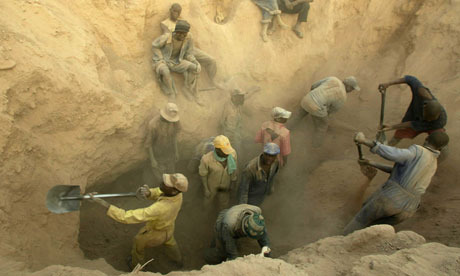
Marange Diamond Mine

Luanda Slum
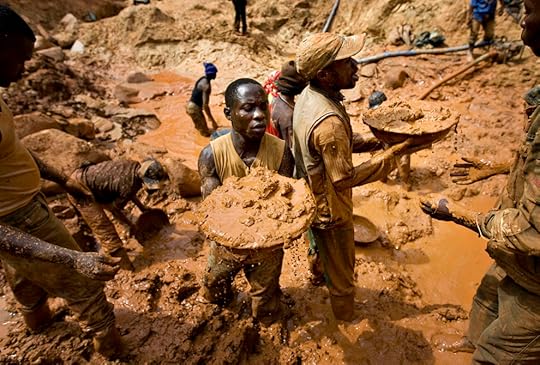
Chudja Mine
Proponents include some of the world’s biggest companies, among them the blue-chip multinationals in which, if you live in the west and have a pension, your money is almost certainly invested. Shell admitted paying bribes worth $2 million to Nigerian customs officials between 2004 and 2006. One installment of a $5 million bribe paid by Kellogg, Brown & Root (KBR) was so bulky when converted to local currency that it had to be loaded onto special vehicles for delivery. At the time, KBR was a subsidiary of Halliburton, whose chief executive, Dick Cheney, departed in 2000 to be George W. Bush’s vice president.
Imagine what would happen if the foremost endeavor of our investment objectives became socially oriented. What if the result of corporate social exploitation was an immediate crash in a company’s stock price, as socially minded investors shunned the company by selling off shares? And what if the stock of socially minded corporations soared when they did the right thing, even if their profits diminished as a result? What if the goal of investors becomes something other than prostrating themselves to Mammon? Something other than sacrificing basic human decency for profit? Something other than being paid to effectuate pockets of hell on earth?
What if the statistics normally associated with stock symbols included a rating of a corporations social effectiveness, extent of human exploitation, sufficiency of wages to the most basic of employees, extent of environmental impacts, and on and on? And what if this social index was the primary driver of stock prices? I smile, just to think of it. Because now, as it stands, the whole stock market is a single edifice to Mammon. The absence of social indicators for corporate performance in human issues is a sacrifice of humanity to Mammon. It is a test to the willingness of the investor to ignore the plight of his fellowman for the sake of Mammon. It is, quite simply, earnings before life and profits before social responsibility. There are those who turn enthusiastically to the financial sections of the paper without even a glance toward the human issues glaring on the front page. Mammon looms large, mesmerizing those beholden to her, and extracting ever greater sacrifices, the ultimate of which is the ruin of humanity.
How It Happens
• Cut me in. In exchange for granting mining and exploration rights, African officials require corporations to make their obscure local companies junior partners, whereby they gain secret stakes.
• Inadequate penalties. A long-neglected U.S. statute, the Foreign Corrupt Practices Act, is supposed to prohibit a company with operations in the United States from paying or offering money or anything of value to foreign officials to win business. However, on the rare occasions when the Department of Justice brings to light such activities, the companies just admit infringements and pay fines that are miniscule in comparison to their exorbitant profits.
• Defense First. The funds that do make it into the African governmental coffers are used primarily for defense, to maintain the regimes in power. Hence, money cannot make it into the needed areas that will help the people, such as health, education, and infrastructure. For example, of the $56 million that China paid for its license to mine uranium in Niger, $47 million was spent on arms to suppress rebels! Crazy!
• African complicity. African’s have assisted in the exploitation of their continent by foreign powers since the slave trade. The classical imperial ploy, perfected by the British, is to foster a client elite whose authority would be buttressed by London, provided this elite maintains London’s interests. Today, in Africa’s resources states, the local potentates are equal partners with the oil executives, the mining magnates, and the globetrotting middlemen.
• Threat of Violence. The people are so traumatized by conflict that they see a vote for any incumbent, no matter how venal, as the option that carries the smallest risk of a return to hostilities. The regimes leave little to chance, dominating the media, appointing its stooges to run the institutions that conduct elections, co-opting opposition politicians, and intimidating opponents.
• Foreign Workers. The influx of foreign workers for mineral extraction, and their expense accounts, drives up prices to astronomical levels, particularly for electricity, water, and essential imported goods. This is exacerbated by pricey spending from those connected to the corrupt government. These upward price pressures distort everything, from food to real estate, pushing the ability to acquire further and further from the masses.
Some Interesting Thoughts That Emerged from This Reading
• Conquer with goodness. What if we decided to conquer other countries for reasons other than greed and exploitation? What if we conquered to bring order, economic prosperity, peace, and humanity? What if we chose to tend the sheep instead of exploiting them for profit?
• Let’s stop being rats. The tragedy is that world resources are developed and rationed as a result of Machiavellian scrambling, infighting, revolution, bribery, and corruption. Certainly, enormous wealth exists for all the world to share, prosper, and grow, so why exist like rats, scrambling over one another to hoard as much wealth as possible?
• Can we take a lesson from China? China has recently made massive investments into Africa, much to the lamentation of the western press. But why, might I ask, shouldn’t the African’s deal openly with the Chinese? After all, the Africans have next to nothing to show for decades of western imperial domination and postcolonial commercial exploitation! Why not try something different? In recent years, Chinese funding has accounted for two-thirds of Africa’s spending on infrastructure, including many hydroelectric dams, mobile phone towers, airports, and tall buildings, the repayments of which occur by the provision of raw natural resources. Thus, instead of currency, which is easy for corrupt officials to hide away, the Chinese ensure some benefit to the masses by actually constructing valuable permanent infrastructure in the country. In contrast, western corporations focus more on acquiring African interests, not African friends. There is a distinct whiff of hypocrisy to western vilification and criticism of China’s advance into Africa.
• Stop the economic lunacy. It is nothing less than economic lunacy for Africa to export crude while importing refined petroleum! If we truly want to help Africa, then lets help them build refineries and other factories. We can send them food and water forever or we can help them help themselves. The bigger question is, do we really want to see them help themselves or do we want to keep them in an exploitable position?
• Find one righteous man? We have to ask ourselves, where is the internal motivation of the indigenous man? Where is the unique indigenous leader who, through love of God and country, will pursue local technologies and the means for the country to exploit its own natural resources? Where is the indigenous man who will see that funds are invested in educating the populace and achieving economic gain, as opposed to rotting in clandestine offshore bank accounts? The worldwide problem hinges upon human frailty and its predisposition to succumb to the worship of Mammon.
• The rise of the anti-human. In the absence of man’s ability to conduct government with moral justice, there may eventually arise a machine, purportedly programmed with justice, to be bequeathed the power to govern. Man harbors within him a pure moral ideal, but man cannot accomplish the ideal physically. It is an ideal that has been declared and written, but never fully carried out. This ideal may eventually be programmed into an artificial intelligence, which will seek the same reverence bequeathed to the stone tablets that bore the Commandments, only in infinitely greater detail. It may be proposed that an anti-human machine, indeed an anti-Christ, be granted sovereignty because no righteous man can be found capable of resisting the hypnosis of money. Isn’t there but one righteous man? Only Christ! So we must unite behind Christ and ask that His righteousness be imputed to us, so that our societies might emerge from the chaos of disorganization. Future historians of more evolved societies will wring their hands in despair at how our society allowed the greed of the few to wreck havoc in our social systems, environment, and economic dispersion.
• Extinguish misery. The overwhelming concern for ourselves blinds us to the reality that we can mitigate misery in the earth. We must cease being like a concentration camp guard on his way home from Auschwitz, picking up chocolates for his tender offspring waiting at home for Daddy’s return. Or like a vulture that picks the eyes of a swollen corpse in a trench before nestling its head against its mate. Or like executives, governmental leaders, and other people who walk past the shacks of the very people who are producing the minerals that make them so fabulously rich, without thinking something is remiss. Extinguishing the misery must become our first aim and certainly must trump the fetish to hoard resources. This realization and its ultimate fruition constitute the unveiling of God’s Kingdom in the earth.
This book reports the shocking statistic that 69% of the people in the world that are in extreme poverty live in countries where oil, gas, and minerals are generating exorbitant sums of money! Africa is the repository of the planets richest diamond mines, 80% of its platinum, 40% of its gold, 15% of its crude oil, as well as significant sources of copper, iron, bauxite, uranium, tin, tungsten, coltan, and practically every other fruit of volcanic geology! And yet, Africa is home to the planet’s poorest people.
Many who consider Africans incapable of governing themselves and innately given to corruption are often ignorant of the extent of exploitation that has persisted in their homeland. Outsiders often think of Africa as a great drain of philanthropy and a continent that guzzles aid to no avail; but much more wealth is taken out of Africa than is provided to it.
When the Colonialists departed Africa, corporate behemoths took their place. In the place of the old empires are hidden networks of multinationals, middlemen, and African potentates. Cargoes of African resources arrive steadily to North America, Europe and China. The disparity between life in the places where Africa’s resources are taken and the places where they are consumed is nearly inconceivable.
The Universal Problem of Hoarding
When the International Monetary Fund examined Angola’s national accounts in 2011, it found that $32 billion had simply gone missing! All the while, half or more of Angola’s population lives below the international poverty line of $1.25 a day! But the problem isn’t limited to Angola, world accounts similarly do not balance because of missing assets that are hoarded secretly in hidden offshore accounts, the world over! Just as Africa could emerge out of poverty through the cessation of hoarding, so could the world.
The resources of the world are more than adequate for humanity; it is only hoarding, greed, and exploitation that creates poverty in the world. The resources of the world could be increased tenfold, but poverty would still persist, because it is not the lack of resources, but the hoarding of resources that creates poverty. One example is Nigeria, where exports of crude oil generate revenues of tens of billions of dollars each year, yet the population suffers in extreme poverty.
Hoarding shortens supply and artificially increases demand, pushing prices ever upwards. An example is when big companies sign long-term contracts with African nations just to lock in their supply of an ore, but do not start mining it. Perhaps even flipping the contract for a profit, all the while keeping the resources of the country tied up. When a foreign company succeeds in contracting a lucrative mine or oil venture with an African nation, its stock immediately rises, instantly transferring that wealth to its stockholders, even while the mineral still lies beneath the ground. Africa’s resource states watch their oil and minerals sail away for that value to accrue elsewhere.
Economic Retardation
The presence of rich mineral resources has been more of a curse to the African populace than a blessing, because it has retarded the normal processes of agricultural and industrial evolution. Instead of extracting and refining their own resources, the Africans license foreign companies to extract them, which creates a pot of money at the disposal of transitioning state officials who invariably enrich themselves. The social contract between the rulers and the ruled is broken because the ruling class does not need to tax the people to fund the government and thus has no need of the peoples consent.
In a normal capitalistic environment, indigenous entrepreneurs would arise from the populace, and the government would be dependent upon taxation of their prosperity. But when external exploitation occurs, foreign corporations simply pay off whatever resemblance of government manifests itself and then proceed to cart off the resources.
Whatever indigenous strongman (and his cohorts) gains control receives a windfall, at the expense of the people. The foreign mining corporation makes a bundle, the governmental officials make a bundle, but the masses of African people are left suffering in slums. Un-beholden to the people, the resource-fueled regimes spend away the national income on their personal interests and stash what’s unspent away in secret offshore accounts.
The major problem is the ability of the rulers of Africa’s resource states to govern without the necessity of popular consent; a problem exacerbated by meddling from abroad. Instead of calling their rulers to account, the citizens of resources states are busy angling for a share through corruption and disorganization that, in turn, causes even greater poverty. Where legitimate business cannot thrive, crime flourishes.
Secret Offshore Accounts
Too often, rights to mineral deposits are sold in complete secrecy to an offshore company for a price far below what it is worth. Then all or part of that asset is sold at a profit to big foreign mining companies. The most popular of these secret jurisdictions is the British Virgin Islands.
An example is when the Congo sold rights to a copper prospect to a private company for $15 million and the company immediately re-sold the same rights for $75 million, establishing a $60 million loss for the state and a $60 million profit for the secret private company. Meanwhile, toddlers with bloated bellies, the signature of malnutrition, totter on the verge of death beneath tattered Congolese flags, flapping from skinny tree trunks. Between 2007 and 2012, just 2.5% of the $41 billion that the mining industry generated in Congo flowed into the country’s meager budget.
Another tactic is when a company establishes a subsidiary in the British Virgin Islands, where the corporation tax is zero, and attributes the majority of its profits to that subsidiary. Or, alternatively, the British Virgin Islands subsidiary makes a huge loan to the mother company, at exorbitant interest, which appears as a tax deduction in the taxing country, but which is interest income in the tax-free country. Or, even more outrageous, the companies manipulate the prices at which they sell goods and services between their subsidiaries to purposefully divert profits into the tax-free environment.
It is a process of separating income from the economic activities that generate that income and shifting that income into non-taxing environments. Through this process, multinationals artificially switch revenues to the non-taxing countries, depriving the governments where their mines or factories are located of the tax revenues to which they are “entitled”. And yet, that word, “entitled”, is the burr under the saddle of every staunch conservative, who nearly always declares that no one is “entitled” to anything, unless they also get themselves into the corruptive fray of enslavement to Mammon. This author reports that the United States alone is losing as much as $60 billion a year to these sort of offshore tax dodges.
I spoke this weekend with a single mother, schoolteacher, earning $36,000 annually, with two children in college and another disabled at home. A sour taste of bile arose in my mouth as this single mother reported that the government takes $800 a month out of her check in taxes! The stark reality is that the full range of the working middle class is getting the screw right along with the masses of Africa, while a minority of the global elite enjoy the cream of the worlds resources and labor.
Taxpayer aid goes to the governments of African countries ostensibly as humanitarian foreign aid to the poor; while in reality purchasing concessions for major corporations, many of which don’t even pay taxes on their profits, sifting them off to secretive tax havens like in the British Virgin Islands. This is, quite simply, effectively subsidizing private oil and mining companies with taxpayer funds.
And all the while chief executives are paid tens of millions of dollars a year, inhabiting a world of corporate jets and dick-swinging machismo. Their thrusts to and fro about Africa are like the raping of an illiterate minor. The author appropriately labels them ‘the looting class”.
Don’t Think You’re Not Involved
We have to be careful not to look at what’s gong on in Africa with condemnation, without examining our own contributions to the problem. Anyone who owns stock in the major extractive corporations or is a keen user of the resources are components to the problem. We prefer not to think of the mothers of eastern Congo, the slum dwellers of Luanda, and the miners of Marange as we talk on our phones, fill up our cars, and propose to our lovers. As long as we go on averting our gaze, the looting machines will endure.
Marange Diamond Mine
Marange Diamond Mine
Luanda Slum
Chudja Mine
Proponents include some of the world’s biggest companies, among them the blue-chip multinationals in which, if you live in the west and have a pension, your money is almost certainly invested. Shell admitted paying bribes worth $2 million to Nigerian customs officials between 2004 and 2006. One installment of a $5 million bribe paid by Kellogg, Brown & Root (KBR) was so bulky when converted to local currency that it had to be loaded onto special vehicles for delivery. At the time, KBR was a subsidiary of Halliburton, whose chief executive, Dick Cheney, departed in 2000 to be George W. Bush’s vice president.
Imagine what would happen if the foremost endeavor of our investment objectives became socially oriented. What if the result of corporate social exploitation was an immediate crash in a company’s stock price, as socially minded investors shunned the company by selling off shares? And what if the stock of socially minded corporations soared when they did the right thing, even if their profits diminished as a result? What if the goal of investors becomes something other than prostrating themselves to Mammon? Something other than sacrificing basic human decency for profit? Something other than being paid to effectuate pockets of hell on earth?
What if the statistics normally associated with stock symbols included a rating of a corporations social effectiveness, extent of human exploitation, sufficiency of wages to the most basic of employees, extent of environmental impacts, and on and on? And what if this social index was the primary driver of stock prices? I smile, just to think of it. Because now, as it stands, the whole stock market is a single edifice to Mammon. The absence of social indicators for corporate performance in human issues is a sacrifice of humanity to Mammon. It is a test to the willingness of the investor to ignore the plight of his fellowman for the sake of Mammon. It is, quite simply, earnings before life and profits before social responsibility. There are those who turn enthusiastically to the financial sections of the paper without even a glance toward the human issues glaring on the front page. Mammon looms large, mesmerizing those beholden to her, and extracting ever greater sacrifices, the ultimate of which is the ruin of humanity.
How It Happens
• Cut me in. In exchange for granting mining and exploration rights, African officials require corporations to make their obscure local companies junior partners, whereby they gain secret stakes.
• Inadequate penalties. A long-neglected U.S. statute, the Foreign Corrupt Practices Act, is supposed to prohibit a company with operations in the United States from paying or offering money or anything of value to foreign officials to win business. However, on the rare occasions when the Department of Justice brings to light such activities, the companies just admit infringements and pay fines that are miniscule in comparison to their exorbitant profits.
• Defense First. The funds that do make it into the African governmental coffers are used primarily for defense, to maintain the regimes in power. Hence, money cannot make it into the needed areas that will help the people, such as health, education, and infrastructure. For example, of the $56 million that China paid for its license to mine uranium in Niger, $47 million was spent on arms to suppress rebels! Crazy!
• African complicity. African’s have assisted in the exploitation of their continent by foreign powers since the slave trade. The classical imperial ploy, perfected by the British, is to foster a client elite whose authority would be buttressed by London, provided this elite maintains London’s interests. Today, in Africa’s resources states, the local potentates are equal partners with the oil executives, the mining magnates, and the globetrotting middlemen.
• Threat of Violence. The people are so traumatized by conflict that they see a vote for any incumbent, no matter how venal, as the option that carries the smallest risk of a return to hostilities. The regimes leave little to chance, dominating the media, appointing its stooges to run the institutions that conduct elections, co-opting opposition politicians, and intimidating opponents.
• Foreign Workers. The influx of foreign workers for mineral extraction, and their expense accounts, drives up prices to astronomical levels, particularly for electricity, water, and essential imported goods. This is exacerbated by pricey spending from those connected to the corrupt government. These upward price pressures distort everything, from food to real estate, pushing the ability to acquire further and further from the masses.
Some Interesting Thoughts That Emerged from This Reading
• Conquer with goodness. What if we decided to conquer other countries for reasons other than greed and exploitation? What if we conquered to bring order, economic prosperity, peace, and humanity? What if we chose to tend the sheep instead of exploiting them for profit?
• Let’s stop being rats. The tragedy is that world resources are developed and rationed as a result of Machiavellian scrambling, infighting, revolution, bribery, and corruption. Certainly, enormous wealth exists for all the world to share, prosper, and grow, so why exist like rats, scrambling over one another to hoard as much wealth as possible?
• Can we take a lesson from China? China has recently made massive investments into Africa, much to the lamentation of the western press. But why, might I ask, shouldn’t the African’s deal openly with the Chinese? After all, the Africans have next to nothing to show for decades of western imperial domination and postcolonial commercial exploitation! Why not try something different? In recent years, Chinese funding has accounted for two-thirds of Africa’s spending on infrastructure, including many hydroelectric dams, mobile phone towers, airports, and tall buildings, the repayments of which occur by the provision of raw natural resources. Thus, instead of currency, which is easy for corrupt officials to hide away, the Chinese ensure some benefit to the masses by actually constructing valuable permanent infrastructure in the country. In contrast, western corporations focus more on acquiring African interests, not African friends. There is a distinct whiff of hypocrisy to western vilification and criticism of China’s advance into Africa.
• Stop the economic lunacy. It is nothing less than economic lunacy for Africa to export crude while importing refined petroleum! If we truly want to help Africa, then lets help them build refineries and other factories. We can send them food and water forever or we can help them help themselves. The bigger question is, do we really want to see them help themselves or do we want to keep them in an exploitable position?
• Find one righteous man? We have to ask ourselves, where is the internal motivation of the indigenous man? Where is the unique indigenous leader who, through love of God and country, will pursue local technologies and the means for the country to exploit its own natural resources? Where is the indigenous man who will see that funds are invested in educating the populace and achieving economic gain, as opposed to rotting in clandestine offshore bank accounts? The worldwide problem hinges upon human frailty and its predisposition to succumb to the worship of Mammon.
• The rise of the anti-human. In the absence of man’s ability to conduct government with moral justice, there may eventually arise a machine, purportedly programmed with justice, to be bequeathed the power to govern. Man harbors within him a pure moral ideal, but man cannot accomplish the ideal physically. It is an ideal that has been declared and written, but never fully carried out. This ideal may eventually be programmed into an artificial intelligence, which will seek the same reverence bequeathed to the stone tablets that bore the Commandments, only in infinitely greater detail. It may be proposed that an anti-human machine, indeed an anti-Christ, be granted sovereignty because no righteous man can be found capable of resisting the hypnosis of money. Isn’t there but one righteous man? Only Christ! So we must unite behind Christ and ask that His righteousness be imputed to us, so that our societies might emerge from the chaos of disorganization. Future historians of more evolved societies will wring their hands in despair at how our society allowed the greed of the few to wreck havoc in our social systems, environment, and economic dispersion.
• Extinguish misery. The overwhelming concern for ourselves blinds us to the reality that we can mitigate misery in the earth. We must cease being like a concentration camp guard on his way home from Auschwitz, picking up chocolates for his tender offspring waiting at home for Daddy’s return. Or like a vulture that picks the eyes of a swollen corpse in a trench before nestling its head against its mate. Or like executives, governmental leaders, and other people who walk past the shacks of the very people who are producing the minerals that make them so fabulously rich, without thinking something is remiss. Extinguishing the misery must become our first aim and certainly must trump the fetish to hoard resources. This realization and its ultimate fruition constitute the unveiling of God’s Kingdom in the earth.

Read
August 3, 2020A lot of this was a rehash of stuff I knew on a more theoretical and statistical level – rapacious corporations, local compradors, rent-seeking, the wealth gap in Luanda, coltan deposits – but I was absolutely floored by the actual research that Burgis did. His ability to follow the money trail was impressive as all fuck, along with his ability to skein together all the linkages between shadowy cabals of African strongmen, Chinese financiers, Swiss and Israeli precious stone dealers (hey there, evil version of Adam Sandler in Uncut Gems), and first-world consumers. Just an all around tour de force, I cannot recommend this highly enough.
April 30, 2020
I really wanted to like this book. I really respect what the author set out to do: describe the kleptocracy that is robbing many African countries, leaving their citizens struggling in grinding poverty that is difficult to even comprehend. The writer also aimed to show how we in the developed world are implicated in this by our lax money-laundering laws.
But the book's failure, like many surveys in this genre, is its lack of vividly drawn characters. All the information the writer heaps on you becomes numbing after a while because there aren't any individuals to care about.
But the book's failure, like many surveys in this genre, is its lack of vividly drawn characters. All the information the writer heaps on you becomes numbing after a while because there aren't any individuals to care about.

May 29, 2015
L’Afrique, dit-on, va mieux. Tel n’est pas le constat dressé par Tom Burgis au terme du voyage auquel il nous convie dans un continent frappé par la malédiction des ressources naturelles (« resource curse »). L’Afrique subsaharienne possède 15 % des réserves mondiales de pétrole, 40 % des ressources en or, 80 % des ressources en platine ; elle ne représente pourtant que 2 % du PNB mondial. Ses richesses naturelles l’ont paradoxalement appauvrie. Cette causalité contrintuitive s’explique : l’exportation massive de matières premières entraîne la hausse de la monnaie et détériore la compétitivité du secteur manufacturier qui conduit à la désindustrialisation de l’économie, à la mono-spécialisation et accroit la vulnérabilité aux variations des cours internationaux. C’est la maladie hollandaise (« Dutch disease ») ainsi baptisée suite aux effets sur l’économie néerlandaise de la découverte d’immenses réserves de gaz naturel dans le nord du pays à la fin des années 50.
Cette surabondance de ressources naturelles a des effets politiques tout aussi malheureux. Leur vente génère une rente qui est captée par une minorité auto-suffisante. Cette manne lui évite de lever l’impôt, rompant du même coup le lien social entre gouvernants et gouvernés. L’exercice du pouvoir n’a plus pour but la satisfaction du plus grand nombre mais l’enrichissement des gouvernants. C’est la « politique du ventre » de Jean-François Bayard – qu’ignore Tom Burgis – ou la survie des obèses (« Survival of the fattest » – qu’il source. Cet accaparement des richesses explique que les pays frappés par la malédiction des ressources naturelles connaissent une croissance très inégalitaire. Leur PIB croît et leur PIB/habitant aussi ; mais la pauvreté ne recule pas.
La Guinée équatoriale incarne à la caricature ce biais (p. 212). Le pétrole y représente 75 % de son PIB, 90 % des ressources publiques, 98 % des exportations. Son PIB/habitant a explosé, approchant les 30.000 $ le rapprochant du niveau de l’Espagne ou de la Nouvelle-Zélande. Pour autant, cette croissance est inégalement répartie. Tandis que le président Obiang (au pouvoir depuis 1979) et sa clique accaparent la rente pétrolière, le reste de la population survit dans la misère. Le pays se classe au 136ème rang mondial de l’index du développement humain du PNUD, derrière le Guatemala où le PIB/habitant n’est que de 5.000 $. L’espérance de vie y est de 51 ans seulement, au même niveau qu’en Somalie.
Journaliste d’investigation au Financial Times, successivement basé à Johannesburg, à Lagos et aujourd’hui à Londres, Tom Burgis nous livre le fruit de ses enquêtes. D’Angola au Niger, en passant par la Zambie, la RDC et le Nigeria, la « machine à piller » a bien des ressorts. Elle n’est plus seulement occidentale, la Chine prenant désormais sa part dans le pillage systématique des ressources naturelles. Avec une ténacité obsessionnelle, Tom Burgis traque un de ces entrepreneurs chinois sans foi ni loi, Sam Pa, le mystérieux président de Queensway Group, un conglomérat aux investissements opaques. Les Africains ont aussi leur part de responsabilité que l’auteur dénonce en décrivant les différentes variantes de kleptocraties africaines : « cryptocratie » dans un Angola dominé par le culte du secret, « contractocratie » dans un Nigeria miné par les trafics d’intérêt ...
Au risque de nous perdre dans la description millimétrique de montages financiers d’une incroyable complexité, Tom Burgis donne de la chair à la malédiction des ressources et un visage aux capitaines d’industrie, seigneurs de la guerre et trafiquants qui en sont responsables.
Cette surabondance de ressources naturelles a des effets politiques tout aussi malheureux. Leur vente génère une rente qui est captée par une minorité auto-suffisante. Cette manne lui évite de lever l’impôt, rompant du même coup le lien social entre gouvernants et gouvernés. L’exercice du pouvoir n’a plus pour but la satisfaction du plus grand nombre mais l’enrichissement des gouvernants. C’est la « politique du ventre » de Jean-François Bayard – qu’ignore Tom Burgis – ou la survie des obèses (« Survival of the fattest » – qu’il source. Cet accaparement des richesses explique que les pays frappés par la malédiction des ressources naturelles connaissent une croissance très inégalitaire. Leur PIB croît et leur PIB/habitant aussi ; mais la pauvreté ne recule pas.
La Guinée équatoriale incarne à la caricature ce biais (p. 212). Le pétrole y représente 75 % de son PIB, 90 % des ressources publiques, 98 % des exportations. Son PIB/habitant a explosé, approchant les 30.000 $ le rapprochant du niveau de l’Espagne ou de la Nouvelle-Zélande. Pour autant, cette croissance est inégalement répartie. Tandis que le président Obiang (au pouvoir depuis 1979) et sa clique accaparent la rente pétrolière, le reste de la population survit dans la misère. Le pays se classe au 136ème rang mondial de l’index du développement humain du PNUD, derrière le Guatemala où le PIB/habitant n’est que de 5.000 $. L’espérance de vie y est de 51 ans seulement, au même niveau qu’en Somalie.
Journaliste d’investigation au Financial Times, successivement basé à Johannesburg, à Lagos et aujourd’hui à Londres, Tom Burgis nous livre le fruit de ses enquêtes. D’Angola au Niger, en passant par la Zambie, la RDC et le Nigeria, la « machine à piller » a bien des ressorts. Elle n’est plus seulement occidentale, la Chine prenant désormais sa part dans le pillage systématique des ressources naturelles. Avec une ténacité obsessionnelle, Tom Burgis traque un de ces entrepreneurs chinois sans foi ni loi, Sam Pa, le mystérieux président de Queensway Group, un conglomérat aux investissements opaques. Les Africains ont aussi leur part de responsabilité que l’auteur dénonce en décrivant les différentes variantes de kleptocraties africaines : « cryptocratie » dans un Angola dominé par le culte du secret, « contractocratie » dans un Nigeria miné par les trafics d’intérêt ...
Au risque de nous perdre dans la description millimétrique de montages financiers d’une incroyable complexité, Tom Burgis donne de la chair à la malédiction des ressources et un visage aux capitaines d’industrie, seigneurs de la guerre et trafiquants qui en sont responsables.

January 26, 2016
The legacy of Cecil Rhodes refuses to wither in the destitute yet mineral rich African continent.
There is little chance for the ordinary people when their governments and ruling cliques are hell bent on enriching themselves. Opinions of people do not matter in resource states where their governments economically rely on external corporations and countries for their sustenance. The only way for the ordinary is to pay tax to their government so that their voice can be heard. Obviously to pay tax they have to be first be making enough money.
Multinational corporations understand this situation very well. Whether its Shell or BP or the many Chinese companies, they are more than willing to get into partnership with any junta or dictator as long as they get rights to mine African resources.
So what can the ordinary do to fight for their resources? I think media and social media might be an avenue. Quick exposures of dodgy deals might help curb these practices? Yes, I know, I am clutching at straws, but there are few other ideas that might work.
How corporations have managed to maintain a soft and benign image despite their money self serving policies over hundreds of years of extortion is still a mystery for me.
There is little chance for the ordinary people when their governments and ruling cliques are hell bent on enriching themselves. Opinions of people do not matter in resource states where their governments economically rely on external corporations and countries for their sustenance. The only way for the ordinary is to pay tax to their government so that their voice can be heard. Obviously to pay tax they have to be first be making enough money.
Multinational corporations understand this situation very well. Whether its Shell or BP or the many Chinese companies, they are more than willing to get into partnership with any junta or dictator as long as they get rights to mine African resources.
So what can the ordinary do to fight for their resources? I think media and social media might be an avenue. Quick exposures of dodgy deals might help curb these practices? Yes, I know, I am clutching at straws, but there are few other ideas that might work.
How corporations have managed to maintain a soft and benign image despite their money self serving policies over hundreds of years of extortion is still a mystery for me.

January 24, 2021
This is the type of book that makes you so mad about what you didn't know that you do more research. Too often Africa is treated as an overarching simplistic concept when talked about in history and in modern potlitics but in reality it is complex and nuanced collection of countries, each with their own history and struggles, often fueled by the very resources within them.
I highly recommend this book to anyone interested in geopolitics, economics, history, etc.
I highly recommend this book to anyone interested in geopolitics, economics, history, etc.

Want to Read
May 10, 2023College Library Rm. 1191
HD9506.A572 B873 2015
HD9506.A572 B873 2015

July 3, 2015
Develops as its central thesis the economic phenomenon called the "Dutch Disease" aka the "resource curse." Why is it that a continent as mineral-rich as Africa contains the poorest, most violent countries in the world? According to the Dutch Disease, the discovery of an abundance of a key resources--oil, coltan, gold, natural gas, etc.--tends to retard the industrial diversity of a nation: the vast majority of economic energy is devoted to the extraction and exportation of said resource. (For a more mainstream-news-prominent example, see Russia's recent tumble due to its reliance on gas/oil exports and the cheapening of crude from Saudi "over"production in order to punish both ISIS's terrorist caliphate and Putin's nationalistic designs).
In Africa, the preponderance of competing ethnic groups all scrambling for a piece of the pie tends to encourage corrupt governments reliant on resource extraction and vast, expensive patronage systems. As these ethnic-dominated governments can only sustain access to resource wealth by remaining perpetually in power, the democratic process becomes a golf-clap farce until "rebel" groups (other ethnic tribes and charismatic warlords) wreck enough havoc to either overthrow a regime or gain sufficient payoffs for keeping particularly chaotic regions under control. And so it goes. Add in IMF/World Bank Structural Adjustment Loans--the money-tap contingent on neoliberal policy, including the selling of national resources to private companies for pennies on the dollar (to be fair, the only entities that can summon the sort of investment capital to extract these resources in the first place)--and a shady organization nicknamed the "88 Queensway Group" which is wholly invested in wheeling and dealing between respectable financial institutions, China, and pariah states, and you've a recipe for the massive quagmire of human suffering and environmental devastation that we yanks tend to glance at on the pages between the latest Kardashian update and blockbuster movie review. Book is very thorough; I imagine the author made serious enemies by bringing some of this stuff to light.
In Africa, the preponderance of competing ethnic groups all scrambling for a piece of the pie tends to encourage corrupt governments reliant on resource extraction and vast, expensive patronage systems. As these ethnic-dominated governments can only sustain access to resource wealth by remaining perpetually in power, the democratic process becomes a golf-clap farce until "rebel" groups (other ethnic tribes and charismatic warlords) wreck enough havoc to either overthrow a regime or gain sufficient payoffs for keeping particularly chaotic regions under control. And so it goes. Add in IMF/World Bank Structural Adjustment Loans--the money-tap contingent on neoliberal policy, including the selling of national resources to private companies for pennies on the dollar (to be fair, the only entities that can summon the sort of investment capital to extract these resources in the first place)--and a shady organization nicknamed the "88 Queensway Group" which is wholly invested in wheeling and dealing between respectable financial institutions, China, and pariah states, and you've a recipe for the massive quagmire of human suffering and environmental devastation that we yanks tend to glance at on the pages between the latest Kardashian update and blockbuster movie review. Book is very thorough; I imagine the author made serious enemies by bringing some of this stuff to light.

July 11, 2017
An extremely engaging and disturbing work of investigative journalism, The Looting Machine tells the tale of the systematic theft of Africa's natural wealth in the post-colonial world. Burgis is incredibly well-researched and thorough in his investigation of the 'looting machines' which make some of the wealthiest nations in the world, the poorest. This text is informative but engaging- and I've come away from it not only with an understanding of the mechanism of this corruption, but also a real sense of the key players involved. At times it was dense and bleak reading- but on the whole was very enlightening. We are all complicit.

January 7, 2016
The writing was a little dry for my taste, but the content was extremely interesting!

March 3, 2016
This book exposes corruption and gives voice to the millions of Africans who suffer the consequences of living under the "resource curse" aka "Dutch Disease" and is a great scrapbook of exploitation.
This is an investigative journalism piece by Tom Burgis and has managed to uncover a system responsible for the wholesale looting of Africa's mineral resources for the benefit of the French, Chinese, Americans, Russians, Israelis, Brits, Brazilians, not to mention small but rapacious African elites, who are all involved in pillaging Africa’s natural resources to line their pockets with unbelievable sums.
The plundering of each of the African nations immense wealth by their individual country's officials, foreign businessmen and organised criminals is a constant throughout this book. Billions of dollars of state assets are transferred into pockets of private firms with no benefit to the state, then after this is exposed, countries create shadow states to steal funds, buy elections and bribe supporters. One witness in the Democratic Republic of Congo said that Laurent Kabila was being handed at least $4m a week in cash-filled suitcases from mining companies.
Sadly this is happening all over Africa, and in the Southern reaches of the continent too.
The “Looting Machine” also analyses the failure of Black Economic Empowerment (BEE) in South Africa, the ANC’s key policy to redistribute the country’s wealth under majority rule. BEE has created multi-millionaires in the top ranks of the ANC who have swapped liberation credentials for a seat on the board of white-controlled companies, but left many of their black followers disillusioned. The resulting industrial unrest led to the massacre of workers by police at Lonmin’s platinum mine at Marikana.
An interesting quote from the book -
"But just as Angola's Jose Eduardo dos Santos fought against apartheid South Africa only to preside over an elite that has used oil money to cut itself off from the rest, Robert Mugabe sits atop a feudal ruling class that resembles in structure - if not in skin colour - the minority rule he waged a guerrilla war to overthrow."
Folarin Gbadebo-Smith, a Nigerian polymath who qualified as a dentist, serving in the Lagos local government, running the Nigerian-Asian Chamber of Commerce, sort of sums it all up as he is quoted as saying that "The British and the rest, they were like the Spanish conquistadores." "The colonial powers set up a machine, a machine to extract resources. When they left, it passed to the next leaders, like DNA. In so many places the military took over to capture the rent. It is incredibly difficult to change that structure. The foreign partners remain with their collaborators. Its like a virus, transmitted from the colonial regime to the post-independence rulers. And these extractors, they are the opposite of a society that is governed for the commonwealth, for the public good."
So the rape of Africa continues................the elite get more and more wealthy and the poor remain with nothing.
Amartya Sen, the Nobel Prize-winning Indian economist writes "The sense of distance between the ruler and the ruled - between "them" and "us" - is a crucial feature of famines."
A must read for all to understand the systematic theft of Africa's wealth!
This is an investigative journalism piece by Tom Burgis and has managed to uncover a system responsible for the wholesale looting of Africa's mineral resources for the benefit of the French, Chinese, Americans, Russians, Israelis, Brits, Brazilians, not to mention small but rapacious African elites, who are all involved in pillaging Africa’s natural resources to line their pockets with unbelievable sums.
The plundering of each of the African nations immense wealth by their individual country's officials, foreign businessmen and organised criminals is a constant throughout this book. Billions of dollars of state assets are transferred into pockets of private firms with no benefit to the state, then after this is exposed, countries create shadow states to steal funds, buy elections and bribe supporters. One witness in the Democratic Republic of Congo said that Laurent Kabila was being handed at least $4m a week in cash-filled suitcases from mining companies.
Sadly this is happening all over Africa, and in the Southern reaches of the continent too.
The “Looting Machine” also analyses the failure of Black Economic Empowerment (BEE) in South Africa, the ANC’s key policy to redistribute the country’s wealth under majority rule. BEE has created multi-millionaires in the top ranks of the ANC who have swapped liberation credentials for a seat on the board of white-controlled companies, but left many of their black followers disillusioned. The resulting industrial unrest led to the massacre of workers by police at Lonmin’s platinum mine at Marikana.
An interesting quote from the book -
"But just as Angola's Jose Eduardo dos Santos fought against apartheid South Africa only to preside over an elite that has used oil money to cut itself off from the rest, Robert Mugabe sits atop a feudal ruling class that resembles in structure - if not in skin colour - the minority rule he waged a guerrilla war to overthrow."
Folarin Gbadebo-Smith, a Nigerian polymath who qualified as a dentist, serving in the Lagos local government, running the Nigerian-Asian Chamber of Commerce, sort of sums it all up as he is quoted as saying that "The British and the rest, they were like the Spanish conquistadores." "The colonial powers set up a machine, a machine to extract resources. When they left, it passed to the next leaders, like DNA. In so many places the military took over to capture the rent. It is incredibly difficult to change that structure. The foreign partners remain with their collaborators. Its like a virus, transmitted from the colonial regime to the post-independence rulers. And these extractors, they are the opposite of a society that is governed for the commonwealth, for the public good."
So the rape of Africa continues................the elite get more and more wealthy and the poor remain with nothing.
Amartya Sen, the Nobel Prize-winning Indian economist writes "The sense of distance between the ruler and the ruled - between "them" and "us" - is a crucial feature of famines."
A must read for all to understand the systematic theft of Africa's wealth!

October 10, 2015
Only 3-6% of the value of Africa's mineral and energy exports stays in Arica, and most of that is looted by oligarchs, militaries and corporations. Increasingly from China.
Burgis writes in overwhelming detail, and this will be valuable primary material for historians. For me it was just profoundly depressing.
Burgis writes in overwhelming detail, and this will be valuable primary material for historians. For me it was just profoundly depressing.

Read
February 20, 2017A thoroughly researched piece of work. A must read for all Africans. It gives context to our lives.

February 3, 2020
One of my favorite books - takes you through today’s main resources and how they have been and still are historically looted - important for those who aren’t familiar with these mechanisms

April 23, 2018
Full review and highlights at https://books.max-nova.com/looting-machine
For my 2018 "Year of Crime and Punishment," I've been reading about bank heists, insider trading, contract killing, and identity theft. But all of these pale in comparison to the scale of the financial crimes described in "The Looting Machine". Financial Times reporter Tom Burgis traces the illicit flows of tens of billions of dollars of African natural resource wealth to local dictators, Western corporations and financial elites, and - more recently - massive Chinese enterprises. Noting that "like its victims, its beneficiaries have names," Burgis dives into the specifics in African resource states from Angola to Zimbabwe. He names names and backs up his claims with painstaking on-the-ground investigative reporting. I was shocked by his level of access to the highest levels of African government and industry.
Yet there was only so much of the hidden financial web that Burgis could untangle. He runs into major roadblocks when investigating Chinese companies generally and the shadowy "Queensway Group" in particular. When Burgis isn't able to get the exact details, he still illuminates the general mechanisms by which the resource wealth of African states is funneled into the hidden bank accounts of the political elites. I especially appreciated a concept from an Angola specialist Burgis met:
Of course, the Western world has been complicit in propping up African dictators for centuries. Oil companies are notorious for this, and Burgis details some of Shell's sketchy operations in the oil-rich Nigerian delta. He also describes how the World Bank and the IMF fund Western companies exploiting African natural resources. But as the World Bank has gotten more squeamish about supporting some of the more repressive regimes in Africa, China has stepped right in. Burgis does an excellent job of tracking the explosion of Chinese investment in Africa and how it continues to support many of the same old toxic governing practices. I had sort of expected the world's two biggest economic powers to be deep into Africa, but Burgis surprised me by also highlighting the role that a handful of Israeli diamond and mining companies play in financing African regimes (and providing military training).
Yet Burgis doesn't lay 100% of the blame on China and the West. He includes a brutal quote from novelist Chinua Achebe:
For my 2018 "Year of Crime and Punishment," I've been reading about bank heists, insider trading, contract killing, and identity theft. But all of these pale in comparison to the scale of the financial crimes described in "The Looting Machine". Financial Times reporter Tom Burgis traces the illicit flows of tens of billions of dollars of African natural resource wealth to local dictators, Western corporations and financial elites, and - more recently - massive Chinese enterprises. Noting that "like its victims, its beneficiaries have names," Burgis dives into the specifics in African resource states from Angola to Zimbabwe. He names names and backs up his claims with painstaking on-the-ground investigative reporting. I was shocked by his level of access to the highest levels of African government and industry.
Yet there was only so much of the hidden financial web that Burgis could untangle. He runs into major roadblocks when investigating Chinese companies generally and the shadowy "Queensway Group" in particular. When Burgis isn't able to get the exact details, he still illuminates the general mechanisms by which the resource wealth of African states is funneled into the hidden bank accounts of the political elites. I especially appreciated a concept from an Angola specialist Burgis met:
“cryptocracy” — a system of government in which the levers of power are hidden.Indeed, parts of the book strongly echoed the main thesis of "Treasure Islands", another book in my "year of crime" about how banking privacy and offshore tax evasion weaken governance and corrod accountability. Both single out the notorious "Elf Affair" between Omar Bongo in Gabon and Elf, the French oil company. Because the chronically cash-strapped rulers of resource-rich African states can rely on resource royalties from Western and Chinese companies, they're able to fund their regimes without taxing their local populations. This makes rulers unaccountable to their citizens - they don't need their consent to keep the army paid and the government running. They're able to get away with all sorts of blatantly self-serving corruption, like appropriating billions in government revenue and stashing it in personal bank accounts in London. Some of the governing tactics reminded me of the cartel management strategies in Tom Wainwright's fantastic "Narconomics".
Of course, the Western world has been complicit in propping up African dictators for centuries. Oil companies are notorious for this, and Burgis details some of Shell's sketchy operations in the oil-rich Nigerian delta. He also describes how the World Bank and the IMF fund Western companies exploiting African natural resources. But as the World Bank has gotten more squeamish about supporting some of the more repressive regimes in Africa, China has stepped right in. Burgis does an excellent job of tracking the explosion of Chinese investment in Africa and how it continues to support many of the same old toxic governing practices. I had sort of expected the world's two biggest economic powers to be deep into Africa, but Burgis surprised me by also highlighting the role that a handful of Israeli diamond and mining companies play in financing African regimes (and providing military training).
Yet Burgis doesn't lay 100% of the blame on China and the West. He includes a brutal quote from novelist Chinua Achebe:
"The Nigerian problem is the unwillingness or inability of its leaders to rise to the responsibility, to the challenge of personal example which are the hallmarks of true leadership."Burgis goes even further, pushing into territory that must have made his publisher very nervous. He broaches the delicate subject of multiculturalism, noting that ethnic diversity can weaken the civic spirit of a country and leave it vulnerable to exploitation by outsiders:
In resource states ethnicity takes a terrible form. As resource rents beget a ruling class that is not accountable to the people, power is maintained through patronage. Public service is largely abandoned. With no record of service to point to, politics becomes a game of mobilizing one’s ethnic brethren. For us to win, they have to lose. The social contract is replaced with a compact of violence.But while this book contains no shortage of outrageous corruption and desperate poverty, Tom Burgis distinguishes himself by actually providing a reasonable idea for how to begin solving this vital problem:
But what if companies were subject to a duty of care to prevent corruption? Imagine a criminal offense that made a company liable if it proceeded with a transaction without having identified the ultimate beneficiaries of its target or prospective partner and if that transaction were subsequently shown to have enriched officials. The company would be treated before the law as though it had knowingly concocted a corrupt scheme. At a stroke, one of the chief conduits for corruption would be stoppered.Burgis opened my eyes to a whole set of dynamics that I was completely unaware of. This book was a fantastic addition to my 2018 "year of crime" and I'm excited to read more about government corruption.
November 28, 2018
Magnificent.

August 9, 2016
This one was a real thinker and a conversation starter in my household. It also makes you want to take action – if only there was an obvious way how – purchase from some oil companies over others? Do not buy diamonds, period? Nothing obvious springs to mind and the situation seems somewhat hopeless.
After years of reporting on financial affairs in Africa, Tom Burgis dissects and analyzes the current circumstances (2015) of African economies. With each chapter dedicated to a specific country, he lays out the ties between political power and financial assets, the historical context which led up to these circumstances and the reverberations and consequences which have resulted so far. The overall effect is horrific and shocking - but also not surprising at all. If you have read anything about any of the current African dictatorships, you kind of get the sense that the leaders are not acting for the benefit of the people; that if there is any national resource which can be exploited, it is probably being exploited; that there is probably some foreign investment greasing the wheels; and that a large amount of this investment probably originates in China. And that this problem is widespread and repeated in most countries on the African continent, and that that is probably not a coincidence.
The word “looting” is very strong, but after reading the case that Burgis lays out, it is extremely hard to argue with.
After years of reporting on financial affairs in Africa, Tom Burgis dissects and analyzes the current circumstances (2015) of African economies. With each chapter dedicated to a specific country, he lays out the ties between political power and financial assets, the historical context which led up to these circumstances and the reverberations and consequences which have resulted so far. The overall effect is horrific and shocking - but also not surprising at all. If you have read anything about any of the current African dictatorships, you kind of get the sense that the leaders are not acting for the benefit of the people; that if there is any national resource which can be exploited, it is probably being exploited; that there is probably some foreign investment greasing the wheels; and that a large amount of this investment probably originates in China. And that this problem is widespread and repeated in most countries on the African continent, and that that is probably not a coincidence.
The word “looting” is very strong, but after reading the case that Burgis lays out, it is extremely hard to argue with.
June 30, 2015
"What has happened to Nigeria is not the result of some innate facet of the African spirit, as some observers suggest with a shrug of casual racism. British members of Parliament have shown themselves willing to sell their right to ask parliamentary questions, and the pork-barrel politics of Capitol Hill in Washington, DC, looks very much like a patronage system. Lobbyists in every major capital inject money into politics on behalf of vested interests. The difference between a corrupted resource state and a state that can still call itself a place of representative rule is the extent to which such subversion of public office for personal benefit is the scandal or the norm. It is the degree to which the institutions of state -- legislative bodies, the police, the courts -- serve as instruments of the mighty or as checks on arbitrary power."

May 22, 2018
The title and description of the book suggests it would be an overview of natural resources on the African continent, something which it is absolutely not. Instead the focus is on a few individuals and groups, predominantly dealing with Angola. It's incredibly in-depth regarding the businessmen and politicians it mentions, yet discusses nothing about the history of African resources, nor does it consider the North African states at all which is baffling given MENA states have often been considered 'cursed' because of the oil.
If you're looking for an expert view on businessmen in Angola, then this is the book for you. The research is genuinely impressive, but the book is incredibly dry and zeros in on such a specific subject, it makes it difficult to read and became a task half way through.
If you're looking for an expert view on businessmen in Angola, then this is the book for you. The research is genuinely impressive, but the book is incredibly dry and zeros in on such a specific subject, it makes it difficult to read and became a task half way through.

May 18, 2017
Very informative and interesting book about how resources flow from Africa and have done so ever since the colonial time. Even before I read the book, I was aware of this problem, but Burgis explains how and to which extent the looting machine keeps Africa poor, and the facts are pretty shocking. The book is pretty heavy, even though not academic. I listened to a recorded version of it, which worked ok. I would however recommend other readers to read it instead, since it contains a lot of numbers and names which I sometimes found difficult to keep track of when I didn't see them in writing. In all, I think this is a book worth reading for anyone interested in Africa and development.

January 12, 2025
This book explains the manifestations of what author Tim Burgis calls “the resource curse” in Sub-Saharan Africa: that lucrative natural resources in institutionally-weak post-colonial African states enable autocrats to govern without recourse to popular consent. Specifically, the resource curse facilitates “looting machines” in which African despots siphon their state resources into international markets for oil and mineral markets using Western, and more recently, Chinese international corporate partners, pocketing the profits for personal gain and leaving their populations largely destitute. “These networks fuse state and corporate power,” the author writes. “They are aligned to no nation and belong instead to the transnational elites that have flourished in the era of globalization. Above all, they serve their own enrichment.”
I felt the case-studies were quite long-winded, and I would have benefitted from conclusive summaries of each at the end of every chapter. I think I would have preferred to read an article about this over an entire book. I also don’t like that Burgis never offers a solution to the systemic looting he spends hundreds of pages condemning.
I felt the case-studies were quite long-winded, and I would have benefitted from conclusive summaries of each at the end of every chapter. I think I would have preferred to read an article about this over an entire book. I also don’t like that Burgis never offers a solution to the systemic looting he spends hundreds of pages condemning.

November 16, 2025
A solid and well-supported thesis. Despite shaking the colonial exploitation, politically fragile, resource-abundant African states suffer from kleptocratic governments and multinational middlemen who bleed nations of their natural inheritance. Such practices make it impossible for resource-generated wealth to trickle down and benefit citizens through infrastructure projects and currency stabilization.
Burgis backs his claims with examples of resources extracted from throughout the continent. From crude oil to coltan and bauxite to rough-cut diamonds. Congo, Niger, Angola, Zimbabwe, and others. Whatever the resources and wherever the country, wealth is consolidated in the hands of the few, leaving the locals with little but a lost way of life.
Burgis himself has been to many of the places he describes and pursues the accused multinational middlemen who perpetrate in fragile nations, giving the book a more authentic, less armchair/latte sipping feel.
All in all, a tough read and a bit of a slog, but informative nonetheless.
Burgis backs his claims with examples of resources extracted from throughout the continent. From crude oil to coltan and bauxite to rough-cut diamonds. Congo, Niger, Angola, Zimbabwe, and others. Whatever the resources and wherever the country, wealth is consolidated in the hands of the few, leaving the locals with little but a lost way of life.
Burgis himself has been to many of the places he describes and pursues the accused multinational middlemen who perpetrate in fragile nations, giving the book a more authentic, less armchair/latte sipping feel.
All in all, a tough read and a bit of a slog, but informative nonetheless.
January 18, 2021
Very insightful look into the issues plaguing Africa from the perspective of foreign companies plundering the continent for its natural resources. This plundering has ultimately led to corruption and a very marginal benefit to the actual citizens of each country. Much of the wealth promised to Africa has been limited to those in power while the majority of the population has essentially been left in poverty.

June 8, 2025
The Looting Machine by Tom Burgess.
Why is the Richest continent in the world also the poorest? I think i have an idea why.. Oil, diamonds, Gold, Cobalt, Copper, Iron, Africa has it all. We all use it and want it. This book shows us why and how Africa is still getting robbed blind by China, America and lots and lots of Euopean countries. A infuriating read, but we must not look away from those power hungry basterds and see a solution to it.
Why is the Richest continent in the world also the poorest? I think i have an idea why.. Oil, diamonds, Gold, Cobalt, Copper, Iron, Africa has it all. We all use it and want it. This book shows us why and how Africa is still getting robbed blind by China, America and lots and lots of Euopean countries. A infuriating read, but we must not look away from those power hungry basterds and see a solution to it.

August 18, 2018
This was fantastic! Informative, enriching and so relevant. Living on the African continent myself, everything described and discussed in this book resonated with me greatly. Tom Burgis hit the nail on the head time and time again, and gives a clear picture of Africa's continuous failings. A great book that leaves a lasting impression.

April 4, 2023
Very captivating deep dive into the various exploitative extractive resource industries in Africa. Some insane deep dives into the Nigerian and Angolan oil industries, Zimbabwe and South Africa's diamond trade, Congo's various precious metal trades and more and the spiderwebbing network of corruption that goes on behind the scenes.
Very very good read, and one that was super up my alley.
Very very good read, and one that was super up my alley.
Displaying 1 - 30 of 318 reviews