

What do you think?
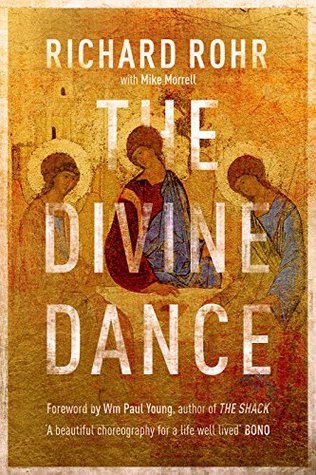
Divine Dance
What if changing our perception of God has the potential to change everything? God is not what you think. Visions of an angry, distant, moral scorekeeper or a supernatural Santa Claus handing out cosmic lottery tickets to those who attend the right church or say the right prayer dominate our culture. For many others, God has become irrelevant or simply unbelievable. In The Divine Dance, Fr. Richard Rohr (with Mike Morrell) points readers to an unlikely opening beyond this divinity impasse: the at-times forgotten, ancient mystery of the Trinity-God as utterly one, yet three. Drawing from Scripture, theology, and the deepest insights of mystics, philosophers, and sages throughout history, Fr. Rohr presents a compelling alternative to aloof and fairytale versions of God: One God, belovedly in communion, as All-Vulnerable, All-Embracing, and All-Given to you and me. The Divine Dance makes accessible and practicable the Christian tradition's most surprising gift... God as Community...as Friendship...as Dance. Are you ready to join in? Finding the sweet spot where contemporary science meets ancient mysticism, and theology meets poetry, The Divine Dance sketches a beautiful choreography for a life well-lived. In our joy or our pain, true life is always relational, a flow, a dance. (And was always meant to be.)-Bono, U2 This is Richard in peak form, doing what he does best: showing you how the best ideas for the future have actually been here, in the Jesus tradition, the whole time.... Our favorite Franciscan has done it again!-Rob Bell, Love Wins Richard Rohr is one of the great spiritual masters of our time, indeed of any time.... The Trinity will of course always remain a profound mystery, but after reading Father Rohr's book, you will experience it as a mystery that can, and will, transform your life.-James Martin, SJ, Jesus: A Pilgrimage The Divine Dance is an example of why Rohr has had such a profound influence on so many Christians seeking to balance reason and mystery, action and contemplation, not to mention faith and real life.-Nadia Bolz-Weber, Accidental Saints
224 pages, Paperback
First published October 4, 2016
About the author
Richard Rohr
247 books2,448 followersFr. Richard Rohr is a globally recognized ecumenical teacher bearing witness to the universal awakening within Christian mysticism and the Perennial Tradition. He is a Franciscan priest of the New Mexico Province and founder of the Center for Action and Contemplation (CAC) in Albuquerque, New Mexico. Fr. Richard's teaching is grounded in the Franciscan alternative orthodoxy—practices of contemplation and expressing itself in radical compassion, particularly for the socially marginalized.
Fr. Richard is author of numerous books, including Everything Belongs, Adam’s Return, The Naked Now, Breathing Under Water, Falling Upward, Immortal Diamond, Eager to Love, and The Divine Dance: The Trinity and Your Transformation (with Mike Morrell).
Fr. Richard is academic Dean of the Living School for Action and Contemplation. Drawing upon Christianity's place within the Perennial Tradition, the mission of the Living School is to produce compassionate and powerfully learned individuals who will work for positive change in the world based on awareness of our common union with God and all beings. Visit cac.org for more information.
Fr. Richard is author of numerous books, including Everything Belongs, Adam’s Return, The Naked Now, Breathing Under Water, Falling Upward, Immortal Diamond, Eager to Love, and The Divine Dance: The Trinity and Your Transformation (with Mike Morrell).
Fr. Richard is academic Dean of the Living School for Action and Contemplation. Drawing upon Christianity's place within the Perennial Tradition, the mission of the Living School is to produce compassionate and powerfully learned individuals who will work for positive change in the world based on awareness of our common union with God and all beings. Visit cac.org for more information.
Ratings & Reviews
Friends & Following
Create a free account to discover what your friends think of this book!
Community Reviews
Displaying 1 - 30 of 398 reviews

September 26, 2016
Disclaimer, I work for the publisher of this book and worked on the manuscript. I have never reviewed one of our books on Goodreads before. I spend so much time in them and, in my personal life, I like to read something else. This one is different. Richard Rohr has mainly written about contemplation and the human soul and our connection with God, and while all of those things are in this book, too, The Divine Dance is primarily about the nature of God in the Trinity, a concept at the center of our faith that we rarely talk about and usually set aside as too mysterious to grasp. Richard, along with Mike Morrell, brings the Trinity to life in the same way that a ballet troop brings a piece of dusty music to life. He has done so much to expand my mind in its consideration and visualization of God. Our Western minds tend to make God into a man--the Father--with many of the same limitations, prejudices, and faults as ourselves. God in our own image. We even accessorize our metaphor with a throne and a foot stool. In our meager attempts to understand God, we reduce Him to a form that is hardly worthy of our worship or devotion. But to see God as the Trinity, and not just each of the three components but the space between them that holds them together, is so freeing for my faith.
Rohr suggests that if there really is one true God, then you would expect to see that God in every aspect of creation. And just so, the basic element of creation is the atom--proton, electron, and neutron. None has much worth on its own, but together they interact in such a way that if you release the energy holding them together, it is the greatest power on earth. Only now consider that the energy holding them together is love--and that God IS love. That is a powerful vision that just forms the tip of the iceberg of Trinity. Dive in, folks. Go deep. It's a great trip.
Rohr suggests that if there really is one true God, then you would expect to see that God in every aspect of creation. And just so, the basic element of creation is the atom--proton, electron, and neutron. None has much worth on its own, but together they interact in such a way that if you release the energy holding them together, it is the greatest power on earth. Only now consider that the energy holding them together is love--and that God IS love. That is a powerful vision that just forms the tip of the iceberg of Trinity. Dive in, folks. Go deep. It's a great trip.

November 6, 2016
I had three reasons for picking up The Divine Dance: The Trinity and Your Transformation. First, it is about the Trinity and how belief in the triune Godhead is a game changer. There are few topics which make me this giddy. My reading of Zizioulas, Volf, Moltmann and Barth in grad school made me a passionately Trinitarian. Secondly,I read this book because its author is Richard Rohr. I mean who doesn't love Rohr? He is the reigning guru on all things enneagram, contemplative prayer in the perennial tradition, Franciscan spirituality and the masculine journey. So what if his mystic speak is a little fuzzy and he pushes things in more of a progressive direction that many of us are comfortable with? His progressive bent is not characterized by a demythologizing, deconstructive tendency, but a desire to squeeze every generous ounce out of God's grace. I don't agree with everything Rohr says, I don't even understand everything Rohr says (he's deeper than I am); yet I am always challenged by reading his books and walk away believing and trusting God just a little more.
My third reason was Rohr's co-author Mike Morrell. Morrell is best known as the organizer of the Wild Goose Festival. One of his seven or eight other day jobs is curating SpeakEasy,a blog review program which has introduced me to some great books the past few years. This book came into fruition when Morrell got his hands on material that Rohr had delivered at two conferences and offered to help Rohr translate them from conference to book form.So the Triune God, Rohr and Morrell conspired. The Divine Dance was born. Um. . .the book, not the dance. The Divine dance has been happening for a little while now.
The book is based on Rohr's lectures, but the concept came to Rohr during a Lenten retreat. While on retreat, he picked up Catherine LaCugna's book, God For Us: The Trinity and Christian Life and read it. Rohr describes the reading of her book as being brought into conversation with the "big tradition." For him the Trinity was no longer a "dusty doctrine" to be shelved, but "almost a phenomenology of my own—and others'—inner experience of God" (40-41).
Organizationally this is different from Rohr's other books (mostly through Morrell's influence). There is an introduction and three parts. In lieu of chapters there are sub-headings in each section—seventy headings in all. This makes it an ideal book for daily devotional reading; however I wouldn't say that there is a linear argument running through each section. Instead Rohr steps, sways, and sashays his way across the floor, circling back to aspects of the Trinity, embellish his dance moves with creative flourishes.
Rohr's introduction describes how despite Western Christians' affirmation of the Trinity, it has made little practical impact on our lives. The invitation, Rohr has for us, is not just to see the triune relationship at the heart of God, but to enter into communion with Father, Son and Spirit. Rohr illustrates this by describing Rublev's Trinity which depicts the Godhood sitting at Abraham's table. Rohr posits that a mirror originally hung in front of the icon, to help the observer take up her space at the table (29-31). This takes Trinity out of the world of abstraction and invites us into Divine relationship.
Part 1, Wanted: a Trinitarian Revolution is conceptual and philosophically rich. Rohr attempts to answer how entering into Triune reality changes everything—breaking all our dualisms (including political dualisms), and opens the way for new paradigms and connection with the world. Part II, Why the Trinity? Why Now?, delves deeper into the nature of God and how commitment to the Trinity dismantles our divine caricatures, and showcases a God more loving, welcoming and present to us. Part III, the Holy Spirit, concludes the book with some thoughts on how the Spirit brings helps us engage deeper with God and the world. An appendix describes seven practices for experiencing the Trinity, notably a litany of seventy evocative names for the Holy Spirit (210-212).
Rohr avoids the practical modalism of Western Christianity by looking East to the Social Trinity of the Cappadocians. He writes, "Don't start with the One and try to make it into Three, but start with the Three and see that this is the deepest nature of the One" (43). Rohr makes the case that the relationship in the Godhead between its members, is the basis of all reality, and understanding and embracing the Divine Dance opens us up to new realities which effect politics and community.
Richard Rohr and I have different starting points He's a Franciscan friar and a priest, I'm a low, roving Protestant. But I appreciate the way Rohr urges a recovery of the Trinity and has traced out its implications. I highly recommend this book for several reasons. First, Rohr is all about the great tradition. He cites Protestants, Patristic, medieval theologians and a healthy helping of notable Franciscans. Secondly, Rohr is both gracious and thoughtful in his analysis. Third, there are lots of theology books about the Trinity, but there have been few books that help us imagine what the practical implications are for our spiritual life. This one delivers. Fourth, even where we may disagree with Rohr,(i.e. his critical and selective reading of some Bible passages), he asks hard questions which we ought to press into. For example, he writes as a Franciscan priest who doesn't believe in forensic models of the atonement (131). If we are to affirm penal substitution, how does God's wrath against the Son on the cross fit into our Trinitarian theology? What impact does our belief about God impact how we live? Our politics? These are great questions. I happily recommend this book and give it four stars.
One final plea, get the hard cover edition instead of the Kindle edition. Reading this as e-book is okay, but because this is a book with no chapters and so many headings. I prefer the orientation and spacial awareness provided by a physical binding. Also, the inside of the front and back covers have a full-color reproduction of Rublev's icon of the Trinity (the same image in copper hue embossed in copper tone across the dust jacket). Divine Dance is published by Whitaker House. Many of their books reflect a charismatic aesthetic. They are best known, to me, for publishing Smith Wiggleworth and a slough of deliverance ministers. This may be the most beautiful book they've ever published.
Note: I received this book from SpeakEasy in exchange for my honest review. I wasn't asked to write a positive review. I just can't help myself.
My third reason was Rohr's co-author Mike Morrell. Morrell is best known as the organizer of the Wild Goose Festival. One of his seven or eight other day jobs is curating SpeakEasy,a blog review program which has introduced me to some great books the past few years. This book came into fruition when Morrell got his hands on material that Rohr had delivered at two conferences and offered to help Rohr translate them from conference to book form.So the Triune God, Rohr and Morrell conspired. The Divine Dance was born. Um. . .the book, not the dance. The Divine dance has been happening for a little while now.
The book is based on Rohr's lectures, but the concept came to Rohr during a Lenten retreat. While on retreat, he picked up Catherine LaCugna's book, God For Us: The Trinity and Christian Life and read it. Rohr describes the reading of her book as being brought into conversation with the "big tradition." For him the Trinity was no longer a "dusty doctrine" to be shelved, but "almost a phenomenology of my own—and others'—inner experience of God" (40-41).
Organizationally this is different from Rohr's other books (mostly through Morrell's influence). There is an introduction and three parts. In lieu of chapters there are sub-headings in each section—seventy headings in all. This makes it an ideal book for daily devotional reading; however I wouldn't say that there is a linear argument running through each section. Instead Rohr steps, sways, and sashays his way across the floor, circling back to aspects of the Trinity, embellish his dance moves with creative flourishes.
Rohr's introduction describes how despite Western Christians' affirmation of the Trinity, it has made little practical impact on our lives. The invitation, Rohr has for us, is not just to see the triune relationship at the heart of God, but to enter into communion with Father, Son and Spirit. Rohr illustrates this by describing Rublev's Trinity which depicts the Godhood sitting at Abraham's table. Rohr posits that a mirror originally hung in front of the icon, to help the observer take up her space at the table (29-31). This takes Trinity out of the world of abstraction and invites us into Divine relationship.
Part 1, Wanted: a Trinitarian Revolution is conceptual and philosophically rich. Rohr attempts to answer how entering into Triune reality changes everything—breaking all our dualisms (including political dualisms), and opens the way for new paradigms and connection with the world. Part II, Why the Trinity? Why Now?, delves deeper into the nature of God and how commitment to the Trinity dismantles our divine caricatures, and showcases a God more loving, welcoming and present to us. Part III, the Holy Spirit, concludes the book with some thoughts on how the Spirit brings helps us engage deeper with God and the world. An appendix describes seven practices for experiencing the Trinity, notably a litany of seventy evocative names for the Holy Spirit (210-212).
Rohr avoids the practical modalism of Western Christianity by looking East to the Social Trinity of the Cappadocians. He writes, "Don't start with the One and try to make it into Three, but start with the Three and see that this is the deepest nature of the One" (43). Rohr makes the case that the relationship in the Godhead between its members, is the basis of all reality, and understanding and embracing the Divine Dance opens us up to new realities which effect politics and community.
Richard Rohr and I have different starting points He's a Franciscan friar and a priest, I'm a low, roving Protestant. But I appreciate the way Rohr urges a recovery of the Trinity and has traced out its implications. I highly recommend this book for several reasons. First, Rohr is all about the great tradition. He cites Protestants, Patristic, medieval theologians and a healthy helping of notable Franciscans. Secondly, Rohr is both gracious and thoughtful in his analysis. Third, there are lots of theology books about the Trinity, but there have been few books that help us imagine what the practical implications are for our spiritual life. This one delivers. Fourth, even where we may disagree with Rohr,(i.e. his critical and selective reading of some Bible passages), he asks hard questions which we ought to press into. For example, he writes as a Franciscan priest who doesn't believe in forensic models of the atonement (131). If we are to affirm penal substitution, how does God's wrath against the Son on the cross fit into our Trinitarian theology? What impact does our belief about God impact how we live? Our politics? These are great questions. I happily recommend this book and give it four stars.
One final plea, get the hard cover edition instead of the Kindle edition. Reading this as e-book is okay, but because this is a book with no chapters and so many headings. I prefer the orientation and spacial awareness provided by a physical binding. Also, the inside of the front and back covers have a full-color reproduction of Rublev's icon of the Trinity (the same image in copper hue embossed in copper tone across the dust jacket). Divine Dance is published by Whitaker House. Many of their books reflect a charismatic aesthetic. They are best known, to me, for publishing Smith Wiggleworth and a slough of deliverance ministers. This may be the most beautiful book they've ever published.
Note: I received this book from SpeakEasy in exchange for my honest review. I wasn't asked to write a positive review. I just can't help myself.

August 3, 2016
The Trinity is hugely important in the twenty first century. In my opinion The Trinity and the Incarnation are the doctrinal core of Christian Mystical Tradition. They are a wake-up call from arrogance and certainty to a combination of knowing and not knowing, which is the root of deep faith accompanied by appropriate humility.
A serious exploration of the Trinity and the Incarnation return us to mystery. They move us from either/or binaries to both/and. The Trinity is at once Three and One. The Incarnation is “at once God and human” (Cyril of Alexandria). Our Western minds don’t like this. We want one or the other, and the one should cancel out the other. Not so! As Rohr points out in his important book the re-vitalization of Christianity depends on a recovery of the Eastern mind’s ability to hold the paradox of the Trinity in creative tension, not demanding an absolute. Instead, letting go, and allowing for a flow, a Divine Dance.
My favorite metaphors that Rohr uses in the book are the atom with its nucleus and three circling electrons and Rublev’s famous icon of the Trinity. The game changer on the Trinity icon is that there is some evidence (from glue residue) that affixed on the original icon was a mirror. This invites us into the dance. When we gaze upon the triune mystery we see our own reflection. We are invited to participate in the mystery, not as an isolated objective ego, but as a partner in the dance. We apprehend the truth: we are co-creators with God. We are God’s hands and feet in this world.
Rohr’s exposition of the Trinity moves us from tired metaphors of Monarch and Singular Reality toward an expanded horizon of relationality. Science, especially environmental science and the study of ecology has shown us that all things in the natural world and inter-related. So too with the ultimate reality. It is primarily about inter-relationship.
Rohr dusts off the leather bound theological behemoth on the library shelf and makes it accessible and engaging for the twenty-first century reader. Highly recommended!
A serious exploration of the Trinity and the Incarnation return us to mystery. They move us from either/or binaries to both/and. The Trinity is at once Three and One. The Incarnation is “at once God and human” (Cyril of Alexandria). Our Western minds don’t like this. We want one or the other, and the one should cancel out the other. Not so! As Rohr points out in his important book the re-vitalization of Christianity depends on a recovery of the Eastern mind’s ability to hold the paradox of the Trinity in creative tension, not demanding an absolute. Instead, letting go, and allowing for a flow, a Divine Dance.
My favorite metaphors that Rohr uses in the book are the atom with its nucleus and three circling electrons and Rublev’s famous icon of the Trinity. The game changer on the Trinity icon is that there is some evidence (from glue residue) that affixed on the original icon was a mirror. This invites us into the dance. When we gaze upon the triune mystery we see our own reflection. We are invited to participate in the mystery, not as an isolated objective ego, but as a partner in the dance. We apprehend the truth: we are co-creators with God. We are God’s hands and feet in this world.
Rohr’s exposition of the Trinity moves us from tired metaphors of Monarch and Singular Reality toward an expanded horizon of relationality. Science, especially environmental science and the study of ecology has shown us that all things in the natural world and inter-related. So too with the ultimate reality. It is primarily about inter-relationship.
Rohr dusts off the leather bound theological behemoth on the library shelf and makes it accessible and engaging for the twenty-first century reader. Highly recommended!

November 8, 2022
0 stars [Occult]
(W: 0.4, U: 0.25, T: 0)
Exact rating: 0.22
This is one of the worst books I have ever read. Rohr has successfully deceived many into considering him a Christian teacher, despite spewing this pure New Age ideology. Because he veils/hides his beliefs, only the discerning will understand in reality he is a fake Christian and “False Teacher,” a “wolf among sheep.”
Believing what Rohr teaches will certainly lead a person to Hell according to the Bible's witness. If Rohr had been honest, he would have titled this “A New Age Interpretation of Christ.” It is the most ridiculous compilation of lies about God I’ve seen in one place since reading part of Neale Donald Walsch's Conversations With God.
It is not hyperbole to say that one will find more truth in a randomly-chosen Reddit thread than this dishonest treatise. Some of the pathological liars I know are more truthful than Rohr’s book.
On the text itself: it is an egregious failure. Rohr is a bad writer but he composes in a style which seems to hold the conceit that it’s coherent or wise. Amazingly, Rohr emptied almost every single word he used of its objective content. On top of that, he repeated himself enough to lose a half-star in the writing category. Some paragraphs are single sentences. He skips around like a zephyr, saying nothing.
Main Body
I took many notes while reading, but even so there were too many fallacious statements to catalog. Here are just some of them.
When, rarely, Rohr pretended to consult Scripture, he simply fabricated/eisegeted. For instance, he made a quagmire out of Genesis 18:1-8 on p.28. I took note of this first one, but before long it was clear Rohr was doing violence to every Scripture he touched. By the end of the book, I do not believe he handled a single verse validly.
Basically whenever Rohr said “Trinity,” he really meant Pantheism.
He had already completely endorsed New Age dogma by p.37: “How about God being the Life Energy between each and every object…coterminous with the ever-larger universe…?” Rohr, with almost certain intent to deceive, ended his 2nd section on his 4th page (p.28) by saying people would refer to him as “New Age” or “heretic” because he used the word “dance” concerning the Trinity. He is called those two epithets because they eminently and validly apply to his non-Christian philosophy full of the transparent New Age idea of "the Cosmic Christ" who is the universe.
Rohr did the same ignorant splicing of English words that Neale Donald Walsch did in his infamous book (like atonement --> at-one-ment). They love the Etymological Fallacy. Another example was per sonare, to sound through, for “person” on p.85). He also screwed up word translations of Ehyeh, Abba, and “knowing” (using a fallacious conflation).
Other horrendous bits:
p.78 said we’re “not a separate Creation” from the Trinity
p.83 compared Trinity to a sexual encounter
p.83 said spirit is feminine in Hebrew and omitted that this is merely a grammatical category
p.88 portrayed the presence of The Spirit in only Christians as false and “narcissism”
p.109 said the Good News is: “we’re all united to God”
p.114 Holy Spirit “is precisely the indwelling of God in all things.”
p.127 “maybe our Christian religion in its present formulation has to die…”
p.168 said being Christian did not have to do with following God’s commandments
Some of the most moronic statements in the book:
p.37 “Thus, everything is holy, for those who have learned how to see.” (Direct oxymoron)
p.46 “I would name salvation as simply the readiness, the capacity, and the willingness to stay in relationship.”
p.107 “You just have to walk and breathe and receive and give and…you’re in on the secret of the universe, and…stepping into this flow is enough to satisfy you forever. …It’s enough to know you really are okay and the world is okay, too.”
p.137 “And the text moves inexorably toward inclusivity, mercy, unconditional love, and forgiveness. I call it the ‘Jesus Hermeneutic.’ Just interpret Scripture the way that Jesus did! He ignores, denies, or openly opposes his own Scriptures whenever they are imperialistic, punitive, exclusionary, or tribal.”
p.140 “I do not believe there is any wrath in God whatsoever—it is theologically impossible”
p.160 “Sin is not a word for certain things that upset or hurt God.”
He cited approvingly Cone, Enns, and possibly Eckhart Tolle. The endorsements for the book included Rob Bell, Brian McLaren, Nadia Bolz-Weber, Shane Claiborne, Jacqui Lewis, Brandan Robertson, and Jim Wallis. That list speaks for itself.
Takeaway
Rohr is a very poor philosopher, a very poor writer, and his nebulous sophistry sounds exactly like one of the villains in This Present Darkness. I tremble at the eternal consequences this False Teacher is accruing with his tremendous falsehoods.
Anyone who wants to know about the true Jesus of the Bible, stay far, far, far away from Richard Rohr.
(W: 0.4, U: 0.25, T: 0)
Exact rating: 0.22
This is one of the worst books I have ever read. Rohr has successfully deceived many into considering him a Christian teacher, despite spewing this pure New Age ideology. Because he veils/hides his beliefs, only the discerning will understand in reality he is a fake Christian and “False Teacher,” a “wolf among sheep.”
Believing what Rohr teaches will certainly lead a person to Hell according to the Bible's witness. If Rohr had been honest, he would have titled this “A New Age Interpretation of Christ.” It is the most ridiculous compilation of lies about God I’ve seen in one place since reading part of Neale Donald Walsch's Conversations With God.
It is not hyperbole to say that one will find more truth in a randomly-chosen Reddit thread than this dishonest treatise. Some of the pathological liars I know are more truthful than Rohr’s book.
On the text itself: it is an egregious failure. Rohr is a bad writer but he composes in a style which seems to hold the conceit that it’s coherent or wise. Amazingly, Rohr emptied almost every single word he used of its objective content. On top of that, he repeated himself enough to lose a half-star in the writing category. Some paragraphs are single sentences. He skips around like a zephyr, saying nothing.
Main Body
I took many notes while reading, but even so there were too many fallacious statements to catalog. Here are just some of them.
When, rarely, Rohr pretended to consult Scripture, he simply fabricated/eisegeted. For instance, he made a quagmire out of Genesis 18:1-8 on p.28. I took note of this first one, but before long it was clear Rohr was doing violence to every Scripture he touched. By the end of the book, I do not believe he handled a single verse validly.
Basically whenever Rohr said “Trinity,” he really meant Pantheism.
He had already completely endorsed New Age dogma by p.37: “How about God being the Life Energy between each and every object…coterminous with the ever-larger universe…?” Rohr, with almost certain intent to deceive, ended his 2nd section on his 4th page (p.28) by saying people would refer to him as “New Age” or “heretic” because he used the word “dance” concerning the Trinity. He is called those two epithets because they eminently and validly apply to his non-Christian philosophy full of the transparent New Age idea of "the Cosmic Christ" who is the universe.
Rohr did the same ignorant splicing of English words that Neale Donald Walsch did in his infamous book (like atonement --> at-one-ment). They love the Etymological Fallacy. Another example was per sonare, to sound through, for “person” on p.85). He also screwed up word translations of Ehyeh, Abba, and “knowing” (using a fallacious conflation).
Other horrendous bits:
p.78 said we’re “not a separate Creation” from the Trinity
p.83 compared Trinity to a sexual encounter
p.83 said spirit is feminine in Hebrew and omitted that this is merely a grammatical category
p.88 portrayed the presence of The Spirit in only Christians as false and “narcissism”
p.109 said the Good News is: “we’re all united to God”
p.114 Holy Spirit “is precisely the indwelling of God in all things.”
p.127 “maybe our Christian religion in its present formulation has to die…”
p.168 said being Christian did not have to do with following God’s commandments
Some of the most moronic statements in the book:
p.37 “Thus, everything is holy, for those who have learned how to see.” (Direct oxymoron)
p.46 “I would name salvation as simply the readiness, the capacity, and the willingness to stay in relationship.”
p.107 “You just have to walk and breathe and receive and give and…you’re in on the secret of the universe, and…stepping into this flow is enough to satisfy you forever. …It’s enough to know you really are okay and the world is okay, too.”
p.137 “And the text moves inexorably toward inclusivity, mercy, unconditional love, and forgiveness. I call it the ‘Jesus Hermeneutic.’ Just interpret Scripture the way that Jesus did! He ignores, denies, or openly opposes his own Scriptures whenever they are imperialistic, punitive, exclusionary, or tribal.”
p.140 “I do not believe there is any wrath in God whatsoever—it is theologically impossible”
p.160 “Sin is not a word for certain things that upset or hurt God.”
He cited approvingly Cone, Enns, and possibly Eckhart Tolle. The endorsements for the book included Rob Bell, Brian McLaren, Nadia Bolz-Weber, Shane Claiborne, Jacqui Lewis, Brandan Robertson, and Jim Wallis. That list speaks for itself.
Takeaway
Rohr is a very poor philosopher, a very poor writer, and his nebulous sophistry sounds exactly like one of the villains in This Present Darkness. I tremble at the eternal consequences this False Teacher is accruing with his tremendous falsehoods.
Anyone who wants to know about the true Jesus of the Bible, stay far, far, far away from Richard Rohr.

December 14, 2016
I’ve often read a book and enjoyed it so much that I’ve wanted to read it straight through again - but I’ve very rarely actually done it. This book is the exception: I’ve just read it straight through a second time.
When I first started it, I thought it was rather trivial. It’s Richard Rohr’s content, but actually written by Mike Morrell who has written up the material from some of Rohr’s conferences on the Trinity and spirituality. This sometimes gives it a bit of a ragged feel, it’s unpolished, there are repetitions. But on the other hand, that makes it also feel informal and immediate.
Trivial… I thought, I know all this stuff! Surely everyone knows this!
But it’s only trivial and simple in the sense of being Immensely Profound. Like this: God does not love you because you are good. God loves you because God is good.
You keep finding sentences like that where you have to put the book down and think about it for a while. Yes, I know that; but am I living it?
This is a book to read and go back to, not least for the helpful spiritual exercises in the Appendix.
When I first started it, I thought it was rather trivial. It’s Richard Rohr’s content, but actually written by Mike Morrell who has written up the material from some of Rohr’s conferences on the Trinity and spirituality. This sometimes gives it a bit of a ragged feel, it’s unpolished, there are repetitions. But on the other hand, that makes it also feel informal and immediate.
Trivial… I thought, I know all this stuff! Surely everyone knows this!
But it’s only trivial and simple in the sense of being Immensely Profound. Like this: God does not love you because you are good. God loves you because God is good.
You keep finding sentences like that where you have to put the book down and think about it for a while. Yes, I know that; but am I living it?
This is a book to read and go back to, not least for the helpful spiritual exercises in the Appendix.

May 25, 2019
Wordy & repetitive. Like a dull, uninspired sermon put on endless repeat. Time better spent reading the Gospel! Read another reviewer & his description of “fuzzy mystic speak” is perfect.
It is the kind of book that makes you think you are more “Christian” for reading it. However, as I have an MA in theology, I prefer actual theologians to Rohr. The interesting thoughts in this book could have been condensed into a brief article, but his name recognition qualifies him for an entire book. 🧐
It is the kind of book that makes you think you are more “Christian” for reading it. However, as I have an MA in theology, I prefer actual theologians to Rohr. The interesting thoughts in this book could have been condensed into a brief article, but his name recognition qualifies him for an entire book. 🧐

October 22, 2016
A powerful look at Trinitarian spirituality. I found it revitalized my prayer life and energized my entire spiritual/daily life. There are some wonderful exercises at the end to practice this spirituality.

January 29, 2025
Richard Rohr, a Franciscan priest and spiritual teacher, explores Christian spirituality through the lens of the Holy Trinity. He uses the Trinity, not just as a theological concept, to invite the reader to join the other three into a transformative relationship of love, unity, and mutual exchange.
Rohr emphasizes the importance of seeing God not as a distant, static figure, but as an ongoing, flowing relationship — a dance of divine movement that we are all invited to participate in. Rohr quotes the Catholic theologian Catherine LaCugna, "The very nature of God, therefore, is to seek the deepest possible communion and friendship with every last creature on the earth."
In Rohr's customary style, he uses both theological reflection and practical examples to guide readers toward a deeper understanding. The book also includes an apendix listing seven spiritual exercises to put his teachings into practice. For those who are familiar with Richard Rohr's works, this book is a must for your library.
Rohr emphasizes the importance of seeing God not as a distant, static figure, but as an ongoing, flowing relationship — a dance of divine movement that we are all invited to participate in. Rohr quotes the Catholic theologian Catherine LaCugna, "The very nature of God, therefore, is to seek the deepest possible communion and friendship with every last creature on the earth."
In Rohr's customary style, he uses both theological reflection and practical examples to guide readers toward a deeper understanding. The book also includes an apendix listing seven spiritual exercises to put his teachings into practice. For those who are familiar with Richard Rohr's works, this book is a must for your library.

January 19, 2025
Read this at the perfect time. Richard Rohr’s insights and loving critiques never fail to make an impact. For me, this was a powerful but gentle reminder to embrace the mystery that is God and to ENJOY the flowing creative spirit in all things.

March 23, 2018
The Christian doctrine of the Trinity is a mystery; a commonly accepted Christian truth that is rationally incomprehensible. In The Divine Dance, Richard Rohr attempts to explain it in a way that feels both familiar and completely foreign. Rather than the mystery being the end of the conversation, he uses it as an invitation to deeper understanding.
The book is profound and insightful. Rohr puts words to your unconscious and intuitive understanding of the nature of God. But he does not try to make it a comprehensive, systematic explanation. It never completely settles on the rational side of things. His instruction adds confidence and clarity to your experiential intuition over your logical.
The traditional understanding of the Trinity is that it consists of three distinct beings existing in perfect relationship. The emphasis on the beings. Rohr emphasizes how the relationship, the space between the members of the Trinity, is the foundational component.
This subtle shift in weight caused so much to click into place for me. Think about it: God (The Trinity) is love because he is relationship itself. This adds a whole new dimension to why isolation and disconnectedness are so destructive. When I become vulnerable, when die to myself, I participate in fuller relationship with those around me. But it doesn’t stop there. In this movement towards weakness and self emptying, I participate, in some way, with whatever is going on in the Trinity!
Back to the book itself, it is not a book of quick answers or comprehensive solutions. The best explanation I can give is that it works to resonate with you. As it resonates, you will understand certain things with a little more clarity. Some parts of the book resonate more than others. I’m certain that’s a result of where I am in my life and how much I am capable of understanding now. I’m excited to come back to it in a couple years and see how my thoughts have changed, because I am certain they will.
Be prepared for a period of adjustment as you start to read this book. Especially if you’re from a traditional Protestant background and have not read anything by Rohr before. He a friar in the Franciscan tradition, which holds different views on the incarnation and atonement, among other things. Franciscans also draw heavily on mystical and contemplative interpretations of scripture. I found this very valuable, but it’s possible it all may be too big a jump for you to make.
Originally posted at https://mcmanus.io/2018/the-divine-da...
God for us, we call you Father.
God alongside us, we call you Jesus.
God within us, we call you Holy Spirit.
You are the eternal mystery that enables, enfolds, and enlivens all things,
Even us and even me. Every name falls short of your goodness and greatness.
We can only see who you are in what is.
We ask for such perfect seeing—
As it was in the beginning, is now, and ever shall be.
Amen.
The book is profound and insightful. Rohr puts words to your unconscious and intuitive understanding of the nature of God. But he does not try to make it a comprehensive, systematic explanation. It never completely settles on the rational side of things. His instruction adds confidence and clarity to your experiential intuition over your logical.
Rational certitude is exactly what the Scriptures do not offer us. They offer us something much better and an entirely different way of knowing: an intimate relationship, a dark journey, a path where we must discover for ourselves that grace, love, mercy, and forgiveness are absolutely necessary for survival—in an always and forever uncertain world.
The traditional understanding of the Trinity is that it consists of three distinct beings existing in perfect relationship. The emphasis on the beings. Rohr emphasizes how the relationship, the space between the members of the Trinity, is the foundational component.
Whatever is going on in God is a flow, a radical relatedness, a perfect communion between Three—a circle dance of love.
This subtle shift in weight caused so much to click into place for me. Think about it: God (The Trinity) is love because he is relationship itself. This adds a whole new dimension to why isolation and disconnectedness are so destructive. When I become vulnerable, when die to myself, I participate in fuller relationship with those around me. But it doesn’t stop there. In this movement towards weakness and self emptying, I participate, in some way, with whatever is going on in the Trinity!
The Christian God’s power comes through his powerlessness and humility. Our God is much more properly called all-vulnerable than almighty.
Back to the book itself, it is not a book of quick answers or comprehensive solutions. The best explanation I can give is that it works to resonate with you. As it resonates, you will understand certain things with a little more clarity. Some parts of the book resonate more than others. I’m certain that’s a result of where I am in my life and how much I am capable of understanding now. I’m excited to come back to it in a couple years and see how my thoughts have changed, because I am certain they will.
Be prepared for a period of adjustment as you start to read this book. Especially if you’re from a traditional Protestant background and have not read anything by Rohr before. He a friar in the Franciscan tradition, which holds different views on the incarnation and atonement, among other things. Franciscans also draw heavily on mystical and contemplative interpretations of scripture. I found this very valuable, but it’s possible it all may be too big a jump for you to make.
Originally posted at https://mcmanus.io/2018/the-divine-da...

October 5, 2023
Hooooow is Richard Rohr always so good?! Even the book topics I feel less enthusiastic about end up being the most mindblowing, transformative and intuitive books I read. How?!
I loved this quote, because it basically sums up every experience I have when reading Rohr:
“All cognition is re-cognition.
You see it because it’s already you.
You know it over there because you already know it in here, at the deepest level of your being. The best feedback I get from readers is, ‘Richard you didn’t teach me anything totally new; the words are different, but somehow, in my deepest intuition I already knew what you were saying.’
All a good spiritual teacher can do is give words and verbalization so that you find yourself saying, ‘yes, I already know this. He may be drawing it out for me, but this insight is not coming from Richard.’
If I am not sparking recognition in you, I don’t think I’m teaching in the Spirit. Because it’s only the Spirit in me that knows what the Spirit in you knows, and we’re both trying to hone back to that same center.”
I loved this quote, because it basically sums up every experience I have when reading Rohr:
“All cognition is re-cognition.
You see it because it’s already you.
You know it over there because you already know it in here, at the deepest level of your being. The best feedback I get from readers is, ‘Richard you didn’t teach me anything totally new; the words are different, but somehow, in my deepest intuition I already knew what you were saying.’
All a good spiritual teacher can do is give words and verbalization so that you find yourself saying, ‘yes, I already know this. He may be drawing it out for me, but this insight is not coming from Richard.’
If I am not sparking recognition in you, I don’t think I’m teaching in the Spirit. Because it’s only the Spirit in me that knows what the Spirit in you knows, and we’re both trying to hone back to that same center.”

November 30, 2017
Assigned this book by my boss, I struggled mightily with this book. The author is truly ADD, flitting from topics without much in the way of transitions. I imagine him sitting at home, pondering ways to get his point across, and writing them down, jerking the reader from one topic to another. Transitions are so lacking in this book, in some ways it makes it easier for the reader because they don't have to read chronologically. Also, the writer tends to capitalize things if he wants them to reference God. The Great Calculator, the All-Knowing Tea Pot, Flowing Mullet all could be words to describe God (who knows, God could be a mullet...sorry, Flowing Mullet) as long as they have a capital letter.
Much of this book is woo-woo for me. Maybe you're wanting that in your walk with the Lord, but I find my mystery-filled spirituality also appreciates a bit more down to Earth understandings about the Trinity. Here are the questions I wrote from the middle section and may be helpful to you.
Rohr says in his section “Distinct Union” that “Clearly, our Triune God is a riot of expression,
transcending and including any possible labels (89).” To what degree is holy mystery a part of
our pastoral/preacher toolbox if there so many expressions that we shouldn't limit God?
Personhood is a major part of understanding, or beginning to understand the Trinity. There is a
chapter on the personhood of the Trinity that was especially important to our beginning to grasp.
In the chapter, Rohr goes into a deep conversation about the Greek understanding of person,
coming from the word prosopon, meaning the stage masks that Greek actors wore. In Greek
theatre, the actors wore exaggerated masks to communicate their purpose/character/person
clearly to the audience who sat far from the action. His point is that the characters are both
individuals and members of a collective, allowing for “balanced degree of self-love and self-
giving...the never-ending dance: the movement in and out, of receiving and handing on” (85).
a. To what degree do we emphasize individuation without becoming a spiritual
island while simultaneously encouraging self-giving without loss of personhood? How
do we do this?
b. What examples can you give of intense individualism? Mindless collectives,
tribalism, and group-think (84)? What tools do we have in our toolbox to combat
both/either?
While describing the Flow, Rohr states that “it’s an allowing; it’s a deep seeing; it’s an
enjoying...the river is already flowing, and you are in it whether you are enjoying it or not (87).”
How in our Wesleyan heritage can we unite (if it is at all possible) “allowing” with agreeing to or
responding to the Spirit’s urging through prevenient grace?
Rohr urges us to call “God ‘The Holy Mystery’ for fifty years, cauterize the wound we’ve inflicted
on our culture and ourselves (89)” in an attempt to erase the damage we’ve done by excluding
some from the divine dance and co-opting Jesus for our causes. Is stepping back from
God/Jesus the answer that you believe (if you concur there has been an inappropriate utilization
of Christ for pet projects) we should try? If so, what would it look like?
Case in point: The song “Heart of Worship” dates back to the late 1990s, born
from a period of apathy within the songwriter Matt Redman’s home church,
Soul Survivor, in Watford, England. Despite the country’s overall contribution to
the current worship revival, Redman’s congregation was struggling to find
meaning in its musical outpouring at the time. “There was a dynamic missing,
so the pastor did a pretty brave thing,” Redman recalls. “He decided to get rid
of the sound system and band for a season, and we gathered together with just
our voices. His point was that we’d lost our way in worship, and the way to get
back to the heart would be to strip everything away.” Is this something that
could be done?
Rohr recounts the rule of three. In this description, he uses a metaphor to hammer home his
point about the Trinity. The Trinity is similar to the parents in bed at night who awake to find their
son or daughter had climbed into their bed and sacked out with them. It is perfect energy. The
child he says finds “safety and tenderness” (92). Are there biblical references you can make to
this aspect of the Trinity and can this understanding of the Trinity be incorporated into our
pastoral responsibilities?
How may delegation be impacted if we utilize the teachings that “supreme happiness is when
two persons share their common delight in a third something - together” (98).
Ambition, to me, is a desecration of holy desire. Can we ever as followers of Christ be satisfied
or is our task ever expansive and ever moving outward? See page 102 for more on this topic.
He recalls a time during Lent when he neglected going to communion but instead lived in a
communion spirit throughout the day. He breathed, his heart beat, and he was in the Flow. How
does this idea jive with Hebrews 10:25 or Wesleyan understandings of The Duty of Constant
Communion? See page 107.
“God does not love you because you are good. God loves you because God is good” (110).
Will God love you more if you are good? Can God be disappointed yet still loving?
Much of this book is woo-woo for me. Maybe you're wanting that in your walk with the Lord, but I find my mystery-filled spirituality also appreciates a bit more down to Earth understandings about the Trinity. Here are the questions I wrote from the middle section and may be helpful to you.
Rohr says in his section “Distinct Union” that “Clearly, our Triune God is a riot of expression,
transcending and including any possible labels (89).” To what degree is holy mystery a part of
our pastoral/preacher toolbox if there so many expressions that we shouldn't limit God?
Personhood is a major part of understanding, or beginning to understand the Trinity. There is a
chapter on the personhood of the Trinity that was especially important to our beginning to grasp.
In the chapter, Rohr goes into a deep conversation about the Greek understanding of person,
coming from the word prosopon, meaning the stage masks that Greek actors wore. In Greek
theatre, the actors wore exaggerated masks to communicate their purpose/character/person
clearly to the audience who sat far from the action. His point is that the characters are both
individuals and members of a collective, allowing for “balanced degree of self-love and self-
giving...the never-ending dance: the movement in and out, of receiving and handing on” (85).
a. To what degree do we emphasize individuation without becoming a spiritual
island while simultaneously encouraging self-giving without loss of personhood? How
do we do this?
b. What examples can you give of intense individualism? Mindless collectives,
tribalism, and group-think (84)? What tools do we have in our toolbox to combat
both/either?
While describing the Flow, Rohr states that “it’s an allowing; it’s a deep seeing; it’s an
enjoying...the river is already flowing, and you are in it whether you are enjoying it or not (87).”
How in our Wesleyan heritage can we unite (if it is at all possible) “allowing” with agreeing to or
responding to the Spirit’s urging through prevenient grace?
Rohr urges us to call “God ‘The Holy Mystery’ for fifty years, cauterize the wound we’ve inflicted
on our culture and ourselves (89)” in an attempt to erase the damage we’ve done by excluding
some from the divine dance and co-opting Jesus for our causes. Is stepping back from
God/Jesus the answer that you believe (if you concur there has been an inappropriate utilization
of Christ for pet projects) we should try? If so, what would it look like?
Case in point: The song “Heart of Worship” dates back to the late 1990s, born
from a period of apathy within the songwriter Matt Redman’s home church,
Soul Survivor, in Watford, England. Despite the country’s overall contribution to
the current worship revival, Redman’s congregation was struggling to find
meaning in its musical outpouring at the time. “There was a dynamic missing,
so the pastor did a pretty brave thing,” Redman recalls. “He decided to get rid
of the sound system and band for a season, and we gathered together with just
our voices. His point was that we’d lost our way in worship, and the way to get
back to the heart would be to strip everything away.” Is this something that
could be done?
Rohr recounts the rule of three. In this description, he uses a metaphor to hammer home his
point about the Trinity. The Trinity is similar to the parents in bed at night who awake to find their
son or daughter had climbed into their bed and sacked out with them. It is perfect energy. The
child he says finds “safety and tenderness” (92). Are there biblical references you can make to
this aspect of the Trinity and can this understanding of the Trinity be incorporated into our
pastoral responsibilities?
How may delegation be impacted if we utilize the teachings that “supreme happiness is when
two persons share their common delight in a third something - together” (98).
Ambition, to me, is a desecration of holy desire. Can we ever as followers of Christ be satisfied
or is our task ever expansive and ever moving outward? See page 102 for more on this topic.
He recalls a time during Lent when he neglected going to communion but instead lived in a
communion spirit throughout the day. He breathed, his heart beat, and he was in the Flow. How
does this idea jive with Hebrews 10:25 or Wesleyan understandings of The Duty of Constant
Communion? See page 107.
“God does not love you because you are good. God loves you because God is good” (110).
Will God love you more if you are good? Can God be disappointed yet still loving?

November 27, 2020
Wow, incredible book. A must read for any Western Protestant or Evangelical. A hopeful read for the skeptic. It is now in my top 5 favorite non-fictions, and has joined my small "To Read Again" list.

September 23, 2020
need to reread!!

December 3, 2016
This was a great read. Rohr pulls the reader out of our modern cultural perspective to view the Trinity from the perspective of relationship, rather than a hierarchical power structure. This is not a new approach and has previously been discussed by a number of theologians, but the concept has been lost due to the current trend to view the Trinity as a triangle with God the Father at the head of it. This shift in perspective is important because it creates strong guidelines for us in how we interact with one another. It emphasizes the downfall of a rule based religion and emphasizes the importance of a faith based in love and respect. Highly recommended reading.
Full review here:
http://englewoodreview.org/richard-ro...
Note: I was given a free ARC of this title in exchange for an honest review.
Full review here:
http://englewoodreview.org/richard-ro...
Note: I was given a free ARC of this title in exchange for an honest review.

March 31, 2018
I was in the mood for Richard Rohr, and this was the one available at the library. I'm not sure a deep dive into the Trinity was what I'd have chosen, but there it was. But it turned out to be a really nice read, and Rohr persuaded me, by the end, that a better and more nuanced engagement with this aspect of Christian theology would, indeed, have a transformative effect on some of the more degraded and judgmental forms of Christianity currently staining our land. I'm less optimistic that the sort of Christians that need to read it are the kind of people that will read it.
When the thing you like about your religion is that it gives you a way to demonize the other, it can be hard to give that up. Self-righteousness is a hell of a drug.
But Rohr does sketch a nice way out, for those who have ears to hear.
When the thing you like about your religion is that it gives you a way to demonize the other, it can be hard to give that up. Self-righteousness is a hell of a drug.
But Rohr does sketch a nice way out, for those who have ears to hear.

August 27, 2017
A very beautiful book; stirring much within my mind and heart, and awakening the desire to plunge all the more into the depths of the Divine communion.
--Tristan Sherwin, author of "Love: Expressed"
--Tristan Sherwin, author of "Love: Expressed"

April 17, 2017
In an early chapter in this book, Richard makes the following invitation for his readers: "Maybe this book will be more of a meditation than a scholarly treatise. But from a deeper place, if you can allow it, my prayer and desire is that something you encounter in these pages will resonate with your own experience . . ."
This captures well what I experienced differently about this book than many other spiritual books I have read. It did not unfold in a progressive fashion and did not follow a linear path. It was more like a collection of small bite sized-meditations, with each chapter only being a few pages long. Less gratifying on one level for a linear minded thinker like myself; yet how fitting for a theme which can only be conceptualized as circular - the divine dance within the Trinity.
But having said this, I found this book to be rife with rich nuggets of truth that enabled me to visualize the Trinity in ways I have not previously considered. The only suitable review is to offer a few of a few of the nuggets that stood out for me:
"Perhaps one of the greatest weaknesses of institutional religion is that we’ve given people the impression that the pope could know for us, or the experts could know for us, or the Bible could know for us— that we could have second-hand knowledge of holy things, and could be really invested in the sacred because someone else told us it was true. God ended up being an outer “thing” and largely remained out there, extraneous to the experience of the soul, the heart, and even the transformed mind. Yet God has no grandchildren, only children. . . . This is much of organized religion. Humans get excited about something only if it includes them in some way. God surely knew this about us, and so God included us inside of God’s own knowing— by planting the Holy Spirit within us as the Inner Knower and Reminder of “all things.” This is indeed a re-minding, a very different kind of mind that is given to us!"
"You know that your worth is not about you personally or individually doing it right on your own; instead, your humanity is just a matter of allowing and loving the divine flow, which Christians usually call the Holy Spirit. Life becomes a matter of showing up and saying yes."
"Power, according to the Jesus of the Trinity, is not something to be “grasped at.” I, Richard, don’t need to cling to my title, my uniform, my authorship, or whatever other trappings I use to make myself feel powerful and important. Waking up inside the Trinitarian dance, I realize that all of this is rather unimportant, in fact often pretense and show that keep me from my True Self. It just gets in the way of honesty and vulnerability and community. We all already have our power (dynamis) within us and between us— in fact, Jesus assures us that we are “clothed” in it! It seems to me that the only people who can handle power are those who don’t need it too much, those who can equally let go of it and share it. In fact, I’d say that at this difficult moment in history, the only people who can handle power are those who have made journeys through powerlessness. . . Trinity is so humble that it does not seem to care who gets the credit."
"The life of faith is not at all 'believing impossible things to be true'; actually, it is a much more vigilant path of learning how to rest in an Ultimate Love and how to rest in an Infinite Source. On a very practical level, you will then be able to trust that you are being held and guided. In fact, you can trust after awhile that almost everything is a kind of guidance— absolutely everything. It’s actually your ability to trust that there is guidance available that allows it to show up as guidance! Amazing circular logic, I know, but don’t dismiss it until you’ve sincerely tried it. I’m confident you’ll come to see it is true in the divine economy of things. I warn you, though, that when your calculating mind moves into place, you’ll hear yourself apprising these profound moments of judgment: Oh, that’s just a coincidence. That’s merely an accident. It just happened. Or, Blast, why did that happen? Or even, I wish I could change it. Inside the Trinitarian life, you will begin to enjoy what some physicists now call “quantum entanglement” and what others call synchronicity, coincidence, or accident. . . The saints often called this trust in Divine Providence."
"If a person is not fundamentally resting in the Eternal Sabbath, they are not yet living inside the Trinitarian flow. . . There’s good news here: all emotional snags, temptations, and mental disruptions are the negative capability for this very peace; they invite you to choose again, and each time, you increase your freedom. Trust me on that."
"This might well be the essence of the spiritual journey for all of us— to accept that we’re accepted and to go and live likewise. But we can’t do this because we’re living out of self-accusation— self-flagellation, in many cases. We’re so convinced that we’re not the body of Christ, that we’re unworthy, that we’re disconnected; thus, we’ve been anesthetized to the good news that the question of union has been resolved once and for all. You cannot create your union with God; it is objectively already given to you. The only difference between people are those who are consciously drawing upon this union and those who are not."
"Here’s a deeper cut on why we’re so resistant: to accept that you are accepted is ironically experienced in the first moment (take my word on this) as a loss of power! The ego wants to be self-made, not other-made, which is our whole problem with grace. If grace is true, dear reader, and if we’re all saved by the mercy of God, then why do we constantly try to create certain cutoff points? We project onto God our way of loving. Our love is determined by the supposed worthiness of a given person: she’s pretty; he’s nice. I, in my magnanimity, will decide to love you because you’re so pretty or so nice. Of course, this has little to do with love, but it feels like love, and it’s perhaps the first steps toward it. We cannot imagine a love that’s not evoked by the worthiness of the object— and so we try to scrub ourselves up, making ourselves as attractive and worthy as possible. Dare we throw our religious beauty standards out the window and boldly embrace reality, instead? God does not love you because you are good. God loves you because God is good. I should just stop writing right here. There’s nothing more to say, and it’ll take the rest of your life to internalize this. Our egoic selves don’t know how to wrap around this reality; it feels like a loss of power because— darn it all— there’s nothing I can do now to pull myself up and make myself a step ahead of the rest of you!"
"As I grow older, faith for me has become a daily readiness to allow and to trust the force field, knowing that it’s good, that it’s totally on my side, and that I’m already inside of it. How else can I really be at peace? I’ve never figured out a long-lasting alternative. Only in a very basic trusting and allowing can I stop fixing things in my mind, even creating mental problems so I have something to work on! The human mind lives inside of such a hamster wheel."
"When God-as-Father is missing or is seen largely as threatening and punitive, there is a foundational scariness and insecurity to our whole human journey— fear and competition dominates more than love. It’s not a safe universe. It’s not a benevolent universe. There’s a terrorist god behind every rock, and I’ve got to protect my life because no one else will. I am not inherently participating, nor do I intrinsically belong. Life is framed in a win/lose paradigm, which we then use Jesus to resolve— in a superhuman kind of way, not a partnering kind of way. Please give this some honest thought and consideration. If God is not for you, then it’s all on you. Like an orphaned child, or a child with an abusive father, you grow up bereft and even bitter if there is no solid ground. You can see why so many people are so paranoid and obsessive today, and so preoccupied with weapons and security systems of every form and shape."
"God must be utterly beyond in order to have any significance within! It’s a paradox. When God is only “inside us,” God becomes neutered of transforming power. I’ve sadly witnessed this in the cheap liberalism of the last forty years, an entire spiritual generation with no ability to kiss the ground, genuflect, or kneel; no capacity to bow, honor, or worship. (And the same is true in too many conservative, seeker-friendly megachurches, not just the liberal mainline churches.)"
"If Trinity is the inner pattern of God, then Jesus— to say it one more time— is the outer, visible pattern, which contains a big surprise and frankly a disappointment for us: Loss and renewal, loss and renewal. Death as the price of resurrection. Remember that even our sun is dying, and it’s just one minor star in a galaxy of much larger stars. It’s dying to itself to the tune of six hundred million tons of hydrogen per second. The sun is constantly dying, while also giving life to our solar system and to every single thing that lives on our planet. That’s the pattern. Nothing lives long-term without dying in its present form. Death is not the opposite of life, but the full process of life. Life has no opposite! That’s why the early Mothers and Fathers of the Church would say a most daring thing. They would say— and this might be shocking to you reading this— that even God suffers. Jesus is the suffering and dying of God visible for all to see."
"'To know the Lord and his ways,' as the Jewish prophets put it, has very little to do with intelligence and very much to do with a wonderful mixture of confidence and surrender. People who live in this way tend to be the calmest and happiest people I know. They draw their life from the inside out."
"The Spirit cannot be constrained through altar-call formulas, pitch-perfect theology, or any confirmation ceremony. These are often attempts to domesticate, “grieve,” or “sadden” the Spirit without even knowing it. It happens easily whenever we confuse the Spirit with order and control instead of energy and life."
"Love is just like prayer; it is not so much an action that we do but a reality that we already are. We don’t decide to “be loving.” The Father doesn’t decide to love the Son. Fatherhood is the flow from Father to Son, 100 percent. The Son does not choose now and then to release some love to the Father, or to the Spirit. Love is their full modus operandi! The love in you— which is the Spirit in you— always somehow says yes. Love is not something you do; love is someone you are. It is your True Self. Love is where you came from and love is where you’re going. It’s not something you can buy. It’s not something you can attain. It is the presence of God within you, called the Holy Spirit— or what some theologians name uncreated grace. You can’t manufacture this by any right conduct, dear reader. You can’t make God love you one ounce more than God already loves you right now. You can’t."
This captures well what I experienced differently about this book than many other spiritual books I have read. It did not unfold in a progressive fashion and did not follow a linear path. It was more like a collection of small bite sized-meditations, with each chapter only being a few pages long. Less gratifying on one level for a linear minded thinker like myself; yet how fitting for a theme which can only be conceptualized as circular - the divine dance within the Trinity.
But having said this, I found this book to be rife with rich nuggets of truth that enabled me to visualize the Trinity in ways I have not previously considered. The only suitable review is to offer a few of a few of the nuggets that stood out for me:
"Perhaps one of the greatest weaknesses of institutional religion is that we’ve given people the impression that the pope could know for us, or the experts could know for us, or the Bible could know for us— that we could have second-hand knowledge of holy things, and could be really invested in the sacred because someone else told us it was true. God ended up being an outer “thing” and largely remained out there, extraneous to the experience of the soul, the heart, and even the transformed mind. Yet God has no grandchildren, only children. . . . This is much of organized religion. Humans get excited about something only if it includes them in some way. God surely knew this about us, and so God included us inside of God’s own knowing— by planting the Holy Spirit within us as the Inner Knower and Reminder of “all things.” This is indeed a re-minding, a very different kind of mind that is given to us!"
"You know that your worth is not about you personally or individually doing it right on your own; instead, your humanity is just a matter of allowing and loving the divine flow, which Christians usually call the Holy Spirit. Life becomes a matter of showing up and saying yes."
"Power, according to the Jesus of the Trinity, is not something to be “grasped at.” I, Richard, don’t need to cling to my title, my uniform, my authorship, or whatever other trappings I use to make myself feel powerful and important. Waking up inside the Trinitarian dance, I realize that all of this is rather unimportant, in fact often pretense and show that keep me from my True Self. It just gets in the way of honesty and vulnerability and community. We all already have our power (dynamis) within us and between us— in fact, Jesus assures us that we are “clothed” in it! It seems to me that the only people who can handle power are those who don’t need it too much, those who can equally let go of it and share it. In fact, I’d say that at this difficult moment in history, the only people who can handle power are those who have made journeys through powerlessness. . . Trinity is so humble that it does not seem to care who gets the credit."
"The life of faith is not at all 'believing impossible things to be true'; actually, it is a much more vigilant path of learning how to rest in an Ultimate Love and how to rest in an Infinite Source. On a very practical level, you will then be able to trust that you are being held and guided. In fact, you can trust after awhile that almost everything is a kind of guidance— absolutely everything. It’s actually your ability to trust that there is guidance available that allows it to show up as guidance! Amazing circular logic, I know, but don’t dismiss it until you’ve sincerely tried it. I’m confident you’ll come to see it is true in the divine economy of things. I warn you, though, that when your calculating mind moves into place, you’ll hear yourself apprising these profound moments of judgment: Oh, that’s just a coincidence. That’s merely an accident. It just happened. Or, Blast, why did that happen? Or even, I wish I could change it. Inside the Trinitarian life, you will begin to enjoy what some physicists now call “quantum entanglement” and what others call synchronicity, coincidence, or accident. . . The saints often called this trust in Divine Providence."
"If a person is not fundamentally resting in the Eternal Sabbath, they are not yet living inside the Trinitarian flow. . . There’s good news here: all emotional snags, temptations, and mental disruptions are the negative capability for this very peace; they invite you to choose again, and each time, you increase your freedom. Trust me on that."
"This might well be the essence of the spiritual journey for all of us— to accept that we’re accepted and to go and live likewise. But we can’t do this because we’re living out of self-accusation— self-flagellation, in many cases. We’re so convinced that we’re not the body of Christ, that we’re unworthy, that we’re disconnected; thus, we’ve been anesthetized to the good news that the question of union has been resolved once and for all. You cannot create your union with God; it is objectively already given to you. The only difference between people are those who are consciously drawing upon this union and those who are not."
"Here’s a deeper cut on why we’re so resistant: to accept that you are accepted is ironically experienced in the first moment (take my word on this) as a loss of power! The ego wants to be self-made, not other-made, which is our whole problem with grace. If grace is true, dear reader, and if we’re all saved by the mercy of God, then why do we constantly try to create certain cutoff points? We project onto God our way of loving. Our love is determined by the supposed worthiness of a given person: she’s pretty; he’s nice. I, in my magnanimity, will decide to love you because you’re so pretty or so nice. Of course, this has little to do with love, but it feels like love, and it’s perhaps the first steps toward it. We cannot imagine a love that’s not evoked by the worthiness of the object— and so we try to scrub ourselves up, making ourselves as attractive and worthy as possible. Dare we throw our religious beauty standards out the window and boldly embrace reality, instead? God does not love you because you are good. God loves you because God is good. I should just stop writing right here. There’s nothing more to say, and it’ll take the rest of your life to internalize this. Our egoic selves don’t know how to wrap around this reality; it feels like a loss of power because— darn it all— there’s nothing I can do now to pull myself up and make myself a step ahead of the rest of you!"
"As I grow older, faith for me has become a daily readiness to allow and to trust the force field, knowing that it’s good, that it’s totally on my side, and that I’m already inside of it. How else can I really be at peace? I’ve never figured out a long-lasting alternative. Only in a very basic trusting and allowing can I stop fixing things in my mind, even creating mental problems so I have something to work on! The human mind lives inside of such a hamster wheel."
"When God-as-Father is missing or is seen largely as threatening and punitive, there is a foundational scariness and insecurity to our whole human journey— fear and competition dominates more than love. It’s not a safe universe. It’s not a benevolent universe. There’s a terrorist god behind every rock, and I’ve got to protect my life because no one else will. I am not inherently participating, nor do I intrinsically belong. Life is framed in a win/lose paradigm, which we then use Jesus to resolve— in a superhuman kind of way, not a partnering kind of way. Please give this some honest thought and consideration. If God is not for you, then it’s all on you. Like an orphaned child, or a child with an abusive father, you grow up bereft and even bitter if there is no solid ground. You can see why so many people are so paranoid and obsessive today, and so preoccupied with weapons and security systems of every form and shape."
"God must be utterly beyond in order to have any significance within! It’s a paradox. When God is only “inside us,” God becomes neutered of transforming power. I’ve sadly witnessed this in the cheap liberalism of the last forty years, an entire spiritual generation with no ability to kiss the ground, genuflect, or kneel; no capacity to bow, honor, or worship. (And the same is true in too many conservative, seeker-friendly megachurches, not just the liberal mainline churches.)"
"If Trinity is the inner pattern of God, then Jesus— to say it one more time— is the outer, visible pattern, which contains a big surprise and frankly a disappointment for us: Loss and renewal, loss and renewal. Death as the price of resurrection. Remember that even our sun is dying, and it’s just one minor star in a galaxy of much larger stars. It’s dying to itself to the tune of six hundred million tons of hydrogen per second. The sun is constantly dying, while also giving life to our solar system and to every single thing that lives on our planet. That’s the pattern. Nothing lives long-term without dying in its present form. Death is not the opposite of life, but the full process of life. Life has no opposite! That’s why the early Mothers and Fathers of the Church would say a most daring thing. They would say— and this might be shocking to you reading this— that even God suffers. Jesus is the suffering and dying of God visible for all to see."
"'To know the Lord and his ways,' as the Jewish prophets put it, has very little to do with intelligence and very much to do with a wonderful mixture of confidence and surrender. People who live in this way tend to be the calmest and happiest people I know. They draw their life from the inside out."
"The Spirit cannot be constrained through altar-call formulas, pitch-perfect theology, or any confirmation ceremony. These are often attempts to domesticate, “grieve,” or “sadden” the Spirit without even knowing it. It happens easily whenever we confuse the Spirit with order and control instead of energy and life."
"Love is just like prayer; it is not so much an action that we do but a reality that we already are. We don’t decide to “be loving.” The Father doesn’t decide to love the Son. Fatherhood is the flow from Father to Son, 100 percent. The Son does not choose now and then to release some love to the Father, or to the Spirit. Love is their full modus operandi! The love in you— which is the Spirit in you— always somehow says yes. Love is not something you do; love is someone you are. It is your True Self. Love is where you came from and love is where you’re going. It’s not something you can buy. It’s not something you can attain. It is the presence of God within you, called the Holy Spirit— or what some theologians name uncreated grace. You can’t manufacture this by any right conduct, dear reader. You can’t make God love you one ounce more than God already loves you right now. You can’t."
September 10, 2026
Nem ragadott magával annyira, mint Az egyetemes Krisztus, azaz nem tenném kötelezővé hívőknek és nem hívőknek egyaránt, de azt hiszem, akinek az tetszett, ezt is hasonló lelkesedéssel fogja olvasni. (Hab a tortán, hogy milyen kitűnő a fordítás, és szerkesztési hibát, hiányosságot sem találtam, le a kalappal a kiadó munkatársai előtt.)
A Szentháromság mint téma nagyon elvontnak tűnhet, és bizonyos értelemben az is, mégis fontos, hogy keresztényként "szentháromságos" legyen a hitünk. Ezt a könyvet olvasva is sokat finomodik az erre nyitott ember istenképe.
Sajnálom, hogy csak az utolsó kb. 50 oldalt olvastam ceruzával a kezemben, érdemes kiemelni a jó gondolatokat, hogy később könnyebben megtaláljuk őket. Például a 142. oldalról:
"Kivetítjük Istenre azt, ahogyan mi szeretünk. A mi szeretetünket az adott személy feltételezett érdemes volta határozza meg: őt szeretem, mert szép, őt szeretem, mert kedves. Nagylelkűségemben úgy döntök, hogy szeretlek, mert annyira szép vagy kedves vagy.
[...] Képtelenek vagyunk elképzelni olyan szeretetet, amelyet nem a szeretet tárgyának érdemes volta vált ki - ezért aztán megpróbáljuk fényesre sikálni magunkat, hogy a lehető legvonzóbbnak és legméltóbbnak tűnjünk. [...]
Isten nem azért szeret minket, mert jók vagyunk. Isten azért szeret minket, mert Isten jó."
"Istenről alkotott kollektív és kulturális elképzelésünk [...] nem sokat távolodott a "Mindenható Isten" szóhasználattól [...]; nem ismertük fel, hogy Isten a Szentháromságban örökre újrafogalmazza az isteni hatalmat. A keresztény Isten ereje erőtlenségéből és alázatából fakad. Sokkal pontosabb Istenünket mindenestől sebezhetőnek, mint mindenhatónak nevezni, és ezt meg kellett volna értenünk az "Isten Báránya" metaforából, amely az egész Újszövetségen végighúzódik." (232.)
"A szentháromságos spiritualitás maga mögött hagyja a bűntudatot és a szégyent." (235.)
"Isten nem dönt arról, hogy szeret, ezért Isten szeretetét soha nem határozhatja meg a szeretet tárgyának érdemes vagy érdemtelen volta. Isten maga a szeretet. Isten nem tud nem szeretni, mert a szeretet éppen Isten legmélyebb valójának természete." (252.)
"Ne feledjük, a Szentlélek a szeretetkapcsolat az Atya és a Fiú között. Mi pedig magát e kapcsolatot kapjuk meg ingyenesen. Vagy még pontosabban fogalmazva: mi magunk is benne foglaltatunk ebben a szeretetben." (253.)
"Ha megtagadjuk a dicsőítést, és inkább a kritizálás, elutasítás, ítélkezés és kategorizálás oldalára állunk, kiselejtezve azt, ami szerintünk nem méltó a dicséretre - akkor nem a bennünk lakozó isteni működik. Ez nem Isten képmása. Inkább ép ez jelenti azt, hogy a gonoszság vagy a bűn állapotában élünk. [...] Amint megtanuljuk elfoglalni helyünket a dicséret és kölcsönös tisztelet körforgásában, eltűnik minden lényeges különbségtétel világi és szent, természetes és természetfeletti között. Az Isteni Ökonómiában minden hasznosítható, még a hibáink és a vétkeink is. [...] csak az tud gátat vetni a szentség és teljesség isteni áramlásának, hogy az emberek nem akarják meglátni, élvezni, és részt venni benne." (256-258.)
"Nem tudjuk csökkenteni Isten irántunk táplált szeretetét. Amit viszont megtehetünk, az, hogy megtanuljuk elhinni, elfogadni, bízni benne, megengedni és ünnepelni, elfogadva a Szentháromság örvénylő meghívását, hogy csatlakozzunk a kozmikus tánchoz." (264.)
Rohr egyes gondolatai (főleg a magukat konzervatívabbnak tartók számára) megbotránkoztathatóak lehetnek, de szerintem nagyon sokat profitálna belőle a kereszténység, ha elmozdulna az általa képviselt befogadóbb, valóban örömhírt hirdető, nem a félelmeket és a bűntudatot tápláló hit felé. Ez ugyanis véleményem szerint sokkal evangéliumibb, jézusibb, mint amivel sokszor az intézményesült egyházak képviselői irányából találkozunk (tisztelet a kivételnek). Hagyjuk, hogy Isten bevigyen minket a Szentháromság áramlásába!
A Szentháromság mint téma nagyon elvontnak tűnhet, és bizonyos értelemben az is, mégis fontos, hogy keresztényként "szentháromságos" legyen a hitünk. Ezt a könyvet olvasva is sokat finomodik az erre nyitott ember istenképe.
Sajnálom, hogy csak az utolsó kb. 50 oldalt olvastam ceruzával a kezemben, érdemes kiemelni a jó gondolatokat, hogy később könnyebben megtaláljuk őket. Például a 142. oldalról:
"Kivetítjük Istenre azt, ahogyan mi szeretünk. A mi szeretetünket az adott személy feltételezett érdemes volta határozza meg: őt szeretem, mert szép, őt szeretem, mert kedves. Nagylelkűségemben úgy döntök, hogy szeretlek, mert annyira szép vagy kedves vagy.
[...] Képtelenek vagyunk elképzelni olyan szeretetet, amelyet nem a szeretet tárgyának érdemes volta vált ki - ezért aztán megpróbáljuk fényesre sikálni magunkat, hogy a lehető legvonzóbbnak és legméltóbbnak tűnjünk. [...]
Isten nem azért szeret minket, mert jók vagyunk. Isten azért szeret minket, mert Isten jó."
"Istenről alkotott kollektív és kulturális elképzelésünk [...] nem sokat távolodott a "Mindenható Isten" szóhasználattól [...]; nem ismertük fel, hogy Isten a Szentháromságban örökre újrafogalmazza az isteni hatalmat. A keresztény Isten ereje erőtlenségéből és alázatából fakad. Sokkal pontosabb Istenünket mindenestől sebezhetőnek, mint mindenhatónak nevezni, és ezt meg kellett volna értenünk az "Isten Báránya" metaforából, amely az egész Újszövetségen végighúzódik." (232.)
"A szentháromságos spiritualitás maga mögött hagyja a bűntudatot és a szégyent." (235.)
"Isten nem dönt arról, hogy szeret, ezért Isten szeretetét soha nem határozhatja meg a szeretet tárgyának érdemes vagy érdemtelen volta. Isten maga a szeretet. Isten nem tud nem szeretni, mert a szeretet éppen Isten legmélyebb valójának természete." (252.)
"Ne feledjük, a Szentlélek a szeretetkapcsolat az Atya és a Fiú között. Mi pedig magát e kapcsolatot kapjuk meg ingyenesen. Vagy még pontosabban fogalmazva: mi magunk is benne foglaltatunk ebben a szeretetben." (253.)
"Ha megtagadjuk a dicsőítést, és inkább a kritizálás, elutasítás, ítélkezés és kategorizálás oldalára állunk, kiselejtezve azt, ami szerintünk nem méltó a dicséretre - akkor nem a bennünk lakozó isteni működik. Ez nem Isten képmása. Inkább ép ez jelenti azt, hogy a gonoszság vagy a bűn állapotában élünk. [...] Amint megtanuljuk elfoglalni helyünket a dicséret és kölcsönös tisztelet körforgásában, eltűnik minden lényeges különbségtétel világi és szent, természetes és természetfeletti között. Az Isteni Ökonómiában minden hasznosítható, még a hibáink és a vétkeink is. [...] csak az tud gátat vetni a szentség és teljesség isteni áramlásának, hogy az emberek nem akarják meglátni, élvezni, és részt venni benne." (256-258.)
"Nem tudjuk csökkenteni Isten irántunk táplált szeretetét. Amit viszont megtehetünk, az, hogy megtanuljuk elhinni, elfogadni, bízni benne, megengedni és ünnepelni, elfogadva a Szentháromság örvénylő meghívását, hogy csatlakozzunk a kozmikus tánchoz." (264.)
Rohr egyes gondolatai (főleg a magukat konzervatívabbnak tartók számára) megbotránkoztathatóak lehetnek, de szerintem nagyon sokat profitálna belőle a kereszténység, ha elmozdulna az általa képviselt befogadóbb, valóban örömhírt hirdető, nem a félelmeket és a bűntudatot tápláló hit felé. Ez ugyanis véleményem szerint sokkal evangéliumibb, jézusibb, mint amivel sokszor az intézményesült egyházak képviselői irányából találkozunk (tisztelet a kivételnek). Hagyjuk, hogy Isten bevigyen minket a Szentháromság áramlásába!

February 15, 2026
I have adored this book and took a long time to read it because I didn’t want it to be over. This book has affirmed so many things that I have felt in my heart since high school that I wasn’t able to verbalize. The author’s use of scripture and such a diverse and ecumenical sources are encouraging and delightful. This was the first theological book that I feel succeeded in not putting God in a box but the author is willing to accept that God is so much bigger and loves so much more than we can comprehend. You will come away being able to see Jesus in others better too and that is a true gift!

May 15, 2022
As someone who has gravitated toward fostering communal life in church community all my adult life, this book challenged so many things I’ve taught and modeled in the past and beautifully painted communal life within God him/herself. I already know I need to reread this a few times to really get it all

October 2, 2022
I read this book in very small sections, and always with a pencil in hand - for me there was a large amount of significant thoughts, interpretations and practices to absorb. I won’t start to list the individual “aha” moments but no doubt the depth of understanding of the Trinity conveyed in this book has left an indelible mark on me.

January 9, 2022
I read this so slowly that I don’t have a strong sense of what the overall argument is. But I DO come away with a really strong sense of the communal nature of Love and experiencing God as Relationship. I also hope to do better at being attentive to the Spirit.

December 20, 2022
Accidentally deleted review, but wow, this is the best exploration of the Trinity I've ever read. If you call yourself a Christian, definitely give this one a read.

September 12, 2024
Rohr always challenges me with big ideas and sweeping statements, and what idea could be larger or more sweeping than the nature of God in the Trinity?
I don’t pretend to understand the deepest aspects of the theology presented here, but I do think the imagery used (dance/relationship/interplay) is useful. While I don’t agree with many of Rohr’s conclusions and find him at times frustratingly fuzzy on the implications of his thought for Christian practice, I do think this book raises some important questions/conversations for those who claim trinitarian belief.
I don’t pretend to understand the deepest aspects of the theology presented here, but I do think the imagery used (dance/relationship/interplay) is useful. While I don’t agree with many of Rohr’s conclusions and find him at times frustratingly fuzzy on the implications of his thought for Christian practice, I do think this book raises some important questions/conversations for those who claim trinitarian belief.
March 20, 2022
Because it was the only library version available, I listened to this on audio, which was frustrating because I couldn't re-read parts or highlight. So now may have to purchase the book and go back through.
I didn't always agree with his theology, but gained a new way of looking at the Trinity which I found helpful and worshipful. It made me think and ponder and pray which is always a good thing!
I didn't always agree with his theology, but gained a new way of looking at the Trinity which I found helpful and worshipful. It made me think and ponder and pray which is always a good thing!

January 13, 2022
I started this book not knowing what to expect and was thrilled to find myself deeply transformed by it.
For me, this text accomplishes three important goals:
1. It provides a contemporary, contextual, and relevant depiction of trinitarian theology and why the Holy Trinity is so important.
2. It calls out the violence of retribution theology that undergirds atonement theology. Furthermore, Rohr and Morrell provide a clear alternative to atonement theology through trinitarian theology.
3. It conveys abstract and complex theological concepts in palatable and accessible language and metaphors.
This book is split into 4 parts. First, the Introduction. This section includes a wonderful forward from William Paul Young and a helpful 'Trinity 101' to set the stage for the rest of the book. Part I focuses on the need for a paradigm shift in how we understand the centrality of the Holy Trinity in our personal and communal spiritual lives and ecclesial structures. To demonstrate this, Rohr does a brilliant historical trajectory of the Christian understanding of trinitarian theology. Part II makes a cause for the contemporary and contextual necessity for trinitarian theology primacy. Our embarrassment of the complexity and mystery of trinitarian theology is rooted in an idolatry of empirical data and a distant/detached God that only embracing the divine dance of the Holy Trinity can topple. Part III spends some time focusing on the vital importance of the Holy Spirit within the Holy Trinity AND her central role in centralizing trinitarian theology in our everyday lives/relationships. Rohr and Morrell then provide 7 spiritual practices to try implementing much of what we learned throughout the text.
This book taught me, challenged me, convicted me, and brought me life-giving joy. I would highly recommend it to any and all Christians, and folks who are curious about inter-religious dialogue.
To end my review, here are a few of my favorite quotes:
"All is whole and holy in the very seeing, because you are standing inside the One Flow of Love without the negative pushback of doubting. This is all that there really is. Call it Consciousness, call it God, call it Love; this is the Ground of all Being out of which all things-and especially all good things-come" (86-7).
"Stridently taking sides in a binary system has nothing to do with truth. The gospel itself is neither liberal nor conservative but severely critiques both sides of this false choice. The true good news of Jesus will never fill stadiums, because dualistic masses can never collectively embrace an enlightened 'Third Way,' which, contemplatively speaking, always feels a bit like nothing, because in this position you are indeed like Jesus-you have 'no place to lay you head' (100).
"Godly knowing is a humble and non-grasping kind of knowledge; it becomes a beautiful process of communion instead of ammunition and power over. It is basically reverence! Knowing without loving is frankly dangerous for the soul and for society. You'll critique most everything you encounter and even have the hubris to call this mode of reflexive cynicism 'thinking' (whereas it's really your ego's narcissistic reaction to the moment). You'll position things too quickly as inferior or superior, 'with me' or 'against me,' and most of the time you'll be wrong" (103).
"The Spirit's work, if we observe, is always to create and then to fully allow otherness; creating many forms and endless diversity seems to be the plan. Creating differences, and then preserving them in being" (113).
"I think penal substitution is a very risky theory, primarily because of what it implies about the Father's lack of freedom to love or to forgive his own creation....Humans change in the process of love-mirroring, and not by paying any price or debt....The cross is the standing icon and image of God, showing us that God knows what it's like to be rejected; God is in solidarity with us in the experience of abandonment; God is not watching the suffering from a safe distance. Somehow, believe it or not, God is in the suffering with us. God is is not only stranger than we thought, but stranger than we're capable of thinking! But we tried to pull salvation into some kind of quid pro quo logic and justice theory-and retributive justice at that! God's justice, revealed in the prophets, is always restorative justice, but this takes a transformed consciousness to understand....The quid pro quo, retributive mind has to break down in order to truly move forward with God. This is the unique job description of grace and undeserved mercy" (132).
"The biblical text mirrors both the growth and the resistance of the soul....the text moves inexorably toward inclusivity, mercy, unconditional love, and forgiveness. I call it the 'Jesus hermeneutic.' Just interpret Scripture the way that Jesus did! He ignores, denies, or openly opposes his own Scriptures whenever they are imperialistic, punitive, exclusionary, or tribal" (137).
"Jesus became incarnate to reveal the image of the invisible God. The personal Incarnation is the logical conclusion of God's love affair with creation....God in Jesus became what God loves-everything human....God had to become human once the love affair began, because-strictly speaking-love implies some level of likeness or even equality. The Incarnation was an inevitable conclusion, not an accident or an anomaly. It shouldn't have been a complete surprise to us. God was destined and determined, I believe, to become a human being, but it's still a big deal when the impossible gap is overcome from God's side and by God's choice, even if it was from the beginning....You see, Incarnation is, rightly appreciated, is already redemption-Jesus doesn't need to die on the cross to convince us that God loves us, although I surely admit that the dramatic imagery has convinced and convicted many a believer. The cross corrected our serious nearsightedness in relation to the Father, buying the human soul a good pair of glasses to clearly see the Father's love. The mystery of Incarnation is already revealing God's total embrace" (174-5).
"If you believe that the Son's task is merely to solve some cosmic problem the Father has with humanity, that the Son's job is to do that, then once the problem is solved, there's apparently no need for the concrete imitation of Jesus or his history-changing teachings. Yes, we continue to thank him for solving this problem, but we've lost the basis for an ongoing communion, a constant love affair, not to mention the wariness we now have about the Father and the lack of an active need for a dynamic Holy Spirit. The idea of God as Trinity largely fell apart once we pulled Jesus out of the One Flow and projected our problem onto God. We needed convincing, not God" (176).
"Any staying in relationship, any insistence on connection, is always the work of the Spirit, who warms, softens, mends, and renews all the broken, cold places in and between things. The Holy Spirit is always 'the third force' happening between any two dynamics. Invisible but powerful, willing to be anonymous, she does not care who gets the credit for the wind from nowhere, the living water that we take for granted, or the bush that always burns and is never consumed" (187).
"Your job is simply to exemplify heaven now. God will take it from there. Here is the remedy when you find it hard to exemplify heaven now: Let love happen....Love is just like prayer; it is not so much an action that we do but a reality that we are. We don't decide to 'be loving....' The love in you-which is the Spirit in you-always somehow says yes. Love is not something you do; love is someone you are. It is your True Self" (192-3).
I hope this quotes bless you as they have blessed me.
For me, this text accomplishes three important goals:
1. It provides a contemporary, contextual, and relevant depiction of trinitarian theology and why the Holy Trinity is so important.
2. It calls out the violence of retribution theology that undergirds atonement theology. Furthermore, Rohr and Morrell provide a clear alternative to atonement theology through trinitarian theology.
3. It conveys abstract and complex theological concepts in palatable and accessible language and metaphors.
This book is split into 4 parts. First, the Introduction. This section includes a wonderful forward from William Paul Young and a helpful 'Trinity 101' to set the stage for the rest of the book. Part I focuses on the need for a paradigm shift in how we understand the centrality of the Holy Trinity in our personal and communal spiritual lives and ecclesial structures. To demonstrate this, Rohr does a brilliant historical trajectory of the Christian understanding of trinitarian theology. Part II makes a cause for the contemporary and contextual necessity for trinitarian theology primacy. Our embarrassment of the complexity and mystery of trinitarian theology is rooted in an idolatry of empirical data and a distant/detached God that only embracing the divine dance of the Holy Trinity can topple. Part III spends some time focusing on the vital importance of the Holy Spirit within the Holy Trinity AND her central role in centralizing trinitarian theology in our everyday lives/relationships. Rohr and Morrell then provide 7 spiritual practices to try implementing much of what we learned throughout the text.
This book taught me, challenged me, convicted me, and brought me life-giving joy. I would highly recommend it to any and all Christians, and folks who are curious about inter-religious dialogue.
To end my review, here are a few of my favorite quotes:
"All is whole and holy in the very seeing, because you are standing inside the One Flow of Love without the negative pushback of doubting. This is all that there really is. Call it Consciousness, call it God, call it Love; this is the Ground of all Being out of which all things-and especially all good things-come" (86-7).
"Stridently taking sides in a binary system has nothing to do with truth. The gospel itself is neither liberal nor conservative but severely critiques both sides of this false choice. The true good news of Jesus will never fill stadiums, because dualistic masses can never collectively embrace an enlightened 'Third Way,' which, contemplatively speaking, always feels a bit like nothing, because in this position you are indeed like Jesus-you have 'no place to lay you head' (100).
"Godly knowing is a humble and non-grasping kind of knowledge; it becomes a beautiful process of communion instead of ammunition and power over. It is basically reverence! Knowing without loving is frankly dangerous for the soul and for society. You'll critique most everything you encounter and even have the hubris to call this mode of reflexive cynicism 'thinking' (whereas it's really your ego's narcissistic reaction to the moment). You'll position things too quickly as inferior or superior, 'with me' or 'against me,' and most of the time you'll be wrong" (103).
"The Spirit's work, if we observe, is always to create and then to fully allow otherness; creating many forms and endless diversity seems to be the plan. Creating differences, and then preserving them in being" (113).
"I think penal substitution is a very risky theory, primarily because of what it implies about the Father's lack of freedom to love or to forgive his own creation....Humans change in the process of love-mirroring, and not by paying any price or debt....The cross is the standing icon and image of God, showing us that God knows what it's like to be rejected; God is in solidarity with us in the experience of abandonment; God is not watching the suffering from a safe distance. Somehow, believe it or not, God is in the suffering with us. God is is not only stranger than we thought, but stranger than we're capable of thinking! But we tried to pull salvation into some kind of quid pro quo logic and justice theory-and retributive justice at that! God's justice, revealed in the prophets, is always restorative justice, but this takes a transformed consciousness to understand....The quid pro quo, retributive mind has to break down in order to truly move forward with God. This is the unique job description of grace and undeserved mercy" (132).
"The biblical text mirrors both the growth and the resistance of the soul....the text moves inexorably toward inclusivity, mercy, unconditional love, and forgiveness. I call it the 'Jesus hermeneutic.' Just interpret Scripture the way that Jesus did! He ignores, denies, or openly opposes his own Scriptures whenever they are imperialistic, punitive, exclusionary, or tribal" (137).
"Jesus became incarnate to reveal the image of the invisible God. The personal Incarnation is the logical conclusion of God's love affair with creation....God in Jesus became what God loves-everything human....God had to become human once the love affair began, because-strictly speaking-love implies some level of likeness or even equality. The Incarnation was an inevitable conclusion, not an accident or an anomaly. It shouldn't have been a complete surprise to us. God was destined and determined, I believe, to become a human being, but it's still a big deal when the impossible gap is overcome from God's side and by God's choice, even if it was from the beginning....You see, Incarnation is, rightly appreciated, is already redemption-Jesus doesn't need to die on the cross to convince us that God loves us, although I surely admit that the dramatic imagery has convinced and convicted many a believer. The cross corrected our serious nearsightedness in relation to the Father, buying the human soul a good pair of glasses to clearly see the Father's love. The mystery of Incarnation is already revealing God's total embrace" (174-5).
"If you believe that the Son's task is merely to solve some cosmic problem the Father has with humanity, that the Son's job is to do that, then once the problem is solved, there's apparently no need for the concrete imitation of Jesus or his history-changing teachings. Yes, we continue to thank him for solving this problem, but we've lost the basis for an ongoing communion, a constant love affair, not to mention the wariness we now have about the Father and the lack of an active need for a dynamic Holy Spirit. The idea of God as Trinity largely fell apart once we pulled Jesus out of the One Flow and projected our problem onto God. We needed convincing, not God" (176).
"Any staying in relationship, any insistence on connection, is always the work of the Spirit, who warms, softens, mends, and renews all the broken, cold places in and between things. The Holy Spirit is always 'the third force' happening between any two dynamics. Invisible but powerful, willing to be anonymous, she does not care who gets the credit for the wind from nowhere, the living water that we take for granted, or the bush that always burns and is never consumed" (187).
"Your job is simply to exemplify heaven now. God will take it from there. Here is the remedy when you find it hard to exemplify heaven now: Let love happen....Love is just like prayer; it is not so much an action that we do but a reality that we are. We don't decide to 'be loving....' The love in you-which is the Spirit in you-always somehow says yes. Love is not something you do; love is someone you are. It is your True Self" (192-3).
I hope this quotes bless you as they have blessed me.
July 6, 2017
In the beginning was Relationship, and Relationship was with God, and Relationship was God.
According to Richard Rohr, a Franciscan friar and contemplative teacher, if Christians are to rediscover the Trinitarian nature of God and take it as seriously as the church fathers did, then this should be a perfectly reasonable formulation.
In their beliefs as well as in their practical lives, many Christians are, for all intents and purposes, “mere” monotheists. More-or-less implicitly, they have taken onboard the Unitarian and Deistic notion of God as First Cause; a Supreme Being who created the universe and now governs it from a healthy distance. Depending on one’s aesthetic preferences or the circumstances of their birth, one may attach to this God the Torah, the New Testament, or the Qur’an; but in any case, the nature of God remains regally singular.
But for orthodox Christians, this is just wrong. God is not merely one; he is three in one and one in three. He is Father, Son, and Holy Spirit, three persons in one divine essence, each person separate from the others, but each fully God. God is not a being at all, but a relationship of giving, sharing and openness, even within “Himself”. God in Trinity is not a static entity, but an eternal giving forth of love and grace, drawing all of creation into communion with Himself—because God is communion.
If we were to return the Trinity to its rightful place at the center of Christian doctrine, a lot of things would change. We would no longer experience God as Freudian Superego or Blakeian Nobodaddy; we would experience Him as a divine flow, edifying all things and connecting them through His abundance. We would see beyond the adversarial dualisms that cut across our culture, our politics, and our religious practices. Instead of seeking isolation and domination, we would seek community; remembering that God dwells wherever people are gathered in love. Instead of fearing weakness, vulnerability, and suffering, we would embrace them, because these are the means by which people learn and grow; a heart closed off to the Other is closed off to the divine mystery, thus interrupting the divine flow. The weakness of God, as Paul said, is greater than human strength.
Though somewhat repetitive if you plow through it as I did, this book would make an excellent devotional reader. It is not an academic work, but a series of meditations on what it might mean to live as if God were not a tyrant, but a community of mutual delight.
According to Richard Rohr, a Franciscan friar and contemplative teacher, if Christians are to rediscover the Trinitarian nature of God and take it as seriously as the church fathers did, then this should be a perfectly reasonable formulation.
In their beliefs as well as in their practical lives, many Christians are, for all intents and purposes, “mere” monotheists. More-or-less implicitly, they have taken onboard the Unitarian and Deistic notion of God as First Cause; a Supreme Being who created the universe and now governs it from a healthy distance. Depending on one’s aesthetic preferences or the circumstances of their birth, one may attach to this God the Torah, the New Testament, or the Qur’an; but in any case, the nature of God remains regally singular.
But for orthodox Christians, this is just wrong. God is not merely one; he is three in one and one in three. He is Father, Son, and Holy Spirit, three persons in one divine essence, each person separate from the others, but each fully God. God is not a being at all, but a relationship of giving, sharing and openness, even within “Himself”. God in Trinity is not a static entity, but an eternal giving forth of love and grace, drawing all of creation into communion with Himself—because God is communion.
If we were to return the Trinity to its rightful place at the center of Christian doctrine, a lot of things would change. We would no longer experience God as Freudian Superego or Blakeian Nobodaddy; we would experience Him as a divine flow, edifying all things and connecting them through His abundance. We would see beyond the adversarial dualisms that cut across our culture, our politics, and our religious practices. Instead of seeking isolation and domination, we would seek community; remembering that God dwells wherever people are gathered in love. Instead of fearing weakness, vulnerability, and suffering, we would embrace them, because these are the means by which people learn and grow; a heart closed off to the Other is closed off to the divine mystery, thus interrupting the divine flow. The weakness of God, as Paul said, is greater than human strength.
Though somewhat repetitive if you plow through it as I did, this book would make an excellent devotional reader. It is not an academic work, but a series of meditations on what it might mean to live as if God were not a tyrant, but a community of mutual delight.

January 17, 2017
I have been a Christian my whole life. For not quite that long, I have been taught that Christians believe in the Trinity (probably not as a young kid, but it began to come up when I got older). As I learned more, it seemed the Trinity was something to believe, something that set us apart from people of other religions. As in, this is how we know we are right, because we believe God in this way and they do not.
For a while now, I have come to see the Trinity is not just something to believe but once we begin to grasp that this is who God is, it changes how we live. If God is inherently relationship between Father-Son-Spirit then God is love and creation of humans is an outpouring of this love; as God comes to us in Jesus so we go to others in a spirit of love and reconciliation. I would say the work of people like Stan Grenz, Miroslav Volf, Jurgen Moltmann and reading the church fathers helped me here.
Richard Rohr's new book on the Trinity is in the spirit of these writers but is more from the prayer/contemplative angle then their work. He freely quotes scripture as well as numerous Christian mystics and theologians. For those concerned, his work on the Trinity is "orthodox" in that it stands in the long Christian tradition back to the early church fathers at the Council of Nicea.
But Rohr's book is...moving. And it is accessible in ways that Grenz and Volf probably are not. Rohr draws conclusions from the Trinity that make sense and strike a chord with the depths of your soul. Some of these conclusions may make more conservative readers uncomfortable, other ones may drive anyone to prayer and amazement. Rohr says the Trinity is a doctrine that could reinvigorate Christianity, if not the entire world's view of God. God is an eternal flow, a movement, a relation of Father-Son-Spirit (which Rohr reminds us are just words, God is not male) and that we are invited into this movement. We pray to God and it is God praying through us. In the end, it seems our choice is whether we will allow God to move in us and to move us into God or if we will resist this and break the relationship.
Rohr writes some stuff on suffering that I am not sure I track with, and I think he wrote more on this same subject in a different book. Overall though, this is an absolutely fantastic read.
For a while now, I have come to see the Trinity is not just something to believe but once we begin to grasp that this is who God is, it changes how we live. If God is inherently relationship between Father-Son-Spirit then God is love and creation of humans is an outpouring of this love; as God comes to us in Jesus so we go to others in a spirit of love and reconciliation. I would say the work of people like Stan Grenz, Miroslav Volf, Jurgen Moltmann and reading the church fathers helped me here.
Richard Rohr's new book on the Trinity is in the spirit of these writers but is more from the prayer/contemplative angle then their work. He freely quotes scripture as well as numerous Christian mystics and theologians. For those concerned, his work on the Trinity is "orthodox" in that it stands in the long Christian tradition back to the early church fathers at the Council of Nicea.
But Rohr's book is...moving. And it is accessible in ways that Grenz and Volf probably are not. Rohr draws conclusions from the Trinity that make sense and strike a chord with the depths of your soul. Some of these conclusions may make more conservative readers uncomfortable, other ones may drive anyone to prayer and amazement. Rohr says the Trinity is a doctrine that could reinvigorate Christianity, if not the entire world's view of God. God is an eternal flow, a movement, a relation of Father-Son-Spirit (which Rohr reminds us are just words, God is not male) and that we are invited into this movement. We pray to God and it is God praying through us. In the end, it seems our choice is whether we will allow God to move in us and to move us into God or if we will resist this and break the relationship.
Rohr writes some stuff on suffering that I am not sure I track with, and I think he wrote more on this same subject in a different book. Overall though, this is an absolutely fantastic read.

November 20, 2018
I loved this book. It gave me new insights into the Trinity, and into my relationship with God and with creation. It is one of the most refreshing Christian books I have ever read. A book that made me ponder and pray. Like drinking from a fresh well of water. The idea of the divine dance of the Trinity is not new and Richard Rohr doesn't claim that, he cites many sources, but he brings it back to the forefront in a readable and compelling way. I am grateful for it.
Displaying 1 - 30 of 398 reviews