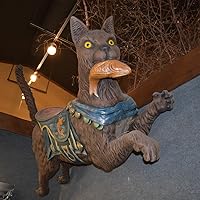
Vera Nazarian is a two-time Nebula Award Finalist, award-winning artist, and member of Science Fiction and Fantasy Writers of America, a writer with a penchant for moral fables and stories of intense wonder, true love, and intricacy.
She immigrated to the USA from the former USSR as a kid, sold her first story at the age of 17, and since then has published numerous works in anthologies and magazines, and has seen her fiction translated into eight languages.
After many years in Los Angeles, Vera lives in a small town in Vermont, and uses her Armenian sense of humor and her Russian sense of suffering to bake conflicted pirozhki and make art.
Book Info: Genre: Fantasy Reading Level: I’d recommend this for any age that can read it Recommended for: I’d recommend this for anyONE that can read it Trigger Warnings: Some minor violence
My Thoughts: The language in this book is lyrical and lovely, comprising a montage of stories and legends about the world of the Compass Rose. It’s a fascinating exercise in true world building, from the ground up. Not only are the parameters of the world culture being built through these loosely connected tales, but we’re also seeing the physical world being built up, literally before our eyes.
The story itself is sort of disjointed, but as you read the various legends and fables, it all starts to come together. All the stories connect in the end, although you need to be paying attention as you read to keep track of each level. However, it is well worth it. The stories are each wondrous gems, brilliant and scintillating, and absolutely lovely to experience. Definitely a book to be savored and enjoyed over and over. Highly recommended.
Disclosure: I won a copy of this e-book through the LibraryThing Members’ Giveaway program in exchange for an honest review. All opinions are my own.
Synopsis: When a young warrior of a dark race finds himself bound in servitude to a beautiful, cruel princess, his loyalty becomes entwined with something more horrifying and mysterious than endless night falling over the ancient desert. When a courageous young servant reveals her hidden wisdom to the madman conqueror of the world, her fate is joined to a nightmare suspended beyond death and the universe. The destinies of two souls become connected through ancient truths that lie buried in an island between worlds. Both souls become enslaved through dream and desire in an endless conflict between truth and illusion. They can only be set free by the wonder of the Compass Rose.
This is a good book. How good, you ask? After reading the first few chapters, I set the book aside and e-mailed Vera Nazarian, asking if she would consider writing a Compass Rose story for an anthology I was editing for DAW.
This isn't a traditionally structured novel which moves from A to B to C. Rather, it moves from Z to G to 16, then comes back to B and C. All of the stories are set in the richly developed world of the Compass Rose, and all of the stories do interweave to tell a larger story, though you don't see the fullness of the story until the very last page.
When you finish reading, you want to flip back to the first page and start over again. This is not only a book that can be read twice; it demands it, and it rewards you for doing so.
Vera's worldbuilding and description are like a really good chocolate mousse: so rich it's almost too sweet, but so good you want more. And the mythological feel of the world feels real and true. Here's a quick example:
A spurting fountain of hueless water began to pulse from her vein, and she offered it to the queen.
"Take my Water and drink, for even Ris drank once from my wrist. For that act of quenching, Ris has given me Water in exchange for my mortal blood."
Maybe it's just me, but the depth of those two little paragraphs blew me away. And the whole book is like that, building a mythology, an entire world with a deep, genuine sense of history.
Because it took me a while to read this one, I sometimes lost track of characters as they disappeared and reappeared in the narrative. If you're into plot-heavy, fast-paced books, this may not be the one for you.
What a trick God or demon that deasert talk by water bringer to save but why hold the dream with unkow one bad to be savior hold the spice holy water make a dream hold the teath unother dust stillness what frute the wisdom talk by
Dreams of the Compass Rose is old fashioned storytelling in the grand style of Arabian Nights or Catherynne M. Valente's "Orphan's Tales". There are tales within tales that overlap and create a rich tapestry defining not just the story, but the history of a world. Each "dream" is told as a separate story, and can stand alone, but they are much richer when taken into consideration with the surrounding stories. The overarching tale is that of the creation of the goddess known as "Risei" and her subsequent dealings with humanity, but there are also the stories of the king who took an eyeless woman to be his queen; of an unsinkable ship and its peerless captain; of the thief of Death's scythe; of a city of no sleep, where dreams of a mad king alter reality; of desert and sea journeys; and of a young man's life as it is intertwined with the strange nobles, a goddess, Illusion and the lessons of servitude, truth and blindness.
The storytelling is a bit like a spirograph - you think you've seen the last of a character and they pop up again, and you learn more each time as the circles twine and build. There are lessons in each, like fables, and the lessons instruct morally, but also add a layer to the view of their world. The language is slightly stilted, and occasionally a bit too flowery for my tastes, but this is in keeping with the narrative form the author chose, and doesn't obscure the tales. If anything, it may lend them a cadence that mimics that of a spoken story. Characters are illuminated, and explored, but kept in a manner of legends - intimate thoughts are only exposed where necessary to propel the story and its lesson, leaving space for the reader's imagination.
I really loved this. I'd recommend it for readers who enjoy storytelling in layers and told with the feel of those normally given in an oral tradition. The price for this is a little steep for an e-book, but the author delivers a whole world, complete with peoples, legends, history and oral traditions.
Overall: 4.5 or 5 stars Review copy supplied by the author as part of LibraryThing's Member Giveaway program.
It is the secret ambition of many a contemporary fantasy writer to create a classic – a book that can stand with Dunsany, or Morris, or Tolkien, or Peake, and hold its head up high. Few of those contemporary writers, however, will attempt to write their stories as if they are free verse poetry, lost children of the Arabian Nights, or perhaps a misplaced myth cycle. The risk of embarrassment is too high.
Vera Nazarian has dared, however, and in finding her own voice, she offers us a new poet of fantasy, whose tales can either stand alone or weave themselves into an extended epic you will hate to see end.
Nope. I’m not kidding. She’s really done it.
COMPASS ROSE is a book filled with the kind of stories that may have been based on real people and real places, but have slowly evolved into “story” and then into myth. A captain sails an unsinkable ship and must bargain with the Sea itself for safety, an old woman claims to be the last descendant of a house that is now considered a temple, a young orphan’s love and loyalty is rewarded with power and a place outside of time – but she must lose the love and loyalty that brought her to this pass.
The collection of stories can be read straight through, or you may skip ahead to a title that catches your fancy, and find that other tales lock seamlessly into a new story like some fantastic quilt. With each tale, there is a wonderful supporting world to step into, even as a part of you says “Ah! This was the sailor in that story!”
On the Amazon scale, so far I give this collection four and a half stars – I’d give it five stars, but readers who are looking for a thrill a minute should look elsewhere.
Downloaded the e-book while it was free for a limited time from Smashwords. ----------------------- I love how the stories are interconnected and how those connections aren't always obvious from the very beginning. I love that moment of, "Oh! So that's how this story fits with the others." The language is lovely and finds the right balance of poetic prose and not going overboard with flowery descriptions. The stories and language have a very dreamy quality that I like a lot.
One thing that bothers me though is the depictions of non-white races. There are a lot of the stereotypical descriptions used for those characters who are black (coffee-colored skin, etc.) and Asian (almond, slanted eyes, yellow skin, exotic). Ever since reading this article (http://www.schoollibraryjournal.com/a...), stereotypical descriptions of people of color is something I've started noticing a lot. -----------------------
Technical note: The epub version of this book from Smashwords is beautifully formatted - one of the best formatted e-books I've read yet.
DREAMS OF THE COMPASS ROSE is well-named: each story is an episode and all the episodes weave in and out of one another until the story is complete. Well, maybe not complete. Like a dream, there are just enough misty bits to make the dreams also weave in and out of the reader, as well.
I subtracted one star because I found the quality of the writing uneven, though it's damn good even at its least. The best is SO good, though, the lesser quality stood out by contrast. LET ME BE CLEAR: Every story in this book is better than most books I've read. I'm wondering if these stories were written at different times in Nazarian's career and collected for this volume.
DREAMS OF THE COMPASS ROSE is a stunning achievement, and a book that MUST be read more than once.
A word of warning before we get to this review. I'm what you'd call a linear reader; also: a profoundly shallow person. I like my plot points to come in bulleted Powerpoint presentations, and my mysterious, meaning-of-life riddles to come with those little upside-down answers at the bottom of the page.
Dreams of the Compass Rose was not what you'd call an easy read for me. I prefer my Point A to go through the alphabet before reaching Point Z. But that doesn't happen here. Instead, we get a luxuriously wild garden of words, where leaves and flowers tumble over each other willy-nilly, and paths crisscross and sometimes loop back into themselves in elegant knots. There were times when I felt more than a little lost. Lots of times, actually.
That's not to say that I didn't love it.
First of all, I have to say that I adored the rythym of the prose. There's some seriously beautiful music going on in the author's mind and I can spend all day listening to it. The best thing is how it's not afraid to poke a little fun at itself. Listen:
���Behold a form more radiant than the desert sun at high noon!��� said Annaelit at last. Lord Ostavi blinked, then squinted, saying, ���I see it. . . .��� ���Yes!��� exclaimed Lord Dava. ���Go on. . . .��� ���Behold gleaming satin hair like a waterfall, a deep sienna color that pours like liquid bronze and yet is wafted by the perfumed wind of your gardens!��� ���Oh, yes!��� ���Behold skin soft to the touch and delicate as the ripest peach, and great slobbering lips tender like the succulent cherry fruit, dripping liquid juices . . .��� ���Ah!��� moaned Lord Dava. ���Yes, go on, for that is she!��� ���Actually,��� said Annaelit, bringing her voice down to a normal volume and smoothly covering the fact that only moments ago she had had no idea what she was saying and why she was saying it, ���I am describing her mare���definitely slobbering after it had been watered from a pail..."
Also, the imagery? Just delicious. There's a mask made of wax which becomes the moon, and a scythe-thief who leads Death in a neverending chase for the sake of his beloved. There's a girl who turns into a cup of endless water, and a king who rearranges his city every night when he sleeps. Dreams is a trove of the most unlikely and unexpected kind of beautiful.
The characters do grow on the reader too. Some of them are outright lovable, like the gentle and honorable Nadir "the lowest of the low" who gives his whole life in service to a woman so spiteful she could turn water into sand. In contrast, there's the despicable and ridiculous tyrant Cireive, who's so obsessed with the idea of ends and edges and the definition of his own power, that he denies that the world is round, even with the frank testimony of three of his best men. In the end, though, even the most unlikable of characters are given a kind of tragic dignity.
And there're plenty of strong, honorable, resourceful women too (not the least of whom is the tavern-keeper who offers Death itself a shoulder to lean on, or at least, a barstool to sit on). The book deserves all stars just for that.
I admit that I stumbled a little on those scenes where there was just so much explanation going on, but for the most part, I found myself engaged by the novel and its themes. (I even had a very uncomfortable moment during Cireive's quest for the Edge of the World, when I realized: Hey, I'm the exact same way! I want there to be a clear and definite End to things! I need things to make Sense!) Dreams deals in illusion and self-delusion, in truth and the power of choosing truth, and naturally, it has the air of a nebulous, evanescent, and yet startlingly revelatory dream.
A slightly difficult book -- your mileage may vary -- but very much worth the serious fantasy reader's while.
“All stories have a curious and even dangerous power. They are manifestations of truth—yours and mine. And truth is all at once the most wonderful yet terrifying thing in the world, which makes it nearly impossible to handle. It is such a great responsibility that it’s best not to tell a story at all unless you know you can do it right. You must be very careful, or without knowing it you can change the world.” The words of Nazarian's character reveal a profound truth about the storyteller's art. Nazarian is a storyteller. She is a weaver of words and in this book she weaves together the words of her different stories to form a tapestry that offers the reader deep insights into our own views of the world. The book is composed of a series of vignettes. The characters change in each vignette, overlap, and interact as the stories intersect. All of this revolves around the Compass Rose – a dream, a state of mind, a place to which we go when we sleep. The world of the Compass Rose is inhabited by gods and thieves, female warriors and men of honor, death and demons – it is reminiscent of the world of the Arabian nights. At the center of this world is Ris, a warrior queen who has been raised to god-hood, or perhaps a grandmother who nurtures her grandchildren and safeguards them from harm, or perhaps a bartender in a remote village or a ship sailing the seas. Nazarian leaves room for the reader to occupy this story and to find their own meaning in the metaphors and illustrative designs of her poetic prose.
She skillfully brings all of the characters together, allowing their paths to intersect and intertwine like threads, creating a pleasing whole at the conclusion of the weaving. Yet each story gives us pause to reflect and at the same time leaves us seeking more. And again quoting from her character, "in each telling the story itself changes a little, changes direction, and that in turn changes you and me. More often than you realize it, the world is shaped by two things—stories told and the memories they leave behind.”
Nazarian leaves us with a memory of a vivid world, filled with characters that have shape and form and evoke our sympathy and draw us into their story changing us. And in the end, there is still the Compass Rose, the navigator that leads us into our dreams.
Dreams of the Compass Rose by Vera Nazarian is a wonderful collection of intertwined stories that explore humanity, godhood, what is right, and what is illusion. It drew me in with a strong storytelling voice, sometimes using an overt narrator and sometimes just the tale unfolding.
In a way, the style reminds me of the older fantastical fiction like Tales of the Arabian Nights, at least in the beginning. This isn’t a modern fantasy where the magic has its own physics, and yet much of it follows conventions and laws within its own world, whether it’s demonstrating the dangers of acting on too little information so though your intent is good the results are bad, or the risks of letting arrogance make you believe yourself smarter than gods. It’s a world where horrible acts have consequences, and horrible suffering sometimes offers a faint reward.
At the start, the characters are all strangers, but as the book progresses, some of those strangers become familiar, even welcome. The narrative style changes too from an account of distant times brought to life by a storyteller to a tale unfolding before your eyes through the lens of a first person actor within the events. The choices made are ripe with conflict and often not what the character deserves, and yet as the stories come full circle, it works out. Things make sense, and even offer elements of happiness.
This is a skillful, complex world peopled with compelling, three-dimensional characters that offer their dreams and nightmares in the hope that you, the reader, will walk away changed. My only regret is that it took me so long after getting the book to read it.
Dreams of the Compass Rose is a long collection of stories that creates a mythological world of the Compass Rose and surrounding terrains. It has gods and goddesses, humans, and those in between. The stories start off standing alone, but as the book moves along, the stories and the characters start to tie together. The cross references and links become stronger and clearer the further a reader goes into the book.
The Compass Rose is a place, a thing, and an idea. It could be anywhere and everywhere. The stories are mystical, and each seems to feel like there is an unspoken message. Like most mythology, the stories, character, and places can be symbols for comparable things in our world. One theme that runs throughout is the idea of what is reality and what is an illusion. What will an individual choose - the illusion or the truth and how far will they go to live with that decision?
The book starts off a little slow and a little confusing because the stories do appear to stand alone and unrelated. That dispels as the book progresses. The latter half of the book brings characters that grow and stories that draw the reader in further to this world. By the end, the book leaves you wishing for more.
Just a format note - Reading the kindle edition, it was difficult to flip back and forth as the stories connected. A list of characters and perhaps a mythological map or a dynamic table of content (allowing you to progress to that story) would have added a lot to the enjoyment of the book.
*** Book reviewed for the LibraryThing Member Giveaway Program ***
A gorgeous, lush, exotic cycle of 14 short stories, beginning and ending with the city of Aramantea: In "Amarantea" Grandmother tells her grandchildren about this ruined city and in "The Story of Time" we see what exactly happened to it and to the Compass Rose. The other stories do not follow chronologically in a straight line, but we do meet recurring characters. We read of a vast desert; an unsinkable ship and its woman captain, Lero; death and the thief who stole her "shimmering" scythe; the Lord of Illusion, trapped in the body of a translucent horse; a girl who becomes a spring of water; a never-empty cup; a city of gold. In "The City of No-Sleep" only an assassination of its ruler will stop the city from changing each day. This happens each night while the mad king sleeps, so the inhabitants try to keep awake too.
There are villains but some figures arouse our sympathy: Nadir, the black man; Lirheas, the somber prince; Yaro, the servant girl; and "the queen with no eyes", builder of the Compass Rose. All the stories are oneiric and surreal with an Oriental flavor.
I feel this collection is destined to be a fantasy classic someday. Most highly recommended.
Once again, a mystical, lyrical, magical book from another time. Reading it was a bit like rummaging through a basket of yarn and knitting something of a ridiculous number of colors that soon starts to take on a recognizable cohesiveness and in the end all the pieces and colors fit just right. Unlike The Cobweb Bride series, this book isn't at all linear. The lessons here are like gossamer and I feel like it could take a lifetime to extract them fully, almost like when you wake up from a vivid dream and are trying to remember it all before the details slip away. This is not mere writing, it is storytelling with soul.
Wow. What a lovely story. It's still mulling around in my head and I just don't think I could give a review that would show justice to the intricacy of this story. Really well-written, amazing world-building, fantastic characters, what else can I say? A great fantasy read! I highly recommend it!!
Thank you very much Vera for the opportunity to read this book. I am in love with everything you write!
Dreams of the Compass Rose By Vera Nazaarian Is comprised of 14 colorful dreams, spanning continents, and many generations. Each dream will stand alone but is also and interesting part of the whole. I loved this book and am so glad I had this chance to read it. Review copy supplied by the author as part of LibraryThing's Member Giveaway program.
The content more than lived up to the great title and lovely cover art. Really liked this book. Drew me in from the beginning. I particularly enjoyed the way characters reappeared in other stories making a cohesive collection of stories, each of which stand well on their own. Recommended.
At first I was a little bit confused because I didn't realize it was short-stories (albeit all tied together). Once I got into it though, I loved the stories it told - haunting and lovely and full of hidden (and not-so-hidden) philosophy. Excellent.
I LOVED this book! It reads a lot like The Arabian Nights. The non-linear plot line was a little confusing at times, but it is still an excellent book. I didn't want it to end.
This book reminded me of a book of fables from somewhere far away. The characters come and go throughout the stories. There is no specific time order which may add a little confusion for some reader who are used to a linear format. I was not really a fan of this book but I could easily see how others may be.
Excellent collection of connected stories, reminiscent of Vance's Dying Earth and Tanith Lee's Night's Master. Full review: https://fakegeekboy.wordpress.com/200...