A good story and an unusual and important book in three ways.
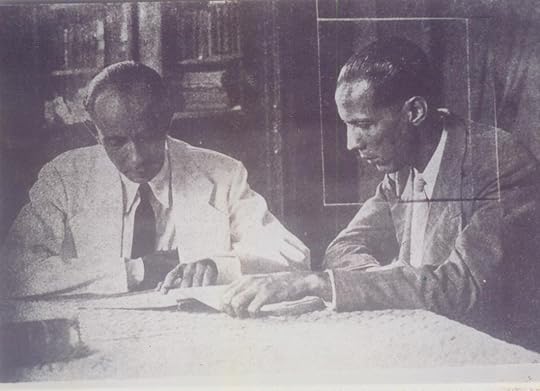
First, it is co-authored by two brothers. We read in the preface that one brother took responsibility for the story line and the other for the actual writing.
Second, it marked a new era in a modern style of Haitian writing. Previously Haitian writers writers, always behind the times, were still writing in the old classic French style of folks like Victor Hugo.
Third, translated from the French and first published in the US in English in 1946, it really was the first book to introduce to a large English-speaking audience the importance of the culture then called voodoo (now Vodou or Vodun) – the gods (loas), zombies, a key evil god, Baron Samedi, and the star of this story, a kind of “Hound of the Baskervilles,’ the Cigonave monster killer beast.
There is a lot of dialogue but here is a sample of the prose writing style:
“It was a morning warm with the softness of spring. The sunlight, filtered by a breeze, powdered the plateau with an incandescent pollen. The stealthy laziness which precedes the mid-day stupor of the tropics crept over the countryside. Only the mocking bird, defying the rapacity of the carrion crows, still praised the sparkling splendor of the light with its thrilling song. Already one could hear the patient gnawing of the termites in the planks of the wooden shack, precursor of the hot and silent hours.”
The basic story is of a town shopkeeper who longs to move to the countryside to be a plantation owner. His pregnant wife will not leave the town but she and the baby die in childbirth. He sells out and buys his farm. He’s a relatively light-skinned ‘mulatto’ so he knows little of the Vodun ways of the rural black folks.
The locals call him ‘master.” He’s a know-it-all and immediately upsets the local by cutting down a sacred tree that the rural folks used to make sacrifices under. Then he fences off a spring on his property, forcing people to travel a greater distance to get water. He earns their animosity and they hate him, even those who work for him. After his wife’s death he has become a heavy drinker and he beats his male farm manager and his female servant.
The Cigonave arrives and start terrorizing the town. (Apparently under someone’s control because the dog reacts to a whistle.) The dog attacks a young man’s genitals, perhaps because the person controlling the dog wants the young man’s woman friend? The farm manager is wasting away because of witchcraft by his godson. The ‘Master’ is terrified and has constant nightmares of the Cigonave. Is it coming after him? He also learns from an old friend of his wife that he had more responsibility for her death than he believed. He leaves the farm and lapses deeper into alcoholism. Meanwhile there are other deaths and suicides.
“Only the knife can know what is in the heart of the yam!”
A good story and an interesting book. (3.5 rounded up to 4)
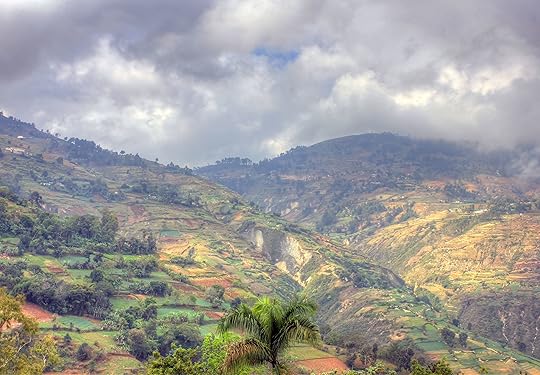
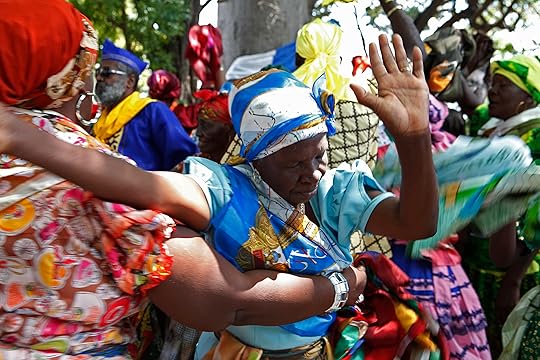
Typical Haitian landscape from goodfreephotos.com Verdun from blogs.reuters.com The Marcelin brothers from Enregistrer0081photo-Freres-Marcelin
I don't think either of the authors was at risk of being ambushed and killed by a dictator's henchmen because of this book. But, with that risk in consideration, it's hard for me to judge.
I think this blog post is an excellent summary/review. The novel is especially interesting in light of the fact that Philippe was a writer, a member of the bourgeois as he says in the intro, who was initially suspicious & dismissive of Vodun; once he realized it might be a good topic, he wanted to "..."go down" among the people, in order to see their life close up, to learn their language and to find out their way of thinking." However, he was still an outsider to a large extent. His younger brother, Pierre, who was not literary-minded ("recalcitrant toward bourgeois life") and had "lived some time in the country and had even been involved in agricultural enterprise" suggested that they collaborate. And thus a few books were born, including this one. "As we worked out the plan of the novel, we decided to oppose a bourgeois atheist to a well-to-do peasant who knew how to read and write but was addicted to the practices of black magic. Then we realized that the work would gain intensity if we gave it a tragic turn." (My side note: Based on his intro, I imagine Philippe sometimes came across as an insufferable pedant to his brother Pierre. Lol.) A fascinating piece of Haitian literary history from the 1940s.
Despite the fact that at one point a mulatto planter possibly possessed by dark voodoo overlord Baron Samedi has sex with a werewolf woman who is in the process of turning into a hoot-owl while a horse-sized dog with human legs waits in the backyard, nothing really seems to happen in this novel. I had high hopes. It was written in the 1940s by a man from the Haitian city, himself a mixed-race descendant of the slave-holding sugarcane planters who rose up against the French alongside slaves to make Haiti the first postcolonial republic in 1804. Voodoo culture was as foreign to the author as it would be to a Manitoban, remnants of some dark past that he felt needed to one day, when the funding came through, be eradicated through public education campaigns. Thoby-Marcelin's approach to Weird Old Haiti is less like the authors of the négritude movement who felt that the traces of an authentic African culture might contain some antidote to the disaster of modernity or even the projections of Maya Deren who saw it as some portal to the suppressed mystical side of being and more like Stephen King's take on native culture in Pet Sematary. Creepy vibes in the nighttime laced heavy-handedly with chunks of folkloric "detail." As national literature, it is the most tentative toe in the water.
I grabbed this at the inestimable Mother Foucault's bookshop in Portland, in a lovely, stiff old Time Editions binding with that amazing cover illustration. It's a short novel from the 1930s, credited with being one of the first works of Haitian literature to get international recognition.
The authors, brothers Philippe Thoby-Marcelin and Pierre Marcelin, were ahead of their time in rendering the supernatural characters and doings of Haitian Voudon without comment, so that early readers were annoyed that they couldn't tell whether the (presumably educated) authors actually believed in the demonic possessions and spirit animals in their story. The introduction in this edition clarifies that point, but the Marcelin brothers still suffered from being ahead of their time.
This is a short book about an upper-class, educated Haitian city-dweller who tries to go back to the land by buying a hill farm, only to create unending problems for himself and the peasant people who are his neighbors and employees. It's not clear that the Marcelin brothers are making a statement about citified folks or the impossible divide between classes--but their peasant characters come off as sincere and honest, if baffled and unfortunate, while their city dweller is an arrogant, troublesome jerk. Fair warning: things don't go well for anyone in this book, especially women. On the other hand, there are some wonderful, spooky, evocative scenes of possession and visitation by stock Voudon figures like Baron Samedi, that make it worth the ride.
Loved this book. I read it about 15 years ago in undergrad when my interest in consciousness/voodoo/ontology/psychological manipulations was high as was my consumption of alcohol. The characters and story never left me and what happens in this story can happen to any individual unwilling to believe in the power of all forces just beyond our obvious sight and sense. The outlined ways that all of these constructions can become as real as the chair we sit upon I believe. I highly recommend this book.
I enjoyed The Beast of the Haitian Hills because it delves deeply into the theme of the colonized mind in the character of Morin Dutilleul who romanticizes peasant life until he moves from city life up into the Haitian hills, where the old ways are still alive and well. The conflict between Christianity and Voodoo comes up several times here, especially when the village of Musseau must figure out how to overcome the scourge of the Cigouave, or the werewolf haunting the hills and tearing the peasants apart. Morin not only lords it over his servants and groundskeeper, but he also fights his own inner demons, the loss of his wife Eugenie and his tendency toward alcoholism to soothe his own inner, savage beast. There are so many things to love about this book that is historical fiction, ghost story, and magic realist folklore. Here, I was successfully transported to the Haitian hills of Musseau, and that made this one worth reading for me. I found it at a book fair, judged the book by its cover, and was not sorry!
It is said that one should not judge a book by its cover. I wholeheartedly agree with that saying, but I am also not ashamed to say that I do pick up things by the cover alone. This was the case with this book. I was wondering the aisles of my local library when I spotted the cover of this book. The book cover shows a yellow anthropomorphic tree with one eye, a mouth with very large fangs and large heavy breasts. It is a very distinct piece of art, that is a perfect fit for this book.
Written in 1946 by a duo of Haitian brothers, this book brings to life the supernatural aspects of the Haitian culture. Filled with voodoo priests and malcontent familial spirits juxtaposed with the ordinary everyday ongoings of rural Haitian life. Although I am not entirely sure if the writing style is simplistic as a narrative tool or not, this style and the story mesh very well and give the reader a fast paced book with a great tense atmosphere.
I liked the book, I will now have to look at more of their works.
"The Beast of the Haitian Hills tells of a well-to-do and respectable city man who retires to the countryside and find himself entangled with voodoo. In relating his story, the Marcelina write of Haitian beliefs not as something shocking or unusual but as part of the very fabric of the people's life. The book is a sympathetic and perceptive study of one of the most fascinating cultures to be found in the Western Hemisphere."
Along with some other unsavory things this city man does, (including cheating on his wife, shooting at the country folk, slapping a woman, etc..) I am pretty sure he rapes his maid lady as she was turning into a werewolf so I wouldn't really call him.. respectable
In the introduction you learn the Marcelin brothers were not a part of this life style and had no knowledge of it or voodoo. They write that they had to go down to the people and essentially interview them, and go as far as to describing the people as 'an object for study.' Though I'm not against publishing a book simply from a perspective, this seems slightly exploitative.
That aside, the book is not the worst thing I've ever read, nor is it the best. I would definitely be open to suggestions for other books from this part of the world.
This entire review has been hidden because of spoilers.
Bracing. Once you get back the formal nearly stilted language-- the book dates from the 1930s-- The beast descends into voodoo, madness, murder and, of course, the titular beast. The plot revolves around the conflict between a city slicker longing for the country after the death of his wife who buys a plantation, and the impoverished, intensely superstitious peasants who power the supernatural goings-on. Is the beast real? What about the werewolf? The hougans, voodoo priests, maulings and the beliefs are real enough.
This was my first Haitiian book. Besides being an excellent story, that is well developed, it established for me a partial inquiry into the nature of this nation's people. I am intrigued now to know more about the traditions, lifestyles, and history of these people leading up to and including the time covered in the story.