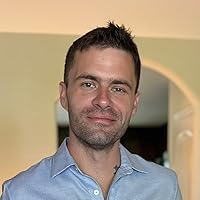
How did a New York–born, Jewish, former-atheist novelist and screenwriter—a winner of multiple Edgar Awards, whose books became films with Clint Eastwood and Michael Douglas—find himself at the age of fifty being baptized and confessing Jesus as Lord? That’s a tale worth telling.
From his childhood outside New York City, through his years as college-dropout wanderer and on to his growing success as a writer, Andrew Klavan consumed stories. From novels and plays to movies and the Bible, literature helped him interpret the world and understand his place in it. Dropping out of college to wander the country as an itinerant journalist, he met the woman who became his wife—and tales of marriage have been central to his writing ever since. Wrestling with severe depression that took him to the brink of suicide, his reading of Hamlet and even Freud became crucial life-giving supports. And lying in bed reading Patrick O’Brien’s seafaring tales, he found the courage to say a prayer—“thank you”—that overturned his life and led, inevitably, to his baptism in New York City a few days after his father’s memorial service. The stories of Western literature led Andrew Klavan to Jesus. This is Klavan’s story of that journey.
Hope to write more about this soon, but for now, let us just say it is superb.
Here is what I wrote on my blog:
Testimonies are powerful. The apostle Paul gives his testimony in the book of Acts more than once, and he did so to great effect. The center of New Testament-style evangelism is found in the two-fold ministry of preaching and testimony. How will they hear without a preacher (Rom. 10:14)? And the one who believes has the witness (marturia) in himself (1 John 5:10).
Witnesses in the first century gave testimony to what the incarnate Christ said and did (1 John 1:2). But that does not render witness superfluous in the ages after—because the Holy Spirit was given to take the place of Christ, and He has been active down to the present day. This is why testimonies have the capacity to be singularly powerful. They can be done poorly, and can be over-run by hackneyed clichés. But sermons can be done poorly also, and yet no one doubts that preaching is an instrument appointed by God.
This testimony is delivered with exceptional grace and force. The Great Good Thing is the testimony of how Andrew Klavan, a secular and very messed up Jew, was found by Christ.
Klavan is an award-winning writer, and it shows. He brings exceptional talents to the description of an exceptional story, one I thoroughly enjoyed reading. The genre of his other books is “crime novel,” a part of Lit Town where I do not usually go, and so until this book I was unfamiliar with his writing. But in the world of mystery and crime writing, he is a well-known name. His novel True Crime was made into a movie, as was Don’t Say a Word. He has won the Edgar Award twice, and can safely be called a competent wordsmith.
I was familiar with him because of his online video commentary on politics and culture, which are very funny and almost always leave bruises. I found out about this book because of his political presence online, ordered it willingly, and read it even more willingly. This is a testimony that has the power to put both hands on your shoulders, and make you sit down with the book.
Here is his description of how he began praying, before He even knew who he was praying to.
“After a while, though, it began to seem to me that I was thinking too much about perfect truth-telling. It was a waste of prayer time. The human heart is so steeped in self-deception that it can easily outrun its own lies. It can use even meticulous honesty as a form of dishonesty, a way of saying to God, ‘Look how honest I am.’ So I let it go. I let it all go. I just flung wide the gates to the sorry junkyard of my soul and let God have a good look at the whole rubble-strewn wreck of it. Then I went ahead and told him my thoughts as plainly as I knew how” (p. 239).
His was a conversion that had cultural, historical, intellectual, and emotion reasons. He deals with them all, honestly, seriously, and without any sanctimony. You will never read a less sanctimonious testimony.
We live in a time when stories like this need to be told, over and again. I cannot recommend this book highly enough.
Of a sane man there is only one safe definition. He is the man who can have tragedy in his heart and comedy in his head. --G.K. Chesterton
I do not usually read books of this kind, because stories of Christian conversion, though important and necessary, are also so highly personal they are almost unrelatable, even to someone who has experienced her own journey with the same conclusion. No one is born a Christian. When St. John supposed that if all the things that Jesus did were written down "the world itself could not contain the books that would be written," I cannot help but wonder if he could be hinting at the millions of stories in the lives of millions of Christians over thousands of years. Each one is a new story. God does not have grandchildren.
But, I love Andrew Klavan, and so I had to read this book. In fact, to me Klavan is like a modern-day G.K. Chesterton, in that he can write and speak meaningfully and entertainingly on such a wide variety of topics that one never tires of hearing him. His light touch and comic outlook make the profundity of his thinking a gasp of surprise to the uninitiated; but, it is a highly addictive combination. He brings both the comedy in his mind and the tragedy in his heart to this story of his conversion.
In a way, this is ultimately the story of two trinities. The Holy Trinity, of course. But, the son, the father, and the spirit of the secular realm are Klavan and his own father (a secular Jew himself, who clung to the barest religious rites out of cultural ferocity and guilt: "It was not in his nature to openly defy a Gigantic Invisible Jew who could give you cancer just by thinking about it.") and the spirit of Klavan's wife Ellen, who never quite takes on flesh and dwells with us but floats like a benevolent presence in the background. What is amazing in a way is that, for a crafter of characters that novelist Klavan has become by trade, there are very few characters in this story. It is mostly just one man at the Jabbok, wrestling demons and God and his own nature. Yet, that one character--Andrew Klavan--is so compelling that the story will not let you go until you bless it. And I do bless it. I do.
In the Introduction to his own spiritual memoir of sorts, Orthodoxy, G.K. Chesterton writes a sentence (the whole preceding paragraph, really) that kept coming to my mind as I read The Great Good Thing: I did try to found a heresy of my own; and when I had put the last touches to it, I discovered that it was orthodoxy. It takes a special sort of spiritual persistence to arrive at those words. I think Klavan matches Chesterton for relentless pursuit of a cogent, integral philosophy.
Andrew Klavan, raised and marinated in the fallacies of his time, sorted through them all, went to the brink of sanity (and even a tad beyond), fought and cursed and feigned indifference to the Maker of his soul, and discovered orthodoxy. Wow.
Klavan makes as good a case as any I've heard against the gods of Materialism, nihilism, etc. This is a book he had to write, a book that Christendom needed him to write, and a book that any God-wrestler--and that is every single one of us, whether we admit it or not--will benefit from reading.
Christmas. Father hunger. Good literature. Commitment to coherent story. Recognition of what underpins Western culture. The beauty of nature. The love of a good woman. The birth of a child. A breaking mind. The effective kindness of a therapist (in spite of a godless worldview). Baptism. These are some of the patient graces by which God brings Andrew Klavan to Himself.
Klavan came to Christianity through unexpected paths, and he didn't land in my neighborhood (Reformed and Evangelical), but I cannot doubt that his faith is genuine. I found some things troublesome in his thinking (he's wobbly on the nature of Scripture, for instance), but he's significantly ahead of me in some areas (a much better pray-er, for instance). It all reminds me that each of our stories is much less about ourselves than about the God who is writing them. They're all His story. To fuss at Klavan over the differences in our stories would be to fuss at our Author over the color of ink He's using.
As for the earthly author, the man can write. I think this is the best-written memoir I've ever read. If I'd consumed it on paper, I'd've underlined a good bit and would share some quotes with you. He's also a good reader, and appears to have narrated all the audio versions of his books. I feel as if I should read at least one of his novels, but the thriller genre is not my cup of tea, so I'm not sure I'll ever get around to it.
I listened to this as read by the author. It was inspiring, as all conversion stories are, and worth reading for that aspect alone. However, this book was so much more. In the story of Andrew Klavan's dysfunctional family, the way literature and Western civilization led him to self discovery, and his descent into and ascent from madness, we are given the story of a truth seeker in an age of disbelief.
I found Klavan's story resonating in unexpected ways. Every conversion story is at once the same, in its discovery of ultimate truth and love, and at once unique, as is each person who discovers God. I knew I would find things that reminded me of my own journey and that showed me new facets of God's love in Klavan's experiences. What I did not know was how familiar his life story was to certain aspects of my own and how that actually helped me to understand myself better. My own difficult father was much less so than Klavan's, for example, but they were enough alike that Klavan's insights about his own personality enlightened me as well.
I will also say that his experience with prayer has haunted me, in a good way, and rejuvenated my search for closeness to God.
Much of the story was outside my own experience, of course, and I have to say that I really appreciated Klavan's feelings about his Jewish heritage which gave me insights that I'd not gotten from other sources.
Klavan is hard headed, questions himself and his experiences, and does not go easily into Christian faith or, indeed, into faith in God in general. I really liked that aspect because many of the objections he struggles with are precisely those which we have all been taught to raise these days. Whether one believes in Christ or not, no one can say that Klavan accepted him blindly. In fact, no one need worry that Klavan is trying to convince anyone else to believe. This story is strictly about his own experience.
This conversion memoir is in itself a magnificent book. I expected Klavan to be an excellent writer, but this is simply beautiful. The story itself is powerful and in many respects unexpected - the story of a Jewish-American growing up in the fervid '60s, hoaxing his way through college, slowly going mad, slowly coming sane again - and discovering God in the unlikeliest of places: not so much in the pain of existence as in the joy; not so much in sermons as in stories from Raymond Chandler to Thomas Malory.
As a writer myself, some of the author's experiences seemed incredibly familiar to me, but from reading the other reviews, I think this must be one of those books that resounds with everyone for different reasons. Recommended.
The best book I've read so far this year. I really admired it. Written with an easy, natural yet very articulate hand—honest, funny, and wise. Highly recommended.
So happy to listen to this audiobook read by Klavan himself! Wonderful to follow his journey as he matured into the fantastic brilliant man he is today.
Although Andrew Klavan is a prolific writer of adventure novels, I was familiar with his name only via a few journalistic articles he had written--- adventure genre not being my thing. It was the subtitle of this memoir that grabbed my interest: "a secular Jew comes to faith in Christ."
A brilliant man, Klavan's inner life was set up for turmoil by his upbringing. His parents were atheists, but clung to the external rituals of Judaism. His Bar Mitzvah did violence to his soul because he was forced to make a public display that held absolutely no meaning for him. The guests who attended his Bar Mitzvah showered him with rich gifts, which he carefully hoarded in a little box. From time to time he'd take the box out and look at the contents, but they sickened him. It was blood money to him; Klavan felt like he had been bribed to perform an action that was repugnant to his soul. One night, he crept outside to the dumpster and threw the box in, taking care to hide it well so it would never be unearthed. That action lifted a weight off his shoulders and is an example of his absolute, unwavering honesty.
Klavan had an uphill climb to faith, something he didn't overtly even seek. What he did seek was WORDS. He loved words, loved writing, loved reading, loved Western culture. He began to see that Western culture could not be divorced from Christianity, so he began to read the Bible and explore from a purely historical and literary point of view.
There was a great deal of turmoil and inner conflict as he delved into these studies. On the one hand, all the beauty of Shakespeare and the rich repertoire of the west had its roots in Christianity. But there was a dark blot: a cruel anti-Semitic streak in church history that popped up again and again. How could a system that produced such beauty be so flawed? If Klavan could not be forced to be a Jew by external ritual, neither could he deny his heritage. He was Jewish, whether practicing or no.
Through many mental tortures, Klavan's intellectual honesty ultimately brought him to faith in Jesus. His arrival at that juncture created a whole new set of challenges as he had determine how to "come out" to his family and to make a public acknowledgement of his newfound faith.
Let me just say that this man is not only brilliant, but brutally honest in his dealings with himself and others--- never resting until his inner life and outward persona display perfect congruence. His baptism and embracing of faith was the climax made even sweeter by the torturous twists and turns of his journey. The great good thing was finally apprehended and this reader acknowledges with great respect the cost of the journey and rejoices in the sweetness of the attaining.
Klavan is a blessing, and his videos are some of the funniest, smartest, most pointed commentary on the internet. But only a novelist would decide to give his testimony in the form of an autobiography that starts basically at the moment of birth, and cover every stretch of his life in intimate detail.
We can be glad that his wife told him to trim the book down to what it has become. The first chapter is in fact the best; everything was anti-climatic after that. I'm not sure I wanted to get so far into Mr. Klavan's head as I was led by the text, but as a guy that toys with becoming a writer at times, it was interesting perspective.
The book itself might not be a great good thing, but it's a good thing. 3 1/2 stars.
Before reading this book, I only kind-of knew about Klavan from seeing some clips on Facebook of him talking politics. I stumbled upon this book at a library book sale and decided to make an impulse buy built off of name-recognition. So I wasn't sure what to expect.
But it didn't take me long to be engrossed in this narrative. I had no idea Klavan was a fiction writer as well when I began reading this, but his love for storytelling shone through, making this an absolutely beautiful narrative. As a fellow fiction writer, a lot of the things that Klavan said connected with me on very deep levels. And while he, growing up as a secular Jew in a tenuous home situation, certainly had a different life experience than I have, this interplay between similarities and differences made this a really enjoyable book to me.
My one criticism would be about the fact that the story ends with Klavan's conversion. I know this is commonplace in these kinds of books, but I really would have liked to hear more about Klavan's life post-conversion. After all, conversion is only the beginning of a narrative, not the end of one, and I would have liked to see how Klavan's Christian perspective began to change other aspects of the way he viewed his life.
Nonetheless, that aside, I really enjoyed this biography. Klavan's life showed me a new perspective, and this new perspective combined with a view of life & story similar to mine made this an engaging story throughout. Definitely worth the read.
This book was ok…Klavan is a fabulous storyteller. But I thought this book was about his conversion and I am still wondering when that happened…? Also he said he and his wife of forty years only fought once ever which makes him a very unreliable narrator. 🙄
A spiritual autobiography and full-frontal assault on post-modern religious thinking There is a lot to unpack in Andrew Klavan's spiritual odyssey from secular Judaism to Protestant Christianity. This is one of those books that gets lauded by Evangelicals and attacked by Jews and Secularists neither of whom will probably read it. Which is a shame. There is so much more to this book than a mere conversion testimonial. Andrew Klavan is, above all things, a brilliant novelist and cultural critic of our times. He grew up in a middle class secular Jewish home on Long Island in the 1950s and 60s. His life reads like a baby-boomer stereotype. His parents, second generation Americans who grew up in the shadow of the Holocaust, raised him to be hostile to Christianity, suspicious of American conservatism, and agnostic on matters of faith, only requiring religious ceremonial participation in order to maintain a separate Jewish identity from the rest of Middle Class America. Klavan is transparent about his own faults, moral confusion, intellectual pride, mental illness, and spiritual emptiness. He found psychotherapy to be an effective treatment for his depression and experienced complete healing from his mental health issues as a result. He credits psychotherapy with changing and saving his life. But one thing loomed in his consciousness that he could never get free from. The Person of Jesus Christ and the spiritual reality he witnessed in the homes and lifestyles of practicing Christian believers during the course of his lifetime. It's no spoiler alert to reveal that Klavan converted to Christianity and was baptized into the Anglican faith. For most evangelical readers, this truth is what motivated them to purchase this book. But Klavan's book is important on several other levels and should be read by thinking Americans of every religious stripe: He spends a large amount of this "memoir" picking apart the philosophical underpinnings of post-modern thinking and recognized them for the destructive force that they have become in 21st Century America. In fact, in one sense, Klavan's conversion was incidental to his larger search for the soul of Western Civilization which, like it or not, leans almost entirely on the Bible and biblical values. That in itself shocked Klavan as he searched for meaning between that idea and the reality of the Holocaust, in which a "biblical civilization," the greatest in human history (according to Klavan), somehow descended into spiritual madness nearly destroying the Jewish people in the process. His conclusions on this matter related to post-modern thinking are an intellectual and spiritual epiphany. Klavan's conversion is a more straight forward matter. He discovered over time that God seemed to answer his prayers. And then he began to suspect God was actually speaking to him by the Holy Spirit at times. All while he was still basically hostile to the idea of Christianity as an organized religion. That he chose one of the most "organized" of organized religious traditions to receive baptism is another of the compelling ironies of Andrew Klavan's fascinating life. By all means, read this book. It is highly recommended and one of the best I have read all year.
If you read one spiritual memoir this year, The Great Good Thing should probably be it. I listened to the audio version of the book while I worked in the kitchen and kept looking for extra tasks—wiping out drawers, organizing spices—just to find an excuse to keep listening.
Klavan recounts the events from his early childhood to his baptism as a series of five epiphanies that led him, by small but essential steps, to finally embrace the truth he could no longer deny. It's not an apologetic work, per se, but he can't help but explain the reasons that the other spiritual (and anti-spiritual) beliefs he tried could not satisfy his need for truth. And he knew that truth—whatever that turned out to be—must be both internally consistent and reflective of the world he saw around him. In that sense, it's a reasonably good argument for Christ. But it's much more than that. It's Klavans gift with story, his sense of timing, his breadth of knowledge, his elegant turns of phrase, that make this a delight to read. And, I confess, I had to wipe away tears of joy as I dumped flour into my whirring KitchenAid while listening to him read, at last, the words of the baptismal rite.
I'd recently been meditating on the first question to the Heidelberg Catechism, which is just packed with wonderful truths:
"Q. What is your only comfortin life and death? A. That I am not my own, but belong with body and soul,both in life and in death, to my faithful Saviour Jesus Christ. He has fully paid for all my sins with his precious blood, and has set me free from all the power of the devil. He also preserves me in such a way that without the will of my heavenly Father not a hair can fall from my head; indeed, all things must work together for my salvation. Therefore, by his Holy Spirit he also assures me of eternal life and makes me heartily willing and ready from now on to live for him."
Every one of these truths is evident in this book, but namely this: "All things must work together for my salvation." Klavan is able to look back at the beauty and the sorrows, the glory and the grief, of his life and see how all of it, even the things that one would never expect could lead a man to Christ, was the hand of God working all things together for his salvation. And that certainly is a great good thing.
Excellent. This is the story of someone who stood in the wreck of Western civilization and saw only despair for a time, and how joy finally overtook him. I work in academia, and I know the feel of that wreck up close, and he describes it well. In a post-Christian world, conversions like his are only going to become more common.
Evangelising (by personal communication or preaching) had no part in his conversion. In America (and Australia, for that matter), the evangelical culture insists on evangelizing at the drop of the hat (only they don't wait for the hat to touch the ground), so this is something evangelicals should pay attention to. Since evangelicals generally talk more than they listen, it's worth repeating: evangelists and ministry outreach had no direct role in his conversion. God, apparently, has the world at his disposal.
Another aspect of Klavan's conversion is that it took decades. He did not come to God in an instant, but in a series of insights over the span of many years. God was not the flick of a switch, but a gradual brightening, until the moment he looked up and saw the sun had risen.
Perhaps I liked this book so much because many of Klavan's questions and some of his experiences were similar to mine. He was a messed-up person, but through love and friendship had many of his problems fixed.
After having heard of this book, I started listening to The Klavan Show, which is incredibly funny, as well as insightful, political/cultural commentary. Also, Andrew is a really cheerful guy, which sets him apart from nearly every other conservative commentator, who are serious, gloomy and pessimistic.
I recommend both this book and the podcast very highly.
Having read a fair number of conversion stories I find similar themes along with the unique story of the individual. Especially true here as Mr. Klavan writes of his childhood on through his difficult professional years and beyond. I especially appreciated how he could speak of some of those difficulties involving his parents without any bitterness with an attempt to better understand them. Especially considering his fathers almost daily attempts to prevent him from becoming a writer. One of those aspects that would be doubtful in fiction, but ring of a real life story.
His detailed treatment of his nihilistic tendencies seeking the goods of life without finding the complete joy of life are well detailed. You really feel as far as anyone is able what this was like. Add to this Klavan's writing skills and this is a phenomenal spiritual biography.
This book is for a general audience and is not a work of Christian apologetics. No attempt is made to explain what Christian church he attended other than a previous connection with the pastor. This book also avoids politics and keeps the story to his personal story. This considerations are very apt to make this book so readable and insightful.
Absorbing account of conversion from nominal Jew to convinced Christian. The author seems to be more of a “cold prickly” character rather than “warm fuzzy”, which makes the long road to conversion that much more intriguing.
This is a Christian read. This is a good and encouraging book. I realize many will (of course) be in disagreement with it but it is aimed at Christians. I can recommend it.
I'm not a reader of thrillers or crime books, so I likely won't read Klavan's fictional work. But I'm familiar with him, and I was curious about his conversion experience. I was in the mood for a bio, so I figured -- why not?
I enjoyed the tone and writing style. Klavan is honest about his familial relationships and doesn't seem bitter about the past. I had no idea he had been through so much -- he's lived in NYC, London, and LA; he bluffed his way through Burkeley; he's lived penniless as a starving, tortured artist working for newspapers and radio; he's overcome suicidal thoughts and anxiety in therapy; he seems to be a very self-driven, stubborn writer, and former agnostic/atheist who had to stumble his way into Christianity the hard way.
Klavan tends to ask important questions about things that matter, which I like. But after asking the questions, he'll suddenly launch into a personal story which may or may not tangentially connect to the point he laid out at the beginning of the chapter. This happens often and gets annoying after a while. But luckily this is a short, easy read, and his writing style isn't opaque or boastful. So it's an easy one to dash through in a day or two.
I didn't think I would really appreciate this, but in the end, I did. Like Klavan said, it's a story, a meandering story of life with all its messiness and beauty swirled together. I learned much more about this author and his life, but also what joy and laughter could look like in all the bittersweet of living too.
Andrew Klavan is (was?) a thriller novelist by profession, and that made his memoir a delight to read. I’ve never heard an author intellectually process and detail his emotions and formative experiences so distinctly. Seeing God use his gift of writing to transform his thoughts and bring him from darkness to redemption was beautiful!
Leave it to Andrew Klavan, a best-selling author of mystery and suspense novels, to write a spiritual memoir that also manages to be a page-turner. Most readers don’t have itchy trigger fingers for Christian-conversion sagas; you either fire on that frequency or you don’t. But everyone likes a good story, and The Great Good Thing is as dramatic as any tale involving Klavan’s many tough-guy protagonists. In 14 exquisitely wrought chapters, he describes how, raised as a Jew in Great Neck, Long Island, he wound up, at 50, being baptized in a Manhattan church, a believer in Christ.
He grew up “Jew-ish,” as he calls it, the child of secular parents who kept the faith at a safe distance. His mother was repulsed by the rituals of traditional Judaism; she refused the mikvah, the ritual bath given to Jewish brides, and her shame for Jewishness “must have colored everything,” Klavan thinks. Klavan’s father, Gene, cohosted a popular New York morning-radio show. Intense, driven, and suspicious, the father “conceived a special animosity” for Andrew that the son would never fully understand. Their relationship was “one long, furious firefight.”
This could have been just chapter one about his childhood and chapter thirteen about his conversion. It reads like a really long blog entry...he's in his head so much. It's obviously a great conversion story. I just wish it had been written differently, less rambling, more plot.
"The choice between idolatry and faith-which is ultimately the choice between slavery in the flesh and freedom in the sprit." That quote is from Mr. Klavan's last chapter in his marvelous story on his slow conversion to Christianity.
Andrew Klavan was born and raised in a suburb of New York City. He was also raised as a secular Jew.
"The Great Good Thing" is Mr. Klavan's account of his struggles with his domineering father and coming to terms with his Jewish faith, of which Mr. Klavan felt at odds.
It is a story of coming to know oneself and accepting who and what you are. Each chapter was a page turner that I thoroughly enjoyed reading.
It's like Chesterton's Orthodoxy, but from a secular Jew's perspective. Or like Lewis's Surprised by Joy, but with a distinctly American flavor.
"I think many Christians come to Jesus and find joy," Klavan writes in a Lewisian reflection, "I found joy, and it led me to Jesus."
Klavan's story is a little like Dostoyevsky's Raskalnikov come to life, but funnier. It has all the brooding genius, madness, and insanity (though thankfully without the murder), and all the redemption and more.
Klavan's journey to Christ through classic literature, his Chestertonian ability to capture the metaphor of Christian theology, and most of all his wrestling with the Holocaust as a Jew coming to faith in Jesus were the most profound aspects of this excellent memoir.
I found this as a Kindle deal and read it just to pass time on vacation. It sneakily became one of my best reads of the year. It could also have been subtitled, “How Great Literature Lead Me to Christ.” Going in, I didn’t know this would be a key theme of the book, as I was expecting more of a direct apologetics approach.
Klavan is apparently a successful crime and suspense novelist, but I had not heard of him before. Since he’s a writer, it’s enjoyable reading, with humorous and insightful anecdotes throughout. Even early in the book before getting to his middle-aged conversion, he tells some incredibly poignant stories about people who influenced him toward Christ along the way, sometimes unbeknownst to him at those times!
In short, Klavan describes how he realized that so many of the great works of literature in Western culture depend on a Christian worldview. The truth and beauty he found in those works led him to the ultimate Source of truth and beauty. It also showed him the sham of postmodernism. It’s very enjoyable as he discusses some of the greatest hits of Western literature. His reasonings on morality and other topics remind one of Lewis discussing his conversion.
If you’ve admired how Tolkien and Lewis conveyed a Christian worldview “under the radar” through narrative, Klavan’s memoir is an example of the positive impact this can have. As such, it should be a great inspiration to anyone aspiring to write for the glory of Christ. At least one person came to Christ specifically because of great writing that conveyed Truth!
By the way, Klavan has another book which addresses this directly, titled The Truth and Beauty: How the Lives and Works of England's Greatest Poets Point the Way to a Deeper Understanding of the Words of Jesus.
The only criticism I have is that I found the ending somewhat unsatisfying as regards his family. He speaks about his wife and their relationship in such profound ways throughout the book, I really wanted to read that she had also come to Christ by the end. Maybe she hasn’t yet, or hadn’t at the time of writing, I don’t know, but I just wish he had said more about it. I also can’t say I agree with his decision not to share his conversion with his dying father.
To close this review, I just want to share some of my favorite quotes from the book, to convey a greater sense of its tone and substance.
“There was also this. The image of a man carrying the ideals of a civilization within him, even when those ideals have crumbled around him, stuck with me through those chaotic years. I wanted to know more about those ideals. I wanted to learn where they came from. I wanted to hear the underlying reasons for them before joining my generation in deconstructing them and throwing them away.”
“These stories were dense with Christian imagery. Of course they were. The church had virtually invented the code of chivalry as a way to convince real medieval knights to stop being the violent louts they were.”
“In fiction, knights were courageous warriors for Christ, and ladies were virtuous in the Holy Virgin’s name. The climactic Arthurian adventure—the quest for the Holy Grail—in most versions of the story was a search for the chalice from which Jesus poured wine at the Last Supper. As it turned out, too, the symbols from these legends were strewn throughout all my favorite books.” “…and that, in turn, connected the novel to T. S. Eliot’s magnificent poem The Wasteland. Here was another writer—Eliot—who had seen the great culture of the West collapse and had tried to reconstruct its values within himself. I could see now why the poet had ultimately become a Christian.”
“In fact, by the time I was fifteen or so, I had begun to understand that Christianity was central to everything I had been reading. I was only a boy still and I didn’t understand much, but I began to understand that at the heart of all Western mythology, all Western civilization, all Western writing, all Western thought, and every Western ideal, there stood a single book, the Bible, and a single man, Jesus of Nazareth.”
“It made sense to me too—natural sense, not supernatural—that after that history was complete, a man might be born who could comprehend it wholly and re-create within himself the relationship at its source. His mind would contain both man and God. It made sense that the creatures of sin and history—not the Jews alone but all of us—would conspire in such a man’s judicial murder. Jesus had to die because we had to kill him. It was either that or see ourselves by his light, as the broken things we truly are. It’s only from God’s point of view that this is a redeeming sacrifice. By living on earth in Jesus, by entering history, by experiencing death, by passing through that moment of absolute blackness when God is forsaken by God, God reunites himself with his fallen creation and reopens the path to the relationship lost in Eden. Jesus’ resurrection is the final proof that no matter how often we kill the truth of who we’re meant to be, it never dies. I didn’t think any of this was true, mind. That is, I didn’t think it had actually happened. But I could see it was a completely cogent depiction of how a loving I AM would interact with a free humanity.”
“But there was one big difference. Hamlet said these things when he was pretending to be mad. My professors said them and pretended to be sane. Shakespeare was telling us, it seemed to me, that relativism was not just crazy, it was make-believe crazy, because even the people who proclaimed it did not believe it deep down. If, after all, there is no truth, how could it be true that there is no truth? If there is no absolute morality, how can you condemn the morality of considering my culture better than another? Relativism made no sense, as Shakespeare clearly saw.”
“I thought that to be ignorant of Christianity was to be ignorant of the underpinnings of our own worldview.”
“Very soon after that, I would read a novel that would complete that process, changing the trajectory of my work and restoring me to my original purposes. The Woman in White by Wilkie Collins is a Victorian thriller so brilliant that some scholars suspect it was heavily rewritten by Collins’s good friend and publisher Charles Dickens. Two-thirds of the way through reading the book, I would literally sit up in bed with the shock of understanding. I would suddenly see, like looking through a clock to the clockwork, the mechanics of how the thrilling stories I loved to write could convey whatever vision of the world I had.”
“To get around that roadblock, I tried the nondoctrinal Universalist church for a while—the “Church of Amorphous Rambling,” in which I’d been married. But the church experience itself was alienating to my contrarian artist’s soul. The ferociously radical-to-the-death Jesus of the Gospels was transformed here into a bland cheerleader for socially acceptable niceness. That made no sense to me. No one ever got himself crucified for organizing a charity golf tournament. As one friend, a lapsed believer, said to me of the church experience, “The services are pretty. It’s the tuna casserole of it all I can’t stand.”
“So we have to choose. Either there is no God and no morality whatsoever, or there is morality and God is real. Either way makes sense, if you’re speaking strictly about logic. I didn’t reject Sade’s outlook on logical grounds. I rejected it because I found it repulsive and I knew it wasn’t true. I know that a Nazi who tortures a child to death is less moral than a priest who gives a beggar bread—and that this is so even in a world that is all Nazis everywhere. In the chain of reasoning that took me finally to Christ, accepting this one axiom—that some actions are morally better than others—is the only truly nonlogical leap of faith I ever made. Hardly a leap really. Barely even a step. I know it’s so. And those who declare they do not are, like Hamlet, only pretending.”
Klavan's conversion story is cerebral, honest, affecting, and inspirational.
I've read some of his fiction, and smiled to learn in the acknowledgements at the end of this book that his wife, Ellen, had read the overlong first draft of the manuscript and told her husband that half of it was the best thing he had ever written. She then spent two weeks showing him which half that was, he says.
We who read the finished product can be grateful for her editorial eye, and for his willingness to write about his unusual spiritual journey. This is a great book.
Insightful and engaging. His intellectual evolution, which seems to have been one of God's major means toward his conversion, was a great read. Lots of insights into the Christ story at the center of the West. It was profound to hear a Jewish Christian observe the beauty created by the West and yet the horror it perpetrated against Jews.