Jump to ratings and reviews
Rate this book

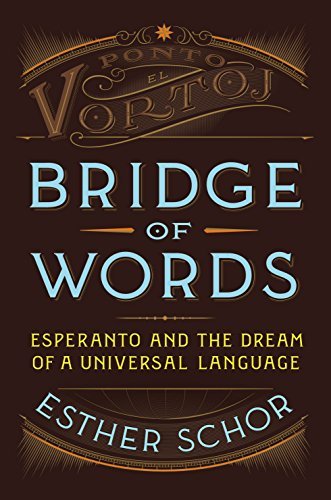
Bridge of Words: Esperanto and the Dream of a Universal Language

Rate this book
A rich and passionate biography of a language and the dream of world harmony it sought to realizeIn 1887, Ludwig Lazarus Zamenhof, a Polish Jew, had the idea of putting an end to tribalism by creating a universal language, one that would be equally accessible to everyone in the world. The result was Esperanto, a utopian scheme full of the brilliance, craziness, and grandiosity that characterize all such messianic visions.In this first full history of a constructed language, poet and scholar Esther Schor traces the life of Esperanto. She follows the path from its invention by Zamenhof, through its turn-of-the-century golden age as the great hope of embattled cosmopolites, to its suppression by nationalist regimes and its resurgence as a bridge across the Cold War. She plunges into the mechanics of creating a language from scratch, one based on rational systems that would be easy to learn, politically neutral, and allow all to speak to all. Rooted in the dark soil of Europe, Esperanto failed to stem the continent's bloodletting, of course, but as Schor shows, the ideal continues draw a following of modern universalists dedicated to its visionary goal.Rich and subtle, Bridge of Words is at once a biography of an idea, an original history of Europe, and a spirited exploration of the only language charged with saving the world from itself.

490 pages, Kindle Edition

First published October 20, 2015

53 people are currently reading
723 people want to read

About the author

Esther Schor

10 books6 followers

Ratings & Reviews

What do you think?
Rate this book

Friends & Following

Create a free account to discover what your friends think of this book!

Community Reviews

5 stars
40 (21%)
4 stars
71 (38%)
3 stars
52 (27%)
2 stars
18 (9%)
1 star
5 (2%)
Displaying 1 - 30 of 38 reviews
Profile Image for Jason Pettus.
Author 18 books1,450 followers
May 3, 2017
(Reprinted from the Chicago Center for Literature and Photography [cclapcenter.com]. I am the original author of this essay, as well as the owner of CCLaP; it is not being reprinted illegally.)

I've long had a fascination for Esperanto, the "global second language" that got invented in the late Victorian Age, flourished among the far-left political parties of Early Modernism's Communist era, and had its last big hurrah among the hippies of the countercultural age. (For those who don't know, Esperanto was deliberately designed to be the easiest language to learn in the entire history of the subject, with the goal being that everyone on the planet would eventually know it as a second language to their local primary first language, as a way of bringing about true global communication without everyone on the planet having to learn every 25 years the latest "language du jour" of whatever hegemony just happened to be dominating the rest of the world during any particular generation.) And so I had an immediate interest when recently coming across Esther Schor's new examination of the subject, Bridge of Words, which is an engaging hybrid of a book -- every odd-numbered chapter examines a piece of Esperanto's fascinatingly checkered history, while every even-numbered chapter looks at Esperanto as it exists as a still popular and functioning language in the 21st century, taking on everything from the people who choose to learn it and why, to a detailed analysis of the language itself and how exactly it works.

And indeed, this book is chock-full of interesting stuff I never knew before about Esperanto, not least of which was that it was invented in the first place by an Eastern European pre-Nazi Jew who had briefly been a part of the "Zionist" movement that eventually led to the formation of modern Israel; and that the language itself has complicated ties to the 20th-century struggles of Jewish identity, reforming the Yiddish language, and the Utopian Socialism dreams that went so hand-in-hand with such people back in those years. And this is not to mention the life that the language took on for itself away from these subjects as well, including its embrace by the '60s counterculture mentioned before, as well as it being seen as a way in the '50s to counter the xenophobia of Joe McCarthy's "red scare" Communist witch hunts. So it's a shame, then, that Schor's own writing style often gets in the way of this book being more enjoyable than it currently is; an Ivy League academe and full-time poet, she often gets too high-falutin' in her examination of Esperanto in all its myriad forms, having the tendency in a lot of places of writing in a nearly incomprehensibly academic way that will go over the heads of most general readers (yours truly included). Still very much worth your time, Bridge of Words is nonetheless unfortunately not as good as it could've been, which is why it's getting a score today that doesn't quite reflect the interest that just the subject itself naturally generates on its own.

Out of 10: 8.5
Profile Image for Robert.
266 reviews46 followers
October 7, 2016
As a passionate and fluent Esperantist, I absolutely loved this book. It's incredibly readable and interesting, and gives a good overview of the language. There is a good balance between telling the history of the language and providing personal experiences in the community. The author began with no knowledge of Esperanto and starts from scratch (both in learning the language and its history). In a way it was like reading a review of my home town, I recognised a lot of the people and places and was probably as familiar with the topic as the author.

This isn't to say that it's perfect, I felt there was too much emphasis on the American and Jewish side of Esperanto, while ignoring Esperanto in other countries. The personal stories were bland and tended to ramble away from the main point (the Vietnam chapter could have been cut in half). There is surprisingly little detail about Esperanto culture or what happens at international events, native speakers of Esperanto aren't even mentioned!

However, these complaints don't overshadow how much I enjoyed this book (it's always easier to criticise than praise). An interesting book about an interesting topic, that I would highly recommend to everyone.
Profile Image for Melora.
576 reviews168 followers
September 5, 2016
Whew. What a slog. This is for the true Esperanto fan. Your average enthusiast for the language will find that this is way too much information – this book is for the reader who is passionately interested in learning every detail of the history of every tiff, debate, and intrigue among the various factions of Esperantists since the moment when Ludovik Lazarus Zamenhof published his first pamphlet, in 1887, in Russian, on Esperanto. I am not that reader.

Part of the problem for me is that I read the subtitle – “Esperanto and the Dream of a Universal Language” – and focused on the part that interested me. The “dream of a universal language” bit. I imagined that this would be a book that would talk about Esperanto, but in the context of a philosophical sort of discussion about language. Stuff about how features of particular languages might shape the way native speakers of those language think – how words and grammar can influence thought – and how bilingualism (since Esperanto was intended, at least by some proponents, to be always a second language) might broaden speakers' horizons and, just possibly, foster improved cooperation among nations. About how an “invented” language, unburdened by national and historical associations, might be particularly liberating for oppressed groups. And so on. Anyway, regardless of my preferences, Schor does not give any of these topics more than the most passing glance, but, instead, sticks doggedly to Zamenhof and his followers and the details of the debates and disagreements of every Esperanto committee and congress which ever met.

I wasn't even fifty pages in before I realized that my interest in Esperanto itself could easily have been satisfied by a medium length magazine article – a 300+ page book was just massive overkill for me. But, having requested this through LibraryThing's Early Reviewer program, I read on. Or, actually, I didn't. It took me over two and a half weeks to “read” this, because every time I thought of reading I remembered that, actually, I needed to do some laundry. Or vacuum. Or weed. My house is tidier than usual, and my shrub beds look pretty good, thanks to Schor's excruciatingly narrow focus on the Esperanto movement's organizational in-fighting. And I've done some pretty fine baking, too, so it's definitely not been a total loss.

Since my copy of the book is stamped “Advance Reader's Edition,” I'm going to assume/hope that in the final published version the many spelling/”typo” sorts of errors will have been corrected. There were more than I've usually seen in ARCs.

I'll end this with a quotation from the book's conclusion, where Schor explains what she intends with this book, explaining her project to her hostess at a really lovely sounding children's foster care home/orphanage in Brazil. I'm letting her speak because my review has, up to now, failed to note that, as well as describing the history of the Esperanto movement, the author describes her travels among Esperantists all around the world, generally at conventions, but also in classes and in one-on-one meetings. I didn't find her characterizations of the people she met to be terribly engaging, but it is another aspect of the book. She also mentions her family from time to time, though not enough that her “revelation” at the end, , offers much emotional impact. Still, other readers may find her voice more congenial.

”It's a hybrid, history and memoir. It's about Zamenhof, his language, his dreams, and the people he entrusted to build Esperanto, then and now. It's about Esperanto as a bridge of words, and all the 'internal ideas' that have crossed it. And it's about my wanderings in Esperantujo, the people I've met in Europe, Asia, California, here...” I didn't tell her it's about me, too, though I never meant it to be; about how Esperanto helped me to navigate my middle-aged anguish, to get across what I needed to say.”


I received this book from LibraryThing through their Early Reviewers program with the understanding that the content of my review would not affect my likelihood of receiving books through the program in the future. Many thanks to Henry Holt and Company, Esther Schor, and LibraryThing!  
18 reviews
June 21, 2017
tre inspira kaj interesa, sed tri steloj. Schor skribas, ŝi suferas de usonozo, sed scias ŝi kiom? eble ŝi ankaŭ havas unuflankozo........ la paĝoj kun la historio de Esperanto estas bona, kaj la paĝoj kun samideanoj estas amuza, sed povas esti malĝentila kaj antaŭjuĝo. estas ĝi la spirito de Esperanto?
Profile Image for Linda.
Author 4 books42 followers
August 28, 2016
Note: I received a free review copy from a LibraryThing giveaway.

What this book does not offer: an overview of Esperanto. What the language is, why it exists, who the speakers are, etc. The author jumps in assuming, apparently, that the reader already knows these things. If you don't, you might want to look for a basic overview of Esperanto before beginning this.

For that and other reasons, I don't feel that the title of the book really reflect the contents of the book. It's largely about leaders within the Esperanto world, not about Esperanto. To me, "Esperanto and the Bridge of Words" implies that it's going to be about Esperanto: the language itself, the community of speakers, etc. The back cover also says it is the "first full history of a constructed language" and that Schor traces the life of Esperanto, including "the mechanics of creating a language from scratch." No, she doesn't. There's less than one page about the actual creation of Esperanto in terms of its linguistic features. The focus is much more narrow, so I think a more specific title would have been more apt. The history of the founding and leadership of Esperanto over the years is interesting and well cited with sources.

Speaking of focus, I also think this would have been better as three separate books: one about Zamenhof and Judaism, one about the leadership and/or movers-and-shakers within the Esperanto world over the decades, and one about the author's personal experiences with Esperanto. As it is, there are quite different narratives spread across the book, not always balanced very successfully. There are hints of the author's life spread thinly here and there, few of which seem to help drive the narrative along. For example, about a third of the way in, she talks about meeting Leo after an Esperanto event but hasn't yet introduced Leo (later, you find out it's her then-husband).

What you will find is a detailed narrative of the politics of Esperanto. The in-fighting, the factions, the very human behavior that pops up no matter which languages people speak.

Overall, the book is a good historical narrative of Esperanto's leaders even if it wasn't what I was expecting from the title and back cover blurbs. However, it could use some editing for typos at the very least. I also hope the editors reverse the author's decision to use asterisks to mark real names rather than pseudonyms. It's confusing and doesn't do the reader any favors.
Profile Image for Tony.
216 reviews
January 30, 2021
Loved this book! It's a history of Esperanto, la lingvo internacia, as well as a personal account of the author's experiences in Esperantujo (Esperanto-land), attending international meetings and congresses, and meeting Esperanto speakers in many parts of the world. Some reviewers have said that these sections interspersing the historical chapters are the least useful part: I found them fascinating. I knew a lot of the history already - though Esther Schor covers lots of ground that I didn't know. But reading about real people whose lives have been shaped by, or dedicated to, this ideal, and the 'universal congresses' she has attended, was for me a great insight.

Lernu!
Profile Image for Nick Klagge.
852 reviews73 followers
Read
December 20, 2024
For some reason I had an urge to read a book about Esperanto (a topic that I don't have any particular connection to), and after a little research this seemed like the kind of thing I was looking for. I really enjoyed it and learned a lot! I appreciated how Schor covered both Zamenhof and the history of the language's creation and evolution, as well as her own experiences in the contemporary Esperanto community. I was especially interested in the connections between the language and Jewish identity and political imagination.
Profile Image for Exanimis.
179 reviews5 followers
August 18, 2016
I received this book through goodreads giveaways.
Imagine if schools all over the world taught not only the native tongue but a secondary, easy to learn language. Imagine being able to travel to anywhere in the world and carry on a conversation with anyone. Imagine political leaders from all over the world getting together and not needing interpreters. Ludwig Lazarus Zamenhof created Esperanto in 1887 with the hope of bringing the world together so why didn't it work? When I first heard of Esperanto I thought it was a brilliant idea and the language has held a fascination for me so I took my time reading the history of Esperanto in Bridge of Words. Now ask yourself why after more than 100 years we are not speaking Esperanto? Why is it that today, English is the newest language to attempt being a world wide universal language when English is one of the hardest languages in the world to learn? The answers are in Bridge of Words, some are sad and some are horrifying, all are fascinating and part of the history of a language of hope.
Profile Image for Rachel.
883 reviews34 followers
September 14, 2018
This book is both a history of the Esperanto movement and personal experiences of the author meeting other Esperantists. I'm really glad this book exists and I was able to read it, but at the same time, I felt disappointed by how boring the history chapters were. Passionate infighting was lost in a tangle of acronyms (often given with their English translation, so they didn't make sense) and dry prose.

I'm no stranger to research on schisms within special interest groups (like Mormon history). I know it was probably really difficult for Schor to do the research when every source probably had a bias one way or another. At the same time... there weren't very many in-line citations, so it's hard for other researchers to verify her facts. Reading the history chapters felt like so many of the books I read for work--containing vital details for referencing an encyclopedia article, but kind of boring unless you're familiar with the greater context surrounding the historical characters. It was detailed in all the things I wasn't interested in--what people looked like and who they married. I was more interested in the literary history of Esperanto and how the language changed over time. The last chapter of Being Colloquial in Esperanto gave a much more interesting and in-depth explanation of the "ata/ita" problem than the paragraph dedicated to it in this book.

The personal narrative chapters were a lot more interesting to me, because I've never been to an Esperanto convention but I think it would be an interesting experience. Even then, she focused so sharply on the details of individual Esperantists that I felt I didn't get a good feel for Esperanto culture. One of the Esperantists she interviewed mentioned Gufujoj, the hangout for nightowls at Esperanto conventions, but she didn't mention if she ever went to one or what kind of tea they had. She mentions how feminism has a long history in Esperanto, but she doesn't mention how common sexist jokes are on Esperanto forums. I was expecting so much from this book and it didn't live up to my expectations.
Profile Image for Andrea.
57 reviews4 followers
April 15, 2024
A fascinating history of the creation of Esperanto, and how it has continued to evolve in the present day. Wonderful blend of historical narrative and memoir.
Profile Image for Nathan Albright.
4,488 reviews158 followers
January 8, 2017
Coming in at more than 300 pages, this is a complicated book, and before discussing my thoughts about it I thought it would be good to discuss the structure of this book and the author's approach to certain matters. The book consists of four parts, each of which is subdivided into smaller sections, and a short coda that gives the author's thoughts and reflections about the viability of Esperanto in the future. Through the course of a narrative that took the author several years to write, during which period her marriage fell apart for reasons unknown, the author examines the history of the Esperanto movement with the drama of its founding people and the context it sprang from as part of the crisis of late 19th and 20th century Jewry and other generally internationalist people trying to avoid being crushed in the face of the horrors of world war and Cold War. She then looks at the success of total immersion in Esperanto and what it does for one's competence as well as one's ability to relate to other people, examines the tangled lives of two people who symbolize the difficulties faced by Esperantists in the mid-20th century under Communist and Nazi rule, and then looks at the idealism of a school for orphans and neglected children in Brazil run by a couple of Esperanto-speakers and the difficulties that result from the attempts of people to be idealistic in a corrupt society.

In looking at this book and its contents, I figure it was only a matter of time before I had developed an interest in Esperanto. My enjoyment of foreign languages is pretty well known [1], and as a quirky person with a strong interest in other cultures and the lure of communication. In that light, it is not surprising that the author would have a strong interest in Esperanto either, given her own Jewish background, her own feelings of rootlessness, her own desire for communication and overcoming the curse of Babel (which she thoughtfully discusses here in a way that will likely be worthy of further commentary), and her own knowledge of the tragic history of the last century. She comments thoughtfully on how Esperantists believe themselves to be neutral, but aren't, seek to build a bridge of words to allow people to communicate but in doing so run face to face with the lack of shared ideals that people even with the same languages often have, as well as the fact that open and avowed membership as part of a cosmopolitan group tends to threaten the more patriotic and nationalistic regimes around them. This is a tragedy that has happened before and can easily happen again.

How is one to regard this book? On the one hand, the author has done considerable duty not only in researching the history of the Esperanto movement but also in immersing herself in its culture. She tells a lot about herself too, in her willingness to engage, her politeness in dealing with others, her concern not to reveal too much about the identity of others who are involved in that culture, perhaps because of concerns about their safety or well-being. It seems to me to be more than a little bit paranoid to hide behind anonymity, but it is possible as well that there are concerns about libel as well. Also, people involved in Esperanto have often been known for an alarming number of pseudonyms as well. This is a warts and all account of Esperanto and its hope as well as its reality, its infighting and quarrels and its genuine concern for helping to better communication. If you have an interest in these matters, this is likely to be a book that you would enjoy, for it reads like a loving but honest account of a quarrelsome but communicative family.

[1] See, for example:

https://edgeinducedcohesion.blog/2010...

https://edgeinducedcohesion.blog/2017...

https://edgeinducedcohesion.blog/2016...

https://edgeinducedcohesion.blog/2011...

https://edgeinducedcohesion.blog/2011...
Profile Image for Trixy Lemell.
98 reviews16 followers
May 4, 2020
I really wanted to give this book a higher rating but the last two chapters really didn't work for me. The book is a Jewish woman's journey of finding herself through Esperanto after separating from her husband. It is a mixture of Esperanto history, interviews, and memoir. And while for the most part it I interesting and works, there are many flaws. One being that she never addresses the situation of her marriage, the reason for the journey, in the end. The reader is left with no mention of it in the last chapter or of how her journey changed her life.

My main issue though was the subtle racial bias and the white saviorism that is sprinkled throughout the book. Issues like questioning the names given to minorities by their parents and actually having them changed to more Western names. One example is one Brazilian girl having her birth named changed to Tanya. Granted, she was named after a candy bar but she lived in Brazil and the white people that the author agreed with could have given her a name that fit her culture and village which she still lived in. Now she is a dark-skinned Brazilan who speaks not a word of English but is to be called Tanya. And there are other issues like this sprinkled throughout the book in which the author either comments on or agrees with the subtle racial and cultural bias.

It seems to completely contradict the ideals of Esperanto in which people should keep their culture, their home language, and stay connected to who they are while still using the language to bridge cultures and race. And I found it very sad to see a Jewish woman of all people question how much better off other cultures and races would be if they just whitewashed themselves.

Because of this, I couldn't give the book a higher rating. It just fell short of what Esperanto is about.
Profile Image for Jeff.
190 reviews4 followers
April 30, 2017
Definitely not for all tastes. If you don't know much about Esperanto, this probably isn't the book to start with.

Bridge of Words goes into a lot of detail on Esperanto's history, with some fascinating stories about the movement's relationship to the changing world around it. (Particularly interesting are the parts about its inventor's restless desire to create utopian movements after moving on from an initial passion for Zionism.)

The parts of the book that are memoirs of the author's trips to various Esperanto conventions are intermittently interesting but often skimmable. These anecdotes do, however, point to the reason why many people are still attracted to learning Esperanto (if not mine) -- the love of meeting people from all around the world and speaking in a "neutral" language without borders.
Profile Image for Carlos Eliseo Ortiz.
60 reviews
July 18, 2017
This book is the story of Esperanto, past, and present, as a language, as a community, and as a tool for learning and discovery across borders.

"… Esperanto bridges the dichotomy between what is “radically given” and what is “freely chosen.” Esperanto is not “radically given” to anyone, …. No, Esperanto is radically chosen. And to choose a language is to see the world a certain way …. Esperantists choose the givenness that language gives the world." (322)
Profile Image for Jonathan Cassie.
Author 6 books10 followers
November 19, 2016
Esperanto fascinis min pro jardekoj. Ĉi libro pri la historio de Esperanto kaj ĝia fondinto estis fascina legi. La aŭtoro nete teksas personajn rakontojn kaj profunde esplorata historio. Iu interesiĝas pri Esperanto trovos tiun libron estimulante sperto.
Profile Image for Jonathan.
589 reviews45 followers
January 2, 2018
I've wanted to read more about L. L. Zamenhof for several years now, but hadn't gotten around to it. So this book was a great find. My interest had been piqued when I was studying Felix Adler and the Ethical/Ethical Culture movement. Zamenhof is a few years younger than Adler, and died about a decade and a half earlier, but they existed in roughly the same time. Both were liberal/progressive-minded Jews whose work centered on humanistic ethics and a balancing pluralism and universalism in an increasingly connected world. Adler's Ethical Culture and Zamenhof's Esperanto and Homoranismo were both heavily influenced by their own Jewish backgrounds, especially in their understanding of ethics and their conceptualization of the projects they devoted their lives to. (Even though these projects/movements were secular in nature, they were still often viewed as Jewish by detractors--or even supporters, given secular Jews were often attracted to them). Both projects also suffered as a liberal idealistic internationalism faded and repression increased in 1930s Europe. Adler's Ethical Culture grew out of New York City's German-American Reform Jewish culture, and Zamenhof's projects came out of the uniqueness of Bialystok in Poland--where Germans, Poles, Russians, and Jews all lived (and had difficulty communicating).

Ester Schor provides a compelling biography of Zamenhof and traces the history of his linguistic movement after his death through key figures and how Esperanto adapted to different social movements (women's movement, LGBTQ movement, etc.) and technological developments (e.g., the internet) in the twenty-first century .

Esperanto is a fascinating, if somewhat eccentric, language. Zamenhof sought to create a universal language, building on Indo-European roots, that could better facilitate communication and resolve differences. Although Esperanto has claimed a political neutrality throughout its history, Schor astutely points out that its central mission is not neutral. There is a politics there--and that's a good thing.

In addition to a biography, Bridge of Words is also part memoir: Schor recounts her own experience learning Esperanto and understanding why people are attracted to it. As someone who would be a linguistics nerd if I had the time, I enjoyed hearing about the conference debates over what the proper word in Esperanto for this, that, or the other thing should be. Schor's experience is a deeply personal one, and she builds a clear sense of growth and personal understanding to the narrative. (I would be lying if I didn't say that I found the historical parts more interesting.)

Why does Esperanto still exist today? It never reached as far as Zamenhof would have hoped (Hitler, Stalin, and World War II did a lot of damage to the networks it had in the early twentieth century). But, as Schor argues, it remains an important innovation, one that will continue to endure because of how central communication--that bridge between self and community--is to our being.
Profile Image for Mike.
326 reviews1 follower
November 25, 2018
Good book overall. Truly 4.5 stars.

A great review of the Esperanto world (Esperantujo). She met many of the Esperantists I've been following or reading for years. She certainly put her money where her mouth was, with trips to Poland, Brazil, Cuba, Vietnam... Certainly am jealous.

She managed to be pretty politically neutral and even the uninvolved narrator during some tours in Vietnam and Cuba. But one small remark, aside even, ruined the flow of reading for me. I never understood why authors would want to isolate half their potential readership by revealing their political biases in an otherwise non-political subject book.

"In one image, a student waves an Alfred E. Neuman-style caricature of George W. Bush...I might have laughed along at this laughingstock of a president, but somehow I felt uneasy and isolated" (213, my italics). Ok, big surprise. You're a university professor and you don't like Bush. Wow, so unique. And you should feel uneasy! It's rude of the presenters. In the words of Sagafi in SkE (263), what? Did we already solve all of the world's problems, we can now concentrate on bashing the U.S president?

Besides that, the book is a worthy read. There were some issues with the editing. The strange lack of the Esperanto letter ŭ in the first half of the book, and then the varied spelling of Raŭma also as Rauma. The occasional misspelling (kai vs. kaj). All small fry and probably invisible to readers not conversant in Esperanto.
Profile Image for Michael McCue.
629 reviews14 followers
June 25, 2018
In Bridge of Words the author Esther Schor wrote a biography of Ludovik Lazarus Zamenhof, the inventor of Esperanto. Zamenhof was a Jewish eye doctor in what was still the Russian Empire in the 19th Century. It is Poland today. Zamenhof saw that in his city people were divided by religion and culture but also by language. He believed that a universal language could forge a bridge between peoples and bring peace. He devoted his life to this effort and the result was the language of Esperanto. Esther Schor's book is not just a biography of Zemenhof, that is only about half of the 324 pages. The rest is a chronicle of her own travels through the contemporary world of Esperanto. She attended Esperanto conferences and seminars all over the world and visited with Esperantists to see what the language is doing now. There are still several Esperanto speakers throughout the world. Some are dedicated to the ideals of peace and universality and others just like the idea of an easy to learn common language. Today with web learning there are over one million people enrolled in the Esperanto lessons offered by Duolingo. Bonan Tagon, Esperanto for Good Day.
Profile Image for Ralphz.
406 reviews5 followers
March 2, 2024
Well right off the bat, this book is part history and part memoir - and I'm not a fan of memoir, because they are mostly feelings-based, not necessarily fact-based.

And because of this, I couldn't even get 60 pages into it before I felt I had to move on.

This was supposed to be a book about Esperanto, the artificial language constructed by a Polish Jew in the late 1880s. But it's really about the author's travels among Esperanto speakers and their foibles.

I wanted to know about the language, the history, and the ideas behind it. But the author dispenses with of all these in a quick and shallow manner so she can talk about the cute old lady, the Esperanto-speaking couple and other quirky people that she meets at a convention. Every here and there (in the first 60 pages a least) she talks a bit about the language itself, but not enough for me.

While reading the book, I pulled up a short article to answer a question I had about Esperanto. I learned more about the language there than from the book. I'd really like to find a good account of this subject - but for me, this isn't it.
Profile Image for Sandy Schmidt.
1,414 reviews11 followers
June 26, 2017
This is a book bought with my donation and has a book plate honoring my mother. Without knowing Mom, they chose well as Mom spoke German, French and English, loved to read, and "argue" about semantics.
Esperanto was not the first attempt at universal language. It was developed by Lazaro Zamenhof (1858-1917) and was not intended to replace any national languages but to be a worldwide second language. Zamenhof translated the Bible into Esperanto and pulls heavily on Genesis to explain his attitude toward language and need for consideration of language (and lack thereof) for communication. “If mortality is what it is like to live after Eden, misunderstanding – to speak perpetually in need of translation – is what it is like to live after Babel.” P. 19 Like Latin, Zemanhof bases his words on roots, prefixes and suffixes. The book is infused with statements and explanations in Esperanto and, had I been inclined to learn it, I may have spent more time and attention to this extremely well written scholarly text.
Profile Image for Joel.
17 reviews4 followers
June 15, 2018
Something of a curate's egg of a book, really. The parts focusing on the history of the language and its community, from its 19th century beginnings up to the present day, are fascinating, although more about Zamenhof's process in developing the language would have been nice. The other interspersed sections, in which Schor describes travelling the world to meet various Esperantists, and describing them and What She Did On Her Holidays in that overly-earnest, well-meaning but uncomfortably patronising way that well-to-do Americans writing about how they spent their midlife crisis seeing how the rest of the world lives do so well are... less good. Trimming them down substantially would have improved the book no end.
Profile Image for H.M..
Author 7 books71 followers
October 14, 2025
A wonderful review of the chequered yet ultimately hopeful history, granda rondo familia (large family circle) and interna ideo (inner idea) of the para-national auxiliary language Esperanto, delightfully interwoven with a memoir of the author meeting and interacting with fellow members of the Esperanto community.

As timely as it has ever been in this deeply troubled and divided world, Esther Schor's book has been a useful orientation and immersion for me as I embark upon my own journey and begin to learn Esperanto. Koran dankon! (Heartfelt thanks!)
Profile Image for Steve Zimcosky.
Author 48 books107 followers
August 19, 2022
A Bridge of Words by Esther Schor is a wonderful story about the trials and tribulations of the constructed language Esperanto. She takes you on a journey from the very beginning when L. L. Zamenhoff created the language, through various Esperanto conferences to a place in Brazil where an elderly Italian couple raises orphans and teaches them Esperanto. A must read if you are studying the language.
Profile Image for Heidi.
3 reviews
December 26, 2020
What an absolute slog. But I’m stubborn and will finish every book I start, though I’ll admit I zoned out a lot while slogging through the pages.

I can see for a diehard Esperanto follower this book could be a delight. But as someone with just a curiosity, it was just way too much, and yet sparse about what the title and description seems to suggest the book will be about.
Profile Image for William.
40 reviews4 followers
May 16, 2018
An interesting blend of a history of Esperanto and a memoir of the author's experience with the language. If you're just looking for a quick overview of the history of the language, this is a bit much, but otherwise it's the most readily accessible history of the language in English.
Profile Image for Bill.
141 reviews1 follower
February 24, 2020
A good introduction to the culture around Esperanto, the people and history. The book is a little dry and boring at time, and there were parts that felt unnecessary altogether.

But, it made me want to learn Esperanto, so that’s something.
40 reviews
May 20, 2023
As with Assassination Vacation, there's a little bit too much "here's MY journey writing this book, cor, what am I like, eh" (particularly the section on visiting Vietnam which to a Brit comes across as remarkably tone-deaf), but the bits about Esperanto are pretty good.
Profile Image for Chad.
35 reviews1 follower
July 5, 2017
What a great little memoir and work of historical storytelling.
Profile Image for Francesca.
56 reviews
July 2, 2018
The writing is either too verbose or not substantiated.

I had to abandon it because I was equal parts bored and 'What the hell did I just read?'
Displaying 1 - 30 of 38 reviews

Can't find what you're looking for?

Get help and learn more about the design.