Jump to ratings and reviews
Rate this book

In a Grove

Rate this book
"In a Grove" is an early modernist short story consisting of seven varying accounts of the murder of a samurai, Kanazawa no Takehiro, whose corpse has been found in a bamboo forest near Kyoto. Each section simultaneously clarifies and obfuscates what the reader knows about the murder, eventually creating a complex and contradictory vision of events that brings into question humanity's ability or willingness to perceive and transmit objective truth. It is the basis for Kurosawa's "Rashoumon."

12 pages, Kindle Edition

First published January 1, 1922

Loading...
Loading...

About the author

Ryūnosuke Akutagawa

1,751 books2,247 followers
Akutagawa Ryūnosuke (芥川 龍之介) was one of the first prewar Japanese writers to achieve a wide foreign readership, partly because of his technical virtuosity, partly because his work seemed to represent imaginative fiction as opposed to the mundane accounts of the I-novelists of the time, partly because of his brilliant joining of traditional material to a modern sensibility, and partly because of film director Kurosawa Akira's masterful adaptation of two of his short stories for the screen.

Akutagawa was born in the Kyōbashi district Tokyo as the eldest son of a dairy operator named Shinbara Toshizō and his wife Fuku. He was named "Ryūnosuke" ("Dragon Offshoot") because he was born in the Year of the Dragon, in the Month of the Dragon, on the Day of the Dragon, and at the Hour of the Dragon (8 a.m.). Seven months after Akutagawa's birth, his mother went insane and he was adopted by her older brother, taking the Akutagawa family name. Despite the shadow this experience cast over Akutagawa's life, he benefited from the traditional literary atmosphere of his uncle's home, located in what had been the "downtown" section of Edo.

At school Akutagawa was an outstanding student, excelling in the Chinese classics. He entered the First High School in 1910, striking up relationships with such classmates as Kikuchi Kan, Kume Masao, Yamamoto Yūzō, and Tsuchiya Bunmei. Immersing himself in Western literature, he increasingly came to look for meaning in art rather than in life. In 1913, he entered Tokyo Imperial University, majoring in English literature. The next year, Akutagawa and his former high school friends revived the journal Shinshichō (New Currents of Thought), publishing translations of William Butler Yeats and Anatole France along with original works of their own. Akutagawa published the story Rashōmon in the magazine Teikoku bungaku (Imperial Literature) in 1915. The story, which went largely unnoticed, grew out of the egoism Akutagawa confronted after experiencing disappointment in love. The same year, Akutagawa started going to the meetings held every Thursday at the house of Natsume Sōseki, and thereafter considered himself Sōseki's disciple.

The lapsed Shinshichō was revived yet again in 1916, and Sōseki lavished praise on Akutagawa's story Hana (The Nose) when it appeared in the first issue of that magazine. After graduating from Tokyo University, Akutagawa earned a reputation as a highly skilled stylist whose stories reinterpreted classical works and historical incidents from a distinctly modern standpoint. His overriding themes became the ugliness of human egoism and the value of art, themes that received expression in a number of brilliant, tightly organized short stories conventionally categorized as Edo-mono (stories set in the Edo period), ōchō-mono (stories set in the Heian period), Kirishitan-mono (stories dealing with premodern Christians in Japan), and kaika-mono (stories of the early Meiji period). The Edo-mono include Gesaku zanmai (A Life Devoted to Gesaku, 1917) and Kareno-shō (Gleanings from a Withered Field, 1918); the ōchō-mono are perhaps best represented by Jigoku hen (Hell Screen, 1918); the Kirishitan-mono include Hokōnin no shi (The Death of a Christian, 1918), and kaika-mono include Butōkai(The Ball, 1920).

Akutagawa married Tsukamoto Fumiko in 1918 and the following year left his post as English instructor at the naval academy in Yokosuka, becoming an employee of the Mainichi Shinbun. This period was a productive one, as has already been noted, and the success of stories like Mikan (Mandarin Oranges, 1919) and Aki (Autumn, 1920) prompted him to turn his attention increasingly to modern materials. This, along with the introspection occasioned by growing health and nervous problems, resulted in a series of autobiographically-based stories known as Yasukichi-mono, after the name of the main character. Works such as Daidōji Shinsuke no hansei(The Early Life of

Ratings & Reviews

What do you think?
Rate this book

Friends & Following

Create a free account to discover what your friends think of this book!

Community Reviews

5 stars
1,391 (31%)
4 stars
1,872 (43%)
3 stars
895 (20%)
2 stars
152 (3%)
1 star
39 (<1%)
Displaying 1 - 30 of 490 reviews
Profile Image for Gaurav Sagar.
215 reviews1,862 followers
September 2, 2026


I sank once and for all into the darkness between lives

What is truth? Is being in accord with fact or reality can be called as truth? And what are facts or realities in that case? It is often said that a fact or reality may be an unquestionable data about various aspects of a circumstance, but is our reality unquestionable? We have come a long way from the perceived veracity of reality in ancient times to be evolved to accept that reality may not be fixed or universal, in fact it could be subjective and flexible. We say that reality is the encapsulation of everything exist in our universe but what if our universe is just projection or simulation, then how could be the reality of such universe may be assumed to be existent or how could we ignore the possibility of our reality being imaginary. What could be said about the nature of truth arising from such a reality? Aren’t we too pristine and biased to divide our reality in truth or falsehood, shouldn’t we do away with our fixation of binaries which appear to be too obsolete to our current times.


Perhaps we need to start from the basic premise, with the ontological question that is it even possible to define the truth, could we distinguish things or circumstances as true or false, is there no truth beyond our truth; and how does truth constitute our knowledge, if we now know that truth may not be absolute, then how the knowledge arising out of it could not be relative. So could we say that the truth of various people may differ from each other and it is more a matter of positioning than of factual absolute? Perhaps it is rather difficult to ascertain the vantage point from where one could see the entire truth, we know our knowledge develops from our truths, which in turn vary as per our experiences, so in essence, we can formulate only our version of truth which may not be in unison with that of others. It brings us to an intriguing possibility that perhaps the truth is fragmented.


link: source

Let us assume for the time being the very basic and innocuous concept that truth is being accordance with the facts, but can we say with authority that these facts are true and authentic experiences of a being. We see in Akutagawa’s story- In a Grove that facts which are taken as truths, are more or less secondhand experiences of people as they put forth these experiences to us, the readers, through the Magistrate. Even if we assume these experiences to be true, being not the firsthand accounts, these acquaintances of truth always carry substantial element of doubt and considerable ground for suspicion. Let’s explore the problem of truth by further delving down into its being, people often feel they are saying the truth, but then again, they may not be as well, since our experiences and thereby our truths are limited to our senses of perception.


On further diving down into the very essence of the problem of truth, we may find something frightening about human nature which shakes us from inside with a shudder since we are talking about ourselves as if looking into a mirror reflecting our own abyss. It is interesting to note that often people may lie about these ‘truthful’ experiences since, generally, our truth gets contaminated by our quintessential virtues of self-interest, lust, vigor, power or beauty. If we look at the psychological level, we will find that human beings have a natural tendency to look for acceptance, in other words, to be heard by others, perhaps that makes us social, and it gives us a sense of importance and power whenever we get even slightest of a chance to express ourselves. The tendency to fulfill our innate desire of power may often lead us to path of deceit, lie or cover up, at times we may go up to such an extent our mind start believing it is our new, transformed truth to give us a feel of creating a unique version of humanity. It brings us to consider another intriguing problem of human existence, that is to explore the nature of our memory, can we say with a commanding jurisdiction that our memories are reliable when the basic nature of our truth is questionable.


In a Grove contains fragments of truths which are told by various people as different versions of the same event, what really intriguing to note is not that how many fragments of truths are conjured up to tell the story but the manner in which they are put forth in front of the readers, by twisting, lying, deceitfully transforming or hiding the pieces of the story which makes it a quizzing puzzle. In the universe of Akutagawa, the reader can’ t be left alone to passively enjoy the story from a distance, and what better example of it could be than this story which truly existential in nature and forces the reader to come out of his comfort zone and flex his mental muscles to arrange various pieces of the puzzling tale and thereby to explore the probable truth or truths, to be more precise. It is like a captivating riddle which you try to solve multiple times but every time it gets better of you.


While certain details of various accounts of the murder (which is expectedly not central theme of the story) by various people including the testimonies of innocuous looking woodcutter, a sacred priest, a dubious policeman, a sympathetic old woman, and confession of a seemingly terrifying bandit, and oscillating accounts of husband and wife, may match but it is difficult to ascertain who is telling truth or who is not leaving, just like human beings. Moreover, we never get to know that version of Magistrate whom all these people are submitting their testimonies and some confessions as well, and further there is a possibility of twisting the facts by the person who may be recording these accounts, so it leaves us with tantalizing possibility that perhaps all are victims and guilty at the same time. In fact, it leads to another fascinating possibility that perhaps there may not be one single possible story framed out of these dubious accounts of various characters of the story, rather there could be multiple possibilities in the story which are pleasingly left to the cognizance of the reader. However, one may feel an intense desire to read it again after finishing it, but on multiple readings you may contradict our own convictions leaving you to wonder at the beauty of the tale.


link: source


Though the story has been written quite early as far as the age of literature is concerned but it gives rise to the captivating and much sought after concept of unreliable narrators, the concept which has been extensively explored in the art movement of modernism. The fabulous tale of Akutagawa stands tall in the litmus test of time and perfectly encapsulates our modern world of fake news, grandiose narratives, and social media hypes. The story underlines the fact that there could not be any absolute truth and it reminds me of A Heart So White by Javier Marias, which deals with the fact that how do we assimilate knowledge and perceive truth.

Profile Image for Flo.
649 reviews2,293 followers
January 12, 2018
Concatenated thoughts #1 - #2

[previous] ...In a Grove; another fine inspiration for Kurosawa's film. This story includes four testimonies, one confession, one repentance and a final account concerning the murder of Kanazawa no Takehiro, a 26 year-old samurai, and the rape of his wife, a 19 year-old woman named Masago, by a notorious brigand known as Tajōmaru. Those might be the most accurate details of the entire story since there are many contradictions among all the people involved in this case, making it impossible for the reader to actually know the truth, even when there might not be such a thing... rather than realities naturally connected with subjectivity. The witnesses' inconsistencies might have not been on purpose. Some sort of explanation can be found in the obvious fact that our memory is not completely reliable. Therefore, inconsequential details or relevant events might get lost in a sea of information, especially to those who are not used to such things that eventually improve one's observation skills. However, I do not believe the same can be said about the other three characters: the samurai (in fact, his spirit), his wife and the criminal, for they all have good reasons to invent, embellish or distort their versions to save their lives and honor.
A lie works as a mechanism of self-preservation for most people.
Am I the only one who kills people? You, you don't use your swords. You kill people with your power, with your money. Sometimes you kill them on the pretext of working for their good... It's hard to say who is a greater sinner, you or me.

The plot revolves around some interesting themes that include the inability to know an absolute truth since everything seems to be contaminated by our impressions; self-interest, beauty and lust, dishonor and the atrocities a person is willing to do to remedy that situation, the ephemeral essence of our existence and the heinous rationalization behind the act of taking somebody else's life.
'Truly human life is as evanescent as the morning dew or a flash of lightning', stated the traveling Buddhist priest in his testimony.

Since the film gave me the absurd idea of merging these reviews, it is only fair to say that Kurosawa's approach differs a bit from Akutagawa's story, where ambiguity controls every aspect of it. But the movie is something you do not want to miss due to stunning performances, sublime music and the symbolism they have employed that is simply mesmerizing, ranging from particular elements to a dichotomy conveyed through an exquisite use of light. Besides, you haven't cinematographically (?) lived until you see Mifune fluctuating between serious dialogues and sudden outbursts of laughter with his unique voice.

Anyway, as the book reaches its peak, everything seems rather superfluous. Even words. There was an implied communication between some of the characters in which many things were said through the eyes. A poetic interpretation would not apply here, since I believe they did it to find whatever they were resolved to find. Another excuse to justify their actions. Nonetheless, in the end, I suppose they were all guilty as they were victims.

The story ends with the account of the murdered samurai as told through a medium. It is the part I loved the most since it allowed me to take a glimpse at Akutagawa's beautiful and poignant writing, something that could not exist in the previous attempt to describe cold, hard facts. A desire for truth. An absolute truth that might never be able to avoid the contact with our personal experiences, our opinions, our interests. Our ego.
[home]


Jan 23, 16
* Also on my blog.
Profile Image for Olga.
519 reviews209 followers
June 13, 2026
Can we ever know what really happened, or do we only know the stories people tell about themselves?

'In a Grove' is much more than a murder mystery consisting of a series of testimonies given by the witnesses and participants of the tragedy which unfolds in a grove. It is more than a literary masterpiece.
It is an unsettling reminder that all of us are unreliable narrators to some extent. We, people, tend to recunstruct events of the past according to our desires, fears, pride, and self-interest. Truth is subjective and can become inaccessible when filtered through human perception.
Profile Image for Cecily.
1,370 reviews5,621 followers
August 27, 2026
A short piece of crime fiction, comprising seven accounts from people who may have been involved. Nothing else. No preamble. No reveal at the end.

Certain details sounded significant (type of trees, colour of a kimono, time of day/night, who had what weapons), but I quickly noticed things didn’t quite stack up. By the end, there were clear contradictions. I reread it, and admired the puzzle all the more. Who (if anyone) is telling the truth? Why would someone confess a crime they didn’t commit? Their accounts may be unreliable, but their memories are probably not.

You kill people with your power, with your money. Sometimes you kill them on the pretext of working for their good. It’s true they don’t bleed. They are in the best of health, but all the same you’ve killed them. It’s hard to say who is a greater sinner, you or me.

Testimonies come from the woodcutter who found the body, then a passing Buddhist priest, a policeman who arrested a “notorious brigand”, the young woman’s mother, the arrested man, the young woman, and, via a medium, the victim. Each fits a “type”, perhaps reflecting the story’s origin in folklore.

There are occasional parenthetical comments: “Her later words were drowned in tears”, “Gloomy excitement”, “A cheerful smile”, “A defiant attitude”, “Gradually, violent sobbing”, “A sudden cry of scorn”, and “Long silence”. But maybe they aren’t objective either?

The only (near) certainties are that a young couple were traveling. He was found bound, stabbed, and dead in a grove, and her whereabouts are unknown.

I dislike overly-tidy endings, but expect a degree of certainty about at least part of a story. Not so here. But perhaps that’s the point?

It encompasses honour, guilt, greed, blame, sacrifice - and truth.


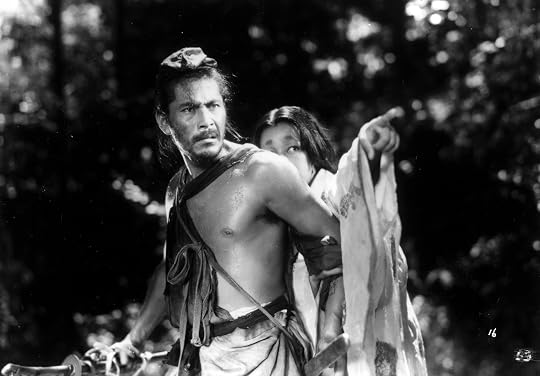
Image: The bandit and the woman, from Kurosawa’s film (Source)

Storytelling

It was published in 1922 and translated to English in 1952, but is based on an older, classical Japanese tale, "The Tale of The Bound Man Who Was Accompanying His Wife to Tanba".

I tried to imagine retelling it in a conventional manner, but I couldn’t.

In 1950, Akira Kurosawa filmed it as Rashomon. I haven’t watched it yet, so don’t know his approach, but Wikipedia says it is “now considered one of the greatest films ever made and among the most influential movies from the 20th century”.

Short story club

I read this with The Short Story Club.

You can read this story HERE.

You can join the group here.
Profile Image for Steven Godin.
2,806 reviews3,623 followers
January 17, 2019
Read as part of my binge on Japanese writers (especially Akutagawa), This excellent short story brings into question the accuracy of the human perception and fully illustrates our tendency to lie.
Akutagawa excels in examining the darker side of our nature, and the great thing about this story is he doesn't really provide the reader with a distinction between what are the truths and what are merely fabrications. We get certain information, and it's up to us to form the puzzle and make out the story for it to be rational. There is a series of testimonials, seven in fact, about a murder. And the further the story moves along, your beliefs or ideas of what truly happened would be contradicted by another person's account, constantly sending the reader on a Merry-Go-Round of suspicion. 4/5

Profile Image for Kushagri.
234 reviews12 followers
July 22, 2023
This is a masterful short story that skillfully delves into the enigmatic nature of truth. By presenting conflicting accounts of a crime, it compels readers to question the reliability of individual perspectives and the elusive concept of objective truth. Is truth an absolute reality, or does it shift depending on the storyteller? How do our biases and perspectives shape the truth we perceive, and can an absolute truth ever be attained? These questions linger, and leaves us contemplating the intricacies of human perception and the complexity of reality itself.
Profile Image for Traveller.
239 reviews798 followers
January 16, 2015
This story is contained in one or two of the anthologies of Akutagawa's short stories. The easiest to get hold of might be Rashamon and Other Stories or Rashomon and Seventeen Other Stories.

I'm hovering on the brink of giving this particular short story 5 stars, just for the premise alone. ( Having more than one protagonist (or no specific protagonist at all) , and the differing viewpoints that these protagonsists have on the same set of events.)

The translation also came across as a lot more elegant than some of Akutagawa's other stories. I've heard that the film that was partly based on this story, Kurosawa's film "Rashomon", actually improves on the characterizations, and if so, I don't want to give the story top marks if it could conceivably have been even better.

I'll write a proper review once I've had a chance to view the film.

In the meantime, may I once more express my disgruntled irritation that GR doesn't allow for half-stars, in which case I could have slipped out of my predicament by giving this 4 and a half stars.
Profile Image for Archer.
86 reviews63 followers
August 12, 2026
In a Grove is a murder mystery detailing several, often contradictory, testimonies of the same murder. Whenever I read short stories, I get the feeling that something is missing, but with both this story and Hell Screen, I have had little to complain about. I simply loved it.
Profile Image for Ana.
2,392 reviews390 followers
January 5, 2016
In the end, it's still not clear what the truth is, given that all three have different things to defend and hide. I suspect that even the ghost wants to preserve as much of his honor as possible even after death.
Profile Image for Himanshu Karmacharya.
1,186 reviews115 followers
September 6, 2021
In a Grove is a short story by Ryunosuke Akutagawa that served as the basis of Akira Kurosawa's classic movie, Rashomon (title based on another short story by the same writer).

The story is about the murder of a samurai through the account of various witnesses. The interesting thing being that every account varies in some aspect. Akutagawa has written the short story in an intelligent fashion, the differing and contradictory accounts of the witnesses exploring multiple realities and questioning the unreliability of eye witnesses.

It is an enjoyable short story and worth one's time .
Profile Image for daph pink ♡ .
1,454 reviews3,409 followers
April 14, 2024
Akutagawa plays the consummate illusionist throughout the entire narrative, keeping the reader bewildered and frequently reflective. Akutagawa has skillfully highlighted the complexity of human psyche through his unconventional narrative style. And it is precisely because of this that this will always be regarded as a cult classic.
Profile Image for Kalpashri☆.
117 reviews
May 13, 2022
Truly this gave me nothing. I have no idea who committed the murder.There are 7 narrators here but I feel like only three of them are directly involved in the crime so I'll ignore the other four. Eyewitness is unreliable anyway. Now I could say stuff about how this book brings to light the subjectivity of experience and how truth can never be verified blah blah blah. I'm not gonna do that. If there's no answer I'll invent one.
This is my take on things.
1) The robber does not seem to be very ashamed of being a rapist. He doesn't seem to have any guilt toward murder and there is a line where he proclaims how terribly inconvenient it is to murder the man. However I feel like he knows they're gonna sentence him to prison anyway and wants to write a story where he is heroic and murders the man cause the woman asked. He does not , I believe , murder the man.
2) She kills the dude. She is ashamed and sees the shame reflected in his eyes and kills him. In order to absolve herself she says that the husband asked her to kill him.
3) The husband cannot believe such a horrible thing happened to him and maintains that he killed himself in order to preserve his agency over his life.
(I believe the robber was taken aback by the woman's request and asks the husband if he should kill her which makes him like the robber. The robber then does not kill the man. This may even be the point where she runs?)

I'm open to different interpretations tho. I'm just upset there are none in the reviews.Gotta go read some analysis of this.
This entire review has been hidden because of spoilers.
Profile Image for Philippe.
1 review1 follower
July 1, 2012
Simplicity is ever so complex. I have to admit that I read this short story mainly because of Kurosawa's Rashomon, which I consider one of the best movies by the best filmmakers in the history of the moving picture which, despite its age and style as we see it with our so-called modern eyes, transcends both time and place. I first did not like this short story, and gave it two stars, mainly because, as they are by definition, short stories are short and I wanted to keep on reading and was left hungry for more. Then I read and re-read it, again and again, and found myself hooked, and still found something new each time, yet still could not find where the truth lied. In 10 pages, Akutagawa has captured the millions shades of grey of the human spirit. This is truly a five star.
Profile Image for Ania.
252 reviews41 followers
November 2, 2012
Oh what a tangled web we weave. When first we practice to deceive. - Sir Walter Scott

I felt this story was not really about different perspectives on a crime, distorted by panic and shoddy memory. You don't forget or misremember a fact like stabbing and killing a guy (or not). And yet there are multiple killers admitting to doing their task individually?

I think this is more of a story about the depths of the human psyche, which has its own reasons to deceive... take blame for crimes undone or done as to protect themselves or others.

Who did it? who knows... Who cares?

Nonetheless, quite a disappointing read given the high ratings.
Profile Image for Tobi トビ.
1,194 reviews110 followers
September 4, 2022
i love this story- the film too, is amazing. slightly different and goes more deeper, but they’re both very good (the film is actually called rashomon, though)

i love mysteries like this
Profile Image for Larrry G .
188 reviews16 followers
August 22, 2026
don't be Rash in decision, indecision prevails, the purview
As in modern physics, you can either experience or experiment
Profile Image for Kyra.
174 reviews
March 21, 2017
This was just 14 pages long on eBook (and 6 pages on paper), yet it had the ability to make my classmates and I crazy. Read it, and you'll find yourself doing this face:

Profile Image for Debi Cates.
509 reviews35 followers
August 25, 2026
(Updated with second reading, almost three years after the first reading.)

Reading In a (Bamboo) Grove story a second time, my glimmering short story universe has been provided a new mag.1 star!

The first time I read this a couple of years ago, I approached it with my Western reason and logic mind. I took away that the story was about truth and how hard it was to get at when dealing with human witnesses which, based on Youtube's countless videos of police interrogations, is still a truism.

But reading it a second time (with Goodreads The Short Story Club), a flash of the Tarot deck came to me. I began to see the characters as seven living archetypes, the kind that constellate around murders and their investigations. That was one of those lightbulb moments, releasing the story with more depth and accounting for its global high regard as a classic.

Then, another thought came to me. Understanding the story this way now reminded me of Zen Buddhism, which makes sense since Akutagawa was Japanese. I asked Google's Gemini to provide me with (scraped) information about that.

That Buddhist answer zoomed the story out and up into the glorious cosmic for me.
.
.
.
=====
Notes
You can join The Short Story Club here on Goodreads and I highly recommend it if you love short stories and thoughtful analysis. Go to this link https://www.goodreads.com/group/show/...
.
Here were my thoughts on Archetypes and below that Gemini's answer about how Buddhism fundamentally informs this work.

Archetypes
Woodcutter as archetype of the HAPLESS BODY DISCOVERER.
Someone minding their own daily business who stumbles on the body. They usually have a certain amount of time alone with the crime scene and provide details. And no wonder they do, they are probably are "taking it all in," standing there, alone, stunned. They also typically know the area and highly aware of what is out of place, of what is normal and what is not. (They also might have their own secrets that they would prefer not be known.)

Buddhist Priest as WORLD PHILOSOPHER
These are those we rely on for comfort when our world suddenly makes no sense, there for us in times of unimaginable distress and unfairness. It is often not true comfort they can offer but only compassion. They remind us we all will experience suffering and death. But really have no "answers" of true consequence as it relates to the actual murder. Instead the "answers" are probably the only true known facts for us: there is death, there is suffering, life is short.

Policeman as archetype of the UNSUCCESSFUL CRIME FIGHTER.
Often the justice system has already been aware of a violent criminal who, as of yet, could not successfully pin any crimes on them. They confirm for the investigators that the captured person historically fits all the known characteristics of the crime and evidence. How much of what they offer is legitimate, though, and how much is self-satisfied vindication?

Mother as archetype of the EMOTIONAL IMPACT.
For almost every murdered person, there is someone who loved them and present for the record the best of the deceased. They are the ones in society that will grieve truest and suffer the longest. The rest of us are base spectators who, at best, think of ourselves as gate-keepers.

Tajomaru as archetype of the COLD BLOODED CRIMINAL.
These human beings that have their own psychology of no remorse for victims, plenty of twisted justifications, disdain for the law, and a repugnant sense of pride in their abilities. They test our positive beliefs about society as civilized.

Wife as archetype of VICTIM & PERPERTRATOR.
Be it a victim of being in the wrong place at the wrong time, or as a victim of society's expectations, this is the person that shocks us and likely that we judge the harshest for their actions, believing how we ourselves would never do what they have done.

Medium as archetype of TRUTH TELLER.
The medium gives us a sense of clarity that we crave, but it's also false. There is much about which we will never know of any real truth, but our desire for the resolution is so strong we will believe what we believe all the same and appreciate that someone who gives us a version we can believe.

Buddhist themes
(Review notes compiled with the assistance of Gemini AI.)

In a Grove by Ryūnosuke Akutagawa is profoundly informed by Buddhist theology and psychology. Akutagawa uses Buddhist concepts and symbols to illustrate how human desires, ego, and attachment blind individuals to objective reality.

1. The Three Poisons (Trivisa)
In Buddhist teachings, the root causes of human suffering and entrapment in the cycle of rebirth (samsara) are the Three Poisons. The three central characters in the grove perfectly embody these destructive forces:

Tajōmaru (The Bandit):Driven completely byLust and Desire (raga).
Takehiro (The Samurai):Driven by Pride and Anger (dvesha).
Masago (The Wife): Driven by Shame and Fear of Loss.

Their intense attachment to these worldly, ego-driven emotions distorts their perception, rendering them incapable of seeing or telling the absolute truth.

2. The Illusion of the Self (Anatta)
A core tenet of Buddhism is Anatta—the doctrine that there is no permanent, unchanging soul or "self." Instead, what humans perceive as the "self" is merely a shifting collection of temporary perceptions, memories, and desires.
Ego Construction: The story serves as a psychological illustration of Anatta. Because a fixed objective self does not exist, each character desperately constructs a fabricated narrative of themselves during their testimony.
Self-Preservation: Each speaker is less concerned with historical accuracy and more concerned with protecting a curated ego-image (as a brave criminal, a tragic victim, or an honorable warrior).

3. The Irony of the Bamboo Grove
The physical setting of the story serves as a profound Buddhist metaphor:

The Symbol of Emptiness: In Zen Buddhism, the hollow center of a bamboo stalk represents emptiness (Śūnyatā)—the ultimate state of liberation, free from ego and worldly attachments.
The Metaphorical Irony:Akutagawa deliberately stages a messy, violent human tragedy inside this symbol of pure enlightenment. Instead of finding clarity, the characters fill the hollow, peaceful grove with their toxic delusions and lies.

4. Textual Buddhist Signifiers
Akutagawa embeds explicit Buddhist frameworks directly into the narrative structure:

The Concept of Impermanence (Anicca): The traveling Buddhist priest who testifies early in the story laments the fragility of human existence. He explicitly compares the samurai's sudden death to "a drop of dew" or "a flash of lightning"—classic scriptural metaphors for the fleeting nature of life.
The Intermediate State (Chūu): When the deceased samurai speaks through a spirit medium, he notes that his soul is currently trapped in the "darkness." This refers to the intermediate state between death and rebirth in Buddhist eschatology, proving that even in death, his spirit remains bound to earthly pride and is unable to achieve Nirvana.
Profile Image for Nazanin .
108 reviews3 followers
November 27, 2023
از شدت زیبایی این متن از سخن عاجز شدم :)))))
"When I kill a man, I do it with my sword, but people like you don't use swords. You gentlemen kill with your power, with your money, and sometimes just with your words: you tell people you're doing them a favor. True, no blood flows, the man is still alive, but you've killed him all the same. I don't know whose sin is greater - yours or mine.
(A sarcastic smile.) "

P.s: like he may be a murderer but at least he never pretended that he wasn't!!!! He confessed it. The honesty involved in this dialogue is just so pure and desirable :)) He is a beast and he'd just faced it. There's no mask included. And yet there's people who can't take his truth.

P.s 2: This short story revolves around the fact that sometimes human beings can't be trusted with what they might perceive as truth and it may be falsified with one's biased perception towards an incident.
Also truth can be multifaceted and it may overlap sometimes.
Profile Image for Yomna Saber.
420 reviews132 followers
April 25, 2025
Quite interesting! Told as a sequence of very contradicting testimonies given after the discovery of a murdered body in a grove, the story delves into the ambiguous motivations and hidden impulses of its characters as they tell different stories about the murder. The image of the grove epitomizes their dark sides and vindictive nature. The story is indeed a pleasure to read!
Profile Image for ტუნგუსკა.
122 reviews
December 4, 2023
ლიტ. და პოლიტიკის კურსის მასალაშია ეს მოთხრობა შეტანილი და უბედნიერესი ვარ, რომ ძლივს ისეთ რაღაცას ვსწავლობ, რაც მართლა მაინტერესებს.
აკუტაგავასთან პირველად მქონდა შეხება და ძალიან კმაყოფილი ვარ. წყალივით იკითხება. მივხვდი, reading slump-ში რომ ვარ მხოლოდ ჩემი ბრალი არაა.

შოპენჰაუერის გამონათქვამი - "სამყარო არის ჩემი წარმოდგენა" გამახსენდა კითხვისას.
Profile Image for George Ilsley.
Author 12 books337 followers
August 27, 2026
The basis for the famous movie, Rashōmon, "In a Grove" is a short story featuring multiple points of view on an encounter in a grove in the mountains, between a couple travelling and a bandit.

Such a short story, and yet it became a full-length movie.

I've never read this before, but have seen the movie multiple times.

This author died young, but is considered to be a writer who established short stories as a form in Japan.
Profile Image for Connie  G.
2,236 reviews731 followers
August 25, 2026
A samurai had been killed in a bamboo grove under violent circumstances. The story is the testimony of seven people: Four people who witnessed some preliminary activity and then the three protagonists. Some of the testimony is especially interesting because it involves the Japanese samurai code of honor. There are contradictory statements given so what is the truth?
Profile Image for Enrique.
656 reviews447 followers
April 17, 2023
Esperaba más de este cuento.
Profile Image for Amanda NEVER MANDY.
697 reviews107 followers
August 28, 2026
She said, he said, they said.

It was simple to read but it became complex once I started working through the layers of it. I read it more than once and I took notes, which is not my usual.

Strong like but not love.
Profile Image for Prospero.
119 reviews14 followers
February 4, 2022
Is this story really about a rape and murder, or about marriage? Ingenious and delicate, by retelling the events from multiple perspectives, the author sheds light not only on different aspects of human nature, but on details of late medieval Japanese culture, making this a bit of a double treat.

In A Grove (1922) is the short story that inspired Akira Kurosawa's Rashomon (1950). The broad strokes of the tale can be seen despite the contradictions in the patchy, overlapping narratives. What the author is trying to demonstrate is that there are different levels of truth (just as Georg Cantor proved that there are different levels of infinity). Broader truths may persist and remain whole and coherent even if their constituent pieces are flawed or faulty.

That the story's impact has been profound can be seen in that the word "Rashomon" has become an essential part of our cultural lexicon - like "Orwellian" and "Lovecraftian" - to express with a single word the idea that a shared experience can give rise to a collection of fragmented and seemingly irreconcilable observations shaped by the perceptions, preconceptions and psychosocial makeups of the various observers, ultimately revealing more about the observers themselves than the thing they observe.
Displaying 1 - 30 of 490 reviews